

|
시장보고서
상품코드
2073585
온라인 데이트 서비스 : 시장 점유율 분석, 업계 동향 및 통계, 성장 예측(2026-2031년)Online Dating Services - Market Share Analysis, Industry Trends & Statistics, Growth Forecasts (2026 - 2031) |
||||||
 Mordor Intelligence
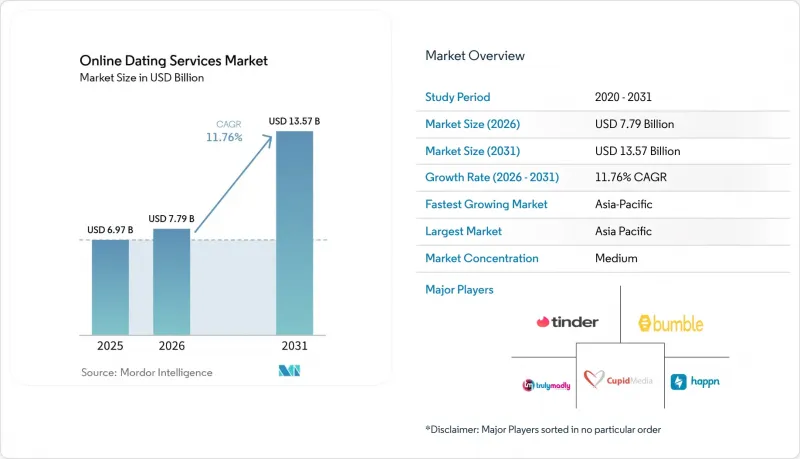
Mordor Intelligence에 의하면, 온라인 데이트 서비스 시장 규모는 2025년 69억 7,000만 달러로 평가되었습니다. 2026년에는 77억 9,000만 달러로 확대되어 2026년부터 2031년에 걸쳐 CAGR 11.76%로 성장을 지속하여, 2031년에는 135억 7,000만 달러에 이를 것으로 예측됩니다.
본 보고서는 유형별(유료 온라인 데이트, 무료 온라인 데이트), 수익 모델별(구독형, 광고 수익형, 기타 모델), 플랫폼별(웹 포털, 용도), 연령대별(성인, 베이비붐 세대 등) 및 지역별로 분류되어 있습니다. 시장 전망치는 금액(달러)으로 표시되어 있습니다.
세계의 온라인 데이트 서비스 시장 동향 및 인사이트
Z세대 및 밀레니얼 세대를 중심으로 프리미엄 매칭 기능에 대한 유료 이용 의향이 높아지고 있습니다.
프리미엄 서비스 이용의 확대는 단순한 열람에서 의도적인 관계 구축으로의 전환을 반영하고 있습니다. 매치 그룹은 2024년에 유료 사용자 1인당 수익이 17% 증가했다고 보고했으며, 북미와 남미에서는 26%의 급증세가 나타나, 유료 사용자 총수가 감소했음에도 불구하고 지출액은 증가하고 있음을 보여주고 있습니다. 사용자들이 정액 요금제 대신 부스트 기능이나 프로파일 분석 기능에 대해 개별적으로 결제하는 방식을 선택함에 따라 소액 결제가 가속화되고 있으며, 다양한 예산 규모에 맞춘 단계별 요금제가 형성되고 있습니다. 또한, 지출액이 높은 사용자는 재이용률도 높아 플랫폼의 현금 흐름을 뒷받침하고 있습니다. 이러한 변화는 포화 상태에 이른 도시에서 계속 상승하는 사용자 확보 비용을 상쇄하는 데 도움이 되고 있습니다.
북미 및 유럽에서 틈새 시장 및 정체성 기반 플랫폼에 대한 수용 확대
틈새 시장용 앱은 대규모 사용자층보다는 커뮤니티와의 친화성을 중시하는 사용자를 끌어모으고 있습니다. Grindr의 2025년 1분기 매출 25% 증가와 월간 활성 사용자 수(MAU) 1,450만 명은 특정 부문에 초점을 맞춘 비즈니스 모델의 효과를 입증하고 있습니다. 종교 및 라이프스타일에 특화된 서비스는 더 깊은 고객 참여와 낮은 해지율로 인해 높은 ARPU를 달성함으로써 수익화를 실현하고 있습니다. 이러한 성공에 힘입어 주요 앱들도 사용자를 유지하기 위해 커뮤니티 필터나 맞춤형 알고리즘을 도입할 수밖에 없게 되었습니다.
GDPR(EU 개인정보보호규정) 및 캘리포니아주 CPRA에 따른 개인정보 보호 규제 비용 증가
Grindr는 데이터 공유 규정 위반으로 노르웨이에서 570만 유로(620만 달러)의 벌금을 부과받았습니다. 이탈리아 데이터 보호 당국은 Luka Inc.의 AI 동반자 서비스에 대해 500만 유로(540만 달러)의 과징금을 부과했습니다. 규정 준수 대응에는 전담 법무팀, 데이터 매핑 시스템, 제3자 감사가 필수적이며, 이로 인해 신규 진입 장벽이 높아지면서 중소 업체들의 이익률이 압박받고 있습니다.
부문별 분석
유료 서비스는 2025년에 온라인 데이트 서비스 시장의 69.45%를 차지했으며, 2031년까지 연평균 성장률(CAGR) 12.61%로 성장할 전망입니다. 사용자들이 요금을 안전성이나 알고리즘의 품질과 연관 짓게 되면서, 유료 요금제를 제공하는 온라인 데이트 서비스 시장 규모는 확대되고 있습니다. 무료 요금제는 “퍼널"로서의 역할을 수행하고 있으며, 첫 매칭에서 신뢰감이 싹트면 사용자는 “읽음 알림 표시"", “"고급 필터 기능"", 인증 배지" 등을 이용하기 위해 유료 요금제로 전환합니다. 각 플랫폼은 강압적인 과금으로 인한 반발을 피하기 위해, 업셀 전략과 사용자 만족도 사이의 균형을 맞추고 있습니다.
가처분 소득이 낮은 신흥국 시장에서는 무료 서비스가 여전히 중요한 역할을 하고 있지만, 스마트폰 보급률이 높아짐에 따라 유료화로 전환될 가능성도 커지고 있습니다. 광고 수익이 무료 서비스 운영 자금의 일부를 충당하고 있지만, 광고 타겟팅에 대한 개인정보 보호 규제가 ARPU(사용자 1인당 평균 수익)에 부담을 주고 있습니다. 그 결과, 듀얼 티어형이나 프리미엄 모델이 계속해서 주류를 이루고 있으며, 신규 사용자 확보 속도를 저해하지 않으면서 평생 가치를 최적화할 수 있도록 조정된 단계적인 기능 제한이 시행되고 있습니다.
2025년, 온라인 데이트 서비스 시장 규모 중 구독 서비스가 54.35%의 점유율을 차지했습니다. 그러나 연평균 성장률(CAGR) 14.58%를 기록하며 성장하고 있는 소액 결제는 선택형 지출로의 전환을 시사하고 있습니다. 가상 선물, 프로파일 눈에 띄게 하기 기능, 기간 한정 표시 패스 등은 참여도가 정점에 달하는 순간 충동적인 구매를 유도합니다. 사용자는 우위성이 필요할 때에만 요금을 지불하는 것에 공정성을 느끼며, 이를 통해 구독 피로감이 완화됩니다.
아시아의 플랫폼은 세심한 가상 경제 구축에 있어 선례를 만들고 있습니다. Grindr는 예산에 민감한 사용자층을 겨냥해 주 단위 구독제를 도입하며, 세분화된 가격 책정 방식을 실험하고 있습니다. 광고는 여전히 두 번째 주축이지만, 쿠키 폐지 및 동의 관련 규제로 인해 정확도가 제한되고 있어, 직접 결제 수익원이 더 높은 전략적 가치를 지니게 되었습니다.
지역별 분석
아시아태평양은 2025년에 온라인 데이트 서비스 시장의 34.85%를 차지했으며, 연평균 성장률(CAGR) 13.12%로 성장할 것으로 전망됩니다. 중국의 2억 4,000만 명의 독신자들이 라이브 스트리밍 데이트와 소셜 커머스가 융합된 ‘동영상 우선" 플랫폼을 주도하며, 구독을 넘어선 다양한 수익원을 창출하고 있습니다. 도쿄가 AI를 활용한 행정 앱에 128만 달러를 투자한 사실은 제도적 지원을 뒷받침하고 있습니다. 인도에서는 2급 도시에서의 보급 확대에 힘입어 2024년 매출이 3억 9,800만 달러로 평가되었으며, 2025년까지는 7억 8,300만 달러에 달했습니다. 학부모용 대시보드 등 지역 특성에 맞춘 기능은 문화적 규범에 부합하며, 그 매력을 더욱 널리 알리고 있습니다.
북미에서는 성장세가 둔화되고 있지만, 높은 ARPU와 확고한 브랜드 입지를 유지하고 있습니다. 매치 그룹은 북미와 남미에서 사용자 1인당 수익을 26% 증가시켜, 가격 책정 여지가 있음을 보여주었습니다. 캘리포니아주 소비자 개인정보 보호법(CCPR법)으로 인해 규정 준수 부담이 증가하고 고정비가 상승함에 따라, 규모의 경제가 촉진되고 있습니다. 사용자들의 흥미가 떨어지는 것을 방지하고, 참여도를 유지하기 위해 각 기업은 현실 세계에서의 교류 행사나 정신 건강 관련 제휴를 적극적으로 추진하고 있습니다.
유럽에서는 엄격한 GDPR(EU 개인정보보호규정)의 감독 하에 균형 잡힌 성장이 나타나고 있습니다. Grindr에 부과된 570만 유로의 벌금은 선례가 되어, 동의 관리 도구에 대한 선제적인 투자를 촉진하고 있습니다. 북유럽에서는 1인당 이용률이 가장 높은 반면, 데이트 앱에 대한 편견이 점차 사라짐에 따라 남유럽 시장도 그 뒤를 바짝 쫓고 있습니다. 브렉시트로 인해 영국 및 EU에 서비스를 제공하는 사업자들에게 국경을 넘는 데이터 유통이 복잡해지고 있으며, 인프라 비용을 증가시키는 데이터 소재지 요건에 대응해야 할 필요성이 대두되고 있습니다. 문화적으로 보수적인 지역에서는 정체성을 중시하거나 인간관계를 중시하는 앱이 지지를 얻으며, 경쟁의 무대가 확대되고 있습니다.
기타 혜택 :
- 엑셀 형식 시장 예측(ME) 시트
- 3개월간의 애널리스트 지원
자주 묻는 질문
목차
제1장 서론
제2장 조사 방법
제3장 주요 요약
제4장 시장 구도
제5장 시장 규모 및 성장 예측
제6장 경쟁 구도
제7장 시장 기회 및 향후 전망
KTH 26.07.08According to Mordor Intelligence, the online dating services market size is expected to grow from USD 6.97 billion in 2025 to USD 7.79 billion in 2026 and is forecast to reach USD 13.57 billion by 2031 at 11.76% CAGR over 2026-2031.
This report is Segmented by Type (Paying Online Dating, Non-Paying Online Dating), Revenue Model (Subscription, Advertising-Supported, Other Model), Platform (Web Portals, Applications), Age Group (Adult, Baby Boomer and More), and Geography. The Market Forecasts are Provided in Terms of Value (USD).
Global Online Dating Services Market Trends and Insights
Surge in Gen-Z and Millennial willingness to pay for premium matchmaking features
Premium adoption reflects a move from casual browsing toward intentional relationship building. Match Group reported a 17% rise in revenue per payer in 2024, with a 26% jump in the Americas, showing higher spending even as overall payers declined. Micro-transactions accelerate as users opt to pay for boosts or profile insights instead of fixed plans, creating tiered offers that meet different wallet sizes. Higher spending users also demonstrate longer retention, sustaining platform cash flows. This shift helps offset user-acquisition costs that continue to rise in saturated cities.
Growing acceptance of niche & identity-based platforms in North America & Europe
Niche applications attract users who value community alignment over large pools. Grindr's 25% Q1 2025 revenue jump and 14.5 million MAUs validate the viability of focused segments. Faith-based or lifestyle-specific services monetize via higher ARPU, stemming from deeper engagement and lower churn. Success forces major apps to add community filters and tailored algorithms to retain users.
Escalating privacy-regulation costs under GDPR & California CPRA
Grindr incurred a EUR 5.7 million fine (USD 6.2 million) in Norway for data-sharing infractions. Italy's data authority penalized Luka Inc. EUR 5 million (USD 5.4 million) for its AI companion service. Compliance now demands dedicated legal teams, data-mapping systems, and third-party audits, raising barriers for new entrants and squeezing margins for smaller players.
Other drivers and restraints analyzed in the detailed report include:
- AI-led personalization improving match success rates in Asia
- Integrations with social-commerce & live-streaming in China and SEA
- Rising user fatigue & app-deletion rates in saturated urban clusters
For complete list of drivers and restraints, kindly check the Table Of Contents.
Segment Analysis
Paying services controlled 69.45% of the online dating services market in 2025 and will compound at 12.61% through 2031. The online dating services market size for paying tiers increases as users equate fees with safety and algorithm quality. Free tiers act as funnels; once initial matches spark confidence, users migrate to paid plans for read-receipt visibility, advanced filters, and verification badges. Platforms balance upsell tactics with user satisfaction to avoid backlash from aggressive paywalls.
Non-paying services retain relevance in emerging economies where disposable incomes lag, yet conversion potential rises alongside smartphone penetration. Advertiser support partially funds free offerings, but privacy curbs on ad targeting pressure ARPU. Consequently, dual-tier or freemium models remain dominant, with iterative feature gating calibrated to optimize lifetime value without stalling onboarding velocity.
Subscriptions captured 54.35% share of the online dating services market size in 2025. However, micro-transactions growing at 14.58% CAGR signal a pivot toward a-la-carte spending. Virtual gifts, profile boosts, and timed visibility passes encourage spontaneous purchases during peak engagement moments. Users perceive fairness in paying only when they need an edge, mitigating subscription fatigue.
Asian platforms set precedents with detailed virtual economies. Grindr introduced weekly subscriptions to match budget-sensitive segments, illustrating granular price-point experimentation. Advertising remains a secondary pillar, but cookie deprecation and consent rules limit precision, giving direct-payment streams higher strategic value.
Complete Report Scope:
- By Type
- Paying Online Dating
- Non-Paying Online Dating
- By Revenue Model
- Subscription
- Advertising-Supported
- Other Model
- By Platform
- Web Portals
- Applications
- By Age Group
- Adult
- Baby Boomer
- Generation X
- Generation Z
- Millennials
- Geography
- North America
- United States
- Canada
- Mexico
- Europe
- Germany
- United Kingdom
- France
- Nordics
- Rest of Europe
- Asia-Pacific
- China
- India
- Japan
- Rest of Asia-Pacific
- South America
- Brazil
- Argentina
- Rest of South America
- Middle East
- United Arab Emirates
- Saudi Arabia
- Rest of Middle East
- Africa
- South Africa
- Nigeria
- Rest of Africa
- North America
Geography Analysis
Asia-Pacific commanded 34.85% of the online dating services market in 2025 and is projected to grow at a 13.12% CAGR. China's 240 million singles fuel video-first platforms where livestream dating merges with social-commerce, yielding diversified revenues beyond subscriptions. Tokyo's investment of USD 1.28 million in an AI-driven government app underscores institutional support. India generated USD 398 million in 2024 revenue with expectations of USD 783 million by 2025, boosted by tier-2 city adoption. Localized features such as parental dashboards meet cultural norms, widening appeal.
North America retains high ARPU and established brands despite slower expansion. Match Group raised revenue per payer by 26% in the Americas, demonstrating pricing headroom. The California Consumer Privacy Rights Act adds compliance layers that increase fixed costs, incentivizing scale economies. User fatigue prompts firms to organize real-world mixers and mental-health partnerships to sustain engagement.
Europe experiences balanced growth amid stringent GDPR oversight. A EUR 5.7 million fine on Grindr set a precedent that prompts preemptive investment in consent management tools. Northern Europe posts the highest per-capita usage, while Southern markets catch up as dating app stigma eases. Brexit complicates cross-border data flows for operators serving the UK and EU, forcing data-residency solutions that raise infrastructure expenses. Identity-based and relationship-focused apps gain traction in culturally conservative pockets, broadening the competitive field.
- Match Group, Inc.
- Bumble Inc.
- Grindr LLC
- The Meet Group, Inc.
- Spark Networks SE
- Coffee Meets Bagel, Inc.
- Happn SAS
- Hello Group Ltd.
- Zhenai Holding Ltd.
- TrulyMadly Matchmakers Pvt Ltd.
- ParshipMeet Holding GmbH
- Cupid Media Pty Ltd.
- Love Group Global Ltd.
- HER (Bloomer Inc.)
- Feeld Ltd.
- HAPPIER Pte Ltd.
- Once Dating Group
- Blued (BlueCity Holdings Ltd.)
- Shaadi.com (People Interactive Pvt Ltd.)
- Tawkify, Inc.
Additional Benefits:
- The market estimate (ME) sheet in Excel format
- 3 months of analyst support
TABLE OF CONTENTS
1 INTRODUCTION
- 1.1 Study Assumptions and Market Definition
- 1.2 Scope of the Study
2 RESEARCH METHODOLOGY
3 EXECUTIVE SUMMARY
4 MARKET LANDSCAPE
- 4.1 Market Overview
- 4.2 Market Drivers
- 4.2.1 Surge in Gen-Z and Millennial Willingness to Pay for Premium Matchmaking Features
- 4.2.2 Growing Acceptance of Niche & Identity-Based Platforms (e.g., Faith-based, LGBTQ+) in North America & Europe
- 4.2.3 AI-Led Personalization Improving Match Success Rates in Asia
- 4.2.4 Integrations with Social-Commerce & Live-Streaming in China and SEA
- 4.2.5 5G-Enabled Video-First Dating Formats Driving User-Time-Spent
- 4.3 Market Restraints
- 4.3.1 Escalating Privacy-Regulation Costs under GDPR & California CPRA
- 4.3.2 Rising User Fatigue & App-Deletion Rates in Saturated Urban Clusters
- 4.3.3 Payment-Fraud & Charge-back Losses on Micro-Transactions
- 4.3.4 Cultural Push-back in MEA on Liberal Dating Norms
- 4.4 Value-Chain Analysis
- 4.5 Regulatory Outlook (Data-Protection & Age-Verification Mandates)
- 4.6 Technological Outlook (Generative-AI Matchmaking, AR/VR Dates)
- 4.7 Porter's Five Forces Analysis
- 4.7.1 Bargaining Power of Suppliers
- 4.7.2 Bargaining Power of Buyers/Consumers
- 4.7.3 Threat of New Entrants
- 4.7.4 Threat of Substitute Products
- 4.7.5 Intensity of Competitive Rivalry
- 4.8 Assessment of Macro Economic Trends on the Market
5 MARKET SIZE AND GROWTH FORECASTS (VALUES)
- 5.1 By Type
- 5.1.1 Paying Online Dating
- 5.1.2 Non-Paying Online Dating
- 5.2 By Revenue Model
- 5.2.1 Subscription
- 5.2.2 Advertising-Supported
- 5.2.3 Other Model
- 5.3 By Platform
- 5.3.1 Web Portals
- 5.3.2 Applications
- 5.4 By Age Group
- 5.4.1 Adult
- 5.4.2 Baby Boomer
- 5.4.3 Generation X
- 5.4.4 Generation Z
- 5.4.5 Millennials
- 5.5 Geography
- 5.5.1 North America
- 5.5.1.1 United States
- 5.5.1.2 Canada
- 5.5.1.3 Mexico
- 5.5.2 Europe
- 5.5.2.1 Germany
- 5.5.2.2 United Kingdom
- 5.5.2.3 France
- 5.5.2.4 Nordics
- 5.5.2.5 Rest of Europe
- 5.5.3 Asia-Pacific
- 5.5.3.1 China
- 5.5.3.2 India
- 5.5.3.3 Japan
- 5.5.3.4 Rest of Asia-Pacific
- 5.5.4 South America
- 5.5.4.1 Brazil
- 5.5.4.2 Argentina
- 5.5.4.3 Rest of South America
- 5.5.5 Middle East
- 5.5.5.1 United Arab Emirates
- 5.5.5.2 Saudi Arabia
- 5.5.5.3 Rest of Middle East
- 5.5.6 Africa
- 5.5.6.1 South Africa
- 5.5.6.2 Nigeria
- 5.5.6.3 Rest of Africa
- 5.5.1 North America
6 COMPETITIVE LANDSCAPE
- 6.1 Market Concentration
- 6.2 Strategic Moves (M&A, Funding, Partnerships)
- 6.3 Market Share Analysis
- 6.4 Company Profiles {(includes Global level Overview, Market level overview, Core Segments, Financials as available, Strategic Information, Market Rank/Share for key companies, Products & Services, and Recent Developments)}
- 6.4.1 Match Group, Inc.
- 6.4.2 Bumble Inc.
- 6.4.3 Grindr LLC
- 6.4.4 The Meet Group, Inc.
- 6.4.5 Spark Networks SE
- 6.4.6 Coffee Meets Bagel, Inc.
- 6.4.7 Happn SAS
- 6.4.8 Hello Group Ltd.
- 6.4.9 Zhenai Holding Ltd.
- 6.4.10 TrulyMadly Matchmakers Pvt Ltd.
- 6.4.11 ParshipMeet Holding GmbH
- 6.4.12 Cupid Media Pty Ltd.
- 6.4.13 Love Group Global Ltd.
- 6.4.14 HER (Bloomer Inc.)
- 6.4.15 Feeld Ltd.
- 6.4.16 HAPPIER Pte Ltd.
- 6.4.17 Once Dating Group
- 6.4.18 Blued (BlueCity Holdings Ltd.)
- 6.4.19 Shaadi.com (People Interactive Pvt Ltd.)
- 6.4.20 Tawkify, Inc.
7 MARKET OPPORTUNITIES AND FUTURE OUTLOOK
- 7.1 White-space and Unmet-Need Assessment


