

|
시장보고서
상품코드
2097091
유럽의 탄약 시장 : 시장 점유율 분석, 업계 동향과 통계, 성장 예측(2026-2031년)Europe Ammunition - Market Share Analysis, Industry Trends & Statistics, Growth Forecasts (2026 - 2031) |
||||||
 Mordor Intelligence
Mordor Intelligence에 의하면, 유럽의 탄약 시장 규모는 2025년 42억 5,000만 달러에서 2026년에는 47억 4,000만 달러로 확대되고, 2026-2031년 CAGR 11.24%로 성장을 지속하여 2031년에는 80억 8,000만 달러에 이를 것으로 예측됩니다.
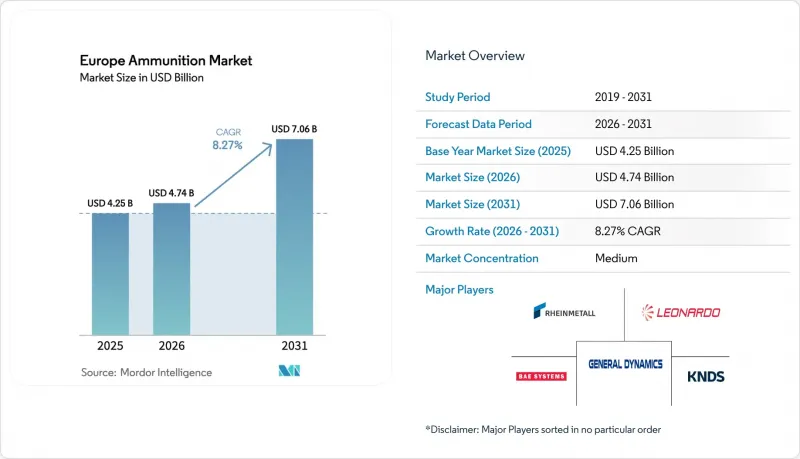
본 보고서는 구경(소구경, 중구경 등), 제품(탄환·카트리지, 포탄·박격포탄 등), 유도 방식(유도식·비유도식), 최종 사용자(군, 법 집행 기관, 민간·스포츠 사격), 플랫폼(육상, 해상, 항공), 지역(영국, 프랑스, 독일 등)별로 분류되어 있습니다. 시장 전망은 금액(달러) 기준으로 제시되어 있습니다.
유럽의 탄약 시장 동향과 인사이트
EU/NATO의 비축 보충이 포탄(155 mm) 수요를 가속화
2022년, 유럽의 재고 수준이 낮은 것으로 밝혀짐에 따라, 평시 최소 비축량에서 특정 포탄 비축 목표를 설정한 전시 대응 태세로 전환이 진행되었습니다. EU의 ‘탄약 생산 지원법’ 및 동맹국 간의 양자 협정에 따라, 우크라이나로의 긴급 수송분을 초과하는 비축량을 재구축하기 위해 155mm 포탄에 대한 명확한 납품 목표가 설정되었습니다. 각국의 국방부는 현재 NATO의 방위 계획에서 탄약 비축량을 공식적인 전투 준비 지표로 취급하고 있으며, 이를 통해 지속적인 구매가 확정되어 구조적인 수요 창출에 기여하고 있습니다. 각국 정부는 단가 상승을 수용하고, 기존 공장의 확장에 공동 출자하며, 경쟁 입찰보다 확실한 조달 물량을 우선시함으로써 생산 속도를 새로운 비축 기준에 맞출 수 있었습니다. 이러한 재편을 통해 높은 최소 수요 수준이 유지되고, 생산 능력 증강이 155mm에 집중됨에 따라 2031년까지 유럽의 탄약 시장의 성장이 확고해졌습니다.
유럽의 다년도 국방 예산과 기본 계약이 탄약 수요를 안정화시킨다.
예산 편성 관행은 다년도 예산 및 기본 계약으로 전환되었습니다. 이를 통해 에너지 및 인프라 분야에 막대한 투자를 하는 공급업체들에게 미래 전망이 명확해졌습니다. 프랑스의 2024-2030년 군사 계획과 독일의 특별 기금 제도는 탄약에 대한 자금 공급원을 확보하고, 실행 절차를 간소화하며, 계약 체결을 가속화하고 있습니다. 북유럽 각국의 파트너사들은 공동 체제를 통해 발주를 집약하고, 수요를 통합하여 규모의 경제를 실현하는 동시에, 역사적으로 주기적인 변동이 나타나는 이 분야 수요 변동을 억제하고 있습니다. 이 모델은 고정비 및 안전 기준 준수 비용이 높고 투자 회수 기간이 긴 탄약 공장의 자본 구조와 부합하며, 민간 사업자에게 미치는 수요 급변 위험을 줄여줍니다. 그 결과, 생산량을 예측할 수 있게 되고 설비 가동률이 안정화되며, 각국의 프로그램이 본격화되고 이후에도 보충이 지속되는 가운데, 유럽의 탄약 시장을 지탱하는 기반이 되고 있습니다.
폭약·화약 공급 병목 현상(TNT, RDX, 니트로셀룰로오스)이 생산량을 제약
수십 년에 걸친 공장 폐쇄 및 통합을 거치면서, 유럽 내 TNT 및 RDX 폭발물 생산량은 과거의 최고 생산 능력을 크게 밑돌고 있습니다. 환경 규제로 인해 지역 내 니트로셀룰로오스 생산이 감소함에 따라, 비동맹국으로부터의 수입 없이는 급증하는 수요에 대응하기 어려워지고 있습니다. 가동 중단 중인 생산 라인을 재개하려면 안전 심사 및 새로운 허가 취득이 필요하지만, 신규 공장 건설에는 지역 주민들의 반대와 고액의 보험료가 걸림돌로 작용하고 있습니다. 가장 심각한 제약은 155mm 포탄의 용융 주조 공정 및 비감응성 탄약의 인증 절차에서 나타나며, 이로 인해 인력 증원이나 추가 교대 근무를 통한 단순한 생산량 증가가 저해되고 있습니다. 이러한 병목 현상으로 인해 당분간 공급량은 정치적 목표를 밑도는 상태가 지속될 것이며, 유럽의 탄약 시장의 성장 속도에도 상한선이 설정되어 있습니다.
부문 분석
2025년 기준, 소구경 탄약은 유럽의 탄약 시장의 40.47%를 차지하며, 군용, 법 집행 기관용, 스포츠용 5.56mm, 7.62mm, 9mm 탄약이 포함됩니다. 대구경 탄약은 가장 빠르게 성장하는 부문으로, 비축 목표 재검토에 따라 2026년부터 2031년까지 유럽 대구경 탄약 시장 규모는 연평균 성장률(CAGR) 12.87%로 확대될 것으로 예측됩니다. 이러한 변화는 유지 수준에서 전시 시나리오로의 전환을 반영하며, 포병의 소모율이 대규모 일일 수요를 결정하게 될 것입니다. 각 제조업체는 공급국과 최전선 사용자 모두를 충족시키기 위해 NATO 규격의 155mm 외에도 기존의 152mm 및 122mm 제품 라인도 갖추고 있습니다. 소구경 시스템의 점진적인 성장은 훈련 시간 및 부대 구성과 밀접하게 관련되어 있는 반면, 중구경 시스템은 차량의 현대화와 연동되어 있어 보다 복잡한 공중 폭발 및 신관 기능이 요구됩니다.
구경 구성은 최근 고강도 작전에서 나타난 플랫폼의 전술 교리 및 병참상의 현실도 반영하고 있습니다. 현재, 대포병 공격 시의 생존성을 바탕으로 중간접 사격에 대한 수요가 우선시되고 있으며, 포병의 사정 거리와 가용성이 특히 중시되고 있습니다. 중구경 탄약은 프로그래밍 가능한 탄약과 드론 및 경장갑 차량에 대한 살상력 향상이 요구되는 신형 보병전투차의 도입으로 혜택을 보고 있습니다. 소구경 탄약의 가격은 무연 기준에 따른 재조성이 진행되고, 구형 재고가 공급망으로 재유입되면서 가격 면에서 압박을 받고 있습니다. 한편, 특정 국가들의 훈련 주기 및 스포츠 사격으로 인해 수요는 안정적인 상태를 유지하고 있습니다. 이러한 폭넓은 구성은 탄약 라인, 신관, 탄피 생산에 대한 지속적인 투자를 뒷받침하며, 결과적으로 유럽의 탄약 시장의 설비 가동률 향상에 기여하고 있습니다.
2025년, 탄환 및 카트리지는 유럽의 탄약 시장 점유율의 63.68%를 차지하며, 군 및 민간 채널 전반에 걸쳐 높은 생산 속도가 유지되고 있음을 반영하고 있습니다. 각국이 간접 사격용 탄약 비축량을 재구축하고 개정된 전투 준비 기준에 적응함에 따라, 포탄 및 박격포탄은 2031년까지 연평균 성장률(CAGR) 12.67%를 나타낼 것으로 예측됩니다. 대포병 작전 및 보다 광범위한 기동 작전을 지원하기 위해 155mm 고폭탄, 사거리 연장탄, 로켓 추진탄에 대한 조달 집중이 가속화되고 있습니다. 박격포는 대대급 유기 화력으로 보급이 확대되면서 분쟁 지역 내 사단급 전력에 대한 의존도를 낮추고 있습니다. 공군은 대부분의 계획 시나리오에서 중력식 탄약보다 스탠드오프 정밀 유도탄을 우선시하고 있어, 항공 폭탄 및 수류탄 수요는 보다 안정적인 양상을 보이고 있습니다.
또한, 납 사용의 단계적 폐지가 확대되는 가운데, 유럽의 탄약 업계는 보다 친환경적인 탄환 및 카트리지 소재로의 전환을 추진하고 있어, 생산 라인 전환 기간 동안 일시적으로 공급이 부족해지고 있습니다. 간접 사격용 탄약은 미결 주문량과 전략적 비축 목표가 가장 명확하게 정의된 카테고리이므로, 투자 회수가 가장 빠르게 진행되고 있습니다. 법 집행 기관이나 스포츠 분야에서도 탄환 및 카트리지에 대한 안정적인 주문이 있지만, 그 양은 군사 수요에 비해 소규모입니다. 사거리 확대 및 신관 개량에 따라 간접 사격용 탄약의 제품 복잡성이 높아지고 있으며, 이는 유럽의 탄약 시장 전체에서 단가 상승과 인증 주기 장기화를 부추기고 있습니다.
기타 혜택:
- 엑셀 형식 시장 예측(ME) 시트
- 3개월간의 애널리스트 지원
자주 묻는 질문
목차
제1장 서론
제2장 조사 방법
제3장 주요 요약
제4장 시장 구도
제5장 시장 규모와 성장 예측
제6장 경쟁 구도
제7장 시장 기회와 향후 전망
KTH 26.08.06According to Mordor Intelligence, the Europe ammunition market size is expected to grow from USD 4.25 billion in 2025 to USD 4.74 billion in 2026 and is forecast to reach USD 8.08 billion by 2031 at a 11.24% CAGR over 2026-2031.
This report is Segmented by Caliber (Small Caliber, Medium Caliber, and More), Product (Bullets and Cartridges, Artillery Shells and Mortars, and More), Guidance (Guided and Unguided), End-User (Military, Law Enforcement, and Civil and Sports Shooting), Platform (Land, Naval, and Airborne), and Geography (United Kingdom, France, Germany, and More). The Market Forecasts are Provided in Terms of Value (USD).
Europe Ammunition Market Trends and Insights
EU/NATO Stockpile Replenishment Accelerates Artillery (155 mm) Demand
European inventories proved shallow in 2022, triggering a shift from lean peacetime stocks to wartime readiness with specific artillery-depth goals. The EU's Act in Support of Ammunition Production and allied bilateral commitments set explicit round delivery targets for 155mm shells to rebuild stocks beyond immediate transfers to Ukraine. Defense ministries now treat ammunition depth as a formal readiness metric in NATO defense planning, thereby locking in recurring buys and contributing to structural demand. Governments accepted higher unit prices, co-financed brownfield expansions, and prioritized assured slots over competitive tendering, thereby aligning production tempo with the new stockpile baselines. This reconfiguration sustains a high-order floor and keeps capacity additions focused on 155mm, anchoring growth in the Europe ammunition market through 2031.
Multi-Year European Defense Budgets and Framework Orders Stabilize Ammo Demand
Budgeting practices shifted to multi-year appropriations and framework contracts, which offer visibility for suppliers making significant investments in energy and infrastructure lines. France's 2024-2030 military program and Germany's special fund structure ring-fence ammunition funding streams to simplify execution and accelerate awards. Nordic partners are aggregating orders through joint structures to pool demand, achieve economies of scale, and reduce volatility in a historically cyclical category. This model aligns with the capital profile of ammunition plants, where fixed costs and safety compliance are high and payback periods are long, thereby reducing the risk of demand shock for private operators. The result is predictable throughput and steadier utilization, which underpin the Europe ammunition market as national programs ramp up and then sustain replenishment.
Explosives/Powder Bottlenecks (TNT, RDX, Nitrocellulose) Constrain Output
Energetics output for TNT and RDX runs well below historic peak capacity in Europe after decades of site closures and consolidation. Environmental restrictions reduced nitrocellulose production within the bloc, making spikes in demand harder to meet without imports from non-allied suppliers. Restarting mothballed energy lines requires safety reviews and new permitting, while brand-new plants face local opposition and high insurance costs. The tightest constraint appears in 155mm melt-pour operations and in insensitive munitions qualification, which prevents simple throughput gains from staffing or extra shifts. This bottleneck keeps supply below political targets in the near term and caps how fast the Europe ammunition market can scale.
Other drivers and restraints analyzed in the detailed report include:
- Rapid EU Industrial Ramp-Up, New 155mm Lines, Propellant Capacity, Localization
- Shift to Precision/Guided and Extended-Range Munitions Across Platforms
- Fragmented Procurement and Ammo Standardization Frictions Increase Costs
For complete list of drivers and restraints, kindly check the Table Of Contents.
Segment Analysis
Small-caliber ammunition accounted for 40.47% of the Europe ammunition market in 2025, covering 5.56mm, 7.62mm, and 9mm rounds for military, law enforcement, and sporting uses. The large-caliber band is the fastest-moving caliber, with the Europe ammunition market size for large caliber projected to expand at a 12.87% CAGR from 2026 to 2031 as stockpile targets are reset. This shift reflects a transition from maintenance levels to wartime modeling, in which artillery consumption rates dictate daily needs at scale. Manufacturers are aligning their products to NATO-standard 155mm, as well as legacy 152mm and 122mm lines, to serve both donors and frontline users. Incremental growth in small-caliber systems is tied to training hours and force structure, whereas medium-caliber systems track vehicle modernization and require more complex airburst and fuzing capabilities.
The caliber mix also mirrors platform doctrine and logistics realities seen in recent high-intensity operations. Heavy indirect-fire needs are now prioritized based on counter-battery survivability, placing a premium on artillery depth and availability. Medium caliber benefits from new infantry fighting vehicles that require programmable rounds and improved lethality against drones and light armor. Small-caliber pricing faces pressure as reformulation to lead-free standards proceeds and as legacy stocks re-enter the supply chain. At the same time, demand remains stable due to training cycles and sports shooting in select countries. The broader mix supports sustained investment in filling lines, fuzing, and case production, thereby reinforcing capacity utilization in the Europe ammunition market.
Bullets and cartridges commanded 63.68% of the Europe ammunition market share in 2025, reflecting high run-rate volumes across services and civilian channels. Artillery shells and mortars are expected to grow at a 12.67% CAGR through 2031 as countries rebuild their indirect fire stocks and adapt to revised readiness benchmarks. Procurement concentration in 155mm high-explosive, extended-range, and rocket-assisted rounds accelerates to support counter-battery and broader maneuver operations. Mortars gain traction as battalion-level organic fires, reducing reliance on divisional assets in contested environments. Aerial bombs and grenades see steadier demand as air forces prioritize stand-off precision over gravity munitions in most planning scenarios.
The European ammunition industry is also retooling for greener bullet and cartridge materials as lead phase-outs expand, which temporarily tightens supply during line transitions. Indirect fire rounds recover investment first because backlogs and strategic stock objectives are most clearly defined in that category. Law enforcement and sporting channels contribute consistent orders of bullets and cartridges, though volumes are small relative to military demand. Product complexity rises for indirect fires with extended range and improved fuzing, which supports higher unit values and longer qualification cycles across the Europe ammunition market.
Complete Report Scope:
- By Caliber
- Small Caliber
- Medium Caliber
- Large Caliber
- Others
- By Product
- Bullets and Cartridges
- Artillery Shells and Mortars
- Aerial Bombs and Grenades
- By Guidance
- Guided
- Unguided
- By End-User
- Military
- Law Enforcement
- Civil and Sports Shooting
- By Platform
- Land
- Naval
- Airborne
- By Geography
- United Kingdom
- France
- Germany
- Russia
- Poland
- Italy
- Spain
- Rest of Europe
List of Companies Covered in this Report:
- BAE Systems plc
- Rheinmetall AG
- Elbit Systems Ltd.
- KNDS N.V.
- General Dynamics Corporation
- Nammo AS
- Leonardo S.p.A.
- MESKO S.A.
- CBC Global Ammunition
- Saab AB
- ARSENAL JSCo.
- ASELSAN A.S.
- Fiocchi Munizioni S.p.A.
- FN BROWNING GROUP
- CZECHOSLOVAK GROUP a.s. (CSG)
- Colt CZ Group SE
- Diehl Stiftung & Co. KG
- STV GROUP a.s.
Additional Benefits:
- The market estimate (ME) sheet in Excel format
- 3 months of analyst support
TABLE OF CONTENTS
1 INTRODUCTION
- 1.1 Study Assumptions and Market Definition
- 1.2 Scope of the Study
2 RESEARCH METHODOLOGY
3 EXECUTIVE SUMMARY
4 MARKET LANDSCAPE
- 4.1 Market Overview
- 4.2 Market Drivers
- 4.2.1 EU/NATO stockpile replenishment accelerates artillery (155 mm) demand
- 4.2.2 Multi-year European defense budgets and framework orders stabilize ammo demand
- 4.2.3 Rapid EU industrial ramp-up: new 155mm lines, propellant capacity, localization
- 4.2.4 Shift to precision/guided and extended-range munitions across platforms
- 4.2.5 Eastern Europe co-production and Ukraine licensing unlock new capacity nodes
- 4.2.6 Environmental shift to lead-free and synthetic propellants drives capex cycle
- 4.3 Market Restraints
- 4.3.1 Explosives/powder bottlenecks (TNT, RDX, nitrocellulose) constrain output
- 4.3.2 Fragmented procurement and ammo standardization frictions increase costs
- 4.3.3 High energy prices and long tooling lead-times limit ramp speed
- 4.3.4 Third-country export commitments divert EU capacity and keep prices elevated
- 4.4 Value Chain Analysis
- 4.5 Regulatory Landscape
- 4.6 Technological Outlook
- 4.7 Porter's Five Forces Analysis
- 4.7.1 Threat of New Entrants
- 4.7.2 Bargaining Power of Suppliers
- 4.7.3 Bargaining Power of Buyers
- 4.7.4 Threat of Substitutes
- 4.7.5 Intensity of Competitive Rivalry
5 MARKET SIZE AND GROWTH FORECASTS (VALUE)
- 5.1 By Caliber
- 5.1.1 Small Caliber
- 5.1.2 Medium Caliber
- 5.1.3 Large Caliber
- 5.1.4 Others
- 5.2 By Product
- 5.2.1 Bullets and Cartridges
- 5.2.2 Artillery Shells and Mortars
- 5.2.3 Aerial Bombs and Grenades
- 5.3 By Guidance
- 5.3.1 Guided
- 5.3.2 Unguided
- 5.4 By End-User
- 5.4.1 Military
- 5.4.2 Law Enforcement
- 5.4.3 Civil and Sports Shooting
- 5.5 By Platform
- 5.5.1 Land
- 5.5.2 Naval
- 5.5.3 Airborne
- 5.6 By Geography
- 5.6.1 United Kingdom
- 5.6.2 France
- 5.6.3 Germany
- 5.6.4 Russia
- 5.6.5 Poland
- 5.6.6 Italy
- 5.6.7 Spain
- 5.6.8 Rest of Europe
6 COMPETITIVE LANDSCAPE
- 6.1 Vendor Market Share Analysis
- 6.2 Vendor Positioning Analysis
- 6.3 Company Profiles (includes Global level Overview, Market level overview, Core Segments, Financials as available, Strategic Information, Market Rank/Share for key companies, Products and Services, and Recent Developments)
- 6.3.1 BAE Systems plc
- 6.3.2 Rheinmetall AG
- 6.3.3 Elbit Systems Ltd.
- 6.3.4 KNDS N.V.
- 6.3.5 General Dynamics Corporation
- 6.3.6 Nammo AS
- 6.3.7 Leonardo S.p.A.
- 6.3.8 MESKO S.A.
- 6.3.9 CBC Global Ammunition
- 6.3.10 Saab AB
- 6.3.11 ARSENAL JSCo.
- 6.3.12 ASELSAN A.S.
- 6.3.13 Fiocchi Munizioni S.p.A.
- 6.3.14 FN BROWNING GROUP
- 6.3.15 CZECHOSLOVAK GROUP a.s. (CSG)
- 6.3.16 Colt CZ Group SE
- 6.3.17 Diehl Stiftung & Co. KG
- 6.3.18 STV GROUP a.s.
7 MARKET OPPORTUNITIES AND FUTURE OUTLOOK
- 7.1 White-space and Unmet-need Assessment


