

|
시장보고서
상품코드
2097140
혈전 제거 기기 : 시장 점유율 분석, 업계 동향과 통계, 성장 예측(2026-2031년)Thrombectomy Devices - Market Share Analysis, Industry Trends & Statistics, Growth Forecasts (2026 - 2031) |
||||||
 Mordor Intelligence
Mordor Intelligence에 의하면, 혈전 제거 기기 시장 규모는 2025년에 17억 5,000만 달러로 평가되었고, 2026년 18억 7,000만 달러에서 2031년까지 26억 2,000만 달러에 이를 것으로 예측되며, 예측 기간(2026-2031년) CAGR은 6.98%를 나타낼 전망입니다.
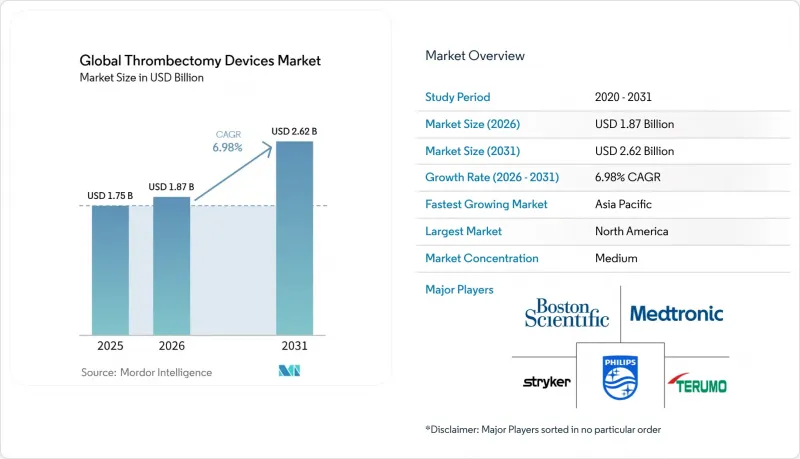
본 보고서는 기술별(기계식 스텐트 리트리버, 흡입 카테터, 레오리틱, 초음파/회전식), 유형별(자동식 및 수동식), 질환 유형별(신경혈관, 말초혈관, 관상동맥, 폐색전증), 지역별(북미, 유럽, 아시아태평양, 남미 등)로 분류되어 있습니다. 시장 전망은 금액(달러) 기준으로 제시되어 있습니다.
전 세계 혈전 제거 기기 시장 동향과 인사이트
고령화와 뇌졸중 발병률 상승
평균 수명의 연장에 따라 전 세계 뇌졸중 환자 수가 증가하고 있으며, 결과적으로 기계적 혈전 제거술의 적응증이 되는 환자 수도 증가하고 있습니다. 전 세계 뇌졸중 발생 건수는 2021년 1,181만 건에서 2050년에는 2,143만 건으로 증가할 것으로 예측되며, 이는 81%의 급증에 해당합니다. 이러한 추세는 연령 조정률이 소폭 하락하더라도 시술 건수의 꾸준한 증가를 뒷받침하는 요인이 될 것입니다. 중국에서는 이미 연간 277만 건의 허혈성 뇌졸중이 보고되고 있으며, 미국의 모델 분석에 따르면 지침의 적응 기준이 확대됨에 따라 혈전 제거술의 대상이 될 수 있는 사례 수는 4배로 증가할 가능성이 있습니다. 이러한 동향에 따라 혈전 제거 기기는 ‘선택적 기술’에서 ‘필수적인 병원 인프라’로 변화하게 되며, 지속적인 교체 수요가 보장될 것입니다.
장치 설계 분야의 기술적 진보
기술 혁신을 통해 해부학적 조건이 까다로운 사례와 확실한 재관류 사이의 격차가 점차 좁혀지고 있습니다. 스탠퍼드 대학의 ‘밀리 스피너(Milli Spinner)’ 프로토타입은 파쇄를 수반하지 않는 와류 유도 압축 기술을 사용하여, 기존 캡처법의 성공률이 50%인 데 반해 난치성 혈전에 대해 90%의 성공률을 달성했습니다. 페누브라사의 ‘라이트닝 플래시 2.0’은 흡입력을 실시간으로 조정하는 이중 혈전 감지 알고리즘을 통해 기기의 작동 시간을 13분으로 단축했습니다. 이러한 개선을 통해 여전히 불완전한 재관류로 끝나는 10-30%의 증례에 대처할 수 있게 되었으며, 병원들은 예정보다 빨리 기기 업그레이드를 진행하고 있습니다.
부문 분석
2025년에는 의사들이 충분히 검증된 스텐트 리트리버의 워크플로우를 신뢰함에 따라, 기계식 플랫폼이 혈전 제거 기기 시장 점유율 46.80%를 차지했습니다. 기계식 시스템의 혈전 제거 기기 시장 규모는 혈전 포획 능력을 향상시키는 편조 니티놀 설계 등의 기술적 개선에 힘입어 2031년까지 연평균 성장률(CAGR) 6.95%로 확대될 것으로 예측됩니다. 초기 시술 성공률은 일반적으로 80%를 초과하지만, 석회화된 혈전이나 가늘고 긴 혈전의 경우 성능이 저하되어 순수한 기계적 힘만으로는 극복할 수 없는 한계가 드러나고 있습니다.
흡입 카테터는 이러한 격차를 메우고 있으며, 컴퓨터 유도 흡입 및 잔해물을 제거하면서 혈류를 유지하는 더 큰 내강에 힘입어 연평균 성장률(CAGR) 7.78%로 가장 빠르게 성장할 것으로 예측됩니다. mini-SOLUMBRA와 같은 하이브리드 기술은 직접 흡입과 스텐트 보조를 결합하여, 허혈성 뇌졸중의 최대 40%를 차지하는 중대혈관 폐색의 치료에 사용되고 있습니다. 향후 세분화에서는 기기가 혈전의 표현형에 따라 분류되게 되며, ‘기계적 제거 대 흡인’이라는 논의에서 정밀 유도형 치료 패키지로의 전환이 진행될 것으로 전망됩니다.
지역별 분석
북미는 2025년 매출의 38.10%를 차지하고 있으며, 성숙한 뇌졸중 치료 시스템, 신뢰할 수 있는 보험 급여, 그리고 높은 전문의 밀도가 시술 건수를 뒷받침하고 있습니다. 미국의 모델 분석에 따르면, 최근의 임상시험 기준이 보편적으로 적용될 경우, 혈관내 치료 대상 환자 수는 4배로 증가할 가능성이 있으며, 이는 혈전 제거 기기 시장에 향후 수년간 시술 건수 증가의 호재가 될 것입니다. 벤더들은 자본 리스와 시술당 일회용 소모품을 세트로 판매하는 사례가 늘어나고 있어, 병원의 현금 흐름에 대한 부담을 완화하고 있습니다. 스트라이커(Stryker)사가 이나리 메디컬(Inari Medical)사를 49억 달러에 인수한 사례가 대표적으로, 이러한 기업 활동은 포트폴리오 확장에 있어 해당 지역의 주도적인 위치를 부각시키고 있습니다.
아시아태평양은 2031년까지 연평균 성장률(CAGR)이 8.11%로 가장 빠르게 성장하고 있는 지역입니다. 중국에서 연간 277만 건의 허혈성 뇌졸중 사례는 충족되지 않은 수요를 여실히 보여주는 반면, 일본에서 PMDA가 ClotTriever를 승인한 것은 첨단 의료기기에 대한 규제 당국의 수용성을 보여줍니다. 인도네시아, 인도 및 중국의 농촌 지역에서는 거리로 인한 장벽을 극복하기 위해 이동식 CT 장비와 AI를 활용한 원격 뇌졸중 치료 프로토콜에 대한 실증 시험이 진행되고 있습니다. 자원이 제한된 병원에서 대구경 흡인 혈전 제거술 후 퇴원 시 생존율이 87.5%에 달했다는 초기 다기관 공동 연구 데이터는 지역 확대의 사업적 타당성을 뒷받침합니다.
유럽에서는 고도의 신경 중재술 노하우가 있는 반면, 치료 역량의 병목 현상도 존재합니다. 프랑스에서는 대상 환자 3명당 1건의 수술만 시행되고 있으며, 독일에서는 1차 의료기관에서 혈전 제거술을 받기 위해 이송되는 비율이 6.7%로 보고되고 있습니다. 32개국을 대상으로 한 비용-효용 분석을 통해 광범위한 경제적 타당성이 확인되었으나, 규모 확대에는 연수와 국경을 초월한 의뢰 경로의 정비가 필수적입니다. 라틴아메리카, 중동 및 아프리카에서는 ANVISA의 새로운 패스트트랙 제도와 걸프협력회의(GCC)의 입찰 개혁을 통해 의료기기 등록 기간이 단축되고, 최고 수준의 시스템 도입이 가속화됨에 따라 추가적인 성장이 예상됩니다.
기타 혜택:
- 엑셀 형식 시장 예측(ME) 시트
- 3개월간의 애널리스트 지원
자주 묻는 질문
목차
제1장 서론
제2장 조사 방법
제3장 주요 요약
제4장 시장 구도
제5장 시장 규모와 성장 예측
제6장 경쟁 구도
제7장 시장 기회와 향후 전망
KTH 26.08.06According to Mordor Intelligence, the thrombectomy devices market size was valued at USD 1.75 billion in 2025 and estimated to grow from USD 1.87 billion in 2026 to reach USD 2.62 billion by 2031, at a CAGR of 6.98% during the forecast period (2026-2031).
This report is Segmented by Technology (Mechanical Stent Retriever, Aspiration Catheter, Rheolytic, and Ultrasonic / Rotational), by Type (Automated and Manual), Disease Area (Neurovascular, Peripheral Vascular, Coronary, and Pulmonary Embolism), and Geography (North America, Europe, Asia-Pacific, South America, and More). The Market Forecasts are Provided in Terms of Value (USD)
Global Thrombectomy Devices Market Trends and Insights
Aging Population and Rising Stroke Incidence
Growing life expectancy is swelling the global pool of stroke patients and, by extension, candidates for mechanical clot removal. Worldwide stroke events are projected to climb from 11.81 million in 2021 to 21.43 million by 2050, an 81% surge that will underpin steady procedure growth even if age-adjusted rates fall modestly . China already records 2.77 million ischemic strokes per year, and U.S. modeling shows potential thrombectomy-eligible volumes quadrupling as guideline criteria widen. These trends turn thrombectomy devices from a discretionary technology into essential hospital infrastructure, guaranteeing recurrent replacement demand.
Technological Advancements in Device Design
Innovation is narrowing the gap between difficult anatomy and dependable recanalization. Stanford's milli-spinner prototype achieved 90% success on hard clots versus 50% for conventional capture, using vortex-induced compression that avoids fragmentation . Penumbra's Lightning Flash 2.0 shortens active device time to 13 minutes through dual clot-detection algorithms that modulate suction in real time. Such improvements attack the 10-30% of cases that still end in incomplete reperfusion and are driving hospitals to upgrade ahead of schedule.
Other drivers and restraints analyzed in the detailed report include:
- Expanding Clinical Evidence and Guidelines
- Improved Healthcare Infrastructure
- High Device Costs and Budget Constraints
- Shortage of Trained Specialists
For complete list of drivers and restraints, kindly check the Table Of Contents.
Segment Analysis
Mechanical platforms captured 46.80% of thrombectomy devices market share in 2025 as physicians rely on well-validated stent-retriever workflows. The thrombectomy devices market size for mechanical systems is expected to expand at 6.95% CAGR through 2031, supported by engineering refinements such as braided nitinol designs that improve clot engagement. First-pass success rates routinely exceed 80%, yet performance drops on calcified or elongated clots, highlighting limits that pure mechanical force cannot breach.
Aspiration catheters are closing that gap and are forecast to grow the fastest at 7.78% CAGR, propelled by computer-guided suction and larger inner lumens that preserve flow while evacuating debris. Hybrid techniques such as mini-SOLUMBRA marry direct aspiration with stent assistance to treat medium-vessel occlusions that account for up to 40% of ischemic strokes. Future segmentation will likely align devices to clot phenotype, moving the conversation from "mechanical versus aspiration" toward precision-guided therapy bundles.
Complete Report Scope:
- By Technology
- Mechanical Stent Retriever
- Aspiration Catheter
- Rheolytic
- Ultrasonic / Rotational
- By Type
- Automated
- Manual
- By Disease Area
- Neurovascular
- Peripheral Vascular
- Coronary
- Pulmonary Embolism
- By Geography (Value)
- North America
- United States
- Canada
- Mexico
- Europe
- Germany
- United Kingdom
- France
- Italy
- Spain
- Rest of Europe
- Asia-Pacific
- China
- Japan
- India
- South Korea
- Australia
- Rest of Asia-Pacific
- South America
- Brazil
- Argentina
- Rest of South America
- Middle East and Africa
- GCC
- South africa
- Rest of Middle East and Africa
- North America
Geography Analysis
North America held 38.10% of 2025 revenue as mature stroke systems, reliable reimbursement, and high specialist density sustain procedure volumes. U.S. modeling suggests that endovascular-eligible patient counts could quadruple if recent trial criteria are applied universally, creating a multi-year volume tailwind for the thrombectomy devices market. Device vendors increasingly bundle capital leases with per-procedure disposables, easing hospital cash-flow barriers. Corporate activity exemplified by Stryker's USD 4.9 billion acquisition of Inari Medical underscores the region's leadership in portfolio expansion.
Asia-Pacific is the fastest-growing territory at an 8.11% CAGR through 2031; China's 2.77 million annual ischemic strokes illustrate an unmet need, while Japan's PMDA clearance of ClotTriever signals regulatory receptiveness to advanced devices. Mobile CT units and AI-driven tele-stroke pathways are being piloted to bypass distance barriers across Indonesia, India, and rural provinces of China. Early multicenter data show 87.5% survival to discharge after large-bore suction thrombectomy in resource-constrained hospitals, reinforcing the business case for regional expansion.
Europe combines sophisticated neuro-interventional know-how with capacity bottlenecks: France manages only one procedure for every three potential candidates, and Germany reports 6.7% thrombectomy transfer rates from primary centers. Cost-utility analyses covering 32 nations confirm broad economic justification, but scaling hinges on training and cross-border referral pathways. Latin America and Middle East & Africa offer incremental upside as ANVISA's new fast-track and Gulf Cooperation Council tender reforms compress device registration timelines, enabling faster uptake of best-in-class systems.
- Medtronic
- Stryker
- Penumbra
- Boston Scientific
- Teleflex
- Johnson & Johnson (Cerenovus)
- Abbott Laboratories
- Terumo
- Inari Medical
- AngioDynamics
- Merit Medical Systems
- Control Medical Technology
- Inquis Medical
- Acandis
- MicroVention
- Cardinal Health
- Beckton Dickinson
- Koninklijke Philips
- Cook Group
- Rapid Medical
- VESALIO
- Kaneka
- Asahi Intecc
Additional Benefits:
- The market estimate (ME) sheet in Excel format
- 3 months of analyst support
TABLE OF CONTENTS
1 Introduction
- 1.1 Study Assumptions & Market Definition
- 1.2 Scope of the Study
2 Research Methodology
3 Executive Summary
4 Market Landscape
- 4.1 Market Overview
- 4.2 Market Drivers
- 4.2.1 Increasing Incidence of Ischemic Stroke & Systemic Embolism
- 4.2.2 Rising Demand for Minimally-Invasive Procedures
- 4.2.3 Favorable Reimbursement in Developed Markets
- 4.2.4 Technological Advances in Stent-Retriever Design
- 4.2.5 AI-Guided Intraprocedural Imaging Adoption
- 4.2.6 Hospital Group Purchasing Boosts Capital Equipment Uptake
- 4.3 Market Restraints
- 4.3.1 High Device & Procedural Costs
- 4.3.2 Shortage of skilled neuro-interventionalists
- 4.3.3 Risk of Complications and Side Effects
- 4.3.4 Limited Access in Rural Areas
- 4.4 Value / Supply-Chain Analysis
- 4.5 Regulatory Landscape
- 4.6 Technological Outlook
- 4.7 Porter's Five Forces
- 4.7.1 Threat of New Entrants
- 4.7.2 Bargaining Power of Suppliers
- 4.7.3 Bargaining Power of Buyers
- 4.7.4 Threat of Substitutes
- 4.7.5 Competitive Rivalry
5 Market Size & Growth Forecasts (Value)
- 5.1 By Technology
- 5.1.1 Mechanical Stent Retriever
- 5.1.2 Aspiration Catheter
- 5.1.3 Rheolytic
- 5.1.4 Ultrasonic / Rotational
- 5.2 By Type
- 5.2.1 Automated
- 5.2.2 Manual
- 5.3 By Disease Area
- 5.3.1 Neurovascular
- 5.3.2 Peripheral Vascular
- 5.3.3 Coronary
- 5.3.4 Pulmonary Embolism
- 5.4 By Geography (Value)
- 5.4.1 North America
- 5.4.1.1 United States
- 5.4.1.2 Canada
- 5.4.1.3 Mexico
- 5.4.2 Europe
- 5.4.2.1 Germany
- 5.4.2.2 United Kingdom
- 5.4.2.3 France
- 5.4.2.4 Italy
- 5.4.2.5 Spain
- 5.4.2.6 Rest of Europe
- 5.4.3 Asia-Pacific
- 5.4.3.1 China
- 5.4.3.2 Japan
- 5.4.3.3 India
- 5.4.3.4 South Korea
- 5.4.3.5 Australia
- 5.4.3.6 Rest of Asia-Pacific
- 5.4.4 South America
- 5.4.4.1 Brazil
- 5.4.4.2 Argentina
- 5.4.4.3 Rest of South America
- 5.4.5 Middle East and Africa
- 5.4.5.1 GCC
- 5.4.5.2 South africa
- 5.4.5.3 Rest of Middle East and Africa
- 5.4.1 North America
6 Competitive Landscape
- 6.1 Market Concentration
- 6.2 Market Share Analysis
- 6.3 Company Profiles (includes Global Level Overview, Market Level Overview, Core Segments, Financials as Available, Strategic Information, Market Rank/Share for Key Companies, Products & Services, and Recent Developments)
- 6.3.1 Medtronic
- 6.3.2 Stryker
- 6.3.3 Penumbra
- 6.3.4 Boston Scientific
- 6.3.5 Teleflex
- 6.3.6 Johnson & Johnson (Cerenovus)
- 6.3.7 Abbott Laboratories
- 6.3.8 Terumo
- 6.3.9 Inari Medical
- 6.3.10 AngioDynamics
- 6.3.11 Merit Medical Systems
- 6.3.12 Control Medical Technology
- 6.3.13 Inquis Medical
- 6.3.14 Acandis
- 6.3.15 MicroVention
- 6.3.16 Cardinal Health (Cordis)
- 6.3.17 Becton Dickinson
- 6.3.18 Philips
- 6.3.19 Cook Medical
- 6.3.20 Rapid Medical
- 6.3.21 Vesalio
- 6.3.22 Kaneka
- 6.3.23 Asahi Intecc
7 Market Opportunities & Future Outlook
- 7.1 White-space & Unmet-Need Assessment


