

|
시장보고서
상품코드
2097174
항공우주 및 방위용 소재 : 시장 점유율 분석, 업계 동향과 통계, 성장 예측(2026-2031년)Aerospace and Defense Materials - Market Share Analysis, Industry Trends & Statistics, Growth Forecasts (2026 - 2031) |
||||||
 Mordor Intelligence
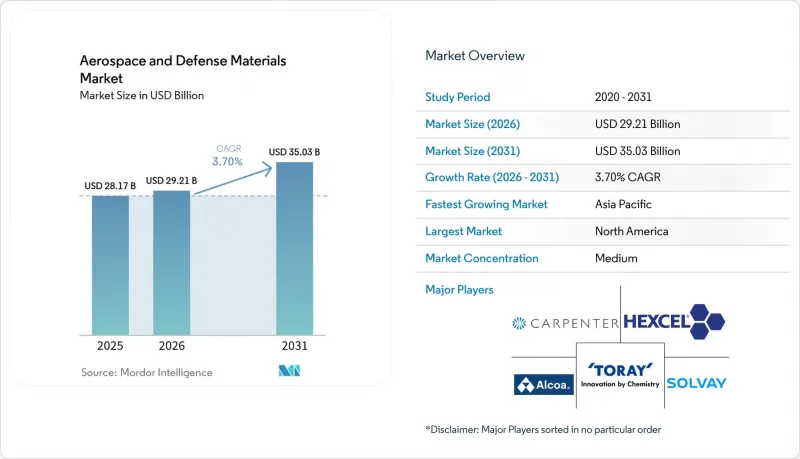
Mordor Intelligence에 의하면, 2026년 항공우주 및 방위용 소재 시장 규모는 292억 1,000만 달러로 추정되고 있으며, 2025년 281억 7,000만 달러에서 2031년에는 350억 3,000만 달러에 이를 것으로 예측됩니다.
또한 2026-2031년 연평균 성장률(CAGR) 3.70%를 기록할 것으로 전망됩니다.
본 보고서는 재료의 유형(알루미늄 합금, 강 합금, 티타늄 합금, 초합금, 복합재료, 기타 재료), 항공기 유형(민간기, 군용기, 비즈니스 제트기 및 일반 항공기 등), 지역(아시아태평양, 북미, 유럽, 남미, 중동 및 아프리카)별로 분류되어 있습니다. 시장 전망은 금액(달러) 기준으로 제시되어 있습니다.
세계 항공우주 및 방위용 소재 시장 동향과 인사이트
단통로형 민간 항공기 생산 잔고가 급증
수주 잔고는 15,700대에 육박하며, 에어버스사만 해도 A320neo 제품군의 수주가 약 8,700대를 차지하고 있습니다. 납기 기간이 장기화되는 가운데, 항공기 제조업체들은 알루미늄·리튬 합금판 및 첨단 탄소섬유 적층재를 포함하는 다년간공급 계약 확보를 서두르고 있으며, 이는 항공우주 및 방위용 소재 시장의 성장을 뒷받침하고 조달 형태를 적시(JIT) 방식에서 전략적 비축으로 전환시키고 있습니다. 현재 각 단일 통로 항공기의 기체에는 고강도 7000계 알루미늄 압출재나 수지 함침 날개 외판이 더 대량으로 채택되고 있으며, 이를 조합함으로써 구조 중량을 최대 10%까지 줄이고 있습니다. 공급업체의 생산 능력 부족을 배경으로, 보잉이 737 생산 라인의 월간 생산 대수를 26대로 축소한 것과 같은 생산 중단은 원자재 공급 상황이 최종 조립 속도를 좌우하고 있음을 여실히 보여주고 있습니다.
차세대 전투기 및 수송기 프로그램을 위한 국방 예산 증액
2024년 전 세계 국방 지출은 2조 4,000억 달러를 넘어설 전망이며, 세라믹 매트릭스 복합재, 레이더 흡수성 티타늄-알루미늄 합금, 1,000°C를 초과하는 외판 온도를 견딜 수 있는 내화 합금이 필요한 6세대 전투기 및 스텔스 수송기의 조달을 뒷받침하고 있습니다. 미국 국방부는 2025년에 초음속 소재 과학 및 미사일 시제기에 69억 달러를 배정했으며, 한편, 스페인이 유로파이터 25대를 추가 발주하기 위해 20억 유로를 투자한 것은 소재 집약형 플랫폼에 대한 유럽의 병행적인 노력을 여실히 보여주고 있습니다. 중국이 초합금 디스크 가공에서 기존 방식보다 3.75배 빠른 냉각 속도를 달성했다는 획기적인 성과를 거둔 것은 야금 분야의 주도권을 둘러싼 세계적 경쟁이 격화되고 있음을 여실히 보여줍니다.
주요 금속 가격 변동
세계은행 데이터에 따르면, 2024년 4월까지의 금속 및 광물 가격 지수는 9% 상승했으며, 2024년 5월 티타늄 생산자물가지수는 190.106에 달했습니다. 수입 철강 및 알루미늄에 대한 25% 관세로 인해 수입 철강 가격은 22.7% 상승했으며, 이로 인해 OEM(원청 브랜드 제조업체) 각사는 공급업체 다각화 및 헤지 조항 협상을 서둘러야 하는 상황에 처했습니다. 러시아가 티타늄 스폰지 시장에서 철수함에 따라 구매자들은 카자흐스탄과 사우디아라비아로 눈을 돌렸고, 현물 시장공급이 부족해졌습니다. 보잉과 에어버스의 사업을 강타한 위조 티타늄 사건은 비용 상승이 규정 준수 관리를 약화시켜 부정합금이 중요 부품에 혼입될 여지를 만들 수 있음을 여실히 드러냈습니다.
부문 분석
알루미늄 합금은 검증된 성능, 폭넓은 공급업체 기반, 그리고 특수 금속보다 낮은 Kg당 단가에 힘입어 2025년 매출의 34.62%를 차지했습니다. 콘스텔리움(Constellium)이 레이븐스우드(Ravenswood)로부터 강판을 공급받는 다년 계약과, 이 회사의 ‘에어웨어(Airware)’ 알루미늄-리튬 제품군은 기존 기업들이 더 높은 탄성 계수와 내식성을 갖춘 제품으로 포트폴리오를 쇄신하고 있음을 보여줍니다. 강 합금은 여전히 착륙 장치에 필수적이며, 카펜터 테크놀로지의 개량형 4340 및 AerMet 100은 아레스터 후크 어셈블리에서 높은 파단 인성을 발휘하고 있습니다. 티타늄 합금은 고온 부위, 배기 시스템 및 중요 패스너의 틈새 시장을 점유하고 있지만, 가격 변동으로 인해 주요 제조업체들은 저밀도 대체재로 티타늄 금속 매트릭스 복합재의 시험적 도입을 강요받고 있습니다.
복합재료는 2031년까지 연평균 성장률(CAGR) 4.58%를 나타낼 것으로 예측되며, 성장의 주역으로 부상하고 있습니다. 2,800°C를 견디는 세라믹 매트릭스 복합재료를 통해 무거운 금속 냉각 부품을 필요로 하지 않고도 더 고온의 터빈 코어를 구현할 수 있어, ICAO의 연료 소비 규제를 직접적으로 충족시키고 있습니다. 탄소섬유 강화 폴리에테르에테르케톤(PEEK) 및 PEKK 열가소성 플라스틱은 리벳 고정 대신 용접이 가능하기 때문에 조립 시간을 단축할 수 있습니다. 이러한 장점은 생산 속도가 빠른 단일 통로 항공기 시리즈에서 특히 두드러집니다. 초합금은 초음속 연구 개발(R&D) 분야에서 1,150°C를 넘는 고온에서도 높은 강도를 발휘하는 니켈·코발트·레늄계 소재가 주목받으면서, 기존 금속 소재 중 가장 빠르게 성장하고 있는 분야가 되었습니다. 또한 연구자들은 796°C의 온도 변동 범위에서 안정적인 감마프라임 구조를 보이는 POSTECH의 ‘Hyperadaptor’와 같은 고엔트로피 합금의 규모 확대에도 힘쓰고 있습니다. 방사선 내성 폴리머부터 그래핀 강화 도료에 이르기까지, 그 밖의 재료 유형들도 10년 이내에 1조 달러에 달할 가능성이 있는 상업 우주 시장을 배경으로 확대되고 있습니다.
지역별 분석
북미는 미국의 국방 예산, 대규모 민간 항공기 함대, 그리고 수직 통합된 금속 생태계 덕분에 2025년 매출의 35.84%를 차지했습니다. 알코아(Alcoa)의 2025년 1분기 순이익 5억 4,800만 달러 및 알루미나 리미티드(Alumina Limited)에 대한 22억 달러 규모의 인수는 보크사이트 및 알루미나 공급을 확보하기 위한 업스트림 부문의 통합을 여실히 보여주고 있습니다. 캐나다와 멕시코는 비용 효율적인 기계 가공 역량을 상호 보완하고 있으며, 특히 멕시코에서는 300개 이상의 인증 공급업체를 육성하는 동시에 직업 훈련 프로그램을 통해 해당 지역의 노동력 고령화로 인한 인력 부족을 완화하고 있습니다. 과제로는 티타늄 제품의 위조 위험과 단조 능력의 부족을 들 수 있지만, 69억 달러에 달하는 초음속 기술에 대한 지속적인 자금 투입으로 연구 거점은 활발한 활동을 이어가고 있습니다.
아시아태평양은 2031년까지 연평균 성장률(CAGR)이 4.34%로 가장 빠르게 성장하고 있는 지역이며, 중국의 C919 협폭기 시장 진출과 터빈 디스크의 급속 냉각 단계에서 냉각 속도를 3배로 높이는 초합금 가공 라인에 대한 투자가 이를 뒷받침하고 있습니다. 일본은 2024년에 항공우주용 티타늄 스폰지 생산량을 5만 5,000톤으로 확대하여, 카자흐스탄에서 1만 9,000톤, 사우디아라비아에서 1만 5,000톤을 보충했습니다. 인도, 한국 및 신흥 아세안 거점에서는 주요 제조업체들이 공급원 집중화에서 벗어나면서 부품 제조 수주가 증가하고 있습니다. 국내 노선을 위해 협폭기 기단을 확대하는 지역 항공사들로 인해 판재, 압출 성형품, 내장 패널에 대한 견조한 수요가 창출되고 있습니다.
유럽은 에어버스의 민용기 미인도 주문 잔고와 각국의 국방 예산 증가에 힘입어 균형 잡힌 상황을 유지하고 있습니다. 2024년 766대의 항공기 인도에 더해, 방위·우주 부문에서 167억 유로 규모의 수주는 내구성이 뛰어난 소재에 대한 수요가 높음을 보여줍니다. 유럽 방위 기금은 초고온 세라믹이 필요한 극초음속기 연구를 포함한 54개 기술 프로그램에 10억 유로 이상을 지원했습니다. ‘ReFuelEU Aviation’을 통한 규제적 주도 하에 항공사들이 수명 주기 배출량 감축을 목표로 하는 가운데, 복합재료의 급속한 도입이 촉진되고 있습니다. 프로그램 구성이 고온 금속으로 전환됨에 따라 주조 및 단조 생산 능력이 한계에 다다르고 있으며, 이에 따라 합작 기업들은 프랑스와 독일에 새로운 열등정압 프레스 설비를 개설하는 움직임을 보이고 있습니다.
기타 혜택:
- 엑셀 형식 시장 예측(ME) 시트
- 3개월간의 애널리스트 지원
자주 묻는 질문
목차
제1장 서론
제2장 조사 방법
제3장 주요 요약
제4장 시장 구도
제5장 시장 규모와 성장 예측
제6장 경쟁 구도
제7장 시장 기회와 향후 전망
KTH 26.08.06According to Mordor Intelligence, aerospace and Defense Materials market size in 2026 is estimated at USD 29.21 billion, growing from 2025 value of USD 28.17 billion with 2031 projections showing USD 35.03 billion, growing at 3.70% CAGR over 2026-2031.
This report is Segmented by Material Type (Aluminum Alloys, Steel Alloys, Titanium Alloys, Super Alloys, Composite Materials, and Other Material Types), Aircraft Type (Commercial, Military, Business and General Aviation, and More), and Geography (Asia-Pacific, North America, Europe, South America, and Middle East and Africa). The Market Forecasts are Provided in Terms of Value (USD).
Global Aerospace and Defense Materials Market Trends and Insights
Surging Production Backlog for Single-Aisle Commercial Aircraft
Order books stand at nearly 15,700 jets, with Airbus alone holding about 8,700 A320neo-family commitments. Long wait times push airframers to secure multi-year supply contracts covering aluminum-lithium plate and advanced carbon fiber laminates, supporting growth in the aerospace and defense materials market and moving procurement away from just-in-time models toward strategic stockpiles. Each single-aisle frame now integrates greater volumes of high-strength 7000-series aluminum extrusions and resin-infused wing skins that reduce up to 10% structural weight together. Production interruptions, such as Boeing's trim to 26 units per month on the 737 line amid supplier capacity gaps, underline how raw-material availability regulates final-assembly cadence.
Rising Defense Budgets for Next-Generation Fighter and Transport Programs
Global defense outlays surpassed USD 2.4 Trillion in 2024, propelling procurement of sixth-generation fighters and stealth transports that rely on ceramic matrix composites, radar-absorbing titanium aluminides, and refractory alloys capable of withstanding skin temperatures above 1,000°C. The Pentagon allocates USD 6.9 Billion in 2025 to hypersonic materials science and prototype missiles, while Spain's EUR 2 Billion order for 25 additional Eurofighters highlights Europe's parallel commitment to material-intensive platforms . China's breakthrough in superalloy disc processing, achieving cooling rates 3.75 times faster than legacy methods, underscores the unfolding global race for metallurgical leadership.
Volatile Prices of Critical Metals
World Bank data show a 9% rise in the metals and minerals price index through April 2024, and the Producer Price Index for titanium reached 190.106 in May 2024 . Tariffs of 25% on incoming steel and aluminum pushed imported steel prices up 22.7%, prompting original equipment manufacturers (OEMs) to diversify suppliers and negotiate hedging clauses. Russia's exit from the titanium sponge market redirected buyers to Kazakhstan and Saudi Arabia, tightening spot availability. The counterfeit titanium incident that hit Boeing and Airbus operations illustrated how cost inflation can erode compliance controls and allow fraudulent alloys into critical parts.
Other drivers and restraints analyzed in the detailed report include:
- Weight-Reduction Mandates Accelerating Composite Adoption
- Hypersonic R&D Ramping Demand for Refractory Alloys and Superalloys
- Lengthy Qualification Cycles and Capital Intensity of New Materials
For complete list of drivers and restraints, kindly check the Table Of Contents.
Segment Analysis
Aluminum alloys retained 34.62% of 2025 revenue, driven by well-proven performance, wide supplier bases, and lower kilogram cost than exotic metals. Constellium's multi-year contract to ship plate from Ravenswood and its Airware aluminum-lithium range shows how incumbents refresh portfolios with higher modulus and corrosion resistance. Steel alloys remain indispensable for landing gear, with Carpenter Technology's modified 4340 and AerMet 100 scoring high fracture-toughness values for arrestor-hook assemblies. Titanium alloys occupy the hot-section, exhaust, and critical fastener niche, though price swings force primes to trial titanium-metal-matrix composites as lower-density substitutes.
Composite materials headline the growth story at a forecast 4.58% CAGR through 2031. Ceramic matrix composites at 2,800°C enable hotter turbine cores without heavy metallic cooling parts, directly meeting ICAO fuel-burn rules. Carbon-fiber reinforced polyetheretherketone (PEEK) and PEKK thermoplastics cut assembly time because they can be welded instead of riveted, a benefit accentuated in high-rate single-aisle lines. Superalloys form the fastest-rising traditional metal subset as hypersonic research and development (R&D) pulls in nickel-cobalt-rhenium systems offering high strength above 1,150°C. Researchers are also scaling high-entropy alloys such as POSTECH's Hyperadaptor, which demonstrates a stable gamma-prime structure across a 796°C temperature swing. Other material types, ranging from radiation-hardened polymers to graphene-enhanced paints, are expanding on the back of a commercial space market that could hit USD 1 Trillion inside ten years.
Complete Report Scope:
- Material Type
- Aluminum Alloys
- Steel Alloys
- Titanium Alloys
- Super Alloys
- Composite Materials
- Other Material Types
- Aircraft Type
- Commercial
- Military
- Business and General Aviation
- Other Aircraft Types
- Geography
- Asia-Pacific
- China
- Japan
- India
- South Korea
- ASEAN Countries
- Rest of Asia-Pacific
- North America
- United States
- Canada
- Mexico
- Europe
- Germany
- United Kingdom
- France
- Italy
- Spain
- Russia
- NORDIC Countries
- Rest of Europe
- South America
- Brazil
- Argentina
- Rest of South America
- Middle East and Africa
- Saudi Arabia
- South Africa
- Rest of Middle East and Africa
- Asia-Pacific
Geography Analysis
North America controlled 35.84% of 2025 revenue due to the United States' defense budget, expansive civil fleet, and vertically integrated metals ecosystem. Alcoa's USD 548 Million Q1-2025 net income and its USD 2.2 Billion Alumina Limited acquisition highlight upstream consolidation that secures bauxite and alumina supply. Canada and Mexico add cost-efficient machining, with Mexico nurturing more than 300 qualified suppliers and vocational programs that alleviate the region's aging-workforce gap. Challenges stem from counterfeit titanium exposure and tight forging capacity, yet sustained hypersonic funding at USD 6.9 Billion keeps research sites busy.
Asia-Pacific is the fastest-growing region with a 4.34% CAGR through 2031, supported by China's C919 narrow-body entry and investments in superalloy processing lines that triple cooling rates during turbine-disc quench stages. Japan boosted aerospace-grade titanium sponge output to 55,000 tons in 2024, supplementing 19,000 tons from Kazakhstan and 15,000 tons from Saudi Arabia. India, South Korea, and emerging ASEAN hubs draw component work as primes diversify away from concentrated sources. Regional airlines expanding narrow-body fleets for domestic routes generate sticky demand for plate, extrusion, and interior panels.
Europe retains a balanced profile thanks to Airbus's civil backlog and rising collective defense budgets. Delivery of 766 aircraft in 2024 coupled with EUR 16.7 Billion Defense and Space division orders indicates durable materials pull. The European Defence Fund granted over EUR 1 Billion to 54 technology programs, including hypersonic vehicle research that consumes ultra-high-temperature ceramics. Regulatory leadership through ReFuelEU Aviation stimulates rapid composite adoption as carriers seek lower lifecycle emissions. Casting and forging capacity tightens as program mix shifts toward high-temperature metals, motivating joint ventures to open new hot-isostatic-press assets in France and Germany.
- Aditya Birla Management Corporation Pvt. Ltd. (Novelis Inc.)
- Alcoa Corporation
- Arconic
- Carpenter Co.
- Constellium
- DuPont
- GKN Aerospace
- Hexcel Corporation
- Howmet Aerospace
- Huntsman International LLC.
- Materion Corporation
- Mitsubishi Chemical Group
- SGL Carbon
- Solvay
- Teijin Limited
- thyssenkrupp Aerospace
- Toray Industries Inc.
- Victrex plc
Additional Benefits:
- The market estimate (ME) sheet in Excel format
- 3 months of analyst support
TABLE OF CONTENTS
1 Introduction
- 1.1 Study Assumptions and Market Definition
- 1.2 Scope of the Study
2 Research Methodology
3 Executive Summary
4 Market Landscape
- 4.1 Market Overview
- 4.2 Market Drivers
- 4.2.1 Surging Production Backlog for Single-Aisle Commercial Aircraft
- 4.2.2 Rising Defense Budgets for Next-gen Fighter and Transport Programs
- 4.2.3 Weight-reduction Mandates Accelerating Composite Adoption
- 4.2.4 Hypersonic Rand D Ramping Demand for Refractory Alloys and Superalloys
- 4.2.5 Megaconstellations Scaling Demand for Space-grade Polymers
- 4.3 Market Restraints
- 4.3.1 Volatile Prices of Critical Metals
- 4.3.2 Lengthy Qualification Cycles and Capital Intensity of New Materials
- 4.3.3 Casting/forging Supply-chain Bottlenecks and Labor Shortages
- 4.4 Value Chain Analysis
- 4.5 Porter's Five Forces
- 4.5.1 Bargaining Power of Suppliers
- 4.5.2 Bargaining Power of Buyers
- 4.5.3 Threat of New Entrants
- 4.5.4 Threat of Substitutes
- 4.5.5 Degree of Competition
5 Market Size and Growth Forecasts (Value)
- 5.1 Material Type
- 5.1.1 Aluminum Alloys
- 5.1.2 Steel Alloys
- 5.1.3 Titanium Alloys
- 5.1.4 Super Alloys
- 5.1.5 Composite Materials
- 5.1.6 Other Material Types
- 5.2 Aircraft Type
- 5.2.1 Commercial
- 5.2.2 Military
- 5.2.3 Business and General Aviation
- 5.2.4 Other Aircraft Types
- 5.3 Geography
- 5.3.1 Asia-Pacific
- 5.3.1.1 China
- 5.3.1.2 Japan
- 5.3.1.3 India
- 5.3.1.4 South Korea
- 5.3.1.5 ASEAN Countries
- 5.3.1.6 Rest of Asia-Pacific
- 5.3.2 North America
- 5.3.2.1 United States
- 5.3.2.2 Canada
- 5.3.2.3 Mexico
- 5.3.3 Europe
- 5.3.3.1 Germany
- 5.3.3.2 United Kingdom
- 5.3.3.3 France
- 5.3.3.4 Italy
- 5.3.3.5 Spain
- 5.3.3.6 Russia
- 5.3.3.7 NORDIC Countries
- 5.3.3.8 Rest of Europe
- 5.3.4 South America
- 5.3.4.1 Brazil
- 5.3.4.2 Argentina
- 5.3.4.3 Rest of South America
- 5.3.5 Middle East and Africa
- 5.3.5.1 Saudi Arabia
- 5.3.5.2 South Africa
- 5.3.5.3 Rest of Middle East and Africa
- 5.3.1 Asia-Pacific
6 Competitive Landscape
- 6.1 Market Concentration
- 6.2 Strategic Moves
- 6.3 Market Share(%)/Ranking Analysis
- 6.4 Company Profiles (includes Global level Overview, Market level overview, Core Segments, Financials as available, Strategic Information, Market Rank/Share for key companies, Products and Services, and Recent Developments)
- 6.4.1 Aditya Birla Management Corporation Pvt. Ltd. (Novelis Inc.)
- 6.4.2 Alcoa Corporation
- 6.4.3 Arconic
- 6.4.4 Carpenter Co.
- 6.4.5 Constellium
- 6.4.6 DuPont
- 6.4.7 GKN Aerospace
- 6.4.8 Hexcel Corporation
- 6.4.9 Howmet Aerospace
- 6.4.10 Huntsman International LLC.
- 6.4.11 Materion Corporation
- 6.4.12 Mitsubishi Chemical Group
- 6.4.13 SGL Carbon
- 6.4.14 Solvay
- 6.4.15 Teijin Limited
- 6.4.16 thyssenkrupp Aerospace
- 6.4.17 Toray Industries Inc.
- 6.4.18 Victrex plc
7 Market Opportunities and Future Outlook
- 7.1 White-space and Unmet-need Assessment
- 7.2 Nanomaterials and Metamaterials for the Aerospace and Defense Sector


