

|
시장보고서
상품코드
2097212
비소세포폐암(NSCLC) : 시장 점유율 분석, 업계 동향 및 통계, 성장 예측(2026-2031년)Non-Small Cell Lung Cancer (NSCLC) - Market Share Analysis, Industry Trends & Statistics, Growth Forecasts (2026 - 2031) |
||||||
 Mordor Intelligence
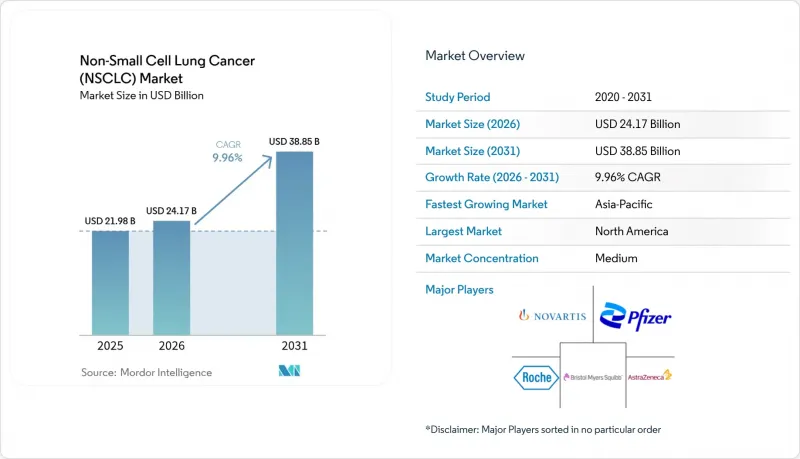
Mordor Intelligence에 의하면, 2026년 비소세포폐암(NSCLC) 시장 규모는 241억 7,000만 달러에 달할 것으로 추정되고 2025년 219억 8,000만 달러에서 확대해, 2031년에는 388억 5,000만 달러에 이를 것으로 예측됩니다.
2026년부터 2031년까지의 연평균 성장률(CAGR)은 9.96%를 나타낼 전망입니다.
본 보고서는 조직형(편평상피암, 선암 등), 치료법(수술, 방사선 치료 등), 약물 분류(EGFR TKI, ALK/ROS1/RET 억제제 등) 및 지역(북미, 유럽, 아시아태평양 등)별로 세분화되어 있습니다. 본 보고서에서는 상기 각 부문 시장 규모(백만 달러)를 제시하고 있습니다.
세계의 비소세포폐암(NSCLC) 시장 동향 및 인사이트
전이성 폐암 1차 치료에서 체크포인트 억제제의 우위성
주요 시장에서 전이성 비소세포폐암(NSCLC)의 1차 치료에 있어 체크포인트 억제 요법이 백금계 이중 요법을 대체하며, 임상 지침 및 보험사의 정책을 재편하고 있습니다. 중국 국가의약품감독관리국이 절제 가능한 II기-IIIA기 NSCLC에 대한 펨브롤리주맙과 화학요법의 병용 요법을 승인한 것은 이 약물군이 근치를 목적으로 하는 치료 영역으로 확대되고 있음을 보여줍니다. 이보네시맙(Ivonecimab)과 같은 신흥 이중 특이성 항체는 PD-L1 고발현 종양에서 펨브롤리주맙에 비해 진행 위험을 49% 감소시켜, 기존 제품 시장 점유율이 향후 잠식될 것임을 시사하고 있습니다. 보상 확보를 위해 제약사들은 현재 실제 임상에서의 무진행 생존 기간에 연동된 가치 기반 계약을 채택하고 있는 반면, 임상의들은 혜택-위험 비율을 극대화하기 위해 바이오마커에 기반한 환자 선별에 의존하고 있습니다. 이러한 동향들이 맞물려 비소세포폐암(NSCLC) 시장의 성장 궤도를 뒷받침하는 동시에, 체크포인트 억제제 브랜드 간의 경쟁을 격화시키고 있습니다.
절제 가능한 조기 비소세포폐암에서 EGFR/ALK 표적 치료법의 급속한 보급
오시멜티니브는 절제 불가능한 3기 EGFR 변이 양성 질환에서 무악화 생존 기간의 중앙값이 39.1개월에 달했으며, 치료 연속체 내에서 표적 치료의 도입 시기를 앞당김으로써 치료 기준을 재정의했습니다. 아미반타맙과 라젤티닙의 병용 요법은 오시멜티닙 단독 요법과 비교하여 사망 위험을 25% 감소시켜, 1차 보조 요법에서의 대체를 가속화하고 있습니다. 외과의사들은 수술 전 유전체 프로파일링을 점점 더 많이 도입하고 있으며, 아시아태평양의 의료 시스템에서는 EGFR 돌연변이 유병률이 높은 환자층에 대응하기 위해 차세대 염기서열 분석(NGS) 실험실 확충이 진행되고 있습니다. 이러한 발전으로 인해 치료 시작까지의 기간이 단축되고 치료의 보급이 확대되면서, 정밀 의학이 비소세포폐암(NSCLC) 시장의 성장을 이끄는 원동력으로서 확고한 입지를 다지고 있습니다.
유럽의 가격 상한선 및 HTA에 따른 승인 지연
유럽의 의료기술평가기관은 비용 대비 효과 기준을 엄격화하여 고가의 면역종양학 치료제 가격 책정에 과제를 제기하고 있습니다. 독일의 IQWiG는 표준 치료에 비해 생존 기간 증가가 불충분하다는 이유로 일부 체크포인트 억제제의 병용 요법을 기각했으며, 제약사들로 하여금 위험 분담 방안을 채택하도록 강요했습니다. 프랑스와 이탈리아의 병행 참조 가격 제도는 전 세계적으로 보험 급여 압력을 확산시켜 비소세포폐암(NSCLC) 시장의 매출 성장세를 둔화시키고 있습니다. 그러나 매니지드 엔트리(Managed Entry) 계약은 실세계 데이터를 기반으로 한 보험 급여 가격 설정을 수용할 의향이 있는 혁신적인 의약품에 있어 여전히 발판이 되고 있습니다.
부문 분석
선암은 비흡연자에서의 높은 유병률과 EGFR 및 ALK 억제제에 대한 우수한 반응성으로 인해, 2025년에는 비소세포폐암(NSCLC) 시장 점유율의 45.10%를 차지했습니다. 오시멜티닙의 절제 불가능한 3기 질환에 대한 적응증 확대로 치료 대상이 되는 선암 환자층이 확대된 한편, 이중 특이성 항체 및 ADC(항체-약물 복합체)도 추가적인 성장이 예상됩니다. 편평상피암은 치료 대상이 되는 돌연변이가 적다는 제약이 있지만, 생존 기간을 연장하는 FGFR 억제제나 화학요법과 면역요법의 병용 요법의 혜택을 받기 시작하고 있습니다. 대세포암은 기저 규모가 작지만, AI를 활용한 병리 진단을 통해 아형 식별 정확도가 향상되고, 임상시험 등록이 진행됨에 따라 연평균 성장률(CAGR) 11.05%를 나타낼 것으로 예측됩니다.
선암을 포함한 비소세포폐암(NSCLC) 시장 규모는 종합적인 유전체 프로파일링 검사 시설의 세계적 확대에 따라 증가할 것으로 예측됩니다. 조기 단계에서의 분자 검사 실시로 인해 수술 전 표적 치료의 대상 환자층이 확대되고, 절제 가능률이 향상되고 있습니다. 제약 기업의 파이프라인에서는 현재 조직형별로 임상시험을 계층화하는 것이 일반화되어 있으며, 작용기전과 종양의 생물학적 특성 간의 일관성이 확보되고 있습니다. 그 결과, 투자자들은 조직형 특이적 자산을 보다 광범위한 비소세포폐암(NSCLC) 시장에서 경쟁 우위로 간주하고 있습니다.
지역별 분석
북미는 신속한 규제 당국의 승인, 충실한 보험 적용 범위, 그리고 집중된 연구 인프라 덕분에 2025년에는 비소세포폐암(NSCLC) 시장의 41.95%를 차지했습니다. 2024년 한 해 동안만 해도 2개의 ADC와 1개의 이중 특이성 항체를 포함한 6개의 새로운 폐암 치료제가 FDA 승인을 획득하는 등 규제 당국의 신속한 대응이 두드러졌습니다. 이 지역에서는 공급 병목 현상을 완화하기 위해 국내 ADC 페이로드 생산에 투자하고 있으며, 이러한 움직임으로 인해 향후 가격 안정화와 의약품의 안정적인 공급이 확보될 것으로 기대됩니다.
아시아태평양은 2031년까지 연평균 성장률(CAGR) 12.23%를 나타낼 것으로 예측되며, 비소세포폐암(NSCLC) 시장에서 가장 빠르게 성장하는 지역이 될 전망입니다. 의료비 지출 증가, 진단 범위 확대, 그리고 EGFR 돌연변이의 높은 유병률이 수요를 뒷받침하고 있습니다. 중국에서는 수입된 체크포인트 억제제 및 ADC의 국내 승인이 가속화되면서 FDA 결정과의 시차도 줄어들고 있습니다. 다만, 지방 지역의 검사 체계 격차가 공평한 접근을 저해하고 있어 원격 병리 진단 및 민관 협력을 통한 유전체 검사 파트너십 확대가 추진되고 있습니다.
유럽에서는 첨단 분자 의학의 도입과 가격 억제 노력이 병행되고 있습니다. 엄격한 의료기술평가(HTA)에 기반하여, 시판 후 증거를 수집하면서도 조기 접근을 가능하게 하는 ‘관리형 시장 진입 협정’이 체결되었습니다. 브렉시트로 인한 물류 혼란으로 일부 생물학적 제제의 리드타임이 길어지고 있지만, 유럽의약품청(EMA)의 중앙 집중형 승인 절차를 통해 여러 국가에 걸친 승인 절차의 효율화가 지속적으로 도모되고 있습니다. 중동 및 아프리카 및 남미는 새로운 기회가 싹트고 있는 지역입니다. 브라질의 공공 암 의료 파트너십이나 걸프 국가들의 암 센터 확장 같은 노력을 통해 인프라가 정비됨에 따라, 이들 지역의 비소세포폐암(NSCLC) 시장은 점차 확대될 가능성이 있습니다.
기타 혜택 :
- 엑셀 형식 시장 예측(ME) 시트
- 3개월간의 애널리스트 지원
자주 묻는 질문
목차
제1장 서론
제2장 조사 방법
제3장 주요 요약
제4장 시장 구도
제5장 시장 규모 및 성장 예측
제6장 경쟁 구도
제7장 시장 기회 및 향후 전망
KTH 26.08.05According to Mordor Intelligence, non-Small cell lung cancer market size in 2026 is estimated at USD 24.17 billion, growing from 2025 value of USD 21.98 billion with 2031 projections showing USD 38.85 billion, growing at 9.96% CAGR over 2026-2031.
This report is Segmented by Histology (Squamous Cell Carcinoma, Adenocarcinoma and More), by Treatment Modality (Surgery, Radiation Therapy and More), by Drug Class (EGFR TKIs, ALK/ROS1/RET Inhibitors and More) and Geography (North America, Europe, Asia-Pacific and More ). The Report Offers the Value (in USD Million) for the Above Segments.
Global Non-Small Cell Lung Cancer (NSCLC) Market Trends and Insights
Check-point Inhibitor Dominance in First-Line Metastatic Setting
Checkpoint blockade regimens have displaced platinum doublets in first-line metastatic disease across major markets, reshaping clinical guidelines and payer policies. China's National Medical Products Administration approval of pembrolizumab plus chemotherapy for resectable stage II-IIIA NSCLC illustrates the class's expansion into curative-intent settings. Emerging bispecifics such as ivonescimab have shown a 49% reduction in progression risk versus pembrolizumab in PD-L1-high tumors, signaling future erosion of incumbent share. To secure reimbursement, manufacturers now embrace value-based contracts pegged to real-world progression-free survival, while clinicians rely on biomarker-driven selection to maximize benefit-risk ratios. These trends collectively reinforce the growth trajectory of the Non-Small Cell Lung Cancer market while increasing competitive churn among checkpoint brands.
Rapid Uptake of EGFR/ALK Targeted Therapies in Resectable Early-Stage NSCLC
Osimertinib's 39.1-month median progression-free survival in unresectable stage III EGFR-mutated disease has redefined standards by shifting targeted therapy earlier in the continuum of care. Combination regimens such as amivantamab plus lazertinib cut death risk by 25% versus osimertinib monotherapy, accelerating substitution in first-line adjuvant settings. Surgeons increasingly integrate genomic profiling preoperatively, and Asia-Pacific health systems are scaling next-generation sequencing labs to serve high EGFR-mutation prevalence populations. These advances shorten treatment initiation and increase uptake, cementing precision therapy as a catalyst for the Non-Small Cell Lung Cancer market.
Price Caps & HTA Push-backs in Europe
European health technology assessment agencies have tightened cost-effectiveness thresholds, challenging premium immuno-oncology pricing. Germany's IQWiG rejected several checkpoint combinations for insufficient incremental survival over standards of care, forcing manufacturers to adopt risk-sharing schemes. Parallel reference pricing in France and Italy cascades reimbursement pressure globally, tempering top-line growth for the Non-Small Cell Lung Cancer market. Managed-entry agreements, however, still create footholds for innovative agents willing to align reimbursement with real-world evidence.
Other drivers and restraints analyzed in the detailed report include:
- Liquid-Biopsy Companion Diagnostics Adoption
- Radiopharmaceutical Pipeline Breakthroughs
- Diagnostic Biomarker Testing Capacity Gaps in Emerging Asia
For complete list of drivers and restraints, kindly check the Table Of Contents.
Segment Analysis
Adenocarcinoma captured 45.10% of Non-Small Cell Lung Cancer market share in 2025 owing to its high prevalence among never-smokers and its responsiveness to EGFR and ALK inhibitors. Osimertinib's move into unresectable stage III disease has expanded the treated adenocarcinoma population, while bispecifics and ADCs promise further gains. Squamous cell carcinoma, limited by fewer actionable mutations, is beginning to benefit from FGFR inhibitors and chemo-immunotherapy pairings that extend survival. Large-cell carcinoma holds a smaller baseline but is projected to grow at 11.05% CAGR as AI-enhanced pathology improves subtype recognition and clinical trial enrollment.
The Non-Small Cell Lung Cancer market size for adenocarcinoma is forecast to rise in tandem with global expansion of comprehensive genomic profiling labs. Early-stage molecular testing has increased the eligible pool for neoadjuvant targeted therapy, improving resectability rates. Pharmaceutical pipelines now routinely stratify trials by histology, ensuring alignment between mechanism of action and tumor biology. Consequently, investors regard histology-specific assets as a competitive advantage in the broader Non-Small Cell Lung Cancer market.
Complete Report Scope:
- By Histology
- Adenocarcinoma
- Squamous Cell Carcinoma
- Large Cell Carcinoma
- By Treatment Modality
- Surgery
- Radiation Therapy
- Chemotherapy
- Targeted Therapy
- Immunotherapy
- Radiopharmaceuticals
- By Drug Class
- EGFR TKIs
- ALK/ROS1/RET Inhibitors
- PD-1 / PD-L1 Inhibitors
- CTLA-4 & LAG-3 Inhibitors
- Antibody-Drug Conjugates (ADC)
- By Region
- North America
- United States
- Canada
- Mexico
- Europe
- Germany
- United Kingdom
- France
- Spain
- Italy
- Rest of Europe
- Asia-Pacific
- China
- India
- Japan
- South Korea
- Australia
- Rest of Asia Pacific
- Middle East and Africa
- GCC
- South Africa
- Rest of Middle East and africa
- South America
- Brazil
- Argentina
- Rest of South America
- North America
Geography Analysis
North America accounted for 41.95% of the Non-Small Cell Lung Cancer market in 2025 thanks to rapid regulatory approvals, advanced insurance coverage, and concentrated research infrastructure. Six new lung cancer therapies gained FDA clearance in 2024 alone, including two ADCs and one bispecific antibody, underscoring regulatory agility. The region is investing in domestic ADC payload production to mitigate supply bottlenecks, a move expected to stabilize future pricing and ensure consistent drug availability.
Asia-Pacific is projected to register a 12.23% CAGR through 2031, making it the fastest-growing component of the Non-Small Cell Lung Cancer market. Rising healthcare expenditures, improved diagnostic coverage, and high EGFR-mutation prevalence underpin demand. China has accelerated local approvals of imported checkpoint inhibitors and ADCs, shrinking the lag against FDA decisions. Nonetheless, rural testing gaps constrain equitable access, prompting expansion of tele-pathology and public-private genomic testing partnerships.
Europe combines sophisticated molecular medicine uptake with price-containment discipline. Stringent HTA assessments produce managed-entry agreements that permit early access while collecting post-marketing evidence. Brexit-related logistics disruptions have increased lead times for certain biologics, but the European Medicines Agency's centralized process continues to streamline multistate approvals. Middle East & Africa and South America represent nascent opportunities; initiatives such as Brazil's public oncology partnerships and Gulf states' cancer center expansions could gradually enlarge the regional Non-Small Cell Lung Cancer market as infrastructure matures.
- AstraZeneca
- Merck
- Roche
- Bristol-Myers Squibb
- Novartis
- Pfizer
- Eli Lilly and Company
- Amgen
- BeiGene
- Takeda Pharmaceuticals
- Regeneron
- Sanofi
- Daiichi Sankyo
- Johnson & Johnson
- Boehringer Ingelheim
- Innovent Biologics
- Exelixis
- Mirati Therapeutics
- Blueprint Medicines
- Zai Lab
Additional Benefits:
- The market estimate (ME) sheet in Excel format
- 3 months of analyst support
TABLE OF CONTENTS
1 Introduction
- 1.1 Study Assumptions & Market Definition
- 1.2 Scope of the Study
2 Research Methodology
3 Executive Summary
4 Market Landscape
- 4.1 Market Overview
- 4.2 Market Drivers
- 4.2.1 Check-point inhibitor dominance in 1L metastatic setting
- 4.2.2 Rapid uptake of EGFR/ALK targeted therapies in resectable early-stage NSCLC
- 4.2.3 Liquid-biopsy companion diagnostics adoption
- 4.2.4 Radiopharmaceutical pipeline breakthroughs
- 4.2.5 AI-guided trial design & faster FDA approvals
- 4.3 Market Restraints
- 4.3.1 Price caps & HTA push-backs in Europe
- 4.3.2 Diagnostic biomarker testing capacity gaps in emerging Asia
- 4.3.3 PD-(L)1 class saturation & payer rebate squeeze
- 4.3.4 Manufacturing bottlenecks for ADC payloads
- 4.4 Value / Supply-Chain Analysis
- 4.5 Regulatory Landscape
- 4.6 Technological Outlook
- 4.7 Porter's Five Forces
- 4.7.1 Threat of New Entrants
- 4.7.2 Bargaining Power of Suppliers
- 4.7.3 Bargaining Power of Buyers
- 4.7.4 Threat of Substitutes
- 4.7.5 Competitive Rivalry
5 Market Size & Growth Forecasts (Value)
- 5.1 By Histology
- 5.1.1 Adenocarcinoma
- 5.1.2 Squamous Cell Carcinoma
- 5.1.3 Large Cell Carcinoma
- 5.2 By Treatment Modality
- 5.2.1 Surgery
- 5.2.2 Radiation Therapy
- 5.2.3 Chemotherapy
- 5.2.4 Targeted Therapy
- 5.2.5 Immunotherapy
- 5.2.6 Radiopharmaceuticals
- 5.3 By Drug Class
- 5.3.1 EGFR TKIs
- 5.3.2 ALK/ROS1/RET Inhibitors
- 5.3.3 PD-1 / PD-L1 Inhibitors
- 5.3.4 CTLA-4 & LAG-3 Inhibitors
- 5.3.5 Antibody-Drug Conjugates (ADC)
- 5.4 By Region
- 5.4.1 North America
- 5.4.1.1 United States
- 5.4.1.2 Canada
- 5.4.1.3 Mexico
- 5.4.2 Europe
- 5.4.2.1 Germany
- 5.4.2.2 United Kingdom
- 5.4.2.3 France
- 5.4.2.4 Spain
- 5.4.2.5 Italy
- 5.4.2.6 Rest of Europe
- 5.4.3 Asia-Pacific
- 5.4.3.1 China
- 5.4.3.2 India
- 5.4.3.3 Japan
- 5.4.3.4 South Korea
- 5.4.3.5 Australia
- 5.4.3.6 Rest of Asia Pacific
- 5.4.4 Middle East and Africa
- 5.4.4.1 GCC
- 5.4.4.2 South Africa
- 5.4.4.3 Rest of Middle East and africa
- 5.4.5 South America
- 5.4.5.1 Brazil
- 5.4.5.2 Argentina
- 5.4.5.3 Rest of South America
- 5.4.1 North America
6 Competitive Landscape
- 6.1 Market Concentration
- 6.2 Market Share Analysis
- 6.3 Company Profiles (includes Global level Overview, Market level overview, Core Segments, Financials as available, Strategic Information, Market Rank/Share for key companies, Products & Services, and Recent Developments)
- 6.3.1 AstraZeneca
- 6.3.2 Merck & Co.
- 6.3.3 F. Hoffmann-La Roche
- 6.3.4 Bristol Myers Squibb
- 6.3.5 Novartis
- 6.3.6 Pfizer
- 6.3.7 Eli Lilly
- 6.3.8 Amgen
- 6.3.9 BeiGene
- 6.3.10 Takeda
- 6.3.11 Regeneron
- 6.3.12 Sanofi
- 6.3.13 Daiichi Sankyo
- 6.3.14 Johnson & Johnson
- 6.3.15 Boehringer Ingelheim
- 6.3.16 Innovent Biologics
- 6.3.17 Exelixis
- 6.3.18 Mirati Therapeutics
- 6.3.19 Blueprint Medicines
- 6.3.20 Zai Lab
7 Market Opportunities & Future Outlook
- 7.1 White-space & Unmet-Need Assessment


