

|
시장보고서
상품코드
2107342
비소세포폐암 시장 : 암 유형별, 분자 유형별, 약제 분류별, 치료법별, 치료 유형별, 투여 경로별, 최종사용자별, 유통 채널별, 지역별 주요 기업별 - 동향 및 예측(-2035년)Non-Small Cell Lung Cancer Market by Type of Cancer, Type of Molecule, Drug Class, Therapy, Type of Treatment, Route of Administration, End User, Distribution Channel, Geographical Regions and Leading Players - Trends and Forecast Till 2035 |
||||||

비소세포폐암 시장 : 개요
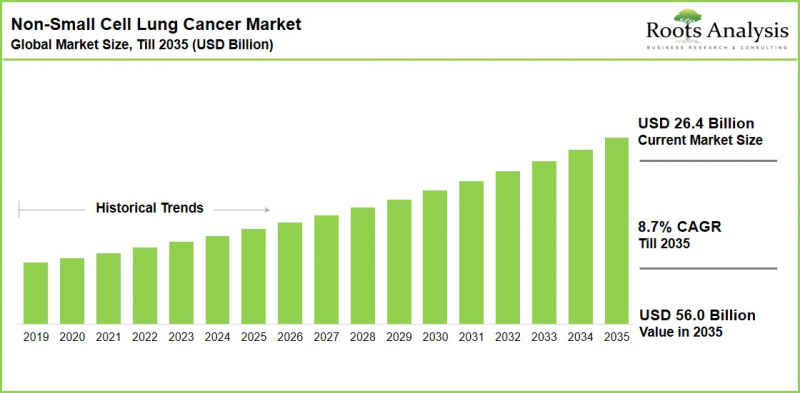
세계의 비소세포폐암 시장 규모는 올해 264억 달러에서 2035년까지 560억 달러로 확대되어, 예측 기간 전체에 걸쳐 CAGR 8.7%를 기록할 것으로 추정됩니다.
비소세포폐암 시장 : 성장 및 동향
비소세포폐암은 전 세계에서 진단되는 폐암의 대부분을 차지합니다. 바이오의약품 개발 기업들이 바이오마커를 활용한 접근법이나 병용요법에 기반한 질환 관리 기법을 정교화함에 따라, 비소세포폐암의 치료 환경은 계속해서 급속히 진화하고 있습니다. 흡연, 대기 오염 및 전 세계적인 고령화에 따른 발병률 증가로 인해 적격 환자층은 지속적으로 확대되고 있습니다. 한편, 표적 치료 및 면역 치료에 대한 규제 당국의 승인이 잇따르면서, 전체 치료 라인에 걸친 표준 치료 경로가 재구성되고 있습니다.
액체 생검 기술의 발전으로 조기 진단 및 질병 진행에 대한 보다 정밀한 실시간 모니터링이 가능해졌습니다. 이는 바이오마커에 기반한 치료법 선택으로의 광범위한 전환을 더욱 촉진하고 있습니다. 또한, 제약 기업들은 반응률 향상 및 새로운 내성 기전에 대응하기 위해 체크포인트 억제제와 표적 치료제, 혹은 화학요법을 조합한 병용요법을 점점 더 우선시하고 있습니다.
예측 기간 동안 경쟁 구도는 계속해서 활발한 상태를 유지할 것으로 예상됩니다. 이러한 꾸준한 성장은 2026년까지 여러 건의 신규 승인을 이끌어낼 것으로 예상되는 탄탄한 후기 임상시험 단계의 파이프라인에 더해, 주요 제약사들이 종양학 분야의 포트폴리오 강화를 모색하는 가운데 인수합병 및 라이선싱 활동이 지속되고 있기 때문으로 보입니다. 바이오마커에 기반한 환자군 세분화가 표준 관행으로 자리 잡음에 따라, 비소세포폐암 시장은 예측 기간 동안 지속적이고 장기적인 성장이 예상됩니다.
성장 요인 : 시장 확대를 뒷받침하는 요소
비소세포폐암 시장은 생활 방식의 변화와 환경적 노출로 인한 전 세계 폐암 발병률 상승에 힘입어 성장하고 있습니다. 또한, 조기 진단 및 효과적인 치료 모니터링에 대한 수요 증가가 시장 성장을 더욱 뒷받침하고 있습니다. 개발사들은 보다 표적화된 효과적인 의약품을 제공하기 위해 EGFR 및 ALK 억제제를 비롯한 바이오마커 기반의 정밀 치료 접근법과 면역관문억제제 등의 첨단 면역요법을 점점 더 적극적으로 추구하고 있습니다.
탄탄한 후기 임상시험 단계의 파이프라인 덕분에 2026년 하반기에는 여러 건의 승인이 이루어질 것으로 예상되며, 이용 가능한 치료 선택지가 더욱 확대될 전망입니다. 또한, 세포 치료 및 동종 이식 치료 분야의 지속적인 발전과 더불어 암 연구에 대한 정부의 지속적인 자금 지원이 맞물려 시장의 장기적인 성장 궤도는 계속해서 강화되고 있습니다.
시장의 과제 : 진전을 가로막는 중대한 장벽
긍정적인 성장 전망에도 불구하고, 시장은 확장을 저해할 수 있는 몇 가지 과제에 직면해 있습니다. 표적 치료 및 면역 치료의 높은 비용은 여전히 일부 지역에서 환자의 접근성을 제한하고 있으며, 한편 견고한 바이오마커 검사 인프라의 필요성은 치료 시작의 복잡성과 비용을 증가시키고 있습니다. 기존 표적 치료제에 대한 내성 기전에 더해, 지역별로 엄격하고 끊임없이 변화하는 규제 요건이 개발 프로그램에 추가적인 시간과 비용을 소요시키는 요인이 되고 있습니다.
또한, 1세대 표적 치료제 중 일부의 특허 만료가 임박함에 따라 개발 기업들은 제네릭 의약품 및 바이오시밀러와의 경쟁 심화에 직면하고 있으며, 특정 부문 전반에 걸쳐 가격 압박이 가중되고 있습니다. 이 분야의 상업적 기회를 최대한 포착하고자 하는 이해관계자들에게 있어, 이러한 접근성, 규제, 경쟁과 관련된 과제를 해결하는 것이 매우 중요합니다.
비소세포폐암 시장 : 주요 인사이트
본 보고서는 비소세포폐암 시장의 현황을 상세히 분석하고, 유통 파트너, 채널 중개업체, 서비스 통합업체를 위한 잠재적 성장 기회를 파악하고 있습니다. 주요 조사 결과는 다음과 같습니다:
- 단일 요법 기반 표준 치료에서 이중 표적 요법으로의 전환 : 비소세포폐암(NSCLC)의 치료 환경은 단일 티로신 키나제 억제제(TKI)에서 이중 표적 요법 및 병용요법 패러다임으로 전환되고 있습니다. 얀센(Janssen)이 EGFR 변이 양성 비소세포폐암(NSCLC)에 대한 1차 치료제로 RYBREVANT(R)(아미반타맙) + LAZCLUZE(TM)(라젤티닙)의 승인을 획득한 것은, 내성 발현을 지연시키기 위한 다중 경로 차단으로의 이러한 전환을 여실히 보여주고 있습니다.
- 내성을 극복할 수 있는 자산에 대한 고액의 M&A 프리미엄 : 대형 제약사들은 2차 내성 변이를 표적으로 할 수 있는 후기 단계의 정밀 치료제에 막대한 투자를 하고 있습니다. 그 중요한 지표로 GSK가 Nuvalent사를 106억 달러에 인수한 사례(후기 단계의 ROS1 억제제 디데사무티닙 및 ALK 억제제 네라달키브 확보)를 들 수 있습니다.
- 전문 유통업체와 콜드체인 물류 : NSCLC 분야에서 복잡한 생물학적 제제, 이중특이성항체, 항체약물접합체(ADC)가 확대됨에 따라, 전문 유통업체는 분산형 정맥주사 센터로 운송하는 동안 제품이 열화되는 것을 방지하기 위해 초저온 콜드체인 추적 시스템 및 바이오 핸들링 워크플로우를 강화해야 합니다.
투자자들의 열기를 보여주는 최근 거래 동향
- 6월 : GSK는 Nuvalent를 106억 달러에 인수한다고 발표했습니다. 이로써 현재 FDA 심사 중인 비소세포폐암(NSCLC) 치료제인 후기 개발 단계의 두 가지 자산, 디데사무티닙과 네라달키브가 GSK의 종양학 파이프라인에 추가되게 됩니다.
- 5월 : 머크(Merck)는 진행성 또는 전이성 비소세포폐암(NSCLC)의 1차 치료제로, 펨브롤리주맙과의 병용요법에서 KRAS G12C 억제제인 칼데라시브(MK-1084)에 대해 FDA로부터 획기적 치료제(Breakthrough Therapy) 지정을 받았습니다.
- 5월 : Nuvation Bio는 진행성 ROS1 양성 비소세포폐암을 대상으로 한 탈레트렉티닙의 추가 신약 승인 신청이 FDA에 접수되었다고 발표했습니다.
- 2월 : FDA는 HER2 변이를 가진 절제 불가능하거나 전이성 비편평상피 비소세포폐암(NSCLC) 성인 환자를 대상으로 한 Boehringer Ingelheim의 존겔티닙(Hernexeos)에 대해 신속 승인을 부여했습니다.
- 1월 : Summit Therapeutics는 EGFR 변이를 가진 비소세포폐암 환자 중 과거에 TKI 요법을 받은 적이 있는 환자를 대상으로, 이보네스시맙과 화학요법의 병용요법에 관한 생물학적 제제 승인 신청이 FDA에 접수되었다고 발표했습니다.
비소세포폐암 시장 세분화
시장 규모 및 기회 분석은 다음 매개변수를 기반으로 세분화되었습니다:
암 유형별
- 편평상피암
- 선암
- 대세포형 신경내분비종양
- 대세포암
분자 유형별
- 저분자 화합물
- 생물학적 제제
약제 분류별
- 알킬화제
- 대사 길항제
- EGFR 억제제
- 유사분열 억제제
- 다중 키나아제 억제제
- 기타
치료법 유형별
- 단일 요법
- 병용요법
치료 유형별
- 화학요법
- 방사선요법
- 표적요법
- 면역요법
- 기타
투여 경로별
- 비경구
- 경구
- 기타
최종사용자별
- 병원
- 재택 의료
- 전문 클리닉
- 기타
유통 채널별
- 병원 내 약국
- 의약품 및 소매 약국
- 온라인 약국
지역별
- 북미
- 유럽
- 아시아태평양
- 중동·북아프리카
- 라틴아메리카
목차
제1장 서문
제2장 조사 방법
제3장 시장 역학
제4장 거시경제 지표
제5장 주요 요약
제6장 소개
제7장 시장 구도
제8장 기업 개요
제9장 특허 분석
제10장 시장 영향 분석
제11장 메가트렌드 분석
제12장 세계의 비소세포폐암 시장
제13장 비소세포폐암 시장(암 유형별)
제14장 비소세포폐암 시장(분자 유형별)
제15장 비소세포폐암 시장(약물 유형별)
제16장 비소세포폐암 시장(치료법별)
제17장 비소세포폐암 시장(치료 유형별)
제18장 비소세포폐암 시장(투여 경로별)
제19장 비소세포폐암 시장(최종사용자별)
제20장 비소세포폐암 시장(유통 채널별)
제21장 비소세포폐암 시장(지역별)
제22장 결론
제23장 부록 I : 표형식 데이터
제24장 부록 II : 기업 및 조직 리스트
KSM 26.08.13NON-SMALL CELL LUNG CANCER MARKET: OVERVIEW
As per Roots Analysis, the global non-small cell lung cancer market is estimated to grow from USD 26.4 billion in the current year to USD 56.0 billion by 2035, registering a CAGR of 8.7% across the forecast period.
Non-Small Cell Lung Cancer Market: Growth and Trends
Non-small cell lung cancer accounts for the majority of all diagnosed lung cancers worldwide. The treatment landscape of non-small cell lung cancer continues to evolve rapidly as biopharmaceutical developers refine biomarker-driven and combination-based approaches to disease management. Rising incidence linked to smoking, air pollution and an ageing global population continues to expand the eligible patient pool. Meanwhile, a steady stream of regulatory approvals for targeted therapies and immunotherapies is reshaping standard-of-care pathways across treatment lines.
Advances in liquid biopsy technology are enabling earlier diagnosis and more precise real-time monitoring of disease progression. This further supports a broader shift toward biomarker-matched treatment selection. Additionally, the drug developers are increasingly prioritizing combination regimens, pairing checkpoint inhibitors with targeted agents or chemotherapy, to improve response rates and address emerging resistance mechanisms.
The competitive landscape remains progressive throughout the forecast period. This steady growth is potentially due to the dense late-stage pipeline anticipated to deliver multiple new approvals through 2026, alongside continued mergers and acquisitions, and licensing activity as large pharmaceutical companies seek to reinforce their oncology portfolios. As biomarker-defined patient segmentation becomes standard practice, the non-small cell lung cancer market is positioned for sustained, long-term growth through the forecast period.
Growth Drivers: Factors Fueling Market Expansion
The non-small cell lung cancer market is being propelled by the rising global incidence of lung cancer that occurs due to changing lifestyles and environmental exposure. Further, the growing demand for early diagnosis and effective treatment monitoring has further fueled the market growth. Developers are increasingly pursuing precise, biomarker-guided treatment approaches, including EGFR and ALK inhibitors, as well as advanced immunotherapies such as immune checkpoint inhibitors, to deliver more targeted and effective medications.
A rich late-stage pipeline is expected to yield multiple approvals in late 2026, further widening the available treatment options. Additionally, ongoing advances in cell therapies and allogeneic treatment modalities, together with sustained government funding for cancer research, continue to reinforce the long-term growth trajectory of the market.
Market Challenges: Critical Barriers Hindering Progress
Despite favourable growth prospects, the market faces several challenges that could impede its expansion. The high cost of targeted therapies and immunotherapies continues to limit patient access in several geographies, while the need for robust biomarker testing infrastructure adds complexity and cost to treatment initiation. Resistance mechanisms to existing targeted agents, combined with stringent and evolving regulatory requirements across geographies, further add time and cost to development programs.
Additionally, as several first-generation targeted therapies approach patent are about to expire developers face intensifying generic and biosimilar competition, creating pricing pressure across select segments. Addressing these access, regulatory and competitive challenges will be critical for stakeholders seeking to capture the full commercial opportunity within this space.
Non-Small Cell Lung Cancer Market: Key Insights
The report delves into the current state of the Non-Small Cell Lung Cancer market and identifies potential growth opportunities for distribution partners, channel intermediaries, and service integrators. Some key findings include:
- Transition from Monotherapy Standard-of-Care to Dual-Targeted Approaches: The NSCLC landscape is shifting away from single-agent tyrosine kinase inhibitors (TKIs) toward dual-targeted and combination paradigms. Janssen's approval of RYBREVANT(R) (amivantamab) + LAZCLUZE(TM) (lazertinib) for first-line EGFR-mutated NSCLC exemplifies this pivot toward multi-pathway blockade to delay resistance onset.
- Heavy M&A Premium on Resistance-Conquering Assets: Big Pharma companies are making significant investments in late-stage precision drugs that are capable of targeting secondary resistance mutations. A key indicator is GSK's $10.6 billion acquisition of Nuvalent (acquiring late-stage ROS1 inhibitor zidesamtinib and ALK inhibitor neladalkib).
- Specialty Distributors & Cold-Chain Logistics: As complex biologics, bispecific antibodies, and antibody-drug conjugates (ADCs) expand within NSCLC, specialty distributors must upgrade ultra-cold chain tracking and bio-handling workflows to prevent product degradation during transit to decentralized infusion centers.
Recent Deal Activity Signalling Investor Momentum
- In June: GSK announced a USD 10.6 billion acquisition of Nuvalent, adding two late-stage non-small cell lung cancer assets, zidesamtinib and neladalkib, currently under FDA review, to its oncology pipeline.
- In May: Merck received FDA Breakthrough Therapy designation for calderasib (MK-1084), a KRAS G12C inhibitor, in combination with pembrolizumab for first-line treatment of advanced or metastatic NSCLC.
- In May: Nuvation Bio announced FDA acceptance of a supplemental New Drug Application for taletrectinib in advanced ROS1-positive NSCLC.
- In February: The FDA granted accelerated approval to Boehringer Ingelheim's zongertinib (Hernexeos) for adults with unresectable or metastatic non-squamous NSCLC harboring HER2 mutations.
- In January: Summit Therapeutics announced FDA acceptance of its Biologics License Application for ivonescimab combined with chemotherapy in EGFR-mutated NSCLC patients following prior TKI therapy.
Non-Small Cell Lung Cancer Market Segments
The market sizing and opportunity analysis has been segmented across the following parameters:
By Type of Cancer
- Squamous Cell Carcinoma
- Adenocarcinoma
- Large Cell Neuroendocrine Tumors
- Large-Cell Carcinoma
By Type of Molecule
- Small Molecules
- Biologics
By Type of Drug Class
- Alkylating Agents
- Antimetabolites
- EGFR Inhibitors
- Mitotic Inhibitors
- Multi-kinase Inhibitors
- Others
By Type of Therapy
- Monotherapies
- Combination Therapies
By Type of Treatment
- Chemotherapy
- Radiation Therapy
- Targeted Therapy
- Immunotherapy
- Other Treatments
By Route of Administration
- Parenteral
- Oral
- Other Routes of Administration
By End User
- Hospitals
- Homecare
- Specialty Clinics
- Other End Users
By Distribution Channel
- Hospital Pharmacies
- Drugs and Retail Pharmacies
- Online Pharmacies
By Geographical Regions
- North America
- Europe
- Asia-Pacific
- Middle East and North Africa
- Latin America
Non-Small Cell Lung Cancer Market: Key Segments
Adenocarcinoma Leads the Market
Based on Roots Analysis market assessment, the adenocarcinoma segment currently secures highest share of overall market revenue. This leading share reflects the rising incidence of adenocarcinoma among smokers and non-smokers alike, along with strong adoption of biomarker-driven targeted therapies and precision medicine approaches.
On the other hand, squamous cell carcinoma segment is expected to register a comparatively higher CAGR through the forecast period. This lucrative growth is supported by a growing late-stage pipeline focused specifically on this subtype.
Small Molecules Dominate the Market
According to the proprietary market analysis, small molecules currently account for the highest market share. This highest share is driven by their central role in combination regimens that pair targeted small-molecule agents with chemotherapy.
In the long run, the biologics segment is likely to register the fastest CAGR during the forecast period. This unprecedented growth is propelled by the increasing shift toward oncology precision medicines for the treatment of non-small cell lung cancer.
EGFR Leads the Drug Class
Based on the Roots Analysis market report, EGFR inhibitors hold the largest share among drug classes. Notably, this segment will continue to maintain its dominance in the future and also register higher CAGR during the forecast period. This highest share is underpinned by their demonstrated ability to slow cancerous cell proliferation via the epidermal growth factor receptor pathway. In addition, the growing development of next-generation, and biomarker-matched inhibitors to overcome these escape mechanisms, allowing biopharma developers to capture high-value second- and third-line treatment settings.
Targeted Therapy Leads the Market and Immunotherapy Grow at Higher CAGR
Based on the Roots Analysis market report, targeted therapy currently accounts for the largest share of the overall market. This highest share reflects strong demand for tailored, biomarker-matched drugs with lower off-target effects to treat non-small cell lung cancer.
However, the immunotherapy segment is projected to grow at a higher CAGR during the forecast period. This growth is likely to be the result of expanding use of immune checkpoint inhibitors and immunocytokines across earlier lines of treatment.
North America Dominates the Market and Asia-Pacific Registers Higher CAGR
North America currently holds the highest overall market share. This highest share is supported by advanced healthcare infrastructure, high adoption of innovative oncology therapies, and a strong concentration of leading pharmaceutical and biotechnology companies.
On the other hand, Asia-Pacific is likely to grow at a relatively higher CAGR during the forecast period. This lucrative growth is driven by rising smoking-linked incidence, expanding healthcare access, and growing diagnosed patient population.
Hospital Pharmacies Hold the Highest Market Share
Hospital pharmacies currently capture more than 65% of the overall market. This dominance reflects their role as the primary dispensing channel for complex, high-cost oncology therapies including immunotherapies and targeted agents.
Meanwhile, drug and retail pharmacies are expected to grow at a higher CAGR during the forecast period. This growth is due to the expanding roster of FDA-approved therapies that are becoming available through broader retail channels.
Example Players in Non-Small Cell Lung Cancer Market
- Amgen
- AstraZeneca
- Bayer
- BeiGene
- Boehringer Ingelheim
- Eli Lilly
- Genentech (Roche)
- GSK
- Johnson & Johnson
- Merck
- Novartis
- Pfizer
NON-SMALL CELL LUNG CANCER MARKET: RESEARCH COVERAGE
- Market Landscape: A comprehensive analysis of active non-small cell lung cancer drug developers, featuring information on year of establishment, company size, location of headquarters, type of molecule, drug class, therapy type, route of administration, line of treatment, target indication, and dosing frequency.
- Company Profiles: In-depth profiles of prominent players engaged in non-small cell lung cancer drug development, covering company overview, product portfolio, and recent initiatives.
- Patent Analysis: A detailed analysis of patents filed / granted in this domain, based on parameters such as publication year, type of patent, type of applicant, application year, patent jurisdiction, patent age, and leading industry and non-industry players, along with patent benchmarking and valuation analysis.
- Market Impact Analysis: An assessment of the key drivers, restraints, opportunities and challenges influencing the evolution of the non-small cell lung cancer market.
- Mega Trend Analysis: An evaluation of the broader industry and macro-level trends likely to shape the near- to long-term trajectory of the non-small cell lung cancer market.
- Market Sizing and Opportunity Analysis: An in-depth analysis of the market focusing on key segments, including type of cancer, type of molecule, type of drug class, type of therapy, type of treatment, route of administration, end user, distribution channel, and geographical regions.
Key Questions Answered in this Report
- Which are the leading companies developing drugs for non-small cell lung cancer?
- Which region dominates the non-small cell lung cancer market, and which region is growing the fastest?
- What are the key trends observed in the non-small cell lung cancer market?
- What factors are likely to influence the evolution of this market through 2035?
- What is the current and future size of the non-small cell lung cancer market?
- What is the CAGR of the non-small cell lung cancer market through 2035?
- How is the current and future market opportunity distributed across type of cancer, molecule, drug class, therapy, treatment, route of administration, end user, distribution channel and geography?
- What opportunities exist for distribution partners and channel intermediaries entering the oncology supply chain?
- What are the primary challenges faced by non-small cell lung cancer drug developers?
Reasons to Buy this Report
This report is designed to give drug developers, distribution partners and investors a decisive analytical edge in a fast-evolving oncology market. Its core differentiators include:
- Scenario-Based Forecasting: Market estimates are built across conservative, base and optimistic scenarios to account for future uncertainty in key parameters, enhancing the robustness and decision-readiness of the forecast.
- Nine-Parameter Segmentation: Granular segmentation across type of cancer, molecule, drug class, therapy, treatment, route of administration, end user, distribution channel and geography enables precise opportunity sizing for any go-to-market or investment thesis.
- Integrated Patent and Competitive Benchmarking: A dedicated patent analysis chapter, covering jurisdiction, applicant type and patent age, is combined with company-level benchmarking to give a fuller picture of competitive positioning than conventional market-sizing reports.
- 253+ Pages Across 24 Chapters: Comprehensive coverage spanning market sizing, competitive landscape, patent analysis, company profiling, and regional opportunity mapping across five geographies.
- Primary Research-Backed Insights: Findings are validated through direct interviews with thoracic oncologists, medical oncologists and commercial leaders, ensuring insights reflect real-world clinical and commercial dynamics rather than desk research alone.
Additional Benefits
- Complementary PPT Insights Pack
- Complementary Excel Data Packs for all Analytical Modules in the Report
- 15% Free Content Customization
- Detailed Report Walkthrough Session with Research Team
- Free Updated report if the report is 6-12 months old or older
TABLE OF CONTENTS
1. PREFACE
- 1.1. Introduction
- 1.2. Market Share Insights
- 1.3. Key Market Insights
- 1.4. Report Coverage
- 1.5. Key Questions Answered
- 1.6. Chapter Outlines
2. RESEARCH METHODOLOGY
- 2.1. Chapter Overview
- 2.2. Research Assumptions
- 2.2.1. Market Landscape and Market Trends
- 2.2.2. Market Forecast and Opportunity Analysis
- 2.2.3. Comparative Analysis
- 2.3. Database Building
- 2.3.1. Data Collection
- 2.3.2. Data Validation
- 2.3.3. Data Analysis
- 2.4. Project Methodology
- 2.4.1. Secondary Research
- 2.4.1.1. Annual Reports
- 2.4.1.2. Academic Research Papers
- 2.4.1.3. Company Websites
- 2.4.1.4. Investor Presentations
- 2.4.1.5. Regulatory Filings
- 2.4.1.6. White Papers
- 2.4.1.7. Industry Publications
- 2.4.1.8. Conferences and Seminars
- 2.4.1.9. Government Portals
- 2.4.1.10. Media and Press Releases
- 2.4.1.11. Newsletters
- 2.4.1.12. Industry Databases
- 2.4.1.13. Roots Proprietary Databases
- 2.4.1.14. Paid Databases and Sources
- 2.4.1.15. Social Media Portals
- 2.4.1.16. Other Secondary Sources
- 2.4.2. Primary Research
- 2.4.2.1. Types of Primary Research
- 2.4.2.1.1. Qualitative Research
- 2.4.2.1.2. Quantitative Research
- 2.4.2.1.3. Hybrid Approach
- 2.4.2.2. Advantages of Primary Research
- 2.4.2.3. Techniques for Primary Research
- 2.4.2.3.1. Interviews
- 2.4.2.3.2. Surveys
- 2.4.2.3.3. Focus Groups
- 2.4.2.3.4. Observational Research
- 2.4.2.3.5. Social Media Interactions
- 2.4.2.4. Key Opinion Leaders Considered in Primary Research
- 2.4.2.4.1. Company Executives (CXOs)
- 2.4.2.4.2. Board of Directors
- 2.4.2.4.3. Company Presidents and Vice Presidents
- 2.4.2.4.4. Research and Development Heads
- 2.4.2.4.5. Technical Experts
- 2.4.2.4.6. Subject Matter Experts
- 2.4.2.4.7. Scientists
- 2.4.2.4.8. Doctors and Other Healthcare Providers
- 2.4.2.5. Ethics and Integrity
- 2.4.2.5.1. Research Ethics
- 2.4.2.5.2. Data Integrity
- 2.4.2.1. Types of Primary Research
- 2.4.3. Analytical Tools and Databases
- 2.4.1. Secondary Research
- 2.5. Robust Quality Control
3. MARKET DYNAMICS
- 3.1. Chapter Overview
- 3.2. Forecast Methodology
- 3.2.1. Top-down Approach
- 3.2.2. Bottom-up Approach
- 3.2.3. Hybrid Approach
- 3.3. Market Assessment Framework
- 3.3.1. Total Addressable Market (TAM)
- 3.3.2. Serviceable Addressable Market (SAM)
- 3.3.3. Serviceable Obtainable Market (SOM)
- 3.3.4. Currently Acquired Market (CAM)
- 3.4. Forecasting Tools and Techniques
- 3.4.1. Qualitative Forecasting
- 3.4.2. Correlation
- 3.4.3. Regression
- 3.4.4. Extrapolation
- 3.4.5. Convergence
- 3.4.6. Sensitivity Analysis
- 3.4.7. Scenario Planning
- 3.4.8. Data Visualization
- 3.4.9. Time Series Analysis
- 3.4.10. Forecast Error Analysis
- 3.5. Key Considerations
- 3.5.1. Demographics
- 3.5.2. Government Regulations
- 3.5.3. Reimbursement Scenarios
- 3.5.4. Market Access
- 3.5.5. Supply Chain
- 3.5.6. Industry Consolidation
- 3.5.7. Pandemic / Unforeseen Disruptions Impact
- 3.6. Limitations
4. MACRO-ECONOMIC INDICATORS
- 4.1. Chapter Overview
- 4.2. Market Dynamics
- 4.2.1. Time Period
- 4.2.1.1. Historical Trends
- 4.2.1.2. Current and Forecasted Estimates
- 4.2.2. Currency Coverage
- 4.2.2.1. Major Currencies Affecting the Market
- 4.2.2.2. Factors Affecting Currency Fluctuations
- 4.2.2.3. Impact of Currency Fluctuations on the Industry
- 4.2.3. Foreign Currency Exchange Rate
- 4.2.3.1. Impact of Foreign Exchange Rate Volatility on the Market
- 4.2.3.2. Strategies for Mitigating Foreign Exchange Risk
- 4.2.4. Recession
- 4.2.4.1. Assessment of Current Economic Conditions and Potential Impact on the Market
- 4.2.4.2. Historical Analysis of Past Recessions and Lessons Learnt
- 4.2.5. Inflation
- 4.2.5.1. Measurement and Analysis of Inflationary Pressures in the Economy
- 4.2.5.2. Potential Impact of Inflation on the Market Evolution
- 4.2.6. Interest Rates
- 4.2.6.1. Interest Rates and Their Impact on the Market
- 4.2.6.2. Strategies for Managing Interest Rate Risk
- 4.2.7. Commodity Flow Analysis
- 4.2.7.1. Type of Commodity
- 4.2.7.2. Origins and Destinations
- 4.2.7.3. Values and Weights
- 4.2.7.4. Modes of Transportation
- 4.2.8. Global Trade Dynamics
- 4.2.8.1. Import Scenario
- 4.2.8.2. Export Scenario
- 4.2.8.3. Trade Policies
- 4.2.8.4. Strategies for Mitigating the Risks Associated with Trade Barriers
- 4.2.8.5. Impact of Trade Barriers on the Market
- 4.2.9. War Impact Analysis
- 4.2.9.1. Russian-Ukraine War
- 4.2.9.2. Israel-Hamas War
- 4.2.10. COVID Impact / Related Factors
- 4.2.10.1. Global Economic Impact
- 4.2.10.2. Industry-specific Impact
- 4.2.10.3. Government Response and Stimulus Measures
- 4.2.10.4. Future Outlook and Adaptation Strategies
- 4.2.11. Other Indicators
- 4.2.11.1. Fiscal Policy
- 4.2.11.2. Consumer Spending
- 4.2.11.3. Gross Domestic Product
- 4.2.11.4. Employment
- 4.2.11.5. Taxes
- 4.2.11.6. Stock Market Performance
- 4.2.11.7. Cross Border Dynamics
- 4.2.1. Time Period
- 4.3. Conclusion
5. EXECUTIVE SUMMARY
6. INTRODUCTION
- 6.1. Chapter Overview
- 6.2. Overview of Non-Small Cell Lung Cancer
- 6.3. Types of Non-Small Cell Lung Cancer
- 6.4. Future Perspectives
7. MARKET LANDSCAPE
- 7.1. Chapter Overview
- 7.2. Non-Small Cell Lung Cancer Drug Developers: Overall Market Landscape
- 7.2.1. Analysis by Year of Establishment
- 7.2.2. Analysis by Company Size
- 7.2.3. Analysis by Location of Headquarters
- 7.2.4. Analysis by Company Size and Location of Headquarters
- 7.2.5. Analysis by Type of Molecule
- 7.2.6. Analysis by Drug Class
- 7.2.7. Analysis by Type of Therapy
- 7.2.8. Analysis by Combination Drug
- 7.2.9. Analysis by Route of Administration
- 7.2.10. Analysis by Line of Treatment
- 7.2.11. Analysis by Target Indication
- 7.2.12. Analysis by Dosing Frequency
8. COMPANY PROFILES
- 8.1. Chapter Overview
- 8.2. Amgen
- 8.2.1. Company Overview
- 8.2.2. Product Portfolio
- 8.2.3. Recent Initiatives
- Similar details are presented for other companies mentioned below (based on information in the public domain)
- 8.3. BeiGene
- 8.4. Genentech
- 8.5. Roche
9. PATENT ANALYSIS
- 9.1. Chapter Overview
- 9.2. Scope and Methodology
- 9.3. Non-Small Cell Lung Cancer Market: Patent Analysis
- 9.3.1. Analysis by Publication Year
- 9.3.2. Analysis by Type of Patent
- 9.3.3. Analysis by Type of Patent and Publication Year
- 9.3.4. Analysis by Type of Applicant
- 9.3.5. Analysis by Application Year
- 9.3.6. Analysis by Patent Jurisdiction (Region)
- 9.3.7. Analysis by Patent Jurisdiction (Country)
- 9.3.8. Analysis by Patent Age
- 9.3.9. Leading Industry Players: Analysis by Number of Patents
- 9.3.10. Leading Non-Industry Players: Analysis by Number of Patents
- 9.3.11. Leading Individual Assignees: Analysis by Number of Patents
- 9.3.12. Analysis by CPC Symbols
- 9.4. Non-Small Cell Lung Cancer: Patent Benchmarking Analysis
- 9.5. Patent Valuation Analysis
10. MARKET IMPACT ANALYSIS
- 10.1. Chapter Overview
- 10.2. Market Drivers
- 10.3. Market Restraints
- 10.4. Market Opportunities
- 10.5. Market Challenges
- 10.6. Conclusion
11. MEGA TREND ANALYSIS
12. GLOBAL NON-SMALL CELL LUNG CANCER MARKET
- 12.1. Chapter Overview
- 12.2. Assumptions and Methodology
- 12.3. Global Non-Small Cell Lung Cancer Market, Forecasted Estimates (till 2035)
- 12.4. Roots Analysis Perspective on Market Growth
- 12.5. Scenario Analysis
- 12.5.1. Conservative Scenario
- 12.5.2. Optimistic Scenario
- 12.6. Key Market Segmentations
13. NON-SMALL CELL LUNG CANCER MARKET, BY TYPE OF CANCER
- 13.1. Chapter Overview
- 13.2. Key Assumptions and Methodology
- 13.3. Non-Small Cell Lung Cancer Market: Distribution by Type of Cancer
- 13.3.1. Non-Small Cell Lung Cancer Market for Squamous Cell Carcinoma, Forecasted Estimates (till 2035)
- 13.3.2. Non-Small Cell Lung Cancer Market for Adenocarcinoma, Forecasted Estimates (till 2035)
- 13.3.3. Non-Small Cell Lung Cancer Market for Large Cell Neuroendocrine Tumors, Forecasted Estimates (till 2035)
- 13.3.4. Non-Small Cell Lung Cancer Market for Large-Cell Carcinoma, Forecasted Estimates (till 2035)
- 13.4. Data Triangulation and Validation
14. NON-SMALL CELL LUNG CANCER MARKET, BY TYPE OF MOLECULE
- 14.1. Chapter Overview
- 14.2. Key Assumptions and Methodology
- 14.3. Non-Small Cell Lung Cancer Market: Distribution by Type of Molecule
- 14.3.1. Non-Small Cell Lung Cancer Market for Small Molecules, Forecasted Estimates (till 2035)
- 14.3.2. Non-Small Cell Lung Cancer Market for Biologics, Forecasted Estimates (till 2035)
- 14.4. Data Triangulation and Validation
15. NON-SMALL CELL LUNG CANCER MARKET, BY TYPE OF DRUG CLASS
- 15.1. Chapter Overview
- 15.2. Key Assumptions and Methodology
- 15.3. Non-Small Cell Lung Cancer Market: Distribution by Type of Drug Class
- 15.3.1. Non-Small Cell Lung Cancer Market for Alkylating Agents, Forecasted Estimates (till 2035)
- 15.3.2. Non-Small Cell Lung Cancer Market for Antimetabolites, Forecasted Estimates (till 2035)
- 15.3.3. Non-Small Cell Lung Cancer Market for EGFR Inhibitors, Forecasted Estimates (till 2035)
- 15.3.4. Non-Small Cell Lung Cancer Market for Mitotic Inhibitors, Forecasted Estimates (till 2035)
- 15.3.5. Non-Small Cell Lung Cancer Market for Multi-kinase Inhibitors, Forecasted Estimates (till 2035)
- 15.3.6. Non-Small Cell Lung Cancer Market for Others, Forecasted Estimates (till 2035)
- 15.4. Data Triangulation and Validation
16. NON-SMALL CELL LUNG CANCER MARKET, BY TYPE OF THERAPY
- 16.1. Chapter Overview
- 16.2. Key Assumptions and Methodology
- 16.3. Non-Small Cell Lung Cancer Market: Distribution by Type of Therapy
- 16.3.1. Non-Small Cell Lung Cancer Market for Monotherapies, Forecasted Estimates (till 2035)
- 16.3.2. Non-Small Cell Lung Cancer Market for Combination Therapies, Forecasted Estimates (till 2035)
- 16.4. Data Triangulation and Validation
17. NON-SMALL CELL LUNG CANCER MARKET, BY TYPE OF TREATMENT
- 17.1. Chapter Overview
- 17.2. Key Assumptions and Methodology
- 17.3. Non-Small Cell Lung Cancer Market: Distribution by Type of Treatment
- 17.3.1. Non-Small Cell Lung Cancer Market for Chemotherapy, Forecasted Estimates (till 2035)
- 17.3.2. Non-Small Cell Lung Cancer Market for Radiation Therapy, Forecasted Estimates (till 2035)
- 17.3.3. Non-Small Cell Lung Cancer Market for Targeted Therapy, Forecasted Estimates (till 2035)
- 17.3.4. Non-Small Cell Lung Cancer Market for Immunotherapy, Forecasted Estimates (till 2035)
- 17.3.5. Non-Small Cell Lung Cancer Market for Other Treatments, Forecasted Estimates (till 2035)
- 17.4. Data Triangulation and Validation
18. NON-SMALL CELL LUNG CANCER MARKET, BY ROUTE OF ADMINISTRATION
- 18.1. Chapter Overview
- 18.2. Key Assumptions and Methodology
- 18.3. Non-Small Cell Lung Cancer Market: Distribution by Route of Administration
- 18.3.1. Non-Small Cell Lung Cancer Market for Parenteral, Forecasted Estimates (till 2035)
- 18.3.2. Non-Small Cell Lung Cancer Market for Oral, Forecasted Estimates (till 2035)
- 18.3.3. Non-Small Cell Lung Cancer Market for Other Route of Administration, Forecasted Estimates (till 2035)
- 18.4. Data Triangulation and Validation
19. NON-SMALL CELL LUNG CANCER MARKET, BY END USER
- 19.1. Chapter Overview
- 19.2. Key Assumptions and Methodology
- 19.3. Non-Small Cell Lung Cancer Market: Distribution by End User
- 19.3.1. Non-Small Cell Lung Cancer Market for Hospitals, Forecasted Estimates (till 2035)
- 19.3.2. Non-Small Cell Lung Cancer Market for Homecare, Forecasted Estimates (till 2035)
- 19.3.3. Non-Small Cell Lung Cancer Market for Specialty Clinics, Forecasted Estimates (till 2035)
- 19.3.4. Non-Small Cell Lung Cancer Market for Other End Users, Forecasted Estimates (till 2035)
- 19.4. Data Triangulation and Validation
20. NON-SMALL CELL LUNG CANCER MARKET, BY DISTRIBUTION CHANNEL
- 20.1. Chapter Overview
- 20.2. Key Assumptions and Methodology
- 20.3. Non-Small Cell Lung Cancer Market: Distribution by Distribution Channel
- 20.3.1. Non-Small Cell Lung Cancer Market for Hospital Pharmacies, Forecasted Estimates (till 2035)
- 20.3.2. Non-Small Cell Lung Cancer Market for Drugs and Retail Pharmacies, Forecasted Estimates (till 2035)
- 20.3.3. Non-Small Cell Lung Cancer Market for Online Pharmacies, Forecasted Estimates (till 2035)
- 20.4. Data Triangulation and Validation
21. NON-SMALL CELL LUNG CANCER MARKET, BY GEOGRAPHICAL REGIONS
- 21.1. Chapter Overview
- 21.2. Key Assumptions and Methodology
- 21.3. Non-Small Cell Lung Cancer Market: Distribution by Geographical Regions
- 21.3.1. Non-Small Cell Lung Cancer Market in North America: Forecasted Estimates (till 2035)
- 21.3.2. Non-Small Cell Lung Cancer Market in Europe: Forecasted Estimates (till 2035)
- 21.3.3. Non-Small Cell Lung Cancer Market in Asia-Pacific: Forecasted Estimates (till 2035)
- 21.3.4. Non-Small Cell Lung Cancer Market in Middle East and North Africa: Forecasted Estimates (till 2035)
- 21.3.5. Non-Small Cell Lung Cancer Market in Latin America: Forecasted Estimates (till 2035)
- 21.4. Market Dynamics Assessment
- 21.4.1. Penetration-Growth (P-G) Matrix
- 21.5. Data Triangulation and Validation


