

|
시장보고서
상품코드
2097246
시각 장애인 보조 기술 : 시장 점유율 분석, 업계 동향과 통계, 성장 예측(2026-2031년)Assistive Technologies For The Visually Impaired - Market Share Analysis, Industry Trends & Statistics, Growth Forecasts (2026 - 2031) |
||||||
 Mordor Intelligence
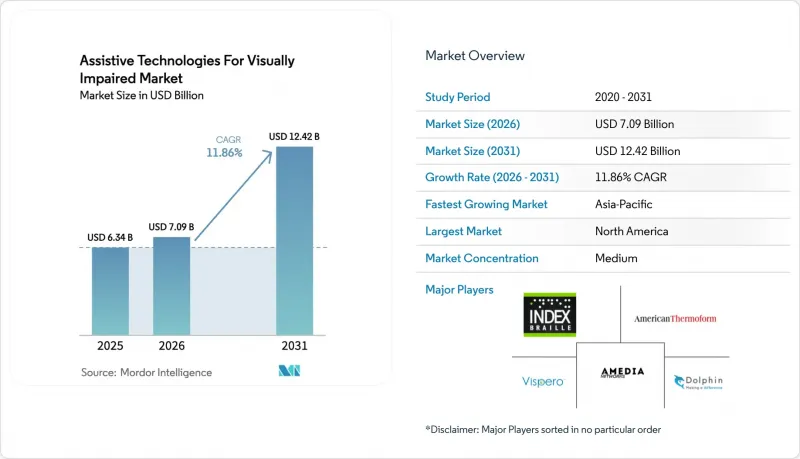
Mordor Intelligence에 의하면, 시각 장애인 보조 기술 시장의 2026년 시장 규모는 70억 9,000만 달러로 추정되고 있으며, 2025년 63억 4,000만 달러에서 2031년에는 124억 2,000만 달러에 이를 것으로 예측됩니다.
또한, 2026-2031년 연평균 성장률(CAGR) 11.86%를 기록할 것으로 전망됩니다.
본 보고서는 기기 폼 팩터별(하드웨어 기기, 소프트웨어 솔루션, 하이브리드 통합 솔루션), 최종 사용자(개인/소비자, 교육 기관, 기업·직장 등), 기술(광학, 전자 등), 지역(북미, 유럽 등)별로 분류되어 있습니다. 시장 전망은 금액(백만 달러)으로 표시되어 있습니다.
시각장애인 보조 기술 세계 시장 동향 및 인사이트
고령화와 시각 장애 유병률의 상승
시각 장애인 보조 기술 시장은 전 세계적인 고령화 진행에 따라 모든 주요 지역에서 시력 상실 발생률이 증가하고 있어 지속적인 성장세를 보이고 있습니다. 법적으로 시각장애로 인정된 성인의 3분의 2는 고령자이며, 45-64세층과 75세 이상층 사이에서는 유병률이 3배로 증가하고 있습니다. 노화성 황반변성만 해도 전 세계적으로 185만 명이 실명 상태이며, 623만 명이 중등도 또는 중증의 시력 장애를 겪고 있습니다. 은퇴자의 평균 수명이 늘어남에 따라 자립적인 생활에 대한 수요가 기존의 계획 기간을 훨씬 뛰어넘어 확대되고 있으며, 보험사와 정부는 비용이 많이 드는 시설 입소를 늦추기 위한 기술 보조금 도입을 검토하고 있습니다. 각 벤더사는 직관적인 음성 인터페이스, 간소화된 촉각 피드백, 그리고 손재주 저하에 대응한 유지보수가 적은 설계를 우선시하고 있습니다. 이러한 설계상의 선택은 고령 사용자층 전체에 대한 호소력을 높이는 한편, 공급업체가 의료 시스템의 비용 절감 예산을 확보할 수 있는 입지를 확립하는 데에도 기여합니다. 그 결과, ‘시각장애인 보조 기술 시장’은 OECD 회원국 전체에서 건강한 고령화 전략의 핵심 추진력으로 점점 더 주목받고 있습니다.
AI와 컴퓨터 비전의 비약적인 발전이 더욱 스마트한 보조 기기를 실현
머신러닝의 발전으로 인해 보조 기기는 수동적인 낭독이나 확대 도구에서 복잡한 환경을 실시간으로 분석하는 능동적인 ‘코파일럿’으로 변모하고 있습니다. 애플의 연구용 프로토타입 ‘SceneScout’는 스트리트 뷰 이미지를 활용해 72%의 장면 묘사 정확도를 달성했으며, 시각 장애가 있는 사용자가 익숙하지 않은 경로를 가상으로 미리 연습할 수 있게 해줍니다. 중국에서는 한 대학이 개발한 스마트 글래스가 골전도 오디오와 AI 기반 물체 식별 기능을 결합하여, 사용자가 흰 지팡이 없이도 혼잡한 도시 환경을 이동할 수 있도록 지원하고 있습니다. 'Audo-Sight'와 같은 다중 모달 대규모 언어 모델은 부적절한 컨텐츠를 필터링하고 주변 소음 상황에 적응함으로써 출력을 실시간으로 개인화합니다. 이러한 기능 덕분에 기존 제품으로는 대응할 수 없었던 내비게이션, 사회적 교류, 취업과 같은 이용 사례가 가능해지면서 시각장애인 보조 기술 시장이 확대되고 있습니다. 또한, 과거에는 하드웨어가 주류를 이루던 이 틈새 시장에 클라우드 AI 제공업체들이 진입함에 따라, 산업 간 경쟁의 경계선도 모호해지고 있습니다. 그 결과, 기능에 대한 기대가 높아지고 기본적인 확대경의 중요성은 낮아지는 반면, 네트워크 연결이 가능하고 업데이트가 가능한 플랫폼에 대한 수요가 증가하고 있습니다.
기기 고가와 제한된 보험 적용
센서 가격이 급락하고 있음에도 불구하고, 고급 보조 기기의 소매 가격은 종종 3,000달러를 초과하여 많은 잠재적 사용자에게는 감당하기 어려운 가격대가 되고 있습니다. 미국 장애 성인 중 절반은 기기 구매가 지연되는 주된 이유로 보험 급여 거부나 터무니없이 높은 본인 부담금을 꼽고 있습니다. 메디케어는 여전히 대부분의 저시력 보조 기기를 적용 대상에서 제외하고 있어, 사실상 가장 큰 사용자층인 은퇴자층에서의 보급을 제한하고 있습니다. '세이카 점자 디스플레이'와 같이 비용 효율성을 고려한 제품은 2,495달러에 판매되고 있지만, 자립성을 높이는 고주사율이나 촉각 그래픽 표시 기능이 생략된 경우가 있습니다. 이러한 가격과 성능의 상충 관계로 인해 시각장애인 보조 기술 시장은 프리미엄층과 저가층으로 양분되어 전반적인 보급이 둔화되고 있습니다. 각 벤더사는 대상 수요를 확대하기 위해 종량제 구독이나 리스-투-오너(Lease-to-Own) 프로그램을 점점 더 모색하고 있지만, 상환 정책이 여전히 장벽으로 작용하고 있습니다.
부문 분석
2025년, 시각장애인 보조 기술 시장에서 소프트웨어 솔루션이 35.18%의 점유율로 1위를 차지했습니다. 이는 클라우드 배포, 자동 업데이트 및 OS 번들이 주요 원동력이 되었습니다. 스크린 리더와 텍스트 음성 변환 엔진은 현재 AI를 활용하여 라벨이 없는 버튼에 자동으로 라벨을 부여함으로써 개발자의 수정 작업 시간을 최소화하고 있습니다. 이러한 낮은 한계 비용 구조 덕분에 교육구는 사이트 계약을 통해 수천 개의 라이선스를 배포할 수 있게 되어 그 우위를 강화하고 있습니다. 그러나 고소득층 교실에서의 보급률이 포화 상태에 가까워짐에 따라 성장 곡선은 정체 국면에 접어들고 있습니다. 스마트 글래스 하드웨어와 AI 엣지 추론을 융합한 ‘하이브리드 통합 솔루션’이 증가하는 수요를 흡수하고 있으며, 연평균 성장률(CAGR) 13.67%를 나타낼 것으로 예측됩니다. 그 예로 ‘Dot Pad’를 들 수 있습니다. 이 촉각 태블릿은 웹툰과의 제휴를 통해 점자 만화를 제공하며, 젊은 독자들의 컨텐츠 선택 폭을 넓히고 있습니다. 하이브리드형 기기는 레이더, GPS, 카메라 센서를 결합하고 있어 소프트웨어만으로는 실현할 수 없는 공간적 이용 사례를 가능하게 하며, 이동 훈련 프로그램과의 교차 판매를 촉진하고 있습니다. 한편, 독립형 하드웨어 기기는 주류 웨어러블 단말기가 보급형 확대경이나 손전등 기능을 흡수해 가고 있기 때문에 상품화(commoditization)에 직면해 있습니다. 그렇긴 하지만, 여러 줄의 점자 그래픽이나 저시력자용 비디오 확대경과 같은 틈새 수요로 인해, 시각장애인 보조 기술 시장 내에는 여전히 프리미엄 부문이 남아 있습니다.
현재 경쟁의 초점은 펌웨어의 확장성과 API의 개방성에 맞추어져 있습니다. 스마트글라스를 판매하는 벤더들은 구매 후 타사가 장면 기술 엔진이나 물체 인식 플러그인을 추가할 수 있는 개발자 키트를 점점 더 많이 공개하고 있으며, 이를 통해 제품 수명 주기의 가치를 확대되고 있습니다. 동시에 조달 담당자들은 적절하게 유지 관리되는 소프트웨어 파이프라인과 무선 보안 패치 제공이 보장된 하드웨어를 선호하는 경향이 있습니다. 따라서 하이브리드 기기에는 내구성이 뛰어난 물리적 설계와 민첩한 클라우드 백엔드라는 두 가지 유지 관리 의무가 부과됩니다. 이 두 분야를 모두 숙달한 공급업체는 기존 점자 디스플레이의 5년 주기 교체에서 2년 주기 구독 갱신으로 업데이트 주기가 단축되는 가운데 시장 점유율을 확보하고, 사용자 1인당 평생 총수익을 향상시키며, 시각장애인 보조 기술 시장의 확대에 기여하게 될 것입니다.
지역별 분석
북미는 확립된 장애인 권리법, 정교한 환급 채널, 그리고 부문 간 지원 네트워크 덕분에 2025년 시각장애인 보조 기술 시장 매출의 34.86%를 차지했습니다. 미국 법무부가 2024년에 제정한, 주 및 지방 자치단체의 디지털 자산에 대해 WCAG 2.1 준수를 의무화하는 규정은 특히 클라우드 감사 및 시정 소프트웨어 분야에서 향후 수년간 조달 측면의 호재를 창출하고 있습니다. 그러나 민간 보험사들은 여전히 많은 지원 솔루션을 ‘편의성 향상을 위한 기기’로 분류하고 있어, 이로 인해 광범위한 보조금 적용이 제한되고 양극화된 도입 양상이 지속되고 있습니다. 캐나다의 연방 연구 보조금은 AI를 활용한 점자 연구 개발을 촉진하고 있는 반면, 멕시코의 IMSS는 도시 지역 진료소에서 저비용 스마트 흰 지팡이의 도입을 시범적으로 추진하고 있습니다.
아시아태평양은 가장 빠르게 성장하는 시장으로, 급속한 고령화와 근시 유병률 증가가 수요를 끌어올리고 있어 2031년까지 연평균 성장률(CAGR)이 17.42%를 나타낼 것으로 예측됩니다. 중국에서는 저비용 스마트폰에 현지 언어로 된 스크린 리더를 추가 장착함으로써 독자적인 설계의 유연성을 보여주고 있는 반면, 한국의 Dot Corporation은 점자 디스플레이를 전 세계로 수출하고 있습니다. 일본 기업들은 스마트글라스 훈련을 재활 보험과 결합하여 통합된 서비스 루프를 구축하고 있습니다. 인도와 인도네시아의 정부 조달에서는 국가의 포용적 교육 의무화를 배경으로, 학교를 거점으로 한 점자 지원 노트북 실험실에 중점을 두고 있습니다. 이러한 노력들이 맞물려, 합리적인 가격 실현이 여전히 정책적 과제로 남아 있음에도 불구하고 아시아태평양 전체의 시각장애인 보조 기술 시장을 확대시키고 있습니다.
유럽은 북미의 성숙도와 아시아의 성장세 사이에 위치해 있습니다. EAA(유럽 접근성 법)에 따른 조화로 인해 국가별 규정 준수 점검이 불필요해졌으며, EU 전역에서의 제품 출시가 촉진되어 규모의 경제가 실현되고 있습니다. 북유럽의 복지 모델에서는 개인 대상 보조 기술 수당이 지급되는 반면, 남유럽의 제도에서는 NGO가 제공하는 기기에 의존하고 있습니다. 데이터 개인정보 보호 규제로 인해 로컬에서의 AI 추론이 촉진되고 있으며, 기기 상에서의 처리가 중요한 판매 포인트가 되고 있습니다. 중동 및 아프리카은 현재로서는 시장 규모가 작지만, 다자간 기부자들에 의한 포용적인 디지털 서비스 전개에 자금이 지원됨에 따라 장기적인 성장 잠재력을 지니고 있습니다. 그러나 정세 불안과 공급망 제약으로 인해 단기적인 성장은 억제되고 있습니다. 따라서 각 지역 고유의 정책과 비용 구조가 전 세계 시각장애인 보조 기술 시장에서 차별화된 시장 진입 모델을 결정짓게 될 것입니다.
기타 혜택:
- 엑셀 형식 시장 예측(ME) 시트
- 3개월간의 애널리스트 지원
자주 묻는 질문
목차
제1장 서론
제2장 조사 방법
제3장 주요 요약
제4장 시장 구도
제5장 시장 규모와 성장 예측
제6장 경쟁 구도
제7장 시장 기회와 향후 전망
KTH 26.08.06According to Mordor Intelligence, assistive technologies for the visually impaired market size in 2026 is estimated at USD 7.09 billion, growing from 2025 value of USD 6.34 billion with 2031 projections showing USD 12.42 billion, growing at 11.86% CAGR over 2026-2031.
This report is Segmented by Device Form Factor (Hardware Devices, Software Solutions, Hybrid Integrated Solutions), End User (Individuals/Consumers, Educational Institutions, Enterprises & Workplace, and More), Technology (Optical, Electronic, and More), and Geography (North America, Europe, and More). The Market Forecasts are Provided in Terms of Value (USD Million).
Global Assistive Technologies For The Visually Impaired Market Trends and Insights
Ageing Population & Rising Prevalence of Visual Impairment
The Assistive Technologies For The Visually Impaired Market draws sustained momentum from global ageing trajectories that are pushing vision-loss incidence upward in every major region. Two-thirds of legally blind adults are seniors, and prevalence triples between the 45-64 and 75-plus cohorts. Age-related macular degeneration alone affects 1.85 million people with blindness and another 6.23 million with moderate or severe impairment worldwide. Retirees' growing life expectancy is stretching independent-living needs well beyond previous planning horizons, prompting insurers and governments to explore technology subsidies that delay costlier institutional care. Vendors are prioritizing intuitive voice interfaces, simplified haptics, and low-maintenance designs that accommodate declining dexterity. These design choices broaden appeal across older users while positioning suppliers to capture healthcare-system cost-avoidance budgets. Consequently, the Assistive Technologies For The Visually Impaired Market is increasingly viewed as a core enabler of healthy ageing strategies across OECD economies.
AI & Computer-Vision Breakthroughs Enabling Smarter Aids
Machine-learning advances are transforming assistive devices from passive reading or magnification tools into proactive co-pilots that analyze complex environments in real time. Apple's research prototype SceneScout achieves 72% scene-description accuracy using Street View imagery, letting blind users virtually rehearse unfamiliar routes. In China, university-developed smart glasses pair bone-conduction audio with AI object identification to guide users through crowded urban settings without canes. Multimodal large-language models such as Audo-Sight personalize output in real time, filtering inappropriate content and adapting to ambient noise conditions. These capabilities expand the Assistive Technologies For The Visually Impaired Market by unlocking navigation, social-interaction, and employment use cases that legacy products could not address. They also blur competitive boundaries as cloud-AI providers enter what was once a hardware-dominated niche. The upshot is an acceleration in feature expectations that lowers the relevance of basic magnifiers while boosting demand for connected, updateable platforms.
High Device Cost & Limited Reimbursement
Despite plummeting sensor prices, premium assistive hardware often retails above USD 3,000, well beyond the means of many potential users. Half of U.S. adults with disabilities cite insurance denials or prohibitive co-pays as key reasons for delayed equipment purchases. Medicare still excludes most low-vision aids, effectively limiting uptake among retirees-the largest afflicted cohort. While cost-engineered products such as the Seika Braille Display sell for USD 2,495, they may omit advanced refresh rates or tactile-graphic rendering that enhance independence. This price-performance tension fragments the Assistive Technologies For The Visually Impaired Market into premium and budget tiers, slowing overall penetration. Vendors increasingly explore pay-as-you-go subscriptions and lease-to-own programmes to expand addressable demand, but reimbursement policy remains a gating factor.
Other drivers and restraints analyzed in the detailed report include:
- Stronger Accessibility Regulations & Public Funding
- Inclusive Education & Workplace Mandates
- Low Awareness & Lack of Trained Instructors
For complete list of drivers and restraints, kindly check the Table Of Contents.
Segment Analysis
Software Solutions led with 35.18% share of the Assistive Technologies For The Visually Impaired Market in 2025, powered by cloud distribution, automatic updates, and operating-system bundling. Screen readers and text-to-speech engines now leverage AI to auto-label unlabeled buttons, minimizing developer retrofitting time. Their low marginal-cost economics allow educational districts to deploy thousands of licences under site agreements, reinforcing dominance. Yet growth curves are flattening as penetration nears saturation in high-income classrooms. Hybrid Integrated Solutions, blending smart-glasses hardware with AI edge inference, are absorbing incremental demand and are forecast to grow at 13.67% CAGR. Examples include Dot Pad, whose tactile tablet streams braille comics via a partnership with WEBTOON, broadening content horizons for younger readers. Because hybrid rigs combine radar, GPS, and camera sensors, they unlock spatial use cases unavailable to pure software, fueling cross-sell with mobility-training programs. Conversely, stand-alone Hardware Devices are facing commoditization as mainstream wearables co-opt entry-level magnifier and flashlight features. Nonetheless, niche needs such as multi-line braille graphics and low-vision video magnifiers protect a residual premium segment within the Assistive Technologies For The Visually Impaired Market.
The competitive stakes now revolve around firmware extensibility and API openness. Vendors shipping smart glasses increasingly expose developer kits that let third parties add scene-description engines or object-recognition plug-ins after purchase, extending lifecycle value. At the same time, procurement officers favour hardware backed by well-maintained software pipelines and over-the-air security patches. Hybrid devices therefore carry dual maintenance obligations: durable physical design plus agile cloud back ends. Suppliers able to master both disciplines will capture share as refresh cycles shorten from traditional five-year braille-display replacements to two-year subscription renewals, raising total lifetime revenue per user and enlarging the Assistive Technologies For The Visually Impaired Market.
Complete Report Scope:
- By Device Form Factor (integrated with Product Type)
- Hardware Devices
- Braille Displays & Note Takers
- Braille Printers & Embossers
- Wearable Assistive Devices
- Navigation Aids
- Magnification Aids
- Others (Document Holders, Monitors, etc.)
- Software Solutions
- Screen Readers
- Voice Recognition & TTS Software
- Others (OCR, Talking Calculators, etc.)
- Hybrid Integrated Solutions
- Smart Glasses (Wearable AI Devices)
- Smart Canes / IoT Navigation Aids
- Integrated Braille Tablets & Pads
- Other Converged Solutions
- Hardware Devices
- By End User
- Individuals / Consumers
- Educational Institutions
- Enterprises & Workplace
- Rehabilitation Centers & NGOs
- Government Organizations
- By Technology
- Optical
- Electronic
- AI-based & Computer Vision
- Mechanical / Braille
- By Geography
- North America
- United States
- Canada
- Mexico
- Europe
- Germany
- United Kingdom
- France
- Italy
- Spain
- Rest of Europe
- Asia-Pacific
- China
- India
- Japan
- South Korea
- Australia
- Rest of Asia-Pacific
- South America
- Brazil
- Argentina
- Rest of South America
- Middle East and Africa
- GCC
- South Africa
- Rest of Middle East and Africa
- North America
Geography Analysis
North America captured 34.86% of Assistive Technologies For The Visually Impaired Market revenue in 2025 thanks to entrenched disability-rights laws, sophisticated reimbursement channels, and cross-sector advocacy networks. The U.S. Department of Justice's 2024 rule mandating WCAG 2.1 compliance for state and local digital assets creates multi-year procurement tailwinds, especially for cloud auditing and remediation software. Private insurers, however, still classify many assistive solutions as convenience devices, limiting broad subsidy coverage and preserving a two-tier adoption pattern. Canadian federal research grants are stimulating AI-powered braille R&D, while Mexico's IMSS is piloting low-cost smart-cane deployments in urban clinics.
Asia-Pacific is the fastest-expanding contributor, forecast to post a 17.42% CAGR through 2031 as rapidly ageing populations and high myopia incidence raise demand. China demonstrates indigenous design flexibility by retrofitting low-cost smartphones with local-language screen readers, while South Korea's Dot Corporation exports tactile displays globally. Japanese firms bundle smart-glasses training with rehabilitation insurance, creating integrated service loops. Government procurement in India and Indonesia is focusing on school-based braille laptop labs, driven by national inclusive-education mandates. These initiatives collectively swell the Assistive Technologies For The Visually Impaired Market across APAC, even as affordability remains a policy challenge.
Europe sits between North American maturity and Asian momentum. Harmonization under the EAA eradicates country-by-country compliance checks, encouraging pan-EU product launches and unlocking scale economies. Nordic welfare models fund personal assistive technology allowances, whereas Southern European systems lean on NGO-provided devices. Data-privacy rules spur local AI inference, making on-device processing a key selling point. The Middle East and Africa contribute smaller volumes today but hold long-run upside as multilateral donors finance inclusive digital-service roll-outs; yet political instability and limited supply chains temper near-term growth. Each region's unique policy and cost structures will therefore dictate differentiated go-to-market models within the global Assistive Technologies For The Visually Impaired Market.
- Apple
- Google LLC
- Microsoft
- Vispero (Freedom Scientific)
- HumanWare Group
- OrCam Technologies Ltd.
- Aira Tech Corp.
- Envision Digital B.V.
- Dot Incorporation
- HIMS International Corp.
- Dolphin Computer Access
- Eschenbach Optik GmbH
- Zoomax Technology Co. Ltd.
- LVI Low Vision International AB
- IrisVision Global Inc.
- Sunu Inc.
- WeWALK Teknoloji Inc.
- Bose Corporation
- Eurobraille (Inside Vision)
- Braille Works Inc.
Additional Benefits:
- The market estimate (ME) sheet in Excel format
- 3 months of analyst support
TABLE OF CONTENTS
1 Introduction
- 1.1 Study Assumptions & Market Definition
- 1.2 Scope of the Study
2 Research Methodology
3 Executive Summary
4 Market Landscape
- 4.1 Market Overview
- 4.2 Market Drivers
- 4.2.1 Ageing population & rising prevalence of visual impairment
- 4.2.2 AI & computer-vision breakthroughs enabling smarter aids
- 4.2.3 Stronger accessibility regulations & public funding
- 4.2.4 Inclusive education & workplace mandates
- 4.2.5 Integration with mainstream consumer-electronics ecosystems
- 4.2.6 Open-source low-cost hardware emerging in developing nations
- 4.3 Market Restraints
- 4.3.1 High device cost & limited reimbursement
- 4.3.2 Low awareness & lack of trained instructors
- 4.3.3 Interoperability gaps due to fragmented standards
- 4.3.4 Data-privacy & cyber-security concerns in AI vision aids
- 4.4 Value / Supply-Chain Analysis
- 4.5 Regulatory Landscape
- 4.6 Technological Outlook
- 4.7 Porter's Five Forces
- 4.7.1 Threat of New Entrants
- 4.7.2 Bargaining Power of Suppliers
- 4.7.3 Bargaining Power of Buyers
- 4.7.4 Threat of Substitutes
- 4.7.5 Competitive Rivalry
5 Market Size & Growth Forecasts (Value, USD Million)
- 5.1 By Device Form Factor (integrated with Product Type)
- 5.1.1 Hardware Devices
- 5.1.1.1 Braille Displays & Note Takers
- 5.1.1.2 Braille Printers & Embossers
- 5.1.1.3 Wearable Assistive Devices
- 5.1.1.4 Navigation Aids
- 5.1.1.5 Magnification Aids
- 5.1.1.6 Others (Document Holders, Monitors, etc.)
- 5.1.2 Software Solutions
- 5.1.2.1 Screen Readers
- 5.1.2.2 Voice Recognition & TTS Software
- 5.1.2.3 Others (OCR, Talking Calculators, etc.)
- 5.1.3 Hybrid Integrated Solutions
- 5.1.3.1 Smart Glasses (Wearable AI Devices)
- 5.1.3.2 Smart Canes / IoT Navigation Aids
- 5.1.3.3 Integrated Braille Tablets & Pads
- 5.1.3.4 Other Converged Solutions
- 5.1.1 Hardware Devices
- 5.2 By End User
- 5.2.1 Individuals / Consumers
- 5.2.2 Educational Institutions
- 5.2.3 Enterprises & Workplace
- 5.2.4 Rehabilitation Centers & NGOs
- 5.2.5 Government Organizations
- 5.3 By Technology
- 5.3.1 Optical
- 5.3.2 Electronic
- 5.3.3 AI-based & Computer Vision
- 5.3.4 Mechanical / Braille
- 5.4 By Geography
- 5.4.1 North America
- 5.4.1.1 United States
- 5.4.1.2 Canada
- 5.4.1.3 Mexico
- 5.4.2 Europe
- 5.4.2.1 Germany
- 5.4.2.2 United Kingdom
- 5.4.2.3 France
- 5.4.2.4 Italy
- 5.4.2.5 Spain
- 5.4.2.6 Rest of Europe
- 5.4.3 Asia-Pacific
- 5.4.3.1 China
- 5.4.3.2 India
- 5.4.3.3 Japan
- 5.4.3.4 South Korea
- 5.4.3.5 Australia
- 5.4.3.6 Rest of Asia-Pacific
- 5.4.4 South America
- 5.4.4.1 Brazil
- 5.4.4.2 Argentina
- 5.4.4.3 Rest of South America
- 5.4.5 Middle East and Africa
- 5.4.5.1 GCC
- 5.4.5.2 South Africa
- 5.4.5.3 Rest of Middle East and Africa
- 5.4.1 North America
6 Competitive Landscape
- 6.1 Market Concentration
- 6.2 Market Share Analysis
- 6.3 Company Profiles (includes Global level Overview, Market level overview, Core Segments, Financials as available, Strategic Information, Market Rank/Share for key companies, Products & Services, and Recent Developments)
- 6.3.1 Apple Inc.
- 6.3.2 Google LLC
- 6.3.3 Microsoft Corporation
- 6.3.4 Vispero (Freedom Scientific)
- 6.3.5 HumanWare Group
- 6.3.6 OrCam Technologies Ltd.
- 6.3.7 Aira Tech Corp.
- 6.3.8 Envision Digital B.V.
- 6.3.9 Dot Incorporation
- 6.3.10 HIMS International Corp.
- 6.3.11 Dolphin Computer Access Ltd.
- 6.3.12 Eschenbach Optik GmbH
- 6.3.13 Zoomax Technology Co. Ltd.
- 6.3.14 LVI Low Vision International AB
- 6.3.15 IrisVision Global Inc.
- 6.3.16 Sunu Inc.
- 6.3.17 WeWALK Teknoloji Inc.
- 6.3.18 Bose Corporation
- 6.3.19 Eurobraille (Inside Vision)
- 6.3.20 Braille Works Inc.
7 Market Opportunities & Future Outlook
- 7.1 White-space & Unmet-Need Assessment


