|
시장보고서
상품코드
2119295
청각 보조 기기 : 시장 점유율 분석, 업계 동향 및 통계, 성장 예측(2026-2031년)Assistive Listening Devices - Market Share Analysis, Industry Trends & Statistics, Growth Forecasts (2026 - 2031) |
||||||
 Mordor Intelligence
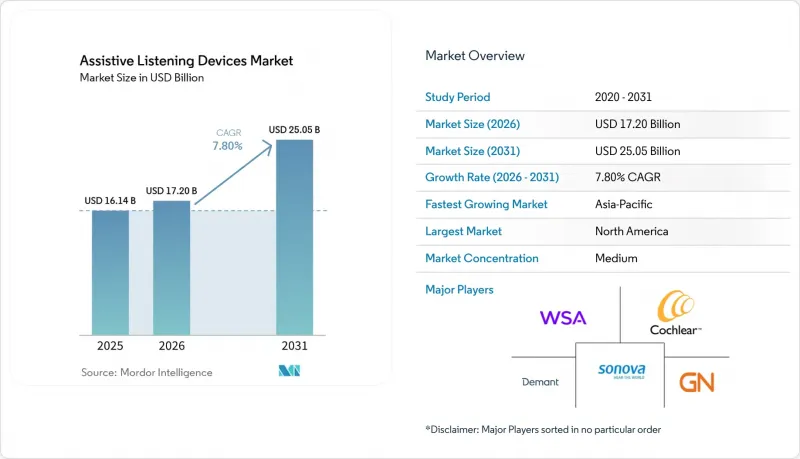
Mordor Intelligence에 의하면, 청각 보조 기기 시장 규모는 2025년 161억 4,000만 달러로 평가되었습니다. 2026년 172억 달러에서 2031년까지 250억 5,000만 달러로 확대되고 2026년부터 2031년에 걸쳐 CAGR 7.80%를 기록할 전망입니다.
본 보고서는 제품 유형(보청기, PSAP, ALS, 연결·알림 기기), 기술(아날로그, 디지털, LE Audio, AI 탑재), 용도(개인용, 의료, 교육, 공공시설), 유통 채널(청각 클리닉, 전문점, 온라인, 기관),지역(북미, 유럽, 아시아태평양, 중동 및 아프리카, 남미)별로 분류되어 있습니다.
세계의 청각 보조 기기 시장 동향 및 인사이트
고령화가 진행되는 인구 구성이 수십 년에 걸친 구조적인 수요의 기반 형성
청각 보조 기기 시장은 노화성 난청을 겪는 인구 증가에 따라 지속적인 수요가 예상됩니다. 2025년 ‘세계 질병 부담(Global Burden of Disease)’ 분석에 따르면, 난청 환자 수는 1990년 7억 4,100만 명에서 2021년에는 15억 5,000만 명으로 증가했습니다. 65세에서 74세 성인층의 난청 유병률은 22%였으나, 75세 이상에서는 55%에 달했습니다. 2025년 조사에 따르면, 60세 이상 성인을 대상으로 한 노화성 난청으로 인한 장애 조정 생명 연수(DALY)가 2022년 2,750만 년에서 2040년에는 4,690만 년으로 증가할 것으로 예측됩니다. 이러한 인구 통계학적 추세는 개별 기기의 교체 주기를 넘어서는 장기적인 현상이며, 청력 검사, 보청기 피팅 및 지속적인 청각 관리에 대한 장기적인 수요를 뒷받침하는 요인이 되고 있습니다. 또한, 일상적인 의사소통의 필요성과 노화에 따른 동반 질환을 모두 충족시킬 수 있는 제품의 중요성도 높아지고 있습니다.
OTC 및 소비자 직접 판매 모델이 클리닉을 통한 유통을 넘어 접근성을 확대
일반 판매 제품의 접근성이 높아짐에 따라, 청각 보조 기기 시장은 기존의 의료 기관을 통한 판매 범위를 넘어 확장되고 있습니다. FDA(미국 식품의약국)의 일반 판매 보청기 관련 규정에 따라, 자각적인 경도에서 중등도의 난청을 가진 성인에 대한 처방전 요건이 철폐되었습니다. 2024년 연구에서는 일반 판매용 보청기를 자가 조절함으로써 일상생활에서 얻는 주관적인 이점이 확인되었습니다. 진단부터 첫 기기 구매까지의 기간이 평균 9년이라는 보고는 비용 절감과 구매 장벽의 완화가 보급에 영향을 미칠 수 있음을 시사합니다. 소비자 주도형 구매 경로는 클리닉 전용 모델보다 더 이른 단계에서 경도 난청을 가진 사용자를 이 범주로 끌어들일 수 있습니다. 처방 의사는 자가 주도형 구매에는 적합하지 않은 피팅 전문 지식, 임상적 사후 관리 및 성능상의 요구 사항을 강조함으로써 복잡한 사례를 계속해서 담당할 수 있습니다.
기기 비용이 청각 장애 부담이 큰 국가에서의 이용을 제한하고 있습니다.
가격이 합리적인지 여부는 특히 난청이 가장 널리 퍼져 있는 지역에서 청각 보조 기기 시장의 핵심적인 장벽으로 남아 있습니다. 세계보건기구(WHO) 보고서에 따르면, 일상생활에 지장을 줄 정도의 난청을 가진 사람들의 약 80%가 저·중소득 국가에 거주하고 있습니다. 제출된 증거에 따르면, 선진국 시장에서 처방전이 필요한 보청기의 가격은 한 쌍당 1,000-7,000달러 사이였습니다. 또한, 경쟁하는 일반 판매 제품의 경우 200-1,500달러 범위로 추정됩니다. 2024년 조사에서는 사람들이 자신의 난청 정도를 판단하기 어려운 경우가 있어, 제품에 대한 접근성이 향상되었음에도 불구하고 보급이 제한되고 있다는 점이 지적되었습니다. 따라서 주요 신흥 경제국에서의 보험 환급 제도 설계가 저비용 기기가 더 폭넓은 계층에 보급될지 여부를 좌우하게 될 것입니다. 보험 적용 범위 확대나 실제 판매 가격 인하가 없다면, 시장 성장은 고소득층 사용자에게만 집중된 채로 남을 가능성이 높습니다.
부문 분석
2025년, 보청기는 청각 보조 기기 시장 점유율의 69.5%를 차지했습니다. 이러한 위상은 확립된 처방 경로와 맞춤 조정된 기기가 제공하는 임상적 가치를 반영합니다. GN ReSound의 ‘Vivia’와 포낙의 ‘Infinio Ultra’는 인공지능(AI) 기능이 프리미엄 기기 제안에 어떻게 기여하고 있는지 보여줍니다. 개인용 소리 증폭 제품은 처음 사용하는 사용자에게 부담이 적은 진입점이 됩니다. 자가 피팅형 시판 기기의 경우, 일상적인 사용에서 주관적인 효과가 보고되고 있습니다.
연결성 및 알림 기기는 2031년까지 연평균 성장률(CAGR) 8.1%를 나타낼 것으로 예측됩니다. 블루투스 스트리머, TV용 리스너, 시각 또는 진동 알림 기능은 접근성과 연결성을 중시하는 사용자들의 요구를 충족시킵니다. GN은 블루투스 LE 오디오와 오라캐스트(Auracast)를 탑재한 ‘ReSound Savi’를 보다 합리적인 가격대로 포지셔닝했습니다. 이 카테고리는 광범위한 소매 유통망을 보유한 가전 브랜드로부터 직접적인 압박에 직면해 있습니다. 각 기업은 액세서리를 임상용 보청기 솔루션의 보완적 구성 요소로 포지셔닝함으로써 가치를 지킬 수 있습니다. 행사장 소유주들이 향후 업그레이드를 계획하는 가운데, 이미 설치된 FM, 적외선, 유도 루프 시스템도 청각 보조 기기 시장에서 여전히 중요한 역할을 하고 있습니다.
2025년, 디지털 기기는 청각 보조 기기 시장의 63.8% 점유율을 차지했습니다. 이러한 상황은 처방전이 필요한 제품 및 일반 판매 제품에서 아날로그 처리가 디지털 처리로 대체되고 있음을 반영합니다. 아날로그 제품은 여전히 가격에 민감한 신흥 시장의 최저가 대에 집중되어 있습니다. 부품 비용의 하락으로 인해 이러한 시장에서도 디지털 제품을 보다 합리적인 가격에 구매할 수 있게 될 가능성이 있습니다. 블루투스 LE 오디오(Bluetooth LE Audio) 및 오라캐스트(Auracast) 기능은 주력 제품 라인 전반에 걸쳐 채택되고 있으며, 접근성을 고려한 행사장용 오디오 시스템을 지원할 수 있습니다.
AI 탑재 기기는 2031년까지 연평균 성장률(CAGR) 8.4%를 나타낼 것으로 예측됩니다. 심층 신경망에 의한 처리를 통해 프리미엄 제품과 중급 제품 간의 성능 격차가 확대되고 있습니다. 2025년 연구에 따르면, 숙련된 보청기 사용자를 대상으로 한 실험에서 딥러닝 기반의 소음 관리로 인해 인지 부하가 경감되는 것이 확인되었습니다. 소노바(Sonova)는 제품 개발 프로그램의 일환으로 2026년 하반기에 도입될 예정인 새로운 AI 탑재 플랫폼을 공개했습니다. 임상적 근거는 단순한 기본적인 음량 증폭 이상의 효과를 바탕으로 한 보험 적용에 대한 논의를 뒷받침할 수 있습니다. 이를 통해 청각 보조 기기 시장 전반에 걸쳐 소프트웨어, 신호 처리 및 원격 업데이트에 대한 지속적인 투자가 촉진될 것입니다.
지역별 분석
2025년, 북미는 전 세계 매출의 41.5%를 차지했습니다. 이 지역은 높은 의료비 지출, 확립된 청각학 인프라, 그리고 FDA의 일반의약품(OTC) 체계를 모두 갖추고 있습니다. 미국의 접근성 요건으로 인해, 해당 기준에 부합하는 공공 장소에서 보청기 지원 시스템에 대한 기관 차원 수요가 발생하고 있습니다. Auracast의 규정 준수 인증은 행사장의 음향 인프라 재검토를 촉진하고 있습니다. 유럽은 독일, 영국, 프랑스, 이탈리아, 스페인의 보험 환급 제도에 힘입어 청각 보조 기기 시장에서 2위의 지역 점유율을 차지하고 있습니다.
아시아태평양은 2031년까지 연평균 성장률(CAGR) 8.5%를 나타낼 것으로 예측됩니다. 일본의 고령화, 중국 도시 지역의 중산층 확대, 그리고 인도의 의료 인프라 투자가 이러한 성장을 뒷받침하고 있습니다. 일본과 호주에서는 노인 요양 시설에서 충전식 디지털 기기의 도입이 확대되고 있습니다. 중국에서는 고급 기종에 대한 본인 부담 수요가 1급 도시에 집중되어 있는 반면, 2급 및 3급 도시로도 수요가 확산되고 있습니다. 인도의 ‘청력 손실 예방·관리 국가 프로그램’과 확대되는 민간 병원 네트워크는 중저가 기기 시장에 기회를 창출하고 있습니다. 한국과 호주는 규모는 작지만, 공공시설에서의 Auracast 도입에 있어 기술적으로 선진적인 환경을 갖추고 있습니다.
중동 및 아프리카 및 남미는 여전히 초기 단계에 있는 지역으로, 기기 보급률은 잠재적인 청력 손실 부담을 밑돌고 있습니다. 걸프협력회의(GCC) 국가들의 정부 의료 투자로 인해 새로운 공공시설 및 오락 시설에 서유럽의 접근성 기준이 도입되고 있습니다. 남아프리카공화국에서는 청력 검사 비용의 일부가 보험 적용을 받는 제도 덕분에 민간 청각 관리 기반이 확립되어 있습니다. 브라질은 사립 병원의 확대와 호환 가능한 제품에 대한 온라인 접근을 통해 남미 수요를 주도하고 있습니다. 이 지역들의 청각 보조 기기 시장은 인프라, 보험 환급 제도 설계 및 현지 생산에 대한 인센티브에 의존하고 있습니다. 더 폭넓은 계층에 도달할 수 있는 가격 인하가 실현된다면, 이 장기적이고 거대한 비즈니스 기회에 접근하기가 훨씬 더 쉬워질 것입니다.
기타 혜택 :
- 엑셀 형식 시장 예측(ME) 시트
- 3개월간의 애널리스트 지원
자주 묻는 질문
목차
제1장 서론
제2장 조사의 전제조건 및 시장 정의
제3장 조사 범위
제4장 조사 방법
제5장 시장 개요
제6장 시장 성장 촉진요인
제7장 시장 성장 억제요인
제8장 공급망 분석
제9장 규제 상황
제10장 기술 전망
제11장 Five Forces 분석
제12장 시장 규모 및 성장 예측
제13장 경쟁 구도
제14장 시장 기회 및 향후 전망
제15장 화이트 스페이스 및 미충족 수요 평가
KTH 26.09.10According to Mordor Intelligence, the assistive listening devices market size is projected to expand from USD 16.14 billion in 2025 and USD 17.20 billion in 2026 to USD 25.05 billion by 2031, registering a CAGR of 7.80% between 2026 to 2031.
This report is Segmented by Product Type (Hearing Aids, Psaps, ALS, Connectivity & Alert Devices), Technology (Analog, Digital, LE Audio, AI-Enabled), Application (Personal Use, Healthcare, Education, Public Venues), Distribution Channel (Audiology Clinics, Specialty Stores, Online, Institutional), Geography (North America, Europe, Asia-Pacific, MEA, South America).
Global Assistive Listening Devices Market Trends and Insights
Aging Demographics Build a Structural, Multi-Decade Demand Floor
The assistive listening devices market draws sustained demand from a growing population with age-related hearing loss. A 2025 Global Burden of Disease analysis reported that hearing loss cases rose from 741 million in 1990 to 1.55 billion in 2021. Adults aged 65 to 74 had a 22% prevalence of hearing loss, while prevalence reached 55% among those aged 75 and older. A 2025 study projected years lived with disability from age-related hearing loss among adults aged 60 and older to rise from 27.5 million in 2022 to 46.9 million in 2040. This demographic pattern extends beyond individual device refresh cycles and supports long-term demand for assessment, fitting, and ongoing hearing care. It also increases the importance of products that can address both daily communication needs and age-related comorbidities.
OTC and Direct-to-Consumer Models Expand Access Beyond Clinic Distribution
The assistive listening devices market is expanding beyond traditional clinic distribution as over-the-counter products become more available. The FDA's over-the-counter hearing aid rule removed prescription requirements for adults with perceived mild-to-moderate hearing loss. A 2024 study found subjective real-world benefits from self-fitting over-the-counter hearing aids. The reported nine-year average gap between diagnosis and first device purchase indicates that reduced cost and purchasing friction can influence adoption. Consumer-led purchase paths can bring milder-loss users into the category earlier than a clinic-only model. Prescription providers can retain complex cases by emphasizing fitting expertise, clinical follow-up, and performance needs that are less suited to self-directed purchasing.
Device Cost Limits Access in High-Burden Countries
Affordability remains a central limit on the assistive listening devices market, particularly where hearing loss is most prevalent. The World Health Organization has reported that nearly 80% of people with disabling hearing loss live in low- and middle-income countries. The supplied evidence placed developed-market prescription hearing aid prices between USD 1,000 and USD 7,000 per pair. It also placed competitive over-the-counter products between USD 200 and USD 1,500. A 2024 review noted that people can find it difficult to assess their own hearing loss, limiting uptake despite easier product access. Reimbursement design in large emerging economies will therefore influence whether lower-cost devices reach a broader share of the population. Without wider coverage or lower delivered prices, growth is likely to remain concentrated in higher-income users.
Other drivers and restraints analyzed in the detailed report include:
- AI, Wireless Connectivity, and Remote Microphones Strengthen Premium Performance
- Auracast-Enabled Venue Modernization Supports Institutional Purchases
- Stigma and Fragmented Care Infrastructure Limit Clinical Adoption
For complete list of drivers and restraints, kindly check the Table Of Contents.
Segment Analysis
Hearing aids held 69.5% of assistive listening devices market share in 2025. Their position reflects established prescription channels and the clinical value offered by fitted devices. GN ReSound Vivia and Phonak Infinio Ultra illustrate how artificial intelligence features are being used to support premium device propositions. Personal sound amplification products provide a lower-commitment entry point for first-time users. Self-fitting over-the-counter devices have shown reported subjective benefit in daily use
Connectivity and alert devices are forecast to grow at an 8.1% CAGR through 2031. Bluetooth streamers, television listeners, and visual or vibration alerts address users who prioritize access and connectivity. GN positioned ReSound Savi with Bluetooth LE Audio and Auracast at a more accessible price tier. This category faces direct pressure from consumer electronics brands with broad retail distribution. Companies can protect value by positioning accessories as complementary parts of clinical hearing solutions. Installed FM, infrared, and induction loop systems also retain relevance in the assistive listening devices market while venue owners plan future upgrades.
Digital devices held 63.8% of the assistive listening devices market share in 2025. This position reflects the replacement of analog processing across prescription and over-the-counter products. Analog products remain concentrated in the lowest-priced tiers of cost-sensitive emerging markets. Falling component costs can make digital products more accessible in those markets. Bluetooth LE Audio and Auracast features are appearing across flagship product ranges and can support accessible venue audio systems.
AI-enabled devices are forecast to grow at an 8.4% CAGR through 2031. Deep neural network processing is widening the performance difference between premium and mid-tier products. A 2025 study measured lower cognitive load from deep learning-based noise management in experienced hearing aid users. Sonova identified a new AI-enabled platform expected in the second half of 2026 as part of its product development program. Clinical evidence can support reimbursement discussions that rely on more than basic sound amplification. This supports continued investment in software, signal processing, and remote updates across the assistive listening devices market.
Complete Report Scope:
- By Product Type
- Hearing Aids
- Personal Sound Amplifiers (PSAPs)
- Assistive Listening Systems (FM, Infrared, Induction Loop)
- Connectivity & Alert Devices (Bluetooth Streamers, TV Listeners, Telephone Amplifiers, Visual/Vibration Alerts)
- By Technology
- Analog Devices
- Digital Devices
- Bluetooth LE Audio & Auracast Devices
- AI-Enabled Devices
- By Application
- Personal Use
- Healthcare Facilities
- Educational Institutions
- Public Venues & Commercial Facilities
- By Distribution Channel
- Audiology Clinics
- Specialty Hearing-Care Stores
- Online Stores
- Institutional & Direct Sales
- By Geography
- North America
- United States
- Canada
- Mexico
- Europe
- Germany
- United Kingdom
- France
- Italy
- Spain
- Rest of Europe
- Asia-Pacific
- China
- India
- Japan
- South Korea
- Australia
- Rest of Asia-Pacific
- Middle East & Africa
- GCC
- South Africa
- Rest of Middle East and Africa
- South America
- Brazil
- Argentina
- Rest of South America
- North America
Geography Analysis
North America held 41.5% of global revenue in 2025. The region combines high healthcare spending, established audiology infrastructure, and the FDA's over-the-counter framework. U.S. accessibility requirements create institutional demand for assistive listening systems in covered assembly areas. Auracast compliance recognition is encouraging reviews of venue audio infrastructure. Europe follows as the second-largest regional part of the assistive listening devices market, supported by reimbursement systems in Germany, the United Kingdom, France, Italy, and Spain.
Asia-Pacific is forecast to grow at an 8.5% CAGR through 2031. Japan's aging population, China's urban middle-income growth, and India's healthcare infrastructure investment support this expansion. Japan and Australia have expanded procurement of rechargeable digital devices in senior care settings. China concentrates premium direct-pay demand in tier-1 cities while demand is spreading across tier-2 and tier-3 cities. India's National Programme for Prevention and Control of Deafness and expanding private hospital networks create opportunities for mid-tier devices. South Korea and Australia are smaller but technologically progressive settings for public-venue Auracast adoption.
Middle East and Africa and South America remain early-stage regions where device penetration is below the underlying hearing loss burden. Government healthcare investment in Gulf Cooperation Council countries is bringing Western accessibility standards into new public buildings and entertainment venues. South Africa anchors a private hearing-care base with partial audiology reimbursement. Brazil leads South American demand through private hospital expansion and online access to compatible products. The assistive listening devices market in these regions depends on infrastructure, reimbursement design, and local manufacturing incentives. Lower pricing that reaches broader populations would make the large long-term opportunity more accessible.
List of Companies Covered in this Report:
- Sonova
- Demant
- Amplifon S.p.A.
- GN Store Nord
- WS Audiology
- Starkey Hearing Technologies
- Cochlear
- MED-EL
- RION
- Williams AV LLC
- Listen Technologies Corporation
- Ampetronic Ltd
- Bellman & Symfon AB
- Sennheiser electronic SE & Co. KG
- Clarity Products
- Panasonic Corporation
- Contacta Systems Ltd
- Geemarc Telecom
- Audina Hearing Instruments
- Serene Group, Inc.
Additional Benefits:
- The market estimate (ME) sheet in Excel format
- 3 months of analyst support
TABLE OF CONTENTS
1 Introduction
2 Study Assumptions and Market Definition
3 Scope of the Study
4 Research Methodology
5 Market Overview
6 Market Drivers
- 6.1 Aging Population and Rising Hearing Impairment Prevalence
- 6.2 Accessibility Requirements in Public and Commercial Venues
- 6.3 Digital Signal Processing, Wireless Connectivity and Bluetooth Integration
- 6.4 OTC, Direct-to-Consumer and Lower-Barrier Hearing Solutions
- 6.5 Auracast-Enabled Venue Modernization
- 6.6 Remote-Microphone Speech Enhancement in Noisy Environments
7 Market Restraints
- 7.1 Device Cost and Limited Affordability in Low-Income Markets
- 7.2 Limited Awareness, Stigma and Inconsistent Hearing-Care Access
- 7.3 Radio-Frequency Privacy, Interference and Compatibility Constraints
- 7.4 Venue Retrofit Complexity, Charging Burden and IT Integration Requirements
8 Supply-Chain Analysis
9 Regulatory Landscape
10 Technological Outlook
11 Porters Five Forces
- 11.1 Threat of New Entrants
- 11.2 Bargaining Power of Suppliers
- 11.3 Bargaining Power of Buyers
- 11.4 Threat of Substitutes
- 11.5 Competitive Rivalry
- 11.6 Analysis
12 Market Size and Growth Forecasts
- 12.1 By Product Type
- 12.1.1 Hearing Aids
- 12.1.2 Personal Sound Amplifiers (PSAPs)
- 12.1.3 Assistive Listening Systems (FM, Infrared, Induction Loop)
- 12.1.4 Connectivity & Alert Devices (Bluetooth Streamers, TV Listeners, Telephone Amplifiers, Visual/Vibration Alerts)
- 12.2 By Technology
- 12.2.1 Analog Devices
- 12.2.2 Digital Devices
- 12.2.3 Bluetooth LE Audio & Auracast Devices
- 12.2.4 AI-Enabled Devices
- 12.3 By Application
- 12.3.1 Personal Use
- 12.3.2 Healthcare Facilities
- 12.3.3 Educational Institutions
- 12.3.4 Public Venues & Commercial Facilities
- 12.4 By Distribution Channel
- 12.4.1 Audiology Clinics
- 12.4.2 Specialty Hearing-Care Stores
- 12.4.3 Online Stores
- 12.4.4 Institutional & Direct Sales
- 12.5 By Geography
- 12.5.1 North America
- 12.5.1.1 United States
- 12.5.1.2 Canada
- 12.5.1.3 Mexico
- 12.5.2 Europe
- 12.5.2.1 Germany
- 12.5.2.2 United Kingdom
- 12.5.2.3 France
- 12.5.2.4 Italy
- 12.5.2.5 Spain
- 12.5.2.6 Rest of Europe
- 12.5.3 Asia-Pacific
- 12.5.3.1 China
- 12.5.3.2 India
- 12.5.3.3 Japan
- 12.5.3.4 South Korea
- 12.5.3.5 Australia
- 12.5.3.6 Rest of Asia-Pacific
- 12.5.4 Middle East & Africa
- 12.5.4.1 GCC
- 12.5.4.2 South Africa
- 12.5.4.3 Rest of Middle East and Africa
- 12.5.5 South America
- 12.5.5.1 Brazil
- 12.5.5.2 Argentina
- 12.5.5.3 Rest of South America
- 12.5.1 North America
13 Competitive Landscape
- 13.1 Market Concentration
- 13.2 Market Share Analysis
- 13.3 Company Profiles (includes Global Level Overview, Market Level Overview, Core Segments, Financials as available, Strategic Information, Market Rank/Share, Products and Services, Recent Developments)
- 13.3.1 Sonova Holding AG
- 13.3.2 Demant A/S
- 13.3.3 Amplifon S.p.A.
- 13.3.4 GN Store Nord A/S
- 13.3.5 WS Audiology
- 13.3.6 Starkey Hearing Technologies
- 13.3.7 Cochlear Limited
- 13.3.8 MED-EL Medical Electronics
- 13.3.9 RION Co., Ltd.
- 13.3.10 Williams AV LLC
- 13.3.11 Listen Technologies Corporation
- 13.3.12 Ampetronic Ltd
- 13.3.13 Bellman & Symfon AB
- 13.3.14 Sennheiser electronic SE & Co. KG
- 13.3.15 Clarity Products
- 13.3.16 Panasonic Corporation
- 13.3.17 Contacta Systems Ltd
- 13.3.18 Geemarc Telecom
- 13.3.19 Audina Hearing Instruments, Inc.
- 13.3.20 Serene Group, Inc.