

|
시장보고서
상품코드
2116517
장애인용 기기 시장 : 점유율 분석, 업계 동향과 통계, 성장 예측(2026-2031년)Disability Devices - Market Share Analysis, Industry Trends & Statistics, Growth Forecasts (2026 - 2031) |
||||||
 Mordor Intelligence
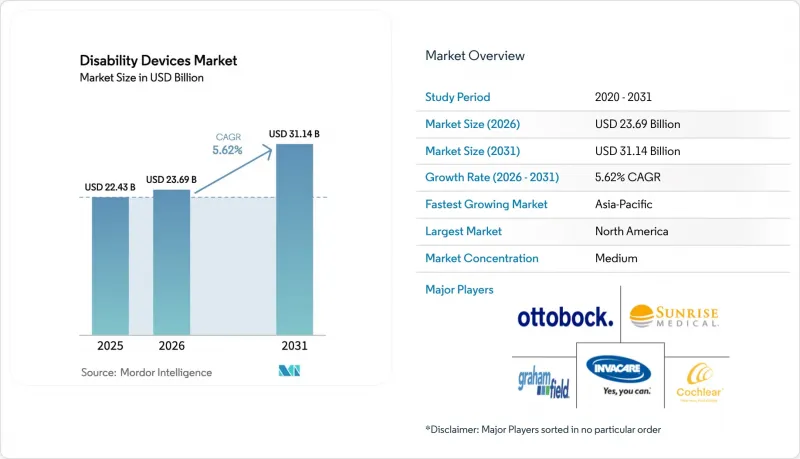
Mordor Intelligence에 의하면, 장애인용 기기 시장 규모는 2025년 224억 3,000만 달러에서 2026년에는 236억 9,000만 달러로 확대되어 2026년부터 2031년까지 CAGR 5.62%로 성장을 지속하여, 2031년에는 311억 4,000만 달러에 이를 것으로 예측됩니다.
본 보고서는 기기 유형(시각 보조 기기 등), 최종 사용자(재택 간호 환경 등), 유통 채널(소매 약국·의료기기 전문점, 전자상거래 플랫폼, 소비자 직접 판매), 지역(북미, 유럽, 아시아태평양, 중동 및 아프리카, 남미)별로 분류되어 있습니다. 시장 전망은 금액(달러) 기준으로 제시되어 있습니다.
전 세계 장애인용 기기 시장 동향 및 인사이트
노화에 따른 장애 유병률 증가
인구 고령화는 장애인용 기기 시장에 있어 가장 강력한 구조적 촉진요인입니다. 세계보건기구(WHO)의 예측에 따르면, 2050년까지 전 세계 60세 이상 인구는 21억 명에 달할 것이며, 70세 이상 성인의 약 70%가 임상적으로 유의미한 난청을 경험할 것으로 예측됩니다. 일본의 초고령화 사회(국민의 29%가 이미 65세 이상)는 기기 이용률 증가를 여실히 보여주고 있습니다. 2025년에는 전국적으로 약 120만 대의 보청기가 처방될 것으로 예상되며, 이는 미국에서 관찰되는 1인당 처방률의 거의 2배에 해당합니다. 고령자의 여러 동반 질환(뇌졸중, 퇴행성 관절염, 당뇨병성 신경병증 등)으로 인해, 낙상 감지, 복약 알림, 긴급 연락 기능을 결합한 다중 모드 플랫폼에 대한 수요가 가속화되고 있습니다. 따라서 이러한 기능을 단일 인터페이스로 통합할 수 있는 공급업체야말로 시장 점유율을 확보하는 데 가장 유리한 입장에 있습니다. 장기적으로는 인구 동향의 추세에 힘입어 최소 1.2퍼센트포인트의 안정적인 기준 성장률이 확보되어 전체 연평균 성장률(CAGR)에 기여하게 될 것입니다.
보조 기술에 대한 정부의 유리한 보험 지급 정책
보험 적용 범위의 확장으로 인해 고급 기기에 대한 접근성이 확대되고 있습니다. 미국에서는 메디케어가 2025년에 내구성 의료장비, 의지, 보조기 및 소모품 청구액으로 80억 달러 이상을 처리했습니다. 또한, 2024년 규정 개정을 통해 1,500달러 미만의 시판용 보청기 구매가 허용됨에 따라 수급자의 본인 부담금이 약 40% 감소했습니다. 독일의 법정 보험사는 보청기에 대해 6년마다 최대 1,500유로(1,650달러)를 지급하는 반면, 프랑스에서는 의수·의족 비용에 대해 상한 2,500유로(2,750달러)의 60%를 지급하고 있습니다. 이러한 급여 상한선은 가격대를 결정짓고, 제조업체로 하여금 지급 기관의 기준에 맞춘 단계적인 제품 포트폴리오 개발을 강요하고 있습니다. ISO 13485 인증은 시장 진입의 관문으로서 그 역할을 점점 더 많이 수행하고 있으며, 소규모 혁신 기업들을 기존 수탁 제조업체와의 전략적 제휴로 이끌고 있습니다.
첨단 보조 기기의 높은 초기 비용
많은 지역에서 고급 보조 기기는 여전히 가구 소득에 비해 비쌉니다. 마이크로프로세서 제어 대퇴 절단용 의족은 50,000-10만 달러, 인공 와우 시스템은 수술비를 제외하고 30,000-5만 달러의 비용이 듭니다. 세계보건기구(WHO)의 추정에 따르면, 보조 기술이 필요한 사람들의 90%가 주로 높은 비용을 이유로 이를 이용하지 못하고 있는 것으로 나타났습니다. 고소득 시장에서도 메디케어의 본인 부담 제도에 따라 수급자는 DMEPOS 비용의 20%를 부담해야 하며, 전동 휠체어의 경우 3,000-6,000달러에 해당합니다. 이러한 비용 부담이 재생 제품의 2차 시장을 활성화시키고 있지만, 책임 문제와 표준적인 품질 관리 프로토콜의 부재로 인해 여전히 공급이 제한되고 있습니다.
부문 분석
의사소통 보조 기기는 2026년부터 2031년까지 연평균 성장률(CAGR) 7.54%를 나타낼 것으로 예측되며, 이는 교실과 사무실에서 보조 및 대체 의사소통 플랫폼의 보급을 반영한 것입니다. 음성 생성 기기에 시선 추적, 자연어 처리, 클라우드 기반 어휘 업데이트 기능이 통합됨에 따라, 의사소통 지원 기기의 장애인용 기기 시장 규모는 2031년까지 60억 달러를 넘어설 것으로 예측됩니다. Tobii Dynavox사는 북미 학군과의 제휴에 이어, 2024년 출하 대수가 전년 대비 22% 증가했다고 보고했습니다. 이동 지원 기기는 2025년에 장애인용 기기 시장 점유율의 34.34%를 차지하며, 수동 휠체어에서 좁은 복도나 단차를 자율 주행할 수 있는 고성능 센서가 탑재된 전동 모델로 전환되고 있습니다. 2024년 후반에 출시된 Permobil사의 ‘M5 Corpus’는 LiDAR(라이더) 기반의 충돌 회피 기능과 GPS 경로 안내 기능을 갖추고 있어 이러한 변화를 상징하는 제품입니다.
보청기 수요는 한 쌍당 200-1,500달러의 시판형 기기가 보급되면서 이용의 문이 넓어지고 있어 계속해서 견조한 추세를 보이고 있습니다. 소노바(Sonova)사의 ‘Sphere Infinio’는 AI 음성 강화 칩을 내장한 최초의 보청기로, 소음이 많은 환경에서도 10데시벨의 청취 개선을 실현하고 배터리 사용 시간을 36시간으로 연장했습니다. 시각 보조 기기는 기존의 확대경에서 텍스트 번역이나 얼굴 인식이 가능한 ‘OrCam MyEye’와 같은 AI 탑재 웨어러블 기기로 진화하고 있습니다. 적응형 식기나 선명한 색상의 약통이 주류를 이루는 일상생활 지원 기기는 여전히 시장이 세분화되어 있지만, ‘재택 고령화’ 시나리오에서 주목받고 있으며, 블루투스 지원 복약 알림 기능이 재입원율 감소에 기여하고 있습니다.
지역별 분석
2025년, 북미는 장애인용 기기 시장 매출의 43.54%를 차지했습니다. 이는 메디케어(Medicare)의 연간 80억 달러 규모의 DMEPOS(의료기기·소모품·서비스) 지출과, 재향군인부의 900만 재향군인에 대한 의수·의족 급여에 힘입은 결과입니다. 1인당 의료비 수준이 높고, 청구 코드가 잘 갖춰져 있으며, FDA(미국 식품의약국)의 신속한 기술 인증 절차 덕분에 획기적인 보조 기기 시장 출시가 가속화되고 있습니다. 그러나 도시 지역의 보급률이 정체되고, 보상 모델이 기기 판매량 대신 기능적 성과를 평가하는 가치 기반 계약으로 전환됨에 따라 성장세는 점차 완만해지고 있습니다.
아시아태평양은 중국, 일본, 인도가 급속한 인구 고령화에 직면해 있어, 2031년까지의 연평균 성장률(CAGR)이 6.43%로 가장 높은 성장률을 나타낼 것으로 예측됩니다. 중국의 60세 이상 인구는 2025년에 2억 8,000만 명에 달하고, 2035년까지 4억 명을 넘어설 것으로 예측됩니다. 이에 따라 ‘배리어프리 환경 조성법’에 근거하여 지자체의 경사로 및 점자 블록 조달이 증가하고 있습니다. 일본에서는 저소득층 고령자에게 보청기 비용의 최대 90%를 보조하고 있으며, 이로 인해 일본은 1인당 보청기 소비량이 세계 1위를 기록하고 있습니다. 인도에서는 빈곤선 이하 가구에 대해 보청기 비용의 최대 50%를 환급하고 있지만, 상한액 설정으로 인해 고성능 수입 제품에 대한 접근은 제한되고 있습니다. 스마트 기기의 보급률은 유럽 및 미국보다 낮지만, 비용 절감을 꾀한 수동식 보청기의 판매량 증가가 제품 구성의 차이를 상쇄하고 있습니다.
2025년 매출액 중 유럽이 28%를 차지했습니다. 환급 제도는 국가마다 다릅니다. 독일에서는 6년마다 보청기 1대당 1,500유로가 지급되는 반면, 프랑스에서는 보청기 비용의 60%(상한 2,500유로)가 지원됩니다. 의료기기 규정(MDR)으로 인해 규정 준수 비용은 증가했으나, 추적성과 시판 후 감시는 개선되고 있습니다. 중동 및 아프리카와 남미를 합친 매출 비중은 약 10%였습니다. 이는 주로 보험 보급률이 낮고 공급망이 세분화되어 있기 때문입니다. 브라질의 ‘포용법’에서는 직장에서의 합리적 배려가 의무화되어 있으나, 주요 도시 이외 지역에서의 이행 상황은 여전히 고르지 않습니다.
기타 혜택:
- 엑셀 형식 시장 예측(ME) 시트
- 3개월간의 애널리스트 지원
자주 묻는 질문
목차
제1장 서론
제2장 조사 방법
제3장 주요 요약
제4장 시장 구도
제5장 시장 규모와 성장 예측
제6장 경쟁 구도
제7장 시장 기회와 향후 전망
JHS 26.08.28According to Mordor Intelligence, the disability devices market size is expected to grow from USD 22.43 billion in 2025 to USD 23.69 billion in 2026 and is forecast to reach USD 31.14 billion by 2031 at a 5.62% CAGR over 2026-2031.
This report is Segmented by Device Type (Vision Aids, and More), End User (Home Care Settings, and More), Distribution Channel (Retail Pharmacies & DME Stores, E-Commerce Platforms, and Direct-To-Customer), and Geography (North America, Europe, Asia-Pacific, Middle East and Africa, and South America). The Market Forecasts are Provided in Terms of Value (USD).
Global Disability Devices Market Trends and Insights
Increasing Prevalence of Age-Related Disabilities
Population aging is the strongest structural driver for the disability devices market. The World Health Organization projects that the global 60-plus cohort will reach 2.1 billion by 2050, with approximately 70% of adults over 70 experiencing clinically significant hearing loss. Japan's super-aged profile (29% of citizens already over 65) illustrates rising device intensity; roughly 1.2 million hearing aids were dispensed nationwide in 2025, nearly double the per-capita rate observed in the United States. Multiple comorbidities among older adults (stroke, osteoarthritis, diabetic neuropathy) are accelerating demand for multimodal platforms that combine fall detection, medication reminders, and emergency communication. Vendors capable of bundling such capabilities within a single interface are therefore best positioned to capture wallet share. Over the long term, demographic momentum ensures a stable baseline growth rate of at least 1.2 percentage points, contributing to the overall CAGR.
Favorable Government Reimbursement Policies for Assistive Technologies
Coverage expansion is widening access to premium devices. In the United States, Medicare processed more than USD 8 billion in Durable Medical Equipment, Prosthetics, Orthotics, and Supplies claims in 2025, and its 2024 rule change allowing over-the-counter hearing aids priced below USD 1,500 cut beneficiary out-of-pocket spending by roughly 40%. Germany's statutory insurers reimburse up to EUR 1,500 (USD 1,650) every six years for hearing aids, while France covers 60% of prosthetic costs up to EUR 2,500 (USD 2,750). Such reimbursement ceilings establish price bands and compel manufacturers to develop tiered product portfolios that align with payer thresholds. ISO 13485 certification increasingly serves as a gatekeeper for market entry, nudging small innovators toward strategic partnerships with established contract manufacturers.
High Upfront Cost of Advanced Assistive Devices
Premium aids remain expensive relative to household income in many regions. Microprocessor-controlled transfemoral limbs cost USD 50,000 to USD 100,000, while cochlear implant systems cost USD 30,000 to USD 50,000 before surgical fees. The World Health Organization estimates that 90% of people needing assistive technology lack access, primarily due to the high cost. Even in high-income markets, Medicare coinsurance requires beneficiaries to cover 20% of DMEPOS costs, translating to a range of USD 3,000-6,000 for a power wheelchair. This expense is driving a secondary market for refurbished devices, but liability concerns and lack of standard quality protocols continue to constrain supply.
Other drivers and restraints analyzed in the detailed report include:
- Rapid Advancements in Assistive Sensor and IoT Integration
- Growing Adoption of 3D-Printed Personalized Prosthetics
- Limited Insurance Coverage in Low- and Middle-Income Countries
For complete list of drivers and restraints, kindly check the Table Of Contents.
Segment Analysis
Communication Aids are expected to register a 7.54% CAGR from 2026 to 2031, reflecting the mainstreaming of augmentative and alternative communication platforms within classrooms and offices. The disability devices market size for Communication Aids is forecast to surpass USD 6 billion by 2031, as speech-generating devices integrate eye-tracking, natural language processing, and cloud-based vocabulary updates. Tobii Dynavox reported a 22% year-over-year increase in shipments in 2024, following its partnership with North American school districts. Mobility Aids, despite holding 34.34% of the disability devices market share in 2025, are transitioning from manual wheelchairs to sensor-rich power models that self-navigate narrow corridors and curb cuts. Permobil's M5 Corpus, launched late 2024, exemplifies the shift with LiDAR-based collision avoidance and GPS routing.
Demand for Hearing Aids remains buoyant as over-the-counter devices, priced at USD 200-1,500 per pair, widen access. Sonova's Sphere Infinio, the first hearing aid with an on-board AI speech-enhancement chip, delivers a 10-decibel improvement in background noise environments and extends battery life to 36 hours. Vision Aids are evolving from legacy magnifiers to AI-enabled wearables such as OrCam MyEye that translate text and identify faces. Daily living aids, dominated by adaptive utensils and bright pill dispensers, retain fragmentation but gain traction in aging-in-place scenarios, where Bluetooth medication reminders help lower hospital readmissions.
Complete Report Scope:
- By Device Type
- Vision Aids
- Braille Devices
- Screen Readers & Magnifiers
- Smart Glasses & Wearables
- Hearing Aids
- Behind-The-Ear
- In-The-Ear
- Bone-Anchored
- Mobility Aids
- Manual Wheelchairs
- Power Wheelchairs
- Mobility Scooters
- Prosthetics & Orthotics
- Communication Aids
- Daily Living Aids
- Other Device Types
- Vision Aids
- By End User
- Home Care Settings
- Hospitals
- Ambulatory Care Centers
- Rehabilitation Centers
- Long-Term Care Facilities
- Educational Institutions
- Workplace Settings
- By Distribution Channel
- Retail Pharmacies & DME Stores
- E-Commerce Platforms
- Direct-To-Customer (Company Owned)
- Geography
- North America
- United States
- Canada
- Mexico
- Europe
- Germany
- United Kingdom
- France
- Italy
- Spain
- Rest Of Europe
- Asia-Pacific
- China
- Japan
- India
- Australia
- South Korea
- Rest Of Asia-Pacific
- Middle East And Africa
- GCC
- South Africa
- Rest Of Middle East And Africa
- South America
- Brazil
- Argentina
- Rest Of South America
- North America
Geography Analysis
North America contributed 43.54% of disability devices market revenue in 2025, underpinned by Medicare's USD 8 billion annual DMEPOS spend and the Department of Veterans Affairs' prosthetic benefits for 9 million veterans. High per-capita health expenditure, robust billing codes, and the FDA's expedited Technology Certification pathway speed time to market for breakthrough aids. Growth is moderating, however, as urban penetration plateaus and reimbursement models shift toward value-based contracting, which rewards functional outcomes instead of device volume.
The Asia-Pacific region is expected to record the fastest growth, with a 6.43% CAGR through 2031, as China, Japan, and India confront rapid demographic aging. China's population aged 60 and above reached 280 million in 2025 and is expected to surpass 400 million by 2035, prompting increased municipal procurement of ramps and tactile paving under the Barrier-Free Environment Construction Law. Japan subsidizes up to 90% of device costs for low-income seniors, making it the world's highest per-capita consumer of hearing aids. India reimburses up to 50% of aid costs for households below the poverty line, though caps limit access to advanced imports. Smart-device penetration is lower than in the West, but volume growth from cost-engineered manual aids offsets the mix.
Europe accounted for 28% of 2025 revenue. Reimbursement differs by nation; Germany offers EUR 1,500 per hearing aid every six years, while France covers 60% of prosthetic costs up to EUR 2,500. The Medical Device Regulation raises compliance costs yet improves traceability and post-market vigilance. The Middle East, Africa, and South America collectively accounted for approximately 10% of sales, largely due to low insurance penetration and fragmented supply chains. Brazil's Inclusion Law mandates workplace accommodations, but enforcement outside major cities remains patchy.
- Advanced Bionics LLC
- Cochlear
- Demant
- Drive DeVilbiss Healthcare
- GF Health Products
- GN Store Nord
- Invacare
- MED-EL
- Merits Health Products
- Meyra
- Ottobock
- Permobil AB
- Pride Mobility Products
- ReSound GN
- Sivantos Inc. (Signia)
- Sonova
- Starkey Hearing Technologies
- Sunrise Medical
- Whisper
- Widex A/S
Additional Benefits:
- The market estimate (ME) sheet in Excel format
- 3 months of analyst support
TABLE OF CONTENTS
1 Introduction
- 1.1 Study Assumptions & Market Definition
- 1.2 Scope Of The Study
2 Research Methodology
3 Executive Summary
4 Market Landscape
- 4.1 Market Overview
- 4.2 Market Drivers
- 4.2.1 Increasing Prevalence of Age-Related Disabilities
- 4.2.2 Favorable Government Reimbursement Policies for Assistive Technologies
- 4.2.3 Rapid Advancements in Assistive Sensor and IoT Integration
- 4.2.4 Growing Adoption of 3D-Printed Personalized Prosthetics
- 4.2.5 Expansion of Universal Design Mandates in Emerging Economies
- 4.2.6 Venture Capital Funding Surge in Neuro-Prosthetic Start-Ups
- 4.3 Market Restraints
- 4.3.1 High Upfront Cost of Advanced Assistive Devices
- 4.3.2 Limited Insurance Coverage in Low-And-Middle Income Countries
- 4.3.3 Interoperability Gaps Between Legacy Aids and Smart Home Ecosystems
- 4.3.4 Shortage of Trained Assistive Technology Specialists
- 4.4 Value / Supply-Chain Analysis
- 4.5 Regulatory Landscape
- 4.6 Technological Outlook
- 4.7 Porter's Five Forces Analysis
- 4.7.1 Threat Of New Entrants
- 4.7.2 Bargaining Power Of Buyers / Consumers
- 4.7.3 Bargaining Power Of Suppliers
- 4.7.4 Threat Of Substitute Products
- 4.7.5 Intensity Of Competitive Rivalry
5 Market Size & Growth Forecasts (Value, USD)
- 5.1 By Device Type
- 5.1.1 Vision Aids
- 5.1.1.1 Braille Devices
- 5.1.1.2 Screen Readers & Magnifiers
- 5.1.1.3 Smart Glasses & Wearables
- 5.1.2 Hearing Aids
- 5.1.2.1 Behind-The-Ear
- 5.1.2.2 In-The-Ear
- 5.1.2.3 Bone-Anchored
- 5.1.3 Mobility Aids
- 5.1.3.1 Manual Wheelchairs
- 5.1.3.2 Power Wheelchairs
- 5.1.3.3 Mobility Scooters
- 5.1.3.4 Prosthetics & Orthotics
- 5.1.4 Communication Aids
- 5.1.5 Daily Living Aids
- 5.1.6 Other Device Types
- 5.1.1 Vision Aids
- 5.2 By End User
- 5.2.1 Home Care Settings
- 5.2.2 Hospitals
- 5.2.3 Ambulatory Care Centers
- 5.2.4 Rehabilitation Centers
- 5.2.5 Long-Term Care Facilities
- 5.2.6 Educational Institutions
- 5.2.7 Workplace Settings
- 5.3 By Distribution Channel
- 5.3.1 Retail Pharmacies & DME Stores
- 5.3.2 E-Commerce Platforms
- 5.3.3 Direct-To-Customer (Company Owned)
- 5.4 Geography
- 5.4.1 North America
- 5.4.1.1 United States
- 5.4.1.2 Canada
- 5.4.1.3 Mexico
- 5.4.2 Europe
- 5.4.2.1 Germany
- 5.4.2.2 United Kingdom
- 5.4.2.3 France
- 5.4.2.4 Italy
- 5.4.2.5 Spain
- 5.4.2.6 Rest Of Europe
- 5.4.3 Asia-Pacific
- 5.4.3.1 China
- 5.4.3.2 Japan
- 5.4.3.3 India
- 5.4.3.4 Australia
- 5.4.3.5 South Korea
- 5.4.3.6 Rest Of Asia-Pacific
- 5.4.4 Middle East And Africa
- 5.4.4.1 GCC
- 5.4.4.2 South Africa
- 5.4.4.3 Rest Of Middle East And Africa
- 5.4.5 South America
- 5.4.5.1 Brazil
- 5.4.5.2 Argentina
- 5.4.5.3 Rest Of South America
- 5.4.1 North America
6 Competitive Landscape
- 6.1 Market Concentration
- 6.2 Strategic Moves
- 6.3 Market Share Analysis
- 6.4 Company Profiles (Includes Global Level Overview, Market Level Overview, Core Segments, Financials As Available, Strategic Information, Market Rank/Share For Key Companies, Products & Services, And Recent Developments)
- 6.4.1 Advanced Bionics LLC
- 6.4.2 Cochlear Limited
- 6.4.3 Demant A/S
- 6.4.4 Drive DeVilbiss Healthcare
- 6.4.5 GF Health Products Inc.
- 6.4.6 GN Store Nord A/S
- 6.4.7 Invacare Corporation
- 6.4.8 MED-EL Medical Electronics
- 6.4.9 Merits Health Products Co., Ltd.
- 6.4.10 Meyra GmbH
- 6.4.11 Ottobock SE & Co. KGaA
- 6.4.12 Permobil AB
- 6.4.13 Pride Mobility Products Corp.
- 6.4.14 ReSound GN
- 6.4.15 Sivantos Inc. (Signia)
- 6.4.16 Sonova Holding AG
- 6.4.17 Starkey Hearing Technologies
- 6.4.18 Sunrise Medical LLC
- 6.4.19 Whisper
- 6.4.20 Widex A/S
7 Market Opportunities & Future Outlook
- 7.1 White-Space & Unmet-Need Assessment


