

|
시장보고서
상품코드
2097256
식품 알레르기 : 시장 점유율 분석, 업계 동향 및 통계, 성장 예측(2025-2030년)Food Allergy - Market Share Analysis, Industry Trends & Statistics, Growth Forecasts (2025 - 2030) |
||||||
 Mordor Intelligence
Mordor Intelligence에 의하면, 세계의 식품 알레르기 시장 규모는 2025년에 418억 8,000만 달러로 평가되었고, 2030년까지 546억 8,000만 달러에 이를 것으로 예측되며, 2025-2030년 CAGR 5.48%로 성장할 전망입니다.
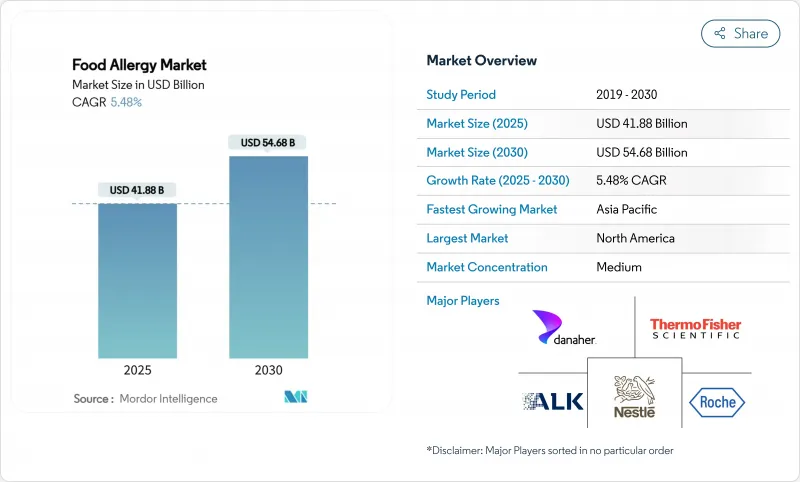
본 보고서는 제품 유형별(진단약, 치료제, 알레르기 유발 물질 무함유 식품), 알레르기 유발 물질 유형별(땅콩, 견과류, 우유, 달걀, 밀·글루텐, 대두, 생선, 갑각류, 참깨, 기타 신흥 알레르겐), 최종 사용자별(병원 및 진료소, 진단 검사 기관 등), 지역별(북미, 유럽 등)로 분류되어 있습니다. 시장 전망은 금액(달러) 기준으로 제시되어 있습니다.
세계의 식품 알레르기 시장 동향 및 인사이트
소아 및 성인의 식품 알레르기 유병률 증가
잉글랜드의 아나필락시스 관련 입원 건수는 2002-03 회계연도의 1만 2,361건에서 2022-23 회계연도에는 2만 5,721건으로 증가했으며, 미국의 연간 경제적 부담은 현재 248억 달러에 달할 전망입니다. 도시화, 서유럽화된 식생활, 그리고 미생물군집의 변화로 인해 아시아태평양 전체에서 감작률이 상승하고 있으며, 이 지역에서는 현재 갑각류가 주요 유발 요인으로 작용하고 있습니다. 테티스 세포를 규명한 기전 연구를 통해 경구 내성을 확립하기 위한 발달상의 적기가 확인되었으며, 고위험 영아를 대상으로 한 예방 요법이 등장할 가능성이 시사되고 있습니다. 유병률 증가에 따라 보호자들은 일시적인 응급 의료에서 지속적인 위험 완화 조치로 전환하고 있으며, 이러한 추세는 진단, 디지털 코칭, 예방 치료에 대한 총 잠재 수요를 확대시키고 있습니다. 그 결과, 다중 알레르겐 대응 제품 파이프라인 및 모니터링 도구가 벤처 투자자들에게 점점 더 매력적으로 다가오며, 식품 알레르기 시장의 성장세를 뒷받침하고 있습니다.
전 세계 식품 알레르기 유발 물질 표시 규제의 강화
미국 FASTER법에 따라 2023년에 참깨가 9번째 주요 알레르기 유발 물질로 추가되었으며, 제조업체에게는 교차 오염 관리 및 공급망 재구축이 의무화되었습니다. 캐나다, 영국 및 아시아 일부 지역에서도 유사한 확대 조치가 검토되고 있으나, 규제 목록은 국가마다 달라 다국적 브랜드들은 서로 다른 규정 준수 기준에 대응해야 하는 상황에 직면해 있습니다. 일부 미국 제과업체에서는 세척 비용을 피하기 위해 의도적으로 참깨를 첨가하는 방식을 선택하고 있는데, 이는 규제 집행의 미비점을 드러내며 지원 단체들의 활동을 다시 활성화시키고 있습니다. 이러한 불일치로 인해 실험실에서의 단백질 스크리닝, 인라인 센서, 그리고 지역별 기준치를 통합할 수 있는 기업용 알레르기 유발 물질 관리 소프트웨어에 대한 수요가 증가하고 있습니다. 비용 압박에 직면한 중소규모 식품 가공업체들은 검증 시험을 제3자 검사 기관에 위탁하는 경향이 강해지고 있으며, 이로 인해 식품 알레르기 시장의 진단 분야 주요 기업들의 수주량이 확대되고 있습니다.
생물학적 제제/면역 요법의 높은 비용과 제한된 보험 환급
오말리주맙의 연간 치료비는 5,000-1만 5,000달러에 달하며, 이 수준은 많은 민간 및 공적 보험의 보장 범위를 초과하기 때문에 경제적으로 여유가 있는 계층 이외에는 보급이 제한되고 있습니다. 경구 면역요법(OIT) 센터에서는 보험 환급액이 낮거나 인력 부족으로 인해 500명 이상의 환자가 대기 명단에 이름을 올리고 있는 것으로 보고되고 있습니다. 의료 경제 모델에 따르면, 땅콩에 대한 경구 면역 요법(OIT)의 연간 비용은 1,235-6,568달러로 산출되지만, 보험사가 충분히 인식하지 못하고 있는 삶의 질(QOL) 향상이 강조되고 있습니다. 수년에 걸친 치료 성과 데이터가 지급 기관의 판단을 바꾸기 전까지, 제약사들은 환자 지원 프로그램을 전개하고 가치 기반 계약 검토를 진행하고 있습니다. 보험 적용 범위가 확대되지 않는 한, 생물학적 제제는 3차 의료 기관으로 한정된 채로 남을 위험이 있으며, 이는 식품 알레르기 시장의 단기적인 성장을 둔화시킬 우려가 있습니다.
부문 분석
2024년, 진단약은 식품 알레르기 시장에서 44.62%의 점유율을 차지했습니다. 이는 널리 보급된 피부 프릭 테스트, 혈청 IgE 측정, 그리고 새롭게 등장한 호염기구 활성화 검사에 힘입은 결과입니다. 검사 건수는 검사 위탁 기관, 병원 알레르기 외래, 그리고 검체 지참 서비스를 도입한 소매 약국을 통해 확대되고 있습니다. 다항목·성분 분해형 패널의 채택으로 인해 보다 상세한 위험 프로파일을 얻을 수 있게 되었으며, 정밀한 투여량 결정이 지원되고 있습니다. 동시에, 치료제 부문은 2030년까지 연평균 성장률(CAGR) 8.38%를 나타낼 것으로 예측되며, 바이오의약품, 경피 패치, 비강용 에피네프린 스프레이 등이 치료 선택지를 넓힘으로써 식품 알레르기 시장 전체의 규모 확대를 가속화할 것으로 전망됩니다. 오말리주맙의 출시는 차세대 후보 약물의 청사진이 되는 한편, DBV 테크놀로지스의 ‘Viaskin’ 패치는 소아 탈감작 치료 분야에서 입지를 넓혀가고 있습니다. 포트폴리오의 확대는 질환 수정 요법으로의 장기적인 전환을 시사하며, 궁극적으로는 진단 분야의 수익원을 능가할 가능성이 있습니다.
치료법의 혁신은 업계를 초월한 협력도 촉진하고 있습니다. 제약업계의 주요 기업들은 투여량 증량 일정을 개인화하고, 호산구 식도염의 위험을 예측하는 머신러닝 플랫폼의 라이선스를 취득하고 있습니다. 디지털 테라퓨틱스 기업들은 복약 순응도를 높이는 기능과 실시간 증상 기록 기능을 통합하여, 규제 당국에 대한 신청 및 보험사와의 협상에 도움이 되는 데이터 흐름을 창출하고 있습니다. 하드웨어, 소프트웨어, 생물학적 제제 간의 이러한 상호작용이 경쟁 구도를 재편하고 있으며, 투자자들은 플랫폼 간의 시너지 효과를 지속적인 서비스 수익으로 이어지는 길로 보고 있습니다. 2030년까지 진단 모니터링과 치료 제공을 결합한 통합 케어 번들이 보험사의 처방약 목록을 주도하며, 식품 알레르기 시장에서 가치를 창출하는 방식을 재정의할 가능성이 있습니다.
지역별 분석
북미는 2024년 식품 알레르기 시장 매출의 36.72%를 차지했습니다. 연방법, 에피네프린 자동 주사기에 대한 광범위한 보험 적용, 그리고 성분 분해 진단법의 조기 도입이 이 지역의 선도적 지위를 뒷받침하고 있습니다. 시장 확대는 학교 내 아나필락시스 대응 프로토콜과 적극적인 환자 옹호 활동에 의해 더욱 가속화되고 있으며, 이러한 요인들이 결합되어 높은 진단율을 유지하고 보험사의 생물학적 제제 보험 적용 시도를 촉진하고 있습니다.
유럽은 규제 체계 측면에서 북미와 유사한 수준을 보이고 있으나, 보험 급여 제도에는 더 큰 편차가 나타납니다. 독일이나 네덜란드 등의 국가들은 공중보건 예산이 여전히 부족한 남유럽 국가들에 비해 경구 면역 요법(OIT) 및 생물학적 제제의 보험 적용을 더 관대하게 시행하고 있습니다. 유럽의 예방적 알레르기 유발 물질 표시(PAL) 제도는 전 세계 포장 기준에 영향을 미치며, 다국적 식품 브랜드들이 선진적인 알레르기 유발 물질 관리 기술을 우선 이 지역에서 시범적으로 도입하도록 촉진하고 있습니다.
아시아태평양은 급속한 도시화, 식생활의 서유럽화, 그리고 갑각류에 대한 감작 증가에 힘입어 2030년까지 연평균 성장률(CAGR)이 7.49%로 가장 높은 성장세를 보이고 있습니다. 그러나 에피네프린 자동 주사기의 접근성이 제한적이고 전문 진료 클리닉도 부족하여 치료 격차가 발생하고 있습니다. 싱가포르와 중국의 도시 지역 민간 보험사들은 현재 오말리주맙에 대한 보험 적용을 시범적으로 도입하고 있으며, 이는 향후 첨단 치료법으로의 전환이 진행될 것임을 시사합니다. 남미, 중동 및 아프리카는 일반인의 인지도가 낮고 보험 환급에 대한 장벽이 있어 다른 지역에 뒤처져 있지만, 전 세계 기업들이 식품 알레르기 시장에서 미개척 수요층을 모색하는 가운데, 이들 지역은 여전히 거대한 미개척 시장 기회를 내포하고 있습니다.
기타 혜택 :
- 엑셀 형식 시장 예측(ME) 시트
- 3개월간의 애널리스트 지원
자주 묻는 질문
목차
제1장 서론
제2장 조사 방법
제3장 주요 요약
제4장 시장 구도
제5장 시장 규모 및 성장 예측
제6장 경쟁 구도
제7장 시장 기회 및 향후 전망
KTH 26.08.05According to Mordor Intelligence, the global food allergy market size stands at USD 41.88 billion in 2025 and is forecast to reach USD 54.68 billion by 2030, expanding at a 5.48% CAGR during 2025-2030.
This report is Segmented by Offering (Diagnostics, Therapeutics, Allergen-Free Food Products), Allergen Type (Peanut, Tree Nut, Cow's Milk, Egg, Wheat & Gluten, Soy, Fish, Shellfish, Sesame, Other Emerging Allergens), End User (Hospitals & Clinics, Diagnostic Laboratories, and More), and Geography (North America, Europe and More). The Market Forecasts are Provided in Terms of Value (USD).
Global Food Allergy Market Trends and Insights
Rising Prevalence of Food Allergies in Children & Adults
Hospitalizations for anaphylaxis in England climbed from 12,361 in 2002-03 to 25,721 in 2022-23, and U.S. annual economic burden is now USD 24.8 billion. Urbanization, westernized diets, and microbiome alterations are escalating sensitization rates across Asia-Pacific, where shellfish now ranks as the dominant trigger. Mechanistic research pinpointing Thetis cells confirms a developmental window for establishing oral tolerance, suggesting that prophylactic therapies could emerge for high-risk infants. As prevalence rises, caregivers are shifting from episodic emergency care toward continuous risk-mitigation solutions, a trend that expands total addressable demand for diagnostics, digital coaching, and prophylactic treatments. Consequently, multi-allergen product pipelines and monitoring tools are growing more attractive to venture investors, reinforcing momentum in the food allergy market.
Stricter Global Food-Allergen Labeling Regulations
The U.S. FASTER Act added sesame as the 9th major allergen in 2023, obliging manufacturers to manage cross-contact and reformulate supply chains. Similar expansions are under review in Canada, the United Kingdom, and parts of Asia, yet regulatory lists vary, forcing multinational brands to juggle divergent compliance codes. Some U.S. bakeries opted to deliberately add sesame to avoid cleaning costs, exposing enforcement gaps and re-energizing advocacy groups. These discrepancies raise demand for lab-based protein screening, inline sensors, and enterprise allergen-management software capable of harmonizing region-specific thresholds. Small and midsize food processors, facing cost pressures, increasingly outsource validation testing to third-party labs, reinforcing volumes for diagnostics leaders within the food allergy market.
High Cost & Limited Reimbursement for Biologics/Immunotherapy
Annual omalizumab therapy ranges from USD 5,000-15,000, levels that outstrip many private or public coverage schedules and restrict uptake outside wealthier cohorts.Oral immunotherapy centers report waiting lists of 500 + patients owing to low reimbursement and staffing constraints. Health-economic models price peanut OIT from USD 1,235-6,568 per year but highlight quality-of-life gains that insurers underrecognize. Until multi-year outcome data sway payers, manufacturers deploy patient-assistance programs and explore value-based contracts. Without broader coverage, biologics risk remaining confined to tertiary centers, tempering near-term growth in the food allergy market.
Other drivers and restraints analyzed in the detailed report include:
- Rapid Adoption of Component-Resolved & At-Home Diagnostics
- FDA/EMA Approvals of First-in-Class Biologics & OIT Products
- Patient Drop-Outs Due to Adverse Events & Adherence Concerns
For complete list of drivers and restraints, kindly check the Table Of Contents.
Segment Analysis
Diagnostics held a 44.62% share of the food allergy market in 2024, underpinned by widespread skin-prick tests, serum IgE assays, and the emerging basophil activation test. Volumes are expanding through reference labs, hospital allergy clinics, and retail pharmacies that added drop-off sample services. Adoption of multiplex, component-resolved panels yields richer risk profiles and supports precision dosing. Simultaneously, the therapeutics category is forecast to post an 8.38% CAGR through 2030, accelerating the overall food allergy market size as biologics, epicutaneous patches, and nasal epinephrine spray widen treatment options. Omalizumab's launch provides a blueprint for next-generation candidates, while DBV Technologies' Viaskin patch builds momentum in pediatric desensitization. Portfolio expansion signals a long-term migration toward disease-modifying regimens that could eventually eclipse diagnostic revenue streams.
Therapeutic innovation is also fostering cross-sector collaboration. Pharmaceutical leaders are licensing machine-learning platforms that individualize updosing schedules and predict eosinophilic esophagitis risk. Digital therapeutics firms embed adherence nudges and real-time symptom logs, creating data flows that inform regulatory submissions and payer negotiations. This interplay of hardware, software, and biologics is reshaping competitive positioning, and investors view platform synergies as a route to recurring service revenue. By 2030, integrated care bundles that couple diagnostic monitoring with therapeutic delivery may dominate payer formularies and redefine value capture within the food allergy market.
Complete Report Scope:
- By Offering
- Diagnostics
- In Vivo Tests
- Skin-Prick Test
- Oral Food Challenge
- In Vitro Tests
- Immunoassay (IgE, sIgG)
- Molecular Diagnostics
- In Vivo Tests
- Therapeutics
- Pharmacotherapy
- Antihistamines
- Epinephrine Auto-Injectors
- Immunotherapy
- Oral Immunotherapy (OIT)
- Sublingual Immunotherapy (SLIT)
- Epicutaneous Immunotherapy (EPIT)
- Biologics (anti-IgE, anti-IL-4/13)
- Emerging Therapies (DNA vaccines, nanoparticle-AIT)
- Pharmacotherapy
- Allergen-Free Food Products
- Dairy Alternatives
- Gluten-Free Products
- Plant-Based Protein Alternatives
- Diagnostics
- By Allergen Type
- Peanut
- Tree Nut
- Cow's Milk
- Egg
- Wheat & Gluten
- Soy
- Fish
- Shellfish
- Sesame
- Other Emerging Allergens
- By End User
- Hospitals & Clinics
- Diagnostic Laboratories
- Specialty Allergy Centers
- Home & Self-Testing Consumers
- Research & Academic Institutes
- Food & Beverage Manufacturers
- By Geography
- North America
- United States
- Canada
- Mexico
- Europe
- Germany
- United Kingdom
- France
- Italy
- Spain
- Rest of Europe
- Asia-Pacific
- China
- Japan
- India
- Australia
- South Korea
- Rest of Asia-Pacific
- Middle East and Africa
- GCC
- South Africa
- Rest of Middle East and Africa
- South America
- Brazil
- Argentina
- Rest of South America
- North America
Geography Analysis
North America generated 36.72% of 2024 revenue for the food allergy market. Federal legislation, broad insurance coverage for epinephrine auto-injectors, and early adoption of component-resolved diagnostics anchor leadership. Market expansion is further reinforced by school-based anaphylaxis protocols and active patient advocacy, which collectively sustain high diagnosis rates and spur payer experimentation with biologic coverage.
Europe mirrors North American precision in regulatory frameworks but shows greater heterogeneity in reimbursement. Countries such as Germany and the Netherlands reimburse OIT and biologics more liberally than Southern Europe, where public health budgets remain strained. The European Precautionary Allergen Labeling (PAL) scheme influences global packaging norms and encourages multinational food brands to pilot advanced allergen-control technologies in the region first.
Asia-Pacific registers the fastest CAGR at 7.49% through 2030, propelled by rapid urbanization, dietary westernization, and rising shellfish sensitization. However, limited epinephrine auto-injector availability and scarce subspecialty clinics create treatment gaps. Private insurers in Singapore and urban China are now piloting coverage for omalizumab, signaling an eventual move toward premium therapies. South America, the Middle East, and Africa trail due to lower public awareness and reimbursement hurdles yet represent sizeable white-space opportunities as global players seek untapped demand pools within the food allergy market.
- Roche
- Thermo Fisher Scientific
- Danaher
- Nestle Health Science (Aimmune Therapeutics)
- DBV Technologies
- ALK-Abello A/S
- Stallergenes Greer
- Allergy Therapeutics plc
- Sanofi
- Regeneron Pharmaceuticals
- Alladapt Immunotherapeutics
- BioVaxys Technology Corp.
- Aravax Pty Ltd
- Prota Therapeutics
- Ukko Inc.
- Neogen
- Quest Diagnostics
- Siemens Healthineers
- Omega Diagnostics Group
Additional Benefits:
- The market estimate (ME) sheet in Excel format
- 3 months of analyst support
TABLE OF CONTENTS
1 Introduction
- 1.1 Study Assumptions and Market Definition
- 1.2 Scope of the Study
2 Research Methodology
3 Executive Summary
4 Market Landscape
- 4.1 Market Overview
- 4.2 Market Drivers
- 4.2.1 Rising Prevalence Of Food Allergies In Children & Adults
- 4.2.2 Stricter Global Food-Allergen Labelling Regulations
- 4.2.3 Rapid Adoption Of Component-Resolved & At-Home Diagnostics
- 4.2.4 FDA/EMA Approvals Of First-In-Class Biologics & OIT Products
- 4.2.5 AI-Driven Personalised Immunotherapy Dosing Platforms
- 4.2.6 Food-Processing Tech (Pulsed-Light, Enzymatic) Lowering Allergenicity
- 4.3 Market Restraints
- 4.3.1 High Cost & Limited Reimbursement For Biologics/Immunotherapy
- 4.3.2 Stringent Safety Requirements & Lengthy Regulatory Pathways
- 4.3.3 Scarcity Of Pharma-Grade Allergen Extracts For Therapy Manufacture
- 4.3.4 Patient Drop-Outs Due To Adverse Events & Adherence Concerns
- 4.4 Value / Supply-Chain Analysis
- 4.5 Regulatory Landscape
- 4.6 Technology Outlook
- 4.7 Porter's Five Forces Analysis
- 4.7.1 Bargaining Power of Suppliers
- 4.7.2 Bargaining Power of Buyers
- 4.7.3 Threat of New Entrants
- 4.7.4 Threat of Substitutes
- 4.7.5 Intensity of Competitive Rivalry
5 Market Size and Growth Forecasts (Value-USD)
- 5.1 By Offering
- 5.1.1 Diagnostics
- 5.1.1.1 In Vivo Tests
- 5.1.1.1.1 Skin-Prick Test
- 5.1.1.1.2 Oral Food Challenge
- 5.1.1.2 In Vitro Tests
- 5.1.1.2.1 Immunoassay (IgE, sIgG)
- 5.1.1.2.2 Molecular Diagnostics
- 5.1.1.1 In Vivo Tests
- 5.1.2 Therapeutics
- 5.1.2.1 Pharmacotherapy
- 5.1.2.1.1 Antihistamines
- 5.1.2.1.2 Epinephrine Auto-Injectors
- 5.1.2.2 Immunotherapy
- 5.1.2.2.1 Oral Immunotherapy (OIT)
- 5.1.2.2.2 Sublingual Immunotherapy (SLIT)
- 5.1.2.2.3 Epicutaneous Immunotherapy (EPIT)
- 5.1.2.3 Biologics (anti-IgE, anti-IL-4/13)
- 5.1.2.4 Emerging Therapies (DNA vaccines, nanoparticle-AIT)
- 5.1.2.1 Pharmacotherapy
- 5.1.3 Allergen-Free Food Products
- 5.1.3.1 Dairy Alternatives
- 5.1.3.2 Gluten-Free Products
- 5.1.3.3 Plant-Based Protein Alternatives
- 5.1.1 Diagnostics
- 5.2 By Allergen Type
- 5.2.1 Peanut
- 5.2.2 Tree Nut
- 5.2.3 Cow's Milk
- 5.2.4 Egg
- 5.2.5 Wheat & Gluten
- 5.2.6 Soy
- 5.2.7 Fish
- 5.2.8 Shellfish
- 5.2.9 Sesame
- 5.2.10 Other Emerging Allergens
- 5.3 By End User
- 5.3.1 Hospitals & Clinics
- 5.3.2 Diagnostic Laboratories
- 5.3.3 Specialty Allergy Centers
- 5.3.4 Home & Self-Testing Consumers
- 5.3.5 Research & Academic Institutes
- 5.3.6 Food & Beverage Manufacturers
- 5.4 By Geography
- 5.4.1 North America
- 5.4.1.1 United States
- 5.4.1.2 Canada
- 5.4.1.3 Mexico
- 5.4.2 Europe
- 5.4.2.1 Germany
- 5.4.2.2 United Kingdom
- 5.4.2.3 France
- 5.4.2.4 Italy
- 5.4.2.5 Spain
- 5.4.2.6 Rest of Europe
- 5.4.3 Asia-Pacific
- 5.4.3.1 China
- 5.4.3.2 Japan
- 5.4.3.3 India
- 5.4.3.4 Australia
- 5.4.3.5 South Korea
- 5.4.3.6 Rest of Asia-Pacific
- 5.4.4 Middle East and Africa
- 5.4.4.1 GCC
- 5.4.4.2 South Africa
- 5.4.4.3 Rest of Middle East and Africa
- 5.4.5 South America
- 5.4.5.1 Brazil
- 5.4.5.2 Argentina
- 5.4.5.3 Rest of South America
- 5.4.1 North America
6 Competitive Landscape
- 6.1 Market Concentration
- 6.2 Market Share Analysis
- 6.3 Company profiles (includes Global level Overview, Market level overview, Core Segments, Financials as available, Strategic Information, Market Rank/Share for key companies, Products and Services, and Recent Developments)
- 6.3.1 F. Hoffmann-La Roche Ltd
- 6.3.2 Thermo Fisher Scientific Inc.
- 6.3.3 Danaher Corporation
- 6.3.4 Nestle Health Science (Aimmune Therapeutics)
- 6.3.5 DBV Technologies
- 6.3.6 ALK-Abello A/S
- 6.3.7 Stallergenes Greer
- 6.3.8 Allergy Therapeutics plc
- 6.3.9 Sanofi SA
- 6.3.10 Regeneron Pharmaceuticals Inc.
- 6.3.11 Alladapt Immunotherapeutics
- 6.3.12 BioVaxys Technology Corp.
- 6.3.13 Aravax Pty Ltd
- 6.3.14 Prota Therapeutics
- 6.3.15 Ukko Inc.
- 6.3.16 Neogen Corporation
- 6.3.17 Quest Diagnostics Inc.
- 6.3.18 Siemens Healthineers AG
- 6.3.19 Omega Diagnostics Group Plc
7 Market Opportunities & Future Outlook
- 7.1 White-Space & Unmet-Need Assessment


