

|
시장보고서
상품코드
2097293
식용 동물성 지방 시장 : 점유율 분석, 업계 동향 및 통계, 성장 예측(2026-2031년)Edible Animal Fat - Market Share Analysis, Industry Trends & Statistics, Growth Forecasts (2026 - 2031) |
||||||
 Mordor Intelligence
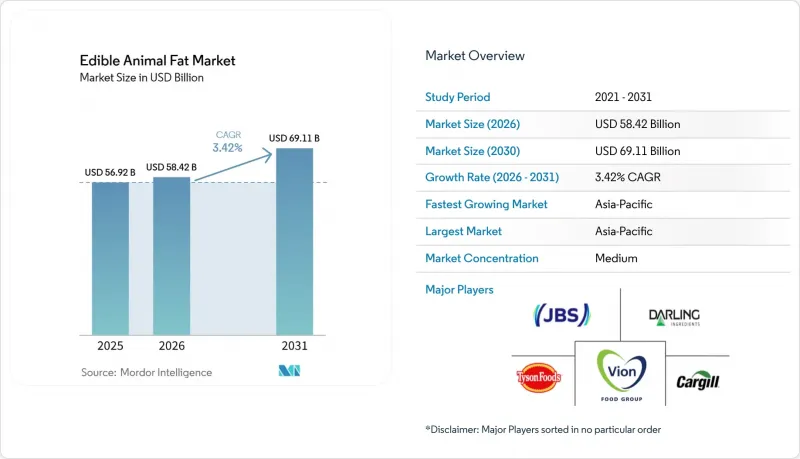
Mordor Intelligence에 의하면, 식용 동물성 지방 시장 규모는 2025년 569억 2,000만 달러에서 2026년에는 584억 2,000만 달러로 확대되어 2026년부터 2031년까지 CAGR 3.42%로 성장을 지속하여, 2031년에는 691억 1,000만 달러에 이를 것으로 예측됩니다.
본 보고서는 원료 유형별(버터, 동물성 지방, 라드, 리퀴드 골드, 기타), 형태별(고체·페이스트형, 액체), 카테고리별(일반, 유기농), 최종 사용자별(식품 가공 업계, 외식 산업, 소매), 지역별(북미, 유럽, 아시아태평양, 남미, 중동 및 아프리카)로 분류되어 있습니다. 시장 전망은 금액(달러) 기준으로 제시되어 있습니다.
세계 식용 동물성 지방 시장 동향 및 인사이트
베이커리 및 페이스트리 제품에서의 기능적 우위
베이커리 및 페이스트리 제품에서 식용 동물성 지방이 광범위하게 사용되는 것은 식감, 풍미 및 제품 품질 향상 측면에서 뛰어난 성능을 발휘하기 때문이며, 이는 시장 성장을 뒷받침하고 있습니다. 버터, 라드, 동물성 지방 등의 원료는 뛰어난 가소성을 제공하여, 페이스트리에는 층층이 쌓인 바삭함을, 케이크에는 부드러운 식감을, 구운 과자에는 입안에서 살살 녹는 맛을 만들어 냅니다. 특히 라드는 바삭바삭한 파이 반죽이나 층층이 쌓인 반죽을 만드는 데 유용하게 쓰이며, 한편 버터는 그 풍부한 풍미와 향 덕분에 고급 빵, 쿠키, 크루아상, 과자류에서 여전히 선호되는 원료로 자리 잡고 있습니다. 식품 제조업체와 장인 제빵사들은 일관된 제품 품질과 가공 효율을 실현하기 위해 계속해서 동물성 지방에 의존하고 있습니다. 고급 구운 과자나 정통 레시피에 대한 소비자의 선호도가 높아짐에 따라, 전통적인 유지 원료에 대한 수요는 더욱 증가하고 있습니다.
레시피 개선 프로젝트에서 클린 라벨 유지방 원료에 대한 수요 증가
클린 라벨 식품에 대한 관심이 높아지는 가운데, 제조업체들은 인식하기 쉽고 최소한의 가공만 거친 원재료를 사용하여 레시피를 재구성하도록 권장받고 있으며, 그 결과 식용 동물성 지방에 대한 수요가 더욱 증가하고 있습니다. 버터, 라드, 동물성 지방 등 전통적인 유지·지방은 인공 첨가물이나 고도로 가공된 유지·지방 원료의 대체품으로서 레시피 개선 프로젝트에 점점 더 많이 도입되고 있습니다. 이러한 변화는 원재료 목록이 더 간결하고 투명성이 높은 제품을 원하는 소비자의 선호도 변화에 힘입고 있습니다. 예를 들어, 미국 제빵 협회(American Baking Association)가 2025년 11월, 구운 과자에서 FD&C 인증 착색료를 배제하겠다고 서약한 것은 더 깨끗한 배합을 지향하는 업계 전반의 움직임을 반영하고 있습니다. 또한, CBI 외무부의 조사에 따르면, 클린 라벨 제품은 2021년 52%에서 증가하여 2025년 및 2026년에는 제품 포트폴리오의 70% 이상을 차지할 전망입니다. 식품 제조업체들이 베이커리, 가공식품, 유제품 등의 분야에서 클린 라벨 노력을 확대함에 따라 천연 유래 식용 동물성 지방의 사용이 증가할 것으로 예측됩니다.
포화지방산과 콜레스테롤에 대한 인식이 여전히 수요의 걸림돌이 되고 있습니다.
포화지방산과 콜레스테롤이 건강에 미치는 영향에 대한 소비자의 우려는 여전히 식용 동물성 지방의 보급을 제한하는 요인으로 작용하고 있습니다. 심혈관 건강 및 생활습관병에 대한 인식이 높아짐에 따라, 많은 소비자가 포화지방산을 많이 함유한 것으로 인식되는 식품의 섭취를 자제하고 있습니다. 그 결과, 식품 제조업체들은 더 건강한 선택지로 여겨지는 식물성 기름이나 기타 대체재를 사용하여 제품 배합을 재검토하는 움직임을 강화하고 있습니다. 또한, 많은 국가의 공중보건 권고 사항이나 영양 지침에서도 포화지방산 섭취를 절제할 것을 권장하고 있으며, 이는 구매 결정에 영향을 미치고 있습니다. 이러한 인식은 저지방이나 심장에 좋은 식품을 찾는 건강 지향적 소비자 수요에 특히 영향을 미치고 있습니다. 게다가 동물성 지방에 대한 소비자의 부정적인 태도 역시 건강 지향적 식품 부문에서 입지를 강화하려는 제조업체들에게 과제가 되고 있습니다.
부문 분석
2025년, 버터는 식용 동물성 지방 시장 매출의 47.11%를 차지하며, 식품 가공 및 외식 산업의 광범위한 용도로 활용되고 있어 가장 큰 원료 유형가 되었습니다. 이러한 지배적인 지위는 풍미, 식감, 제품 품질을 향상시키는 버터에 대한 제빵, 제과, 유제품 및 즉석식품 업계의 강력한 수요에 의해 뒷받침되고 있습니다. 또한 버터는 합성 유지나 고도로 가공된 대체 유지에 비해 자연스러운 맛과 클린 라벨의 매력 덕분에 소비자들에게도 널리 선호되고 있습니다. 고급 구운 과자, 페이스트리, 디저트 및 고급 유제품의 소비 확대가 버터 시장의 주도적 지위를 더욱 공고히 하고 있습니다.
라드는 식품 제조 및 특수 조리 용도에서의 사용 확대에 힘입어 2031년까지 4.93%라는 가장 높은 연평균 성장률(CAGR)을 나타낼 전망입니다. 전통적인 조리법이나 정통 향토 요리에 대한 소비자의 관심이 높아지면서 제빵, 육류 가공, 튀김 용도에서의 라드 수요 회복에 기여하고 있습니다. 또한, 식품 제조업체들은 페이스트리, 파이, 비스킷, 가공육 제품 등의 식감, 층 형성, 풍미를 향상시키기 위해 라드를 활용하고 있습니다. 일부 시장에서 케토제닉, 팔레오, 고지방 식단이 인기를 끌고 있는 점도 라드를 포함한 동물성 지방의 사용을 더욱 촉진하고 있습니다.
고체 및 페이스트 형태의 부문이 2025년에 63.21%의 시장 점유율을 차지하고, 2031년까지 연평균 성장률(CAGR) 4.93%로 선두를 유지할 것이라는 이중의 성과를 거둔 것은 식감이나 기능성을 추구하는 식품 업계가 계속해서 구조화된 지방에 의존하고 있음을 여실히 보여줍니다. 이 형태의 우위는 식품 과학의 기본 원칙을 반영한 것으로, 고체 지방은 구운 과자, 제과류, 가공육에서 액체 대체품으로는 재현할 수 없는 필수적인 구조적 특성을 제공했기 때문입니다. 각 제조업체들은 온도 변화나 보관 조건에 관계없이 안정성을 유지하는 유지·지방을 점점 더 요구하게 되었으며, 이는 예측 가능한 성능 특성을 갖춘 고체 및 페이스트 형태의 유지·지방에 대한 수요를 뒷받침했습니다.
한편, 액체 동물성 지방은 유동성이나 열전달 특성이 구조적 기능성보다 우선시되는 튀김 조리, 바이오디젤 생산 및 산업 공정과 같은 특수한 용도로 사용되었습니다. 렌더링 업계 전반에 걸친 유지 회수 및 정제 기술의 발전으로 액체 유지의 품질이 향상되었으며, 재생 가능 연료 생산 분야의 활용 기회가 확대되었습니다. 2025년 2월, 텍사스주 아마릴로에 건설된 Coast Packing의 6,000만 달러 규모 신규 시설은 가정용 및 상업용 시장을 위한 동물성 지방 쇼트닝 생산 확대를 목표로 하고 있으며, 이는 고체 형태에 대한 수요가 지속되고 있음을 시사합니다. 시장 부문은 최종 용도의 최적화를 점점 더 반영하게 되었으며, 제조업체들은 기존의 선호도보다는 특정 기능적 요구 사항에 따라 형태를 선택하게 되었습니다.
지역별 분석
아시아태평양은 2025년 식용 동물성 지방 시장 점유율의 40.22%를 차지하고 있으며, 2031년까지 연평균 성장률(CAGR) 5.67%를 나타낼 것으로 예측됩니다. 이에 따라 이 지역은 가장 큰 시장 규모와 가장 빠른 지역적 성장을 달성하게 될 것입니다. 중국, 동남아시아 및 일본의 요리 및 식품 제조 과정에서 돼지 기름과 기타 동물성 지방이 대량으로 사용되고 있는 점이 이 지역의 동물성 식용유·지방 시장을 뒷받침하고 있습니다. 일본에서는 렌더링 시설의 원료 부족이 지속되고 있어, 2025년 초에는 라드 도매 가격이 15kg 캔당 5,765엔(15kg당 38달러)에 달하는 등 가장 심각한 공급 부족 상황이 예상됩니다. 인도에서는 소득 수준 향상에 따라 베이커리 및 고급 포장 식품 부문이 확대되고 있어, 향후 추가적인 성장의 발판이 되고 있습니다. 홍콩에서는 셰프들이 조리 현장에서 돼지 라드의 부활을 적극적으로 뒷받침하고 있으며, 이로 인해 고급 제품에 대한 수요가 증가하면서 고부가가치 외식 채널에서의 라드 사용이 정착되고 있습니다.
유럽은 여전히 식용 동물성 지방 시장의 성숙한 지역으로, 프랑스, 독일, 이탈리아, 스페인, 네덜란드가 버터, 동물성 지방, 라드의 주요 생산국 및 소비국입니다. 소시지 제조, 페이스트리, 가공육 제품에서의 전통적인 사용이 계속해서 지역 수요를 뒷받침하고 있습니다. 규제 강화 또한 공급 환경에 변화를 가져오고 있습니다. EU 규정(EC) 1069/2009의 2026년 개정에 따라, 렌더링 시설에서는 CCP 데이터의 지속적인 디지털 기록과 더욱 엄격한 추적성 문서 작성이 의무화될 예정입니다. 이러한 요건은 소규모 가공업체의 규정 준수 비용 증가로 이어지지만, 한편으로는 고급 식품 구매자나 수출처 고객이 점점 더 요구하는 검증 기록의 질을 향상시키는 결과도 가져올 것입니다. 남미에서는 브라질과 아르헨티나가 중심이 되어, 대규모 쇠고기 및 돼지고기 생산 체제를 통해 렌더링용 지방공급이 대폭 확보되고 있습니다. Minerva Foods는 57억 브라질 레알(10억 달러)에 인수한 Marfrig의 공장 13곳을 통합하여 이 공급 기반을 대폭 확대했습니다. 이로 인해 7개국에 걸쳐 있는 46개 산업 시설의 일일 총 처리 능력은 소 4만 1,789마리, 양 2만 5,716마리로 증가했습니다.
중동 및 아프리카는 식용 동물성 지방 시장에서는 여전히 규모가 가장 작은 지역 부문이지만, 할랄 인증을 받은 동물성 지방 및 버터공급망에서 계속해서 비즈니스 기회를 제공합니다. 사우디아라비아, 아랍에미리트, 남아프리카공화국이 주요 수요 거점으로 자리 잡고 있으며, 외식 산업의 성장, 가공식품 사용 증가, 할랄 프리미엄 식품에 대한 관심 고조에 힘입고 있습니다. JBS는 쇠고기와 양고기 가공을 포함하는 중동의 멀티 단백질 허브에 1억 5,000만 달러를 투자함으로써 이러한 기회를 뒷받침했습니다. 수출업체들은 또한 걸프 표준화 기구(GSO) 및 SANHA와 같은 기관이 정한 할랄 요건을 충족해야 하며, 인증은 조달 과정에서 점점 더 중요한 선별 기준이 되고 있습니다. 이러한 요건들은 규모, 규정 준수 체계, 안정적인 지역 유통망을 모두 갖춘 공급업체에게 유리하게 작용합니다.
기타 혜택:
- 엑셀 형식 시장 전망(ME) 시트
- 3개월간의 애널리스트 지원
자주 묻는 질문
목차
제1장 서론
제2장 조사 방법
제3장 주요 요약
제4장 시장 구도
제5장 시장 규모와 성장 예측
제6장 경쟁 구도
제7장 시장 기회와 향후 전망
JHS 26.08.07According to Mordor Intelligence, the edible animal fat market size is expected to grow from USD 56.92 billion in 2025 to USD 58.42 billion in 2026 and is forecast to reach USD 69.11 billion by 2031 at 3.42% CAGR over 2026-2031.
This report is Segmented by Ingredient Type (Butter, Tallow, Lard, Liquid Gold, Others), Form (Solid and Paste, Liquid), Category (Conventional and Organic), End-User (Food Processing Industry, Foodservice, Retail), and Geography (North America, Europe, Asia-Pacific, South America, Middle East and Africa). The Market Forecasts are Provided in Terms of Value (USD).
Global Edible Animal Fat Market Trends and Insights
Functional superiority in bakery and pastry applications
The widespread use of edible animal fats in bakery and pastry products is supporting market growth due to their superior performance in enhancing texture, flavor, and product quality. Ingredients such as butter, lard, and tallow provide excellent plasticity, creating flaky layers in pastries, tender crumbs in cakes, and improved mouthfeel in baked goods. Lard, in particular, is valued for producing crisp pie crusts and laminated doughs, while butter remains a preferred ingredient in premium breads, cookies, croissants, and confectionery products because of its rich flavor and aroma. Food manufacturers and artisan bakeries continue to rely on animal fats to achieve consistent product quality and processing efficiency. The growing consumer preference for premium baked goods and authentic recipes has further increased demand for traditional fat ingredients.
Rising demand for clean-label fats in reformulation projects
The increasing focus on clean-label food products is encouraging manufacturers to reformulate recipes using recognizable and minimally processed ingredients, creating greater demand for edible animal fats. Traditional fats such as butter, lard, and tallow are increasingly being incorporated into reformulation projects as alternatives to artificial additives and highly processed fat ingredients. This shift is supported by changing consumer preferences for products with shorter and more transparent ingredient lists. For instance, the American Baking Association's November 2025 pledge to remove certified FD&C colors from baked goods reflects the broader industry movement toward cleaner formulations. Furthermore, according to research by the CBI Ministry of Foreign Affairs, clean-label products are projected to account for more than 70% of product portfolios during 2025 and 2026, up from 52% in 2021. As food manufacturers expand clean-label initiatives across bakery, processed foods, and dairy applications, the use of naturally derived edible animal fats is expected to increase.
Saturated fat and cholesterol perception remains a demand ceiling
Consumer concerns regarding the health effects of saturated fat and cholesterol continue to limit the widespread adoption of edible animal fats. Growing awareness of cardiovascular health and lifestyle-related diseases has encouraged many consumers to reduce the consumption of foods perceived to be high in saturated fats. As a result, food manufacturers are increasingly reformulating products with vegetable oils and other alternatives that are often viewed as healthier options. Public health recommendations and nutritional guidelines in many countries also advocate moderation in the intake of saturated fats, influencing purchasing decisions. This perception has particularly affected demand among health-conscious consumers seeking low-fat or heart-friendly food products. In addition, negative consumer attitudes toward animal-based fats create challenges for manufacturers attempting to expand their presence in wellness-focused food categories.
Other drivers and restraints analyzed in the detailed report include:
- Zero-waste rendering and byproduct valorization
- Expanding foodservice use of high-heat stable fats
- Substitution pressure from vegetable oils and interesterified fats
For complete list of drivers and restraints, kindly check the Table Of Contents.
Segment Analysis
Butter accounted for 47.11% of the edible animal fat market revenue in 2025, making it the largest ingredient type due to its widespread use across food processing and foodservice applications. Its dominant position is supported by strong demand from the bakery, confectionery, dairy, and ready-to-eat food industries, where it enhances flavor, texture, and product quality. Butter is also widely preferred by consumers for its natural taste and clean-label appeal compared to synthetic or highly processed fat alternatives. Growing consumption of premium baked goods, pastries, desserts, and gourmet dairy products continues to reinforce its market leadership.
Lard is projected to register the fastest CAGR of 4.93% through 2031, driven by its expanding use in food manufacturing and specialty culinary applications. Increasing consumer interest in traditional cooking methods and authentic regional cuisines is contributing to renewed demand for lard in bakery, meat processing, and frying applications. Food manufacturers are also utilizing lard to improve texture, flakiness, and flavor in products such as pastries, pies, biscuits, and processed meat items. The growing popularity of ketogenic, paleo, and high-fat dietary patterns in several markets has further encouraged the use of animal-based fats, including lard.
The solid/paste segment's dual achievement of 63.21% market share in 2025 and 4.93% CAGR leadership through 2031 underscores the food industry's continued reliance on structured fats for texture and functionality. This format's dominance reflected core food science principles, as solid fats provided essential structural properties in baked goods, confectionery, and processed meats that liquid alternatives could not replicate. Manufacturers increasingly required fats that remained stable across temperature variations and storage conditions, supporting demand for solid/paste formats with predictable performance characteristics.
Liquid animal fats served specialized applications in frying operations, biodiesel production, and industrial processes where flowability and heat transfer properties took priority over structural functionality. Technological advances in fat recovery and purification across the rendering industry improved liquid fat quality and expanded application opportunities in renewable fuel production. In February 2025, Coast Packing's new USD 60 million facility in Amarillo, Texas, was expected to target increased production of animal fat shortenings for both home and commercial channels, indicating sustained demand for solid formats. Form segmentation increasingly reflected end-use optimization, with manufacturers selecting formats based on specific functional requirements rather than traditional preferences.
Complete Report Scope:
- By Ingredient Type
- Butter
- Tallow
- Lard
- Liquid Gold
- Other Ingredient Types
- By Form
- Solid and Paste
- Liquid
- By Category
- Conventional
- Organic
- 5.4 By End-User
- Food Processing Industry
- Bakery
- Confectionery
- Savory Snacks
- Others
- Foodserivce
- Retail
- Food Processing Industry
- By Geography
- North America
- United States
- Canada
- Mexico
- Rest of North America
- Europe
- Germany
- United Kingdom
- Italy
- France
- Spain
- Netherlands
- Rest of Europe
- Asia-Pacific
- China
- India
- Japan
- Australia
- Rest of Asia-Pacific
- South America
- Brazil
- Argentina
- Rest of South America
- Middle East and Africa
- South Africa
- Saudi Arabia
- United Arab Emirates
- Rest of Middle East and Africa
- North America
Geography Analysis
Asia-Pacific accounted for 40.22% of the animal edible fat market share in 2025 and is projected to register a CAGR of 5.67% through 2031, giving it the largest base and the fastest regional expansion. Heavy use of pork and other animal fats in Chinese, Southeast Asian, and Japanese cooking and food manufacturing supports the animal edible fat market in the region. Japan is expected to show the tightest supply conditions, with wholesale lard prices reaching JPY 5,765 per 15 kg can, or USD 38 per 15 kg, in early 2025 as raw material shortages continue at rendering facilities. India adds another growth avenue as its bakery and premium packaged food sectors expand amid improving income levels. In Hong Kong, chefs have actively supported a culinary return to rendered pork fat, strengthening premium demand and helping normalize lard use in higher-value dining channels.
Europe remains a mature part of the animal edible fat market, with France, Germany, Italy, Spain, and the Netherlands serving as major producing and consuming countries for butter, tallow, and lard. Traditional use in sausage making, pastry, and prepared meats continues to support regional demand. Regulatory tightening is also changing the supply landscape, as the 2026 amendment to EU Regulation (EC) 1069/2009 will require continuous digital CCP data logging and stronger traceability documentation at rendering facilities. This requirement raises compliance costs for smaller processors, but it also improves the verification record that premium food buyers and export customers increasingly require. South America centers on Brazil and Argentina, where large beef and pork systems create substantial rendered fat supply. Minerva Foods materially expanded this base after integrating 13 Marfrig plants acquired for BRL 5.7 billion, or USD 1.0 billion, increasing combined daily processing capacity to 41,789 cattle and 25,716 sheep across 46 industrial units in 7 countries.
The Middle East and Africa remain the smallest regional segment in the animal edible fat market, but they continue to offer opportunities in halal-certified tallow and butter supply chains. Saudi Arabia, the United Arab Emirates, and South Africa are the key demand centers, supported by foodservice growth, rising processed food use, and broader interest in halal premium foods. JBS supported this opportunity with a USD 150 million investment in a multiprotein hub in the Middle East that includes beef and lamb processing. Exporters also need to meet halal requirements from bodies such as the Gulf Standards Organization and SANHA, making certification an increasingly important procurement filter. These requirements favor suppliers that can combine scale, compliance discipline, and steady regional distribution.
- Darling Ingredients
- Tyson Foods, Inc.
- Cargill, Incorporated
- JBS S.A.
- Vion Food Group
- West Coast Reduction
- Saria Group
- Bunge Limited
- Minerva Foods
- Cooperl Arc Atlantique
- NH Foods
- Marfrig
- Smithfield Foods
- Los Angeles Rendering
- Colyer Fehr
- MOPAC
- Coast Packing
- AAK AB
- Veos Group
- Innova Flavors (Griffith Foods)
Additional Benefits:
- The market estimate (ME) sheet in Excel format
- 3 months of analyst support
TABLE OF CONTENTS
1 INTRODUCTION
- 1.1 Study Assumptions and Market Definition
- 1.2 Scope of the Study
2 RESEARCH METHODOLOGY
3 EXECUTIVE SUMMARY
4 MARKET LANDSCAPE
- 4.1 Market Overview
- 4.2 Market Drivers
- 4.2.1 Functional superiority in bakery and pastry applications
- 4.2.2 Rising demand for clean-label fats in reformulation projects
- 4.2.3 Zero-waste rendering and byproduct valorization
- 4.2.4 Expanding foodservice use of high-heat stable fats
- 4.2.5 Premiumization of heritage and traditional food positioning
- 4.2.6 Tightening traceability requirements favors rendered animal fats over blends
- 4.3 Market Restraints
- 4.3.1 Saturated fat and cholesterol perception remains a demand ceiling
- 4.3.2 Substitution pressure from vegetable oils and interesterified fats
- 4.3.3 Volatile livestock and rendering input supply
- 4.3.4 Formulation constraints from odor and flavor drift
- 4.4 Supply Chain Analysis
- 4.5 Regulatory Landscape
- 4.6 Technological Outlook
- 4.7 Porter's Five Forces
- 4.7.1 Threat of New Entrants
- 4.7.2 Bargaining Power of Suppliers
- 4.7.3 Bargaining Power of Buyers
- 4.7.4 Threat of Substitutes
- 4.7.5 Intensity of Competitive Rivalry
5 MARKET SIZE AND GROWTH FORECASTS (VALUE)
- 5.1 By Ingredient Type
- 5.1.1 Butter
- 5.1.2 Tallow
- 5.1.3 Lard
- 5.1.4 Liquid Gold
- 5.1.5 Other Ingredient Types
- 5.2 By Form
- 5.2.1 Solid and Paste
- 5.2.2 Liquid
- 5.3 By Category
- 5.3.1 Conventional
- 5.3.2 Organic
- 5.4 5.4 By End-User
- 5.4.1 Food Processing Industry
- 5.4.1.1 Bakery
- 5.4.1.2 Confectionery
- 5.4.1.3 Savory Snacks
- 5.4.1.4 Others
- 5.4.2 Foodserivce
- 5.4.3 Retail
- 5.4.1 Food Processing Industry
- 5.5 By Geography
- 5.5.1 North America
- 5.5.1.1 United States
- 5.5.1.2 Canada
- 5.5.1.3 Mexico
- 5.5.1.4 Rest of North America
- 5.5.2 Europe
- 5.5.2.1 Germany
- 5.5.2.2 United Kingdom
- 5.5.2.3 Italy
- 5.5.2.4 France
- 5.5.2.5 Spain
- 5.5.2.6 Netherlands
- 5.5.2.7 Rest of Europe
- 5.5.3 Asia-Pacific
- 5.5.3.1 China
- 5.5.3.2 India
- 5.5.3.3 Japan
- 5.5.3.4 Australia
- 5.5.3.5 Rest of Asia-Pacific
- 5.5.4 South America
- 5.5.4.1 Brazil
- 5.5.4.2 Argentina
- 5.5.4.3 Rest of South America
- 5.5.5 Middle East and Africa
- 5.5.5.1 South Africa
- 5.5.5.2 Saudi Arabia
- 5.5.5.3 United Arab Emirates
- 5.5.5.4 Rest of Middle East and Africa
- 5.5.1 North America
6 COMPETITIVE LANDSCAPE
- 6.1 Market Concentration
- 6.2 Strategic Moves
- 6.3 Market Share Analysis
- 6.4 Company Profiles (includes Global level Overview, Market level overview, Core Segments, Financials as available, Strategic Information, Market Rank/Share for key companies, Products and Services, and Recent Developments)
- 6.4.1 Darling Ingredients
- 6.4.2 Tyson Foods, Inc.
- 6.4.3 Cargill, Incorporated
- 6.4.4 JBS S.A.
- 6.4.5 Vion Food Group
- 6.4.6 West Coast Reduction
- 6.4.7 Saria Group
- 6.4.8 Bunge Limited
- 6.4.9 Minerva Foods
- 6.4.10 Cooperl Arc Atlantique
- 6.4.11 NH Foods
- 6.4.12 Marfrig
- 6.4.13 Smithfield Foods
- 6.4.14 Los Angeles Rendering
- 6.4.15 Colyer Fehr
- 6.4.16 MOPAC
- 6.4.17 Coast Packing
- 6.4.18 AAK AB
- 6.4.19 Veos Group
- 6.4.20 Innova Flavors (Griffith Foods)


