

|
시장보고서
상품코드
2119078
지방산 : 시장 점유율 분석, 산업 동향 및 통계 데이터, 성장 예측(2026-2031년)Fatty Acids - Market Share Analysis, Industry Trends & Statistics, Growth Forecasts (2026 - 2031) |
||||||
 Mordor Intelligence
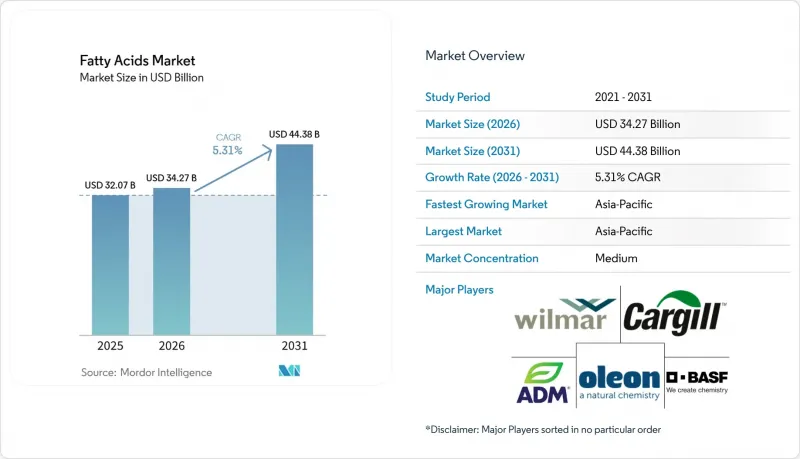
Mordor Intelligence에 따르면 지방산 시장 규모는 2025년에 320억 7,000만 달러로 평가되며, 2026년 342억 7,000만 달러에서 2031년까지 443억 8,000만 달러에 달할 것으로 예측되고 있으며, 예측 기간(2026-2031년)에 CAGR은 5.31%에 달할 전망입니다.
이 보고서는 원료별(식물성 오일, 동물성 지방 등), 제품 유형별(포화지방산, 불포화지방산, 특수지방산), 용도(비누·세제, 의약품 등), 최종 용도 산업(가정용·산업용 세정제, 식품 및 음료 등),및 지역(아시아태평양, 북미 등)별로 분류되어 있습니다. 시장 예측은 금액(달러) 기준으로 제시되어 있습니다.
세계 지방산 시장의 동향 및 인사이트
오메가 지방산 및 건강 지향 영양 제품에 대한 소비자 수요 증가
2025년, 오메가-3 원료의 공급량은 전 세계에서 136,000 메트릭 톤에 달하여 2024년 대비 2.60% 증가했습니다. 총액은 엘니뇨 현상 이후의 가격 정상화를 거쳐 4.30% 감소한 25억 3,000만 달러를 기록했습니다. 에이코사펜타엔산(EPA) 및 도코사헥사엔산(DHA) 오메가-3에 관한 세계 기구(GOED)는 2028년까지 원료 출하량이 연평균 3%-4% 성장할 것으로 예측하고 있습니다. 영양 보충제 및 의약품 등급의 EPA 제품이 확립된 소비자 대상 헬스케어 채널 전반에서 이러한 수요를 지원하고 있습니다. 순도 규격이 엄격해짐에 따라 공급업체에게 분자 증류 및 분별 증류의 중요성이 커지고 있습니다. 따라서 지방산 시장에서는 프리미엄 등급 제품이 범용 제품의 대량 거래보다 전략적으로 중요해지며, 공급업체와의 보다 긴밀한 관계 구축에 기여할 가능성이 있습니다.
비누·세제 및 산업용 세정 분야에서의 지방산 활용 확대
팔미트산과 라우린산은 비누화 반응 및 계면활성제 제조에 필수적이기 때문에 비누와 세제는 여전히 주요 판로입니다. 유럽의 세제 제조업체들은 저온 세탁 및 에너지 소비 감축을 목적으로 제품의 배합을 재검토하고 있습니다. 이러한 제품에는 메틸에스테르설포네이트나 알킬폴리글루코사이드 등의 원료가 사용되고 있습니다. 인도네시아와 말레이시아의 공급업체들은 유럽 시장 고객을 대응하기 위해 순도 기준 및 인증 기준을 조정하고 있습니다. 또한 천연 성분에 대한 수요 증가로 인해 프리미엄 퍼스널 케어 제품의 배합에 지방알코올계 알킬폴리글루코사이드가 채택되는 추세입니다. 이러한 폭넓은 세정 수요로 인해 헬스케어 및 퍼스널 케어 분야의 특수 용도가 확대되는 가운데에서도 지방산 시장은 안정적인 기반을 유지하고 있습니다.
식물성 오일, 동물성 지방 및 해양 유래 원료의 가격 변동
식물성 오일 가격은 여전히 기상 조건, 바이오연료 정책 및 세계 재고 수준 변동에 민감합니다. FAO 식물성 오일 가격 지수는 2026년 5월에 전월 대비 4.60% 하락했습니다. 엘니뇨·남방 진동(ENSO) 주기는 반복적으로 발생하는 양상으로 동남아시아의 팜유 공급에 혼란을 초래할 가능성이 있습니다. 또한 바이오연료 의무화로 인해 적절한 등급의 원료가 수소화 식물성 오일 제조 공정에 배정됨에 따라 동물성 지방 공급에도 압박이 가해지고 있습니다. 페루의 멸치 어획 할당량 변동 역시 해양 유래 지방산의 공급원으로서 유사한 위험을 초래하고 있습니다. 이러한 요인들로 인해 가공업체, 유통업체 및 구매업체의 운전자금 수요가 증가하며, 지방산 시장 전반에 걸쳐 계약 가격 책정이 복잡해질 가능성이 있습니다.
부문 분석
2025년, 식물성 오일은 지방산 시장 점유율의 65.72%를 차지했습니다. 팜유와 대두유는 전 세계 세정 및 산업용 공급망에서 대량 생산에 필요한 규모를 제공하고 있습니다. 통합형 생산자는 유지 가공 및 하류 오일케미칼 사업에 대한 직접적인 접근이라는 이점을 누리고 있습니다. 이러한 구조는 비누, 세제, 산업 용도 및 광범위한 배합 고객에 대한 공급을 지원하고 있습니다. 동물성 지방은 두 번째로 큰 원료 공급원으로서의 위치를 차지하고 있으며, 동물성 지방을 원료로 하는 스테아르산 생산에서 여전히 중요한 역할을 수행하고 있습니다.
미생물 및 발효 유래 원료는 2031년까지 연평균 성장률(CAGR) 8.06%로 성장할 것으로 예측됩니다. 이러한 생산 업체들은 맞춤형 조성, 보장된 순도 및 명확한 성능이 요구되는 특수 지질 용도를 목표로 하고 있습니다. 2025년 연구에 따르면 유전자 변형된 Prototheca moriformis는 1리터 규모의 바이오리액터 내에서 지질 농도 48.00 g/L의 고올레산 팜유 대체물을 생산하는 것으로 나타났습니다. 발효 기술을 활용함으로써 프리미엄 등급 제품에서 토지 제약이나 팜유 가격 변동의 영향을 완화할 수 있습니다. 따라서 지방산 업계에서는 대량 생산에는 기존 원료를 유지하면서, 지방산 시장에서 차별화된 제품에는 발효 기술을 활용하여 나갈 것으로 보입니다.
2025년 지방산 시장 규모 중 포화지방산이 52.16%를 차지했습니다. 팔미트산 및 스테아린산은 비누, 플라스틱 첨가제, 고무 가공 및 기타 확립된 용도로 사용되고 있습니다. 대량 생산되는 많은 배합에서 이러한 성분의 역할을 대체하기는 어려우며, 이는 산업 밸류체인 전반에 걸쳐 안정적인 수요를 지원하고 있습니다. 불포화 지방산에는 올레산, 리놀레산, 리놀렌산이 포함됩니다. 이러한 물질은 퍼스널 케어 제품, 식품 유화제, 산업용 윤활유 등에 활용되고 있습니다.
특수 지방산은 2031년까지 연평균 성장률(CAGR) 6.93%로 성장할 것으로 예측됩니다. 수요에는 지질 나노입자 전달용 및 의약품 부형제용 고순도 중쇄 지방산 등급이 포함됩니다. 또한 명확한 성능 특성을 갖춘 정밀 화장품 원료도 포함됩니다. IOI Oleo GmbH는 지질 나노입자를 이용한 약물전달 용도로 ‘LipoGalen’ 폴리글리세롤 에스테르 시리즈를 개발했습니다. 이 제품군은 지방산 시장에서 특정 등급의 제품이 범용 원료에서 규제 대상 고객을 위한 기능성 원료로 전환되고 있음을 보여줍니다.
지역별 분석
아시아태평양은 2025년 지방산 시장 점유율의 45.67%를 차지하고 있으며, 2031년까지 연평균 성장률(CAGR) 6.27%로 성장할 것으로 예측됩니다. 인도네시아와 말레이시아는 통합된 유지 화학 단지를 통해 전 세계 팜유 유래 지방산의 대부분을 공급하고 있습니다. 원료의 근접성 덕분에 이 지역의 생산자들은 비용 및 공급 측면에서 큰 우위를 점하고 있습니다. 또한 이 지역은 세정제, 퍼스널 케어 제품, 식품, 건강 제품 분야에서 대규모이며 지속적으로 확대되는 소비 거점이기도 합니다. 공급자이자 고객이라는 이중 역할이 하류 부문의 생산 능력에 대한 지속적인 투자를 지원하고 있습니다.
북미는 지방산 시장에서 기술적으로 높은 수준이 요구되는 지역입니다. 특수 제품 및 의약품 등급 제품, 바이오 기반 윤활유, 오메가-3 보충제가 이 지역의 수요를 주도하고 있습니다. 카길(Cargill)은 2026년 3월, 전 세계 식품 원료 고객을 대상으로 특수 유지 라인을 신설하고 포트클란(Port Clann) 시설을 확장했습니다. 이 투자를 통해 코코아 버터 대체품, 저트랜스지방산 대체품 및 고성능 유지가 제품 라인업에 추가되었습니다. 아시아의 통합형 사업 거점을 통한 공급은 지방산 시장에서 북미의 특수한 요건을 충족시킬 수 있습니다.
유럽은 주요 지역 중 가장 엄격한 규제 조건이 적용되고 있습니다. EU 산림 파괴 규제(EUDR) 요건에 따라 팜유 유래 공급망은 추적성을 확보하고 산림 파괴를 수반하지 않는 조달 방식으로 전환되고 있습니다. 쿠로다사는 2026년 3월, RSPO 인증을 받은 유지 화학 제품, 재생 가능 에너지 및 액체 배출 제로 시스템을 도입한 제조 시설을 인도 다헤지에 개설했습니다. 남미는 대두 가공 능력이 뛰어나 원료의 안정적인 공급을 지원하고 있습니다. 윌머(Wilmer)사는 베트남에서 대두 압착 합작 사업을 확대하고, 남아프리카에서는 정제 설비의 가동을 시작했습니다.
기타 혜택:
- Excel 형식의 시장 예측(ME) 시트
- 3개월간의 애널리스트 지원
자주 묻는 질문
목차
제1장 서론
제2장 분석 방법
제3장 개요
제4장 시장 구도
제5장 시장 규모·성장률 예측
제6장 경쟁 구도
제7장 시장 기회와 향후 전망
KSA 26.09.02According to Mordor Intelligence, the fatty acids market was valued at USD 32.07 billion in 2025 and is estimated to grow from USD 34.27 billion in 2026 to reach USD 44.38 billion by 2031, at a CAGR of 5.31% during the forecast period (2026-2031).
This report is Segmented by Source (Vegetable Oils, Animal Fats, and More), Product Type (Saturated Fatty Acids Unsaturated Fatty Acids, and Specialty Fatty Acids), Application (Soaps and Detergents, Pharmaceuticals, and More), End-Use Industry (Household and Industrial Cleaning, Food and Beverage, and More), and Geography (Asia-Pacific, North America, and More). The Market Forecasts are Provided in Terms of Value (USD).
Global Fatty Acids Market Trends and Insights
Growing Consumer Demand for Omega Fatty Acids and Health-Oriented Nutritional Products
Omega-3 ingredient volume reached 136,000 metric tons globally in 2025, increasing 2.60% from 2024. Total value declined 4.30% to USD 2.53 billion after post-El Nino price normalization. The Global Organization for eicosapentaenoic acid (EPA) and docosahexaenoic acid (DHA) Omega-3s (GOED) expects ingredient volumes to grow 3% to 4% annually through 2028. Dietary supplements and pharmaceutical-grade EPA products support this demand across established consumer health channels. Tighter purity specifications make molecular distillation and fractionation more important for suppliers. In the fatty acids market, premium grades can therefore carry more strategic importance than commodity volume and support closer supplier relationships.
Expanding Use of Fatty Acids in Soaps, Detergents, and Industrial Cleaning Applications
Soaps and detergents remain a large outlet because palmitic and lauric acids are central to saponification and surfactant production. European detergent makers are reformulating products for colder washing and lower energy use. These products use inputs such as methyl ester sulfonates and alkyl polyglucosides. Suppliers in Indonesia and Malaysia are adapting purity and certification practices for customers serving European markets. Natural ingredient targets also support fatty alcohol-based alkyl polyglucosides in premium personal care formulations. This broad cleaning demand gives the fatty acids market a stable base even as specialty uses expand across health and personal care applications.
Volatility in Vegetable Oil, Animal Fat, and Marine Feedstock Prices
Vegetable oil prices remain sensitive to weather, biofuel policy, and changes in global inventory levels. The FAO Vegetable Oil Price Index fell 4.60% in May 2026 from the previous month. El Nino-Southern Oscillation (ENSO) cycles can disrupt Southeast Asian palm supply on recurring patterns. Animal fat availability also faces pressure as biofuel mandates divert suitable grades toward hydrotreated vegetable oil pathways. Peruvian anchovy quota variability creates a parallel risk for marine fatty acid inputs. These factors can raise working capital needs and complicate contract pricing across the fatty acids market for processors, distributors, and buyers.
Other drivers and restraints analyzed in the detailed report include:
- Rising Adoption of Bio-Based Lubricants, Surfactants, and Renewable Chemical Products
- Advancements in Enzymatic, Fermentation, and Algae-Based Fatty Acid Production Technologies
- Sustainability Concerns Related to Palm Oil Production and Marine Resource Utilization
For complete list of drivers and restraints, kindly check the Table Of Contents.
Segment Analysis
Vegetable oils held 65.72% of the fatty acids market share in 2025. Palm and soybean oils provide the scale required for high-volume fatty acid production across global cleaning and industrial supply chains. Integrated producers benefit from direct access to oil processing and downstream oleochemical operations. This structure supports supply to soaps, detergents, industrial applications, and a wide range of formulation customers. Animal fats held the second source position and remain important for tallow-based stearic acid production.
Microbial and fermentation sources are forecast to grow at an 8.06% CAGR through 2031. These producers target specialty lipid applications that need customized compositions, assured purity, and defined performance. A 2025 study showed engineered Prototheca moriformis producing a high-oleic palm oil alternative at a lipid titer of 48.00 g/L in a 1-liter bioreactor. Fermentation can reduce exposure to land constraints and palm-price changes in premium grades. The fatty acids industry is therefore likely to retain conventional feedstocks for quantity while using fermentation for differentiated products in the fatty acids market.
Saturated fatty acids accounted for 52.16% of the fatty acids market size in 2025. Palmitic and stearic acids are used in soaps, plastic additives, rubber processing, and other established applications. Their roles are difficult to replace in many high-volume formulations, supporting steady demand across industrial value chains. Unsaturated fatty acids include oleic, linoleic, and linolenic acids. These materials support personal care, food emulsification, and industrial lubricants.
Specialty fatty acids are forecast to grow at a 6.93% CAGR through 2031. Demand includes high-purity medium-chain grades for lipid nanoparticle delivery and pharmaceutical excipients. It also includes precision cosmetic ingredients with defined performance characteristics. IOI Oleo GmbH developed the LipoGalen polyglycerol ester family for lipid nanoparticle drug delivery applications. These offerings show how the fatty acids market is shifting selected grades from commodity inputs toward functional ingredients for regulated customers.
Complete Report Scope:
- By Source
- Vegetable Oils
- Animal Fats
- Marine Oils
- Microbial and Fermentation
- By Product Type
- Saturated Fatty Acids
- Unsaturated Fatty Acids
- Specialty Fatty Acids
- By Application
- Soaps and Detergents
- Food and Beverages
- Dietary Supplements and Nutraceuticals
- Personal Care and Cosmetics
- Pharmaceuticals
- Industrial Chemicals
- Lubricants
- Plastics and Rubber
- Biofuels
- Animal Feed
- Other Applications
- By End-Use Industry
- Household and Industrial Cleaning
- Food and Beverage
- Personal Care and Cosmetics
- Pharmaceuticals and Nutraceuticals
- Chemical Industry
- Automotive and Transportation
- Energy and Biofuels
- Agriculture and Animal Nutrition
- By Geography
- Asia-Pacific
- China
- India
- Japan
- South Korea
- Rest of Asia-Pacific
- North America
- United States
- Canada
- Mexico
- Europe
- Germany
- United Kingdom
- France
- Italy
- Russia
- Rest of Europe
- South America
- Brazil
- Argentina
- Rest of South America
- Middle-East and Africa
- Saudi Arabia
- South Africa
- Rest of Middle-East and Africa
- Asia-Pacific
Geography Analysis
Asia-Pacific held 45.67% of the fatty acids market share in 2025 and is forecast to grow at a 6.27% CAGR through 2031. Indonesia and Malaysia together supply the majority of global palm-derived fatty acids through integrated oleochemical complexes. Feedstock proximity gives regional producers a strong cost and supply advantage. The region is also a large and expanding consumption base for cleaning, personal care, food, and health products. Its dual role as supplier and customer supports continued investment in downstream capacity.
North America is a technically demanding region for the fatty acids market. Specialty and pharmaceutical-grade products, bio-based lubricants, and omega-3 supplements shape regional demand. Cargill expanded its Port Klang facility in March 2026 with a specialty fats line that serves global food ingredient customers. The investment added cocoa butter equivalents, low-trans fatty acid replacers, and performance fats. Supply from integrated Asian operations can support specialized North American requirements in the fatty acids market.
Europe has the most demanding regulatory conditions among the major regions. EU Deforestation Regulation (EUDR) requirements are moving palm-derived supply chains toward traceable and deforestation-free sourcing. Croda opened a manufacturing facility in Dahej, India, in March 2026 using RSPO-certified oleochemicals, renewable energy, and zero liquid discharge systems. South America benefits from soybean processing capacity, which supports feedstock availability. Wilmar expanded a soybean crushing joint venture in Vietnam and commissioned refining capacity in South Africa.
- AAK AB
- ADM
- Ashland
- BASF
- Cargill, Incorporated
- Croda International Plc
- Eastman Chemical Company
- Ecogreen Oleochemicals
- Godrej Chemicals
- IOI Corporation Berhad
- KLK OLEO
- Mitsubishi Chemical Corporation
- Oleon NV
- Permata Group
- Stepan Company
- Wilmar International Ltd
Additional Benefits:
- The market estimate (ME) sheet in Excel format
- 3 months of analyst support
TABLE OF CONTENTS
1 Introduction
- 1.1 Study Assumptions and Market Definition
- 1.2 Scope of the Study
2 Research Methodology
3 Executive Summary
4 Market Landscape
- 4.1 Market Overview
- 4.2 Market Drivers
- 4.2.1 Growing Consumer Demand for Omega Fatty Acids and Health-Oriented Nutritional Products
- 4.2.2 Expanding Use of Fatty Acids in Soaps, Detergents, and Industrial Cleaning Applications
- 4.2.3 Rising Adoption of Bio-Based Lubricants, Surfactants, and Renewable Chemical Products
- 4.2.4 Increasing Preference for Natural, Plant-Based, and Sustainably Sourced Fatty Acids
- 4.2.5 Advancements in Enzymatic, Fermentation, and Algae-Based Fatty Acid Production Technologies
- 4.3 Market Restraints
- 4.3.1 Volatility in Vegetable Oil, Animal Fat, and Marine Feedstock Prices
- 4.3.2 Sustainability Concerns Related to Palm Oil Production and Marine Resource Utilization
- 4.3.3 Complex Regulatory Requirements Across Food, Pharmaceutical, and Industrial Applications
- 4.4 Value Chain Analysis
- 4.5 Porter's Five Forces Analysis
- 4.5.1 Threat of New Entrants
- 4.5.2 Bargaining Power of Suppliers
- 4.5.3 Bargaining Power of Buyers
- 4.5.4 Threat of Substitutes
- 4.5.5 Competitive Rivalry
5 Market Size and Growth Forecasts (Value)
- 5.1 By Source
- 5.1.1 Vegetable Oils
- 5.1.2 Animal Fats
- 5.1.3 Marine Oils
- 5.1.4 Microbial and Fermentation
- 5.2 By Product Type
- 5.2.1 Saturated Fatty Acids
- 5.2.2 Unsaturated Fatty Acids
- 5.2.3 Specialty Fatty Acids
- 5.3 By Application
- 5.3.1 Soaps and Detergents
- 5.3.2 Food and Beverages
- 5.3.3 Dietary Supplements and Nutraceuticals
- 5.3.4 Personal Care and Cosmetics
- 5.3.5 Pharmaceuticals
- 5.3.6 Industrial Chemicals
- 5.3.7 Lubricants
- 5.3.8 Plastics and Rubber
- 5.3.9 Biofuels
- 5.3.10 Animal Feed
- 5.3.11 Other Applications
- 5.4 By End-Use Industry
- 5.4.1 Household and Industrial Cleaning
- 5.4.2 Food and Beverage
- 5.4.3 Personal Care and Cosmetics
- 5.4.4 Pharmaceuticals and Nutraceuticals
- 5.4.5 Chemical Industry
- 5.4.6 Automotive and Transportation
- 5.4.7 Energy and Biofuels
- 5.4.8 Agriculture and Animal Nutrition
- 5.5 By Geography
- 5.5.1 Asia-Pacific
- 5.5.1.1 China
- 5.5.1.2 India
- 5.5.1.3 Japan
- 5.5.1.4 South Korea
- 5.5.1.5 Rest of Asia-Pacific
- 5.5.2 North America
- 5.5.2.1 United States
- 5.5.2.2 Canada
- 5.5.2.3 Mexico
- 5.5.3 Europe
- 5.5.3.1 Germany
- 5.5.3.2 United Kingdom
- 5.5.3.3 France
- 5.5.3.4 Italy
- 5.5.3.5 Russia
- 5.5.3.6 Rest of Europe
- 5.5.4 South America
- 5.5.4.1 Brazil
- 5.5.4.2 Argentina
- 5.5.4.3 Rest of South America
- 5.5.5 Middle-East and Africa
- 5.5.5.1 Saudi Arabia
- 5.5.5.2 South Africa
- 5.5.5.3 Rest of Middle-East and Africa
- 5.5.1 Asia-Pacific
6 Competitive Landscape
- 6.1 Market Concentration
- 6.2 Strategic Moves
- 6.3 Market Share (%)/Ranking Analysis
- 6.4 Company Profiles (includes Global Overview, Market Overview, Core Segments, Financials as available, Strategic Information, Products and Services, and Recent Developments)
- 6.4.1 AAK AB
- 6.4.2 ADM
- 6.4.3 Ashland
- 6.4.4 BASF
- 6.4.5 Cargill, Incorporated
- 6.4.6 Croda International Plc
- 6.4.7 Eastman Chemical Company
- 6.4.8 Ecogreen Oleochemicals
- 6.4.9 Godrej Chemicals
- 6.4.10 IOI Corporation Berhad
- 6.4.11 KLK OLEO
- 6.4.12 Mitsubishi Chemical Corporation
- 6.4.13 Oleon NV
- 6.4.14 Permata Group
- 6.4.15 Stepan Company
- 6.4.16 Wilmar International Ltd
7 Market Opportunities and Future Outlook
- 7.1 White-Space and Unmet-Need Assessment


