

|
시장보고서
상품코드
2097343
자동 하이빔 제어 시장 : 시장 점유율 분석, 산업 동향 및 통계 데이터, 성장 예측(2026-2031년)Automatic High Beam Control - Market Share Analysis, Industry Trends & Statistics, Growth Forecasts (2026 - 2031) |
||||||
 Mordor Intelligence
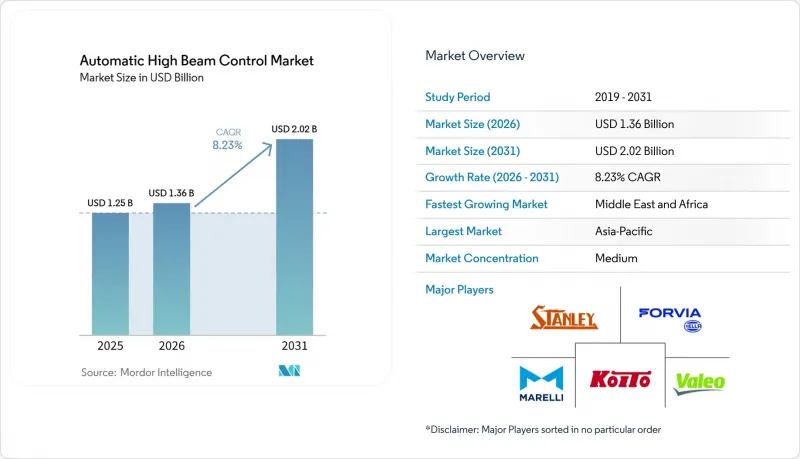
Mordor Intelligence에 의하면, 자동 하이빔 제어 시장 규모는 2025년에 12억 5,000만 달러로 평가되었고, 2026년에 13억 6,000만 달러에 이를 것으로 추정되고, 2031년까지 20억 2,000만 달러에 이를 것으로 예상되고 있으며, 2026-2031년 CAGR 8.23%로 성장할 전망입니다.
본 보고서는 기술별(카메라식 시스템, 레이더식 시스템, 라이다(LiDAR)식 시스템, 센서 퓨전 모듈), 차종별(승용차, 소형 상용차 등), 구동 방식별(내연기관 등), 유통 채널별(OEM, 애프터마켓), 지역별로 분류되어 있습니다. 시장 예측은 금액(달러)으로 표시되어 있습니다.
세계의 자동 하이빔 제어 시장 동향 및 인사이트
미국 내 어댑티브 드라이빙 빔을 허용하는 규제
미국 도로교통안전국(NHTSA)은 2022년 9월, 어댑티브 드라이빙 빔을 승인하며 10년에 걸친 장벽을 제거했습니다. 이를 통해 자동차 제조업체들은 전 세계 프로그램에서 이 기능을 표준화할 수 있게 되었으며, 금형 및 소프트웨어 공유를 통한 이점을 누릴 수 있게 되었습니다. 야간 하이빔 사용률은 여전히 낮은 수준을 유지하고 있습니다. IIHS의 조사에 따르면, 수동으로 하이빔을 켜는 운전자는 고작 18%에 불과하며, 자동 눈부심 방지 하이빔은 입증된 안전상의 문제를 해결해 줍니다. 모델 연도 갱신 주기가 이 규제와 일치하기 때문에 각 OEM 업체는 제품 수명 주기 중반에 비용 증가를 초래하지 않고도 이 기능을 탑재할 수 있게 되었습니다. 주(州)의 차량 검사 기준에 따른 후속 업데이트로 인해 딜러 쇼룸에서 수요가 더욱 높아지고 있습니다.
LED 매트릭스 비용 감소로 대중 시장에도 AHB 탑재 가능
비용 효율이 최우선인 아시아태평양 시장에서는 최근 웨이퍼 수율 향상과 드라이버 부품 통합을 통해 매트릭스 LED 패키지의 비용이 대폭 절감되었습니다. 이러한 변화로 인해 자동 하이빔 제어 기능이 중형차에 표준 사양으로 탑재될 수 있는 길이 열렸습니다. 각 공급업체들은 다양한 구역 구성에 대응할 수 있는 확장성이 뛰어난 모듈식 광학 시스템을 순차적으로 출시하고 있습니다. 이러한 혁신을 통해 자동차 제조업체들은 독자적인 조명 기능을 갖춘 차별화된 트림을 제공할 수 있게 될 것입니다. 또한, LED 조립 공정이 중국의 주요 자동차 생산 거점 근처로 재배치됨에 따라 물류상의 과제 완화 및 환율 리스크 감소로 인한 혜택을 받아 추가적인 비용 절감이 예상됩니다.
카메라의 눈부심이나 폭우 시 성능 격차가 규제 당국의 승인을 가로막고 있습니다.
카메라 방식의 자동 하이빔 시스템은 악천후, 특히 폭우 시나 직사광선, 혹은 센서의 눈부심을 유발하는 반사면이 있는 경우 등에 성능이 저하됩니다. 열대 지역의 규제 당국은 계절적인 몬순 기간에 기능 장애를 일으킬 가능성이 있는 기술에 대한 승인에 신중한 태도를 보이고 있습니다. 시험 주기가 장기화됨에 따라 시장 출시가 지연되고, 레이더와 비전 기술의 융합에 대한 관심이 높아지고 있습니다. OEM 각사는 추가 부품 비용과 보증 청구 위험을 저울질하고 있어, 플래그십 모델에 이 기능이 탑재되어 있음에도 불구하고 엔트리 모델의 채택률은 정체되어 있습니다.
부문별 분석
2025년, 자동 하이빔 제어 시장 점유율의 69.57%를 카메라 모듈이 차지했습니다. 이는 전방 ADAS 카메라를 재사용할 수 있어 추가 비용을 절감할 수 있다는 점이 높이 평가되었기 때문입니다. 센서 퓨전 설계를 기반으로 한 자동 하이빔 제어 시장 규모는 예측 기간(2026-2031년) 동안 연평균 성장률(CAGR) 11.57%로 확대될 것으로 전망됩니다. 이는 레이더, 그리고 향후 단거리 라이다(LiDAR)가 안개나 폭우 시의 중복성을 높이기 때문입니다. 자동차 제조업체들은 도메인 컨트롤러에 융합 기술을 점점 더 많이 통합하고 있으며, 이를 통해 배선 무게를 줄이는 동시에 눈부심 없는 고정밀도를 실현하기 위한 고화소화가 가능해집니다. 확장성이 향상됨에 따라, 이 부문은 특히 변화무쌍한 기상 조건에서 운행되는 상용차 분야에서 독립형 카메라 솔루션에 압박을 가할 것으로 예측됩니다.
센서 퓨전 모듈은 다중 스펙트럼 입력을 융합함으로써 성능의 한계를 넓히고, 더 부드러운 빔 컷오프를 실현하며, 오감지(위음성)를 줄입니다. 각 공급업체들은 40룩스의 후방 산란광 조건에서도 표적 인식을 유지하는 알고리즘을 입증하고 있으며, 이는 카메라 단독으로는 달성하기 어려운 임계값입니다. 오픈소스 지각 스택을 통해 실증까지 걸리는 시간이 단축되며, 라이선싱 모델을 통해 중견 브랜드라도 풀 스택을 보유하지 않고도 첨단 융합 기술을 활용할 수 있게 됩니다. 향후 10년이 끝날 무렵에는 기본적인 전방 충돌 경고 시스템에서 보였던 추세와 마찬가지로, 저가형 차량을 제외하고는 카메라 단독의 지배력이 후퇴할 전망입니다.
2025년, 승용차는 자동 하이빔 제어 시장에서 64.46%라는 압도적인 시장 점유율을 차지했으며, 예측 기간(2026-2031년) 동안 10.29%라는 가장 높은 연평균 성장률(CAGR)을 보일 것으로 전망됩니다. 각 자동차 제조업체들은 이 기능을 고급 트림에서 대중형 모델의 기본 사양으로 전환함에 따라, 구매자들은 현재 눈부심을 줄인 하이빔을 사치스러운 옵션이 아닌 일상적인 안전 장비로 인식하고 있습니다. LED 매트릭스 헤드라이트의 가격 하락과 규제 명확화가 이러한 전환을 뒷받침하고 있는 한편, 안전성을 중시하는 마케팅 덕분에 구매자들은 소액의 추가 비용을 기꺼이 감수하게 되었습니다. 소형 상용 밴이 2위를 차지한 것은 이 시스템을 탑재함으로써 야간 충돌 사고 감소 및 보험료 절감 효과가 보고되고 있기 때문입니다. 중형 및 대형 트럭의 경우, 어둠 속 주행 시간이 길어 사고 위험이 높아지는 장거리 노선을 중심으로 이 기술이 채택되고 있어, 투자 회수 전망이 더욱 명확해지고 있습니다.
여러 요인으로 인해 승용차의 우위는 앞으로도 유지될 것입니다. 부품 비용은 여전히 하락하고 있어, 자동차 제조업체들은 쇼룸 가격을 감당하기 어려운 수준으로 올리지 않고도 빔 어시스트 기능을 추가할 수 있게 되었습니다. 주요 시장의 규제 당국은 현재 첨단 헤드라이트를 안전 평가 대상에 포함하고 있어, 이 기능이 옵션 목록의 상위권으로 밀려나고 있습니다. 소비자의 인식도 중요한 요소입니다. 마주 오는 차량의 눈부심을 느끼지 않고 더 선명한 야간 시야를 운전자가 경험할 때마다, 입소문과 보험사의 할인이 수요를 뒷받침합니다. 버스나 장거리 버스의 경우, 승객의 안전과 배상 책임이 최우선 과제인 프리미엄 노선을 중심으로 이 기능이 도입되고 있지만, 공공 예산의 부족으로 인해 더 광범위한 도입은 지연되고 있습니다. 이러한 동향을 종합해 보면, 에어백이나 전자제어식 차체동태제어장치(ESC)의 급속한 보급을 연상시킵니다. 구매자와 규제 당국이 그 이점에 대해 합의한다면, 업계 전반에 걸친 도입은 단기간 내에 진행될 것입니다.
지역별 분석
2025년, 아시아태평양은 자동 하이빔 제어 시장의 46.04%를 차지했습니다. 이는 중국의 배터리 전기자동차(BEV) 붐과 일본의 조명 공급망 확충이 원동력이 되었습니다. NIO 및 BYD와 같은 국내 전기차 제조업체들은 NCAP 프로토콜을 준수하고 대시보드의 차별화를 꾀하기 위해 빔 어시스트 기능을 기본 사양으로 탑재하고 있습니다. 일본의 Tier 1 공급업체인 코이토 공업과 스탠리는 매트릭스 모듈을 국내 및 수출용 프로그램 모두에 공급하며, 해당 지역에서의 리더십을 강화하고 있습니다. 한국은 반도체 기술과 광학 노하우를 융합하여 현대자동차(현대) 및 기아(기아)의 플랫폼을 위한 통합형 LED 드라이버 ASIC의 자체 개발을 추진하고 있습니다. 인도는 비용 중시 경향이 있지만, 바라트 NCAP 도입에 따라 안전 평가에 대한 인식이 높아지고 있어, 2027년 이후의 추가적인 시장 침투를 위한 기반이 마련되고 있습니다.
유럽에서는 높은 도입 대수를 유지하고 있지만, 해당 지역이 경제적 역풍에 직면해 있어 성장이 둔화되고 있습니다. UNECE의 헤드램프 규제에 따라 27개 회원국 간 요건이 통일되어, 공급업체의 인증 절차가 간소화되었습니다. 고급차 부문, 특히 독일 자동차 제조업체들은 픽셀 밀도 향상을 지속적으로 추진하고 있어, 유럽 대륙은 고해상도 어댑티브 램프의 실증 무대가 되고 있습니다. 동유럽의 위탁 조립 제조업체들은 동일한 조명 하네스를 채택하여, 개별 형식 인증 비용을 들이지 않고도 공급 범위를 확대되고 있습니다. 에너지 가격 변동은 여전히 미미한 걸림돌이 되고 있지만, 각 OEM 업체들이 신형 전기차 출시 때마다 수익성이 높은 기술 패키지를 판매하려는 움직임에 의해 그 영향은 일부 상쇄되고 있습니다.
북미도 이에 뒤이어 2031년까지 연평균 성장률(CAGR) 6.27%로 확대될 전망이며, 2022년 NHTSA(미국 도로교통안전국)의 규정 개정이 수요를 뒷받침하고 있습니다. 픽업 트럭과 대형 SUV에서 수요가 가장 크게 증가하고 있는데, 이는 시선 위치가 높아 눈부심에 대한 우려가 커지고, 어댑티브 빔이 마케팅상의 강점으로 쉽게 받아들여지기 때문입니다. 캐나다의 혹독한 겨울은 대비가 낮은 눈길에서의 성능을 입증해 주며, 미국의 보험사들은 이미 IIHS 헤드라이트 평가에서 ‘Good’ 등급을 획득한 차량에 대해 보험료 할인을 제공합니다. 멕시코는 USMCA의 현지 조달률 규정을 활용하여 램프 모듈 수출 거점을 확립하고, 북미 대륙 전체공급망을 강화하고 있습니다. 중동 및 아프리카은 절대적 규모로는 작지만, 걸프 국가로의 고급차 수입과 남아프리카의 조립 거점이 세계적 안전 기능 세트를 따라잡음에 따라 8.59%라는 가장 높은 연평균 성장률(CAGR)을 기록하고 있습니다.
기타 혜택 :
- Excel 형식 시장 예측(ME) 시트
- 3개월간의 애널리스트 지원
자주 묻는 질문
목차
제1장 서론
제2장 분석 방법
제3장 주요 요약
제4장 시장 구도
제5장 시장 규모 및 성장률 예측
제6장 경쟁 구도
제7장 시장 기회 및 향후 전망
AJY 26.08.07According to Mordor Intelligence, the automatic high beam control market size reached USD 1.25 billion in 2025, USD 1.36 billion in 2026, and is expected to reach USD 2.02 billion by 2031, growing at a CAGR of 8.23% from 2026 to 2031.
This report is Segmented by Technology (Camera-Based Systems, Radar-Based Systems, LiDAR-Based Systems, and Sensor Fusion Module), Vehicle Type (Passenger Cars, Light Commercial Vehicles, and More), Propulsion Type (Internal Combustion Engine and More), Distribution Channel (OEM and Aftermarket), and Geography. The Market Forecasts are Provided in Terms of Value (USD).
Global Automatic High Beam Control Market Trends and Insights
Regulatory Mandates Allowing Adaptive Driving Beam in the United States
The National Highway Traffic Safety Administration cleared adaptive driving beams in September 2022, removing a decade-long roadblock. Automakers can now standardize the function across global programs, benefiting from shared tooling and software. Night-time high-beam usage remains low; IIHS found that only 18% of drivers engage manual beams, so automated glare-free high beams address a proven safety gap. Model-year refresh cycles align with the ruling, helping OEMs incorporate the feature without mid-cycle cost penalties. Follow-on updates to state inspection codes are reinforcing demand in dealership showrooms.
LED Matrix Cost Decline Enabling Mass-Market AHB Integration
In Asia-Pacific markets, where cost efficiency is paramount, recent enhancements in wafer yields and the integration of driver components have slashed the costs of matrix LED packages. This shift is paving the way for automatic high beam control to become a standard feature in mid-range vehicles. Suppliers are rolling out scalable modular optics that cater to diverse zone configurations. This innovation allows automakers to offer differentiated trim levels with distinct lighting features. Furthermore, as LED assembly operations relocate closer to China's primary automotive manufacturing hubs, they stand to benefit from reduced logistics challenges and diminished currency exposure, heralding further cost reductions.
Camera Glint and Heavy-Rain Performance Gaps Limit Regulatory Acceptance
Camera-based automatic high beam systems experience performance degradation in challenging weather conditions, particularly during heavy rainfall and when facing direct sunlight or reflective surfaces that cause sensor glint. Regulators in tropical markets hesitate to approve tech that may fail during seasonal monsoons. Testing cycles grow longer, delaying launches and driving interest in radar-vision fusion. OEMs weigh the extra bill of materials against warranty-claim risk, slowing take rate on entry models even as halo cars showcase the feature.
Other drivers and restraints analyzed in the detailed report include:
- United States Embraces Advanced Headlights, Setting Stage for Global Standardization
- OTA-Upgradable Lighting Software Tiers Creating New Revenue Pools
- Cyber-Hardening Costs for Headlamp ECU (UN R155) Pressure Tier-1 Margins
For complete list of drivers and restraints, kindly check the Table Of Contents.
Segment Analysis
Camera modules accounted for 69.57% of the automatic high beam control market share in 2025, favored for reusing forward-facing ADAS cameras, which limit incremental costs. The automatic high beam control market size tied to sensor-fusion designs is projected to expand at an 11.57% CAGR during the forecast period (2026-2031) as radar and, later, short-range LiDAR add redundancy in fog and heavy rain. Automakers increasingly integrate fusion within domain controllers, trimming wiring weight and enabling higher pixel counts for glare-free precision. As scalability improves, the segment is expected to put pressure on standalone camera solutions, especially in commercial vehicles operating in variable weather conditions.
Sensor-fusion modules push the performance envelope by blending multi-spectral inputs, yielding smoother beam cutoffs and fewer false negatives. Suppliers demonstrate algorithms that maintain target recognition at 40 lux backscatter, a threshold that cameras struggle to meet on their own. Open-source perception stacks shorten time-to-proof, and licensing models mean even mid-tier brands can access advanced fusion without owning the full stack. By decade's end, pure camera dominance is likely to recede in favor of budget cars, similar to the trajectory seen with basic forward-collision warning systems.
Passenger cars held a commanding 64.46% market share in the automatic high beam control market in 2025 and are expected to post the fastest 10.29% CAGR during the forecast period (2026-2031). Carmakers have moved the feature from high-end trims into standard equipment on many mass-market models, so shoppers now view glare-free high beams as routine safety gear rather than a luxury add-on. Falling LED matrix prices and clearer regulations encourage that shift, while safety-focused marketing helps buyers justify the small extra cost. Light commercial vans rank second because fleet managers report fewer nighttime collisions and lower insurance bills when the systems are fitted. Medium and heavy trucks adopt the technology mainly on long-haul routes where hours of darkness raise crash risk, so payback looks more convincing.
Several forces will keep the passenger-car lead intact. Component costs are still easing, letting automakers add beam-assist without nudging showroom prices out of reach. Regulators in major markets now count advanced headlights toward safety ratings, pushing the feature up the options list. Consumer awareness also matters; word of mouth and insurer discounts reinforce demand each time a driver experiences clearer night vision with no oncoming glare. Buses and coaches primarily add the function to premium lines, where passenger safety and liability are top of mind, but tight public budgets slow broader rollouts. Taken together, these trends echo the rapid rise of airbags and electronic stability control: once buyers and regulators agree on the benefits, industry-wide adoption follows in short order.
Complete Report Scope:
- By Technology
- Camera-Based Systems
- Radar-Based Systems
- LiDAR-Based Systems
- Sensor Fusion Modules
- By Vehicle Type
- Passenger Cars
- Light Commercial Vehicles (LCVs)
- Medium and Heavy Commercial Vehicles (MHCVs)
- Buses and Coaches
- By Propulsion Type
- Internal Combustion Engine (ICE)
- Battery Electric Vehicle (BEV)
- Plug-in Hybrid Electric Vehicle (PHEV)
- Hybrid Electric Vehicle (HEV)
- Fuel Cell Electric Vehicle (FCEV)
- By Distribution Channel
- OEM
- Aftermarket
- By Region
- North America
- United States
- Canada
- Rest of North America
- South America
- Brazil
- Argentina
- Rest of South America
- Europe
- United Kingdom
- Germany
- Spain
- Italy
- France
- Russia
- Rest of Europe
- Asia-Pacific
- India
- China
- Japan
- South Korea
- Rest of Asia-Pacific
- Middle East and Africa
- United Arab Emirates
- Saudi Arabia
- Turkey
- South Africa
- Rest of Middle-East and Africa
- North America
Geography Analysis
Asia-Pacific delivered 46.04% of the automatic high beam control market share in 2025, propelled by China's battery-electric boom and Japan's lighting supply chain depth. Domestic EV makers such as NIO and BYD standardize beam assist to meet NCAP protocols and differentiate their dashboards. Japanese tier-1s Koito and Stanley funnel matrix modules to both local and export programs, reinforcing regional leadership. South Korea aligns its semiconductor prowess with optical know-how, bringing integrated LED driver ASICs in-house for Hyundai and Kia platforms. India, while cost-sensitive, benefits from rising awareness of safety ratings as Bharat NCAP comes online, setting the stage for wider penetration after 2027.
Europe maintains a high installed base, though growth is moderating as the region faces economic headwinds. UNECE headlamp rules harmonize requirements across 27 member states, simplifying supplier validation. Luxury segments, especially German marques, continue to push pixel densities upward, making the continent a proving ground for high-resolution adaptive lamps. Eastern Europe's contract assemblers adopt identical lighting harnesses, broadening reach without separate homologation costs. Energy-price fluctuations remain a minor drag but are partly offset by the OEM push to sell profitable technology bundles with every new EV.
North America follows closely, expanding at a 6.27% CAGR through 2031, with the 2022 NHTSA rule change catalyzing demand. Pickup trucks and large SUVs gain the most because their high eye-point exacerbates glare concerns, making adaptive beams an easy marketing win. Canada's harsh winters validate performance claims in low-contrast snow, and United States insurers already offer premium discounts for IIHS "good" headlight ratings. Mexico leverages USMCA content rules to establish lamp-module export bases, reinforcing the continental supply web. Middle East and Africa, though smaller in absolute value, experiences the swiftest 8.59% CAGR as Gulf-state luxury imports and South African assembly clusters converge on global safety feature sets.
- Koito Manufacturing Co., Ltd.
- Hella GmbH and Co. KGaA
- Valeo SA
- Stanley Electric Co., Ltd.
- Marelli Automotive Lighting
- Continental AG
- Robert Bosch GmbH
- Hyundai Mobis Co., Ltd.
- DENSO Corporation
- ZKW Group GmbH
- Gentex Corporation
- OSRAM Continental GmbH
- Varroc Engineering Ltd.
- Magna International Inc.
- Aptiv PLC
- Texas Instruments Inc.
- NXP Semiconductors N.V.
- Renesas Electronics Corp.
- Lear Corporation
- Panasonic Holdings Corp.
Additional Benefits:
- The market estimate (ME) sheet in Excel format
- 3 months of analyst support
TABLE OF CONTENTS
1 Introduction
- 1.1 Study Assumptions and Market Definition
- 1.2 Scope of the Study
2 Research Methodology
3 Executive Summary
4 Market Landscape
- 4.1 Market Overview
- 4.2 Market Drivers
- 4.2.1 Regulatory Mandates Allowing Adaptive Driving Beam in the United States (2022)
- 4.2.2 LED Matrix Cost Decline Enabling Mass-Market AHB Integration
- 4.2.3 United States Embraces Advanced Headlights, Setting Stage for Global Standardization
- 4.2.4 OTA-Upgradable Lighting Software Tiers Creating New Revenue Pools
- 4.2.5 Insurance and Safety-Rating Incentives Accelerating OEM Integration
- 4.2.6 Regional NCAP Lighting Protocols in Latin America and ASEAN Speeding Feature Adoption
- 4.3 Market Restraints
- 4.3.1 Camera Glint and Heavy-Rain Performance Gaps Limit Regulatory Acceptance
- 4.3.2 Cyber-Hardening Costs For Headlamp ECU (UN R155) Pressure Tier-1 Margins
- 4.3.3 Driver Disengagement After False Automatic Switching Events
- 4.3.4 Low Consumer Awareness In Emerging Markets Slows Option-Take Rates
- 4.4 Value / Supply-Chain Analysis
- 4.5 Regulatory Landscape
- 4.6 Technological Outlook
- 4.7 Porter's Five Forces Analysis
- 4.7.1 Threat of New Entrants
- 4.7.2 Bargaining Power of Suppliers
- 4.7.3 Bargaining Power of Buyers
- 4.7.4 Threat of Substitutes
- 4.7.5 Intensity of Competitive Rivalry
5 Market Size and Growth Forecasts (Value (USD))
- 5.1 By Technology
- 5.1.1 Camera-Based Systems
- 5.1.2 Radar-Based Systems
- 5.1.3 LiDAR-Based Systems
- 5.1.4 Sensor Fusion Modules
- 5.2 By Vehicle Type
- 5.2.1 Passenger Cars
- 5.2.2 Light Commercial Vehicles (LCVs)
- 5.2.3 Medium and Heavy Commercial Vehicles (MHCVs)
- 5.2.4 Buses and Coaches
- 5.3 By Propulsion Type
- 5.3.1 Internal Combustion Engine (ICE)
- 5.3.2 Battery Electric Vehicle (BEV)
- 5.3.3 Plug-in Hybrid Electric Vehicle (PHEV)
- 5.3.4 Hybrid Electric Vehicle (HEV)
- 5.3.5 Fuel Cell Electric Vehicle (FCEV)
- 5.4 By Distribution Channel
- 5.4.1 OEM
- 5.4.2 Aftermarket
- 5.5 By Region
- 5.5.1 North America
- 5.5.1.1 United States
- 5.5.1.2 Canada
- 5.5.1.3 Rest of North America
- 5.5.2 South America
- 5.5.2.1 Brazil
- 5.5.2.2 Argentina
- 5.5.2.3 Rest of South America
- 5.5.3 Europe
- 5.5.3.1 United Kingdom
- 5.5.3.2 Germany
- 5.5.3.3 Spain
- 5.5.3.4 Italy
- 5.5.3.5 France
- 5.5.3.6 Russia
- 5.5.3.7 Rest of Europe
- 5.5.4 Asia-Pacific
- 5.5.4.1 India
- 5.5.4.2 China
- 5.5.4.3 Japan
- 5.5.4.4 South Korea
- 5.5.4.5 Rest of Asia-Pacific
- 5.5.5 Middle East and Africa
- 5.5.5.1 United Arab Emirates
- 5.5.5.2 Saudi Arabia
- 5.5.5.3 Turkey
- 5.5.5.4 South Africa
- 5.5.5.5 Rest of Middle-East and Africa
- 5.5.1 North America
6 Competitive Landscape
- 6.1 Market Concentration
- 6.2 Strategic Moves
- 6.3 Market Share Analysis
- 6.4 Company Profiles (includes Global level Overview, Market level overview, Core Segments, Financials as available, Strategic Information, Market Rank/Share for key companies, Products and Services, and Recent Developments)
- 6.4.1 Koito Manufacturing Co., Ltd.
- 6.4.2 Hella GmbH and Co. KGaA
- 6.4.3 Valeo SA
- 6.4.4 Stanley Electric Co., Ltd.
- 6.4.5 Marelli Automotive Lighting
- 6.4.6 Continental AG
- 6.4.7 Robert Bosch GmbH
- 6.4.8 Hyundai Mobis Co., Ltd.
- 6.4.9 DENSO Corporation
- 6.4.10 ZKW Group GmbH
- 6.4.11 Gentex Corporation
- 6.4.12 OSRAM Continental GmbH
- 6.4.13 Varroc Engineering Ltd.
- 6.4.14 Magna International Inc.
- 6.4.15 Aptiv PLC
- 6.4.16 Texas Instruments Inc.
- 6.4.17 NXP Semiconductors N.V.
- 6.4.18 Renesas Electronics Corp.
- 6.4.19 Lear Corporation
- 6.4.20 Panasonic Holdings Corp.
7 Market Opportunities and Future Outlook
- 7.1 White-space and unmet-need assessment


