

|
시장보고서
상품코드
2097372
미국의 암 바이오마커 시장 : 시장 점유율 분석, 산업 동향 및 통계 데이터, 성장 예측(2025-2030년)United States Cancer Biomarkers - Market Share Analysis, Industry Trends & Statistics, Growth Forecasts (2025 - 2030) |
||||||
 Mordor Intelligence
Mordor Intelligence에 의하면, 미국의 암 바이오마커 시장은 2025년에 76억 2,000만 달러로 평가되었고, 2030년까지 112억 3,000만 달러에 이를 전망이며, 이것은 CAGR 8.06%에 상당할 것으로 예측됩니다.
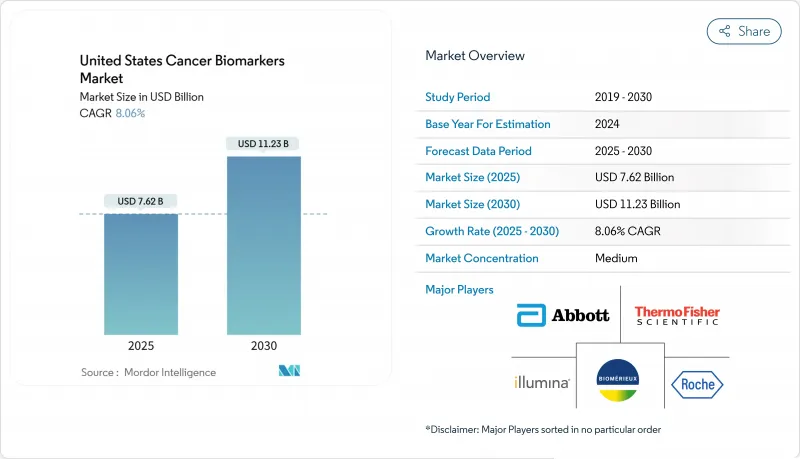
본 보고서는 질환별(유방암, 폐암, 전립선암 등), 생체분자 유형별(단백질 바이오마커 등), 프로파일링 기술별(오믹스 기술, 영상 진단 기술 등), 최종 사용자별(병원 및 진료소 등)로 분류되어 있습니다. 시장 세분화 및 전망은 금액(달러) 기준으로 제시되어 있습니다.
미국의 암 바이오마커 시장 동향 및 인사이트
암 유병률 상승 및 고령화
현재 암 신규 진단 건수는 연간 200만 건을 초과하며, 사망률은 바이오마커 접근성이 여전히 제한적인 비대도시권 카운티에 집중되어 있습니다. 선벨트 지역으로의 인구 이동으로 인해 플로리다주, 텍사스주, 애리조나주에서 수요가 증가하고 있으며, 도시 지역에서는 고품질의 멀티오믹스 패널이 요구되는 반면, 지방 카운티에서는 미개척 검사 수요가 막대하게 존재하는 등 양극화된 시장 역학이 형성되고 있습니다. CDC의 지리 공간 매핑은 중서부 지역의 사망률 집중 지역을 보여주고 있으며, 이는 충족되지 않은 수요를 뒷받침합니다. 전국의 중앙 연령이 상승함에 따라 동반 질환이 복잡해지면서 의료 제공업체들은 더 광범위한 검사 패널을 처방하게 되었고, 이로 인해 환자 1인당 평균 수익이 증가하고 있습니다. 지역 병원에서 진행 중인 현장 진단(PoC) 액체 생검 시범 사업은 물류상의 장벽을 낮추고 있지만, 부족한 검사 인프라는 여전히 보급 범위를 제한하고 있습니다. 이러한 인구 통계학적 요인으로 인해 예측 기간을 훨씬 뛰어넘는 지속적인 수익 성장이 예상됩니다.
정밀 의학의 추진 및 동반 진단제의 FDA 승인
FDA는 2024년, FoundationOne CDx의 적응증 확대를 포함하여 영향력이 큰 여러 동반진단 검사를 승인했습니다. 조직 비의존형 지침에 따라 제약사는 종양의 부위가 아닌 분자 변이를 표적으로 삼을 수 있게 되어, 검사 대상 환자층이 확대되고 있습니다. 이와 병행하여 마련된 ctDNA 관련 지침안은 미세잔류병변(MRD)을 유효한 평가 지표로 인정함으로써, 보험사의 지속적인 모니터링에 대한 보험 급여를 촉진하고 있습니다. 메이요 클리닉(Mayo Clinic) 등 학술적 선도 기관의 보고에 따르면, 종합적인 유전체 프로파일링은 제한적인 패널에 비해 임상시험 적합 확률을 2배로 높입니다. 규제 측면의 이러한 추세는 병원 네트워크 전체로 확산되어 조직 차원의 도입을 촉진하고 있습니다. 전자건강기록(EHR)에 통합된 표준화된 주문 세트는 검사의 표준화를 더욱 진전시키고 의사결정 주기를 단축함으로써 도입의 선순환을 강화하고 있습니다.
고액의 진단 비용과 민간 보험사별 보상 차이에 대한 문제
종양 전문의의 3분의 2가 바이오마커 검사 의뢰 시 가장 큰 장벽으로 보험 적용 거부를 꼽고 있습니다. 17개 주에서 보험 적용이 의무화되어 있는 반면, 민간 보험사들은 불균일한 기준을 적용하고 있으며, 유나이티드헬스케어와 시그나는 각각 독자적인 의료 방침을 공표하여 행정 처리상의 마찰을 야기하고 있습니다. 의료 경제 모델에 따르면, 광범위한 차세대 염기서열 분석은 순차적 단일 유전자 검사와 비교하여 환자 1인당 비용을 50% 이상 절감할 수 있는 것으로 나타났으나, 보험사들은 여전히 사전 승인 단계에서 범위가 더 좁은 검사 패널을 우선시하고 있습니다. 이러한 불일치로 인해 3상 생존 데이터가 부족한 신흥 검사법 시장 침투가 지연되고 있습니다. 병원의 수익 주기 관리 팀은 거부 결정에 대한 이의를 제기하기 위해 바이오마커 ‘거부 대응’ 부서를 운영하고 있으며, 이러한 간접비 증가가 소규모 의료 기관이 첨단 검사 패널을 제공하는 데 걸림돌이 되고 있습니다.
부문별 분석
2024년, 유방암은 HER2, ER, PR 및 다유전자 발현을 대상으로 하는 검증된 패널을 통해 미국 암 바이오마커 시장 매출의 36.33%를 차지했습니다. 전립선 검사와 관련된 미국 암 바이오마커 시장 규모는 침습적인 직장 수지 검사를 불필요하게 만드는 MyProstateScore 2.0과 같은 소변 검사에 힘입어 연평균 성장률(CAGR) 9.02%로 확대될 것으로 예측됩니다. 다중 암 조기 발견(MCED) 시범 사업에도 유방암 및 전립선암 시그니처가 포함되어 있어 수요 증가를 뒷받침하고 있습니다. 비뇨기과 의사들 사이에서 ‘Decipher’ 및 ‘Prolaris’ 유전자 점수 검사가 빠르게 보급되고 있는 점은 추가적인 성장 가능성을 시사합니다.
혁신적인 기업들은 고위험 생식세포계 마커와 체세포 변이를 활용하여 아프리카계 미국인 남성을 대상으로 한 위험도 기반 선별 검사를 실현하고 있습니다. 이 집단은 사망률이 높음에도 불구하고, 그동안 바이오마커 이용률이 낮았습니다. 지역사회와의 협력과 가정 내 소변 채취를 결합함으로써, 그동안 선별 검사가 미흡했던 지역으로의 보급 범위가 확대되고 있습니다. 중서부 지역의 한 암 진료 그룹은 현재 불필요한 생검을 줄이기 위해 전립선 유전체 점수와 MRI를 활용한 선별 검사를 병행하고 있으며, 이 부문의 높은 비용 대비 효과가 입증되고 있습니다. PSA의 특이도 한계가 더욱 뚜렷해짐에 따라, 지침 제정 위원회는 멀티오믹스 패널의 채택을 권장할 것으로 예상되며, 이는 수익 확대를 뒷받침할 것입니다.
2024년에도 단백질 분석은 매출의 50.41%를 계속 차지했습니다. 이는 대부분의 병원 검사실에서 면역분석법이 분석 장비의 워크플로우에 여전히 통합되어 있기 때문입니다. 미국 암 바이오마커 시장에서 유전자 검사 시장 규모는 시퀀싱 가격 하락과 동반 진단의 적응증 확대에 따라 연평균 성장률(CAGR) 9.11%로 확대될 것으로 예측됩니다. 써모피셔의 Proximity Extension Assay 인수로 5,000개 이상의 고특이성 단백질 표적이 추가되면서, 기존 생체 분자의 경계가 모호해져 통합 패널의 구현이 가능해졌습니다.
RNA-seq 및 메틸화 시그니처는 단백질 마커에 비해 조기 검출이 가능함이 입증되어 주목도를 높이고 있습니다. 그러나 보험 급여 측면에서는 임상의들이 수십 년간 익숙해져 온 CA 19-9, CEA, PSA 등의 단일 분석 대상 단백질이 여전히 우대받고 있습니다. 항체의 교차반응성 문제를 극복하기 위해 질량 분석법을 이용한 단백질체학가 트랜스레이셔널 파이프라인에 도입되고 있지만, 설비 투자 부담이 일상적인 도입을 지연시키고 있습니다. 한편, 순환 엑소좀과 대사 산물은 여전히 연구 단계에 있으며, 2030년까지는 유전자 바이오마커와 단백질 바이오마커가 두 축으로서의 지위를 유지할 전망입니다.
기타 혜택 :
- Excel 형식 시장 예측(ME) 시트
- 3개월간의 애널리스트 지원
자주 묻는 질문
목차
제1장 서론
제2장 분석 방법
제3장 주요 요약
제4장 시장 구도
제5장 시장 규모 및 성장률 예측
제6장 경쟁 구도
제7장 시장 기회 및 향후 전망
AJY 26.08.07According to Mordor Intelligence, the United States cancer biomarkers market stands at USD 7.62 billion in 2025 and is on course to reach USD 11.23 billion by 2030, translating into an 8.06% CAGR.
This report is Segmented by Disease (Breast Cancer, Lung Cancer, Prostate Cancer, and More), Biomolecule Type (Protein Biomarkers and More), Profiling Technology (Omics Technologies, Imaging Technologies, and More), and End User (Hospitals & Clinics, and More). The Market and Forecasts are Provided in Terms of Value (USD).
United States Cancer Biomarkers Market Trends and Insights
Rising Cancer Prevalence and Ageing Population
Cancer incidence now tops 2 million diagnoses each year, with mortality clustering in nonmetropolitan counties where biomarker access remains sparse. Population migration toward the Sun Belt magnifies demand in Florida, Texas, and Arizona, creating a dual market dynamic: urban centers pull premium multi-omic panels, whereas rural counties present large untapped test volumes. CDC geospatial mapping shows mortality hot spots in the Midwest, confirming unmet diagnostic need. As the national median age rises, comorbidity complexity pushes providers to order broader panels, lifting average revenue per patient. Point-of-care liquid-biopsy pilots in community hospitals cut logistic barriers, but insufficient lab infrastructure still limits reach. These demographics ensure durable revenue upside well beyond the forecast horizon.
Precision-Medicine Push and FDA Approvals for Companion Diagnostics
The FDA cleared multiple high-impact companion tests in 2024, including broader indications for FoundationOne CDx. Tissue-agnostic guidance now lets drug developers target molecular alterations rather than tumor sites, expanding testable patient pools. Parallel ctDNA draft guidance validates minimal residual disease endpoints, encouraging payers to reimburse serial monitoring. Academic flagships like Mayo Clinic report that comprehensive genomic profiling doubles trial-matching odds relative to narrow panels. The regulatory momentum cascades through hospital networks, driving enterprise-wide adoption. Standardized order sets embedded in electronic health records further normalize testing and shorten decision cycles, reinforcing the virtuous adoption loop.
High Diagnostic Costs and Fragmented Private-Payer Reimbursement
Two-thirds of oncologists cite insurance denials as the top barrier to ordering biomarkers. While 17 states mandate coverage, commercial payers apply heterogeneous criteria; UnitedHealthcare and Cigna each publish distinct medical policies that create administrative friction. Health-economic models show that broad next-generation sequencing can cut per-patient costs by more than 50% compared with sequential single-gene testing, yet payers still favor narrower panels during prior authorization. This fragmentation slows market penetration for emerging assays lacking phase-III survival data. Hospital rev-cycle teams maintain biomarker "denial management" units to appeal rejections, adding overhead that discourages smaller centers from offering advanced panels.
Other drivers and restraints analyzed in the detailed report include:
- Surge in Liquid-Biopsy Adoption for Minimally Invasive Detection
- Federal Cancer Moonshot and NIH Funding Uptick for Biomarker Research
- Complex Multi-Agency Regulatory Pathway
For complete list of drivers and restraints, kindly check the Table Of Contents.
Segment Analysis
Breast cancer generated 36.33% of United States cancer biomarkers market revenue in 2024 through well-established panels targeting HER2, ER, PR, and multi-gene expression. The United States cancer biomarkers market size for prostate testing is projected to expand at a 9.02% CAGR, underpinned by urine-based assays such as MyProstateScore 2.0 that remove invasive digital rectal examinations. Multi-cancer early detection (MCED) pilots also embed breast and prostate signatures, reinforcing volume demand. Rapid adoption of Decipher and Prolaris gene score tests among urologists signals further upside.
Innovators are leveraging high-risk germline markers and somatic mutations to enable risk-stratified screening in African-American men, a cohort with elevated mortality yet historically low biomarker utilization. Community outreach paired with at-home urine collection broadens reach into previously under-screened zip codes. Oncology groups in the Midwest now bundle prostate genomic scores with MRI triage to reduce unnecessary biopsies, validating the segment's cost-effectiveness story. As PSA specificity limitations become more visible, guideline committees are expected to recommend multi-omic panels, catalyzing revenue.
Protein assays retained a 50.41% revenue position in 2024 because immunoassays remain embedded in analyzer workflows across most hospital laboratories. The United States cancer biomarkers market size for genetic assays is forecast to rise at a 9.11% CAGR as sequencing prices fall and companion diagnostic labeling expands. Thermo Fisher's Proximity Extension Assay acquisition adds more than 5,000 high-specificity protein targets, blurring traditional biomolecule boundaries and enabling integrated panels.
RNA-seq and methylation signatures gain visibility as they prove earlier detection windows compared with protein markers. Yet reimbursement still favors single-analyte proteins such as CA 19-9, CEA, and PSA because of decades-long clinician familiarity. Mass-spectrometry proteomics is entering translational pipelines to overcome antibody cross-reactivity challenges, but capital-expenditure requirements slow routine adoption. Meanwhile, circulating exosomes and metabolites remain in discovery, positioning genetic and protein biomarkers as dual pillars through 2030.
Complete Report Scope:
- By Disease
- Breast Cancer
- Lung Cancer
- Prostate Cancer
- Colorectal Cancer
- Cervical Cancer
- Other Cancers
- By Biomolecule Type
- Protein Biomarkers
- Genetic Biomarkers
- Others
- By Profiling Technology
- Omics Technologies
- Imaging Technologies
- Immunoassays
- Others
- By End User
- Hospitals & Clinics
- Clinical & Reference Laboratories
- Pharma & Biotech Companies
- Others
List of Companies Covered in this Report:
- Abbott Laboratories
- Agilent Technologies
- bioMerieux
- Bio-Rad Laboratories
- Caris Life Sciences
- Exact Sciences
- Roche
- Foundation Medicine
- Guardant Health
- GRAIL
- Hologic
- Illumina
- Myriad Genetics
- Natera
- NeoGenomics
- QIAGEN
- Quest Diagnostics
- Thermo Fisher Scientific
- 23andMe
- Adaptive Biotechnologies
- Somalogic
Additional Benefits:
- The market estimate (ME) sheet in Excel format
- 3 months of analyst support
TABLE OF CONTENTS
1 Introduction
- 1.1 Study Assumptions & Market Definition
- 1.2 Scope of the Study
2 Research Methodology
3 Executive Summary
4 Market Landscape
- 4.1 Market Overview
- 4.2 Market Drivers
- 4.2.1 Rising Cancer Prevalence And Ageing Population
- 4.2.2 Precision-Medicine Push & FDA Approvals For Companion Diagnostics
- 4.2.3 Surge In Liquid-Biopsy Adoption For Early, Minimally-Invasive Detection
- 4.2.4 Federal Cancer Moonshot & NIH Funding Uptick For Biomarker Research
- 4.2.5 AI-Enabled Multi-Omic Biomarker Discovery From Integrated EHR-Omics Datasets
- 4.2.6 CMS Transitional Coverage For Emerging Technologies Fast-Track For Novel Tests
- 4.3 Market Restraints
- 4.3.1 High Diagnostic Costs & Fragmented Private-Payer Reimbursement
- 4.3.2 Complex Multi-Agency Regulatory Pathway
- 4.3.3 Genomic-Privacy And Data-Ownership Concerns Among Patients
- 4.3.4 Under-Represented Minority Biospecimen Availability In US Biobanks
- 4.4 Regulatory Landscape
- 4.5 Technological Outlook
- 4.6 Porters Five Forces Analysis
- 4.6.1 Threat of New Entrants
- 4.6.2 Bargaining Power of Buyers
- 4.6.3 Bargaining Power of Suppliers
- 4.6.4 Threat of Substitutes
- 4.6.5 Intensity of Competitive Rivalry
5 Market Size & Growth Forecasts (Value, USD)
- 5.1 By Disease
- 5.1.1 Breast Cancer
- 5.1.2 Lung Cancer
- 5.1.3 Prostate Cancer
- 5.1.4 Colorectal Cancer
- 5.1.5 Cervical Cancer
- 5.1.6 Other Cancers
- 5.2 By Biomolecule Type
- 5.2.1 Protein Biomarkers
- 5.2.2 Genetic Biomarkers
- 5.2.3 Others
- 5.3 By Profiling Technology
- 5.3.1 Omics Technologies
- 5.3.2 Imaging Technologies
- 5.3.3 Immunoassays
- 5.3.4 Others
- 5.4 By End User
- 5.4.1 Hospitals & Clinics
- 5.4.2 Clinical & Reference Laboratories
- 5.4.3 Pharma & Biotech Companies
- 5.4.4 Others
6 Competitive Landscape
- 6.1 Market Concentration
- 6.2 Market Share Analysis
- 6.3 Company Profiles (includes Global level Overview, Market level overview, Core Segments, Financials as available, Strategic Information, Market Rank/Share for key companies, Products & Services, and Recent Developments)
- 6.3.1 Abbott Laboratories
- 6.3.2 Agilent Technologies
- 6.3.3 BioMerieux
- 6.3.4 Bio-Rad Laboratories
- 6.3.5 Caris Life Sciences
- 6.3.6 Exact Sciences
- 6.3.7 F. Hoffmann-La Roche
- 6.3.8 Foundation Medicine
- 6.3.9 Guardant Health
- 6.3.10 GRAIL
- 6.3.11 Hologic
- 6.3.12 Illumina
- 6.3.13 Myriad Genetics
- 6.3.14 Natera
- 6.3.15 NeoGenomics
- 6.3.16 Qiagen
- 6.3.17 Quest Diagnostics
- 6.3.18 Thermo Fisher Scientific
- 6.3.19 23andMe
- 6.3.20 Adaptive Biotechnologies
- 6.3.21 Somalogic
7 Market Opportunities & Future Outlook
- 7.1 White-space & Unmet-need Assessment


