

|
시장보고서
상품코드
2097394
가전제품용 전자기기 제조 서비스 : 시장 점유율 분석, 업계 동향 및 통계, 성장 예측(2026-2031년)Electronics Manufacturing Services For Consumer Electronics - Market Share Analysis, Industry Trends & Statistics, Growth Forecasts (2026 - 2031) |
||||||
 Mordor Intelligence
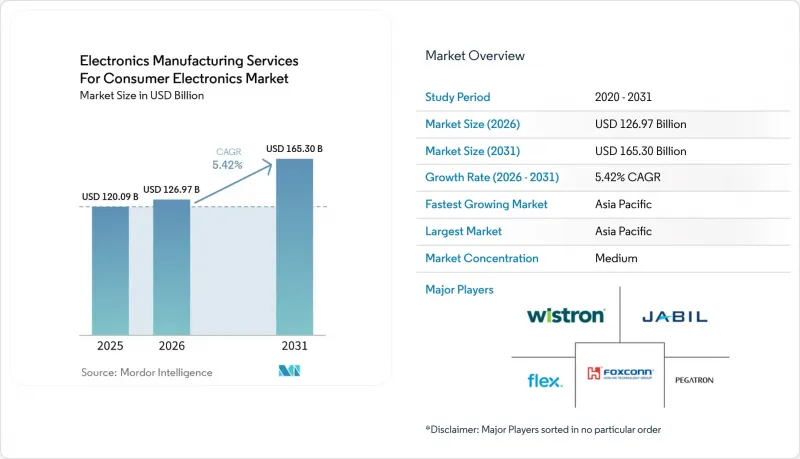
Mordor Intelligence에 의하면, 가전제품용 전자기기 제조 서비스(EMS) 시장 규모는 2025년 1,200억 9,000만 달러로 평가되었습니다. 2026년에는 1,269억 7,000만 달러로 확대되어 2026년부터 2031년에 걸쳐 CAGR 5.42%로 성장을 지속하여, 2031년에는 1,653억 달러에 이를 것으로 예측됩니다.
본 보고서는 서비스 유형(PCB 조립, 전기 기계 조립/박스 빌드 등을 포함한 전자기기 제조 서비스), 비즈니스 모델(수탁 제조 등), 제조 공정(표면실장기술 등) 및 지역별로 분류되어 있습니다. 시장 예측은 금액(달러) 기준으로 제시되어 있습니다.
세계의 가전제품용 전자기기 제조 서비스 시장 동향 및 인사이트
소형화 및 고밀도화된 EMS가 필요한 스마트 웨어러블 기기의 보급
웨어러블 단말기의 출하 대수는 2025년에 5억 2,300만 대에 달했으며, 일반적인 스마트 워치에는 현재 두께 10mm 미만의 다층 리지드-플렉스 기판이 탑재되어 있습니다. 이에 대응하기 위해 각 EMS 파트너사는 50µm 미만의 선폭을 구현하는 레이저 직접 노광 장치 및 마이크로 비아 드릴을 도입하여, 1 cm²당 120개 이상의 부품 배치 밀도를 가능하게 했습니다. 디바이스에는 능동적인 냉각 기능이 없기 때문에 열 관리가 매우 중요합니다. 공급업체들은 피부 접촉 온도를 IEC 62368-1 규격의 한계치인 41°C 이하로 억제하기 위해 스프레더의 공동 설계 및 칩셋 선정을 진행하고 있습니다(IEC.CH). 애플이 워치 조립을 바쿠산에 위치한 럭스쉐어(Luxshare)의 클린룸으로 이전한 것은 웨어러블 제품 생산이 지역별로 분산되는 추세를 여실히 보여주고 있습니다.
스마트폰 제품 수명 주기의 단축이 아웃소싱을 촉진
2025년에 출시된 플래그십 단말기 시장 체류 기간은 불과 9.7개월에 그쳐, 2020년의 14.2개월에서 단축되었습니다. 이에 따라 각 OEM 업체들은 설비 비용을 여러 브랜드에 분산할 수 있는 EMS 파트너에게 조립을 위탁하고 있습니다. 폭스콘의 정저우 공장에서는 72시간 이내에 47개의 SMT 라인을 재조정하고, 스텐실을 교체하거나 픽 앤 플레이스 헤드를 재프로그래밍함으로써 3개 브랜드 간에 생산을 전환할 수 있습니다. 아웃소싱을 통해 고정비를 변동비로 전환할 수 있다는 점은 기술 노후화 위험이 높은 상황에서 결정적인 이점이 됩니다.
상품 가격 변동에 따른 이익률 압박
2025년, 구리 가격은 톤당 8,200달러에서 1만 400달러 사이에서 변동했으며, 에폭시 수지는 전년 대비 14% 상승했습니다. 부품 원가의 최대 22%를 차지하는 PCB 라미네이트가 EMS의 매출총이익률을 압박하는 요인이 되었습니다. 플렉스(Flex)사는 비용 전가 조항이 있었음에도 불구하고, 2025 회계연도 3분기에 120 베이시스 포인트의 매출총이익률 하락을 기록했습니다. 규모가 작은 기업들은 특히 어려움을 겪고 있으며, 경우에 따라서는 복잡도가 낮은 제조 프로젝트에서 철수하기도 합니다.
부문별 분석
2025년 매출에서 PCB 조립이 차지하는 비중은 41.73%로, 소비자용 전자기기 시장에서 전자기기 제조 서비스(EMS)의 기반을 이루었습니다. 그러나 각 브랜드가 공급업체 통합을 추진하는 가운데, 전기 기계 및 박스 빌드 계약은 5.81%의 성장세가 예상되며, 이는 시장 전체 성장률을 상회할 것으로 전망됩니다. 이러한 변화는 단일 구매 주문 내에서 턴키 방식의 케이스, 열 솔루션, 최종 테스트에 대한 수요를 반영하며, 조정 비용을 절감하고 제품 출시 속도를 향상시키고 있습니다.
박스 빌드 비용에는 대개 케이블 배선, 펌웨어 프로그래밍 및 패키징이 포함되어 있어, 이를 통해 EMS 파트너는 프로젝트 가치에서 더 큰 비중을 차지할 수 있게 됩니다. 프로토타이핑은 여전히 틈새 분야이지만, 양산 설계(DFM) 검증에 필수적이며, Sanmina사는 10일 미만의 사이클을 실현하고 있습니다. AI 중심 기판에서는 신경망의 정확도 검증이 필요하기 때문에 테스트 서비스의 중요성이 높아지고 있으며, 이에 따라 Benchmark사는 2025년에 자동 테스트 역량을 18% 확대할 예정입니다. 따라서 소비자 가전 시장 내 박스 빌드 EMS 시장 규모는 2031년까지 점유율을 확대해 나갈 전망입니다.
지역별 분석
아시아태평양은 2025년에 가전제품용 전자기기 제조 서비스 시장의 전 세계 매출의 60.88%를 차지했으며, 2031년까지 연평균 성장률(CAGR) 6.55%로 확대되어 해당 지역의 주도적 지위를 유지할 것으로 전망됩니다. 소비자용 가전제품용 EMS 시장 점유율 우위는 광둥성, 장쑤성, 페낭의 밀집된 부품 생태계와 더불어, 5년 동안 증분 매출액의 최대 6%를 환급해 주는 인도의 PLI(생산 연계형 인센티브) 제도 덕분입니다. 베트남은 2025년에 89억 달러 규모의 전자기기 분야 외국인 직접 투자(FDI)를 유치했으나, 하이퐁 항구의 혼잡으로 인해 컨테이너 체류 시간이 4.3일 연장되면서, 당초 중국에서 OEM 제조업체를 유치함으로써 기대했던 물류 비용 절감 효과가 상쇄되었습니다. 말레이시아의 클림 코리도(Klim Corridor)는 시험 및 패키징 역량을 강화한 반면, 태국은 중급 스마트폰 조립에 주력함으로써, 소비자용 가전제품용 전자기기 제조 서비스(EMS) 시장은 계속해서 아시아태평양 여러 국가에 걸친 공급 기반을 중심으로 전개되고 있습니다.
인도의 가전제품용 전자기기 제조 서비스(EMS) 규모는 2025년 스마트폰 생산 대수가 3억 4,000만 대에 달하고, 출하량의 58%를 수출이 차지함에 따라 확대되었습니다. 폭스콘, 페가트론, 위스트론은 통관 절차를 12시간으로 단축하는 보세 창고 규정을 활용하여 타밀나두주, 우타르프라데시주, 카르나타카주에 박스 빌드 라인을 설치했습니다. 베트남 박닌성에는 삼성의 6개 공장으로 구성된 복합 단지가 있으며, 이를 핵심으로 2차 인쇄회로기판 및 렌즈 공급업체 클러스터가 형성되어 있습니다. 이를 통해 선전에서 출하되는 부품에 비해 리드타임을 27% 단축하고 있습니다. 멕시코 과달라하라 및 치와와 시설은 노트북 및 네트워크 장비의 지역 허브 역할을 수행하고 있으며, 북미산 부가가치율이 75% 이상인 조립품에 대한 관세를 면제하는 USMCA 규정을 활용하고 있습니다. 이러한 거점들은 전반적으로 ‘차이나 플러스 원(China Plus One)’ 전략의 기반을 형성하고 있으며, 수출 규제나 팬데믹으로 인한 제한으로 중국공급망이 혼란에 빠졌을 경우 OEM 제조업체에 대체 경로를 제공합니다.
북미와 유럽을 합친 2025년 매출 비중은 25% 미만이지만, 이 지역에서는 엄격한 지적 재산권 보호와 설계 팀과의 근접성이 요구되는 다품종 소량 생산에 중점을 두고 있습니다. 캘리포니아주와 텍사스주에 위치한 미국 시설은 첨단 패키징의 시범 생산 및 방위용도의 내환경형 태블릿을 전문으로 하는 반면, 루마니아와 폴란드 공장에서는 유럽의 전기차 프로그램을 위한 배터리 관리 시스템을 조립하고 있습니다. 브라질은 관세 장벽과 현지 조달률 규제를 통해 가전 산업의 기반을 보호하고 있으며, 이에 따라 Flex와 같은 EMS 기업들은 공공 부문 수주를 확보하기 위해 브라질 자회사의 ISO 14001 인증 취득을 추진하고 있습니다. 중동 및 아프리카는 여전히 틈새 시장이며, 아랍에미리트(UAE)는 주로 유럽 및 아프리카 유통 경로에 제품을 공급하는 물류·재수출 허브 역할을 수행하고 있습니다. 정책 및 노동 환경의 변동이 심화되는 가운데, 가전제품용 하는 전자기기 제조 서비스에서 공급의 지속성을 유지하기 위해서는 3개 대륙에 걸친 병행 생산 능력이 이제 필수적입니다.
기타 혜택 :
- 엑셀 형식 시장 예측(ME) 시트
- 3개월간의 애널리스트 지원
자주 묻는 질문
목차
제1장 서론
제2장 조사 방법
제3장 주요 요약
제4장 시장 구도
제5장 시장 규모 및 성장 예측
제6장 경쟁 구도
제7장 시장 기회 및 향후 전망
KTH 26.08.05According to Mordor Intelligence, the electronics manufacturing services for consumer electronics market size is expected to grow from USD 120.09 billion in 2025 to USD 126.97 billion in 2026 and is forecast to reach USD 165.30 billion by 2031 at 5.42% CAGR over 2026-2031.
This report is Segmented by Service Type (Electronic Manufacturing Services Including PCB Assembly, Electromechanical Assembly/Box Build, and More), Business Model (Contract Manufacturing, and More), Manufacturing Process (Surface Mount Technology, and More), and Geography. The Market Forecasts are Provided in Terms of Value (USD).
Global Electronics Manufacturing Services For Consumer Electronics Market Trends and Insights
Proliferation Of Smart Wearables Requiring Miniaturized High-Density EMS
Wearable shipments hit 523 million units in 2025, and the typical smartwatch now packs multilayer rigid-flex boards under 10 mm thick. EMS partners responded by installing laser direct imaging and micro-via drillers that achieve sub-50 µm line widths, enabling densities above 120 components per cm2. Thermal management is vital because devices lack active cooling; suppliers co-design spreaders and select chipsets to keep skin-contact temperature below 41 °C, the IEC 62368-1 limit IEC.CH. Apple's relocation of Watch assembly to a Luxshare cleanroom in Bac Giang underscores the trend toward regionalized wearable production.
Shortening Product Life Cycles In Smartphones Driving Outsourcing
Flagship devices launched in 2025 stayed on shelves for only 9.7 months, compared with 14.2 months in 2020. OEMs therefore offload assembly to EMS partners that spread equipment costs across several brands. Foxconn's Zhengzhou site can retune 47 SMT lines within 72 hours, swapping stencils and reprogramming pick-and-place heads to pivot among three brands. Outsourcing converts fixed overhead to variable cost, a decisive advantage when obsolescence risk is high.
Margin Pressure From Volatile Commodity Prices
Copper swung between USD 8,200 and USD 10,400 per ton in 2025, while epoxy resin climbed 14% year on year. PCB laminate, up to 22% of bill-of-materials, drove EMS gross-margin compression; Flex saw a 120 basis-point dip in fiscal Q3 2025 despite pass-through clauses. Smaller firms lacking scale struggle most, occasionally exiting low-complexity builds.
Other drivers and restraints analyzed in the detailed report include:
- OEM Push For Regionalized Manufacturing, China-Plus-One
- Adoption Of Advanced Packaging Substrates In Consumer SoCs
- Geopolitical Export Controls On Advanced Semiconductor Technology
For complete list of drivers and restraints, kindly check the Table Of Contents.
Segment Analysis
PCB assembly accounted for 41.73% of 2025 revenue, anchoring the electronics manufacturing services for consumer electronics market. However, electromechanical and box-build contracts are forecast to expand at 5.81%, surpassing overall growth as brands consolidate suppliers. This shift reflects demand for turnkey enclosures, thermal solutions, and final testing within a single purchase order, trimming coordination costs and boosting launch velocity.
Box-build fees often bundle cable routing, firmware flashing, and packaging, allowing EMS partners to capture a larger share of project value. Prototyping remained niche yet crucial for design-for-manufacturing validation, with Sanmina delivering sub-10-day cycles. Testing services gained profile as AI-centric boards require neural-network accuracy checks, prompting Benchmark to boost automated-test capacity by 18% in 2025. The EMS for consumer electronics market size for box-build is therefore positioned to widen its slice through 2031.
Complete Report Scope:
- By Service type
- Electronic Manufacturing Services
- PCB Assembly
- Electromechanical Assembly/Box Build
- Prototyping
- Other Electronic Manufacturing Services
- Engineering Services
- Test and Development Implementation
- Logistics Services
- Other Service Types
- Electronic Manufacturing Services
- By Business Model
- Contract Manufacturing (CM)
- Original Design Manufacturing (ODM)
- Hybrid / Turnkey / Other Business Models
- By Manufacturing Process
- Surface Mount Technology (SMT)
- Through-Hole Technology (THT)
- Advanced Packaging / Hybrid Processes
- By Region
- North America
- United States
- Canada
- Mexico
- Europe
- Germany
- United Kingdom
- Rest of Europe
- Asia-Pacific
- China
- Japan
- South Korea
- India
- South-east Asia
- Rest of Asia-Pacific
- South America
- Middle East and Africa
- North America
Geography Analysis
Asia Pacific generated 60.88% of global revenue for the EMS for consumer electronics market in 2025 and is projected to expand at a 6.55% CAGR through 2031, maintaining the region's leadership position. The electronics manufacturing services for consumer electronics market share advantage stems from dense component ecosystems in Guangdong, Jiangsu, and Penang, coupled with India's PLI incentives that reimburse up to 6% of incremental sales for five years. Vietnam attracted USD 8.9 billion in electronics foreign direct investment in 2025, yet port congestion at Hai Phong extended container dwell time by 4.3 days, eroding logistics savings that initially drew OEMs from China. Malaysia's Kulim corridor strengthened test and packaging depth, while Thailand concentrated on mid-tier smartphone assembly, ensuring that the electronics manufacturing services for consumer electronics market continue to pivot around a multi-country Asia Pacific supply base.
India's electronic manufacturing services for the consumer electronics market size accelerated as smartphone output hit 340 million units in 2025, with exports comprising 58% of shipments. Foxconn, Pegatron, and Wistron installed box-build lines in Tamil Nadu, Uttar Pradesh, and Karnataka, exploiting bonded-warehouse rules that reduce customs clearance to 12 hours. Vietnam's Bac Ninh province hosts Samsung's six-plant complex, anchoring a cluster of tier-2 printed circuit board and lens suppliers that shortens lead times by 27% relative to components shipped from Shenzhen. Mexico's Guadalajara and Chihuahua facilities serve as regional hubs for laptop and networking gear, leveraging USMCA rules that waive tariffs on assemblies with 75% North American value content. Collectively these locations form the backbone of the China-plus-one strategy, giving OEMs alternate routes when export controls or pandemic restrictions disrupt Chinese supply lines.
North America and Europe together commanded under 25% of 2025 revenue but focus on high-mix, low-volume builds that demand tight intellectual-property security and proximity to design teams. U.S. facilities in California and Texas specialize in advanced packaging pilots and ruggedized tablets for defense uses, while Romanian and Polish factories assemble battery-management systems for European electric-vehicle programs. Brazil protects its consumer-electronics base through tariff barriers and localized content rules, driving EMS firms such as Flex to certify Brazilian subsidiaries for ISO 14001 to win public-sector orders. The Middle East and Africa remain niche, with the United Arab Emirates serving primarily as a logistics re-export hub that feeds European and African channels. As policy and labor variables evolve, parallel capacity across three continents is now essential to preserve supply continuity in the electronics manufacturing services for consumer electronics market.
- Foxconn Technology Group
- Pegatron Corporation
- Flex Ltd.
- Wistron Corporation
- Jabil Inc.
- Sanmina Corporation
- Celestica Inc.
- Compal Electronics Inc.
- Inventec Corporation
- Quanta Computer Inc.
- BYD Electronic (International) Company Limited
- Plexus Corporation
- Universal Scientific Industrial Co Ltd. (USI)
- New Kinpo Group (Cal-Comp Electronics)
- Luxshare-ICT Co Ltd.
- Venture Corporation Limited
- Kimball Electronics Inc.
- Benchmark Electronics Inc.
- Zollner Elektronik AG
- Asteelflash (USI Subsidiary)
Additional Benefits:
- The market estimate (ME) sheet in Excel format
- 3 months of analyst support
TABLE OF CONTENTS
1 INTRODUCTION
- 1.1 Study Assumptions and Market Definition
- 1.2 Scope of the Study
2 RESEARCH METHODOLOGY
3 EXECUTIVE SUMMARY
4 MARKET LANDSCAPE
- 4.1 Market Overview
- 4.2 Market Drivers
- 4.2.1 Proliferation of Smart Wearables Requiring Miniaturized High-Density EMS
- 4.2.2 Shortening Product Life Cycles in Smartphones Driving Outsourcing
- 4.2.3 OEM Push for Regionalized Manufacturing, China Plus One
- 4.2.4 Adoption of Advanced Packaging Substrates in Consumer SoCs
- 4.2.5 Rising Demand for Eco-Designed Electronics Under EU Right-to-Repair
- 4.2.6 Integration of AI Accelerators in Edge Devices Boosting Complex PCB Demand
- 4.3 Market Restraints
- 4.3.1 Margin Pressure from Volatile Commodity Prices
- 4.3.2 Geopolitical Export Controls on Advanced Semiconductor Technology
- 4.3.3 Labor Shortages and Wage Inflation in Key EMS Hubs
- 4.3.4 Environmental Compliance Costs, RoHS3 and PFAS Bans
- 4.4 Industry Value Chain Analysis
- 4.5 Regulatory Landscape
- 4.6 Technological Outlook
- 4.7 Impact of Macroeconomic Factors on the Market
- 4.8 Porter's Five Forces Analysis
- 4.8.1 Threat of New Entrants
- 4.8.2 Bargaining Power of Buyers
- 4.8.3 Bargaining Power of Suppliers
- 4.8.4 Threat of Substitutes
- 4.8.5 Competitive Rivalry
5 MARKET SIZE AND GROWTH FORECASTS (VALUE)
- 5.1 By Service type
- 5.1.1 Electronic Manufacturing Services
- 5.1.1.1 PCB Assembly
- 5.1.1.2 Electromechanical Assembly/Box Build
- 5.1.1.3 Prototyping
- 5.1.1.4 Other Electronic Manufacturing Services
- 5.1.2 Engineering Services
- 5.1.3 Test and Development Implementation
- 5.1.4 Logistics Services
- 5.1.5 Other Service Types
- 5.1.1 Electronic Manufacturing Services
- 5.2 By Business Model
- 5.2.1 Contract Manufacturing (CM)
- 5.2.2 Original Design Manufacturing (ODM)
- 5.2.3 Hybrid / Turnkey / Other Business Models
- 5.3 By Manufacturing Process
- 5.3.1 Surface Mount Technology (SMT)
- 5.3.2 Through-Hole Technology (THT)
- 5.3.3 Advanced Packaging / Hybrid Processes
- 5.4 By Region
- 5.4.1 North America
- 5.4.1.1 United States
- 5.4.1.2 Canada
- 5.4.1.3 Mexico
- 5.4.2 Europe
- 5.4.2.1 Germany
- 5.4.2.2 United Kingdom
- 5.4.2.3 Rest of Europe
- 5.4.3 Asia-Pacific
- 5.4.3.1 China
- 5.4.3.2 Japan
- 5.4.3.3 South Korea
- 5.4.3.4 India
- 5.4.3.5 South-east Asia
- 5.4.3.6 Rest of Asia-Pacific
- 5.4.4 South America
- 5.4.5 Middle East and Africa
- 5.4.1 North America
6 COMPETITIVE LANDSCAPE
- 6.1 Market Concentration
- 6.2 Strategic Moves
- 6.3 Market Share Analysis
- 6.4 Company Profiles (includes Global Level Overview, Market Level Overview, Core Segments, Financials as available, Strategic Information, Market Rank/Share for key companies, Products and Services, and Recent Developments)
- 6.4.1 Foxconn Technology Group
- 6.4.2 Pegatron Corporation
- 6.4.3 Flex Ltd.
- 6.4.4 Wistron Corporation
- 6.4.5 Jabil Inc.
- 6.4.6 Sanmina Corporation
- 6.4.7 Celestica Inc.
- 6.4.8 Compal Electronics Inc.
- 6.4.9 Inventec Corporation
- 6.4.10 Quanta Computer Inc.
- 6.4.11 BYD Electronic (International) Company Limited
- 6.4.12 Plexus Corporation
- 6.4.13 Universal Scientific Industrial Co Ltd. (USI)
- 6.4.14 New Kinpo Group (Cal-Comp Electronics)
- 6.4.15 Luxshare-ICT Co Ltd.
- 6.4.16 Venture Corporation Limited
- 6.4.17 Kimball Electronics Inc.
- 6.4.18 Benchmark Electronics Inc.
- 6.4.19 Zollner Elektronik AG
- 6.4.20 Asteelflash (USI Subsidiary)
7 MARKET OPPORTUNITIES AND FUTURE OUTLOOK
- 7.1 White-space and Unmet-need Assessment


