|
시장보고서
상품코드
2097417
관류 영상 진단 시장 : 시장 점유율 분석, 업계 동향 및 통계, 성장 예측(2026-2031년)Perfusion Radiology - Market Share Analysis, Industry Trends & Statistics, Growth Forecasts (2026 - 2031) |
||||||
 Mordor Intelligence
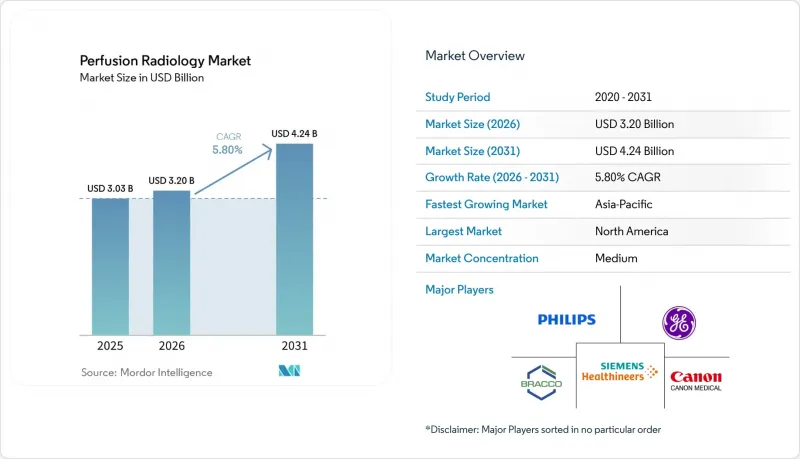
Mordor Intelligence에 의하면, 관류 영상 진단 시장 규모는 2025년 30억 3,000만 달러로 평가되었고, 2026년에는 32억 달러로 확대될 것으로 추정되고, 2031년까지 42억 4,000만 달러에 이를 것으로 예상되며, 2026-2031년 CAGR 5.80%로 성장할 전망입니다.
본 보고서는 모달리티별(CT 관류, MRI 관류 등), 용도별(신경학, 심장학, 종양학 등), 최종 사용자별(병원, 영상진단센터, 외래수술센터(ASC) 등), 지역별(북미, 유럽, 아시아태평양, 중동 및 아프리카, 남미)로 분류되어 있습니다. 시장 예측은 금액(달러) 기준으로 제시되어 있습니다.
세계의 관류 영상 진단 시장 동향 및 인사이트
뇌졸중 발생률 증가가 시간적 제약이 있는 관류 진단 도구에 대한 불가피한 수요를 창출하고 있습니다.
뇌졸중은 치료 가능한 조직과 돌이킬 수 없는 손상을 신속하게 식별하는 것이 적시 치료의 핵심이므로, 관류 영상 진단 시장의 주요 수요 촉진요인으로 계속 작용하고 있습니다. 『2025년 세계 뇌졸중 팩트 시트』에 따르면, 뇌졸중의 전 세계 연간 비용이 8,900억 달러 이상에 달할 것으로 추정되며, 이는 보다 신속한 분류 도구와 표준화된 영상 진단 프로토콜의 필요성을 부각시키고 있습니다. 『Journal of the American Heart Association』지의 2024년 예측에 따르면, 2050년까지 전 세계 뇌졸중 환자 수는 2,143만 명에 달할 것으로 예상되며, 이는 관류 평가에 대한 수요가 지속될 것임을 시사합니다. 종합 뇌졸중 센터에서는 특히 최적의 치료 시기를 놓친 환자에 대해 혈전 제거술 여부를 결정하기 위해 실시간 CT 관류 맵의 활용이 점점 더 늘어나고 있습니다. 2024년과 2025년, 중국 병원에서는 두경부 CTA를 병용한 60초간의 전뇌 CT 관류 검사가 도입되었으며, 가이드라인에 기반한 분류 모델에 따라 그 활용이 주요 의료기관에서 더 광범위한 병원 네트워크로 확대되었습니다. 이러한 추세는 증가하는 환자 수에 대응하고, 의료 시스템 전반에 걸쳐 급성 뇌졸중에 대한 일관된 의사결정을 확보하는 데 시장이 주력하고 있음을 반영합니다.
AI를 활용한 정량적 관류 분석이 플랫폼 간 경쟁 구도를 재정의
정량 분석 소프트웨어는 관류 영상의학 시장에서 중요한 경쟁 요소가 되고 있으며, 구매자들은 단일 플랫폼에서 속도, 일관성, 그리고 임상적으로 유용한 결과를 기대하고 있습니다. 현재 북미 및 유럽의 뇌졸중 센터에서는 자동화된 관류 맵, 허혈 코어의 분할, 의료진에 대한 알림이 표준 워크플로우 기능으로 기대되고 있습니다. ESOC 2025에서 발표된 1,591건의 사례 연구에 따르면, RapidAI는 CT 관류 영상을 사용하여 중등도 혈관 폐색의 93%를 감지했으며, 이는 경쟁 플랫폼의 감지율 70%를 상회하는 수치입니다. 연구는 조영제를 사용하지 않는 기법으로 발전하고 있으며, 2026년 연구에서는 생성형 AI 모델이 비조영 CT 데이터를 활용하여 경쟁 수준에 달하는 관류 지도를 생성한 것이 입증되었습니다. 이 접근 방식이 대규모로 검증된다면 조영제 투여에 대한 의존도를 낮출 수 있어, 시장의 주요 진입 장벽을 해소하는 데 기여할 것입니다. 이러한 혁신 기술이 연구 단계에서 임상 적용 단계로 얼마나 신속하게 전환될지는 여전히 FDA의 승인 절차가 관건이 될 것입니다.
조영제의 안전성과 신장 위험이 임상 현장에서 지속적인 과제로 대두되고 있습니다.
조영제 투여는 관류 영상 진단 시장에서 여전히 큰 과제로 남아 있습니다. 이는 긴급한 관류 영상 진단이 필요한 환자 중 상당수가 신장 위험을 안고 있거나 부작용의 병력이 있기 때문입니다. CT 관류 영상 진단은 요오드계 조영제에 의존하고 있는 반면, MRI 관류 영상 진단에서는 가돌리늄 노출에 대한 우려가 있어, 두 방법 모두 엄격한 임상 검증의 대상이 되고 있습니다. 특히 고령 환자나 만성 신장 질환 환자를 대상으로 한 이러한 검증을 통해 관류 영상 진단의 진단적 가치가 인정받고 있음에도 불구하고, 그 도입은 지연되고 있습니다. 게다가 조영제 투여량의 자동 권장 기능을 지원하는 소프트웨어 역시 규제 당국의 더욱 엄격한 심사에 직면해 있습니다. 조영제를 사용하지 않는 기법에 대한 연구는 진전되고 있으며, 생성형 AI 모델을 활용한 비조영 CT에 대한 기대가 높아지고 있지만, 검증에 소요되는 시간, 워크플로우 조정, 그리고 임상 현장에서의 신뢰 구축이 필요하기 때문에 당분간은 조영제와 관련된 과제가 지속될 전망입니다.
부문 분석
2025년, CT 퍼퓨전은 42.45%의 점유율을 차지하며 퍼퓨전 방사선 의학 시장에서 주도적인 위치를 유지했습니다. 이러한 우위는 속도, 스캐너의 광범위한 보급, 그리고 시기적절한 영상 진단이 치료 방침 결정에 큰 영향을 미치는 뇌졸중 응급 워크플로우에의 원활한 통합에 의해 뒷받침되고 있습니다. 병원에서 첨단 512-슬라이스 시스템을 이용한 60초 전뇌 촬영의 도입은 이러한 입지를 더욱 공고히 했으며, 급성 뇌혈관 질환 사례에서 CTA와의 동시 스캔을 가능하게 했습니다. 핵의학에 의한 관류 검사는 심장학 및 종양학 분야에서 여전히 중요하며, 해부학적 평가를 뛰어넘는 정량적 혈류 평가를 제공합니다. 도플러 및 심초음파 검사에 기반한 관류 검사는 비용 효율성을 중시하는 심장 의료 현장이나 CT 및 MRI 인프라가 갖춰지지 않은 지역 의료 환경에서 계속해서 중요한 역할을 수행하고 있습니다.
MRI 관류 검사는 2031년까지 연평균 성장률(CAGR) 7.25%를 나타낼 것으로 예측되며, 관류 영상 진단 시장에서 가장 빠르게 성장하는 모달리티가 될 전망입니다. 그 장점으로는 방사선 피폭이 없는 영상 진단과 뛰어난 연부 조직 묘사 능력이 포함되며, 종양학의 경과 관찰, 소아 사례 및 장기적인 신경학적 평가에 있어 필수적인 존재가 되고 있습니다. 에를랑겐에서 진행 중인 연구에서는 관류 측정 및 영상 융합을 다매개변수 뇌종양 MRI에 통합하는 노력이 진행되고 있으며, 이는 치료 모니터링 및 감별 진단의 정확도 향상에 기여하고 있습니다. 2025년, Philips(Philips)는 통합된 워크플로우 내에서 스캔 계획과 관류 정량화를 자동화함으로써 심장 MRI의 도입 확대가 용이해짐을 입증했습니다. 이러한 추세는 전문 의료기관에 그치지 않고 일반 의료기관에서의 MRI 일상적 도입으로 전환되고 있음을 보여줍니다.
지역별 분석
2025년, 북미는 관류 영상 진단 시장에서 40.25%라는 압도적인 점유율을 차지했으며, 미국은 선진적인 뇌졸중 센터, AI를 활용한 영상 분석 소프트웨어, 그리고 핵의학 및 심장 관류 검사에 대한 강력한 보험 급여 지원으로 시장을 주도하고 있습니다. 방사성 의약품 및 PET 영상 진단에 대한 보험 급여 확대는 의료기관이 검사 역량을 확대하고 복잡한 워크플로우를 도입하는 데 박차를 가하고 있습니다. 정책의 명확화로 인해 장비 구매에서 일상적인 이용으로의 전환이 가속화되고 있으며, 이는 설비 투자와 보다 명확한 수익 모델로 이어지고 있습니다. 유럽, 특히 독일, 영국, 프랑스는 주요 임상 검증 거점 역할을 하고 있으며, 학술 기관들이 새로운 관류 검사법을 표준화하고 있습니다.
아시아태평양은 2031년까지 연평균 성장률(CAGR) 8.12%를 나타낼 것으로 예측되며, 관류 영상 진단 시장에서 가장 빠르게 성장하는 지역이 될 전망입니다. 중국, 인도, 일본, 한국, 호주 등의 국가들은 질병 부담, 병원 투자, 디지털 헬스케어 도입이 맞물려 성장을 주도하고 있습니다. 중국에서는 병원들이 스캐너 확충과 병행하여 AI를 활용한 관류 영상 진단의 후처리를 도입함으로써, 뇌졸중 진단을 효율화하고 워크플로우의 일관성을 높이고 있습니다. 이러한 동향은 아시아태평양 시장 성숙도를 반영하며, 워크플로우의 고도화와 하드웨어 확충이 진행됨에 따라 장기적인 보급이 촉진되고 있습니다.
중동 및 아프리카, 남미 및 아시아태평양 일부 지역에서는 수익 기여도는 작지만, 관류 방사선 의학에 대한 명확한 수요가 나타나고 있습니다. GCC 국가에서는 3차 의료 기관에 고품질 영상 진단 인프라를 구축하고 있어, 심장 PET 및 CT 관류 검사가 발전하고 있습니다. 브라질과 남아프리카공화국은 보다 발달된 영상 진단 네트워크를 보유한 지역 리더로서의 역할을 수행하고 있습니다. 그러나 보험 환급 제도의 불균형, 높은 수입 비용, 방사선과 전문의 밀도 부족과 같은 과제가 보다 광범위한 도입을 저해하고 있습니다. 이러한 제약은 클라우드 기반 및 구독 모델에 대한 기회를 창출하며, 현장 비용을 절감하는 동시에 의사 밀도가 낮은 임상 네트워크에도 대응하고 있습니다.
기타 혜택 :
- 엑셀 형식 시장 예측(ME) 시트
- 3개월간의 애널리스트 지원
자주 묻는 질문
목차
제1장 서론
제2장 조사 방법
제3장 주요 요약
제4장 시장 구도
제5장 시장 규모 및 성장 예측
제6장 경쟁 구도
제7장 시장 기회 및 향후 전망
AJY 26.08.07According to Mordor Intelligence, the perfusion radiology market size is expected to increase from USD 3.03 billion in 2025 to USD 3.20 billion in 2026 and reach USD 4.24 billion by 2031, growing at a CAGR of 5.80% over 2026-2031.
This report is Segmented by Modality (CT Perfusion, MRI Perfusion, and More), Application (Neurology, Cardiology, Oncology, and More), End User (Hospitals, Diagnostic Imaging Centers, Ambulatory Surgical Centers, and More), and Geography (North America, Europe, Asia-Pacific, Middle East and Africa, South America). The Market Forecasts are Provided in Terms of Value (USD).
Global Perfusion Radiology Market Trends and Insights
Rising Stroke Incidence Creates Irreversible Demand for Time-Sensitive Perfusion Tools
Stroke remains the primary driver of demand in the perfusion radiology market, as timely treatment depends on quickly identifying salvageable tissue versus irreversible damage. The 2025 Global Stroke Fact Sheet estimated the annual global cost of strokes at over USD 890 billion, highlighting the need for faster triage tools and standardized imaging protocols. A 2024 forecast from the Journal of the American Heart Association projected global stroke cases to reach 21.43 million by 2050, indicating sustained demand for perfusion evaluations. Comprehensive stroke centers increasingly use real-time CT Perfusion maps to guide thrombectomy decisions, especially for patients presenting beyond the optimal treatment window. In 2024 and 2025, Chinese hospitals adopted 60-second whole-brain CT perfusion with head-to-neck CTA, expanding its use from flagship centers to broader hospital networks under guideline-driven triage models. This trend reflects the market's focus on addressing rising patient volumes and ensuring consistent acute stroke decision-making across healthcare systems.
AI-Enabled Quantitative Perfusion Analysis Redefines Platform Competition
Quantitative software has become a key competitive factor in the perfusion radiology market, with buyers demanding speed, consistency, and clinically relevant outputs from a single platform. Stroke centers in North America and Europe now expect automated perfusion maps, ischemic core segmentation, and care-team alerts as standard workflow features. A 1,591-case study presented at ESOC 2025 showed RapidAI detected 93% of medium vessel occlusions with CT perfusion imaging, outperforming a competing platform's 70% detection rate.] Research is advancing toward contrast-free methods, with a 2026 study demonstrating that a generative AI model produced competitive perfusion maps using non-contrast CT data. If validated at scale, this approach could reduce reliance on contrast administration, addressing a key access barrier in the market. FDA clearance pathways remain critical in determining how quickly these innovations transition from research to clinical use.
Contrast Agent Safety and Renal Risk Create Sustained Clinical Friction
Contrast administration remains a significant challenge in the perfusion radiology market, as many patients requiring urgent perfusion imaging also face renal risks or have a history of adverse reactions. CT Perfusion relies on iodinated contrast, while MRI perfusion raises concerns about gadolinium exposure, ensuring both methods undergo intense clinical scrutiny. This scrutiny, particularly for elderly patients and those with chronic kidney disease, slows adoption despite the acknowledged diagnostic value of perfusion imaging. Additionally, software supporting automated dosing recommendations faces stricter regulatory scrutiny. Although research into contrast-free methods is advancing, with non-contrast CT showing promise through generative AI models, contrast-related challenges will persist in the near term due to the time required for validation, workflow adjustments, and building clinical trust.
Other drivers and restraints analyzed in the detailed report include:
- Imaging Department Automation Addresses Radiologist Capacity Constraints
- Oncology Perfusion Expands the Addressable Clinical Base
- Workflow Fragmentation Limits Scalable Deployment Across Multi-Site Networks
For complete list of drivers and restraints, kindly check the Table Of Contents.
Segment Analysis
In 2025, CT Perfusion held a 42.45% share, maintaining its leadership in the perfusion radiology market. Its dominance is driven by speed, widespread scanner availability, and seamless integration into emergency stroke workflows, where timely imaging significantly impacts treatment decisions. Hospitals' adoption of 60-second whole-brain acquisition on advanced 512-slice systems further strengthened this position, enabling simultaneous scanning with CTA for acute cerebrovascular cases. Nuclear medicine perfusion remains critical in cardiology and oncology, offering quantitative flow assessments that surpass anatomical evaluations. Doppler and echocardiography-based perfusion continue to be relevant in cost-sensitive cardiac settings and community care environments lacking CT or MRI infrastructure.
MRI Perfusion is projected to grow at a 7.25% CAGR through 2031, making it the fastest-growing modality in the perfusion radiology market. Its advantages include radiation-free imaging and superior soft-tissue characterization, making it essential for oncology follow-ups, pediatric cases, and long-term neurological evaluations. Research at Erlangen is advancing the integration of perfusion measurements and image fusion into multiparametric brain tumor MRIs, enhancing therapy monitoring and differential diagnosis. In 2025, Philips demonstrated that automating scan planning and perfusion quantification within a unified workflow simplifies cardiac MRI scaling. This trend indicates a shift toward routine MRI adoption beyond specialized centers.
Complete Report Scope:
- By Modality
- CT Perfusion
- MRI Perfusion
- Nuclear Medicine Perfusion
- Doppler and Echocardiography-Based Perfusion
- By Application
- Neurology
- Cardiology
- Oncology
- Pulmonology
- Transplantation
- Emergency Medicine
- By End User
- Hospitals
- Diagnostic Imaging Centers
- Ambulatory Surgical Centers
- Academic and Research Institutes
- By Geography
- North America
- United States
- Canada
- Mexico
- Europe
- Germany
- United Kingdom
- France
- Italy
- Spain
- Rest of Europe
- Asia-Pacific
- China
- India
- Japan
- Australia
- South Korea
- Rest of Asia-Pacific
- Middle East and Africa
- GCC
- South Africa
- Rest of Middle East and Africa
- South America
- Brazil
- Argentina
- Rest of South America
- North America
Geography Analysis
In 2025, North America held a dominant 40.25% share of the perfusion radiology market, with the U.S. leading due to advanced stroke centers, AI-driven imaging software, and strong payment support for nuclear and cardiac perfusion. Enhanced reimbursement for radiopharmaceuticals and PET imaging encourages providers to expand capacity and adopt complex workflows. Policy clarity accelerates the transition from equipment purchase to routine use, linking capital investments to clearer revenue models. Europe, particularly Germany, the U.K., and France, serves as a key clinical validation hub, with academic centers standardizing newer perfusion methods.
Asia-Pacific is projected to grow at an 8.12% CAGR through 2031, making it the fastest-growing region in the perfusion radiology market. Countries like China, India, Japan, South Korea, and Australia are driving growth through a combination of disease burdens, hospital investments, and digital healthcare adoption. In China, hospitals are integrating AI-driven perfusion post-processing alongside scanner expansions, streamlining stroke diagnoses and improving workflow consistency. This trend reflects a maturing market in Asia-Pacific, with advancements in workflow sophistication and hardware depth supporting long-term adoption.
The Middle East, Africa, South America, and parts of Asia-Pacific exhibit clear demand for perfusion radiology despite smaller revenue contributions. GCC countries are integrating premium imaging infrastructure into tertiary hospitals, advancing cardiac PET and CT perfusion. Brazil and South Africa act as regional leaders with more developed diagnostic imaging networks. However, challenges like reimbursement fragmentation, high import costs, and low radiologist density hinder broader adoption. These constraints create opportunities for cloud-based and subscription models, reducing on-site expenses and catering to less dense clinical networks.
- Bayer
- Bracco Imaging S.p.A.
- Canon
- Cercare Medical A/S
- FUJIFILM
- GE HealthCare Technologies Inc.
- Guerbet S.A.
- HeartFlow, Inc.
- Koninklijke Philips
- Lantheus Holdings, Inc.
- Olea Medical S.A.
- Profound Medical
- RadNet, Inc.
- Ram Soft
- RapidAI, Inc.
- Shimadzu
- Siemens Healthineers
- TeraRecon, Inc.
- United Imaging Healthcare Co., Ltd.
- Viz.ai, Inc.
Additional Benefits:
- The market estimate (ME) sheet in Excel format
- 3 months of analyst support
TABLE OF CONTENTS
1 INTRODUCTION
- 1.1 Study Assumptions and Market Definition
- 1.2 Scope of the Study
2 RESEARCH METHODOLOGY
3 EXECUTIVE SUMMARY
4 MARKET LANDSCAPE
- 4.1 Market Overview
- 4.2 Market Drivers
- 4.2.1 Rising Stroke and Acute Coronary Workflow Dependence on Rapid Perfusion Decisions
- 4.2.2 Expansion of AI-Enabled Quantitative Perfusion Analysis in Radiology Workflows
- 4.2.3 Imaging Department Productivity Pressure, Driving Automated Reconstruction and Interpretation
- 4.2.4 Growing Adoption of CT Perfusion in Emergency and Neurovascular Care Pathways
- 4.2.5 Increasing Use of Advanced Perfusion Analytics for Oncology, Cardiology, and Transplant Evaluation
- 4.2.6 Reimbursement Support for Advanced Cardiac and Neuro Imaging Analytics
- 4.3 Market Restraints
- 4.3.1 Contrast Agent Safety, Renal Risk, and Operational Screening Burden
- 4.3.2 Workflow Fragmentation Across PACS, RIS, and Vendor-Specific Perfusion Software
- 4.3.3 High Capital and Subscription Cost of Advanced Perfusion Platforms
- 4.3.4 Limited Access to Trained Radiologists and Technologists in Smaller and Emerging Healthcare Facilities
- 4.4 Value/ Supply Chain Analysis
- 4.5 Regulatory Landscape
- 4.6 Technological Outlook
- 4.7 Porters Five Forces Analysis
- 4.7.1 Bargaining Power of Suppliers
- 4.7.2 Bargaining Power of Buyers
- 4.7.3 Threat of New Entrants
- 4.7.4 Threat of Substitutes
- 4.7.5 Intensity of Competitive Rivalry
5 MARKET SIZE AND GROWTH FORECASTS (VALUE, USD)
- 5.1 By Modality
- 5.1.1 CT Perfusion
- 5.1.2 MRI Perfusion
- 5.1.3 Nuclear Medicine Perfusion
- 5.1.4 Doppler and Echocardiography-Based Perfusion
- 5.2 By Application
- 5.2.1 Neurology
- 5.2.2 Cardiology
- 5.2.3 Oncology
- 5.2.4 Pulmonology
- 5.2.5 Transplantation
- 5.2.6 Emergency Medicine
- 5.3 By End User
- 5.3.1 Hospitals
- 5.3.2 Diagnostic Imaging Centers
- 5.3.3 Ambulatory Surgical Centers
- 5.3.4 Academic and Research Institutes
- 5.4 By Geography
- 5.4.1 North America
- 5.4.1.1 United States
- 5.4.1.2 Canada
- 5.4.1.3 Mexico
- 5.4.2 Europe
- 5.4.2.1 Germany
- 5.4.2.2 United Kingdom
- 5.4.2.3 France
- 5.4.2.4 Italy
- 5.4.2.5 Spain
- 5.4.2.6 Rest of Europe
- 5.4.3 Asia-Pacific
- 5.4.3.1 China
- 5.4.3.2 India
- 5.4.3.3 Japan
- 5.4.3.4 Australia
- 5.4.3.5 South Korea
- 5.4.3.6 Rest of Asia-Pacific
- 5.4.4 Middle East and Africa
- 5.4.4.1 GCC
- 5.4.4.2 South Africa
- 5.4.4.3 Rest of Middle East and Africa
- 5.4.5 South America
- 5.4.5.1 Brazil
- 5.4.5.2 Argentina
- 5.4.5.3 Rest of South America
- 5.4.1 North America
6 COMPETITIVE LANDSCAPE
- 6.1 Market Concentration
- 6.2 Market Share Analysis
- 6.3 Company Profiles (includes Global Level Overview, Market Level Overview, Core Segments, Financials as available, Strategic Information, Market Rank/Share, Products and Services, Recent Developments)
- 6.3.1 Bayer AG
- 6.3.2 Bracco Imaging S.p.A.
- 6.3.3 Canon Medical Systems Corporation
- 6.3.4 Cercare Medical A/S
- 6.3.5 FUJIFILM Holdings Corporation
- 6.3.6 GE HealthCare Technologies Inc.
- 6.3.7 Guerbet S.A.
- 6.3.8 HeartFlow, Inc.
- 6.3.9 Koninklijke Philips N.V.
- 6.3.10 Lantheus Holdings, Inc.
- 6.3.11 Olea Medical S.A.
- 6.3.12 Profound Medical Corp.
- 6.3.13 RadNet, Inc.
- 6.3.14 RamSoft, Inc.
- 6.3.15 RapidAI, Inc.
- 6.3.16 Shimadzu Corporation
- 6.3.17 Siemens Healthineers AG
- 6.3.18 TeraRecon, Inc.
- 6.3.19 United Imaging Healthcare Co., Ltd.
- 6.3.20 Viz.ai, Inc.
7 MARKET OPPORTUNITIES AND FUTURE OUTLOOK
- 7.1 White-Space and Unmet-Need Assessment