

|
시장보고서
상품코드
2100584
중재적 방사선학(IVR) 시장 : 점유율 분석, 업계 동향 및 통계, 성장 예측(2026-2031년)Interventional Radiology - Market Share Analysis, Industry Trends & Statistics, Growth Forecasts (2026 - 2031) |
||||||
 Mordor Intelligence
Mordor Intelligence에 의하면, 중재적 방사선학(IVR) 시장 규모는 2025년 285억 5,000만 달러에서 2026년에는 301억 5,000만 달러로 확대되어 2026년부터 2031년까지 CAGR 5.62%로 성장을 지속하여, 2031년에는 396억 5,000만 달러에 이를 것으로 예측됩니다.
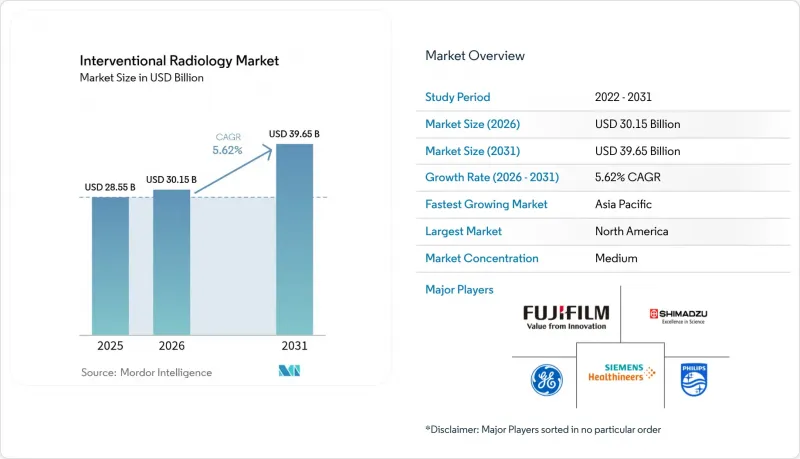
본 보고서는 제품별(영상 시스템, IVR용 소모품 등), 시술 유형별(진단·치료), 용도별(순환기, 종양 등), 최종 사용자별(병원 등), 지역별(북미, 유럽, 아시아태평양, 중동 및 아프리카, 남미)로 분류되어 있습니다. 시장 전망은 금액(달러) 기준으로 제시되어 있습니다.
전 세계 중재적 방사선학(IVR) 시장 동향 및 인사이트
만성 질환 및 생활습관병 유병률 상승
심혈관 질환 및 종양 질환의 부담 증가로 인해, 지속적인 임상적 이점을 제공하는 카테터를 이용한 중재술에 대한 수요가 높아지고 있습니다. 경카테터 대동맥판막 교체술(TAVR)만 해도 2024년에는 약 70억 달러 시장 규모를 기록하며, 이 시술의 도입이 지속되고 있음을 보여줍니다. 테르모사의 웹 시스템 등 신경혈관 분야의 발전으로 인해 파열된 동맥류에 대해 86.5%의 폐쇄율을 달성하여, 기존에는 개두술을 통해 치료되던 적응증의 범위가 확대되었습니다. 말초동맥질환의 치료법은 2,000만 명 이상의 환자가 있는 미국 시장을 위해 설계된 애보트(Abbott)사의 FDA 승인 용해형 스텐트 ‘Esprit BTK’를 통해 발전하고 있습니다. 평균 수명의 연장에 따라 만성 동반 질환이 안정적인 시술 파이프라인을 창출하며, 중재적 방사선학(IVR) 시장의 장기적인 성장을 뒷받침하고 있습니다.
저침습 영상 진단 기술의 지속적인 발전
인공지능(AI)을 통해 투시 검사에 소요되는 시간과 방사선 피폭량이 감소하고 있습니다. 그 예로 지멘스 헬스인어즈(Siemens Healthineers)의 ‘Ciartic Move’를 들 수 있으며, 이는 척추 및 골반 시술 속도를 최대 50%까지 단축시킵니다. AI와 통합된 로봇 기술을 통해 리드리스 좌측 다리 차단 페이싱이 가능해졌으며, 이는 애보트(Abbott)사의 임상시험 중인 전도계 페이싱 플랫폼을 사용하여 최초로 시행되었습니다. RapidAI사의 'Lumina 3D'는 수 분 이내에 고품질의 신경 영상을 재구성하여 기술자 부족 문제를 해소하는 동시에, 시간과의 싸움이 요구되는 뇌졸중 치료 워크플로우를 지원합니다. Philips(Philips)는 엔비디아(NVIDIA)와의 다년간의 제휴를 통해 클릭 조작이 필요 없는 스캔 계획을 실현하는 MRI 기반 모델 개발에 매진하며, 혁신 역량을 한층 더 강화하고 있습니다. 이러한 발전들이 어우러져 시술의 정밀도가 향상되었으며, 프리미엄 영상 진단 스위트에 확고한 차별화 요소가 생겨나고 있습니다.
하이브리드 영상 진단 스위트의 높은 설비 투자 및 운영 비용
혈관조영, CT, MRI를 융합한 하이브리드 스위트의 도입 비용은 수백만 달러를 초과할 수 있으며, 전용 차폐 시설, 공조 설비 업그레이드, 멀티모달 소프트웨어 통합이 필요합니다. 지속적인 서비스 계약 및 직원 교육은 총 소유 비용을 상승시켜, 예산에 제약이 있는 병원의 도입을 가로막고 있습니다. 지멘스 헬스인어즈는 현대화 비용을 상각하고 장비군을 표준화하는 10년에 걸친 ‘밸류 파트너십’을 통해 이러한 장벽을 완화하고 있습니다. 그러나 소규모 시설의 경우 자금 조달이나 공동 조달을 위해 합병을 모색하는 사례가 많아, 발전 중인 의료 시스템에서의 보급을 지연시키고 있습니다.
부문 분석
2025년, 영상 시스템은 45.88%의 점유율을 유지하며 시술 계획 및 안내에서 그 기초적인 역할을 부각시켰습니다. 지멘스의 'syngo DynaCT'에 탑재된 AI 학습 기반 골 제거 알고리즘 등 지속적인 기능 업그레이드는 예산이 부족한 상황에서도 정기적인 장비 교체 주기를 뒷받침하고 있습니다. 한편, IR 소모품은 2031년까지 연평균 성장률(CAGR) 7.1%를 나타낼 것으로 예측되며, 이는 사례 수 증가에 따라 지속적인 수익원으로서의 우위를 반영한 것입니다. 일회용 카테터와 색전 코일은 교차 감염 위험을 줄이고 재고 관리를 효율화하기 때문에 환자 유입이 빈번한 외래 검사실에서 매력적인 선택지로 자리 잡고 있습니다. 치료의 복잡성이 증가함에 따라, 중재적 방사선학(IVR) 분야의 소모품 시장 규모는 급속히 확대될 것으로 예측됩니다.
클라우드 분석을 통해 모달리티의 가동 중단 시간이 단축되고 스케줄링이 최적화됨에 따라, 액세서리 및 워크플로우 소프트웨어의 성장률은 하드웨어를 상회하고 있습니다. Philips의 헬륨 프리 MRI ‘BlueSeal’은 1대당 연간 약 40 MWh의 전력 소비를 절감하고 있어, 환경 효율성이 임상 성능을 어떻게 보완하고 있는지 보여주고 있습니다. AI를 활용한 선량 모니터링 기능을 통합한 투시 시스템은 엄격해지는 안전 기준을 충족하며, 중규모 병원에 매력적인 선택지가 되고 있습니다. 전반적으로, 성숙한 영상 진단 인프라가 높은 수익률을 보이는 일회용 제품의 보급을 뒷받침하며, 중재적 방사선학(IVR) 시장 전체의 수익성 높은 성장을 주도하고 있습니다.
치료 시술은 연평균 성장률(CAGR) 7.32%로 발전하고 있으며, 그 원동력은 메리엇 메디컬(Merit Medical)사의 'Wrapsody'와 같은 세포 투과성이 없는 엔도프로테즈와 같은 의료기기의 획기적인 진보입니다. 이 제품은 혈액 투석 접근로에서 높은 1차 개통률을 달성했습니다. 혈관 성형술 및 스텐트 삽입술 분야에서는 애보트(Abbott)사의 'Esprit BTK' 플랫폼과 같이, 약물 전달을 보장하면서 혈관 치유를 촉진하는 흡수성 스캐폴드가 활용되고 있습니다. 절제 기술의 발전으로 병변 경계의 예측 가능성이 높아지고, 부수적 손상이 감소함에 따라 종양학 및 통증 관리의 적용 범위가 확대되고 있습니다. 그 결과, 치료 서비스에 기인한 중재적 방사선학(IVR) 시장 규모는 부문 수준에서 2031년까지 268억 5,000만 달러에 달할 것으로 예측됩니다.
진단 시술은 37.65%의 점유율을 차지하며, 중재의학 전문의에게 필수적인 영상 진단 지침을 제공하지만, 1건당 수익은 낮은 임베디드니다. 그럼에도 불구하고 콘빔 CT 및 AI 지원 혈관조영술의 혁신으로 진단 정확도가 향상되어, 간접적으로 치료 분야의 확장을 뒷받침하고 있습니다. 생검 및 배액은 종양의 병기 분류 및 감염 관리에 있어 여전히 필수적입니다. 이러한 확고한 진단 기반을 통해 치료 파이프라인으로의 안정적인 환자 유입이 확보되어, 중재적 방사선학(IVR) 시장 전체의 성장 모멘텀이 유지되고 있습니다.
지역별 분석
북미는 2025년 매출의 42.60%를 차지할 것으로 예상되며, 확립된 임상 지침, 높은 의료기기 보급률, 그리고 지멘스 헬스인어즈(Siemens Healthineers)의 미국 내 1억 5,000만 달러 규모의 시설 확장을 포함한 탄탄한 연구 개발 노력에 힘입고 있습니다. 메디케어가 진료 보수표를 2.83% 인하하고, 중재적 방사선학(IVR)의 보상액도 4% 삭감될 전망인 만큼, 지불 압박이 우려되고 있으며, 이에 따라 의료 제공업체들은 비용 대비 효과가 높은 외래 진료 체계에 대한 투자를 가속화하고 있습니다. FDA의 ‘신기술에 대한 과도기적 적용(Transitional Coverage for Emerging Technologies)’과 같은 규제적 노력은 획기적인 의료기기 시장 도입을 촉진하며, 재정 긴축에도 불구하고 혁신의 흐름을 유지하고 있습니다.
아시아태평양은 충족되지 않은 의료 수요의 규모, 도시 지역의 병원 건설 확대, 합작 투자에 힘입어 연평균 성장률(CAGR) 6.05%라는 가장 높은 성장률을 기록하고 있습니다. 이나리 메디컬(Inari Medical)과 6디멘션스 캐피탈(6 Dimensions Capital)의 제휴는 중화권에서 혈전 제거 기기의 상용화를 가속화하고 있으며, 첨단 치료법을 현지화하는 국내외 협업의 한 사례가 되고 있습니다. 각국 정부는 해외 의료 관광을 억제하기 위해 영상 진단 인프라와 의사 연수를 우선시하고 있는 반면, 민관 협력에서는 클라우드 플랫폼을 활용하여 지역 네트워크 전반에 걸쳐 AI 도구를 확대되고 있습니다.
유럽은 엄격한 의료기기 안전 기준과 견고한 대학병원 네트워크를 기반으로 안정적인 성장을 유지하고 있습니다. 2024년에는 Philips가 유럽 특허청에 제출한 의료 기술 관련 출원 건수가 594건을 기록하며, 해당 지역의 혁신 분야에서 명성을 더욱 공고히 했습니다. 동유럽 국가들에서는 유럽연합(EU)의 결속 기금을 활용하여 혈관조영실을 개보수하고, 시술 역량을 향상시키고 있습니다. 중동 및 아프리카·남미는 여전히 발전 단계에 있지만, 탄자니아의 ‘Road2IR’ 프로그램과 같은 교육 이니셔티브를 통해 1,500건 이상의 시술을 높은 성공률로 완료하는 등 도입이 가속화되고 있습니다. 다국적 OEM 기업들은 비용에 민감한 이들 시장에 진출하기 위해 개별 자금 조달 패키지를 제안하고 있으며, 전 세계 중재적 방사선학(IVR) 시장 전반에서 수익원의 다각화가 진행되고 있습니다.
기타 혜택:
- 엑셀 형식 시장 예측(ME) 시트
- 3개월간의 애널리스트 지원
자주 묻는 질문
목차
제1장 서론
제2장 조사 방법
제3장 주요 요약
제4장 시장 구도
제5장 시장 규모와 성장 예측
제6장 경쟁 구도
제7장 시장 기회와 향후 전망
JHS 26.08.11According to Mordor Intelligence, the interventional radiology market size is expected to grow from USD 28.55 billion in 2025 to USD 30.15 billion in 2026 and is forecast to reach USD 39.65 billion by 2031 at 5.62% CAGR over 2026-2031.
This report is Segmented by Product (Imaging Systems, IR Consumables, and More), Procedure Type (Diagnostic and Therapeutics), Application (Cardiology, Oncology, and More), End-User (Hospitals, and More), Geography (North America, Europe, Asia-Pacific, The Middle East and Africa, and South America). The Market Forecasts are Provided in Terms of Value (USD).
Global Interventional Radiology Market Trends and Insights
Rising Prevalence of Chronic and Lifestyle Diseases
Cardiovascular and oncologic burdens elevate demand for catheter-based interventions that offer durable clinical benefits. Transcatheter aortic valve replacement alone generated nearly USD 7 billion in 2024, signaling sustained procedure uptake. Neurovascular advances such as Terumo's WEB system achieved an 86.5% occlusion rate for ruptured aneurysms, broadening indications previously treated via open craniotomy. Peripheral artery disease therapies progress with Abbott's FDA-cleared Esprit BTK dissolving stent, designed for more than 20 million affected Americans. As life expectancy rises, chronic comorbidities generate steady procedural pipelines, anchoring long-term growth for the interventional radiology market.
Continuous Advancements in Minimally Invasive Imaging Technologies
Artificial intelligence reduces fluoroscopy times and radiation dose, exemplified by Siemens Healthineers' Ciartic Move, which accelerates spine and pelvic procedures by up to 50%. Robotics integrated with AI enable leadless left bundle branch pacing, first performed with Abbott's investigational conduction system pacing platform. RapidAI's Lumina 3D reconstructs high-quality neuro images within minutes, addressing technologist shortages and supporting time-sensitive stroke workflows. Philips deepens innovation capacity through a multi-year collaboration with NVIDIA to develop MRI foundational models that deliver zero-click scan planning. Together, these developments raise procedural accuracy and create defensible differentiation for premium imaging suites.
High Capital and Operating Costs of Hybrid Imaging Suites
Hybrid suites blending angiography, CT, and MRI can exceed several million USD and require specialized shielding, HVAC upgrades, and multi-modal software integration. Ongoing service contracts and staff training raise the total cost of ownership and deter adoption in budget-constrained hospitals. Siemens Healthineers mitigates these barriers through decade-long Value Partnerships that amortize modernization costs and standardize equipment fleets. Nonetheless, small facilities often pursue mergers to access financing and pooled procurement, slowing diffusion in less-developed health systems.
Other drivers and restraints analyzed in the detailed report include:
- Expansion of Interventional Radiology Applications Across Therapeutic Areas
- Shift Toward Outpatient and Day-Case Treatment Settings
- Stringent Radiation Safety Regulations and Compliance Burdens
For complete list of drivers and restraints, kindly check the Table Of Contents.
Segment Analysis
In 2025, Imaging Systems retained a 45.88% share, underscoring their foundational role in procedure planning and guidance. Continuous feature upgrades-such as AI-trained bone-removal algorithms on Siemens' syngo DynaCT-support recurrent capital replacement cycles even as budgets tighten. IR Consumables, however, exhibit a 7.1% CAGR through 2031, reflecting their recurring revenue advantage as case volumes climb. Single-use catheters and embolization coils reduce cross-contamination risks and streamline inventory control, making them attractive for outpatient labs where turnover is high. The interventional radiology market size for consumables is projected to broaden swiftly as therapeutic complexity rises.
Accessories and workflow software outpace hardware growth because cloud analytics lower modality downtime and optimize scheduling. Philips' helium-free BlueSeal MRI saves nearly 40 MWh annually per unit, illustrating how eco-efficiency complements clinical performance. Fluoroscopy systems that bundle AI-enabled dose monitoring meet tightening safety mandates and appeal to mid-tier hospitals. Overall, mature imaging infrastructure sets the stage for high-margin disposable uptake, driving profitable expansion across the interventional radiology market.
Therapeutic procedures are advancing at a 7.32% CAGR, propelled by device breakthroughs like Merit Medical's Wrapsody cell-impermeable endoprosthesis that achieved strong primary patency for hemodialysis access. Angioplasty and stenting benefit from absorbable scaffolds that support vessel healing while ensuring drug delivery, such as Abbott's Esprit BTK platform. Ablation technology progression yields predictable lesion boundaries and shrinks collateral injury, broadening oncology and pain-management indications. Consequently, the interventional radiology market size attributed to therapeutic services is projected to reach USD 26.85 billion by 2031 at segment level.
Diagnostic procedures hold a 37.65% share, providing essential imaging roadmaps for interventionists but delivering lower revenue per case. Nevertheless, innovations in cone-beam CT and AI-assisted angiography enhance diagnostic accuracy, indirectly supporting therapeutic expansion. Biopsy and drainage remain vital for oncologic staging and infection control. The enduring diagnostic foundation ensures a steady flow of patients into the therapeutic pipeline, sustaining growth momentum in the broader interventional radiology market.
Complete Report Scope:
- By Product
- Imaging Systems
- Angiography Systems
- Fluoroscopy Systems
- CT Scanners
- MRI Systems
- IR Consumables
- Catheters & Guidewires
- Balloon & Stent Systems
- Embolization & Thrombus Devices
- Accessories & Software
- Imaging Systems
- By Procedure Type
- Diagnostic
- Angiography
- Biopsy & Drainage
- Therapeutic
- Angioplasty & Stenting
- Embolization
- Ablation
- Diagnostic
- By Application
- Cardiology
- Oncology
- Gastroenterology & Hepatology
- Urology & Nephrology
- Other Applications
- By End-user
- Hospitals
- Ambulatory Surgical Centers (ASCs)
- Office-Based Labs (OBLs) & Imaging Centers
- Geography
- North America
- United States
- Canada
- Mexico
- Europe
- Germany
- United Kingdom
- France
- Italy
- Spain
- Rest of Europe
- Asia-Pacific
- China
- Japan
- India
- Australia
- South Korea
- Rest of Asia-Pacific
- Middle East & Africa
- GCC
- South Africa
- Rest of Middle East & Africa
- South America
- Brazil
- Argentina
- Rest of South America
- North America
Geography Analysis
North America commanded 42.60% revenue in 2025, supported by established clinical guidelines, high device penetration, and robust R&D commitments including Siemens Healthineers' USD 150 million facility expansion in the United States. Payment pressures loom as Medicare enacts a 2.83% fee schedule reduction and a projected 4% cut in interventional radiology reimbursements, spurring provider investment in cost-efficient outpatient capacity. Regulatory initiatives such as the FDA's Transitional Coverage for Emerging Technologies pathway expedite market uptake for breakthrough devices, sustaining innovation flow despite fiscal tightening.
Asia-Pacific registers the fastest growth at a 6.05% CAGR, fueled by large unmet procedural needs, urban hospital build-outs, and joint ventures. Inari Medical's partnership with 6 Dimensions Capital accelerates commercialization of thrombectomy devices in Greater China, illustrating foreign-domestic collaboration that localizes advanced therapies. Governments prioritize imaging infrastructure and physician training to curb outbound medical tourism, while public-private alliances leverage cloud platforms to scale AI tools across regional networks.
Europe maintains stable expansion anchored by tight device-safety standards and strong university hospital networks. Philips led European Patent Office filings with 594 medical technology applications in 2024, reinforcing the region's innovation reputation. Eastern European systems allocate European Union cohesion funds to upgrade angiography labs, boosting procedure capacity. The Middle East & Africa and South America remain nascent but show accelerating adoption as training initiatives like Tanzania's Road2IR program complete more than 1,500 procedures with high success rates. Multinational OEMs tailor financing packages to penetrate these value-conscious markets, diversifying revenue streams across the global interventional radiology market.
- Siemens Healthineers
- GE Healthcare
- Koninklijke Philips
- Canon
- FUJIFILM
- Shimadzu
- Hologic
- Samsung Medison Co. Ltd.
- Boston Scientific
- Medtronic
- Cook Group
- Terumo Corp.
- Abbott Laboratories
- Stryker
- Penumbra
- AngioDynamics
- Merit Medical Systems
- Cardinal Health
- Teleflex
- Esaote
Additional Benefits:
- The market estimate (ME) sheet in Excel format
- 3 months of analyst support
TABLE OF CONTENTS
1 Introduction
- 1.1 Study Assumptions & Market Definition
- 1.2 Scope of the Study
2 Research Methodology
3 Executive Summary
4 Market Landscape
- 4.1 Market Overview
- 4.2 Market Drivers
- 4.2.1 Rising Prevalence of Chronic And Lifestyle Diseases
- 4.2.2 Continuous Advancements in Minimally Invasive Imaging Technologies
- 4.2.3 Expansion of Interventional Radiology Applications Across Therapeutic Areas
- 4.2.4 Shift Toward Outpatient and Day-Case Treatment Settings
- 4.2.5 Increasing Capital Investments in High-End Imaging Infrastructure
- 4.2.6 Growing Reimbursement Support For Image-Guided Procedures
- 4.3 Market Restraints
- 4.3.1 High Capital and Operating Costs Of Hybrid Imaging Suites
- 4.3.2 Stringent Radiation Safety Regulations and Compliance Burdens
- 4.3.3 Shortage of Skilled Interventional Radiologists and Staff
- 4.3.4 Competitive Pressure From Alternative Endovascular Specialties
- 4.4 Regulatory Landscape
- 4.5 Porter's Five Forces Analysis
- 4.5.1 Threat of New Entrants
- 4.5.2 Bargaining Power of Buyers/Consumers
- 4.5.3 Bargaining Power of Suppliers
- 4.5.4 Threat of Substitute Products
- 4.5.5 Intensity of Competitive Rivalry
5 Market Size & Growth Forecasts (Value, USD)
- 5.1 By Product
- 5.1.1 Imaging Systems
- 5.1.1.1 Angiography Systems
- 5.1.1.2 Fluoroscopy Systems
- 5.1.1.3 CT Scanners
- 5.1.1.4 MRI Systems
- 5.1.2 IR Consumables
- 5.1.2.1 Catheters & Guidewires
- 5.1.2.2 Balloon & Stent Systems
- 5.1.2.3 Embolization & Thrombus Devices
- 5.1.3 Accessories & Software
- 5.1.1 Imaging Systems
- 5.2 By Procedure Type
- 5.2.1 Diagnostic
- 5.2.1.1 Angiography
- 5.2.1.2 Biopsy & Drainage
- 5.2.2 Therapeutic
- 5.2.2.1 Angioplasty & Stenting
- 5.2.2.2 Embolization
- 5.2.2.3 Ablation
- 5.2.1 Diagnostic
- 5.3 By Application
- 5.3.1 Cardiology
- 5.3.2 Oncology
- 5.3.3 Gastroenterology & Hepatology
- 5.3.4 Urology & Nephrology
- 5.3.5 Other Applications
- 5.4 By End-user
- 5.4.1 Hospitals
- 5.4.2 Ambulatory Surgical Centers (ASCs)
- 5.4.3 Office-Based Labs (OBLs) & Imaging Centers
- 5.5 Geography
- 5.5.1 North America
- 5.5.1.1 United States
- 5.5.1.2 Canada
- 5.5.1.3 Mexico
- 5.5.2 Europe
- 5.5.2.1 Germany
- 5.5.2.2 United Kingdom
- 5.5.2.3 France
- 5.5.2.4 Italy
- 5.5.2.5 Spain
- 5.5.2.6 Rest of Europe
- 5.5.3 Asia-Pacific
- 5.5.3.1 China
- 5.5.3.2 Japan
- 5.5.3.3 India
- 5.5.3.4 Australia
- 5.5.3.5 South Korea
- 5.5.3.6 Rest of Asia-Pacific
- 5.5.4 Middle East & Africa
- 5.5.4.1 GCC
- 5.5.4.2 South Africa
- 5.5.4.3 Rest of Middle East & Africa
- 5.5.5 South America
- 5.5.5.1 Brazil
- 5.5.5.2 Argentina
- 5.5.5.3 Rest of South America
- 5.5.1 North America
6 Competitive Landscape
- 6.1 Market Concentration
- 6.2 Market Share Analysis
- 6.3 Company Profiles (includes Global level Overview, Market level overview, Core Business Segments, Financials, Headcount, Key Information, Market Rank, Market Share, Products and Services, and analysis of Recent Developments)
- 6.3.1 Siemens Healthineers AG
- 6.3.2 GE HealthCare
- 6.3.3 Koninklijke Philips NV
- 6.3.4 Canon Medical Systems Corp.
- 6.3.5 Fujifilm Holdings Corporation
- 6.3.6 Shimadzu Corporation
- 6.3.7 Hologic Inc.
- 6.3.8 Samsung Medison Co. Ltd.
- 6.3.9 Boston Scientific Corp.
- 6.3.10 Medtronic PLC
- 6.3.11 Cook Medical LLC
- 6.3.12 Terumo Corp.
- 6.3.13 Abbott Laboratories
- 6.3.14 Stryker Corp.
- 6.3.15 Penumbra Inc.
- 6.3.16 AngioDynamics Inc.
- 6.3.17 Merit Medical Systems Inc.
- 6.3.18 Cardinal Health Inc.
- 6.3.19 Teleflex Inc.
- 6.3.20 Esaote SpA
7 Market Opportunities & Future Outlook
- 7.1 White-space & Unmet-Need Assessment


