|
시장보고서
상품코드
2098540
네트워크 트래픽 분석 분야 AI 시장 : 점유율 분석, 업계 동향 및 통계, 성장 예측(2026-2031년)AI In Network Traffic Analysis - Market Share Analysis, Industry Trends & Statistics, Growth Forecasts (2026 - 2031) |
||||||
 Mordor Intelligence
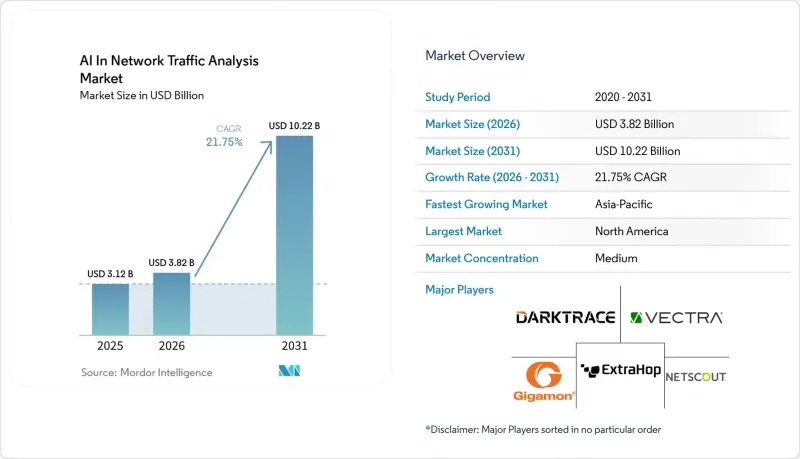
Mordor Intelligence에 의하면, 네트워크 트래픽 분석 분야 AI 시장 규모는 2025년 31억 2,000만 달러에서 2026년에는 38억 2,000만 달러로 확대되어 2026년부터 2031년까지 CAGR 21.75%로 성장을 지속하여, 2031년에는 102억 2,000만 달러에 이를 것으로 예측됩니다.
본 보고서는 구성 요소(소프트웨어 및 서비스), 배포 방식(클라우드, On-Premise, 하이브리드), 기업 규모(대기업 등), 네트워크 유형(기업 네트워크, 데이터센터 네트워크 등), 용도(침입 감지·방지 등), 최종 사용 산업(BFSI 등), 지역별로 분류되어 있습니다. 시장 전망은 금액(달러) 기준으로 제시되어 있습니다.
전 세계 네트워크 트래픽 분석 분야 AI 시장 동향 및 인사이트
실시간 위협 감지에 대한 기업 수요 증가
보안 팀은 의심스러운 트래픽을 검증하기 위해 몇 시간이나 기다릴 수 없기 때문에 실시간 위협 감지는 네트워크 트래픽 분석 AI 시장에서 단기적인 구매 우선순위로 자리 잡고 있습니다. ExtraHop은 2026년 보고서에서 응답자의 55%가 AI 도구를 가장 큰 보안 위험으로 간주한다고 밝혔으며, 이는 이러한 요구가 얼마나 신속하게 실제 보안 예산에 반영되고 있는지를 여실히 보여줍니다. 자율형 소프트웨어 에이전트가 내부 네트워크 간에 통신할 경우, 패턴이 지속적으로 모델링될 때까지는 그 동작이 정상적인 머신 트래픽에 섞여 버릴 가능성이 있으므로 이 문제는 더욱 심각해집니다. ExtraHop은 2026년 3월, AI 인프라 감지, 에이전트 통신 패턴 매핑, 그리고 비정상적인 데이터 마이그레이션의 실시간 감지를 목적으로 ‘AI Observability’를 출시했습니다. 이러한 기능은 횡방향 이동이 연결된 시스템 전체로 확산되기 전에 분석가가 경보 확인에서 대응으로 신속하게 전환할 수 있도록 지원하기 때문에 매우 중요합니다. 그 결과, 네트워크 트래픽 분석 분야 AI 시장은 정기적인 트래픽 확인에서 지속적인 행동 검사로 전환되고 있습니다.
하이브리드 및 멀티 클라우드 네트워크의 복잡화
하이브리드 및 멀티 클라우드의 무분별한 확장은 네트워크 트래픽 분석 분야 AI 시장 사각지대를 확대하고 있으며, 여러 환경에 걸친 트래픽을 추적할 수 있는 도구의 가치를 높이고 있습니다. Gigamon의 2025년 조사에 따르면, AI 도입 압박 속에서 91%의 조직이 하이브리드 클라우드 환경에서 고위험 보안 타협을 하고 있는 것으로 나타났습니다. 또한, 같은 조사에서 47%의 조직이 이미 대규모 언어 모델 도입을 노린 공격 증가를 인식하고 있으며, 네트워크 가시성의 격차가 새로운 엔터프라이즈 워크로드와 직접적으로 연결되어 있음이 밝혀졌습니다. Thales는 2025년 보고서에서 응답자의 55%가 클라우드 환경의 보안을 확보하는 것이 On-Premise 시스템보다 어렵다고 느끼고 있다고 보고했습니다. 또한 Thales는 조직이 평균 85개의 SaaS 용도를 이용하고 있다고 보고했는데, 이는 트래픽 기준선이 다양한 패턴을 포괄해야 함을 의미합니다. 이것이 바로 네트워크 트래픽 분석 분야 AI 시장이 이스트-웨스트 트래픽, 클라우드 서비스, 공유 정책 계층에 걸친 보다 광범위한 가시성으로 나아가고 있는 이유입니다.
다양한 트래픽 환경에서의 높은 오감지율
오감지는 네트워크 트래픽 분석 분야 AI 시장에서 여전히 실질적인 장벽으로 남아 있습니다. 이는 잡음이 많은 경보가 제한된 분석가의 시간을 소모하고, 자동 감지에 대한 신뢰를 저해하기 때문입니다. 『International Journal of Advanced Research in Computer Science and Engineering』 저널의 2025년 조사에 따르면, AI를 활용한 예측 분석은 규칙 기반 시스템에 비해 오탐을 40% 이상 줄일 수 있는 것으로 밝혀졌습니다. 이러한 개선은 의미 있지만, 방대한 양의 엔터프라이즈 트래픽과 다양한 디바이스가 혼재된 환경으로 인해 발생하는 부담을 해소해 주지는 못합니다. 모델이 과거의 행동 패턴을 기반으로 학습된 경우, 새로운 SaaS 도구, 컨테이너 워크로드 또는 IoT 디바이스로 인해 네트워크 패턴이 변화하면 감지 정확도가 떨어질 가능성이 있습니다. 이는 IT, OT, IoT 트래픽을 통합하여 모니터링하는 환경에서 특히 어려운 문제입니다. 단일 기준선이 모든 자산 클래스에 적합할 가능성은 거의 없기 때문입니다. 벤더가 튜닝을 용이하게 할 때까지 일부 구매자는 도입을 미루거나, 수동 검토를 프로세스에 확실히 통합하게 될 것입니다.
부문 분석
네트워크 트래픽 분석 분야 AI 시장에서 서비스는 가장 빠르게 성장하는 분야로, 2026년부터 2031년까지 연평균 성장률(CAGR) 22.84%를 나타낼 것으로 예측되며, 운영 지원이 수요의 중심에 자리 잡고 있습니다. 이러한 성장 속도는 많은 구매자가 일회성 소프트웨어 구매가 아닌 지속적인 모니터링, 튜닝 및 대응 지원을 원하고 있음을 보여줍니다. 소프트웨어는 여전히 주요 제공 계층이며, 시장 점유율은 61.12%를 차지하고 있습니다. 이는 네트워크 감지 및 대응 플랫폼, 행동 분석 엔진, 그리고 SIEM 통합이 대부분의 조직이 대규모 검사를 전개하는 수단이 되고 있기 때문입니다. 네트워크 트래픽 분석 분야 AI 시장이 이러한 움직임을 보이는 이유는 많은 팀에게 있어 플랫폼을 적절히 운영하기 위한 충분한 사내 전문 지식을 구축하는 것보다 플랫폼을 구매하는 것이 더 신속하기 때문입니다. 이로 인해 모델 튜닝, 정책 설정, 조사 지원이 모두 실제 환경에서의 성능을 좌우하는 대규모 도입에서 부가 서비스의 가치가 높아지고 있습니다.
네트워크 트래픽 분석 분야 AI 시장 중 서비스 부문은 2031년까지 시장 전체 성장률을 상회하는 속도로 확대될 것으로 예측되며, 이는 벤더들을 지속적인 제공 모델로 이끌고 있습니다. IBM은 2025년 4월, 위협 분류, 조사 및 시정 조치를 자동화하는 'ATOM'을 출시하며, 소프트웨어 벤더가 플랫폼 내에 서비스와 같은 성과를 통합하고 있는 실제 사례를 보여주었습니다. Darktrace는 2026년 2월, 행동 모니터링 범위를 생성형 AI 도구 및 자율형 에이전트까지 확대하는 'SECURE AI'를 출시하여, 전담 AI 보안 전문가를 보유하지 않은 사내 팀의 부담을 경감시켰습니다. 이러한 모델이 성숙해짐에 따라, 고객은 벤더를 비교할 때 기능 목록보다는 가치 실현 속도, 커버리지의 폭, 그리고 일상적인 운영 지원을 더 중요하게 여기게 될 것입니다. 네트워크 트래픽 분석 분야 AI 업계에서는 의료, 금융, 산업 환경을 위해 트래픽 모델을 사전 설정해 둔 제공업체가 서비스 주도형 판매에서 우위를 유지할 것입니다.
2025년, 네트워크 트래픽 분석 AI 시장 점유율 중 클라우드 도입이 54.08%를 차지하며, 기업 구매자에게 가장 큰 비중을 차지하는 제공 모델이 되었습니다. 이러한 우위는 도입의 신속성, 확장 용이성, 그리고 분산된 사용자, 용도, 지사 거점에 걸친 광범위한 센서 커버리지를 반영합니다. 네트워크 트래픽 분석 AI 시장에서는 소프트웨어 업데이트나 감지 기능 개선을 어플라이언스 기반 업데이트 주기보다 신속하게 적용할 수 있기 때문에 클라우드 제공 방식이 선호되고 있습니다. 2031년까지 가장 빠르게 성장하는 모델은 하이브리드 배포입니다. 이는 대다수의 대규모 조직이 여전히 기밀성이 높은 시스템, 레거시 워크로드 및 클라우드 분석을 여러 환경으로 분할하여 운영하고 있기 때문입니다. 이러한 분할로 인해 경계에 검사 사각지대를 발생시키지 않으면서도 두 환경에 걸친 활동을 상관 분석할 수 있는 플랫폼에 대한 수요가 증가하고 있습니다.
2031년까지 하이브리드 배포는 다른 모델보다 빠르게 성장할 것으로 예상되는 반면, 국방, 정부, 규제 대상 금융 분야에서는 On-Premise 인프라가 계속해서 필수적인 역할을 수행하고 있습니다. Cato Networks는 2026년 3월 GPU 기반 SASE 플랫폼을 출시하며, 클라우드를 통한 검사가 더 높은 부하를 요구하는 인라인 분석 워크로드도 처리할 수 있게 되었음을 보여주었습니다. 이 점이 중요한 이유는 구매자들이 네트워크 가시성을 클라우드 기반 제어 플레인으로 이전할 때, 더 이상 성능과 유연성 간의 절충을 원하지 않기 때문입니다. 네트워크 트래픽 분석 분야 AI 시장은 프라이빗, 퍼블릭 및 하이브리드 환경 모두에서 일관된 행동 로직을 적용할 수 있는 벤더를 계속해서 우대할 것입니다. 클라우드, On-Premise 및 주권형 도입 모델을 동등한 정책 품질로 지원하는 벤더는 복잡한 고객 기반에서 계속해서 강점을 발휘할 가능성이 높습니다.
지역별 분석
2025년, 북미는 네트워크 트래픽 분석 AI 시장 점유율의 32.11%를 차지하며 지역별 1위를 유지했습니다. 이 지역은 성숙한 보안 예산, 높은 벤더 집중도, 대기업의 새로운 감지 모델 신속 도입 등의 혜택을 누리고 있습니다. 2025년 7월 미국 국방부가 발표한 지침에서는 OT 환경을 포함한 기밀 및 비기밀 시스템 전반에 걸쳐 타겟 수준의 제로 트러스트와 XDR의 통합을 의무화함으로써 운영 기준을 높였습니다. 이러한 연방 정부의 지침은 많은 경우 정부의 직접적인 활용 범위를 훨씬 뛰어넘어 조달 기준을 형성합니다. 네트워크 트래픽 분석 분야 AI 시장은 벤더의 본사 위치, 채널의 깊이, 그리고 기업용 보안 도구의 대규모 도입 기반에서도 지역적 지지를 받고 있습니다.
유럽은 여전히 중요한 수요 거점으로 남아 있습니다. 이는 기업들이 패킷 검사와 관련된 더욱 엄격한 개인정보 보호 기대치와의 균형을 맞추면서, 동시에 더 면밀한 모니터링을 필요로 하기 때문입니다. CERT-FR의 2025년 사이버 위협 파노라마에서는 위협 행위자들의 AI 도구 활용 확대가 부각되었으며, 유럽 전역의 네트워크에서 더욱 강력한 행동 감시의 필요성이 강조되었습니다. 이에 따라 메타데이터 기반 분석, 암호화 트래픽 모니터링, 그리고 지역별 정책 제어에 대한 관심은 계속해서 높은 수준을 유지하고 있습니다. 남미에서는 도입이 아직 초기 단계이지만, 금융 및 기타 규제 대상 서비스의 디지털화가 진행되면서 네트워크 가시성 향상의 필요성이 높아지고 있어, 브라질이 이 지역 수요를 주도하고 있습니다.
아시아태평양은 2026년부터 2031년까지 연평균 성장률(CAGR) 23.51%로 확대될 것으로 예측되며, 네트워크 트래픽 분석 분야 AI 시장에서 가장 빠르게 성장하는 지역 부문이 될 전망입니다. 이러한 수요는 클라우드 확충, 프라이빗 5G 구축, 그리고 분산형 디지털 인프라의 보안 확보를 위한 광범위한 노력에 힘입어 뒷받침되고 있습니다. 각 벤더들은 저지연 및 강력한 현지 지원을 갖춘 클라우드 기반 감지 서비스를 제공하기 위해 해당 지역 내 서비스 제공 체계를 확대되고 있습니다. 중동 및 아프리카는 비교적 소규모 기반에서 성장하고 있으며, 걸프 국가들이 기업의 사이버 보안 지출을 주도하는 반면, 아프리카의 도입은 금융 서비스 분야에 집중되어 있습니다. 이러한 지역별 추세가 진화함에 따라, 네트워크 트래픽 분석 분야 AI 시장은 성숙한 플랫폼 시장, 규정 준수 주도형 시장, 그리고 클라우드 확장 시장으로 계속해서 분화될 것으로 예측됩니다.
기타 혜택:
- 엑셀 형식 시장 예측(ME) 시트
- 3개월간의 애널리스트 지원
자주 묻는 질문
목차
제1장 서론
제2장 조사 방법
제3장 주요 요약
제4장 시장 구도
제5장 시장 규모와 성장 예측
제6장 경쟁 구도
제7장 시장 기회와 향후 전망
JHS 26.08.07According to Mordor Intelligence, the AI in network traffic analysis market size is expected to grow from USD 3.12 billion in 2025 to USD 3.82 billion in 2026 and is forecast to reach USD 10.22 billion by 2031 at 21.75% CAGR over 2026-2031.
This report is Segmented by Component (Software, and Services), Deployment (Cloud, On-Premises, and Hybrid), Enterprise Size (Large Enterprises, and More), Network Type (Enterprise Networks, Data Center Networks, and More), Application (Intrusion Detection and Prevention, and More), End-User Industry (BFSI, and More), and Geography. The Market Forecasts are Provided in Terms of Value (USD).
Global AI In Network Traffic Analysis Market Trends and Insights
Rising Enterprise Demand for Real-Time Threat Detection
Real-time threat detection has become a near-term buying priority in the AI in network traffic analysis market because security teams cannot wait hours to validate suspicious traffic. ExtraHop reported in 2026 that 55% of respondents viewed AI tools as a top security risk, underscoring how quickly this need has moved into live security budgets. The issue is sharper when autonomous software agents communicate across internal networks, because their behavior can blend into normal machine traffic until patterns are modeled continuously. ExtraHop launched AI Observability in March 2026 to discover AI infrastructure, map agent communication patterns, and detect unauthorized data movement in real time. These capabilities matter because they help analysts move from alert review to action before lateral movement spreads across connected systems. As a result, the AI in network traffic analysis market is shifting toward continuous behavioral inspection rather than periodic traffic review.
Increasing Hybrid and Multi-Cloud Network Complexity
Hybrid and multi-cloud sprawl is widening blind spots in the AI in network traffic analysis market and raising the value of tools that can follow traffic across several environments. Gigamon's 2025 survey found that 91% of organizations made risky security compromises in hybrid cloud environments under pressure to adopt AI. The same survey found that 47% were already seeing more attacks targeting large language model deployments, tying network visibility gaps directly to new enterprise workloads. Thales reported in 2025 that 55% of respondents found cloud environments harder to secure than on-premises systems. Thales also reported that organizations use an average of 85 SaaS applications, which means traffic baselines must cover many distinct patterns. This is why the AI in network traffic analysis market is moving toward broader observability across east-west traffic, cloud services, and shared policy layers.
High False Positive Sensitivity in Diverse Traffic Environments
False positives remain a practical barrier in the AI in network traffic analysis market because noisy alerts consume limited analyst time and weaken trust in automated detection. A 2025 study in the International Journal of Advanced Research in Computer Science and Engineering found that AI-driven predictive analytics cut false positives by more than 40% compared with rule-based systems. That improvement is meaningful, but it does not remove the burden created by high-volume enterprise traffic and mixed device environments. When models are trained on past behavior, detection quality can weaken as new SaaS tools, container workloads, or IoT devices change network patterns. This is especially hard in environments that monitor IT, OT, and IoT traffic together, because a single baseline rarely fits all asset classes. Until vendors make tuning easier, some buyers will slow rollouts or keep human review tightly in the loop.
Other drivers and restraints analyzed in the detailed report include:
- Growing Adoption f Zero Trust and XDR Architectures
- Expansion of Encrypted Traffic Monitoring Requirements
- Data Privacy and Packet Inspection Constraints
For complete list of drivers and restraints, kindly check the Table Of Contents.
Segment Analysis
Services are the fastest-growing component of the AI in network traffic analysis market, with a 22.84% CAGR during 2026-2031, positioning operating support close to the center of demand. That pace shows that many buyers now want ongoing monitoring, tuning, and response help instead of a one-time software purchase. Software remains the main delivery layer with a share of 61.12% because network detection and response platforms, behavioral analytics engines, and SIEM integrations are how most organizations deploy inspection at scale. The AI in network traffic analysis market is moving this way because many teams can buy a platform faster than they can build enough in-house expertise to operate it well. This makes service attachments more valuable in large rollouts where model tuning, policy setting, and investigation support all shape real-world performance.
Services in the AI in network traffic analysis market are projected to outpace headline growth through 2031, nudging vendors toward recurring delivery models. IBM launched ATOM in April 2025 to automate threat triage, investigation, and remediation, demonstrating how software vendors are packaging service-like outcomes within their platforms. Darktrace launched SECURE AI in February 2026 to extend behavioral oversight to generative AI tools and autonomous agents, thereby reducing the burden on internal teams that lack dedicated AI security specialists. As these models mature, customers will compare vendors less on feature lists and more on speed to value, depth of coverage, and day-to-day operational support. In the AI in network traffic analysis industry, providers that preconfigure traffic models for healthcare, finance, and industrial environments should retain an edge in services-led sales.
Cloud deployment accounted for 54.08% of the AI in network traffic analysis market share in 2025, making it the largest delivery model among enterprise buyers. That lead reflects faster rollout, easier scaling, and broader sensor reach across distributed users, applications, and branch locations. The AI in network traffic analysis market is also favoring cloud delivery because software updates and detection improvements can be applied faster than appliance-based refresh cycles. Hybrid deployment is the fastest-growing model through 2031 because most large organizations still split sensitive systems, legacy workloads, and cloud analytics across multiple environments. That split keeps demand high for platforms that can correlate activity across both settings without leaving inspection gaps at the boundary.
Hybrid deployment is growing faster than the other models through 2031, while on-premises infrastructure continues to hold a necessary role in defense, government, and regulated finance. Cato Networks launched a GPU-powered SASE platform in March 2026, which showed that cloud-delivered inspection can now support more demanding inline analysis workloads. This matters because buyers no longer want to trade off performance against flexibility when they move network visibility into cloud-based control planes. The AI in network traffic analysis market should continue rewarding vendors that can apply consistent behavioral logic across private, public, and mixed environments. Vendors that support cloud, on-premises, and sovereign deployment models with the same policy quality are likely to remain stronger in complex accounts.
Complete Report Scope:
- By Component
- Software
- Services
- By Deployment
- Cloud
- On-Premises
- Hybrid
- By Enterprise Size
- Large Enterprises
- Small and Medium Enterprises
- By Network Type
- Enterprise Networks
- Data Center Networks
- Cloud Networks
- Industrial and OT Networks
- By Application
- Intrusion Detection and Prevention
- Network Performance Monitoring
- Anomaly Detection and Behavioral Analytics
- Threat Hunting and Incident Response
- Network Forensics and Root Cause Analysis
- Capacity Planning and Traffic Optimization
- By End-user Industry
- BFSI
- Healthcare and Life Sciences
- Information Technology and Telecom
- Retail and E-commerce
- Industrial Manufacturing
- Government and Public Sector
- Other End-user Industries
- By Geography
- North America
- United States
- Canada
- Mexico
- South America
- Brazil
- Argentina
- Rest of South America
- Europe
- Germany
- United Kingdom
- France
- Italy
- Spain
- Russia
- Rest of Europe
- Asia-Pacific
- China
- India
- Japan
- South Korea
- Australia
- Rest of Asia-Pacific
- Middle East and Africa
- Middle East
- Saudi Arabia
- United Arab Emirates
- Rest of Middle East
- Africa
- South Africa
- Nigeria
- Rest of Africa
- Middle East
- North America
Geography Analysis
North America held 32.11% of the AI in network traffic analysis market share in 2025, maintaining its lead across regions. The region benefits from mature security budgets, high vendor concentration, and quicker adoption of new detection models across large enterprises. The U.S. Department of Defense directive issued in July 2025 raised the operational bar by requiring target-level zero trust and XDR integration across classified and unclassified systems, including OT environments. That kind of federal direction often shapes procurement standards far beyond direct government use. The AI in network traffic analysis market also gains regional support from vendor headquarters, channel depth, and a large installed base of enterprise security tools.
Europe remains an important demand center because enterprises need closer monitoring while balancing tighter privacy expectations around packet inspection. CERT-FR's 2025 cyber threat panorama highlighted the growing use of AI tools by threat actors, underscoring the need for stronger behavioral monitoring across European networks. This keeps interest high in metadata-based analysis, encrypted traffic monitoring, and region-specific policy controls. South America is still earlier in adoption, but Brazil is leading regional demand as digitization in finance and other regulated services raises the need for better network visibility.
Asia-Pacific is projected to expand at a 23.51% CAGR during 2026-2031, making it the fastest-growing regional segment of the AI in network traffic analysis market. Demand is being supported by cloud buildout, private 5G activity, and a wider push to secure distributed digital infrastructure. Vendors are expanding regional delivery capacity to offer cloud-based detection with lower latency and stronger local support. The Middle East and Africa are building from a smaller base, with Gulf countries leading enterprise cybersecurity spending while African adoption is more concentrated in financial services. As these regional patterns evolve, the AI in network traffic analysis market should continue to split into mature platform markets, compliance-led markets, and cloud-expansion markets.
- Darktrace plc
- Vectra AI, Inc.
- ExtraHop Networks, Inc.
- Gigamon Inc.
- NETSCOUT Systems, Inc.
- Arista Networks, Inc.
- Cisco Systems, Inc.
- Palo Alto Networks, Inc.
- Fortinet, Inc.
- IBM Corporation
- Broadcom Inc.
- Juniper Networks, Inc.
- Progress Software Corporation
- Accedian Networks Inc.
- Savvius, Inc.
- Netskope, Inc.
- Observe.AI, Inc.
- Rapid7, Inc.
- Splunk LLC
- Cisco ThousandEyes, Inc.
Additional Benefits:
- The market estimate (ME) sheet in Excel format
- 3 months of analyst support
TABLE OF CONTENTS
1 INTRODUCTION
- 1.1 Study Assumptions and Market Definition
- 1.2 Scope of the Study
2 RESEARCH METHODOLOGY
3 EXECUTIVE SUMMARY
4 MARKET LANDSCAPE
- 4.1 Market Overview
- 4.2 Market Drivers
- 4.2.1 Rising Enterprise Demand for Real-Time Threat Detection
- 4.2.2 Increasing Hybrid And Multi-Cloud Network Complexity
- 4.2.3 Growing Adoption of Zero Trust And XDR Architectures
- 4.2.4 Expansion of Encrypted Traffic Monitoring Requirements
- 4.2.5 Need for Automated Network Forensics and Root-Cause Analysis
- 4.2.6 Under-Reported, AI-Specific Model Drift Management Demand In Security Operations
- 4.3 Market Restraints
- 4.3.1 High False Positive Sensitivity In Diverse Traffic Environments
- 4.3.2 Data Privacy And Packet Inspection Constraints
- 4.3.3 Skilled Analyst Shortage For AI Tuning And Validation
- 4.3.4 Integration Friction With Legacy NDR, SIEM, And SOAR Stacks
- 4.4 Industry Value-Chain Analysis
- 4.5 Regulatory Landscape
- 4.6 Technological Outlook
- 4.7 Porter's Five Forces Analysis
- 4.7.1 Bargaining Power of Buyers
- 4.7.2 Bargaining Power of Suppliers
- 4.7.3 Threat of New Entrants
- 4.7.4 Threat of Substitutes
- 4.7.5 Intensity of Competitive Rivalry
5 MARKET SIZE AND GROWTH FORECASTS (VALUE)
- 5.1 By Component
- 5.1.1 Software
- 5.1.2 Services
- 5.2 By Deployment
- 5.2.1 Cloud
- 5.2.2 On-Premises
- 5.2.3 Hybrid
- 5.3 By Enterprise Size
- 5.3.1 Large Enterprises
- 5.3.2 Small and Medium Enterprises
- 5.4 By Network Type
- 5.4.1 Enterprise Networks
- 5.4.2 Data Center Networks
- 5.4.3 Cloud Networks
- 5.4.4 Industrial and OT Networks
- 5.5 By Application
- 5.5.1 Intrusion Detection and Prevention
- 5.5.2 Network Performance Monitoring
- 5.5.3 Anomaly Detection and Behavioral Analytics
- 5.5.4 Threat Hunting and Incident Response
- 5.5.5 Network Forensics and Root Cause Analysis
- 5.5.6 Capacity Planning and Traffic Optimization
- 5.6 By End-user Industry
- 5.6.1 BFSI
- 5.6.2 Healthcare and Life Sciences
- 5.6.3 Information Technology and Telecom
- 5.6.4 Retail and E-commerce
- 5.6.5 Industrial Manufacturing
- 5.6.6 Government and Public Sector
- 5.6.7 Other End-user Industries
- 5.7 By Geography
- 5.7.1 North America
- 5.7.1.1 United States
- 5.7.1.2 Canada
- 5.7.1.3 Mexico
- 5.7.2 South America
- 5.7.2.1 Brazil
- 5.7.2.2 Argentina
- 5.7.2.3 Rest of South America
- 5.7.3 Europe
- 5.7.3.1 Germany
- 5.7.3.2 United Kingdom
- 5.7.3.3 France
- 5.7.3.4 Italy
- 5.7.3.5 Spain
- 5.7.3.6 Russia
- 5.7.3.7 Rest of Europe
- 5.7.4 Asia-Pacific
- 5.7.4.1 China
- 5.7.4.2 India
- 5.7.4.3 Japan
- 5.7.4.4 South Korea
- 5.7.4.5 Australia
- 5.7.4.6 Rest of Asia-Pacific
- 5.7.5 Middle East and Africa
- 5.7.5.1 Middle East
- 5.7.5.1.1 Saudi Arabia
- 5.7.5.1.2 United Arab Emirates
- 5.7.5.1.3 Rest of Middle East
- 5.7.5.2 Africa
- 5.7.5.2.1 South Africa
- 5.7.5.2.2 Nigeria
- 5.7.5.2.3 Rest of Africa
- 5.7.5.1 Middle East
- 5.7.1 North America
6 COMPETITIVE LANDSCAPE
- 6.1 Market Concentration
- 6.2 Strategic Moves
- 6.3 Market Share Analysis
- 6.4 Company Profiles (includes Global Level Overview, Market Level Overview, Core Segments, Financials as available, Strategic Information, Market Rank/Share, Products and Services, Recent Developments)
- 6.4.1 Darktrace plc
- 6.4.2 Vectra AI, Inc.
- 6.4.3 ExtraHop Networks, Inc.
- 6.4.4 Gigamon Inc.
- 6.4.5 NETSCOUT Systems, Inc.
- 6.4.6 Arista Networks, Inc.
- 6.4.7 Cisco Systems, Inc.
- 6.4.8 Palo Alto Networks, Inc.
- 6.4.9 Fortinet, Inc.
- 6.4.10 IBM Corporation
- 6.4.11 Broadcom Inc.
- 6.4.12 Juniper Networks, Inc.
- 6.4.13 Progress Software Corporation
- 6.4.14 Accedian Networks Inc.
- 6.4.15 Savvius, Inc.
- 6.4.16 Netskope, Inc.
- 6.4.17 Observe.AI, Inc.
- 6.4.18 Rapid7, Inc.
- 6.4.19 Splunk LLC
- 6.4.20 Cisco ThousandEyes, Inc.
7 MARKET OPPORTUNITIES AND FUTURE OUTLOOK
- 7.1 White-Space and Unmet-Need Assessment