

|
시장보고서
상품코드
2098544
GPU 미들웨어 : 시장 점유율 분석, 업계 동향과 통계, 성장 예측(2026-2031년)GPU Middleware - Market Share Analysis, Industry Trends & Statistics, Growth Forecasts (2026 - 2031) |
||||||
 Mordor Intelligence
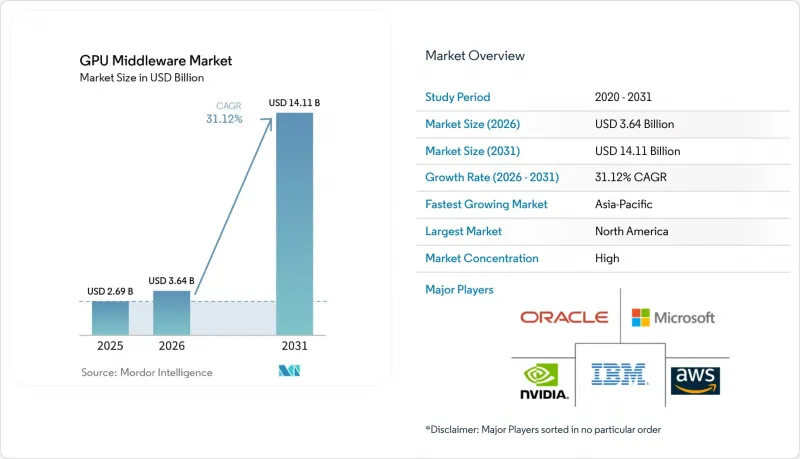
Mordor Intelligence에 의하면, GPU 미들웨어 시장 규모는 2025년 26억 9,000만 달러에서 2026년에는 36억 4,000만 달러로 확대되고, 2031년까지 141억 1,000만 달러에 이를 것으로 예측되며, 2026-2031년 CAGR 31.12%를 기록할 전망입니다.
본 보고서는 구성 요소(소프트웨어 및 서비스), 도입 형태(클라우드, On-Premise, 하이브리드, 엣지/임베디드), 기업 규모(대기업 및 중소기업), 용도(가상 데스크톱 인프라 및 원격 워크스테이션 등), 최종 사용자 산업(헬스케어 및 생명과학 등), 지역별로 분류되어 있습니다. 시장 전망은 금액(달러) 기준으로 제시되어 있습니다.
세계 GPU 미들웨어 시장 동향 및 인사이트
AI 모델 훈련 및 추론에서 GPU 밀도 증가
AI 모델 개발이 점점 더 대규모의 고밀도 컴퓨팅 환경에 의존하게 됨에 따라 GPU 미들웨어 시장은 확대되고 있습니다. NVIDIA는 2026년 6월, 과학 및 AI 워크로드를 위해 CPU, GPU, 네트워크, 소프트웨어를 통합한 랙스케일 시스템인 ‘Vera Rubin’ 플랫폼을 발표했습니다. 이는 차세대 도입 환경이 얼마나 긴밀하게 통합되고 있는지를 보여줍니다. 또한, 마이크로소프트도 2026년 6월, 텍사스주 페코스(Pecos)에 새로운 데이터센터 캠퍼스를 건설하여 AI 및 클라우드 용량을 약 2기가와트 증설할 것이라고 발표했습니다. 이는 주요 구매층에서 인프라 확장이 급속히 진행되고 있음을 반영합니다. 또한, 엔비디아와 일라이 릴리는 2026년 1월, 공동 혁신 AI 연구소를 설립하고 5년간 최대 10억 달러를 투자할 계획입니다. 이는 대규모 모델의 워크로드가 규제가 엄격한 상용 환경으로 확대되고 있음을 보여줍니다. 이러한 클러스터가 확대됨에 따라 스케줄러, 메모리 제어 계층 및 리소스 할당 도구에 가해지는 운영 부하도 증가합니다. 이러한 추세로 인해 GPU 미들웨어 시장은 AI 훈련 및 추론의 규모 확대라는 새로운 물결과 계속해서 밀접하게 연결되어 있습니다.
멀티테넌트형 GPU 리소스 공유에 대한 기업 수요 증가
또한, GPU 미들웨어 시장은 제어성을 저해하지 않으면서 제한된 GPU 리소스를 팀, 모델, 워크로드 간에 공유해야 할 필요성에서도 혜택을 받고 있습니다. IBM Research, Red Hat 및 NxtGen Cloud는 2026년 6월, 오픈소스 llm-d 프레임워크가 혼합 GPU 하드웨어에서 추론 속도를 3-5배 가속화하고 처리량을 2배로 높였습니다고 보고하는 한편, 대규모 도입 1건당 연간 최대 525만 달러의 비용 절감이 가능할 수 있음을 시사했습니다. 또한 NVIDIA는 2026년 3월, GPU용 ‘Dynamic Resource Allocation’ 드라이버를 쿠버네티스 커뮤니티에 공개하고, KAI Scheduler를 CNCF Sandbox 프로젝트로 임베디드시켰습니다. 이를 통해 정책 기반 공유 GPU 스케줄링을 더 폭넓게 활용할 수 있게 되었습니다. Red Hat은 NVIDIA와의 공동 프로젝트인 ‘AI Factory’와 유사한 방향성을 제시하고 있으며, 장기 실행 작업에 대해 리소스 풀링, 지능형 오케스트레이션 및 자동 체크포인트 기능을 제공합니다. 이러한 노력을 통해 단일 용도이나 팀이 클러스터 전체를 장기간 예약해야 할 필요성이 줄어듭니다. 이로 인해 멀티테넌트 제어가 선택적 기능이 아닌 주요 구매 기준이 됨에 따라 GPU 미들웨어 시장이 활성화될 전망입니다.
GPU 인프라의 높은 비용과 통합의 복잡성
GPU 미들웨어 시장은 여전히 뚜렷한 장벽에 직면해 있습니다. GPU 인프라 확장은 막대한 초기 투자와 신중한 통합을 필요로 하기 때문입니다. CoreWeave는 2026년 3월에 85억 달러의 자금 조달 한도를 확보했으며, 2026년 5월에는 31억 달러의 자금 조달 한도를 추가로 확보했습니다. 이는 전문 공급업체라 하더라도 GPU 플랫폼 확장이 얼마나 자본 집약적인지 여실히 보여줍니다. 2026년 6월 마이크로소프트의 Pecos 발표 역시 현재 대규모 AI 용량 증설이 극히 광범위하게 진행되고 있어, 소규모 구매자가 쉽게 따라잡을 수 없음을 여실히 드러냈습니다. 도입 측면에서는 레드햇(Red Hat)과 엔비디아(NVIDIA)가 공동으로 제공하는 ‘AI Factory’가 시스코(Cisco), 델 테크놀로지스(Dell Technologies), 레노버(Lenovo), 슈퍼마이크로(Supermicro) 각사의 하드웨어에서 검증된 상태입니다. 이는 실제 환경에서의 도입에는 대부분의 경우 여러 계층에 걸친 검증된 조합이 필요함을 보여줍니다. HPE의 ‘AI Factory’ 포트폴리오도 동일한 논리에 기반하여 오케스트레이션, 테넌트 관리, 기업 소프트웨어를 인증된 시스템에 패키지화하고 있습니다. 이러한 도입이 보다 용이하고 저비용으로 이루어질 수 있게 될 때까지는 GPU 미들웨어 시장의 확산이 계속해서 주춤할 것입니다.
부문 분석
2025년에는 소프트웨어가 매출의 74.28%를 차지했으나, 서비스는 2031년까지 연평균 성장률(CAGR) 32.56%를 나타낼 것으로 예측됩니다. 이러한 매출 구성비는 구매자가 GPU 환경을 처음 구축할 때 여전히 스케줄러, 가상화 도구 및 런타임 소프트웨어에 가장 많은 비용을 지출하고 있음을 보여줍니다. 현재의 구성비는 GPU 미들웨어 시장이 플랫폼 제어, 클러스터 관리 및 컨테이너 지원 소프트웨어 계층을 중심으로 발전해 온 경위도 반영하고 있습니다. NVIDIA가 2026년에 KAI 스케줄러를 오픈소스로 공개하고, GPU용 동적 리소스 할당(DRA) 드라이버를 무상으로 제공하기로 결정한 것은 스택 내에서 소프트웨어의 중심적인 위치를 더욱 공고히 했습니다. 또한, Red Hat이 OpenShift 4.21에서 ‘Dynamic Resource Allocation’을 일반 공개한 것은 엔터프라이즈 환경에서의 도입에 있어 표준화가 진행되고 있는 성숙한 소프트웨어 계층을 부각시켰습니다.
그러나 도입의 복잡성을 소프트웨어만으로 흡수하기 어려워짐에 따라 서비스 확대 속도는 더욱 가속화되고 있습니다. ‘Red Hat AI Factory with NVIDIA’에는 GPU-as-a-Service 오케스트레이션, 풀링된 액세스, 자동 체크포인트 기능이 포함되어 있으며, 이러한 배포에는 일반적으로 체계적인 구현 지원과 운영 지침이 필요합니다. HPE 역시 AI Factory 포트폴리오를 통해 유사한 방향성을 추진하고 있으며, 여기에서는 Mission Control 소프트웨어와 하이브리드 도입 지원이 엔터프라이즈 인프라 서비스와 함께 패키지화되어 있습니다. Anyscale이 2026년 6월에 NVIDIA cuDF를 지원하는 ‘Ray Data’를 출시한 것은 워크로드 계층에서의 비용 및 성능 향상조차도 더 광범위한 운영 환경과의 강력한 통합에 의존하고 있음을 보여줍니다. 실제로 서비스의 성장이 가속화되고 있다는 점은 GPU 미들웨어 시장이 단순한 소프트웨어 구매 결정에서 ‘소프트웨어 + 도입 성과’로 전환되고 있음을 시사합니다. 이러한 변화로 인해 조직이 파일럿 클러스터에서 프로덕션 규모의 환경으로 전환함에 따라, 서비스 중심의 접근 방식의 중요성은 앞으로도 지속될 것입니다.
2025년 매출에서 클라우드가 차지하는 비중은 52.41%였으나, 하이브리드는 2031년까지 연평균 성장률(CAGR) 31.96%로 가장 빠른 성장을 기록할 것으로 예측됩니다. 이러한 세부 내역은 현재 지출의 대부분이 여전히 관리형 GPU 액세스에 할당되고 있음을 보여주며, 이를 통해 기업은 전용 인프라를 사전에 구축하지 않고도 신속하게 도입을 시작할 수 있습니다. 동시에 하이브리드 분야의 성장률이 더 높다는 점은 GPU 미들웨어 시장이 ‘클라우드 전용’이라는 기본 설정에서 벗어나 혼합 운영 모델로 전환되고 있음을 보여줍니다. 이러한 추세는 버스트 트레이닝, 내부 데이터 관리, 그리고 워크로드별 다양한 지연 시간 요구 사항을 결합함으로써 기업의 요구를 충족시키고 있습니다. 또한, 클라우드 환경과 On-Premise 환경이 단순한 선택지가 아니라 단일 운영 스택을 구성하는 상호 연결된 요소로 취급되고 있다는 사실도 반영하고 있습니다.
벤더들의 동향도 이러한 방향성을 뒷받침하고 있습니다. Red Hat의 'AI Factory with NVIDIA'는 기업 환경 전반에 걸친 리소스 풀링 및 오케스트레이션을 핵심으로 구축되어 있어, 유연한 리소스 공유를 희생하지 않으면서도 내부 관리를 원하는 조직에 적합합니다. HPE가 2026년 3월에 발표한 'AI Factory' 업데이트에서도 멀티스케일 테넌트 기능, Mission Control과의 통합, 그리고 하이브리드 AI 배포를 위한 Red Hat OpenShift 지원이 강조되었습니다. 2026년 4월 마이크로소프트가 일본과 관련하여 발표한 내용은 데이터의 소재지가 중요시되는 상황에서 국내 AI 인프라와 로컬 컴퓨팅 서비스가 얼마나 계속해서 중요한 역할을 할지 보여주었습니다. 따라서 GPU 미들웨어 시장에서는 구매자에게 정책 제어, 워크로드 유연성, 그리고 인프라를 내부 거버넌스에 부합시킬 수 있는 여지를 제공하기 위해 하이브리드형이 탄력을 받고 있습니다. 엣지 및 임베디드 환경에서의 도입 규모는 여전히 작지만, 이와 유사한 하이브리드형 접근 방식이 자동차 및 산업 분야의 실시간 이용 사례에도 영향을 미치기 시작하고 있습니다.
지역별 분석
2025년, 북미는 전 세계 매출의 43.72%를 차지하며 GPU 미들웨어 시장에서 가장 큰 기여를 한 지역이 되었습니다. 이러한 선두 위상은 해당 지역의 하이퍼스케일러 캠퍼스, AI 소프트웨어 벤더, 그리고 엔터프라이즈용 GPU 도입 밀도를 반영합니다. 마이크로소프트는 2026년 6월, 텍사스주 페코스(Pecos)에 새로운 데이터센터 캠퍼스를 건설하겠다고 발표하며 약 2기가와트의 AI 및 클라우드 용량을 추가했습니다. 이를 통해 현재 주기에서 북미가 최대 인프라 구축 지역으로서의 역할이 더욱 강화되었습니다. 또한 엔비디아(NVIDIA)도 2026년 1월, 2030년까지 5기가와트를 초과하는 AI 팩토리 용량 확장을 가속화하기 위한 협력 확대의 일환으로 코어위브(CoreWeave)에 20억 달러를 투자했습니다. 인프라, 소프트웨어, 서비스 각 계층이 일체화되어 확장되고 있기 때문에 이러한 움직임은 해당 지역의 규모적 우위를 뒷받침하고 있습니다. 남미는 여전히 규모는 작지만, 매니지드 클라우드에 대한 접근성 및 지역 기업들의 현대화 프로그램을 통해 수요는 계속해서 확대되고 있습니다. 실질적으로 GPU 미들웨어 시장에서 제품의 성숙도, 도입 규모, 벤더 간 협력 측면에서 북미가 여전히 주도적인 역할을 하고 있습니다.
유럽에서는 거버넌스, 주권 및 기업의 관리권을 더욱 중시하는 차별화된 접근 방식을 통해 GPU 미들웨어 시장이 발전하고 있습니다. 이 지역 수요 패턴은 규정 준수에 민감한 데이터를 포함하는 워크로드에서 클라우드 비의존형 및 On-Premise형 도입 모델을 선호하는 경향을 보입니다. 프랑스의 국가 AI 전략에서는 GPU 미들웨어 혁신이 지원 우선 분야로 지정되었으며, 소프트웨어 조정 계층이 부차적인 것이 아니라 전략적으로 중요한 것으로 자리매김하고 있음이 밝혀졌습니다. 이러한 정책적 배경에 힘입어, 지역별 도입 옵션 및 더욱 엄격한 운영 요건에 적응할 수 있는 오케스트레이션 도구에 대한 안정적인 수요가 뒷받침되고 있습니다. 그 결과, 유럽은 단순한 규모보다는 통제 가능하고 주권을 중시하는 운영 모델을 추진함으로써 GPU 미들웨어 시장에 기여하고 있습니다.
아시아태평양은 가장 빠르게 성장하는 지역으로, 이 지역의 GPU 미들웨어 시장 규모는 2031년까지 연평균 성장률(CAGR) 32.15%로 확대될 것으로 예측됩니다. 이 지역은 주권 AI에 대한 투자, 기업 수요 증가, 그리고 국내 연산 능력 강화를 위한 광범위한 노력의 혜택을 받고 있습니다. 마이크로소프트는 2026년 4월, 일본에 100억 달러를 투자하겠다고 발표했습니다. 여기에는 사쿠라 인터넷 및 소프트뱅크와의 제휴를 통해 국내 데이터 상주 요건을 충족하는 GPU 기반 AI 컴퓨팅 서비스 제공이 포함됩니다. 이 사례는 성장이 단순히 용량 확충뿐만 아니라 현지 관리 요건에 의해서도 주도되고 있다는 점에서 이 지역의 추세를 명확히 보여줍니다. 아시아태평양의 성장 속도가 빠르다는 것은 특히 기업이나 공공 기관이 자국 내에 AI 인프라를 구축하고자 할 때, 이 지역이 신규 계약의 더 중요한 공급원이 되어가고 있음을 의미합니다. 이러한 추세에 힘입어, 현재 매출액 기준으로는 북미가 여전히 선두를 차지하고 있지만, 장기적으로는 GPU 미들웨어 시장의 지역별 균형이 더욱 고르게 잡힐 것으로 전망됩니다.
기타 혜택:
- 엑셀 형식 시장 예측(ME) 시트
- 3개월간의 애널리스트 지원
자주 묻는 질문
목차
제1장 서론
제2장 조사 방법
제3장 주요 요약
제4장 시장 구도
제5장 시장 규모와 성장 예측
제6장 경쟁 구도
제7장 시장 기회와 향후 전망
KTH 26.08.06According to Mordor Intelligence, the GPU middleware market size is expected to increase from USD 2.69 billion in 2025 to USD 3.64 billion in 2026 and reach USD 14.11 billion by 2031, growing at a CAGR of 31.12% over 2026-2031.
This report is Segmented by Component (Software, and Services), Deployment Mode (Cloud, On-Premises, Hybrid, and Edge/Embedded), Enterprise Size (Large Enterprises, and Small and Medium Enterprises), Application (Virtual Desktop Infrastructure and Remote Workstations, and More), End-User Industry (Healthcare and Life Sciences, and More), and Geography. The Market Forecasts are Provided in Terms of Value (USD).
Global GPU Middleware Market Trends and Insights
Rising AI Model Training and Inference GPU Density
The GPU middleware market is rising as AI model development increasingly depends on larger, denser compute environments. NVIDIA presented the Vera Rubin platform in June 2026 as a rack-scale system that combines CPU, GPU, networking, and software for science and AI workloads, which shows how tightly integrated next-generation deployments are becoming. Microsoft also announced a new datacenter campus in Pecos, Texas, in June 2026 to add around 2 gigawatts of AI and cloud capacity, reflecting how quickly infrastructure expansion continues in the core buyer base. NVIDIA and Eli Lilly also formed a co-innovation AI lab in January 2026, with up to USD 1 billion in planned investment over 5 years, indicating that large model workloads are spreading into highly regulated commercial settings. As these clusters grow, the operational load on schedulers, memory control layers, and resource allocation tools also rises. That pattern keeps the GPU middleware market closely tied to every new wave of AI training and scale-up in inference.
Growing Enterprise Demand for Multi-Tenant GPU Resource Sharing
The GPU middleware market is also gaining from the need to share limited GPU resources across teams, models, and workloads without losing control. IBM Research, Red Hat, and NxtGen Cloud reported in June 2026 that the open-source llm-d framework delivered 3 to 5 times faster inference and doubled throughput on mixed GPU hardware, while indicating potential annual savings of up to USD 5.25 million per large deployment. NVIDIA also moved its Dynamic Resource Allocation driver for GPUs into the Kubernetes community and onboarded the KAI Scheduler as a CNCF Sandbox project in March 2026, enabling wider use of shared, policy-driven GPU scheduling. Red Hat is built in the same direction as its AI Factory with NVIDIA, which offers pooled access, intelligent orchestration, and automatic checkpointing for long-running jobs. These moves reduce the need for a single application or team to reserve entire clusters for long periods. That supports the GPU middleware market because multi-tenant control becomes a central buying criterion rather than an optional feature.
High GPU Infrastructure Cost and Integration Complexity
The GPU middleware market still faces a clear barrier: scaling GPU infrastructure requires significant upfront investment and careful integration. CoreWeave closed a USD 8.5 billion financing facility in March 2026, followed by a further USD 3.1 billion loan facility in May 2026, underscoring how capital-intensive GPU platform expansion has become, even for specialized providers. Microsoft's June 2026 Pecos announcement also underlined that major AI capacity additions now happen at a very large scale, which smaller buyers cannot easily match. On the deployment side, Red Hat's AI Factory with NVIDIA was validated across hardware from Cisco, Dell Technologies, Lenovo, and Supermicro, which shows that real-world implementation often requires tested combinations across multiple layers. HPE's AI Factory portfolio follows the same logic by packaging orchestration, tenancy, and enterprise software into certified systems. Until these deployments become easier and cheaper to stand up, the GPU middleware market will continue to face slower adoption.
Other drivers and restraints analyzed in the detailed report include:
- Increasing Need for GPU Utilization Optimization in Cloud and On-Premises Environments
- Expansion of High-Performance Computing Workloads Across Industries
- Limited Talent for GPU Orchestration, CUDA Tuning, and Cluster Optimization
For complete list of drivers and restraints, kindly check the Table Of Contents.
Segment Analysis
Software accounted for 74.28% of revenue in 2025, while services are forecast to grow at a 32.56% CAGR through 2031. This revenue split shows that buyers still spend most heavily on schedulers, virtualization tools, and runtime software when they first build out GPU environments. The current mix also reflects how the GPU middleware market developed around platform control, cluster management, and container-ready software layers. NVIDIA's decision to open-source the KAI Scheduler and donate the Dynamic Resource Allocation driver for GPUs in 2026 reinforced software's central position in the stack. Red Hat's general availability release of Dynamic Resource Allocation in OpenShift 4.21 also highlighted a maturing software layer that is becoming more standardized across enterprise deployments.
Services, however, are expanding faster because deployment complexity is now harder to absorb solely through software. Red Hat AI Factory with NVIDIA includes GPU-as-a-Service orchestration, pooled access, and automatic checkpointing, and that kind of rollout usually requires structured implementation support and operating guidance. HPE also pushed the same direction through its AI Factory portfolio, where Mission Control software and hybrid deployment support are packaged with enterprise infrastructure services. Anyscale's June 2026 release of Ray Data with NVIDIA cuDF support showed that even cost and performance gains at the workload layer still depend on strong integration into broader operating environments. In practice, the faster growth of services suggests that the GPU middleware market is moving from software purchase decisions toward software plus deployment outcomes. That shift should keep service-heavy engagements important as organizations move from pilot clusters to production-scale estates.
Cloud represented 52.41% of revenue in 2025, while hybrid is projected to record the fastest growth at a 31.96% CAGR through 2031. That split shows that the largest share of current spending still goes to managed GPU access, which lets enterprises get started quickly without building dedicated infrastructure first. At the same time, the faster hybrid growth rate indicates that the GPU middleware market is moving toward mixed operating models rather than a cloud-only default. This pattern meets enterprise needs by combining burst training, internal data control, and varying latency requirements across workloads. It also reflects the fact that cloud and on-premises environments are being treated less as alternatives and more as interconnected parts of a single operating stack.
Vendor moves support that direction. Red Hat's AI Factory with NVIDIA was built around pooled access and orchestration across enterprise environments, which fits organizations that want internal control without giving up flexible resource sharing. HPE's March 2026 AI Factory updates also highlighted multi-scale tenancy, Mission Control integration, and Red Hat OpenShift support for hybrid AI deployments. Microsoft's April 2026 announcement on Japan showed how in-country AI infrastructure and local compute services remain important where data residency matters. The GPU middleware market is therefore seeing hybrid gain traction because it gives buyers policy control, workload flexibility, and more room to align infrastructure with internal governance. Edge and embedded deployments remain smaller, but the same hybrid logic is starting to influence real-time use cases in automotive and industrial settings.
Complete Report Scope:
- By Component
- Software
- Services
- By Deployment Mode
- Cloud
- On-Premises
- Hybrid
- Edge/Embedded
- By Enterprise Size
- Large Enterprises
- Small and Medium Enterprises
- By Application
- Artificial Intelligence and Machine Learning
- High-Performance Computing and Scientific/Engineering Simulation
- Data Analytics, Databases and Graph Processing
- Graphics, Visualization and Rendering
- Virtual Desktop Infrastructure and Remote Workstations
- Digital Twins and Industrial Simulation
- By End-User Industry
- Cloud Service Providers, Hyperscalers and Data Center Operators
- Information Technology and Telecommunications
- Banking, Financial Services and Insurance
- Healthcare and Life Sciences
- Media and Entertainment
- Automotive
- Manufacturing
- Other End-User Industries
- By Geography
- North America
- United States
- Canada
- Mexico
- Europe
- Germany
- United Kingdom
- France
- Italy
- Rest of Europe
- Asia-Pacific
- China
- Japan
- South Korea
- India
- Southeast Asia
- Rest of Asia-Pacific
- South America
- Middle East and Africa
- North America
Geography Analysis
North America accounted for 43.72% of global revenue in 2025, making it the largest regional contributor to the GPU middleware market. This lead reflects the region's dense concentration of hyperscaler campuses, AI software vendors, and enterprise GPU deployments. Microsoft announced a new datacenter campus in Pecos, Texas, in June 2026, adding around 2 gigawatts of AI and cloud capacity, which reinforced North America's role as the largest infrastructure build zone in the current cycle. NVIDIA also invested USD 2 billion in CoreWeave in January 2026 as part of an expanded collaboration to accelerate more than 5 gigawatts of AI factory capacity by 2030. These moves support the region's scale advantage because infrastructure, software, and service layers are being expanded together. South America remained smaller, but demand continued to build through managed cloud access and regional enterprise modernization programs. In practical terms, North America still sets the pace for product maturity, deployment scale, and vendor alignment in the GPU middleware market.
Europe is developing the GPU middleware market through a different path that places more weight on governance, sovereignty, and enterprise control. The region's demand pattern favors cloud-agnostic and on-premises deployment models in workloads that involve compliance-sensitive data. France's national AI strategy identified GPU middleware innovation as a priority area for support, which showed that the software coordination layer is being treated as strategically important rather than secondary. This policy backdrop supports steady demand for orchestration tools that can fit localized deployment choices and stricter operating requirements. As a result, Europe contributes to the GPU middleware market less through sheer scale and more through the push for controllable and sovereign operating models.
Asia-Pacific is the fastest-growing region, with the GPU middleware market size in this geography projected to advance at a 32.15% CAGR through 2031. The region is benefiting from sovereign AI investment, expanding enterprise demand, and a wider push for in-country compute capability. Microsoft announced a USD 10 billion investment in Japan in April 2026, including work with Sakura Internet and SoftBank to provide GPU-based AI compute services with domestic data residency. That example captures the regional theme clearly, because growth is being driven not only by capacity additions but also by local control requirements. Asia-Pacific's faster pace means it is becoming a more important source of new contracts, especially where enterprises and public institutions want AI infrastructure within national boundaries. This momentum should keep the GPU middleware market geographically more balanced over time, even though North America still leads in current revenue.
- NVIDIA Corporation
- Amazon Web Services, Inc.
- Microsoft Corporation
- International Business Machines Corporation
- Oracle Corporation
- Red Hat, Inc.
- Hewlett Packard Enterprise Company
- CoreWeave, Inc.
- RunPod Inc.
- Rafay Systems, Inc.
- DigitalOcean, LLC
- Crusoe Energy Systems LLC
- Fujitsu Limited
- Lenovo Group Limited
- OVH SAS
- Scaleway SAS
- The Constant Company, LLC
- Linode, LLC
- Civo Limited
- Anyscale, Inc.
- Modal Labs, Inc.
Additional Benefits:
- The market estimate (ME) sheet in Excel format
- 3 months of analyst support
TABLE OF CONTENTS
1 INTRODUCTION
- 1.1 Study Assumptions and Market Definition
- 1.2 Scope of the Study
2 RESEARCH METHODOLOGY
3 EXECUTIVE SUMMARY
4 MARKET LANDSCAPE
- 4.1 Market Overview
- 4.2 Market Drivers
- 4.2.1 Rising AI Model Training and Inference GPU Density
- 4.2.2 Growing Enterprise Demand for Multi-Tenant GPU Resource Sharing
- 4.2.3 Increasing Need for GPU Utilization Optimization in Cloud and On-Premises Environments
- 4.2.4 Expansion of High-Performance Computing Workloads Across Industries
- 4.2.5 Rising Adoption of Containerized AI and MLOps Workflows
- 4.2.6 Greater Use of Hybrid and Multi-Cloud GPU Infrastructure
- 4.3 Market Restraints
- 4.3.1 High GPU Infrastructure Cost and Integration Complexity
- 4.3.2 Limited Talent for GPU Orchestration, CUDA Tuning, and Cluster Optimization
- 4.3.3 Power, Cooling, and Rack Density Constraints in Legacy Data Centers
- 4.3.4 Export Controls and Hardware Allocation Volatility for Advanced GPUs
- 4.4 Industry Value Chain Analysis
- 4.5 Regulatory Landscape
- 4.6 Technological Outlook
- 4.7 Porter's Five Forces Analysis
- 4.7.1 Bargaining Power of Suppliers
- 4.7.2 Bargaining Power of Buyers
- 4.7.3 Threat of New Entrants
- 4.7.4 Threat of Substitutes
- 4.7.5 Competitive Rivalry
5 MARKET SIZE AND GROWTH FORECASTS (VALUE)
- 5.1 By Component
- 5.1.1 Software
- 5.1.2 Services
- 5.2 By Deployment Mode
- 5.2.1 Cloud
- 5.2.2 On-Premises
- 5.2.3 Hybrid
- 5.2.4 Edge/Embedded
- 5.3 By Enterprise Size
- 5.3.1 Large Enterprises
- 5.3.2 Small and Medium Enterprises
- 5.4 By Application
- 5.4.1 Artificial Intelligence and Machine Learning
- 5.4.2 High-Performance Computing and Scientific/Engineering Simulation
- 5.4.3 Data Analytics, Databases and Graph Processing
- 5.4.4 Graphics, Visualization and Rendering
- 5.4.5 Virtual Desktop Infrastructure and Remote Workstations
- 5.4.6 Digital Twins and Industrial Simulation
- 5.5 By End-User Industry
- 5.5.1 Cloud Service Providers, Hyperscalers and Data Center Operators
- 5.5.2 Information Technology and Telecommunications
- 5.5.3 Banking, Financial Services and Insurance
- 5.5.4 Healthcare and Life Sciences
- 5.5.5 Media and Entertainment
- 5.5.6 Automotive
- 5.5.7 Manufacturing
- 5.5.8 Other End-User Industries
- 5.6 By Geography
- 5.6.1 North America
- 5.6.1.1 United States
- 5.6.1.2 Canada
- 5.6.1.3 Mexico
- 5.6.2 Europe
- 5.6.2.1 Germany
- 5.6.2.2 United Kingdom
- 5.6.2.3 France
- 5.6.2.4 Italy
- 5.6.2.5 Rest of Europe
- 5.6.3 Asia-Pacific
- 5.6.3.1 China
- 5.6.3.2 Japan
- 5.6.3.3 South Korea
- 5.6.3.4 India
- 5.6.3.5 Southeast Asia
- 5.6.3.6 Rest of Asia-Pacific
- 5.6.4 South America
- 5.6.5 Middle East and Africa
- 5.6.1 North America
6 COMPETITIVE LANDSCAPE
- 6.1 Market Concentration
- 6.2 Strategic Moves
- 6.3 Vendor Positioning Analysis
- 6.4 Company Profiles (includes Global Level Overview, Market Level Overview, Core Segments, Financials as available, Strategic Information, Market Rank/Share, Products and Services, Recent Developments)
- 6.4.1 NVIDIA Corporation
- 6.4.2 Amazon Web Services, Inc.
- 6.4.3 Microsoft Corporation
- 6.4.4 International Business Machines Corporation
- 6.4.5 Oracle Corporation
- 6.4.6 Red Hat, Inc.
- 6.4.7 Hewlett Packard Enterprise Company
- 6.4.8 CoreWeave, Inc.
- 6.4.9 RunPod Inc.
- 6.4.10 Rafay Systems, Inc.
- 6.4.11 DigitalOcean, LLC
- 6.4.12 Crusoe Energy Systems LLC
- 6.4.13 Fujitsu Limited
- 6.4.14 Lenovo Group Limited
- 6.4.15 OVH SAS
- 6.4.16 Scaleway SAS
- 6.4.17 The Constant Company, LLC
- 6.4.18 Linode, LLC
- 6.4.19 Civo Limited
- 6.4.20 Anyscale, Inc.
- 6.4.21 Modal Labs, Inc.
7 MARKET OPPORTUNITIES AND FUTURE OUTLOOK
- 7.1 White-Space and Unmet-Need Assessment


