

|
시장보고서
상품코드
2098545
GPU 오케스트레이션 : 시장 점유율 분석, 업계 동향과 통계, 성장 예측(2026-2031년)GPU Orchestration - Market Share Analysis, Industry Trends & Statistics, Growth Forecasts (2026 - 2031) |
||||||
 Mordor Intelligence
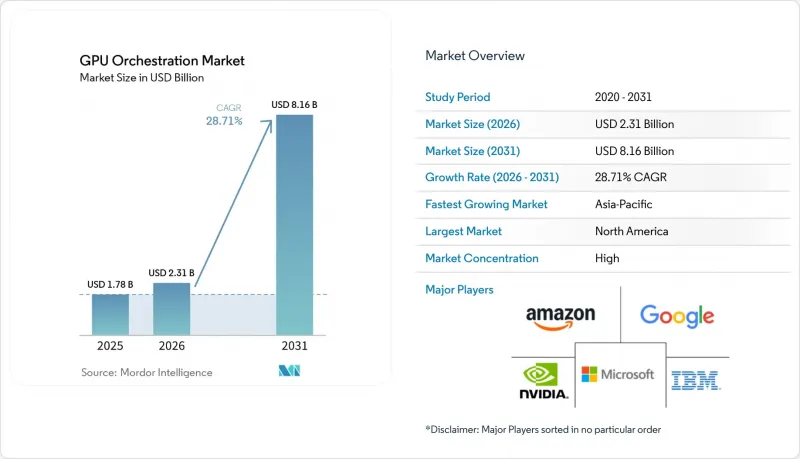
Mordor Intelligence에 의하면, GPU 오케스트레이션 시장 규모는 2025년 17억 8,000만 달러에서 2026년에는 23억 1,000만 달러로 확대되고, 2031년까지 81억 6,000만 달러에 이를 것으로 예측되며, 2026-2031년 CAGR 28.71%를 기록할 전망입니다.
본 보고서는 구성 요소(소프트웨어 및 서비스), 도입 모델(클라우드, On-Premise, 하이브리드), 용도(GPU 스케줄링 및 할당, 워크로드 오케스트레이션, 거버넌스 및 멀티테넌트 등), 최종 사용자(클라우드 서비스 제공업체 및 GPU-as-a-Service 제공업체, IT·기술 기업, BFSI 등), 지역별로 분류되어 있습니다. 시장 전망은 금액(달러) 기준으로 제시되어 있습니다.
세계 GPU 오케스트레이션 시장 동향 및 인사이트
LLM 훈련 및 추론 워크로드에 대한 수요 증가
GPU 오케스트레이션 시장은 대규모 모델의 훈련과 프로덕션 환경에서의 추론이 현재 동일한 가속기 풀에 대해 극히 상이한 요구 사항을 부과하고 있다는 사실로부터 혜택을 받고 있습니다. 훈련 작업에는 긴 예약 기간, 안정적인 상호 연결 성능, 그리고 협력적인 다중 노드 실행이 필요한 반면, 추론은 시간이나 장소에 따라 급격히 증감하는 불균일한 수요를 발생시킵니다. 이러한 불일치로 인해 정적인 GPU 할당은 비용이 많이 들고 처리 속도도 저하됩니다. 따라서 GPU 오케스트레이션 시장은 기업 AI 인프라 설계의 중심축으로 자리매김하고 있습니다. NVIDIA는 자사의 NeMo 프레임워크가 적응형 리소스 오케스트레이션을 활용하여 분산 훈련 중 장거리 대역폭에 가해지는 부하를 경감하는 메커니즘을 설명하고, 오케스트레이션이 더 이상 클러스터 관리에만 그치지 않고 모델 성능과 직접적으로 연결되어 있음을 입증했습니다. 추론 모델, 미세 조정 파이프라인, 프로덕션 환경에서의 추론이 모두 동일한 인프라를 경쟁적으로 사용하기 때문에 GPU 오케스트레이션 시장에서는 용량을 엄격한 예약에 묶어두지 않고, 장시간 실행되는 작업과 버스트형 워크로드의 균형을 조정할 수 있는 소프트웨어가 주목받고 있습니다. 이에 따라 GPU 오케스트레이션 시장의 각 벤더들은 스케줄링, 큐 정책, 클러스터 인식 기능을 구매자가 간과할 수 있는 배경적인 인프라 기능이 아닌, 제품의 차별화 요소로 자리매김하고 있습니다.
고가의 GPU 활용도를 극대화해야 할 필요성
GPU 오케스트레이션 시장은 AI 인프라의 높은 비용과, GPU 클러스터 내 유휴 용량을 회수해야 한다는 운영자에게 가해지는 압박이 커짐에 따라 성장하고 있습니다. 최근 AI 구축 주기에서 대규모 GPU 플릿을 구매하거나 예약한 기업들은 현재 이러한 자산이 체계적이고 측정 가능한 방식으로 활용되고 있음을 입증해야 하는 압박을 받고 있습니다. 가용성 향상은 하드웨어 설치 규모가 동일하더라도 훈련, 미세 조정, 추론의 실질적 비용을 변화시킬 가능성이 있기 때문에 이러한 압박은 GPU 오케스트레이션 시장을 실용적인 비용 관리 분야로 변화시키고 있습니다. Anyscale는 2026년 3월, NVIDIA H100 및 H200 플릿을 활용한 프로덕션 환경 배포에서 랙 단위 스케줄링과 부분 할당을 통해 80%가 넘는 GPU 가동률을 유지하고 있다고 발표했습니다. 이를 통해 GPU 오케스트레이션 시장에 대해 성숙한 구현이 달성할 수 있는 성과에 관한 명확한 운영 벤치마크가 제시되었습니다. NVIDIA 또한 KAI Scheduler를 통해 핵심 스케줄링 소프트웨어를 오픈소스로 공개했으며, 이후 동적 리소스 할당 드라이버를 커뮤니티 거버넌스 하에 두었습니다. 이를 통해 GPU를 보다 효율적으로 활용하기 위한 광범위한 생태계가 지원되고 있습니다. 그 결과, GPU 오케스트레이션 시장은 더 이상 운영상의 편의성만을 내세우는 것이 아니라, 비용이 많이 드는 GPU 플릿의 소비 및 관리 방식에 있어 측정 가능한 개선을 제공하게 되었습니다.
이종 GPU 스택 간의 상호 운용성 격차
GPU 오케스트레이션 시장은 기업이 혼합 가속기 환경 전반에 걸쳐 하드웨어, 드라이버, 스케줄링 로직을 관리하기 위한 단일 소프트웨어 계층을 필요로 할 때, 여전히 실질적인 도입 장벽에 직면해 있습니다. 많은 오케스트레이션 스택은 당초 NVIDIA 중심 환경을 전제로 구축되었기 때문에 플러그인, 가시성 도구, 토폴로지 처리, 정책 프레임워크 측면에서 다른 하드웨어 생태계에 대한 지원은 여전히 불균일한 상태입니다. 이로 인해 AI 스택 전체를 단일 벤더로 표준화하기를 원하지 않는 구매자의 경우, 통합 주기가 길어지고 유지 관리 오버헤드가 증가하게 됩니다. 2026년 3월, NVIDIA가 자사의 GPU 동적 리소스 할당 드라이버를 CNCF에 기증하기로 한 결정은 커뮤니티 주도형 스케줄링 표준을 통해 상호 운용성을 확대하려는 노력을 보여주지만, 동시에 벤더 간의 일관성이 여전히 진행 중인 과제임을 여실히 드러내고 있습니다. 따라서 GPU 오케스트레이션 시장은 툴 환경이 여전히 분산되어 있음에도 불구하고, 멀티 벤더 지원이 점점 더 중요해지고 있는 환경 속에서 발전하고 있습니다. 상호 운용성이 더욱 향상될 때까지는 일부 구매자들이 도입 규모를 작게 유지하거나, 관리형 서비스 파트너에 대한 의존도를 높이거나, 광범위한 오케스트레이션 계층 대신 벤더 고유의 스택을 선택하게 될 것입니다.
부문 분석
2025년 매출액 중 소프트웨어가 78.83%를 차지하고 있으며, 이는 GPU 오케스트레이션 시장의 구매자들이 부수적인 서비스보다 제어 계층을 가장 중요하게 여긴다는 것을 보여줍니다. 소프트웨어 비중이 높은 이러한 구성은 기업이 AI 워크로드를 프로덕션 환경으로 전환함에 있어 스케줄링 정책, 가시성, 거버넌스, 멀티테넌트 액세스 및 활용도 관리를 직접 제어하고자 한다는 사실을 반영합니다. GPU 오케스트레이션 시장에서 소프트웨어는 동일한 하드웨어 인프라를 팀, 우선순위, 환경 간에 얼마나 효율적으로 공유할 수 있는지를 결정하는 요소가 되는 경우가 많습니다. 따라서 매니지드 클라우드 및 통합 서비스를 중심으로 인프라 스택 전체가 지속적으로 확장되는 상황에서도 소프트웨어가 가장 큰 점유율을 차지한 것입니다. 또한 구매자들은 도입 기간을 단축하고, 리소스 할당, 큐 정책, 성능 모니터링을 위한 단일 관리 평면을 제공하는 소프트웨어 플랫폼을 선호하는 경향이 있습니다.
서비스 분야는 2031년까지 연평균 성장률(CAGR) 29.86%를 나타낼 것으로 예측되며, 초기 기반 규모는 작았으나 GPU 오케스트레이션 시장에서 가장 빠르게 성장하는 구성 요소가 될 전망입니다. 이러한 성장은 특히 구매자가 스케줄러를 스토리지, 가시성, 규정 준수 및 레거시 사내 도구와 연동해야 하는 경우, 기업 내 도입에는 여전히 막대한 설계 및 운영 작업이 수반됨을 시사합니다. Anyscale의 2026년 3월 릴리스에서는 NVIDIA H100 및 H200 플리트에서 높은 가동률을 유지하기 위해 랙 기반 스케줄링과 부분 할당을 활용한 프로덕션 환경의 도입 사례가 소개되었습니다. 이는 적절하게 구현된 오케스트레이션이 단순히 소프트웨어 구매뿐만 아니라 치밀한 운영 튜닝에 의존한다는 견해를 뒷받침합니다. NVIDIA가 KAI Scheduler 및 DRA 드라이버를 오픈소스로 공개하는 움직임은 기본적인 스케줄링 계층의 진입 장벽을 낮출 가능성이 있지만, 동시에 기업이 파일럿 단계에서 대규모 운영으로 전환하는 것을 지원하는 통합, 거버넌스, 최적화 서비스로 가치를 전환시키는 요인이 되고 있습니다. 장기적으로 볼 때, 이러한 구성 요소들의 조합을 통해 GPU 오케스트레이션 시장은 플랫폼 제어 소프트웨어와, 복잡한 기업 환경 내에서 해당 소프트웨어가 안정적으로 작동하도록 보장하는 데 필요한 서비스 양쪽 모두에서 지속적으로 수익을 창출할 것으로 시사됩니다.
2025년 GPU 오케스트레이션 시장 규모 중 클라우드가 52.69%를 차지했습니다. 이는 공유 GPU 리소스에 대한 신속한 접근을 원하는 AI 팀에게 있어, 매니지드 클라우드 환경이 여전히 가장 손쉬운 출발점이었습니다는 사실을 뒷받침합니다. 클라우드가 주도적인 위치를 차지한 배경에는 관리형 쿠버네티스 환경의 운영 편의성, 신속한 프로비저닝, 그리고 대규모 사내 플랫폼 팀을 사전에 구축하지 않고도 오케스트레이션을 시작할 수 있다는 점이 꼽힙니다. GPU 오케스트레이션 시장의 많은 구매자에게 있어 클라우드 도입은 실제 프로덕션 워크로드 환경에서 큐 정책, 모니터링 모델, 팀 수준의 액세스 제어를 테스트하는 데 필요한 시간을 단축하는 결과로 이어졌습니다. 이로 인해 많은 조직이 아직 초기 프로덕션 AI 운영 패턴을 확립하는 단계에 있는 상황에서 클라우드가 가장 큰 도입 모델이 되었습니다. 또한, 이는 하이퍼스케일러가 오케스트레이션을 자사 생태계와 더욱 긴밀하게 연계할 수 있게 했으며, 매니지드 컴퓨팅의 활용과 임베디드 스케줄링 소프트웨어 간의 연동을 강화하는 데에도 기여했습니다.
하이브리드 환경은 2031년까지 연평균 성장률(CAGR) 29.53%로 확대될 것으로 예측되며, 이는 GPU 오케스트레이션 시장이 자체 소유 및 임대 인프라를 모두 아우르는 보다 분산된 운영 모델로 전환되고 있음을 보여줍니다. On-Premise GPU 하드웨어에 투자해 온 기업들은 기밀성이 높은 워크로드나 규제 대상 데이터를 관리된 환경에 유지하면서, 수요가 급증할 때 클라우드로 유연하게 확장할 수 있기를 원하고 있습니다. 소프트뱅크가 발표한 'Infrinia AI Cloud OS' 는 GPU AI 데이터센터용 소프트웨어 스택으로서, Kubernetes-as-a-Service(KaaS) 및 Inference-as-a-Service(IaaS)를 자동화하는 것으로, 이는 다중 환경 운영 관리에서 오케스트레이션 소프트웨어의 중요성이 높아지고 있음을 반영합니다. 2026년 4월에 시작된 KDDI의 ‘GPU Cloud’ 서비스도 이러한 방향성을 뒷받침합니다. 해당 서비스는 자동차용 AI 훈련, 유전체학, 금융 모델링 등 보안과 데이터 주권이 요구되는 이용 사례를 대상으로 하고 있기 때문입니다. 따라서 이러한 도입 사례들의 조합은 GPU 오케스트레이션 시장이 단순한 클라우드 스케줄링에서 벗어나, 여러 인프라 경계를 넘어 비용, 규정 준수, 워크로드 배치를 관리할 수 있는 보다 광범위한 제어 평면으로 전환되고 있음을 시사합니다.
지역별 분석
북미는 2025년에 GPU 오케스트레이션 시장 점유율의 47.52%를 차지하며 계속해서 선두를 유지하고 있습니다. 이는 하이퍼스케일러의 존재, 엔터프라이즈 AI 수요, 그리고 클라우드 네이티브 소프트웨어 팀에 의한 긴밀한 생태계가 결합된 결과입니다. 많은 매니지드 GPU 서비스, 오케스트레이션 소프트웨어 벤더, AI 플랫폼 전문 기업들이 미국에 본사를 두고 있거나 미국의 클라우드 생태계와 밀접하게 연결되어 있기 때문에 미국은 여전히 GPU 오케스트레이션 시장의 주요 성장 동력으로 자리 잡고 있습니다. 이러한 집중 현상으로 인해 북미는 오케스트레이션 기능이 기술적 과제에서 상용 제품으로 가장 빠르게 전환되는 지역이 되었습니다. 또한, 이로 인해 GPU 오케스트레이션 시장은 관리형 Kubernetes 도입, 엔터프라이즈용 추론 배포, 그리고 GPU 거버넌스를 이사회 수준의 인프라 문제로 다루는 움직임과 밀접하게 연결되어 있습니다. Anyscale가 2026년 6월, Azure Kubernetes Service 및 Azure Resource Manager를 기반으로 한 네이티브 Azure 통합 기능을 출시한 것은 북미 생태계가 오케스트레이션을 기업이 직접 활용할 수 있는 소프트웨어 계층으로 지속적으로 변화시키고 있음을 여실히 보여줍니다.
유럽은 계속해서 GPU 오케스트레이션 지역 시장 규모에서 2위를 유지하고 있으며, 그 수요는 규제 대상인 엔터프라이즈 워크로드, 국가 차원의 컴퓨팅 우선순위, 그리고 감사 가능한 인프라 제어의 필요성에 의해 주도되고 있습니다. 독일과 영국이 특히 두드러지는 이유는 자동차용 AI, 금융 서비스, 생명과학 각 분야에서 스케줄링 정책 및 워크로드 추적 가능성이 중요한 프로덕션 환경에 의존하고 있기 때문입니다. 또한, 이 지역에서는 구매자가 리소스 접근, 워크로드 배치, 운영의 일관성을 문서화할 수 있는 소프트웨어를 필요로 하는 경우가 많기 때문에 GPU 오케스트레이션 시장에서 거버넌스를 중시하는 수요 프로파일이 형성되고 있습니다. 2026년 3월 암스테르담에서 개최된 KubeCon Europe에서 NVIDIA가 자사의 GPU DRA 드라이버를 CNCF의 거버넌스 하에 두기로 결정한 것은 오픈 표준 및 커뮤니티 주도형 인프라 구성 요소에 대한 유럽 전역의 추세를 뒷받침하는 것입니다. 따라서 유럽은 GPU 오케스트레이션 시장에서 가장 빠르게 성장하는 지역은 아닐지라도, 엔터프라이즈급 오케스트레이션에 있어 여전히 중요한 지역으로 남아 있습니다.
아시아태평양은 2031년까지 연평균 성장률(CAGR) 29.45%로 확대될 것으로 예측되며, GPU 오케스트레이션 시장에서 가장 두드러진 성장을 보이는 지역입니다. 이러한 성장세의 주된 원동력은 일본이며, KDDI는 2026년 4월 ‘GPU Cloud’를 출시했고, 소프트뱅크는 멀티테넌트형 GPU AI 데이터센터용 국산 소프트웨어 스택으로 ‘Infrinia AI Cloud OS’를 도입했습니다. 또한, GMO 인터넷도 2026년 3월 자사의 매니지드 Slurm GPU 클라우드 서비스에 NVIDIA HGX B300을 도입하여, 해당 지역 내 첨단 매니지드 컴퓨팅 인프라에 대한 접근성을 강화했습니다. 남미 및 중동 및 아프리카는 GPU 오케스트레이션 시장에서 여전히 규모는 작지만, 자국 주도형 AI 역량, 국내 데이터 처리, 업계 고유의 클라우드 수요가 초기 도입을 뒷받침하기 시작함에 따라 두 지역 모두 그 중요성이 높아지고 있습니다.
기타 혜택:
- 엑셀 형식 시장 예측(ME) 시트
- 3개월간의 애널리스트 지원
자주 묻는 질문
목차
제1장 서론
제2장 조사 방법
제3장 주요 요약
제4장 시장 구도
제5장 시장 규모와 성장 예측
제6장 경쟁 구도
제7장 시장 기회와 향후 전망
KTH 26.08.06According to Mordor Intelligence, the GPU orchestration market size is expected to increase from USD 1.78 billion in 2025 to USD 2.31 billion in 2026 and reach USD 8.16 billion by 2031, growing at a CAGR of 28.71% over 2026-2031.
This report is Segmented by Component (Software, and Services), Deployment Model (Cloud, On-Premises, and Hybrid), Application (GPU Scheduling and Allocation, Workload Orchestration, Governance and Multi-Tenancy, and More), End User (Cloud Service Providers and GPU-As-A-Service Providers, IT and Technology Companies, BFSI, and More), and Geography. The Market Forecasts are Provided in Terms of Value (USD).
Global GPU Orchestration Market Trends and Insights
Rising Demand for LLM Training and Inference Workloads
The GPU orchestration market is benefiting from the fact that large model training and production inference now place very different demands on the same pool of accelerators. Training jobs require long reservation windows, stable interconnect performance, and coordinated multi-node execution, while inference creates uneven demand that can rise or fall quickly over time and location. That mismatch makes static GPU allocation expensive and slow, which is why the GPU orchestration market is moving closer to the center of enterprise AI infrastructure design. NVIDIA described how its NeMo Framework uses adaptive resource orchestration to reduce long-haul bandwidth pressure during distributed training, demonstrating that orchestration is now tied directly to model performance rather than solely to cluster administration. As reasoning models, fine-tuning pipelines, and production inference all compete for the same infrastructure, the GPU orchestration market is gaining from software that can balance long-running jobs with burst workloads without locking capacity into rigid reservations. This is also pushing vendors in the GPU orchestration market to treat scheduling, queue policy, and cluster awareness as product differentiators rather than background infrastructure features that buyers can ignore.
Need To Maximize Expensive GPU Utilization
The GPU orchestration market is also being driven by the high cost of AI infrastructure and the growing pressure on operators to recover idle capacity within GPU clusters. Enterprises that bought or reserved large GPU fleets during the recent AI build cycle are now under pressure to demonstrate that these assets are being used in a disciplined, measurable way. That pressure is turning the GPU orchestration market into a practical cost-control category, because utilization improvements can change the effective cost of training, fine-tuning, and inference even when the hardware footprint stays the same. Anyscale stated in March 2026 that production deployments using NVIDIA H100 and H200 fleets were sustaining more than 80% GPU utilization through rack-aware scheduling and fractional allocation, providing the GPU orchestration market with a clear operational benchmark for what mature implementations can achieve. NVIDIA also moved core-scheduling software into the open with the KAI Scheduler and later placed a Dynamic Resource Allocation driver under community governance, which supports a broader ecosystem for higher-efficiency GPU use. As a result, the GPU orchestration market is no longer selling only operational convenience; it is selling measurable improvement in how costly GPU fleets are consumed and governed.
Interoperability Gaps Across Heterogeneous GPU Stacks
The GPU orchestration market still faces a real adoption barrier when enterprises need a single software layer to manage hardware, drivers, and scheduling logic across mixed-accelerator environments. Many orchestration stacks were initially built around NVIDIA-heavy environments, so support for other hardware ecosystems remains uneven across plugins, observability tools, topology handling, and policy frameworks. That creates longer integration cycles and higher maintenance overhead for buyers who do not want to standardize their entire AI stack on one vendor. NVIDIA's decision to donate its GPU Dynamic Resource Allocation driver to the CNCF in March 2026 points to an effort to widen interoperability through community-led scheduling standards, but it also highlights that cross-vendor consistency is still a work in progress. The GPU orchestration market is therefore advancing in an environment where multi-vendor support is becoming increasingly important, even as the tooling landscape remains fragmented. Until interoperability improves further, some buyers will keep deployments smaller, rely more heavily on managed service partners, or choose vendor-specific stacks instead of broader orchestration layers.
Other drivers and restraints analyzed in the detailed report include:
- Rapid Shift to Cloud-Native and Hybrid GPU Operations
- Multi-Tenant GPU Sharing Across Enterprise AI Teams
- Limited Availability of GPU-Cluster Orchestration Talent
For complete list of drivers and restraints, kindly check the Table Of Contents.
Segment Analysis
Software accounted for 78.83% of revenue in 2025, indicating that buyers in the GPU orchestration market have placed the highest value on the control layer rather than attached services. The software-heavy mix reflects the fact that enterprises want direct command over scheduling policy, observability, governance, multi-tenant access, and utilization management as they move AI workloads into production. In the GPU orchestration market, software is often the part that determines how efficiently the same hardware base can be shared across teams, priorities, and environments. That is why software captured the largest share even as the broader infrastructure stack continued to expand around managed cloud and integration services. Buyers also tend to prefer software platforms that shorten deployment time and provide a single administrative plane for resource allocation, queue policy, and performance monitoring.
Services are projected to grow at a 29.86% CAGR through 2031, making it the fastest-growing component of the GPU orchestration market, even though it started from a smaller base. That growth signals that enterprise adoption still involves heavy design and operational work, especially when buyers need to connect schedulers with storage, observability, compliance, and legacy internal tooling. Anyscale's March 2026 release pointed to production deployments that used rack-aware scheduling and fractional allocation to sustain high utilization on NVIDIA H100 and H200 fleets, which supports the view that well-implemented orchestration depends on deep operational tuning and not only software purchase. NVIDIA's open-source moves around KAI Scheduler and the DRA driver may lower barriers at the basic scheduling layer, but they also push value in the GPU orchestration market toward integration, governance, and optimization services that help enterprises move from pilots to scaled operations. Over time, the component mix suggests that the GPU orchestration market will keep monetizing both platform control software and the services required to make that software work reliably inside complex enterprise environments.
Cloud accounted for 52.69% of the GPU orchestration market size in 2025, which confirms that managed cloud environments remained the easiest starting point for AI teams that wanted fast access to shared GPU capacity. The cloud lead came from the operational simplicity of managed Kubernetes environments, faster provisioning, and the ability to begin orchestration without first building large internal platform teams. For many buyers in the GPU orchestration market, cloud deployment also reduced the time needed to test queue policies, monitoring models, and team-level access controls under real production workloads. That made cloud the largest deployment model at a time when many organizations were still establishing their first production AI operations pattern. It also helped hyperscalers keep orchestration closer to their own ecosystems, strengthening the link between managed compute consumption and embedded scheduling software.
Hybrid is projected to expand at a 29.53% CAGR through 2031, indicating that the GPU orchestration market is moving toward a more distributed operating model across both owned and rented infrastructure. Enterprises that invested in on-premises GPU hardware now want the flexibility to burst into cloud when demand spikes, while still keeping sensitive workloads or regulated data in controlled environments. SoftBank's Infrinia AI Cloud OS was introduced as a software stack for GPU AI data centers that automates Kubernetes-as-a-Service and Inference-as-a-Service, which reflects the increasing importance of orchestration software in managing multi-environment operations. KDDI's GPU Cloud service launch in April 2026 also supports this direction, because it was positioned for secure and data-sovereign use cases such as automotive AI training, genomics, and financial modeling. The deployment mix therefore suggests that the GPU orchestration market is shifting from simple cloud scheduling toward broader control planes that can manage cost, compliance, and workload placement across several infrastructure boundaries.
Complete Report Scope:
- By Component
- Software
- Services
- By Deployment Model
- Cloud
- On-Premises
- Hybrid
- By Application
- GPU Scheduling and Allocation
- Workload Orchestration
- Cluster Management
- Governance and Multi-Tenancy
- Monitoring and Cost Optimization
- By End User
- Cloud Service Providers and GPU-as-a-Service Providers
- IT and Technology Companies
- BFSI
- Healthcare and Life Sciences
- Manufacturing and Automotive
- Other End Users
- By Geography
- North America
- United States
- Canada
- Mexico
- Europe
- Germany
- United Kingdom
- France
- Italy
- Rest of Europe
- Asia-Pacific
- China
- Japan
- South Korea
- India
- Southeast Asia
- Rest of Asia-Pacific
- South America
- Middle East and Africa
- North America
Geography Analysis
North America held 47.52% of the GPU orchestration market share in 2025, keeping the region in the lead, as it combines hyperscaler presence, enterprise AI demand, and a dense ecosystem of cloud-native software teams. The United States remains the core growth engine in the GPU orchestration market because many managed GPU services, orchestration software vendors, and AI platform specialists are either headquartered there or closely tied to its cloud ecosystem. That concentration has made North America the region where orchestration features move fastest from engineering problem to commercial product. It has also kept the GPU orchestration market closely linked to managed Kubernetes adoption, enterprise inference rollout, and the push to treat GPU governance as a board-level infrastructure issue. Anyscale's June 2026 launch of a native Azure integration built on Azure Kubernetes Service and Azure Resource Manager highlights how the North American ecosystem continues to turn orchestration into a directly consumable enterprise software layer.
Europe remained the second-largest regional market for GPU orchestration, with demand driven by regulated enterprise workloads, sovereign compute priorities, and the need for auditable infrastructure control. Germany and the United Kingdom stand out because automotive AI, financial services, and life sciences all depend on production environments where scheduling policy and workload traceability matter. The region also gives the GPU orchestration market a governance-heavy demand profile, because buyers often need software that can document resource access, workload placement, and operational consistency. NVIDIA's March 2026 move to place its GPU DRA driver under CNCF governance at KubeCon Europe in Amsterdam supports a broader European preference for open standards and community-led infrastructure components. Europe therefore remains an important region for enterprise-grade orchestration, even when it is not the fastest-growing part of the GPU orchestration market.
Asia-Pacific is projected to expand at a 29.45% CAGR through 2031, which makes it the fastest-growing region in the GPU orchestration market. Japan is a major source of that momentum, with KDDI launching GPU Cloud in April 2026 and SoftBank introducing Infrinia AI Cloud OS as a domestically developed software stack for multi-tenant GPU AI data centers. GMO Internet also introduced NVIDIA HGX B300 on its managed Slurm GPU cloud service in March 2026, which strengthens the region's access to advanced managed compute infrastructure. South America and the Middle East and Africa remain smaller in the GPU orchestration market, but both regions are becoming more relevant where sovereign AI capacity, domestic data handling, and industry-specific cloud demand are beginning to support early deployments.
- NVIDIA Corporation
- Amazon.com, Inc.
- Microsoft Corporation
- Google LLC
- IBM Corporation
- Intel Corporation
- Hewlett Packard Enterprise Company
- Red Hat, Inc.
- Databricks, Inc.
- DigitalOcean Holdings, Inc.
- CoreWeave, Inc.
- Alibaba Group Holding Limited
- Oracle Corporation
- Anyscale, Inc.
- RunPod, Inc.
- Rafay Systems, Inc.
- OctoML, Inc.
- Atos SE
Additional Benefits:
- The market estimate (ME) sheet in Excel format
- 3 months of analyst support
TABLE OF CONTENTS
1 INTRODUCTION
- 1.1 Study Assumptions and Market Definition
- 1.2 Scope of the Study
2 RESEARCH METHODOLOGY
3 EXECUTIVE SUMMARY
4 MARKET LANDSCAPE
- 4.1 Market Overview
- 4.2 Market Drivers
- 4.2.1 Rising Demand for LLM Training and Inference Workloads
- 4.2.2 Need to Maximize Expensive GPU Utilization
- 4.2.3 Rapid Shift to Cloud-Native and Hybrid GPU Operations
- 4.2.4 Multi-Tenant GPU Sharing Across Enterprise AI Teams
- 4.2.5 Energy-Aware Scheduling to Reduce AI Compute Waste
- 4.2.6 Edge-Integrated Real-Time AI Processing
- 4.3 Market Restraints
- 4.3.1 Interoperability Gaps Across Heterogeneous GPU Stacks
- 4.3.2 Limited Availability of GPU-Cluster Orchestration Talent
- 4.3.3 Security and Privacy Risks in Multi-Tenant Environments
- 4.3.4 High Integration Complexity With Legacy Data Center Tooling
- 4.4 Industry Value Chain Analysis
- 4.5 Regulatory Landscape
- 4.6 Technological Outlook
- 4.7 Porter's Five Forces Analysis
- 4.7.1 Bargaining Power of Suppliers
- 4.7.2 Bargaining Power of Buyers
- 4.7.3 Threat of New Entrants
- 4.7.4 Threat of Substitutes
- 4.7.5 Competitive Rivalry
5 MARKET SIZE AND GROWTH FORECASTS (VALUE)
- 5.1 By Component
- 5.1.1 Software
- 5.1.2 Services
- 5.2 By Deployment Model
- 5.2.1 Cloud
- 5.2.2 On-Premises
- 5.2.3 Hybrid
- 5.3 By Application
- 5.3.1 GPU Scheduling and Allocation
- 5.3.2 Workload Orchestration
- 5.3.3 Cluster Management
- 5.3.4 Governance and Multi-Tenancy
- 5.3.5 Monitoring and Cost Optimization
- 5.4 By End User
- 5.4.1 Cloud Service Providers and GPU-as-a-Service Providers
- 5.4.2 IT and Technology Companies
- 5.4.3 BFSI
- 5.4.4 Healthcare and Life Sciences
- 5.4.5 Manufacturing and Automotive
- 5.4.6 Other End Users
- 5.5 By Geography
- 5.5.1 North America
- 5.5.1.1 United States
- 5.5.1.2 Canada
- 5.5.1.3 Mexico
- 5.5.2 Europe
- 5.5.2.1 Germany
- 5.5.2.2 United Kingdom
- 5.5.2.3 France
- 5.5.2.4 Italy
- 5.5.2.5 Rest of Europe
- 5.5.3 Asia-Pacific
- 5.5.3.1 China
- 5.5.3.2 Japan
- 5.5.3.3 South Korea
- 5.5.3.4 India
- 5.5.3.5 Southeast Asia
- 5.5.3.6 Rest of Asia-Pacific
- 5.5.4 South America
- 5.5.5 Middle East and Africa
- 5.5.1 North America
6 COMPETITIVE LANDSCAPE
- 6.1 Market Concentration
- 6.2 Strategic Moves
- 6.3 Vendor Positioning Analysis
- 6.4 Company Profiles (includes Global Level Overview, Market Level Overview, Core Segments, Financials as available, Strategic Information, Market Rank/Share, Products and Services, Recent Developments)
- 6.4.1 NVIDIA Corporation
- 6.4.2 Amazon.com, Inc.
- 6.4.3 Microsoft Corporation
- 6.4.4 Google LLC
- 6.4.5 IBM Corporation
- 6.4.6 Intel Corporation
- 6.4.7 Hewlett Packard Enterprise Company
- 6.4.8 Red Hat, Inc.
- 6.4.9 Databricks, Inc.
- 6.4.10 DigitalOcean Holdings, Inc.
- 6.4.11 CoreWeave, Inc.
- 6.4.12 Alibaba Group Holding Limited
- 6.4.13 Oracle Corporation
- 6.4.14 Anyscale, Inc.
- 6.4.15 RunPod, Inc.
- 6.4.16 Rafay Systems, Inc.
- 6.4.17 OctoML, Inc.
- 6.4.18 Atos SE
7 MARKET OPPORTUNITIES AND FUTURE OUTLOOK
- 7.1 White-Space and Unmet-Need Assessment


