
|
시장보고서
상품코드
2098552
ADAS용 GPU 시장 : 점유율 분석, 업계 동향 및 통계, 성장 예측(2026-2031년)ADAS GPU - Market Share Analysis, Industry Trends & Statistics, Growth Forecasts (2026 - 2031) |
||||||
 Mordor Intelligence
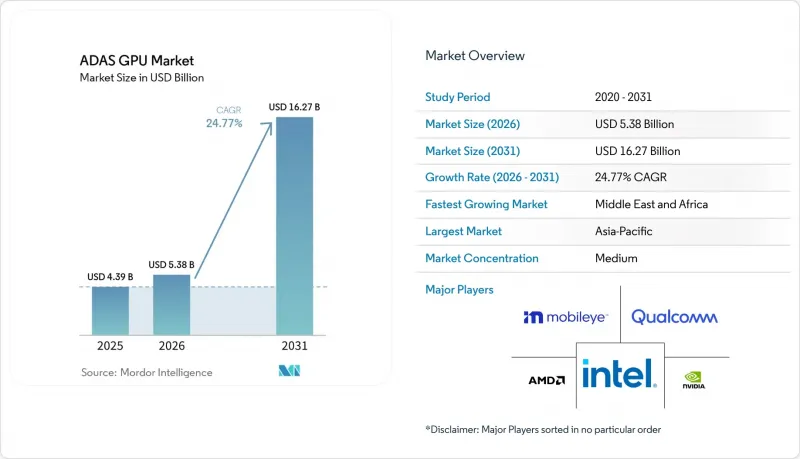
Mordor Intelligence에 의하면, ADAS용 GPU 시장 규모는 2025년 43억 9,000만 달러에서 2026년에는 53억 8,000만 달러로 확대되어 2026년부터 2031년까지 CAGR 24.77%로 성장을 지속하여, 2031년에는 162억 7,000만 달러에 이를 것으로 예측됩니다.
본 보고서는 GPU 통합 유형(통합형 GPU/SoC, 디스크리트 GPU/가속기), ADAS 용도(지각 및 센서 퓨전, 경로 계획, 운전자 모니터링, 서라운드 뷰, 자율주행용 연산), 차량 유형(승용차, 상용차), 자율주행 레벨(레벨 1, 레벨 2, 레벨 3, 기타), 지역별로 분류되어 있습니다. 시장 전망은 금액(달러) 기준으로 제시되어 있습니다.
전 세계 ADAS용 GPU 시장 동향과 인사이트
차량 1대당 ADAS 탑재 기능 증가
ADAS용 GPU 시장에서 단기적으로 가장 강력한 호재로 작용하고 있는 것은 차량 1대당 탑재되는 계산 부하가 높은 안전 및 편의 기능의 꾸준한 증가입니다. 현재 중급 모델에는 레이더, 서라운드 뷰 카메라, 운전자 모니터링, 탑승자 모니터링, 그리고 고속도로나 도심에서의 주행 지원 기능 등 더욱 폭넓은 조합이 탑재되어 있으며, 이로 인해 처리 수요는 기존의 제어 아키텍처를 훨씬 뛰어넘는 수준에 도달했습니다. 이러한 변화는 더 이상 고급차에만 국한된 것이 아니라, 주류 신차에도 더 많은 병렬 연산과 고속 데이터 처리가 필요한 기능 번들이 채택되고 있습니다. 이러한 기능이 양산 단계로 넘어감에 따라, 각 공급업체들은 소프트웨어, 메모리 및 검증 계획을 일체화하여 확정할 수 있도록 차량 개발 주기의 더 이른 단계에서 GPU나 SoC를 선정하고 있습니다. 또한, 자동차 제조업체들은 새로운 기능마다 별도의 프로세서를 추가하는 것을 피하고자 하기 때문에 동일한 칩에서 여러 워크로드를 지원할 수 있는 플랫폼의 가치도 높아지고 있습니다. 따라서 ADAS용 GPU 시장은 운전 지원 기능을 채택하는 차량 증가뿐만 아니라, 해당 기능을 탑재한 각 차량이 이전 모델 주기보다 더 높은 연산 부하를 감당하게 됨으로써도 혜택을 받고 있습니다.
소프트웨어 정의 차량으로의 전환
소프트웨어 정의 차량으로의 전환은 자동차 제조업체의 전자 시스템 설계 방식을 변화시키고 있으며, 이것이 ADAS용 GPU 시장을 직접적으로 뒷받침하고 있습니다. 수십 개의 전용 제어 장치에 기능을 분산시키는 대신, 새로운 아키텍처에서는 센싱, 의사 결정, 사용자 인터페이스 등의 작업을 더 적은 수의 고성능 연산 노드에 집약하고 있습니다. 이 모델은 고속 병렬 처리와 공유 메모리 액세스가 필요한 추론 부하가 높은 워크로드에 적합하기 때문에 GPU 탑재 SoC가 유리합니다. 퀄컴과 BMW는 신형 BMW iX3에 공동 개발한 자율주행 시스템 ‘Snapdragon Ride Pilot’을 탑재함으로써, 칩 공급업체가 소프트웨어 스택 및 하드웨어 플랫폼 측면에서 자동차 제조업체와 얼마나 긴밀하게 협력하고 있는지를 입증했습니다. 비즈니스 측면에서의 영향도 마찬가지로 중요합니다. 소프트웨어 정의 모델을 통해 반도체 플랫폼 공급업체는 개발 주기가 긴 자동차 프로그램에서 더 큰 역할을 맡게 되며, 칩과 자동차 로드맵 간의 격차가 줄어들기 때문입니다. ADAS용 GPU 시장에 있어 이는 수요가 단일 차종 라인의 기능 채택뿐만 아니라, 모델 패밀리 전체에 걸친 플랫폼 표준화와 점점 더 밀접하게 연결되고 있음을 의미합니다.
엄격한 자동차 인증 요건과 기능 안전의 부담
기능 안전은 ADAS용 GPU 시장에서 여전히 가장 큰 제약 요소 중 하나입니다. 자동차 인증에는 뛰어난 연산 성능 이상의 것이 요구되기 때문입니다. 공급업체는 장기간에 걸친 개발 주기를 통해 최고 수준의 자동차 안전 기준을 충족하는 하드웨어의 안전 메커니즘, 중복성, 진단 기능, 공정 제어 및 문서화가 필요합니다. 이로 인해 안전성이 극히 중요한 자동차 프로그램에서 플랫폼이 양산 단계에 진입하기까지 시간, 비용, 엔지니어링 노력이 증가하게 됩니다. NVIDIA는 자사의 DriveOS 플랫폼이 TUV SUD의 평가를 거쳐 ASIL-D 준수를 달성했으며, 더불어 ISO 21434 사이버 보안 프로세스 인증도 획득했다고 발표했습니다. 이는 고도화된 자율주행 용도에 적합한 플랫폼을 구축하는 데 필요한 작업의 규모를 보여줍니다. 이러한 요구 사항으로 인해 공급업체의 선택 폭은 좁아집니다. 왜냐하면 소비자용이나 데이터센터용 설계를 대대적인 재설계와 검증 없이 차량에 그대로 적용할 수는 없기 때문입니다. ADAS용 GPU 시장에서는 그 결과로 인증을 받은 플랫폼 벤더의 수가 감소하고, 규격 준수 솔루션의 가격이 급등하며, 순수한 수요가 뒷받침해야 할 속도보다 생산 능력 확대가 지연될 것입니다.
부문 분석
2025년에는 통합형 GPU 및 GPU 탑재 SoC 솔루션이 매출의 59.46%를 차지하며, 이 형태가 ADAS용 GPU 시장의 중심적인 위치를 계속 유지했습니다. 자동차 제조업체들은 단일 칩을 통해 패키징을 단순화하고, 전력 소비 오버헤드를 줄이며, 여러 기능에 걸친 안전 인증을 효율화할 수 있기 때문에 계속해서 통합형 설계를 선호하고 있습니다. 이러한 이점은 중앙 집중형 차량 아키텍처가 보급됨에 따라 더욱 강화될 것입니다. 단일 플랫폼에서 공유된 연산 도메인 내에서 지각, 인포테인먼트, 게이트웨이 및 모니터링 워크로드를 모두 처리할 수 있기 때문입니다. NVIDIA에 따르면, DRIVE Thor는 단일 아키텍처 상에서 자율 주행과 차량 내 경험을 실행하도록 설계되었으며, 이는 다기능 차량 플랫폼에서 통합형 솔루션의 가치를 입증하는 것입니다.
디스크리트 GPU 및 가속기 솔루션은 2031년까지 연평균 성장률(CAGR) 24.99%를 나타낼 것으로 예측되며, ADAS용 GPU 시장에서 가장 빠르게 성장하는 통합 형태입니다. 이러한 성장의 배경에는 단일 모놀리식 SoC가 일반적인 열 설계 범위 내에서 편안하게 제공할 수 있는 수준을 훨씬 뛰어넘는 지속적인 연산 능력을 필요로 하는 프로그램이 존재하기 때문입니다. WeRide와 Lenovo는 NVIDIA DRIVE AGX Thor 프로세서 2개를 탑재한 자동차 등급의 HPC 3.0 플랫폼을 발표했습니다. 이 사례는 자율주행 용도에서 디스크리트형 컴퓨팅에 대한 수요가 어디에서 가장 뚜렷하게 증가하고 있는지를 보여줍니다. 한편, Imagination Technologies는 전력 소비와 다이 면적의 오버헤드를 줄이는 안전성을 중시한 GPU IP를 강조하고 있으며, 이는 양산차 라인에서 통합형 포맷의 지속적인 경쟁력을 뒷받침하고 있습니다. 바로 이러한 균형 덕분에 오늘날에도 통합형 솔루션이 ADAS용 GPU 시장에서 여전히 큰 점유율을 차지하는 반면, 패키징의 간편함보다 연산 여력이 중시되는 분야에서는 디스크리트 가속기가 세를 넓혀가고 있는 이유를 설명해 줍니다.
2025년에는 지각 및 센서 퓨전이 매출의 33.02%를 차지하며, 이 카테고리는 ADAS용 GPU 시장에서 가장 큰 용도 분야가 되었습니다. ADAS를 탑재한 모든 차량에는 지각 파이프라인이 필요하며, 이 워크로드는 레벨 1, 레벨 2 및 그 이상의 자율주행 구성에서 계속해서 중요한 역할을 수행하고 있습니다. 또한, 이 부문은 높은 처리량의 병렬 처리에 의존하는 카메라, 레이더 및 운전자 모니터링 기능의 광범위한 활용으로부터도 혜택을 받고 있습니다. 그 결과, ADAS용 GPU 시장 내에서 다른 용도 카테고리가 성장세를 보이고 있음에도 불구하고, 지각 분야는 여전히 수익의 주축으로 자리 잡고 있습니다.
자율주행용 컴퓨팅은 2031년까지 연평균 성장률(CAGR) 25.03%로 확대될 것으로 예측되며, ADAS용 GPU 시장에서 가장 빠르게 성장하는 용도 분야가 될 것입니다. NVIDIA에 따르면, BYD, 지리(Geely), 이스즈, 닛산이 레벨 4 차량 프로그램에 ‘DRIVE Hyperion’을 채택하고 있으며, 주변 센싱, 경로 계획, 차량 내 AI를 통합적으로 처리할 수 있는 플랫폼에 대한 수요가 증가하고 있음을 보여줍니다. 경로 계획, 의사 결정, 주변 시야 파악, 주차 지원, 그리고 운전자 및 승객 모니터링은 별도의 하드웨어 상의 독립적인 모듈이 아닌, 동일한 컴퓨팅 스택의 일부로 계속 확장되고 있습니다. 이러한 워크로드가 통합됨에 따라, 단일 칩이나 컴퓨팅 도메인에서 이를 통합할 수 있는 벤더는 자동차 제조업체에 더 강력한 가치 제안을 할 수 있습니다. 또한, ADAS용 GPU 시장에서 고급 용도 스택의 점유율이 더욱 중요해지는 것도 바로 이 때문입니다. 왜냐하면 가장 빠른 성장은 단순한 기능 추가가 아니라, 소프트웨어를 적극 활용한 도입에서 비롯되고 있기 때문입니다.
지역별 분석
2025년, 아시아태평양은 매출의 39.18%를 차지하며, ADAS용 GPU 시장에서 지역별 1위를 차지했습니다. 이 지역은 대규모 자동차 생산 대수, 중국 내 기능의 신속한 전개, 그리고 국내 자동차 프로그램 및 컴퓨팅 플랫폼 공급업체와의 견고한 협력이라는 이점을 누리고 있습니다. 중국은 광범위한 승용차 생산과 집중형 컴퓨팅 및 첨단 지원 기능의 급속한 보급을 모두 갖추고 있어 여전히 주요 수요 거점으로 자리 잡고 있습니다. 일본은 상용차 및 자율주행 버스 분야에서의 활동을 통해 이 지역의 기반을 뒷받침하고 있는 반면, 한국은 첨단 반도체 및 차량 플랫폼 개발을 통해 시장을 강화하고 있습니다. NVIDIA에 따르면, BYD, 지리(Geely), 이스즈, 닛산이 레벨 4 프로그램을 위해 ‘DRIVE Hyperion’을 채택하고 있으며, 이는 승용차 및 상용차 양쪽 플랫폼에 걸친 지역적 관여의 깊이를 입증하고 있습니다.
북미와 유럽은 프리미엄 차량 프로그램, 엄격한 안전 기준, 그리고 활발한 자율주행 모빌리티 개발에 힘입어 ADAS용 GPU 시장의 다음 주요 클러스터를 형성하고 있습니다. Euro NCAP은 4대 기둥으로 구성된 안전 프레임워크를 갖춘 2026년 프로토콜 전면 개정을 발표했으며, 이에 따라 최고 수준의 안전 점수를 목표로 하는 차량에게 있어 긴밀하게 통합된 컴퓨팅의 중요성이 더욱 커지고 있습니다. 북미는 로보택시 개발, 시뮬레이션 인프라, 그리고 컴퓨팅 플랫폼 공급업체와 모빌리티 사업자 간의 파트너십 측면에서 여전히 중요한 위치를 차지하고 있습니다. 메르세데스-벤츠는 레벨 4를 지원하는 아키텍처를 갖춘 NVIDIA DRIVE AV가 탑재된 차세대 S-클래스를 발표했습니다. 이는 프리미엄 차량의 혁신을 통해 유럽이 ADAS용 GPU 시장의 고급 부문에 계속해서 영향을 미치고 있음을 보여줍니다.
중동 및 아프리카은 2031년까지 연평균 성장률(CAGR) 25.11%로 확대될 것으로 예측되며, ADAS용 GPU 시장에서 가장 빠르게 성장하는 지역 부문이 될 전망입니다. 이 지역의 성장은 스마트 모빌리티에 대한 투자, 프리미엄 차량 수요, 그리고 걸프 지역 시장에서의 자율주행 모빌리티 생태계 조기 구축에 힘입고 있습니다. NVIDIA는 2026년 6월 DRIVE Hyperion 생태계 확장에 중동 모빌리티 분야와의 제휴가 포함되었다고 밝혔으며, 이는 단순한 탐색적 차원을 넘어 적극적인 상업적 관심을 나타내는 것입니다. 남미는 여전히 규모는 작지만, 상용차의 안전 요건 및 프리미엄 승용차의 도입이 진행되면서, 지역 특성에 맞춘 차량 플랫폼의 컴퓨팅 탑재량이 서서히 증가하고 있습니다.
기타 혜택:
- 엑셀 형식 시장 예측(ME) 시트
- 3개월간의 애널리스트 지원
자주 묻는 질문
목차
제1장 서론
제2장 조사 방법
제3장 주요 요약
제4장 시장 구도
제5장 시장 규모와 성장 예측
제6장 경쟁 구도
제7장 시장 기회와 향후 전망
JHS 26.08.07According to Mordor Intelligence, the ADAS GPU market size is expected to grow from USD 4.39 billion in 2025 to USD 5.38 billion in 2026 and is forecast to reach USD 16.27 billion by 2031 at 24.77% CAGR over 2026-2031.
This report is Segmented by GPU Integration Type (Integrated GPU/SoC, and Discrete GPU/Accelerator), ADAS Application (Perception and Sensor Fusion, Path Planning, Driver Monitoring, Surround View, and Autonomous Driving Compute), Vehicle Type (Passenger Vehicles, and Commercial Vehicles), Level of Autonomy (Level 1, Level 2, Level 3, More), and Geography. The Market Forecasts are Provided in Terms of Value (USD).
Global ADAS GPU Market Trends and Insights
Rising ADAS Content Per Vehicle
The ADAS GPU market is seeing its strongest near-term push from the steady increase in compute-heavy safety and convenience features per vehicle. Mid-range models now carry broader combinations of radar, surround-view cameras, driver monitoring, occupant monitoring, and highway or city assistance functions, which raises processing needs well beyond older control architectures. That change is no longer limited to premium vehicles, because mainstream launches now use feature bundles that require more parallel compute and faster data handling. As those features move into higher-volume production, suppliers are making GPU and SoC decisions earlier in the vehicle development cycle so they can lock software, memory, and validation plans together. This also raises the value of platforms that can support multiple workloads on the same silicon, since automakers want to avoid adding separate processors for each new function. The ADAS GPU market, therefore, benefits not only from more vehicles using assistance functions but also from each equipped vehicle carrying a higher compute load than the previous model cycle.
Shift Toward Software-Defined Vehicles
The shift toward software-defined vehicles is changing how automakers design electronic systems, and that directly supports the ADAS GPU market. Instead of spreading functions across dozens of dedicated control units, newer architectures move more sensing, decision-making, and user-interface tasks into fewer high-performance compute nodes. That model favors GPU-enabled SoCs because they are better suited to inference-heavy workloads that need fast parallel processing and shared memory access. Qualcomm and BMW introduced Snapdragon Ride Pilot in the all-new BMW iX3 as a jointly developed automated driving system, demonstrating how closely chip vendors now work with automakers on the software stack and hardware platform. The commercial effect is equally important because the software-defined model gives semiconductor platform suppliers a greater role in long-cycle vehicle programs and reduces the gap between the chip and vehicle roadmaps. For the ADAS GPU market, this means demand is increasingly tied to platform standardization across model families, not only to feature adoption in one vehicle line.
High Automotive Qualification And Functional Safety Burden
Functional safety remains one of the biggest constraints on the ADAS GPU market because automotive qualification requires more than strong compute performance. Suppliers need hardware safety mechanisms, redundancy, diagnostics, process controls, and documentation that meet the highest automotive safety standards over long development cycles. That adds time, cost, and engineering effort before a platform can enter production in safety-critical vehicle programs. NVIDIA said its DriveOS platform reached ASIL-D conformance, assessed by TUV SUD, and also achieved ISO 21434 cybersecurity process certification, which shows the scale of work needed to make a platform suitable for advanced autonomous applications. These requirements narrow the supplier base because consumer or data-center designs cannot be moved into vehicles without major redesign and validation. For the ADAS GPU market, the outcome is a smaller group of qualified platform vendors, premium pricing for compliant solutions, and slower capacity expansion than raw demand would otherwise support.
Other drivers and restraints analyzed in the detailed report include:
- Growth Of Centralized And Zonal Vehicle Architectures
- Expansion Of High-Resolution Digital Cockpits And Multi-Display Systems
- Thermal And Power Envelope Constraints
For complete list of drivers and restraints, kindly check the Table Of Contents.
Segment Analysis
Integrated GPU and GPU-enabled SoC solutions accounted for 59.46% of revenue in 2025, which kept this format at the center of the ADAS GPU market. Automakers continue to favor integrated designs because a single chip can simplify packaging, reduce power overhead, and streamline safety qualification across multiple functions. This advantage becomes stronger as centralized vehicle architectures spread, since one platform can cover perception, infotainment, gateway, and monitoring workloads in a shared compute domain. NVIDIA says DRIVE Thor is built to run automated driving and in-vehicle experiences on one architecture, which supports the value case for integrated solutions in multi-function vehicle platforms.
Discrete GPU and accelerator solutions are projected to grow at a 24.99% CAGR through 2031, which makes them the faster-rising integration format within the ADAS GPU market. Their growth comes from programs that need sustained compute far above what a single monolithic SoC can comfortably deliver in a mainstream thermal envelope. WeRide and Lenovo introduced an automotive-grade HPC 3.0 platform using dual NVIDIA DRIVE AGX Thor processors, and that example shows where discrete compute demand is emerging most clearly in autonomous mobility programs. At the same time, Imagination Technologies highlights safety-focused GPU IP that lowers power and die-area overhead, which supports the continued competitiveness of integrated formats in volume vehicle lines. This balance explains why integrated solutions still carry the larger ADAS GPU market size today, while discrete accelerators are building momentum where compute headroom matters more than packaging simplicity.
Perception and sensor fusion accounted for 33.02% of revenue in 2025, giving this category the largest application position in the ADAS GPU market. Every ADAS-equipped vehicle needs a perception pipeline, which keeps this workload relevant across Level 1, Level 2, and higher-autonomy configurations. The segment also benefits from the broad use of cameras, radar, and driver-monitoring functions that all rely on high-throughput parallel processing. That is why perception remains the revenue anchor even as other application categories gain speed within the ADAS GPU market.
Autonomous driving compute is projected to expand at a 25.03% CAGR through 2031, making it the fastest-growing application area in the ADAS GPU market. NVIDIA said BYD, Geely, Isuzu, and Nissan have adopted DRIVE Hyperion for Level 4 vehicle programs, pointing to rising demand for platforms that can handle surround sensing, path planning, and in-cabin AI together. Path planning, decision-making, surround view, parking assistance, and driver or occupant monitoring continue to expand as part of the same compute stack, rather than as isolated modules on separate hardware. As those workloads converge, platform vendors that can unify them on a single chip or compute domain gain a stronger value proposition with automakers. This is also where the ADAS GPU market share of advanced application stacks becomes more meaningful, because the fastest growth is coming from software-rich deployments rather than from simple feature additions alone.
Complete Report Scope:
- By GPU Integration Type
- Integrated GPU / GPU-Enabled SoC
- Discrete Automotive GPU / Accelerator
- By ADAS Application
- Perception and Sensor Fusion
- Path Planning and Decision-Making
- Driver Monitoring and Occupant Monitoring
- Surround View and Parking Assistance
- Autonomous Driving Compute
- By Vehicle Type
- Passenger Vehicles
- Commercial Vehicles
- By Level of Autonomy
- Level 1
- Level 2
- Level 3
- Level 4
- Level 5
- By Geography
- North America
- United States
- Canada
- Mexico
- Europe
- Germany
- United Kingdom
- France
- Italy
- Rest of Europe
- Asia-Pacific
- China
- Japan
- South Korea
- India
- Southeast Asia
- Rest of Asia-Pacific
- South America
- Middle East and Africa
- North America
Geography Analysis
Asia-Pacific held 39.18% of revenue in 2025, which gave it the leading regional position in the ADAS GPU market. The region benefits from large vehicle production volumes, fast feature rollout in China, and strong links between domestic vehicle programs and compute platform suppliers. China remains the main demand center because it combines broad passenger vehicle output with rapid adoption of centralized compute and advanced assistance functions. Japan supports the regional base through commercial vehicle and autonomous bus activity, while South Korea adds strength through advanced semiconductor and vehicle platform development. NVIDIA said BYD, Geely, Isuzu, and Nissan adopted DRIVE Hyperion for Level 4 programs, which underlines the depth of regional engagement across both passenger and commercial platforms.
North America and Europe form the next major cluster in the ADAS GPU market, supported by premium vehicle programs, strict safety expectations, and active autonomous mobility development. Euro NCAP announced a 2026 protocol overhaul with a four-pillar safety framework, and that increases the importance of tightly integrated compute for vehicles targeting top safety scores. North America remains important for robotaxi development, simulation infrastructure, and partnerships between compute platform vendors and mobility operators. Mercedes-Benz presented its next-generation S-Class on NVIDIA DRIVE AV with an L4-ready architecture, which shows how Europe continues to influence the high end of the ADAS GPU market through premium vehicle innovation.
The Middle East and Africa is projected to expand at a 25.11% CAGR through 2031, making it the fastest-growing regional segment in the ADAS GPU market. Growth there is supported by smart mobility investment, premium vehicle demand, and the early buildout of autonomous mobility ecosystems in Gulf markets. NVIDIA said its June 2026 DRIVE Hyperion ecosystem expansion included Middle East mobility collaborations, which signals active commercial interest rather than only exploratory positioning. South America remains smaller, but it is progressing through commercial fleet safety requirements and premium passenger vehicle adoption that gradually raise the compute content of locally relevant vehicle platforms.
- NVIDIA Corporation
- Qualcomm Technologies, Inc.
- Intel Corporation
- Advanced Micro Devices, Inc.
- Mobileye Global Inc.
- Renesas Electronics Corporation
- NXP Semiconductors N.V.
- Infineon Technologies AG
- STMicroelectronics N.V.
- Texas Instruments Incorporated
- Samsung Electronics Co., Ltd.
- MediaTek Inc.
- Arm Ltd.
- Imagination Technologies Limited
- Huawei Technologies Co., Ltd.
- Horizon Robotics
- Black Sesame Technologies (Hong Kong) Limited
- Valens Semiconductor Ltd.
- Synopsys, Inc.
- Cadence Design Systems, Inc.
- Socionext Inc.
Additional Benefits:
- The market estimate (ME) sheet in Excel format
- 3 months of analyst support
TABLE OF CONTENTS
1 INTRODUCTION
- 1.1 Study Assumptions and Market Definition
- 1.2 Scope of the Study
2 RESEARCH METHODOLOGY
3 EXECUTIVE SUMMARY
4 MARKET LANDSCAPE
- 4.1 Market Overview
- 4.2 Market Drivers
- 4.2.1 Rising ADAS Content Per Vehicle
- 4.2.2 Shift Toward Software-Defined Vehicles
- 4.2.3 Growth of Centralized and Zonal Vehicle Architectures
- 4.2.4 Expansion of High-Resolution Digital Cockpits and Multi-Display Systems
- 4.2.5 Safety Regulation-Driven Compute Upgrades
- 4.2.6 Automotive AI and Sensor Fusion Workload Growth
- 4.3 Market Restraints
- 4.3.1 High Automotive Qualification and Functional Safety Burden
- 4.3.2 Thermal and Power Envelope Constraints
- 4.3.3 Semiconductor Supply Chain and Advanced Node Availability Risk
- 4.3.4 Cost Pressure in Mass-Market Vehicle Platforms
- 4.4 Impact of Macroeconomic Factors on the Market
- 4.5 Market Positioning Analysis
- 4.6 Regulatory Landscape
- 4.7 Technological Outlook
- 4.8 Porter's Five Forces Analysis
- 4.8.1 Bargaining Power of Suppliers
- 4.8.2 Bargaining Power of Buyers
- 4.8.3 Threat of New Entrants
- 4.8.4 Threat of Substitutes
- 4.8.5 Intensity of Competitive Rivalry
5 MARKET SIZE AND GROWTH FORECASTS (VALUE)
- 5.1 By GPU Integration Type
- 5.1.1 Integrated GPU / GPU-Enabled SoC
- 5.1.2 Discrete Automotive GPU / Accelerator
- 5.2 By ADAS Application
- 5.2.1 Perception and Sensor Fusion
- 5.2.2 Path Planning and Decision-Making
- 5.2.3 Driver Monitoring and Occupant Monitoring
- 5.2.4 Surround View and Parking Assistance
- 5.2.5 Autonomous Driving Compute
- 5.3 By Vehicle Type
- 5.3.1 Passenger Vehicles
- 5.3.2 Commercial Vehicles
- 5.4 By Level of Autonomy
- 5.4.1 Level 1
- 5.4.2 Level 2
- 5.4.3 Level 3
- 5.4.4 Level 4
- 5.4.5 Level 5
- 5.5 By Geography
- 5.5.1 North America
- 5.5.1.1 United States
- 5.5.1.2 Canada
- 5.5.1.3 Mexico
- 5.5.2 Europe
- 5.5.2.1 Germany
- 5.5.2.2 United Kingdom
- 5.5.2.3 France
- 5.5.2.4 Italy
- 5.5.2.5 Rest of Europe
- 5.5.3 Asia-Pacific
- 5.5.3.1 China
- 5.5.3.2 Japan
- 5.5.3.3 South Korea
- 5.5.3.4 India
- 5.5.3.5 Southeast Asia
- 5.5.3.6 Rest of Asia-Pacific
- 5.5.4 South America
- 5.5.5 Middle East and Africa
- 5.5.1 North America
6 COMPETITIVE LANDSCAPE
- 6.1 Market Concentration
- 6.2 Strategic Moves
- 6.3 Market Positioning Analysis
- 6.4 Company Profiles (includes Global Level Overview, Market Level Overview, Core Segments, Financials as available, Strategic Information, Market Rank/Share, Products and Services, Recent Developments)
- 6.4.1 NVIDIA Corporation
- 6.4.2 Qualcomm Technologies, Inc.
- 6.4.3 Intel Corporation
- 6.4.4 Advanced Micro Devices, Inc.
- 6.4.5 Mobileye Global Inc.
- 6.4.6 Renesas Electronics Corporation
- 6.4.7 NXP Semiconductors N.V.
- 6.4.8 Infineon Technologies AG
- 6.4.9 STMicroelectronics N.V.
- 6.4.10 Texas Instruments Incorporated
- 6.4.11 Samsung Electronics Co., Ltd.
- 6.4.12 MediaTek Inc.
- 6.4.13 Arm Ltd.
- 6.4.14 Imagination Technologies Limited
- 6.4.15 Huawei Technologies Co., Ltd.
- 6.4.16 Horizon Robotics
- 6.4.17 Black Sesame Technologies (Hong Kong) Limited
- 6.4.18 Valens Semiconductor Ltd.
- 6.4.19 Synopsys, Inc.
- 6.4.20 Cadence Design Systems, Inc.
- 6.4.21 Socionext Inc.
7 MARKET OPPORTUNITIES AND FUTURE OUTLOOK
- 7.1 White-Space and Unmet-Need Assessment