|
시장보고서
상품코드
2098601
독일의 그린 물류 시장 : 점유율 분석, 업계 동향 및 통계, 성장 예측(2026-2031년)Germany Green Logistics - Market Share Analysis, Industry Trends & Statistics, Growth Forecasts (2026 - 2031) |
||||||
 Mordor Intelligence
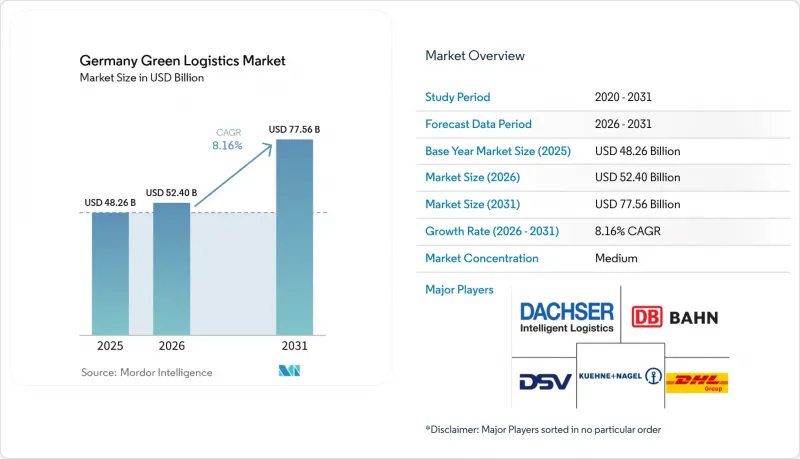
Mordor Intelligence에 의하면, 독일 그린 물류 시장 규모는 2025년에 482억 6,000만 달러로 평가되었고 2026년에는 524억 달러, 2031년까지 775억 6,000만 달러에 이를 것으로 예측되며, 2026년부터 2031년까지 연평균 복합 성장률(CAGR)은 8.16%를 나타낼 전망입니다.
화물 운송의 탈탄소화에 관한 규제 강화, 전기 배송 차량의 보급 확대, 그리고 운송 계약에서 측정 가능한 배출량 감축을 요구하는 화주들 수요 증가가 시장 성장을 견인하고 있습니다. 본 보고서는 물류 기능별(친환경 운송, 친환경 창고·유통, 친환경 부가가치 서비스), 연료·에너지 유형별(전력 구동형 물류, 바이오연료 기반 물류 등), 최종 사용자 산업별(소매 및 전자상거래, 자동차 산업 등), 지역별(노르트라인-베스트팔렌주, 바이에른주 등)로 분류되어 있습니다. 시장 전망은 금액(달러) 기준으로 제시되어 있습니다.
독일 그린 물류 시장 동향과 인사이트
화물 운송의 탈탄소화 및 보고에 관한 규제 압력
현재, 규제상의 압력이 독일 그린 물류 시장의 일상적인 운영 의사결정을 좌우하고 있습니다. EU의 대형 차량 대상 CO2 규제 체계에 따라 트럭의 탈탄소화는 확고한 길을 걷고 있으며, 또한 ‘FuelEU Maritime’을 통해 2025년 1월부터 해상 운송에 대한 연료 온실가스 배출 강도 감축 요건이 적용되고 있습니다. 또한, 주요 화주들은 물류 파트너에게 보다 상세한 배출량 데이터를 요구하고 있으며, 이로 인해 탄소 보고는 단순한 부가 서비스가 아닌 일반적인 상업적 심사 기준의 일부가 되었습니다. 이러한 상황으로 인해 운송업체들은 고객의 보고 의무를 지원할 수 있는 측정 시스템, 감사 가능한 프로세스 및 서비스 제공에 대한 투자를 강요받고 있습니다. 따라서 독일의 그린 물류 시장은 물리적 운송 자산과 마찬가지로 규정 준수 준비 상태에 의해서도 형성되고 있습니다.
도시 지역 및 단거리 운송 노선에서의 차량 전기화
독일의 그린 물류 시장에서 도시 내 배송 및 단거리 운송 분야의 차량 전기화는 눈에 띄는 규모로 확대되고 있습니다. DHL 그룹은 2025년 7월, 2,400대의 포드 ‘Pro e-van’을 추가로 도입하여 독일 내 전기차 보유 대수를 3만 5,000대로 확대했습니다. 이 회사에 따르면, 이를 통해 독일 우편번호 구역의 3분의 1에서 무배출 배송이 실현되고 있다고 합니다. 헤르메스 독일은 2026년 1분기 말까지 약 1,960대의 전기차를 운용하며, 독일 내 80개 이상의 도심 지역에서 배출가스 제로 소포 배송을 실현했습니다. 이러한 움직임은 저배출 구역이나 배송이 집중되는 지역에서의 도시 물류 서비스 품질 기준을 높이고 있습니다. 또한, 차량 전환을 대규모로 추진할 수 있는 대형 사업자와 여전히 기존 차량에 의존하고 있는 중소 운송업체 간의 격차를 더욱 벌리고 있습니다.
무공해 차량과 충전 인프라의 높은 자본 집약성
높은 초기 비용은 독일의 그린 물류 시장에서의 보급 확대에 있어 여전히 가장 뚜렷한 장벽으로 남아 있습니다. 헤르만(Hermann), DSV 및 기타 사업자들은 독일 연방 정부의 KsNI 지원 체제의 혜택을 받고 있으며, 헤르만은 2025년 해당 프로그램이 종료되기 전에 보조금 지원과 자사의 e-모빌리티 도입을 연계했습니다. 닥서(Daxer)사도 2025년, 자사가 전기 차량 도입을 확대하고 있음에도 불구하고 차량 구입 비용은 여전히 높으며, 트럭용 공공 충전 인프라도 아직 부족하다고 밝혔습니다. 이러한 비용 격차는 더 광범위한 네트워크나 장기 계약을 통해 투자를 분산할 수 있는 대형 사업자에게 유리하게 작용합니다. 그 결과, 저배출 서비스에 대한 고객 수요가 증가하고 있음에도 불구하고 중소규모 운송업체들은 전환 속도가 느려지는 문제에 직면해 있습니다.
부문 분석
2025년 시점에서 친환경 운송의 점유율은 61.58%를 차지하고 있으며, 독일 그린 물류 시장 규모에서 지출의 대부분을 여전히 화물 운송이 차지하고 있는 것으로 나타났습니다. 이 부문에는 도로, 철도, 항공, 해운 활동이 포함되며, 현재 운영상의 관심은 주로 도로 전기화 및 복합 운송 철도 프로젝트에 집중되어 있습니다. 친환경 부가가치 서비스 및 기타 부문은 2031년까지 연평균 성장률(CAGR) 12.75%라는 가장 높은 성장률을 나타낼 것으로 예상되며, 이는 배출량 데이터 관리, 지속 가능한 포장 지원 및 검증 서비스에 대한 수요 증가를 반영합니다. 이러한 변화는 고객이 운송 업무 자체뿐만 아니라 검증, 측정 및 프로세스 지원에 점점 더 중점을 두고 있음을 보여줍니다. 독일의 그린 물류 시장에서는 서비스 설계가 변화하고 있으며, 컨설팅 및 보고 업무는 패키지에 포함된 부가 서비스가 아닌 유료 추가 옵션으로 전환되고 있습니다.
그린 창고 및 물류는 이 두 극단 사이의 중간 지점에 위치하며, 사업자들이 시설의 에너지 시스템이나 자체 발전 설비를 업그레이드함에 따라 그 중요성이 높아지고 있습니다. FIEGE사는 2025년 그라벤-레켄펠트의 태양광 발전 시스템을 약 3,000 kWp로 확장하여 연간 최대 2.4GWh의 발전량을 달성했습니다. 이러한 시설에 대한 투자는 운영에 따른 배출량을 줄이고, 창고 내 보다 탄력적인 에너지 사용을 뒷받침하고 있습니다. 따라서 독일의 그린 물류 업계는 단순히 운송에만 초점을 맞춘 방식에서 벗어나, 서비스 패키지에 데이터, 시설, 에너지 관리를 포함하는 보다 광범위한 운영 모델로 전환하고 있습니다.
기타 혜택:
- 엑셀 형식 시장 예측(ME) 시트
- 3개월간의 애널리스트 지원
목차
제1장 서론
제2장 조사 방법
제3장 주요 요약
제4장 시장 구도
제5장 시장 규모 및 성장 예측(금액, 2026-2031년)
제6장 경쟁 구도
제7장 시장 기회와 향후 전망
JHSAccording to Mordor Intelligence, the Germany green logistics market size was valued at USD 48.26 billion in 2025 and is forecast to reach USD 52.40 billion in 2026 and USD 77.56 billion by 2031 at 8.16% CAGR from 2026 to 2031.
Tighter freight decarbonization rules, wider use of electric delivery fleets, and stronger shipper demand for measurable emissions cuts in transport contracts are shaping growth. This report is Segmented by Logistics Function (Green Transportation, Green Warehousing and Distribution, Green Value-Added Services), by Fuel/Energy Type (Electric Powered Logistics, Biofuel-Based Logistics, and More), by End-User Industry (Retail & E-Commerce, Automotive, and More), and by Region (North Rhine-Westphalia, Bavaria, and More). The Market Forecasts are Provided in Terms of Value (USD).
Germany Green Logistics Market Trends and Insights
Regulatory Pressure on Freight Decarbonization and Reporting
Regulatory pressure now shapes daily operating choices across the Germany green logistics market. The EU heavy-duty vehicle CO2 framework keeps truck decarbonization on a fixed path, and FuelEU Maritime has applied a fuel greenhouse gas intensity reduction requirement for maritime transport since January 2025. Large shippers also need more detailed emissions data from logistics partners, which makes carbon reporting part of normal commercial qualification rather than a side service. This is pushing carriers to invest in measurement systems, auditable processes, and service offers that can support customer reporting obligations. The Germany green logistics market is therefore being shaped by compliance readiness as much as by physical transport assets.
Fleet Electrification in Urban and Short-Haul Lanes
Fleet electrification in city delivery and short-haul transport has moved into a visible scale in the Germany green logistics market. DHL Group expanded its electric fleet in Germany to 35,000 vehicles after adding 2,400 Ford Pro e-vans in July 2025, and the company said this supports zero-emission delivery across one-third of German postcodes. Hermes Germany reached emission-free parcel delivery across more than 80 German city centers by the end of Q1 2026, with around 1,960 electric vehicles in service. These moves are raising the standard for urban logistics service quality in low-emission zones and dense delivery districts. They also widen the gap between large operators that can scale fleet conversion and smaller carriers that still rely on conventional assets.
High Capital Intensity of Zero-Emission Fleets and Charging Infrastructure
High upfront costs remain the clearest brake on wider adoption in the Germany green logistics market. Hellmann, DSV, and other operators benefited from the German federal KsNI support framework, and Hellmann linked its e-mobility rollout to that subsidy support before the program ended in 2025. Dachser also stated in 2025 that vehicle acquisition costs remained high and public charging infrastructure for trucks was still scarce, even as the company expanded its electric fleet. This cost gap favors larger operators that can spread investment across bigger networks and longer contract books. Smaller carriers, therefore, face a slower transition path, even as customer demand for low-emission services rises.
Other drivers and restraints analyzed in the detailed report include:
- Rising Customer Demand for Low-Carbon Logistics Procurement
- Intermodal Shift from Road to Rail and Inland Waterways
- Limited Hydrogen and High-Power Charging Availability on Freight Corridors
For complete list of drivers and restraints, kindly check the Table Of Contents.
Segment Analysis
Green transportation accounted for 61.58% share in 2025, indicating that freight movement still accounts for the majority of spending in the Germany green logistics market size. This segment includes road, rail, air, and sea activity, and road electrification and intermodal rail projects are drawing much of the current operational attention. Green value-added services and others are projected to record the fastest growth at 12.75% CAGR through 2031, reflecting stronger demand for emissions data management, sustainable packaging support, and verification services. That shift shows that customers increasingly value proof, measurement, and process support alongside the transport task itself. In the Germany green logistics market, service design is changing: advisory and reporting work is becoming a paid add-on rather than a bundled extra.
Green warehousing and distribution sits between these two poles and is gaining relevance as operators upgrade site energy systems and local power generation. FIEGE expanded its photovoltaic system in Greven-Reckenfeld in 2025 to around 3,000 kWp, with annual generation of up to 2.4 GWh. That kind of site investment lowers operating emissions and supports more resilient energy use in warehouses. The Germany green logistics industry is therefore moving from a transport-only transition to a broader operating model that includes data, facilities, and energy management within the service package.
Complete Report Scope:
- By Logistics Function
- Green Transportation
- Road
- Air
- Sea and Inland Waterways
- Rail
- Green Warehousing & Distribution
- Green Value-added Services and Others
- Green Transportation
- By Fuel / Energy Type
- Electric-Powered Logistics
- Biofuel-Based Logistics
- Hydrogen-Powered Logistics
- Others
- By End-user Industry
- Retail & E-commerce
- Manufacturing & Industrial
- Automotive
- Healthcare & Pharmaceuticals
- Food & Beverages
- Chemicals & Hazardous Materials
- Others
- By Region
- North Rhine-Westphalia
- Bavaria (Bayern)
- Baden-Wurttemberg
- Rest of States
List of Companies Covered in this Report:
- DHL Group
- DSV A/S (including DB Schenker)
- Kuehne+Nagel
- Dachser Group SE & Co. KG
- Deutsche Bahn AG
- Rhenus SE & Co. KG
- Hellmann Worldwide Logistics SE & Co. KG
- A.P. Moller's Maersk
- CEVA Logistics (CMA CGM)
- GEODIS
- FIEGE Logistik Stiftung & Co. KG
- BLG Logistics Group AG & Co. KG
- UPS
- FedEx
- Hermes Europe GmbH
- GLS Germany GmbH & Co. OHG
- DPD Deutschland
- Hapag-Lloyd
- Lufthansa Cargo
- Nagel-Group
- Gebruder Weiss
- Nippon Express Holdings
Additional Benefits:
- The market estimate (ME) sheet in Excel format
- 3 months of analyst support
TABLE OF CONTENTS
1 Introduction
- 1.1 Study Assumptions & Market Definition
- 1.2 Scope of the Study
2 Research Methodology
3 Executive Summary
4 Market Landscape
- 4.1 Market Overview and Role of Green Logistics in Logistics
- 4.2 ESG Spending Trends
- 4.3 Market Drivers
- 4.3.1 Regulatory Pressure on Freight Decarbonization and Reporting
- 4.3.2 Fleet Electrification in Urban and Short-Haul Lanes
- 4.3.3 Rising Customer Demand for Low-Carbon Logistics Procurement
- 4.3.4 Intermodal Shift from Road to Rail and Inland Waterways
- 4.3.5 Carbon-Aware Routing, Load Consolidation, and Network Optimization Software
- 4.3.6 Green Warehouse Retrofits, Rooftop Solar, and Energy Management Systems
- 4.4 Market Restraints
- 4.4.1 High Capital Intensity of Zero-Emission Fleets and Charging Infrastructure
- 4.4.2 Limited Hydrogen and High-Power Charging Availability on Freight Corridors
- 4.4.3 Higher Operational Complexity from Mixed-Fleet Transition and Payload Penalties
- 4.4.4 Slow Payback for Sustainability Upgrades in Low-Margin Logistics Contracts
- 4.5 Regulatory Framework
- 4.6 Value Chain and Distribution Channel Architecture Analysis
- 4.7 Technology Innovations Outlook
- 4.8 Porter's Five Forces
- 4.8.1 Threat of New Entrants
- 4.8.2 Bargaining Power of Suppliers
- 4.8.3 Bargaining Power of Buyers
- 4.8.4 Threat of Substitutes
- 4.8.5 Rivalry Among Competitors
- 4.9 Evolution of Green Logistics Requirements
- 4.10 Impact of Geo-Political Events on Supply Chain Shifts
5 Market Size & Growth Forecasts (Value, 2026-2031)
- 5.1 By Logistics Function
- 5.1.1 Green Transportation
- 5.1.1.1 Road
- 5.1.1.2 Air
- 5.1.1.3 Sea and Inland Waterways
- 5.1.1.4 Rail
- 5.1.2 Green Warehousing & Distribution
- 5.1.3 Green Value-added Services and Others
- 5.1.1 Green Transportation
- 5.2 By Fuel / Energy Type
- 5.2.1 Electric-Powered Logistics
- 5.2.2 Biofuel-Based Logistics
- 5.2.3 Hydrogen-Powered Logistics
- 5.2.4 Others
- 5.3 By End-user Industry
- 5.3.1 Retail & E-commerce
- 5.3.2 Manufacturing & Industrial
- 5.3.3 Automotive
- 5.3.4 Healthcare & Pharmaceuticals
- 5.3.5 Food & Beverages
- 5.3.6 Chemicals & Hazardous Materials
- 5.3.7 Others
- 5.4 By Region
- 5.4.1 North Rhine-Westphalia
- 5.4.2 Bavaria (Bayern)
- 5.4.3 Baden-Wurttemberg
- 5.4.4 Rest of States
6 Competitive Landscape
- 6.1 Market Concentration
- 6.2 Key Strategic Moves
- 6.3 Market Share Analysis
- 6.4 Company Profiles (includes Global level Overview, Market level overview, Core Segments, Financials as available, Strategic Information, Market Rank/Share for key companies, Products & Services, and Recent Developments)
- 6.4.1 DHL Group
- 6.4.2 DSV A/S (including DB Schenker)
- 6.4.3 Kuehne+Nagel
- 6.4.4 Dachser Group SE & Co. KG
- 6.4.5 Deutsche Bahn AG
- 6.4.6 Rhenus SE & Co. KG
- 6.4.7 Hellmann Worldwide Logistics SE & Co. KG
- 6.4.8 A.P. Moller's Maersk
- 6.4.9 CEVA Logistics (CMA CGM)
- 6.4.10 GEODIS
- 6.4.11 FIEGE Logistik Stiftung & Co. KG
- 6.4.12 BLG Logistics Group AG & Co. KG
- 6.4.13 UPS
- 6.4.14 FedEx
- 6.4.15 Hermes Europe GmbH
- 6.4.16 GLS Germany GmbH & Co. OHG
- 6.4.17 DPD Deutschland
- 6.4.18 Hapag-Lloyd
- 6.4.19 Lufthansa Cargo
- 6.4.20 Nagel-Group
- 6.4.21 Gebruder Weiss
- 6.4.22 Nippon Express Holdings
7 Market Opportunities & Future Outlook
- 7.1 White-space & Unmet-Need Assessment