

|
시장보고서
상품코드
2099068
즉시 결제 시장 : 시장 점유율 분석, 업계 동향 및 통계, 성장 예측(2026-2031년)Instant Payments - Market Share Analysis, Industry Trends & Statistics, Growth Forecasts (2026 - 2031) |
||||||
 Mordor Intelligence
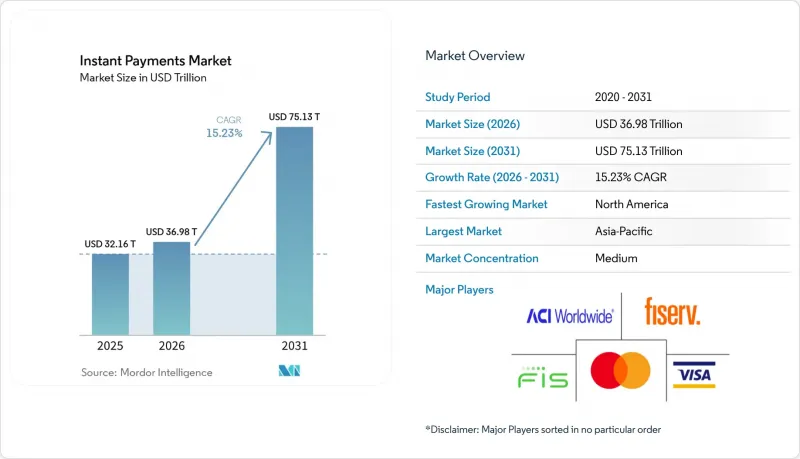
Mordor Intelligence에 의하면, 즉시 결제 시장 규모는 2025년 32조 1,600억 달러로 평가되었고, 2026년에는 36조 9,800억 달러로 확대될 것으로 추정되고, 2031년까지 75조 1,300억 달러에 이를 것으로 예상되며, 2026-2031년 CAGR 15.23%로 성장할 전망입니다.
본 보고서는 결제 흐름별(국내 즉시 결제 등), 최종 사용자 부문별(소비자 및 소매, 영세 및 중소기업(MSME) 등), 이용 사례별(계좌 간 송금 등), 지역별(북미, 남미, 유럽, 아시아태평양, 중동 및 아프리카)로 분류되어 있습니다. 시장 전망은 금액(달러) 기준으로 제시되어 있습니다.
세계의 즉시 결제 시장 동향 및 인사이트
실시간 결제의 의무화가 시스템 도입 가속화
규제상의 의무는 즉시 결제 시장에서 가장 강력한 수요 견인 요인 중 하나로, 자발적인 가격 책정이나 상업적 인센티브보다 더 신속한 도입을 촉진하고 있습니다. 유럽연합(EU)은 유로존의 결제 서비스 제공업체에 대해 2025년 1월까지 즉시 결제의 수취를, 2025년 10월까지 송금을 가능하게 할 것을 의무화했을 뿐만 아니라, 즉시 송금 수수료가 표준 송금 수수료를 초과하지 않도록 요구하고 있습니다. 도입의 다음 단계에서는 EEA(유럽경제지역) 내 유로존 외의 제공업체가 대상이 되며, 수취 의무는 2027년 1월까지, 송금 의무는 2027년 7월까지 이행되도록 되어 있어, 이를 통해 규정 준수 적용 범위가 지역 내로 더욱 깊게 확대될 것입니다. 2025년 10월 시행에 따라 수취인의 준비 상황 확인도 앞당겨졌습니다. 이는 결제 속도의 향상과 더불어 계좌 검증에 대한 더 엄격한 요건이 도입됨을 의미합니다. 이 규제 모델은 즉시 결제를 단순한 경쟁적 특징에서 벗어나 광범위한 제공업체에게 필수적인 서비스 요건으로 격상시키기 때문에 즉시 결제 시장에 있어 중요한 의미를 지닙니다.
마찰 없는 결제와 청구서 결제를 요구하는 소매 시장 수요
소비자의 행동 또한 즉시 결제 시장의 잠재 고객층을 확대시키고 있습니다. 특히 사용자들은 급여 수령, 청구서 결제, 전자지갑 입금, 그리고 매장 결제 시 자금이 동일한 속도로 이동하기를 기대합니다. 수요는 더 이상 개인 간(P2P) 이용에만 국한되지 않습니다. 각 가구는 현재 급여, 보험금, 환급금 및 기타 시간적 제약이 있는 수입에 대한 신속한 접근을 기대하고 있기 때문입니다. 이러한 변화로 인해 즉시 결제 인프라는 시기가 수취인의 현금 가용성에 직접적인 영향을 미치는 구조화된 자금 흐름에 점차 통합되고 있습니다. 유럽에서는 지갑 중심의 계좌 간 결제 모델도 상거래 분야로 진출하고 있습니다. Wero사는 기존 로컬 앱에서 사용자를 전환시켜 전자상거래 및 POS 환경으로 사업을 확장하고 있습니다. 이러한 추세는 실시간 결제를 가끔 발생하는 긴급 송금에만 국한하지 않고, 일상적인 이용을 정착시킴으로써 즉시 결제 시장을 뒷받침하고 있습니다.
사기 위험 및 승인된 푸시 결제(APP) 사기에 대한 노출
결제 속도가 빠르기 때문에 결제 후 복구 여지가 거의 없습니다는 점으로 인해, 부정행위는 여전히 즉시 결제 시장에서 가장 명백한 운영 위험 중 하나입니다. 영국에서는 결제 시스템 규제 당국(Payment Systems Regulator)이 2024년 10월 7일부터 APP(승인된 송금) 사기로 인한 환불에 대해 상한선 8만 5,000파운드를 적용하고, 송금 측과 수취 측 제공업체 간의 책임 분담을 규정한 의무적 체계를 도입했습니다. 이로 인해 결제 체인의 양 당사자는 더욱 강력한 관리 체제에 대한 투자를 피할 수 없게 되었습니다. 유럽에서는 2026년 4월 유럽 이사회가 타협안으로 발표한 ‘결제 서비스 규정’ 초안에서 제83조에 따른 거래 모니터링 의무화 및 위반에 대한 직접적 책임을 제안하고 있으며, 이는 유럽 전역에서 유사한 관리 방침이 제시되고 있음을 시사합니다. 따라서 실시간 부정 관리 기능은 단순한 보조적 기능에서 결제 플랫폼 설계의 핵심 요건으로 전환되고 있습니다. 이러한 압박으로 인해 즉시 결제 시장에서의 서비스 출시가 지연되고 운영 비용이 증가할 가능성이 있습니다. 특히, 여러 결제 경로에서 여전히 개별적인 부정 방지 도구에 의존하고 있는 금융 기관의 경우 그 영향이 두드러질 것입니다.
부문 분석
2025년 즉시 결제 시장 점유율 중 국내 결제가 92.89%를 차지한 반면, 국경을 넘는 결제는 2026-2031년 연평균 성장률(CAGR) 22.73%로 확대될 것으로 예측됩니다. 이러한 구성은 UPI, PIX, FedNow, RTP, SEPA Instant와 같은 국내 결제 체계가 각 국내 시장에 얼마나 깊이 뿌리내리고 있는지를 보여줍니다. 국내 시장 규모는 규제, 은행 부문의 폭넓은 참여, 그리고 개인 간 송금이나 청구서 결제와 같은 친숙한 이용 사례를 통해 구축되어 왔습니다. 국경을 넘는 자금 흐름은 여전히 소규모 기반에서 시작되고 있지만, 송금, 재무 자금 이동, 공급업체에 대한 지급, 무역 관련 송금 등이 포함되기 때문에 일반적으로 더 고액의 거래가 됩니다. 이는 제한된 수의 고액 거래 경로만이라도 완전한 실시간 처리를 실현하는 것만으로도, 즉시 결제 시장이 상대적으로 큰 경제적 가치를 창출할 수 있음을 의미합니다.
이러한 전환을 위한 법적·운영적 프레임워크는 현재 더욱 구체화되고 있습니다. 유럽중앙은행(ECB)이 2026년 5월, ‘One-Leg-Out 즉시 신용 이체(One-Leg-Out Instant Credit Transfer)’ 를 TIPS에 통합하기 위한 지침 ECB/2026/11을 채택한 것은 중앙은행 통화를 이용한 유로존 내 국경을 넘는 즉시 결제를 위한 공식적인 근거를 제공하는 것입니다. 인도와 싱가포르는 이미 ‘UPI-PayNow’ 운영을 시작했으며, 인도는 말레이시아, 필리핀, 태국, 싱가포르와 함께 보다 광범위한 다자간 협력을 목표로 하는 BIS 프로젝트 ‘Nexus’에 참여했습니다. 2026년 6월, 뱅크 오브 아메리카는 SWIFT 및 CashPro를 통한 법인 및 기관 투자자 대상의 국경을 넘는 실시간 결제 솔루션을 발표했습니다. 이는 대형 은행들이 국경을 초월한 즉시 결제를 미래의 선택지가 아닌 상업적 제품으로 인식하기 시작했음을 시사합니다. 이러한 협력이 심화됨에 따라, 즉시 결제 시장에서는 여러 국내 결제 네트워크에 걸친 회선 연결, 데이터 검증 및 조정을 관리할 수 있는 제공업체가 우위를 점할 것입니다.
지역별 분석
2025년, 아시아태평양은 즉시 결제 시장의 56.63%를 차지했으며, 금액 기준으로 최대의 지역 거점이 되었습니다. 인도는 여전히 주요 거점 중 하나로, 2025년에는 UPI를 통한 거래 처리 건수가 월간 150억 건에 육박하며, UPI-PayNow 및 BIS 프로젝트 넥서스(Project Nexus) 참여를 통해 연결성을 확대되고 있습니다. 중국의 CIPS도 계속 확대되고 있으며, 2024년 연간 처리액은 175조 4,900억 위안(24조 4,500억 달러 상당)에 달한 것으로 평가되었으며, 2025년 말까지 124개국에 걸친 193개의 직접 참여 기관 및 1,573개의 간접 참여 기관으로 참여 범위가 확대된 것으로 평가되었습니다. 동남아시아에서는 인도네시아, 태국, 말레이시아, 베트남, 싱가포르, 일본 등 시장 간에 QR 코드 및 고속 결제 상호 연동을 포함한 아세안(ASEAN) 결제 연계를 통해 더욱 탄탄한 지역적 기반을 구축하고 있습니다. 호주와 한국도 디지털 결제 환경이 성숙해 있으며, 광범위한 상호 운용성에 대한 논의에 지속적으로 적극적으로 참여하고 있어 해당 지역의 위상을 강화하고 있습니다.
북미는 2026-2031년 연평균 성장률(CAGR) 21.45%를 나타낼 것으로 예측되며, 즉시 결제 시장에서 가장 두드러진 성장을 보일 것으로 전망됩니다. 이 지역의 성장세는 RTP와 FedNow가 모두 확대되면서 소비자, 중소기업, 기관 간의 자금 흐름에서 서로 다른 이용 패턴을 형성하고 있는 ‘듀얼 레일 구조’에 기인합니다. 2026년 FedNow의 평균 결제 금액이 높은 것은 기업용 및 고액 송금에서의 중요성이 커지고 있음을 나타내는 반면, RTP는 기존의 소매 및 비즈니스 이용 패턴과 계속해서 밀접하게 연관되어 있습니다. 멕시코에서는 SPEI가 시장의 깊이를 더하고 있으며, 캐나다의 실시간 결제 시스템 현대화 프로그램도 예측 기간 동안 중요한 요소로 남아 있습니다. 남미에서는 브라질이 PIX를 통해 계속해서 지역 활동을 주도하고 있습니다. 한편, 2025년 10월에 시작되어 ACI Worldwide가 기반 기술을 제공하는 콜롬비아의 Bre-B는 가동 시작 이후 5억 건 이상의 거래를 처리하며, 인프라가 갖춰지면 국내 결제 체계가 얼마나 신속하게 확대될 수 있는지를 보여주고 있습니다.
유럽은 규제가 결제의 경제성과 제공업체의 의무를 직접적으로 재구성하고 있기 때문에 즉시 결제 시장에서 여전히 가장 중요한 지역 중 하나입니다. EU의 즉시 결제 프레임워크는 수취 및 송금 의무를 규정하고, 수수료 균일화를 의무화하며, 2027년 기한을 통해 유로존 외 EEA 제공업체로의 도입 경로를 확대했습니다. 또한, 2025년 10월 알바니아, 몬테네그로, 북마케도니아가 SEPA 가입을 본격화함에 따라 해당 지역에서는 금융기관의 서비스 범위도 확대되고 있습니다. 중동에서는 UAE의 ‘Aani’가 2026년 4월 기준 1,250만 명의 사용자 수를 보고하며, 3초 만에 송금 처리가 가능하다고 발표했습니다. 또한 2026년 2월에는 Montran이 Aani의 국제 송금 게이트웨이를 지원하는 사업자로 선정되었습니다. 아프리카에서도 그 중요성이 높아지고 있으며, 2024년에는 31개국에서 36개의 즉시 결제 시스템이 가동되어 640억 건의 거래(총액 2조 달러)를 처리했습니다. 이는 즉시 결제 시장이 더 이상 가장 성숙한 은행 업계 지역에 집중되어 있지 않음을 보여줍니다.
기타 혜택 :
- 엑셀 형식 시장 예측(ME) 시트
- 3개월간의 애널리스트 지원
자주 묻는 질문
목차
제1장 서론
제2장 조사 방법
제3장 주요 요약
제4장 시장 구도
제5장 시장 규모 및 성장 예측
제6장 경쟁 구도
제7장 시장 기회 및 향후 전망
AJY 26.08.07According to Mordor Intelligence, the instant payments market size is expected to increase from USD 32.16 trillion in 2025 to USD 36.98 trillion in 2026 and reach USD 75.13 trillion by 2031, growing at a CAGR of 15.23% over 2026-2031.
This report is Segmented by Payment Flow (Domestic Instant Payments, and More), by End-User Segment (Consumers / Retail, Micro, Small and Medium Enterprises (MSMEs), and More), by Use-Case Coverage (Account-To-Account Transfers, and More), by Geography (North America, South America, Europe, Asia-Pacific, and the Middle East and Africa). The Market Forecasts are Provided in Terms of Value (USD).
Global Instant Payments Market Trends and Insights
Real-Time Settlement Mandates Accelerate Scheme Adoption
Regulatory mandates have become one of the strongest demand drivers in the instant payments market, driving faster adoption than voluntary pricing or commercial incentives. The European Union required euro-area payment service providers to receive instant payments by January 2025 and to send them by October 2025, while also requiring that fees for instant transfers do not exceed fees for standard credit transfers. The next phase of the rollout reaches non-Euro Area providers in the EEA, with receiving obligations due by January 2027 and sending obligations due by July 2027, which extends the compliance cycle deeper into the region. The October 2025 implementation also advanced verification of payee readiness, which means higher payment speed is being introduced alongside stronger account validation expectations. This regulatory model matters for the instant payments market because it elevates instant settlement from a competitive feature to a baseline service requirement for a wide range of providers.
Retail Demand for Frictionless Checkout and Bill Payments
Consumer behavior is also widening the addressable base of the instant payments market, especially as users expect funds to move at the same pace across payroll, bill payment, wallet funding, and merchant checkout. Demand no longer comes only from peer-to-peer use, because households now expect fast access to wages, claims, refunds, and other time-sensitive receipts. That shift is pulling instant rails into structured financial flows, where timing directly affects recipients' cash availability. In Europe, wallet-led account-to-account payment models are also moving into commerce, as Wero has migrated users from earlier local apps and is extending into e-commerce and point-of-sale environments. This pattern supports the instant payments market by expanding recurring everyday use rather than limiting real-time payments to occasional urgent transfers.
Scam Risk and Authorized Push Payment Fraud Exposure
Fraud remains one of the clearest operating risks for the instant payments market because payment speed leaves little room for post-settlement recovery. In the United Kingdom, the Payment Systems Regulator brought APP scam reimbursement into a mandatory framework from October 7, 2024, with a GBP 85,000 cap and shared liability between sending and receiving providers, which forces both sides of the payment chain to invest in stronger controls. In Europe, the draft Payment Services Regulation published through Council compromise texts in April 2026 proposed mandatory transaction monitoring under Article 83 and direct liability for non-compliance, which points to a similar control direction across the region. Real-time fraud management is therefore moving from a supporting function into a core requirement of payment platform design. This pressure can slow rollout and raise operating costs in the instant payments market, especially for institutions that still rely on separate fraud tools across multiple rails.
Other drivers and restraints analyzed in the detailed report include:
- Cross-Border Push for Faster Remittances and B2B Trade Payments
- ISO 20022 and API Orchestration Reduce Integration Friction
- Legacy Core Banking Dependencies Slow Rollout
For complete list of drivers and restraints, kindly check the Table Of Contents.
Segment Analysis
Domestic payments accounted for 92.89% of the instant payments market share in 2025, while cross-border payments are forecast to expand at a 22.73% CAGR from 2026 to 2031. That split shows how deeply national schemes such as UPI, PIX, FedNow, RTP, and SEPA Instant are embedded in home markets. The domestic scale has been built through regulation, broad participation from the banking sector, and familiar use cases such as person-to-person transfers and bill settlement. Cross-border flows still start from a smaller base, but they usually carry higher values because they include remittances, treasury movements, supplier payments, and trade-related transfers. This means the instant payments market can deliver disproportionate economic value even with a limited number of high-value corridors becoming fully real-time.
The legal and operating framework for this shift is now becoming more concrete. The ECB's May 2026 adoption of Guideline ECB/2026/11 for the integration of One-Leg-Out Instant Credit Transfer into TIPS provides a formal basis for euro-leg cross-border instant settlement in central bank money. India and Singapore had already operationalized UPI-PayNow, and India joined the BIS Project Nexus with Malaysia, the Philippines, Thailand, and Singapore for broader multilateral interlinking. In June 2026, Bank of America announced a cross-border real-time payments solution for corporate and institutional clients via SWIFT and CashPro, signaling that large banks now see cross-border instant settlement as a commercial product rather than a future option. As these linkages deepen, the instant payments market is likely to favor providers that can manage corridor connectivity, data validation, and orchestration across multiple domestic rail networks.
Complete Report Scope:
- By Payment Flow
- Domestic Instant Payments
- Cross-Border Instant Payments
- By End-User Segment
- Consumers / Retail
- Micro, Small and Medium Enterprises (MSMEs)
- Large Enterprises / Corporates
- Government and Public Sector
- By Use Case
- Account-to-Account Transfers
- Merchant / Point-of-Sale and E-commerce Payments
- Bill Payments and Recurring Payments
- Salary, Wage and Disbursement Payments
- Supplier / Vendor / B2B Commercial Payments
- Government Collections, Benefits, Subsidies and Disbursements
- Other Account-to-Account Payments
- By Geography
- North America
- United States
- Canada
- Mexico
- South America
- Brazil
- Argentina
- Rest of South America
- Europe
- United Kingdom
- Germany
- France
- Italy
- Spain
- Rest of Europe
- Asia-Pacific
- India
- China
- Japan
- South Korea
- Australia
- South East Asia (Singapore, Malaysia, Thailand, Indonesia, Vietnam, and Philippines)
- Middle East and Africa
- United Arab Emirates
- Saudi Arabia
- South Africa
- Nigeria
- North America
Geography Analysis
Asia-Pacific accounted for 56.63% of the instant payments market in 2025, making it the largest regional center by value. India remains one of the key anchors, with UPI processing close to 15 billion transactions per month in 2025 and extending connectivity through UPI-PayNow and its participation in the BIS Project Nexus. China's CIPS also continues to scale, with 2024 annual volume reaching CNY 175.49 trillion, equivalent to USD 24.45 trillion, and participation widening to 193 direct and 1,573 indirect institutions across 124 countries by the end of 2025. Southeast Asia is building an additional regional layer through ASEAN payment connectivity, including QR and fast payment interlinking among markets such as Indonesia, Thailand, Malaysia, Vietnam, Singapore, and Japan. Australia and South Korea also strengthen the region's position because both operate digitally mature payment environments and remain active in broader interoperability discussions.
North America is projected to grow at a 21.45% CAGR from 2026 to 2031, making it the fastest-growing regional part of the instant payments market. The region's momentum comes from its dual-rail structure, where RTP and FedNow are both expanding and are shaping different usage patterns across consumer, SME, and institutional flows. FedNow's high average payment values in 2026 indicate growing relevance for corporate and higher-value transfers, while RTP remains closely associated with established retail and business usage patterns. Mexico adds depth through SPEI, and Canada's Real-Time Rail modernization program remains an important addition within the forecast period. In South America, Brazil continues to anchor regional activity through PIX, while Colombia's Bre-B, launched in October 2025 and powered by ACI Worldwide, has processed more than 500 million transactions since go-live, showing how quickly national schemes can scale once infrastructure is in place.
Europe remains one of the most consequential regions for the instant payments market because regulation is directly reshaping payment economics and the obligations of providers. The EU instant payments framework established receiving and sending mandates, required fee parity, and extended the adoption path to non-eurozone EEA providers through deadlines in 2027. The region is also broadening institution coverage, as Albania, Montenegro, and North Macedonia operationalized SEPA membership in October 2025. In the Middle East, the UAE's Aani reported 12.5 million users in April 2026 and the ability to process transfers in 3 seconds, while Montran was selected in February 2026 to support Aani's international remittance gateway. Africa is also becoming more relevant, with 36 active instant payment systems across 31 countries processing 64 billion transactions worth USD 2 trillion in 2024, indicating that the instant payments market is no longer concentrated in the most mature banking regions.
- ACI Worldwide, Inc.
- FIS
- Fiserv, Inc.
- Visa Inc.
- Mastercard Incorporated
- Finastra
- Montran Corporation
- Volante Technologies Inc.
- SWIFT
- Worldline
- Adyen N.V.
- PayPal Holdings, Inc.
- Stripe, Inc.
- Temenos AG
- Nexi S.p.A.
- Bottomline Technologies, Inc.
- Tietoevry Corporation
- FSS
- Jack Henry and Associates, Inc.
- The Clearing House Payments Company L.L.C.
- National Payments Corporation of India
Additional Benefits:
- The market estimate (ME) sheet in Excel format
- 3 months of analyst support
TABLE OF CONTENTS
1 INTRODUCTION
- 1.1 Study Assumptions and Market Definition
- 1.2 Scope of the Study
2 RESEARCH METHODOLOGY
3 EXECUTIVE SUMMARY
4 MARKET LANDSCAPE
- 4.1 Market Overview
- 4.2 Market Drivers
- 4.2.1 Real-Time Settlement Mandates Accelerate Scheme Adoption
- 4.2.2 Retail Demand for Frictionless Checkout and Bill Payments
- 4.2.3 Cross-Border Push for Faster Remittances and B2B Trade Payments
- 4.2.4 Bank Modernization of Core and Payments Infrastructure
- 4.2.5 ISO 20022 and API Orchestration Reduce Integration Friction
- 4.2.6 Embedded Finance Expands Instant Payout Use Cases
- 4.3 Market Restraints
- 4.3.1 Scam Risk and Authorized Push Payment Fraud Exposure
- 4.3.2 Legacy Core Banking Dependencies Slow Rollout
- 4.3.3 Interoperability Gaps Across Domestic and Cross-Border Schemes
- 4.3.4 Merchant Liquidity and Exception-Handling Costs in 24/7 Settlement
- 4.4 Value Chain Analysis
- 4.5 Regulatory Landscape
- 4.6 Technological Outlook
- 4.7 Porter's Five Forces Analysis
- 4.7.1 Threat of New Entrants
- 4.7.2 Bargaining Power of Suppliers
- 4.7.3 Bargaining Power of Buyers
- 4.7.4 Threat of Substitutes
- 4.7.5 Competitive Rivalry
5 MARKET SIZE and GROWTH FORECASTS
- 5.1 By Payment Flow
- 5.1.1 Domestic Instant Payments
- 5.1.2 Cross-Border Instant Payments
- 5.2 By End-User Segment
- 5.2.1 Consumers / Retail
- 5.2.2 Micro, Small and Medium Enterprises (MSMEs)
- 5.2.3 Large Enterprises / Corporates
- 5.2.4 Government and Public Sector
- 5.3 By Use Case
- 5.3.1 Account-to-Account Transfers
- 5.3.2 Merchant / Point-of-Sale and E-commerce Payments
- 5.3.3 Bill Payments and Recurring Payments
- 5.3.4 Salary, Wage and Disbursement Payments
- 5.3.5 Supplier / Vendor / B2B Commercial Payments
- 5.3.6 Government Collections, Benefits, Subsidies and Disbursements
- 5.3.7 Other Account-to-Account Payments
- 5.4 By Geography
- 5.4.1 North America
- 5.4.1.1 United States
- 5.4.1.2 Canada
- 5.4.1.3 Mexico
- 5.4.2 South America
- 5.4.2.1 Brazil
- 5.4.2.2 Argentina
- 5.4.2.3 Rest of South America
- 5.4.3 Europe
- 5.4.3.1 United Kingdom
- 5.4.3.2 Germany
- 5.4.3.3 France
- 5.4.3.4 Italy
- 5.4.3.5 Spain
- 5.4.3.6 Rest of Europe
- 5.4.4 Asia-Pacific
- 5.4.4.1 India
- 5.4.4.2 China
- 5.4.4.3 Japan
- 5.4.4.4 South Korea
- 5.4.4.5 Australia
- 5.4.4.6 South East Asia (Singapore, Malaysia, Thailand, Indonesia, Vietnam, and Philippines)
- 5.4.5 Middle East and Africa
- 5.4.5.1 United Arab Emirates
- 5.4.5.2 Saudi Arabia
- 5.4.5.3 South Africa
- 5.4.5.4 Nigeria
- 5.4.1 North America
6 COMPETITIVE LANDSCAPE
- 6.1 Market Concentration
- 6.2 Strategic Moves
- 6.3 Market Share Analysis
- 6.4 Company Profiles (includes Global Level Overview, Market Level Overview, Core Segments, Financials as available, Strategic Information, Market Rank/Share, Products and Services, Recent Developments)
- 6.4.1 ACI Worldwide, Inc.
- 6.4.2 FIS
- 6.4.3 Fiserv, Inc.
- 6.4.4 Visa Inc.
- 6.4.5 Mastercard Incorporated
- 6.4.6 Finastra
- 6.4.7 Montran Corporation
- 6.4.8 Volante Technologies Inc.
- 6.4.9 SWIFT
- 6.4.10 Worldline
- 6.4.11 Adyen N.V.
- 6.4.12 PayPal Holdings, Inc.
- 6.4.13 Stripe, Inc.
- 6.4.14 Temenos AG
- 6.4.15 Nexi S.p.A.
- 6.4.16 Bottomline Technologies, Inc.
- 6.4.17 Tietoevry Corporation
- 6.4.18 FSS
- 6.4.19 Jack Henry and Associates, Inc.
- 6.4.20 The Clearing House Payments Company L.L.C.
- 6.4.21 National Payments Corporation of India
7 MARKET OPPORTUNITIES and FUTURE OUTLOOK
- 7.1 White-Space and Unmet-Need Assessment


