

|
시장보고서
상품코드
2117325
청산소 및 결제 시장 : 시장 점유율 분석, 업계 동향 및 통계, 성장 예측(2026-2031년)Clearing Houses And Settlements - Market Share Analysis, Industry Trends & Statistics, Growth Forecasts (2026 - 2031) |
||||||
 Mordor Intelligence
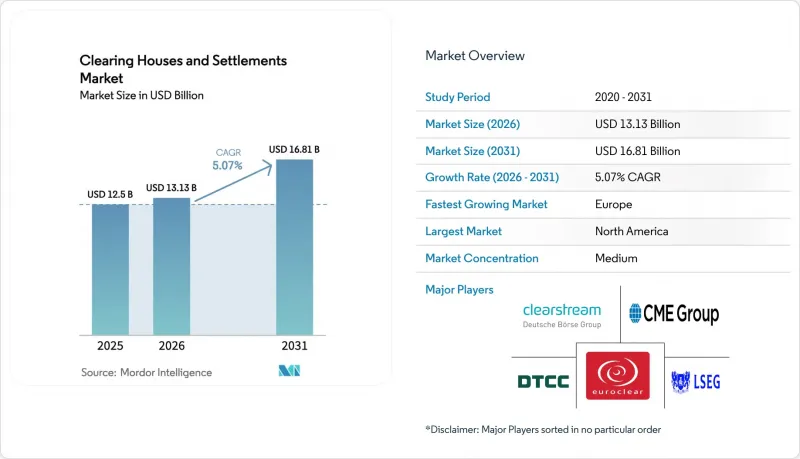
Mordor Intelligence에 의하면, 청산소 및 결제 시장 규모는 2025년 125억 달러로 평가되었고, 2026년에는 131억 3,000만 달러로 추정되고, 2026-2031년 CAGR 5.07%로 성장을 지속할 전망이며, 2031년에는 168억 1,000만 달러에 이를 것으로 예측됩니다.
본 보고서는 유형별(아웃워드 청산소, 인워드 청산소), 서비스별(TARGET2, SEPA, EBICS, 기타 서비스(EURO1, CCBM)), 지역별(북미, 유럽, 아시아태평양, 라틴아메리카, 중동 및 아프리카)로 분류되어 있습니다. 본 보고서에서는 상기 모든 부문에 대해 전 세계 청산소 및 결제 시장 규모 및 전망(금액 기준, 10억 달러)을 제시하고 있습니다.
세계의 청산 기관 및 결제 시장 동향과 인사이트
전 세계 거래 활동의 확대가 청산 인프라 수요를 견인
전자 채널 및 알고리즘 트레이딩로 인해 일일 거래량이 증가하고 있어, 청산 사업자들은 처리 능력 확대를 요구받고 있습니다. 그렇지 않으면 병목 현상이 발생할 우려가 있습니다. TARGET 서비스는 거래량이 201.8% 급증하는 가운데, 2024년에는 16억 6,000만 건 이상의 거래를 처리했습니다. TARGET2-Securities는 2024년에 총액 292조 7,000억 달러(248조 9,000억 유로)에 해당하는 2억 260만 건의 증권 거래를 결제하며, 통합된 국경 간 결제를 위한 중앙 집중형 플랫폼으로의 전환을 뒷받침하고 있습니다. 미국 재무부의 청산 의무화에 따라 2027년 중반까지 하루 최대 4조 달러 규모의 거래가 중앙 청산으로 유도되었으며, 2025년 6월 30일 현재 주요 미국 CCP의 총 증거금은 963억 달러에 달했습니다. 일본증권결제기구는 2024년에 금리 스왑 청산 규모가 사상 최고치를 기록하며, 중앙청산기관으로 집약되는 금리 헤지 거래 흐름이 심화되고 있음을 보여주고 있습니다. 한국의 KRX는 파생상품 거래의 견조한 성장과 2조 달러를 넘는 OTC 청산 잔고를 보고하고 있으며, 이는 전자 거래의 활성화에 따른 처리 능력의 이동을 보여줍니다. FedNow 서비스는 2025년 3분기에 분기당 250만 건, 총액 3,073억 달러 규모의 거래를 보고했으며, 즉시 결제의 확대가 지속되면서 실시간 결제의 진전이 드러나고 있습니다.
중앙 청산에 대한 규제적 중점화가 시스템적 위험을 저감
2023년에 확정된 미국의 규정에 따라 중앙 청산 대상이 현금 국채와 레포 거래까지 확대되었으며, 준수 기한은 2026년 12월 31일과 2027년 6월 30일로 정해졌습니다. 이를 통해 투명성이 향상되고 총액 증거금 관리의 규율이 강화될 것입니다. 2024년 4분기 시점에서 딜러의 레포 거래 중 중앙 청산 대상이 된 비율은 고작 37%에 그치고 있으며, 2조 4,000억 달러에 달하는 양자간 거래가 청산을 통해 해소되어야 할 결제상의 마찰에 여전히 노출되어 있습니다. EMIR REFIT에 따라 보고 항목이 204개로 확대되는 한편,미국 은행의 금리 파생상품에 대해서는 중앙청산 침투율이 2024년 4분기 32.5%에서 2025년 1분기에는 명목금액 기준으로 48.1%로 상승하여, 규제가 표준화에 미치는 영향이 뚜렷이 드러나고 있습니다. 유럽의 CDS 시장은 2023년까지 높은 청산 침투율을 달성했는데, 이는 EMIR의 감독 하에 표준화된 상품이 CCP(중앙청산기관)에 임베디드되는 데 위기 이후 광범위하게 중점을 두어 온 경향과 일치합니다. 인도에서 거래소 연계형 청산을 통한 회사채 결제는 확대되고 있으나, 선진국 시장과 비교하면 여전히 규모가 작아 표준화 및 포스트트레이드 부문에서의 추가 도입 여지가 있음을 보여주고 있습니다. CPMI-IOSCO의 PFMI와 EU의 사이버 위험 프레임워크 간의 수렴은 회복력과 데이터 무결성에 대한 조화로운 기대를 뒷받침하고 있으며, 이는 전 세계 FMI의 운영을 점점 더 이끌어가는 지침이 되고 있습니다.
높은 담보 및 자본 요건이 시장 진입을 제약
미국 정부 증권 청산 기금 요건의 총액은 2025년 6월 30일까지 963억 달러로 증가할 것이며, 그 증가분은 위험 프로파일에 따라 각 회원사에 배분되므로 소규모 기업에게는 진입 장벽이 높아집니다. LME Clear 등에서 규정하고 있는 디폴트 기금에 대한 최소 출자액 및 순자본 기준액은 적격 담보를 제공할 수 있는 충분한 자본력을 갖춘 기관으로만 직접적인 청산 참여를 제한하고 있습니다. 사우디아라비아의 Muqassa를 포함한 지역 CCP의 담보 적격성 및 비율 조정은 유연성을 제공하지만, 소규모 참가자 전반에 걸친 달러 표시 유동성 제약을 완전히 상쇄하지는 못합니다. 미국 국채 청산 일정에 따라 예상되는 대규모 증거금 인상으로 인해 중소 브로커-딜러들은 수익성과 관리권을 훼손하는 스폰서 부착 접근 계약으로 내몰리고 있습니다. 인도 회사채 시장의 장외(OTC) 포지션은 여전히 상당한 규모로 집중 청산 대상에서 제외되어 있어, 이로 인해 양방향 위험과 유동성의 분산이 지속되고 있습니다. 따라서 청산 기관 및 결제 시장에서는 다양한 적격 담보를 보유한 대형 참여자와 제한된 자본 구조를 관리하는 중소기업 간의 격차가 확대되고 있습니다.
부문 분석
아웃워드 청산 기관은 2025년에 67.50%의 점유율을 차지한 것으로 평가되었으며, 총 부채를 축소하고 국경 간 자금 조달 부담을 완화하는 다각적 네팅에 힘입어 2031년까지 연평균 성장률(CAGR) 5.82%로 성장할 것으로 전망됩니다. 아웃워드 플랫폼은 고액 결제 및 도매 거래를 청산하는 동시에, 효율적인 상계를 위해 관할 구역을 초월한 익스포저를 통합하므로, 그 유동성의 이점은 일상 업무에도 파급되고 있습니다. EURO1은 2024년에 4,577만 건, 총액 53조 4,000억 달러(45조 4,000억 유로) 규모의 결제를 처리하고 있으며, TARGET2에서 최종 잔액을 최종적으로 결제하는 보완적인 다자간 네팅 시스템으로서 기능함으로써 참가자의 유동성 프로파일을 최적화하고 있습니다. 미국 재무부의 중앙 청산 의무화에 따라 아웃워드 플랫폼은 2027년까지 하루 4조 달러 규모의 거래를 처리하게 되며, 이를 통해 대규모 네팅과 증거금 효율화가 더욱 제도화될 것입니다.
국내 청산 기관은 국내 결제 및 증권 거래에 중점을 두고 각국 시장 구조에 적합한 리스크 모델을 채택하고 있으며, 이는 담보 요건의 완화 및 보다 간소화된 운영 요건과의 조화를 도모하고 있습니다. 인도의 회사채용 거래소 연계형 청산 시스템은 방대한 거래 건수를 처리하고 있지만, 중앙집권적인 거래소 외 사모 발행이 주류를 이루고 있어 인워드 루트의 보급은 제한적입니다. 홍콩의 CCASS는 2025년 말 시점에서 주식과 펀드의 네팅 비율이 각각 98% 이상, 88% 이상에 달하는 등, 규율 있는 네팅이 국내 환경에서도 유동성을 대폭 완화할 수 있음을 보여주고 있습니다. 해외용 거래소가 AI를 활용한 리스크 분석이나 DLT 시범 운영과 같은 기능을 추가함에 따라, 국내용 모델도 결제 및 담보 프로세스의 연속성을 유지하기 위해 상호 운용 가능한 기준에 점차 적응해 나갈 것입니다. 중앙 집중식 리스크 관리와 일관된 증거금 제도를 장려하는 규제 체계 하에서 해외용 플랫폼은 청산 기관 및 결제 시장에서 국경을 초월한 리스크 집약의 주요 채널로 계속 자리 잡고 있습니다.
지역별 분석
북미는 연방준비제도(FRB)의 광범위한 서비스와 미국 재무부 증권 거래 규모에 힘입어 2025년에 청산 기관 및 결제 시장의 34.65%를 차지했습니다. 전미결제서비스(NSS)는 2024년에 28조 3,000억 달러를 처리했으며, 일일 평균 결제액은 1,126억 달러에 달했습니다. 이는 해당 지역의 대규모 결제 및 순결제 워크플로우 기반을 공고히 하고 있습니다. FedNow는 실시간 처리 기능을 추가하여 2025년 3분기에는 250만 건, 총액 3,073억 달러 규모의 거래를 처리했습니다. 이는 전미 금융 기관들의 신속한 도입이 진행되고 있음을 반영합니다. 2025년 1분기에는 금리 헤지가 원동력이 되어 중앙청산되는 파생상품의 명목 잔고가 증가했으며, 이는 미국 은행들의 CCP 채택 확대를 뒷받침하고 있습니다. SEC의 국채 청산 일정이 구체화됨에 따라, 승인된 CCP와 후보 CCP 간의 경쟁이 격화되고 있으며, 하루 4조 달러 규모의 거래가 중앙 청산으로 전환되고 있습니다. 캐나다와 멕시코의 인프라는 확립된 실시간 및 일괄 처리 시스템(멕시코의 SPEI, 디지털 이용을 촉진하는 부수적인 결제 식별자 등)을 통해 해당 지역의 사업 범위를 확대되고 있습니다.
유럽은 TARGET 서비스 통합, ISO 20022의 조화, 즉시 결제 규제를 배경으로 2031년까지 연평균 성장률(CAGR) 6.65%라는 가장 빠른 성장을 이룰 것입니다. 클리어스트림은 T2S 하에서 높은 결제 효율을 실현하고 있으며, 일일 마감 시 ‘인도 대 결제(DVP)’ 구현이 거의 완료되었습니다. 또한, 자동 담보화를 통해 피크 시간대의 자금 조달 탄력성이 뒷받침되고 있습니다. LCH와 ICE Clear Europe은 ESMA의 관할 하에 Tier 2 CCP로 운영되고 있으며, 이를 통해 해당 지역의 OTC 금리·신용 상장 파생상품 전반에 걸친 감독상의 일관성이 강화되고 있습니다. 프랑스 중앙은행은 중앙은행 간 조정을 통해 국경 간 토큰화 이니셔티브에 참여하고 있으며, 이는 도매 거래의 청산 및 결제에 있어 향후 상호 운용성이 가능할 것임을 시사합니다. 포르투갈의 T2 활동 등 각국의 사례 연구는 통합된 유로시스템 스택 내에서 회원국 전반에 걸쳐 도입이 광범위하게 이루어지고 있음을 뒷받침합니다. DORA가 시행됨에 따라 대규모 사이버 보안 프로그램을 갖춘 기존 사업자들은 규정 준수 및 준비 태세 측면에서 우위를 점하고 있습니다.
아시아태평양에서는 일본의 JSCC에서 스왑 청산이 사상 최고치를 기록한 것부터 한국의 OTC 시장의 급속한 성장, 인도 등 시장의 즉시 결제 강력한 보급에 이르기까지 성숙도에 차이가 보입니다. 홍콩의 CCASS는 T+2 처리 효율 99.89%를 기록한 반면, OTC Clear의 파생상품 거래량은 2025년 상반기에 급증하고 있으며, 이는 주식 및 파생상품 시스템의 강점을 반영하고 있습니다. 인도의 회사채 시장에서는 발행 규모가 확대되고 있음에도 불구하고, 2차 시장의 유동성 문제가 남아 있으며, 이는 여전히 양방향 거래 채널에 대한 의존이 지속되고 있고, 청산 도입의 여지가 있음을 여실히 보여줍니다. 호주에서는 OTC 파생상품과 현물 주식의 청산 규모가 방대하지만, 사고 발생 후 감독이 강화됨에 따라 ASX 시스템 전체에 대한 기대치와 시정 조치가 엄격해지고 있습니다. 싱가포르의 외환 거래량은 하루 1조 5,000억 싱가포르 달러를 초과하며, 지역 유동성을 강화하는 동시에 고도화된 실행 및 리스크 관리 도구를 통한 담보 최적화를 뒷받침하고 있습니다. 남미에서는 브라질의 PIX가 도입을 주도하고 있으며, 월간 수십억 건의 거래와 일반 가정 및 기업의 폭넓은 참여를 통해 무현금화의 진전을 촉진하고 있습니다. 칠레의 RTGS 및 카드 이용 지표는 1인당 결제 이용률이 높아 디지털 결제로의 명확한 전환을 보여주고 있습니다. 아프리카와 중동에서는 GCC와 남아프리카공화국에서 활발한 움직임이 관찰되며, 아랍에미리트의 플랫폼 전환과 남아프리카공화국의 거래량 증가는 견고한 인프라를 입증하고 있습니다.
기타 혜택
- 엑셀 형식 시장 예측(ME) 시트
- 3개월간의 애널리스트 지원
자주 묻는 질문
목차
제1장 서론
제2장 조사 방법
제3장 개요
제4장 시장 구도
제5장 시장 규모 및 성장 예측
제6장 경쟁 구도
제7장 시장 기회 및 향후 전망
AJY 26.09.01According to Mordor Intelligence, the clearing houses and settlements market size is expected to grow from USD 12.5 billion in 2025 to USD 13.13 billion in 2026 and is forecast to reach USD 16.81 billion by 2031 at 5.07% CAGR over 2026-2031.
This report is Segmented by Type (Outward Clearing House, Inward Clearing House), by Service (TARGET2, SEPA, EBICS, Other Services (EURO1, CCBM)), and by Geography (North America, Europe, Asia-Pacific, Latin America, and the Middle East and Africa). The Report Offers Market Size and Forecasts for the Global Clearing Houses and Settlements Market in Value (USD Billion) for all the Above Segments.
Global Clearing Houses And Settlements Market Trends and Insights
Growth in Global Trading Activity Driving Clearing Infrastructure Demand
Electronic channels and algorithmic trading amplify daily volumes, pushing clearing operators to scale capacity or risk bottlenecks, with TARGET Services processing over 1.66 billion transactions in 2024 amid a 201.8% volume surge. TARGET2-Securities settles 202.6 million securities transactions valued at USD 292.7 trillion (EUR 248.9 trillion) in 2024, reinforcing the shift toward centralized platforms for harmonized cross-border settlement. The U.S. Treasury clearing mandate channels up to USD 4 trillion in daily transactions toward central clearing by mid-2027, with aggregate margins at a key U.S. CCP reaching USD 96.3 billion by June 30, 2025. Japan Securities Clearing Corporation sets record interest-rate swap clearing in 2024, signaling the depth of rate hedging flows consolidating at central counterparties. South Korea's KRX reports strong growth in derivatives activity and OTC clearing balances above USD 2 trillion, indicating the capacity shift that comes with electronic trading intensity. The instant payment expansion continues as the FedNow Service reports 2.5 million quarterly transactions worth USD 307.3 billion in Q3 2025, showcasing the real-time settlement trajectory.
Regulatory Emphasis on Central Clearing Reduces Systemic Risk
United States rules finalized in 2023 extend central clearing to cash Treasury and repo transactions with compliance dates on December 31, 2026, and June 30, 2027, which elevates transparency and aggregate margining discipline. Only 37% of dealer repo was centrally cleared as of Q4 2024, leaving USD 2.4 trillion in bilateral activity exposed to settlement frictions that clearing aims to address. EMIR REFIT lifts reporting granularity to 204 fields, while United States bank interest-rate derivatives show higher central clearing penetration at 48.1% notional by Q1 2025 from 32.5% in Q4 2024, underscoring regulatory impact on standardization. European CDS markets reached high clearing penetration by 2023, which aligns with the broader post-crisis emphasis on standardized products entering CCPs under EMIR oversight. India's corporate bond settlement through exchange-linked clearing grows yet remains shallow relative to developed markets, highlighting room for standardization and deeper post-trade adoption. Convergence under CPMI-IOSCO PFMI and the EU's cyber risk frameworks sustains harmonized expectations for resilience and data integrity that increasingly guide global FMI operations.
High Collateral and Capital Requirements Constrain Market Entry
Aggregate clearing fund requirements for United States government securities rise to USD 96.3 billion by June 30, 2025, with increases distributed across members in line with risk profiles, which raises barriers to entry for smaller firms. Minimum default fund contributions and net capital thresholds, such as those at LME Clear, restrict direct clearing participation to well-capitalized institutions that can supply eligible collateral. Adjustments in collateral eligibility and percentages at regional CCPs, including Saudi Arabia's Muqassa, provide flexibility yet do not fully offset USD liquidity constraints across smaller participants. Large projected margin increases related to Treasury clearing timelines push smaller broker-dealers toward sponsored access arrangements that dilute economics and control. OTC positions in India's corporate bond space remain outside centralized clearing in significant size, which sustains bilateral risk and diffusion of liquidity. The clearing houses and settlements market, therefore, sees a widening divide between large participants with diverse eligible collateral and smaller firms managing constrained capital stacks.
Other drivers and restraints analyzed in the detailed report include:
- Advancements in Clearing Technologies Enhance Operational Efficiency
- Increase in Cross-border and Derivatives Trading Requires Interoperable Clearing
- Rising Regulatory and Compliance Complexity Increases Implementation Burdens
For complete list of drivers and restraints, kindly check the Table Of Contents.
Segment Analysis
Outward clearing houses held a 67.50% share in 2025 and are projected to grow at a 5.82% CAGR through 2031, supported by multilateral netting that compresses gross obligations and reduces funding stress across borders. Liquidity benefits carry into day-to-day operations because outward platforms settle large-value payments and wholesale transactions while pooling exposures across jurisdictions for efficient offset. EURO1 settled 45.77 million payments worth USD 53.4 trillion (EUR 45.4 trillion) in 2024 and operates as a complementary multilateral net system that ultimately settles final balances in TARGET2, which optimizes participant liquidity profiles. Mandated U.S. Treasury central clearing positions outward venues to receive USD 4 trillion in daily activity by 2027, which will further institutionalize netting and margin efficiency at scale.
Inward clearing houses focus on domestic payment, and securities flows with risk models suited to national market structures, which aligns with lower collateral needs and simpler operational expectations. India's exchange-linked clearing for corporate bonds processes sizable trade counts, although the dominance of private placements outside centralized venues limits penetration for inward routes. Hong Kong's CCASS shows how disciplined netting can materially relieve liquidity even in domestic environments, with stock and funds netting ratios above 98% and 88%, respectively, in late 2025. As outward venues add features like AI-enhanced risk analytics and DLT pilots, inward models gradually adapt to interoperable standards to maintain continuity of settlement and collateral processes. With regulatory frameworks incentivizing centralized risk and consistent margining, outward platforms remain the primary channel for cross-border risk aggregation within the clearing houses and settlements market.
Complete Report Scope:
- By Type
- Outward Clearing House
- Inward Clearing House
- By Service
- TARGET2
- SEPA
- EBICS
- Other Services
- EURO1
- CCBM
- By Geography
- North America
- United States
- Canada
- Mexico
- South America
- Brazil
- Argentina
- Chile
- Peru
- Rest of South America
- Europe
- United Kingdom
- Germany
- France
- Spain
- Italy
- Benelux (Belgium, Netherlands, and Luxembourg)
- Nordics (Sweden, Norway, Denmark, Finland, and Iceland)
- Rest of Europe
- Asia-Pacific
- China
- India
- Japan
- South Korea
- Australia
- South-East Asia (Singapore, Indonesia, Malaysia, Thailand, Vietnam, and Philippines)
- Rest of Asia-Pacific
- Middle East and Africa
- United Arab Emirates
- Saudi Arabia
- South Africa
- Nigeria
- Rest of Middle East and Africa
- North America
Geography Analysis
North America held 34.65% of the clearing houses and settlements market in 2025, supported by the breadth of Federal Reserve services and the scale of U.S. Treasury transactions. The National Settlement Service processed USD 28.3 trillion in 2024 with average daily settlements of USD 112.6 billion, which reinforces the region's foundation for large-value and net settlement workflows. FedNow adds real-time capability with 2.5 million transactions totaling USD 307.3 billion in Q3 2025, reflecting fast integration by institutions across the country. Centrally cleared derivatives notional rose in Q1 2025, fueled by interest-rate hedging, which supports wider CCP adoption across U.S. banks. The SEC's Treasury clearing timelines intensify competition among approved and prospective CCPs as the pathway for USD 4 trillion in daily activity shifts toward central clearing. Canada's and Mexico's infrastructures extend the region's footprint with established real-time and batch systems, including Mexico's SPEI and adjunct payment identifiers that fuel digital usage.
Europe delivers the fastest growth at a 6.65% CAGR through 2031, underpinned by the convergence of TARGET Services, ISO 20022 harmonization, and the Instant Payments Regulation. Clearstream drives high settlement efficiency under T2S with day-end delivery-versus-payment performance near completion, and auto-collateralization supports resilient funding in peak periods. LCH and ICE Clear Europe operate as Tier 2 CCPs under ESMA, which consolidates supervisory alignment across OTC rate, credit, and listed derivatives in the region. France's central bank participates in cross-border tokenization initiatives under central bank coordination, which points to future interoperability of clearing and settlement for wholesale transactions. National case studies such as Portugal's T2 activity confirm the breadth of adoption across member states in the consolidated Eurosystem stack. As DORA takes effect, incumbents with scaled cyber programs gain an advantage in compliance and readiness.
Asia-Pacific shows heterogeneous maturity, from Japan's record swap clearing at JSCC to rapid OTC growth in South Korea and strong instant-payment penetration in markets like India. Hong Kong's CCASS posts 99.89% T+2 efficiency while OTC Clear's derivative volumes rise sharply in H1 2025, which reflects both equity and derivatives system strength. India's corporate bond market retains liquidity challenges in secondary trading despite expanding issuance, which highlights continued reliance on bilateral channels and room for clearing adoption. Australia clears high volumes in OTC derivatives and cash equities, though post-incident oversight has tightened expectations and remediation across ASX systems. Singapore's FX turnover above SGD 1.5 trillion per day strengthens regional liquidity and supports collateral optimization via advanced execution and risk tools. In South America, Brazil's PIX leads adoption with billions of monthly transactions and broad participation by households and firms, catalyzing cashless growth. Chile's RTGS and card usage metrics show a clear shift toward digital flows with high per-capita payment usage. Africa and the Middle East see strong activity in the GCC and South Africa, with the UAE's platform transitions and South Africa's turnover growth pointing to resilient infrastructures.
- Intact Financial Corporation
- Apex Clearing Corporation
- Bank of America Merrill Lynch
- FOLIOfn, Inc. (Folio Financial Investments)
- Goldman Sachs Execution and Clearing LP
- J.P. Morgan Clearing Corp
- National Financial Services LLC
- Pershing LLC
- RBC Correspondent Services (Royal Bank of Canada)
- StoneX Group Inc.
- Southwest Securities Inc.
- Depository Trust & Clearing Corporation (DTCC)
- LCH Limited (London Stock Exchange Group / LSEG)
- Euroclear Group
- Clearstream (Deutsche Borse Group)
- SIX x-clear & SIX SIS (SIX Group)
- CME Clearing (CME Group)
- ICE Clear (Intercontinental Exchange)
- Outward Clearing House
- BNY Mellon
- Japan Securities Clearing Corporation (JSCC)
Additional Benefits:
- The market estimate (ME) sheet in Excel format
- 3 months of analyst support
TABLE OF CONTENTS
1 Introduction
- 1.1 Study Assumptions & Market Definition
- 1.2 Scope of the Study
2 Research Methodology
3 Executive Summary
4 Market Landscape
- 4.1 Market Drivers
- 4.1.1 Growth in global trading activity, with rising electronic and high-volume transactions increasing demand for efficient clearing and settlement infrastructure
- 4.1.2 Regulatory emphasis on central clearing, driven by post-financial-crisis reforms aimed at reducing systemic risk and enhancing market transparency
- 4.1.3 Advancements in clearing technologies, including AI, blockchain, and automation, improving processing speed, accuracy, and operational efficiency
- 4.1.4 Increase in cross-border and derivatives trading, requiring interoperable, resilient clearing systems across jurisdictions
- 4.1.5 Heightened focus on counterparty risk management, as market volatility accelerates adoption of centralized clearing mechanisms
- 4.1.6 Expansion of electronic and high-frequency trading platforms, driving the need for scalable, high-capacity settlement solutions
- 4.2 Market Restraints
- 4.2.1 High collateral and capital requirements, raising operational costs and limiting participation by smaller market players
- 4.2.2 Rising regulatory and compliance complexity, with evolving global standards increasing implementation and monitoring burdens
- 4.2.3 Escalating cybersecurity risks, necessitating continuous investment in secure infrastructure for high-value transaction systems
- 4.2.4 Dependence on legacy clearing infrastructure, constraining scalability and slowing integration with next-generation technologies
- 4.3 Value / Supply-Chain Analysis
- 4.4 Regulatory or Technological Outlook
- 4.5 Porter's Five Forces Analysis
- 4.5.1 Threat of New Entrants
- 4.5.2 Bargaining Power of Buyers
- 4.5.3 Bargaining Power of Suppliers
- 4.5.4 Threat of Substitutes
- 4.5.5 Competitive Rivalry
5 Market Size & Growth Forecasts (Value)
- 5.1 By Type
- 5.1.1 Outward Clearing House
- 5.1.2 Inward Clearing House
- 5.2 By Service
- 5.2.1 TARGET2
- 5.2.2 SEPA
- 5.2.3 EBICS
- 5.2.4 Other Services
- 5.2.4.1 EURO1
- 5.2.4.2 CCBM
- 5.3 By Geography
- 5.3.1 North America
- 5.3.1.1 United States
- 5.3.1.2 Canada
- 5.3.1.3 Mexico
- 5.3.2 South America
- 5.3.2.1 Brazil
- 5.3.2.2 Argentina
- 5.3.2.3 Chile
- 5.3.2.4 Peru
- 5.3.2.5 Rest of South America
- 5.3.3 Europe
- 5.3.3.1 United Kingdom
- 5.3.3.2 Germany
- 5.3.3.3 France
- 5.3.3.4 Spain
- 5.3.3.5 Italy
- 5.3.3.6 Benelux (Belgium, Netherlands, and Luxembourg)
- 5.3.3.7 Nordics (Sweden, Norway, Denmark, Finland, and Iceland)
- 5.3.3.8 Rest of Europe
- 5.3.4 Asia-Pacific
- 5.3.4.1 China
- 5.3.4.2 India
- 5.3.4.3 Japan
- 5.3.4.4 South Korea
- 5.3.4.5 Australia
- 5.3.4.6 South-East Asia (Singapore, Indonesia, Malaysia, Thailand, Vietnam, and Philippines)
- 5.3.4.7 Rest of Asia-Pacific
- 5.3.5 Middle East and Africa
- 5.3.5.1 United Arab Emirates
- 5.3.5.2 Saudi Arabia
- 5.3.5.3 South Africa
- 5.3.5.4 Nigeria
- 5.3.5.5 Rest of Middle East and Africa
- 5.3.1 North America
6 Competitive Landscape
- 6.1 Market Concentration
- 6.2 Strategic Moves
- 6.3 Market Share Analysis
- 6.4 Company Profiles {(includes Global level Overview, Market level overview, Core Segments, Financials as available, Strategic Information, Market Rank/Share for key companies, Products & Services, and Recent Developments)}
- 6.4.1 Intact Financial Corporation
- 6.4.2 Apex Clearing Corporation
- 6.4.3 Bank of America Merrill Lynch
- 6.4.4 FOLIOfn, Inc. (Folio Financial Investments)
- 6.4.5 Goldman Sachs Execution and Clearing LP
- 6.4.6 J.P. Morgan Clearing Corp
- 6.4.7 National Financial Services LLC
- 6.4.8 Pershing LLC
- 6.4.9 RBC Correspondent Services (Royal Bank of Canada)
- 6.4.10 StoneX Group Inc.
- 6.4.11 Southwest Securities Inc.
- 6.4.12 Depository Trust & Clearing Corporation (DTCC)
- 6.4.13 LCH Limited (London Stock Exchange Group / LSEG)
- 6.4.14 Euroclear Group
- 6.4.15 Clearstream (Deutsche Borse Group)
- 6.4.16 SIX x-clear & SIX SIS (SIX Group)
- 6.4.17 CME Clearing (CME Group)
- 6.4.18 ICE Clear (Intercontinental Exchange)
- 6.4.19 Outward Clearing House
- 6.4.20 BNY Mellon
- 6.4.21 Japan Securities Clearing Corporation (JSCC)
7 Market Opportunities & Future Outlook
- 7.1 Expansion of central clearing across new asset classes
- 7.2 Technology-led efficiency and value-added services


