

|
시장보고서
상품코드
2099197
음악 제작 및 녹음 시장 : 점유율 분석, 업계 동향 및 통계, 성장 예측(2026-2031년)Music Production and Recording - Market Share Analysis, Industry Trends & Statistics, Growth Forecasts (2026 - 2031) |
||||||
 Mordor Intelligence
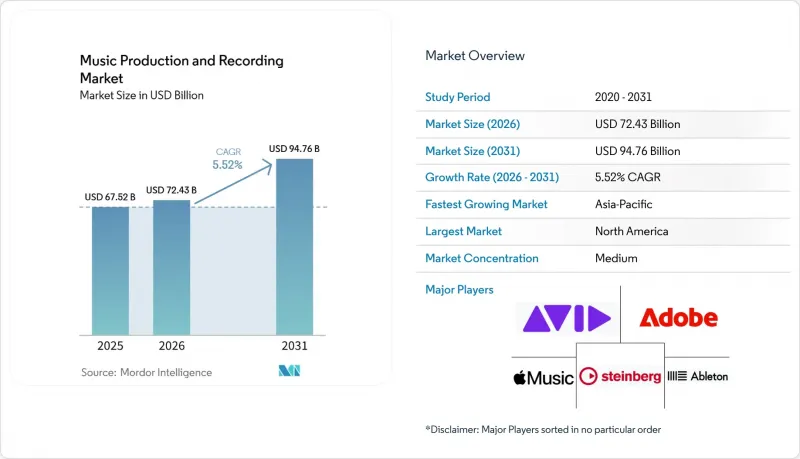
에 의하면, 음악 제작 및 녹음 시장 규모는 2025년 675억 2,000만 달러, 2026년 724억 3,000만 달러에서 2031년까지 947억 6,000만 달러로 확대한다고 예측되고 있어 2026년부터 2031년까지 연평균 복합 성장률(CAGR)은 5.52%를 나타낼 전망입니다.
본 보고서는 제작 단계(프리프로덕션 및 크리에이티브 개발, 오디오 녹음 및 트래킹 등), 용도(상업용 음악 제작, 게임용 오디오 컨텐츠 등), 포맷(디지털 녹음, 물리적 매체 등), 최종 사용자(개인 소비자, 기업 및 전문가 사용자), 그리고 지역별로 분류되어 있습니다. 시장 전망은 금액(달러) 기준으로 제시됩니다.
세계 음악 제작 및 녹음 시장 동향과 인사이트
AI를 활용한 작곡, 편집, 믹싱이 제작의 주요 워크플로우를 혁신하고 있습니다
현재 AI 도구는 음악 제작 및 녹음 시장 전반에 걸쳐 작곡, 편집, 믹싱, 그리고 최종 납품에 영향을 미치고 있습니다. 이러한 변화가 중요한 이유는 과거에는 더 깊은 기술적 경험과 더 많은 스튜디오 시간이 필요했던 작업에서 수작업의 부담을 줄여주기 때문입니다. Avid사는 2026년 5월, Pro Tools 2026.4에서 프라운호퍼 IIS와의 제휴를 통해 네이티브 MPEG-H 지원과 Dolby Atmos 헤드폰 개인화 기능을 추가하며 이러한 방향성을 반영했습니다. 이는 고급 워크플로우 기능이 전문가용 도구의 주류가 되어가고 있음을 보여줍니다. Apple 역시 같은 길을 걷고 있으며, 2026년 1월 ‘Apple Creator Studio’ 내에서 『Logic Pro 12』를 출시했습니다. AI를 활용한 ‘Chord ID’ 및 ‘Synth Player Session’ 도구를 탑재함으로써, 전문가 수준의 깊이를 해치지 않으면서도 초보자와 중급 수준의 크리에이터에게 접근성을 확대했습니다. 따라서 음악 제작 및 녹음 시장에서는 AI가 단순한 선택적 기능 강화에서 제작 스택에 통합된 기반으로 전환되고 있습니다.
부상하는 인디 크리에이터 경제가 툴 체인 전반에 걸친 수요를 확대되고 있습니다.
독립적으로 음원을 발매하는 아티스트의 부상으로 인해 음악 제작 및 녹음 시장 전반에서 수요가 확대되고 있으며, 특히 합리적인 가격으로 전문가 수준의 결과물을 만들어낼 수 있는 도구에 대한 수요가 높아지고 있습니다. Spotify는 『Loud and Clear 2026』 보고서에서 2025년에 음악 업계에 110억 달러 이상을 지급했으며, 1만 3,800명 이상의 아티스트가 Spotify를 통해 연간 최소 10만 달러의 수입을 올렸다고 밝혔는데, 이는 인디 아티스트의 커리어가 실질적인 경제 규모를 확보해 가고 있음을 보여줍니다. 이러한 수익 패턴에 따라 단순한 저비용 초보자용 제품뿐만 아니라 소프트웨어, 인터페이스, 모니터, 협업 도구에 대한 지출도 증가하고 있습니다. 또한 취미로서의 창작과 지속적인 상업 활동 간의 경계가 모호해지면서, 워크플로우의 여러 단계에 걸쳐 수요가 증가하고 있습니다. 더 많은 사용자가 제작비를 일회성 개인 지출이 아닌, 수익을 창출하는 과정의 일부로 인식하게 되면서 음악 제작 및 녹음 시장이 그 혜택을 누리고 있습니다.
AI 컨텐츠 권리에 대한 불확실성이 기업 내 도입을 지연시키고 있다.
AI 생성 및 AI 학습을 통한 음악 도구에 대한 저작권 불확실성은 음악 제작 및 녹음 시장에 명백한 걸림돌이 되고 있습니다. 미국 저작권청은 생성형 AI 학습에 관한 2025년 파트 3 보고서에서 라이선싱 시장의 발전을 용인해야 한다고 밝히면서도, 자발적인 라이선싱이 항상 실현 가능한 것은 아니라는 점에도 언급하고 있어, 그 결과 상업용 사용자들은 향후 진행 방향에 대한 명확한 지침을 얻지 못한 상황입니다. 이러한 불확실성은 일반 사용자보다 방송사, 라이선서, 에이전시, 대형 스튜디오에 더 큰 영향을 미치고 있습니다. 기업 구매 담당자들은 법적 위험이나 평판 위험에 더 크게 노출되어 있기 때문입니다. 그 결과, 생산성 향상이 명백하더라도 일부 고부가가치 고객은 조달 시 더 신중한 태도를 보일 가능성이 있습니다. 따라서 음악 제작 및 녹음 시장에서는 일반적으로 계정당 평균 수익이 높은 사용자층에서 AI 도입 속도가 단기적으로는 제한될 것입니다.
부문 분석
2025년, 오디오 녹음 및 트래킹은 31.11%의 점유율을 차지하며, 음악 제작 및 녹음 시장에서 여전히 가장 큰 제작 단계로서의 지위를 유지했습니다. 이는 하류에 있는 모든 프로세스가 녹음 품질과 안정적인 DAW 세션의 기반에 계속 의존하고 있기 때문입니다. 더 많은 크리에이터들이 대형 상업 스튜디오를 떠나는 추세 속에서도, 이 단계는 마이크, 인터페이스, 프리앰프 및 주요 녹음 소프트웨어에 대한 수요로부터 계속해서 혜택을 받고 있습니다. 프리프로덕션 및 크리에이티브 개발은 수익 면에서는 여전히 소규모이지만, 초기 단계의 아이디어 창출이 더욱 신속하고 반복적으로 이루어지고 있어 그 중요성이 높아지고 있습니다. 이러한 변화로 인해 사용자가 편곡 스케치나 화음 실험을 하고, 스튜디오 세팅 시간을 늘리지 않으면서도 아이디어에서 세션으로 신속하게 전환할 수 있는 도구가 주목받고 있습니다.
오디오 믹싱 및 사운드 처리는 2031년까지 연평균 성장률(CAGR) 11.32%를 나타낼 것으로 예측되며, 음악 제작 및 녹음 시장의 제작 단계에서 가장 빠른 확장이 예상됩니다. Avid는 2026년 5월, Pro Tools 2026.4 출시와 프라운호퍼 IIS와 공동 개발한 네이티브 MPEG-H 통합을 통해 이 워크플로우 분야를 강화하고, 몰입형 및 오브젝트 기반 스트리밍에 대한 지원을 향상시켰습니다. 이러한 높은 성장률은 믹싱이 현재 자동화, 몰입형 스트리밍, 소프트웨어 주도형 기능 강화가 가장 직접적으로 융합되고 있는 분야임을 반영합니다. 또한 AI 지원 도구를 통해 레벨 조정, 공간 배치, 보정 처리 등의 작업에 기존에 필요했던 시간과 기술이 절감됨에 따라, 음악 제작 및 녹음 업계에서 이 단계가 더 폭넓은 사용자층을 포용하고 있음을 알 수 있습니다.
2025년 음악 제작 및 녹음 시장 규모 중 상업 음악 제작이 51.73%를 차지하고 있어, 여전히 가장 큰 수요원은 직접적인 음악 발매, 카탈로그 개발 및 지속적인 상업 제작을 수행하는 사용자들임을 알 수 있습니다. 이 부문에서는 신뢰성과 납품 품질이 여전히 필수적이기 때문에 모든 기능을 갖춘 소프트웨어, 플러그인 제품군, 모니터링 시스템 및 인터페이스 업그레이드에 대한 지출이 계속될 것으로 예측됩니다. 영화 및 TV 사운드트랙, 광고 및 브랜드 오디오도 수요를 뒷받침하고 있습니다. 이 모든 분야는 관리된 워크플로우, 수정 능력, 일관된 포스트 프로덕션 기준에 의존하고 있기 때문입니다. 기타에도 팟캐스트, 스포츠 오디오, 음악 워크플로우와 점점 더 중첩되고 있는 라이브 관련 제작 업무 등이 폭넓은 기반에 유의미한 규모를 더하고 있습니다.
게임용 오디오 컨텐츠는 2031년까지 연평균 성장률(CAGR) 11.63%를 나타낼 것으로 예측되며, 음악 제작 및 녹음 시장에서 가장 빠르게 성장하는 용도가 될 전망입니다. 이러한 성장은 몰입형 사운드 디자인과 어댑티브 오디오에 대한 수요 증가, 그리고 인터랙티브 미디어 분야의 제작 예산 확대를 반영한 것입니다. 2025년 Logic Pro 업데이트를 통해 현대 컨텐츠 형식 전반에 걸쳐 보다 유연한 비트 제작 및 편집 이용 사례를 지원하는 제작 기능이 확장되었으며, Apple은 워크플로우 간의 상호 연관성을 더욱 강화했습니다. 그 결과, 음악 제작 및 녹음 업계에서 게임 관련 워크플로가 고급 편집, 믹싱, 배포 기능을 위한 더 중요한 견인 요인으로 부상하고 있습니다. 이에 따라 기존의 음악 발매 업무와 인터랙티브 오디오 제작을 모두 단일 환경 내에서 제공할 수 있는 공급업체에게 시장 기회가 창출되고 있습니다.
지역별 분석
2025년, 북미는 35.64%의 점유율을 차지하며 음악 제작 및 녹음 시장에서 가장 규모가 큰 지역 블록이 되었습니다. 이 지역은 대형 음반사, 소프트웨어 개발사, 포스트 프로덕션 시설, 그리고 고품질 스튜디오 하드웨어 생태계가 밀접하게 융합되어 있다는 강점을 가지고 있습니다. 또한, Apple, Avid, Universal Audio 등 북미에서 강력한 입지를 보이는 기업들에 의해 전 세계적인 워크플로우 표준이 다수 제정되고 있다는 점에서도 그 중요성은 변함이 없습니다. AI 주도형 업그레이드, 구독형 액세스, 크리에이터의 수익화가 전문가 및 프로슈머 사용자 전체 수요를 지속적으로 견인함에 따라, 이 지역은 예측 기간 동안 주도적인 위치를 유지할 것으로 전망됩니다.
2025년에도 유럽은 음악 제작 및 녹음 시장의 핵심 지역으로 자리매김했습니다. 이는 성숙한 인프라 기반과 일렉트로닉 음악, 방송 제작, 스튜디오용 소프트웨어에 대한 강력한 전문적 수요가 결합된 결과입니다. 이 지역은 영국, 독일, 북유럽 국가들에 확립된 제작 거점의 혜택을 받고 있으며, 이들 지역에서는 소프트웨어 및 하드웨어 도입이 구조적으로 견조한 추세를 보이고 있습니다. 또한, 제품 개발 및 표준화에 초점을 맞춘 워크플로우 혁신이 유럽에서 계속해서 두드러진 존재감을 보이고 있다는 점도 중요합니다. AI 훈련을 둘러싼 논의에서 미국 저작권청이 라이선싱의 실현 가능성에 대해 검토하고 있다는 사실은 유럽을 포함한 선진 시장의 상업용 사용자에게 서비스를 제공하는 벤더에게 규제 명확성이 여전히 중요한 이유를 보여줍니다. 그 결과, 유럽에서는 안정적인 수요가 예상되는 반면, 일부 신흥 지역에 비해 규정 준수, 권리 관리, 플랫폼 투명성이 더욱 중시되고 있습니다.
아시아태평양은 2031년까지 연평균 성장률(CAGR) 10.41%를 나타낼 것으로 예측되며, 음악 제작 및 녹음 시장에서 가장 빠르게 성장하는 지역이 될 전망입니다. 이러한 성장은 K-POP의 대규모 제작 모델, 인도 및 동남아시아의 인디 아티스트층 확대, 그리고 일본의 물리적 매체와 디지털 수요의 지속적인 공존에 힘입고 있습니다. 일본 레코드 협회에 따르면, 2025년 일본의 연간 레코드 시장 규모는 3,988억 엔에 달할 것으로 예상되며, 이는 약 26억 6,000만 달러에 해당합니다. 한편, 스트리밍 구독 매출은 1377억 엔으로 증가할 전망이며, 이는 약 9억 1,900만 달러에 해당합니다. 이러한 조합은 해당 지역이 단일 발매 모델에 의존하지 않고 상업적으로 다양한 상태를 유지하고 있는 이유를 보여줍니다. 남미, 중동 및 아프리카에서는 인프라 구축 속도보다 크리에이터 채용이 빠르게 진행되고 있어 음악 제작 및 녹음 시장에 새로운 측면이 더해지고 있습니다. 이에 따라 합리적인 가격의 도구, 경량화된 클라우드 워크플로우, 그리고 더 나은 수익 창출 경로에 대한 수요가 높아지고 있습니다.
기타 혜택:
- 엑셀 형식 시장 예측(ME) 시트
- 3개월간의 애널리스트 지원
자주 묻는 질문
목차
제1장 서론
제2장 조사 방법
제3장 주요 요약
제4장 시장 구도
제5장 시장 규모와 성장 예측
제6장 경쟁 구도
제7장 시장 기회와 향후 전망
JHS 26.08.07According to Mordor Intelligence, the music production and Recording market size is projected to expand from USD 67.52 billion in 2025 and USD 72.43 billion in 2026 to USD 94.76 billion by 2031, registering a CAGR of 5.52% between 2026 to 2031.
This report is Segmented by Production Stage (Pre-Production and Creative Development, Audio Recording and Tracking, and More), Application (Commercial Music Production, Gaming Audio Content, and More), Formats (Digital Recording, Physical, and More), End User (Individual Consumers, and Enterprises and Professional Users), and Geography. The Market Forecasts are Provided in Terms of Value (USD).
Global Music Production and Recording Market Trends and Insights
AI-Assisted Composition, Editing, and Mixing is Reshaping Core Production Workflows
AI tools are now influencing composition, editing, mixing, and final delivery across the music production and recording market. This shift matters because it reduces manual effort in tasks that once required deeper technical experience and more studio time. Avid reflected this direction in May 2026 when Pro Tools 2026.4 added native MPEG-H support and Dolby Atmos Headphone Personalization in partnership with Fraunhofer IIS, which shows that advanced workflow features are moving into mainstream professional tools. Apple followed the same path when it launched Logic Pro 12 inside Apple Creator Studio in January 2026 with AI-powered Chord ID and the Synth Player Session tool, which widened access for entry and mid-tier creators without removing professional depth. The music production and recording market is, therefore, seeing AI move from an optional enhancement to a built-in layer of the production stack.
Rising Independent Creator Economy is Expanding Demand Across The Full Tool Chain
The rise of self-releasing artists is broadening demand across the music production and recording market, especially for affordable tools that still deliver professional output. Spotify stated in its Loud and Clear 2026 report that it paid the music industry more than USD 11 billion in 2025, and more than 13,800 artists each earned at least USD 100,000 annually from Spotify alone, which shows that independent careers are gaining real economic scale. That income pattern supports stronger spending on software, interfaces, monitors, and collaboration tools rather than only low-cost entry products. It also narrows the line between hobbyist creation and sustained commercial activity, which lifts demand across multiple workflow stages. The music production and recording market benefits because a larger share of users now sees production spending as part of an income-generating path rather than a one-time personal expense.
AI Content Rights Uncertainty is Slowing Enterprise Adoption
Copyright uncertainty around AI-generated and AI-trained music tools is acting as a clear brake on the music production and recording market. The US Copyright Office stated in its 2025 Part 3 report on generative AI training that licensing markets should be allowed to develop, while also noting that voluntary licensing is not always feasible, which leaves commercial users with limited clarity on how to proceed. That uncertainty affects broadcasters, licensors, agencies, and larger studios more than casual users because enterprise buyers face heavier legal and reputational exposure. As a result, some high-value customers are likely to move more carefully on procurement even when the productivity upside is clear. The music production and recording market therefore faces a near-term limit on AI adoption speed in the part of the user base that usually supports higher average revenue per account.
Other drivers and restraints analyzed in the detailed report include:
- Subscription-Based Music Creation Tools are Lowering The Professional Access Barrier
- Remote Collaboration Across Distributed Production Teams is Creating Lasting Infrastructure Demand
- Piracy and Unlicensed Software Use Continue to Limit Revenue Capture
For complete list of drivers and restraints, kindly check the Table Of Contents.
Segment Analysis
Audio recording and tracking held 31.11% share in 2025, which kept it as the largest production stage in the music production and recording market because every downstream process still depends on capture quality and stable DAW session foundations. This stage continues to benefit from demand for microphones, interfaces, preamps, and core recording software, even as more creators shift away from large commercial studios. Pre-production and creative development remain smaller in revenue terms, but they are gaining importance because early-stage idea creation is becoming faster and more iterative. That shift supports tools that help users sketch arrangements, test harmonies, and move quickly from idea to session without extending studio setup time.
Audio mixing and sound processing is projected to grow at an 11.32% CAGR through 2031, giving it the fastest expansion within the production stage view of the music production and recording market. Avid strengthened this part of the workflow in May 2026 with Pro Tools 2026.4 and native MPEG-H integration developed with Fraunhofer IIS, which improved support for immersive and object-based delivery. The faster growth rate reflects how mixing is now where automation, immersive delivery, and software-driven enhancement are converging most directly. The music production and recording industry is also seeing this stage pull in a wider user base, because AI-assisted tools reduce the time and skill once needed for tasks such as leveling, spatial placement, and corrective processing.
Commercial music production accounted for 51.73% of the music production and recording market size in 2025, which shows that the largest demand pool still comes from users producing for direct music release, catalog development, and recurring commercial output. This segment continues to absorb spending on full-featured software, plugin suites, monitoring systems, and interface upgrades because reliability and delivery quality remain essential. Film and television soundtracks and advertising and brand audio also support demand, since both rely on controlled workflows, revision capacity, and consistent post-production standards. Other applications add useful volume to the broader base, including podcasting, sports audio, and live-related production tasks that increasingly overlap with music workflows.
Gaming audio content is projected to grow at an 11.63% CAGR through 2031, making it the fastest-growing application in the music production and recording market. That rise reflects stronger demand for immersive sound design, adaptive audio, and higher production budgets in interactive media. Apple reinforced cross-workflow relevance when Logic Pro updates in 2025 expanded production capabilities that support more flexible beat making and editing use cases across modern content formats. The music production and recording industry is therefore seeing game-related workflows become a more important pull factor for advanced editing, mixing, and delivery features. This creates room for vendors that can serve both traditional music release work and interactive audio creation inside one environment.
Complete Report Scope:
- By Production Stage
- Pre-Production and Creative Development
- Audio Recording and Tracking
- Audio Mixing and Sound Processing
- Audio Mastering and Editing
- Post-Production Support
- By Application
- Commercial Music Production
- Film and Television Soundtracks
- Advertising and Brand Audio
- Gaming Audio Content
- Other Applications
- By Formats
- Digital Recordings
- Physical Recordings
- Hybrid Releases
- Special Edition and Collector Formats
- Other Formats
- By End User
- Individual Consumers
- Enterprises and Professional Users
- By Geography
- North America
- United States
- Canada
- Mexico
- South America
- Brazil
- Argentina
- Chile
- Rest of South America
- Europe
- Germany
- United Kingdom
- France
- Italy
- Spain
- Rest of Europe
- Asia-Pacific
- China
- Japan
- India
- South Korea
- Australia
- Rest of Asia-Pacific
- Middle East
- Saudi Arabia
- United Arab Emirates
- Qatar
- Rest of Middle East
- Africa
- South Africa
- Egypt
- Nigeria
- Rest of Africa
- North America
Geography Analysis
North America held 35.64% share in 2025, which made it the largest regional block in the music production and recording market. The region benefits from a dense mix of major labels, software developers, post-production facilities, and premium studio hardware ecosystems. It also remains important because many global workflow standards are set by companies with a strong North American presence, including Apple, Avid, and Universal Audio. The region is likely to keep its leadership position through the forecast period as AI-led upgrades, subscription-based access, and creator monetization continue to reinforce demand across professional and prosumer users.
Europe remained a core region within the music production and recording market in 2025 because it combines a mature infrastructure base with strong specialized demand in electronic music, broadcast production, and studio software. The region benefits from established production centers in the United Kingdom, Germany, and the Nordic countries, where software and hardware adoption has stayed structurally strong. Europe also matters because product development and standards-focused workflow innovation continue to have a visible presence there. The US Copyright Office discussion on licensing feasibility in the AI training debate shows why regulatory clarity remains important for vendors serving commercial users across advanced markets, including Europe. As a result, Europe supports stable demand, but it also places more weight on compliance, rights management, and platform transparency than some emerging regions do.
Asia-Pacific is projected to grow at a 10.41% CAGR through 2031, making it the fastest-growing region in the music production and recording market. This growth is supported by K-pop's scaled production model, a wider independent artist base in India and Southeast Asia, and the continued coexistence of physical and digital demand in Japan. The Recording Industry Association of Japan reported that Japan's full-year record market reached JPY 398.8 billion in 2025, which the input converted to approximately USD 2.66 billion, while streaming subscriptions rose to JPY 137.7 billion, which the input converted to approximately USD 919 million. That combination shows why the region remains commercially varied rather than dependent on one release model. South America and the Middle East and Africa add a different layer to the music production and recording market because creator adoption is rising faster than infrastructure depth, which increases demand for affordable tools, lighter cloud workflows, and better monetization pathways.
- Avid Technology, Inc.
- Adobe Inc.
- Apple Inc.
- Ableton AG
- Steinberg Media Technologies GmbH
- Native Instruments GmbH
- PreSonus Audio Electronics, Inc.
- Focusrite plc
- Yamaha Corporation
- Roland Corporation
- Shure Incorporated
- Sennheiser electronic GmbH & Co. KG
- Universal Audio, Inc.
- Waves Audio Ltd.
- IK Multimedia Production Srl
- BandLab Technologies Pte. Ltd.
- Splice, Inc.
- LANDR Audio Inc.
- FL Studio, a product of Image-Line Software
- Sony Corporation
- Samsung Electronics Co., Ltd.
Additional Benefits:
- The market estimate (ME) sheet in Excel format
- 3 months of analyst support
TABLE OF CONTENTS
1 INTRODUCTION
- 1.1 Study Assumptions and Market Definition
- 1.2 Scope of the Study
2 RESEARCH METHODOLOGY
3 EXECUTIVE SUMMARY
4 MARKET LANDSCAPE
- 4.1 Market Overview
- 4.2 Market Drivers
- 4.2.1 Rising Independent Creator Economy and Self-Production Workflows
- 4.2.2 Subscription-Based Music Creation Tool Adoption
- 4.2.3 AI-Assisted Composition, Editing, and Mixing Workflows
- 4.2.4 Remote Collaboration Across Distributed Production Teams
- 4.2.5 Spatial Audio and Immersive Music Delivery Requirements
- 4.2.6 Creator Monetization Through Short-Form Video, Gaming, and Podcast Supply Chains
- 4.3 Market Restraints
- 4.3.1 Piracy and Unlicensed Software Use Pressure Monetization
- 4.3.2 Fragmented Toolchains Increase Switching and Training Costs
- 4.3.3 Professional Studio Capex Remains High for Small Producers
- 4.3.4 AI Content Rights Uncertainty Slows Enterprise Adoption
- 4.4 Industry Value Chain Analysis
- 4.5 Impact of Macroeconomic Factors on the Market
- 4.6 Regulatory Landscape
- 4.7 Technological Outlook
- 4.8 Porter's Five Forces Analysis
- 4.8.1 Bargaining Power of Suppliers
- 4.8.2 Bargaining Power of Buyers
- 4.8.3 Threat of New Entrants
- 4.8.4 Threat of Substitutes
- 4.8.5 Competitive Rivalry
5 MARKET SIZE AND GROWTH FORECASTS (VALUE)
- 5.1 By Production Stage
- 5.1.1 Pre-Production and Creative Development
- 5.1.2 Audio Recording and Tracking
- 5.1.3 Audio Mixing and Sound Processing
- 5.1.4 Audio Mastering and Editing
- 5.1.5 Post-Production Support
- 5.2 By Application
- 5.2.1 Commercial Music Production
- 5.2.2 Film and Television Soundtracks
- 5.2.3 Advertising and Brand Audio
- 5.2.4 Gaming Audio Content
- 5.2.5 Other Applications
- 5.3 By Formats
- 5.3.1 Digital Recordings
- 5.3.2 Physical Recordings
- 5.3.3 Hybrid Releases
- 5.3.4 Special Edition and Collector Formats
- 5.3.5 Other Formats
- 5.4 By End User
- 5.4.1 Individual Consumers
- 5.4.2 Enterprises and Professional Users
- 5.5 By Geography
- 5.5.1 North America
- 5.5.1.1 United States
- 5.5.1.2 Canada
- 5.5.1.3 Mexico
- 5.5.2 South America
- 5.5.2.1 Brazil
- 5.5.2.2 Argentina
- 5.5.2.3 Chile
- 5.5.2.4 Rest of South America
- 5.5.3 Europe
- 5.5.3.1 Germany
- 5.5.3.2 United Kingdom
- 5.5.3.3 France
- 5.5.3.4 Italy
- 5.5.3.5 Spain
- 5.5.3.6 Rest of Europe
- 5.5.4 Asia-Pacific
- 5.5.4.1 China
- 5.5.4.2 Japan
- 5.5.4.3 India
- 5.5.4.4 South Korea
- 5.5.4.5 Australia
- 5.5.4.6 Rest of Asia-Pacific
- 5.5.5 Middle East
- 5.5.5.1 Saudi Arabia
- 5.5.5.2 United Arab Emirates
- 5.5.5.3 Qatar
- 5.5.5.4 Rest of Middle East
- 5.5.6 Africa
- 5.5.6.1 South Africa
- 5.5.6.2 Egypt
- 5.5.6.3 Nigeria
- 5.5.6.4 Rest of Africa
- 5.5.1 North America
6 COMPETITIVE LANDSCAPE
- 6.1 Market Concentration
- 6.2 Strategic Moves
- 6.3 Vendor Positioning Analysis
- 6.4 Company Profiles (includes Global Level Overview, Market Level Overview, Core Segments, Financials as available, Strategic Information, Products and Services, Recent Developments)
- 6.4.1 Avid Technology, Inc.
- 6.4.2 Adobe Inc.
- 6.4.3 Apple Inc.
- 6.4.4 Ableton AG
- 6.4.5 Steinberg Media Technologies GmbH
- 6.4.6 Native Instruments GmbH
- 6.4.7 PreSonus Audio Electronics, Inc.
- 6.4.8 Focusrite plc
- 6.4.9 Yamaha Corporation
- 6.4.10 Roland Corporation
- 6.4.11 Shure Incorporated
- 6.4.12 Sennheiser electronic GmbH & Co. KG
- 6.4.13 Universal Audio, Inc.
- 6.4.14 Waves Audio Ltd.
- 6.4.15 IK Multimedia Production Srl
- 6.4.16 BandLab Technologies Pte. Ltd.
- 6.4.17 Splice, Inc.
- 6.4.18 LANDR Audio Inc.
- 6.4.19 FL Studio, a product of Image-Line Software
- 6.4.20 Sony Corporation
- 6.4.21 Samsung Electronics Co., Ltd.
7 MARKET OPPORTUNITIES AND FUTURE OUTLOOK
- 7.1 White-Space and Unmet-Need Assessment


