

|
시장보고서
상품코드
2099258
음악 라이선싱 시장 : 점유율 분석, 업계 동향 및 통계, 성장 예측(2026-2031년)Music Licensing - Market Share Analysis, Industry Trends & Statistics, Growth Forecasts (2026 - 2031) |
||||||
 Mordor Intelligence
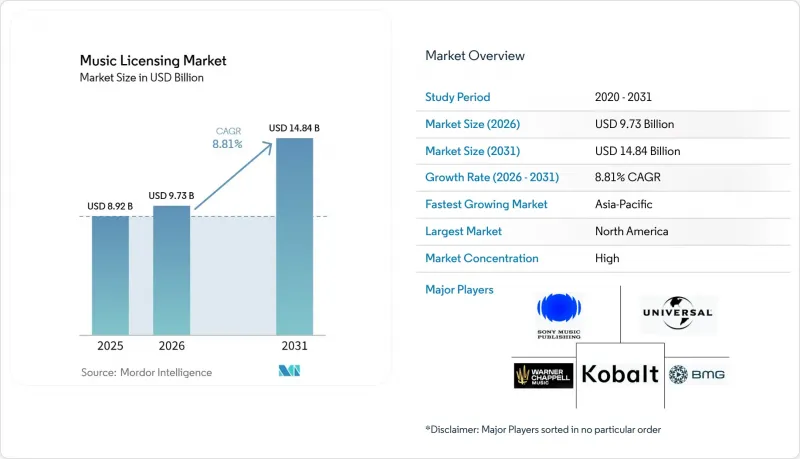
에 의하면, 음악 라이선싱 시장 규모는 2025년 89억 2,000만 달러, 2026년 97억 3,000만 달러에서 2031년까지 148억 4,000만 달러로 확대한다고 예측되고 있어 2026년부터 2031년까지 연평균 복합 성장률(CAGR)은 8.81%를 나타낼 전망입니다.
본 보고서는 권리 유형(연주권, 기계 복제권, 동기화권, 악보, 기타), 이용 플랫폼(오디오 스트리밍, 동영상 스트리밍, 소셜 미디어 플랫폼, 라이브 이벤트, 비디오 게임, 기타), 최종 사용자(컨텐츠 크리에이터 및 디지털 미디어 플레이어, 영화·TV 제작사, 기타), 지역별로 분류되어 있습니다. 시장 전망은 금액(달러)으로 표시되어 있습니다.
세계 음악 라이선싱 시장 동향 및 인사이트
스트리밍 플랫폼의 확대: 가입자 수 증가에 따라 라이선싱 규모도 확대
스트리밍의 보급으로 인해 라이선싱 규모는 가입자 수 증가와 더욱 직접적으로 연동되게 되었으며, 이로 인해 음악 라이선싱 시장은 더 광범위하고 안정적인 로열티 기반을 확보하고 있습니다. 2025년에는 전 세계 유료 스트리밍 가입자 수가 8억 3,700만 명에 달했습니다. 이는 라이선스 음악의 이용이 일회성 거래가 아니라 플랫폼의 규모에 얼마나 의존하고 있는지를 보여줍니다. 2025년, Spotify는 음악 업계에 110억 달러 이상을 지불했는데, 이는 대규모 디지털 서비스가 현재 음악 라이선싱 시장의 중심에 위치하고 있음을 여실히 보여줍니다. 2025년 스트리밍 수익은 220억 달러를 넘어 음반 음악 수익의 69.6%를 차지했습니다. 이는 청취 활동이 증가할 때마다 공연권, 기계 복제권, 그리고 경우에 따라 동기화 이용권에 대한 청구 대상이 되는 수익원이 확대된다는 것을 의미합니다. 중동·북아프리카(MENA) 지역 및 남미에서는 이미 음반 음악 수익의 88% 이상이 스트리밍에서 발생하고 있으며, 디지털 이용이 이미 주류를 이루고 있는 이 지역에서 음악 라이선싱 시장은 수익화를 더욱 심화시킬 여지가 분명히 있습니다. 유료 구독형 스트리밍은 2025년에 8.8% 성장했으며, 이는 음악 라이선싱 시장이 단순히 무료 사용자를 각 요금제 계층으로 전환시키고 있을 뿐만 아니라, 여전히 수익화되는 청취자 수를 계속 늘리고 있음을 보여줍니다.
증가하는 싱크로라이제이션 수요: 새로운 채널이 기존 미디어를 넘어선 싱크로라이제이션 수익을 확대
싱크로라이제이션 수요는 영화와 TV의 범위를 넘어 확대되고 있으며, 이에 따라 음악 라이선싱 시장의 상업적 범위가 숏폼 동영상, 브랜드 캠페인, 플랫폼 고유의 컨텐츠로 확장되고 있습니다. 미국에서는 2025년에 싱크로라이제이션 수익이 전체 음악 출판 수익의 24%를 차지하고, 이는 싱크로라이제이션이 음악 라이선싱 시장에서 더 이상 틈새 시장의 역할을 훨씬 뛰어넘는 존재가 되었음을 보여줍니다. 이러한 변화가 중요한 이유는 크리에이터 주도의 광고나 상업적 소셜 컨텐츠에는 사전에 사용 허가를 받은 음악이 필요하기 때문이며, 이로 인해 컨텐츠가 기존의 스튜디오 체제 밖에서 제작된 경우에도 라이선스 수요가 증가하기 때문입니다. 따라서 음악 라이선싱 시장에서는 싱크로라이선스가 캠페인 기반의 이용에 그치지 않고, 일상적인 브랜드 홍보 및 플랫폼 상의 유통을 뒷받침하는 ‘상시 가동형’ 워크플로로 전환되고 있습니다. 이러한 수요의 확대에 따라, 예측 기간 동안 싱크로라이선스는 음악 라이선싱 시장 내에서 특히 반응이 좋은 성장 분야 중 하나로 계속 자리매김할 것입니다.
권리자 및 지역에 따른 사용료 세분화: 여러 체계로 인한 복잡성이 징수 효율을 제약
한 곡의 음악이 서로 다른 시스템을 통해 연주권, 기계 복제권, 싱크로권 및 인접권에 따른 수익을 창출할 가능성이 있기 때문에 로열티의 분산은 여전히 음악 라이선싱 시장에 큰 걸림돌이 되고 있습니다. ASCAP은 2025년에 사상 최고치인 17억 6,000만 달러를 지급했으나, 그 규모는 여전히 동일한 자산의 서로 다른 부분을 여러 조직과 법적 체계가 다루는 광범위한 환경 속에 위치해 있습니다. SoundExchange가 90건 이상의 국제 협정을 체결한 것은 로열티가 원래 권리자에게 환원되기까지 국경을 넘는 회수가 종종 여러 개별 거래 상대방에 의존한다는 것을 보여줍니다. 영국 지적재산청도 보도 자료 발표부터 메타데이터 제출까지의 지연을 지적하고 있는데, 이는 권리 분산이 법적·제도적 문제일 뿐만 아니라 운영상의 문제이기도 함을 의미합니다. 음악 라이선싱 시장은 권리 귀속, 이용 보고 및 징수 경로가 지역이나 권리 구분을 넘어 더 긴밀하게 조화를 이루게 될 때까지 효율성 저하가 지속될 것입니다. 이 문제는 독립 크리에이터나 소규모 카탈로그 보유자에게 가장 큰 부담으로 작용하고 있습니다. 왜냐하면 이들은 일반적으로 파편화된 청구 내역을 대규모로 관리하는 데 필요한 사내 팀을 갖추지 못하고 있기 때문입니다.
부문 분석
2025년, 연주권은 음악 라이선싱 시장 점유율의 46.23%를 차지하며 이 카테고리에서 가장 큰 권리 유형이 되었습니다. 이러한 위상은 라디오, 방송, 라이브 공연, 스트리밍 환경 등 공중 송신 청구가 여전히 중심적인 역할을 하는 분야에서 공연권 관리 단체가 광범위한 영향력을 행사하고 있음을 반영합니다. ASCAP은 2025년 작사가와 출판사에 사상 최대인 17억 6,000만 달러를 배분했습니다. 이는 대규모 징수 네트워크가 여전히 음악 라이선싱 시장의 대부분을 지탱하고 있음을 보여줍니다. 기계적 권리도 계속해서 이 부문의 중요한 부분을 차지했으나, 주요 디지털 플랫폼들이 구독 번들이 로열티 배분에 미치는 영향을 조정함에 따라 출판사의 수익은 압박을 받았습니다. 악보 권리 및 기타 소규모 권리 수입원은 틈새 시장 수준에 머물렀으나, 물리적 매체의 성장세에 힘입어 지난 몇 년보다 더 견고한 기반을 다질 수 있었습니다.
싱크로라이선스는 2031년까지 연평균 성장률(CAGR) 10.12%로 확대될 것으로 예측되며, 이에 따라 예측 기간 동안 음악 라이선싱 시장 규모에서 가장 빠르게 성장하는 권리 유형이 될 것입니다. 미국에서는 2025년에 싱크로라이선스 권리가 음악 출판 총수익의 24%를 차지하고 있으며, 이는 향후 추가 성장이 완전히 반영되기 전부터 이 부문이 이미 중요한 비중을 차지하고 있음을 보여줍니다. 이러한 비중 변화는 상업용 크리에이터 컨텐츠, 소셜 광고, 브랜드 계열 디지털 미디어에서 적극적인 권리 클리어런스가 필요한 음악 사용이 증가하고 있기 때문입니다. 이에 따라 싱크로 라이선싱은 음악 라이선싱 업계가 디지털 컨텐츠 형식을 아우르며, 보다 신속하고 재현성이 높은 클리어런스 워크플로로 전환되고 있음을 가장 명확하게 보여주는 사례 중 하나가 되고 있습니다. 플랫폼, 에이전시, 권리 소유자가 이러한 워크플로우를 표준화해 나감에 따라, 싱크로 라이선싱은 음악 라이선싱 시장에서 계속해서 전략적 중요성을 높여갈 것으로 전망됩니다.
지역별 분석
2025년, 북미는 음악 라이선싱 시장 점유율의 41.61%를 차지하며 지역별로는 가장 큰 기여도를 보였습니다. 미국의 출판 생태계는 2025년에 73억 달러의 수익을 창출했으며, 그중 연주 사용료가 52%, 싱크로라이선싱이 24%, 기계 복제권이 19%를 차지하여 이 지역을 지탱하는 수익원의 규모와 균형을 보여주고 있습니다. 또한 북미는 플랫폼과의 직접 계약 및 신속한 사용료 관리의 주요 시험장으로 자리매김하고 있으며, 이를 통해 음악 라이선싱 시장에는 다른 지역들이 향후 점점 더 따라올 가능성이 있는 비즈니스 모델이 확립되고 있습니다. 유럽은 음악 라이선싱 시장이 디지털 우선 채널로 계속 전환되고 있는 가운데, 성숙한 저작권 관리 단체, 활발한 온라인 이용, 확립된 출판 인프라를 모두 갖추고 있어 계속해서 2위 지역으로서의 지위를 유지했습니다. 남미는 절대적인 수익 규모는 작지만, 2025년에 해당 지역의 음반 수익 중 88.1%를 스트리밍이 차지한 것으로 보아 강력한 디지털 수익 창출이 두드러집니다.
아시아태평양은 2031년까지 연평균 성장률(CAGR) 9.91%로 확대될 것으로 예측되며, 음악 라이선싱 시장에서 가장 빠르게 성장하는 지역 부문이 될 것입니다. JASRAC은 2025년도에 사상 최고치인 1518억 6,000만 엔을 배분했다고 보고했으며, 이는 출처 자료에 기재된 환율 기준으로 10억 1,000만 달러에 해당합니다. 일본은 2025년에 8.9%의 성장률로 회복세를 보이며, 성숙한 시장으로서 그리고 권리 관리 규모 확대의 기반으로서 이 지역의 중요성을 입증하고 있습니다. 중국은 2025년에 전년 대비 20.1%의 성장을 기록하며 세계 4위의 음반 시장을 차지했습니다. 이는 해당 지역에서 국경을 초월한 라이선싱 수요가 증가하고 있음을 시사합니다. 인도는 재생 횟수 기준으로 세계 2위의 스트리밍 시장을 유지하고 있으며, 유료 모델과 공식적인 권리 관리 시스템이 앞으로 더욱 정착됨에 따라 향후 대규모 라이선싱 기반이 형성될 것으로 예측됩니다.
중동 및 아프리카는 음악 라이선싱 시장에서 성장률이 가장 높은 신흥 지역으로, MENA(중동·북아프리카)와 사하라 이남 아프리카는 2025년에 각각 15.2%의 매출 성장을 기록했습니다. MENA 지역의 음악 수익 중 97.5%를 스트리밍이 차지하고 있으며, 이는 해당 지역의 라이선싱 기회가 현재 디지털 이용에 의해 얼마나 크게 형성되고 있는지를 보여줍니다. 사하라 이남 아프리카 음악 수익의 78.1%를 남아프리카공화국이 차지하고 있지만, 국제 징수 협정이 더 많은 지역으로 확대됨에 따라 인접권 인프라도 확충되고 있습니다. SoundExchange는 2026년 2월, 케냐를 포함한 시장에서 새로운 협정을 체결했습니다. 이는 과거 대규모 수익 창출이 어려웠던 지역에서도 음악 라이선싱 시장이 더욱 견고한 징수 경로를 구축해 나가고 있음을 보여줍니다.
기타 혜택:
- 엑셀 형식 시장 예측(ME) 시트
- 3개월간의 애널리스트 지원
자주 묻는 질문
목차
제1장 서론
제2장 조사 방법
제3장 주요 요약
제4장 시장 구도
제5장 시장 규모와 성장 예측
제6장 경쟁 구도
제7장 시장 기회와 향후 전망
JHS 26.08.05According to Mordor Intelligence, the music licensing market size is projected to expand from USD 8.92 billion in 2025 and USD 9.73 billion in 2026 to USD 14.84 billion by 2031, registering a CAGR of 8.81% between 2026 to 2031.
This report is Segmented by Rights Type (Performance, Mechanical, Synchronization, Print Music, and More), Usage Platform (Streaming Audio, Video Streaming, Social Media Platforms, Live Events, Video Games, and More), End-User (Content Creators and Digital Media Companies, Film and Television Production Companies, and More), and Geography. The Market Forecasts are Provided in Terms of Value (USD).
Global Music Licensing Market Trends and Insights
Expansion Of Streaming Platforms: Licensing Volume Scales with Subscriber Growth
Streaming has made licensing volume move more directly with subscriber growth, which gives the music licensing market a wider and more repeatable royalty base. Paid streaming subscribers reached 837 million globally in 2025, which shows how much licensed music use now depends on platform scale rather than one-off transactions. Spotify paid more than USD 11 billion to the music industry in 2025, which highlights how large digital services now sit at the center of the music licensing market. Streaming revenues passed USD 22 billion in 2025 and represented 69.6% of recorded music income, which means each rise in listening activity feeds a larger pool of performance, mechanical, and sometimes synchronization claims. MENA and South America already derive more than 88% of recorded music revenue from streaming, so the music licensing market has clear room to deepen monetization in regions where digital use is already dominant. Paid subscription streaming grew 8.8% in 2025, which shows the music licensing market is still adding monetized listeners rather than only shifting free users across plan tiers.
Rising Synchronization Demand: New Channels Broaden Sync Revenue Beyond Traditional Media
Synchronization demand is expanding beyond film and television, which is widening the commercial reach of the music licensing market across short-form video, branded campaigns, and platform-native content. In the United States, synchronization revenue represented 24% of total music publishing income in 2025, which shows that sync already sits well beyond a niche role in the music licensing market. The shift matters because creator-led advertising and commercial social content need pre-cleared music, and that raises licensing demand even when content is produced outside traditional studio systems. The music licensing market is therefore seeing sync move closer to an always-on workflow that supports daily brand publishing and platform circulation rather than only campaign-based uses. This broadening demand profile should keep synchronization one of the more responsive growth areas within the music licensing market through the forecast period.
Royalty Fragmentation Across Rights Holders and Territories: Multi-Framework Complexity Constrains Collection Efficiency
Royalty fragmentation remains a real drag on the music licensing market because one song can generate performance, mechanical, synchronization, and neighboring rights income through different systems. ASCAP paid out a record USD 1.76 billion in 2025, but that scale still sits inside a broader environment where multiple organizations and legal frameworks handle different parts of the same asset. SoundExchange's expansion to more than 90 international agreements shows that cross-border recovery often depends on many separate counterparties before royalties can move back to the original rights holder. The UK Intellectual Property Office also pointed to delays between release and metadata submission, which means fragmentation is not only legal and institutional, it is also operational. The music licensing market will continue to lose efficiency until rights ownership, usage reporting, and collection pathways align more closely across territories and rights classes. This issue weighs most heavily on independent creators and smaller catalogs because they usually lack the internal teams needed to manage fragmented claims at scale.
Other drivers and restraints analyzed in the detailed report include:
- Greater Use Of Real-Time Licensing Data: Uncollected Royalties Drive Matching Infrastructure Investment
- Growth Of Direct Licensing: Publishers Seek Better Economics and Faster Collection
- Metadata Inaccuracy and Usage-Tracking Gaps: Data Gaps Channel Royalties Into Unallocated Accounts
For complete list of drivers and restraints, kindly check the Table Of Contents.
Segment Analysis
Performance rights held 46.23% of the music licensing market share in 2025, which made them the largest rights type in the category. This position reflects the broad reach of performing rights organizations across radio, broadcast, live performance, and streaming environments where public performance claims remain central. ASCAP paid out a record USD 1.76 billion to songwriters and publishers in 2025, which shows how large-scale collection networks still underpin a major part of the music licensing market. Mechanical rights remained an important part of the category, but publisher economics came under pressure as large digital platforms adjusted how subscription bundles affect royalty allocation. Print music rights and other smaller rights streams stayed niche, though physical music momentum gave them a firmer base than in prior years.
Synchronization rights are projected to expand at an 10.12% CAGR through 2031, which makes them the fastest-growing rights type in the music licensing market size mix over the forecast period. In the United States, sync represented 24% of total music publishing revenue in 2025, which shows that the segment already carries material weight before its faster growth is fully reflected. The mix is shifting because commercial creator content, social advertising, and branded digital media use more music that needs active rights clearance. That makes synchronization one of the clearest expressions of how the music licensing industry is moving toward faster, more repeatable clearance workflows across digital content formats. As platforms, agencies, and rights owners standardize these workflows, synchronization should continue gaining strategic importance inside the music licensing market.
Complete Report Scope:
- By Rights Type
- Performance Rights
- Mechanical Rights
- Synchronization Rights
- Print Music Rights
- Other Rights Type
- By Usage Platform
- Streaming Audio
- Video Streaming
- Social Media Platforms
- Live Events and Venues
- Video Games
- Other Usage Platforms
- By End-User
- Content Creators and Digital Media Companies
- Film and Television Production Companies
- Advertising and Marketing Agencies
- Broadcasters
- Other End-Users
- By Geography
- North America
- United States
- Canada
- Mexico
- South America
- Brazil
- Argentina
- Chile
- Rest of South America
- Europe
- Germany
- United Kingdom
- France
- Italy
- Spain
- Rest of Europe
- Asia-Pacific
- China
- Japan
- India
- South Korea
- Australia
- Rest of Asia-Pacific
- Middle East
- Saudi Arabia
- United Arab Emirates
- Qatar
- Rest of Middle East
- Africa
- South Africa
- Egypt
- Nigeria
- Rest of Africa
- North America
Geography Analysis
North America held 41.61% of the music licensing market share in 2025, which made it the largest regional contributor. The United States publishing ecosystem generated USD 7.3 billion in 2025, with performance royalties contributing 52%, synchronization 24%, and mechanical 19%, which shows the scale and balance of revenue streams supporting the region. North America also remains the main testing ground for direct platform arrangements and faster royalty administration, which gives the music licensing market a commercial model that other regions may increasingly follow. Europe remained the second-largest region because it combines mature collecting societies, strong online usage, and established publishing infrastructure, even as the music licensing market continues shifting toward digital-first channels. South America, while smaller by absolute revenue, stands out for strong digital monetization because streaming represented 88.1% of recorded music revenue in the region in 2025.
Asia-Pacific is projected to expand at an 9.91% CAGR through 2031, which makes it the fastest-growing regional segment in the music licensing market. JASRAC reported a record fiscal 2025 distribution of JPY 151.86 billion, which was equivalent to USD 1.01 billion using the reported conversion basis in the source material. Japan returned to growth at 8.9% in 2025, which supports the region's importance as both a mature market and a base for rights administration scale. China became the world's fourth-largest recorded music market in 2025 after 20.1% year-on-year growth, which signals rising cross-border licensing demand in the region. India remained the world's second-largest streaming market by volume, which suggests a large future licensing base as paid models and formal rights systems deepen over time.
The Middle East and Africa are the highest-growth emerging geographies in the music licensing market, with MENA and Sub-Saharan Africa each recording 15.2% revenue growth in 2025. Streaming accounted for 97.5% of MENA music revenue, which shows how fully digital use now shapes the region's licensing opportunity. South Africa represented 78.1% of Sub-Saharan African music revenue, but neighboring rights infrastructure is widening as international collection agreements extend into more territories. SoundExchange added new agreements in markets including Kenya in February 2026, which shows the music licensing market is building stronger collection pathways in regions that were once harder to monetize at scale.
- Sony Music Publishing LLC
- Universal Music Publishing Group Inc.
- Warner Chappell Music Inc.
- Kobalt Music Group Ltd.
- BMG Rights Management GmbH
- Reservoir Media, Inc.
- Concord Music Publishing LLC
- Downtown Music Holdings LLC
- SESAC Holdings, Inc.
- Broadcast Music, Inc.
- American Society of Composers, Authors and Publishers
- PRS for Music Limited
- Society of Composers, Authors and Music Publishers of Canada
- SoundExchange, Inc.
- Mechanical Licensing Collective
- APRA AMCOS Limited
- GEMA Gesellschaft fur musikalische Auffuhrungs- und mechanische Vervielfaltigungsrechte
- JASRAC
- SACEM
- Peermusic
Additional Benefits:
- The market estimate (ME) sheet in Excel format
- 3 months of analyst support
TABLE OF CONTENTS
1 INTRODUCTION
- 1.1 Study Assumptions and Market Definition
- 1.2 Scope of the Study
2 RESEARCH METHODOLOGY
3 EXECUTIVE SUMMARY
4 MARKET LANDSCAPE
- 4.1 Market Overview
- 4.2 Market Drivers
- 4.2.1 Expansion of Streaming and Short-Form Audio Monetization
- 4.2.2 Rising Synchronization Demand Across Film, TV, Advertising, and Gaming
- 4.2.3 Greater Use of Real-Time Royalty Analytics and Automation
- 4.2.4 Growth of Direct Licensing and Creator-First Monetization Models
- 4.2.5 Cross-Border Catalog Monetization Through Improved Collective Management
- 4.2.6 Higher Enforcement and Compliance Pressure on Unlicensed Music Use
- 4.3 Market Restraints
- 4.3.1 Royalty Fragmentation Across Rights Holders and Territories
- 4.3.2 Metadata Inaccuracy and Usage-Tracking Gaps
- 4.3.3 Slow Reconciliation Cycles and Payout Delays
- 4.3.4 Rising Legal Complexity Around AI-Generated and Derivative Music
- 4.4 Industry Value Chain Analysis
- 4.5 Impact of Macroeconomic Factors on the Market
- 4.6 Regulatory Landscape
- 4.7 Technological Outlook
- 4.8 Porter's Five Forces Analysis
- 4.8.1 Threat of New Entrants
- 4.8.2 Bargaining Power of Suppliers
- 4.8.3 Bargaining Power of Buyers
- 4.8.4 Threat of Substitutes
- 4.8.5 Competitive Rivalry
5 MARKET SIZE AND GROWTH FORECASTS (VALUE)
- 5.1 By Rights Type
- 5.1.1 Performance Rights
- 5.1.2 Mechanical Rights
- 5.1.3 Synchronization Rights
- 5.1.4 Print Music Rights
- 5.1.5 Other Rights Type
- 5.2 By Usage Platform
- 5.2.1 Streaming Audio
- 5.2.2 Video Streaming
- 5.2.3 Social Media Platforms
- 5.2.4 Live Events and Venues
- 5.2.5 Video Games
- 5.2.6 Other Usage Platforms
- 5.3 By End-User
- 5.3.1 Content Creators and Digital Media Companies
- 5.3.2 Film and Television Production Companies
- 5.3.3 Advertising and Marketing Agencies
- 5.3.4 Broadcasters
- 5.3.5 Other End-Users
- 5.4 By Geography
- 5.4.1 North America
- 5.4.1.1 United States
- 5.4.1.2 Canada
- 5.4.1.3 Mexico
- 5.4.2 South America
- 5.4.2.1 Brazil
- 5.4.2.2 Argentina
- 5.4.2.3 Chile
- 5.4.2.4 Rest of South America
- 5.4.3 Europe
- 5.4.3.1 Germany
- 5.4.3.2 United Kingdom
- 5.4.3.3 France
- 5.4.3.4 Italy
- 5.4.3.5 Spain
- 5.4.3.6 Rest of Europe
- 5.4.4 Asia-Pacific
- 5.4.4.1 China
- 5.4.4.2 Japan
- 5.4.4.3 India
- 5.4.4.4 South Korea
- 5.4.4.5 Australia
- 5.4.4.6 Rest of Asia-Pacific
- 5.4.5 Middle East
- 5.4.5.1 Saudi Arabia
- 5.4.5.2 United Arab Emirates
- 5.4.5.3 Qatar
- 5.4.5.4 Rest of Middle East
- 5.4.6 Africa
- 5.4.6.1 South Africa
- 5.4.6.2 Egypt
- 5.4.6.3 Nigeria
- 5.4.6.4 Rest of Africa
- 5.4.1 North America
6 COMPETITIVE LANDSCAPE
- 6.1 Market Concentration
- 6.2 Strategic Moves
- 6.3 Vendor Positioning Analysis
- 6.4 Company Profiles (includes Global Level Overview, Market Level Overview, Core Segments, Financials as available, Strategic Information, Products and Services, Recent Developments)
- 6.4.1 Sony Music Publishing LLC
- 6.4.2 Universal Music Publishing Group Inc.
- 6.4.3 Warner Chappell Music Inc.
- 6.4.4 Kobalt Music Group Ltd.
- 6.4.5 BMG Rights Management GmbH
- 6.4.6 Reservoir Media, Inc.
- 6.4.7 Concord Music Publishing LLC
- 6.4.8 Downtown Music Holdings LLC
- 6.4.9 SESAC Holdings, Inc.
- 6.4.10 Broadcast Music, Inc.
- 6.4.11 American Society of Composers, Authors and Publishers
- 6.4.12 PRS for Music Limited
- 6.4.13 Society of Composers, Authors and Music Publishers of Canada
- 6.4.14 SoundExchange, Inc.
- 6.4.15 Mechanical Licensing Collective
- 6.4.16 APRA AMCOS Limited
- 6.4.17 GEMA Gesellschaft fur musikalische Auffuhrungs- und mechanische Vervielfaltigungsrechte
- 6.4.18 JASRAC
- 6.4.19 SACEM
- 6.4.20 Peermusic
7 MARKET OPPORTUNITIES AND FUTURE OUTLOOK
- 7.1 White-Space and Unmet-Need Assessment


