

|
시장보고서
상품코드
2099198
위성 TV 시장 : 점유율 분석, 업계 동향 및 통계, 성장 예측(2026-2031년)Satellite TV - Market Share Analysis, Industry Trends & Statistics, Growth Forecasts (2026 - 2031) |
||||||
 Mordor Intelligence
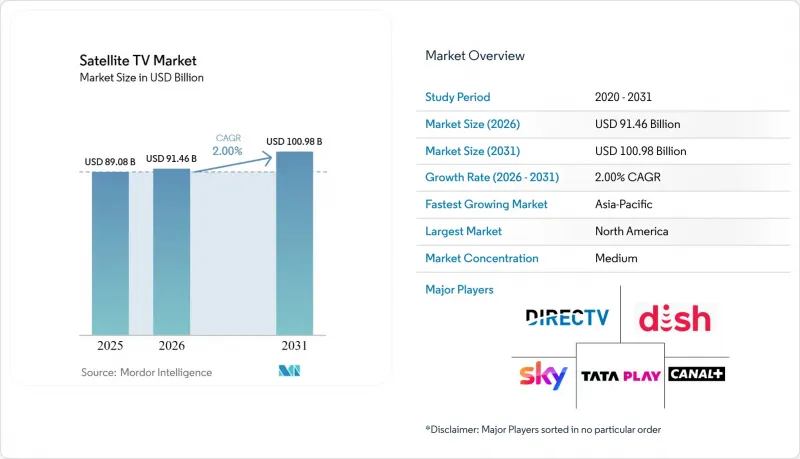
Mordor Intelligence에 의하면, 위성 TV 시장 규모는 2025년에 890억 8,000만 달러로 평가되었고 2026년 914억 6,000만 달러에서 2031년까지 1,009억 8,000만 달러에 이를 것으로 예측되며, 예측 기간(2026-2031년) CAGR은 2.00%를 나타낼 전망입니다.
본 보고서는 서비스 유형(DTH, 위성 유료 TV, 무료 방송, 상업용, 하이브리드 및 부가가치형), 수익 모델(구독형, 광고형, 거래형/PPV), 최종 사용자(가정, 상업 및 기관), 지역(북미, 남미, 유럽, 아시아태평양, 기타)별로 분류되어 있습니다. 시장 전망은 금액(달러) 기준으로 제시되어 있습니다.
전 세계 위성 TV 시장 동향 및 인사이트
프리미엄 스포츠 및 라이브 이벤트 시청이 가입자 수 증가를 주도
시청자들은 여전히 신뢰할 수 있는 라이브 이벤트에 대한 접근성을 높이 평가하고 있기 때문에 프리미엄 스포츠는 위성 TV 시장에서 가장 확실한 고객 유지 수단 중 하나로 자리 잡고 있습니다. DIRECTV는 월 69.99달러의 ‘MySports Genre Pack’을 출시했는데, 이는 사업자가 현재의 시청 행태에 더 잘 부응하기 위해 스포츠를 전체 채널 번들에서 분리하고 있음을 보여줍니다. 많은 가구가 더 이상 대규모 엔터테인먼트 번들을 원하지 않는 반면, 제안이 더 단순하고 납득하기 쉬운 형태라면 라이브 스포츠를 위해 여전히 요금을 지불할 의향이 있으므로, 이러한 움직임은 중요합니다. 또한, FCC는 2026년 2월 스포츠 방송 관행 및 시장 동향에 대한 의견 수렴을 진행하며, 소비자들이 프리미엄 스포츠 컨텐츠에 접근하는 방식이 얼마나 파편화되어 있는지를 부각시켰습니다. 이러한 상황에서 사업자가 서비스의 복잡성을 줄이고 스포츠 시청을 보다 통합된 형태로 제공할 수 있다면, 위성 TV 시장은 그 혜택을 누리게 될 것입니다. 이 요인은 패키지의 안정성에도 기여합니다. 주요 토너먼트나 리그의 중계권은 그렇지 않으면 광범위한 유료 TV 계약을 유지하지 않을 수도 있는 일시적인 시청자들을 계속해서 다시 불러모으기 때문입니다.
농촌 및 인프라가 부족한 지역의 DTH 보급률
TV 수신 상황이 여전히 가구의 광대역 환경보다 전파 도달 범위에 크게 의존하는 지역에서 DTH 접근성은 위성 TV 시장에 있어 기본적인 구조적 버팀목으로 남아 있습니다. 많은 농촌 지역에서는 하나의 플랫폼으로 광범위한 지역을 커버할 수 있고, 지역별 라스트 마일 회선의 중복 구축이 필요하지 않기 때문에 위성 수신은 고밀도 지상파 네트워크의 확장보다 더 쉽게 규모를 확대할 수 있습니다. 이를 통해 소비자가 시간이 지남에 따라 유료와 무료 시청 옵션 사이를 오가더라도, 위성 TV 시장은 입지를 유지할 수 있습니다. 파라볼라 안테나를 통한 수신이 여전히 중요하다는 것은 이미 설치된 장비, 시청에 대한 익숙함, 채널 조작 습관이 당장 사라지지는 않을 것임을 의미합니다. 이는 중요한 점입니다. 사업자가 이러한 기존 기반을 활용하여 가치, 컨텐츠, 유연성을 중심으로 서비스를 재검토하면서도 각 가구에서의 존재 의의를 지킬 수 있기 때문입니다. 이러한 요인으로 인한 최대의 혜택은 여전히 아시아태평양, 아프리카, 남미에 집중되어 있습니다. 이 지역들에서는 지역적 조건이나 경제적 사정이 성숙한 광대역 시장보다 TV 접근성을 더 직접적으로 좌우하고 있기 때문입니다.
코드 커팅과 OTT로의 전환
코드 커팅은 가입자 수와 가구가 광범위한 TV 패키지에 지불할 의사가 있는 금액 모두에 영향을 미치기 때문에 여전히 위성 TV 시장에 있어 가장 큰 구조적 제약 요인으로 남아 있습니다. 닐슨은 2025년에 스트리밍 시청 점유율이 방송과 케이블의 합계 점유율을 처음으로 넘어섰다고 보고했으며, 이는 일상적인 시청 행동에 있어 뚜렷한 변화를 보여줍니다. 스트리밍이 주요 시청 수단이 됨에 따라, 위성 TV 시장은 단순히 컨텐츠를 제공하는 것뿐만 아니라 패키지의 폭넓음을 정당화해야 한다는 추가적인 압박에 직면하게 되었습니다. 이 문제는 단순한 기술적 대체에 그치지 않습니다. 온디맨드 시청은 시청자가 ‘시점’, ‘통제권’, ‘오락비’에 대해 생각하는 방식 자체를 바꾸기 때문입니다. 그 결과, 스포츠 중심 요금제나 하이브리드형, 이벤트 특화형 요금제에 비해 일반 오락용 패키지는 더 큰 영향을 받기 쉬워졌습니다. 따라서 위성 TV 시장에서는 기존의 방대한 채널 라인업에서 일상적인 가치를 더 이상 찾지 못하는 시청자의 이탈을 막기 위해, 더욱 정제된 패키지 구성, 더 명확한 가치 제안, 그리고 더 강력한 서비스 통합이 요구되고 있습니다.
부문 분석
2025년, DTH 위성 TV 서비스는 위성 TV 시장 점유율의 42.22%를 차지하며, 매출 기준 주요 서비스 형태로서의 지위를 계속 유지했습니다. 이러한 지위는 가정에 대한 직접 전송, 수신기 생태계, 설치 네트워크, 그리고 브랜드화된 가입자 관계에 대한 오랜 기간의 투자를 반영한 것이며, 이를 단기간에 대체하는 것은 여전히 어렵습니다. 위성 TV 시장은 여전히 DTH에 크게 의존하고 있습니다. 이는 DTH가 일반 가정의 인지도 및 전국적인 커버리지와 가장 밀접하게 연결된 서비스 형태이기 때문입니다. 또한 DTH는 도시 지역의 프리미엄 사용자, 중산층 가구, 그리고 대도시에 비해 광대역 선택지가 부족한 외곽 지역 가구까지 모두 대응할 수 있다는 점에서도 여전히 중요한 역할을 하고 있습니다. 성장이 둔화되고 있는 상황에서도 이 부문은 사상 최대의 보급 실적과 월정액 구독 요금제와의 가장 명확한 연계성을 유지하고 있어, 위성 TV 시장의 기반으로 남아 있습니다.
무료 방송, 상업 방송 및 기타 위성 주도형 서비스 유형은 가격, 기관 이용 또는 보편적 접근성이 고급 프리미엄 번들보다 더 중요하게 여겨지는 지역에서 시청자 도달 범위를 유지하기 위해 여전히 중요한 위치를 차지하고 있습니다. 이러한 범주들은 위성 TV 시장을 일반 시청자의 요구, 비즈니스 환경, 그리고 기존의 프리미엄 DTH 요금제만으로는 이용하기 어려울 수 있는 저소득 가구와 지속적으로 연결해 주고 있습니다. 하이브리드 및 부가가치형 위성 TV 서비스는 2031년까지 연평균 성장률(CAGR) 5.11%로 확대될 것으로 예상되며, 위성 TV 시장에서 가장 빠르게 성장하는 서비스 유형이 될 전망입니다. 이러한 성장은 파라볼라 안테나를 통한 수신과 인터넷 반송 경로, 앱 통합, 온디맨드 기능을 단일 인터페이스 내에서 통합한 서비스로의 전환을 반영합니다. 위성 TV 업계는 이러한 서비스 구성의 과도기 단계에서 가장 두드러진 변화를 겪고 있습니다. 이는 향후 수익 구조가 안테나만을 통한 시청에 대한 의존도를 낮추고, 사업자가 리니어 TV와 디지털의 편의성을 어떻게 패키징하느냐에 크게 좌우될 것이기 때문입니다.
지역별 분석
2025년, 북미는 위성 TV 시장의 26.11%를 차지하며, 수익 측면에서 가장 큰 기여를 한 지역이 되었습니다. 스트리밍이 더욱 세력을 확장하고 있는 상황에서도 프리미엄 스포츠, 정평이 나 있는 DTH 브랜드, 그리고 고부가가치 TV 시청 습관이 여전히 유료 서비스를 지탱하고 있기 때문에 이 지역은 중요한 위치를 계속 차지하고 있습니다. 또한, 북미 위성 TV 시장은 ‘코드 커팅’으로 인한 가장 직접적인 압박을 받고 있으며, 이는 사업자들이 이전보다 더 명확한 제품 정의가 필요함을 의미합니다. 2026년 1월 DIRECTV가 ‘MySports Genre Pack’을 출시한 것은 기존의 전체 채널 번들에만 의존하지 않고, 보다 선별된 이벤트 중심의 제공 방식으로 전환한다는 이러한 변화를 반영한 것입니다. 북미는 다른 성숙한 시장들이 나중에 더 선택적인 형태로 도입하게 될 상업적 패턴을 종종 결정짓기 때문에 이러한 지역적 변화는 중요합니다.
유럽은 강력한 광섬유 및 IPTV 인프라 아래에서도 위성 수신이 사라지지 않고 여전히 공존하고 있기 때문에 위성 TV 시장의 주요 축으로 남아 있습니다. 이 지역은 오랜 기간 확립된 궤도상 전송 체계, 공영 및 민간 방송의 탄탄한 전통, 그리고 여전히 대규모로 선형 TV를 이용하는 가구라는 이점을 누리고 있습니다. 유텔샛은 2025년 1월, HOTBIRD 궤도군에서의 영상 전송과 관련하여 Polsat Plus Group과의 오랜 제휴를 갱신했습니다. 이는 유럽 TV 전송에서 위성이 계속해서 수행하는 역할을 뒷받침하는 것이었습니다. 또한, CANAL+는 MultiChoice 인수를 완료한 후 2025년 총 매출이 86억 6,500만 유로(94억 200만 달러)에 달했다고 보고했으며, 이는 성숙 시장과 성장 지향 시장을 아우르는 규모의 가치를 부각시켰습니다. 따라서 유럽은 방송 범위, 포트폴리오 규모, 그리고 방송 사업자들의 지속적인 노력을 통해 위성 TV 시장이 전략적 중요성을 유지하고 있는 지역으로 남아 있습니다.
아시아태평양은 2031년까지 연평균 성장률(CAGR) 3.42%를 나타낼 것으로 예측되며, 위성 TV 시장에서 가장 두드러진 성장을 보일 것으로 전망됩니다. 이 지역의 성장은 광대역 보급률의 불균형, 농촌 인구의 다수성, 그리고 다양한 소득 계층에 걸친 대규모 TV 방송에 대한 지속적인 수요에 의해 뒷받침되고 있습니다. 또한, 아시아태평양의 위성 TV 시장은 기존의 TV 형식을 그대로 유지하려 하기보다는 다양한 시청 행태에 신속하게 적응하고 있는 사업자들로부터도 혜택을 받고 있습니다. 아스트로(Astro)의 2026년 ‘디즈니+(Disney+)’ 통합 및 현지 컨텐츠에 대한 폭넓은 집중은 지역 사업자들이 세계 스트리밍 서비스에 대한 접근성과 현지 TV 업계와의 관계를 어떻게 융합하고 있는지를 보여줍니다. 남미, 중동 및 아프리카는 전체 시장 규모로는 여전히 작지만, 광범위한 방송 지역, 스포츠 시청, 가격대에 따른 수신 모델이 이들 지역 전반에 걸쳐 지속적인 중요성을 뒷받침하고 있어, 위성 TV 시장에서 계속해서 중요한 위치를 차지하고 있습니다.
기타 혜택:
- 엑셀 형식 시장 예측(ME) 시트
- 3개월간의 애널리스트 지원
자주 묻는 질문
목차
제1장 서론
제2장 조사 방법
제3장 주요 요약
제4장 시장 구도
제5장 시장 규모와 성장 예측
제6장 경쟁 구도
제7장 시장 기회와 향후 전망
JHS 26.08.05According to Mordor Intelligence, the satellite TV market size was valued at USD 89.08 billion in 2025 and estimated to grow from USD 91.46 billion in 2026 to reach USD 100.98 billion by 2031, at a CAGR of 2.00% during the forecast period (2026-2031).
This report is Segmented by Service Type (DTH, Satellite Pay-TV, Free-To-Air, Commercial, and Hybrid and Value-Added), Revenue Model (Subscription-Based, Advertisement-Based, and Transactional/PPV), End User (Residential Households, and Commercial and Institutional), and Geography (North America, South America, Europe, Asia-Pacific, and More). The Market Forecasts are Provided in Terms of Value (USD).
Global Satellite TV Market Trends and Insights
Premium Sports And Live Event Viewing Fueling Subscriptions
Premium sports remains one of the clearest retention tools in the satellite TV market because viewers still place high value on reliable live event access. DIRECTV launched its MySports Genre Pack at USD 69.99 per month, which showed how operators are separating sports from the full channel bundle to better match current viewing behavior. This move matters because many households no longer want large entertainment bundles, but they still pay for live sports when the offer is simpler and easier to justify. The FCC also sought comment in February 2026 on sports broadcasting practices and marketplace developments, which highlighted how fragmented access to premium sports has become for consumers. In that setting, the satellite TV market benefits when operators can reduce service complexity and present sports viewing in a more unified way. This driver also supports package stability because major tournaments and league rights continue to bring back occasional viewers who may not otherwise retain a broad pay-TV subscription.
DTH Penetration in Rural and Infrastructure-Underserved Areas
DTH access remains a basic structural support for the satellite TV market in areas where television coverage still depends more on signal reach than on household broadband capability. In many rural locations, satellite reception remains easier to scale than dense terrestrial network expansion because one platform can serve a wide footprint without local last-mile duplication. This allows the satellite TV market to remain present even when consumers move between paid and free viewing options over time. The continued importance of dish-based reception also means that the installed base of equipment, viewing familiarity, and channel navigation habits does not disappear quickly. That matters because operators can use this installed base to defend household relevance while they reshape offers around value, content, and flexibility. The strongest benefit from this driver remains concentrated in Asia-Pacific, Africa, and South America, where geography and affordability still shape television access more directly than in mature broadband markets.
Cord-Cutting and OTT Substitution
Cord-cutting remains the strongest structural restraint on the satellite TV market because it affects both subscriber counts and the amount households are willing to pay for broad television packages. Nielsen reported in 2025 that streaming exceeded the combined share of broadcast and cable viewing for the first time, which marked a clear change in everyday viewing behavior. Once streaming became the larger viewing destination, the satellite TV market faced more pressure to justify package breadth rather than only content availability. The problem is not limited to technology substitution because on-demand viewing also changes how households think about timing, control, and entertainment spending. That leaves general entertainment bundles more exposed than sports-led, hybrid, or event-focused offers. The satellite TV market therefore needs narrower packaging, clearer value positioning, and stronger service integration to slow the loss of viewers who no longer see daily value in large traditional channel lineups.
Other drivers and restraints analyzed in the detailed report include:
- Rising Demand For HD and UHD Linear Broadcasting
- Hybrid Satellite-OTT Bundling Improves Retention
- Declining Pay-TV Willingness in Price-Sensitive Markets
For complete list of drivers and restraints, kindly check the Table Of Contents.
Segment Analysis
DTH Satellite TV Services held 42.22% of the satellite TV market share in 2025, which kept it as the leading service type by revenue. This position reflects years of investment in direct household delivery, receiver ecosystems, installation networks, and branded subscription relationships that remain difficult to replace quickly. The satellite TV market still depends heavily on DTH because it is the service format most closely tied to broad household familiarity and national coverage. DTH also remains important because it works across premium urban users, mid-income families, and remote households that do not have the same broadband options as large cities. Even in slower-growth conditions, this segment continues to anchor the satellite TV market because it holds the widest historical installed base and the clearest connection to monthly subscription billing.
Free-to-air, commercial, and other satellite-led service types remain meaningful because they preserve audience reach in places where price, institutional use, or universal access matter more than deep premium bundling. These categories keep the satellite TV market connected to public viewing needs, business environments, and lower-income households that may not enter through a traditional premium DTH plan. Hybrid and Value-Added Satellite TV Services is projected to expand at a 5.11% CAGR through 2031, making it the fastest-growing service type in the satellite TV market size. That growth reflects the shift toward integrated services that combine dish-based reception with internet return paths, app aggregation, and on-demand features inside one interface. The satellite TV industry is changing most clearly at this edge of the service mix because the future revenue layer will depend less on dish-only viewing and more on how operators package linear television with digital convenience.
Complete Report Scope:
- By Service Type
- Direct-to-Home Satellite TV Services
- Satellite Pay-TV Services
- Free-to-Air Satellite TV Services
- Commercial Satellite TV Services
- Hybrid and Value-added Satellite TV Services
- By Revenue Model
- Subscription based
- Advertisement Based
- Transactional / Pay-Per-View
- By End User
- Residential Households
- Commercial and Institutional
- By Geography
- North America
- United States
- Canada
- Mexico
- South America
- Brazil
- Argentina
- Chile
- Rest of South America
- Europe
- Germany
- United Kingdom
- France
- Italy
- Spain
- Rest of Europe
- Asia-Pacific
- China
- Japan
- India
- South Korea
- Australia
- Rest of Asia-Pacific
- Middle East
- Saudi Arabia
- United Arab Emirates
- Qatar
- Rest of Middle East
- Africa
- South Africa
- Egypt
- Nigeria
- Rest of Africa
- North America
Geography Analysis
North America held 26.11% of the satellite TV market in 2025, which made it the largest regional contributor by revenue. The region remains important because premium sports, established DTH brands, and high-value television habits still support paid services even as streaming gains further ground. The satellite TV market in North America is also under the most direct pressure from cord-cutting, which means operators need sharper product definitions than they did in earlier years. DIRECTV's launch of the MySports Genre Pack in January 2026 reflected this change by moving toward a narrower, event-led offer instead of relying only on the traditional full channel bundle. This regional shift matters because North America often sets the commercial pattern that other mature markets later adapt in more selective form.
Europe remained a major pillar of the satellite TV market because satellite reception continues to coexist with strong fiber and IPTV infrastructure rather than disappearing under it. The region benefits from long-established orbital distribution, strong public and private broadcast traditions, and households that still use linear television at scale. Eutelsat renewed its long-running partnership with Polsat Plus Group in January 2025 for video distribution from the HOTBIRD neighborhood, which reinforced the continuing role of satellite in European television delivery. CANAL+ also reported combined 2025 revenue of EUR 8,665 million (USD 9,402 million) after completing the MultiChoice acquisition, which highlighted the value of scale across mature and growth-oriented territories. Europe therefore remains a region where the satellite TV market preserves strategic relevance through distribution reach, portfolio scale, and continued broadcaster commitment.
Asia-Pacific is projected to grow at a 3.42% CAGR through 2031, making it the fastest-growing regional part of the satellite TV market. Growth in this region is supported by uneven broadband penetration, large rural populations, and continuing demand for mass television distribution across diverse income groups. The satellite TV market in Asia-Pacific also benefits from operators that are adapting quickly to mixed viewing behavior rather than defending legacy television formats without change. Astro's 2026 Disney+ integration and broader local content positioning showed how regional providers are blending global streaming access with local television relationships. South America, the Middle East, and Africa remain smaller in overall value, but they continue to matter to the satellite TV market because broad coverage, sports viewing, and price-tiered reception models still support ongoing relevance across those regions.
- DIRECTV, LLC
- EchoStar Corporation
- Sky Group Limited
- Tata Play Limited
- Sun Direct TV Private Limited
- CANAL+ S.A.
- MEO - Servicos de Comunicacoes e Multimedia, S.A.
- Orange S.A.
- Astro Malaysia Holdings Berhad
- SKY Perfect JSAT Corporation
- TrueVisions Group Co., Ltd.
- StarTimes Software Technology Co., Ltd.
- Vrio Corp.
- Cignal TV, Inc.
- DISH TV India Limited
- Grupo Televisa, S.A.B.
- Bell Canada
- Foxtel Management Pty Ltd
- Shaw Satellite Services Inc.
- Eutelsat Communications S.A.
Additional Benefits:
- The market estimate (ME) sheet in Excel format
- 3 months of analyst support
TABLE OF CONTENTS
1 INTRODUCTION
- 1.1 Study Assumptions and Market Definition
- 1.2 Scope of the Study
2 RESEARCH METHODOLOGY
3 EXECUTIVE SUMMARY
4 MARKET LANDSCAPE
- 4.1 Market Overview
- 4.2 Market Drivers
- 4.2.1 Rising Demand For HD and UHD Linear Broadcasting
- 4.2.2 DTH Penetration In Rural and Infrastructure-Constrained Markets
- 4.2.3 Premium Sports and Live Event Viewing Retains Pay-TV Value
- 4.2.4 Hybrid Satellite-OTT Bundling Improves Retention and ARPU
- 4.2.5 Spectrum Reuse and Beam-Targeted Capacity Gains Improve Monetization
- 4.2.6 Set-Top Box Renewal Cycles Create Upgrade-Led Demand
- 4.3 Market Restraints
- 4.3.1 Cord-Cutting and OTT Substitution
- 4.3.2 Declining Pay-TV Willingness in Price-Sensitive Households
- 4.3.3 Satellite Capacity and Launch Cost Pressure
- 4.3.4 Content Rights Fragmentation Raises Churn and Acquisition Cost
- 4.4 Industry Value Chain Analysis
- 4.5 Regulatory Landscape
- 4.6 Technological Outlook
- 4.7 Impact Of Macroeconomic Factors On The Market
- 4.8 Porter's Five Forces Analysis
- 4.8.1 Threat Of New Entrants
- 4.8.2 Bargaining Power Of Suppliers
- 4.8.3 Bargaining Power Of Buyers
- 4.8.4 Threat Of Substitutes
- 4.8.5 Industry Rivalry
5 MARKET SIZE AND GROWTH FORECASTS (VALUE)
- 5.1 By Service Type
- 5.1.1 Direct-to-Home Satellite TV Services
- 5.1.2 Satellite Pay-TV Services
- 5.1.3 Free-to-Air Satellite TV Services
- 5.1.4 Commercial Satellite TV Services
- 5.1.5 Hybrid and Value-added Satellite TV Services
- 5.2 By Revenue Model
- 5.2.1 Subscription based
- 5.2.2 Advertisement Based
- 5.2.3 Transactional / Pay-Per-View
- 5.3 By End User
- 5.3.1 Residential Households
- 5.3.2 Commercial and Institutional
- 5.4 By Geography
- 5.4.1 North America
- 5.4.1.1 United States
- 5.4.1.2 Canada
- 5.4.1.3 Mexico
- 5.4.2 South America
- 5.4.2.1 Brazil
- 5.4.2.2 Argentina
- 5.4.2.3 Chile
- 5.4.2.4 Rest of South America
- 5.4.3 Europe
- 5.4.3.1 Germany
- 5.4.3.2 United Kingdom
- 5.4.3.3 France
- 5.4.3.4 Italy
- 5.4.3.5 Spain
- 5.4.3.6 Rest of Europe
- 5.4.4 Asia-Pacific
- 5.4.4.1 China
- 5.4.4.2 Japan
- 5.4.4.3 India
- 5.4.4.4 South Korea
- 5.4.4.5 Australia
- 5.4.4.6 Rest of Asia-Pacific
- 5.4.5 Middle East
- 5.4.5.1 Saudi Arabia
- 5.4.5.2 United Arab Emirates
- 5.4.5.3 Qatar
- 5.4.5.4 Rest of Middle East
- 5.4.6 Africa
- 5.4.6.1 South Africa
- 5.4.6.2 Egypt
- 5.4.6.3 Nigeria
- 5.4.6.4 Rest of Africa
- 5.4.1 North America
6 COMPETITIVE LANDSCAPE
- 6.1 Market Concentration
- 6.2 Strategic Moves
- 6.3 Vendor Positioning Analysis
- 6.4 Company Profiles (includes Global Level Overview, Market Level Overview, Core Segments, Financials as available, Strategic Information, Products and Services, Recent Developments)
- 6.4.1 DIRECTV, LLC
- 6.4.2 EchoStar Corporation
- 6.4.3 Sky Group Limited
- 6.4.4 Tata Play Limited
- 6.4.5 Sun Direct TV Private Limited
- 6.4.6 CANAL+ S.A.
- 6.4.7 MEO - Servicos de Comunicacoes e Multimedia, S.A.
- 6.4.8 Orange S.A.
- 6.4.9 Astro Malaysia Holdings Berhad
- 6.4.10 SKY Perfect JSAT Corporation
- 6.4.11 TrueVisions Group Co., Ltd.
- 6.4.12 StarTimes Software Technology Co., Ltd.
- 6.4.13 Vrio Corp.
- 6.4.14 Cignal TV, Inc.
- 6.4.15 DISH TV India Limited
- 6.4.16 Grupo Televisa, S.A.B.
- 6.4.17 Bell Canada
- 6.4.18 Foxtel Management Pty Ltd
- 6.4.19 Shaw Satellite Services Inc.
- 6.4.20 Eutelsat Communications S.A.
7 MARKET OPPORTUNITIES AND FUTURE OUTLOOK
- 7.1 White-Space And Unmet-Need Assessment


