|
시장보고서
상품코드
2099238
인도의 냉장 창고 시장 : 점유율 분석, 업계 동향 및 통계, 성장 예측(2026-2031년)India Cold Storage - Market Share Analysis, Industry Trends & Statistics, Growth Forecasts (2026 - 2031) |
||||||
 Mordor Intelligence
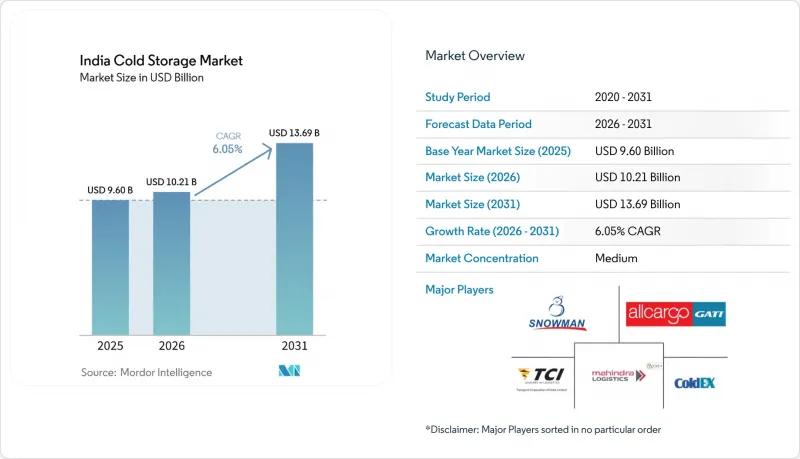
Mordor Intelligence에 의하면, 인도 냉장 창고 시장 규모는 2025년 96억 달러에서 2026년에는 102억 1,000만 달러로 확대되어 2031년까지 136억 9,000만 달러에 이를 것으로 예상되고 있어 2026년부터 2031년까지 CAGR 6.05%로 성장할 전망입니다.
인도의 냉장 창고 시장은 현재 병행하여 진행되고 있는 세 가지 수요 흐름, 즉 식품 소매의 현대화, 의약품 콜드체인의 확대, 그리고 퀵 커머스를 위한 다크 스토어의 보급에 의해 형성되고 있습니다. 본 보고서는 온도 유형별(냉장, 냉동, 상온, 초저온), 자동화 수준별(기존 시설 및 자동화 냉장 창고), 용도별(과일 및 채소, 육류·가금류, 수산물, 유제품 및 냉동 디저트, 즉석식품 등), 그리고 지역별(북부, 중부, 서부, 동부, 남부)로 분류되어 있습니다. 시장 전망은 금액(달러) 기준으로 제시되어 있습니다.
인도 냉장 창고 시장 동향과 인사이트
다중 온도대 창고에 대한 수요 증가
인도 냉장 창고 시장 수요는 더 이상 단일 온도대에만 집중되어 있지 않습니다. 소매 체인, 패스트푸드점, 제약 회사에서는 동일한 시설 내에 냉장, 냉동, 상온 구역을 함께 마련해야 할 필요성이 커지고 있습니다. 이러한 변화로 인해 사업자들은 창고 설계를 재검토해야 하는 상황에 직면해 있습니다. 단일 상품이나 단일 온도대를 위해 건설된 시설로는 다양한 재고를 쉽게 수용할 수 없기 때문입니다. 퀵 커머스 플랫폼에 따르면, 2025년 여름철에 냉동·냉장 제품 수요가 30% 증가할 것으로 예상되며, 엄격한 배송 시간대 내에서 여러 냉장 구역을 관리해야 하는 다크 스토어 운영 사업자에 대한 압박이 더욱 커지고 있습니다. 인도 냉장 창고 시장에서 이러한 설계상의 불일치로 인해 투자 주기는 신축에만 국한되지 않고 확대되고 있습니다. 오래된 시설의 개보수는 새로운 수용 능력을 건설하는 것만큼이나 중요한 경우가 많기 때문입니다. 그 결과, 특히 인프라의 질이 소비 확대 속도를 따라가지 못하는 도시에서는 현대화 과정이 더 장기화되는 경향이 있습니다.
조직화된 식품 소매 및 퀵커머스 확대
조직화된 식품 소매업과 퀵커머스는 인도 냉장 창고 시장의 운영 논리를 변화시키고 있습니다. 인도의 퀵커머스 총 상품 가치는 2025년에 113억 달러에 달하고, Zepto사만 해도 2027 회계연도부터 2030 회계연도까지 다크 스토어 확장에 1,629카롤 루피(1억 9,000만 달러)를 배정했습니다. 또한 Blinkit도 2027년 3월까지 다크 스토어 네트워크를 3,000개 점포로 확대할 계획을 밝혔으며, 이에 따라 냉장이 필요한 도시 지역의 재고 밀도가 더욱 높아질 전망입니다. 현재 이러한 플랫폼의 주문 대부분을 신선식품이 차지하고 있기 때문에 수요는 장기 보관을 목적으로 한 창고에서 주거지 인근에 위치한 회전율이 높은 마이크로 풀필먼트 거점으로 이동하고 있습니다. 이 때문에 인도의 냉장 창고 시장에서는 대규모 지방 및 도시 근교의 대량 저장 시설뿐만 아니라, 도시 지역의 다중 구역 시설에 대한 수요도 증가하고 있습니다. 주요 대도시권의 대부분에서 공급 부족이 여전히 심각하기 때문에 도시 근교의 냉장 인프라는 가장 확실한 확장 분야 중 하나가 되고 있습니다.
현대적인 콜드체인 시설의 높은 자본 집약도
높은 프로젝트 비용은 인도 냉장 창고 시장의 성장 속도를 제약하는 가장 두드러진 요인 중 하나로 남아 있습니다. 냉동용 냉장 창고의 건설 비용은 1제곱피트당 3,200-4,000루피(33.80-43.60달러) 범위이지만, 의약품 등급 냉장실은 용량 1메트르톤당 25,000-40,000루피(267-462 달러)가 소요됩니다. 다온도대 레이아웃, 자동화 시스템, 창고 관리 소프트웨어, 비상 전원 등은 필요한 투자액을 더욱 높입니다. 이로 인해, 특히 장기적인 주요 고객이나 보조금 지원을 통해 설비 투자를 상쇄할 수 없는 사업자의 경우 투자 회수 기간이 장기화됩니다. 인도의 냉장 창고 시장에서는 이러한 상황이 양극화를 초래하고 있습니다. 대규모의 체계적인 사업자들은 급속히 확장하고 있는 반면, 소규모 사업자들은 고객이 점점 더 요구하는 시설 업그레이드에 필요한 자금 조달에 어려움을 겪고 있습니다. 이러한 압박은 재무적인 측면에만 그치지 않습니다. 식품 및 헬스케어 분야의 규정 준수 요건이 강화되면서, 저사양 보관 시설이 경쟁력을 유지할 수 있는 여지가 좁아지고 있기 때문입니다.
부문 분석
2025년 기준, 인도 냉장 창고 시장 점유율의 52.40%를 ‘냉장(0-5℃)’이 차지하고 있으며, 이는 총 취급량 측면에서 과일, 채소, 유제품이 여전히 지배적인 위치를 차지하고 있음을 반영합니다. '냉동' 및 '상온' 형태는 가공식품, 과자, 건조 의약품 분야에서 여전히 중요한 역할을 하고 있습니다. 그러나 가장 급격한 변화가 나타나는 분야는 초저온·극저온 저장 분야로, 2031년까지 연평균 성장률(CAGR) 11.31%를 나타낼 것으로 예측됩니다. 이 성장률은 인도의 냉장 창고 시장이 기존의 농산물 저장에 중점을 두던 단계에서 보다 전문적인 온도대로 전환되고 있음을 보여줍니다. 의약품의 이용 사례가 일반 의약품에서 바이오의약품, 백신, 기타 온도에 민감한 치료제로 확대됨에 따라, -20°C에서 -80°C 사이의 보관 수요가 증가하고 있습니다.
이러한 변화는 현재 프로젝트 진행 상황에서도 드러나고 있습니다. 인디콜드(IndiCold)는 2024년 구자라트주 도호라산에 인도 최초의 완전 자동화된 고층 냉동 ASRS 창고를 도입했으며, 이어 2025년 4월에는 -25°C에서 10,000 팔레트 이상의 수용 능력을 갖춘 데트로이트 시설을 두 번째로 개설했습니다. 따라서 인도의 냉장 창고 업계는 단계적인 설비 투자 주기를 거치고 있으며, 냉장 용량은 기존 인프라로 유지되는 한편, 체계적인 식품 유통을 위해 냉동 용량이 확대되고, 초저온 인프라가 상업적 중요성을 띠고 있습니다. 퀵 커머스 사업을 전개하는 사업자에게도 중앙 창고, 마이크로 풀필먼트 거점, 그리고 최종 배송지 사이에서 냉동 제품의 연속성을 보다 확실하게 확보해야 할 필요가 있습니다. 그 결과, 인도 냉장 창고 시장의 온도 구분은 더 이상 단순한 기술적 분류에 그치지 않고, 새로운 자본이 어디에 투입되고 있는지를 보여주는 직접적인 지표가 되고 있습니다.
기타 혜택:
- 엑셀 형식 시장 예측(ME) 시트
- 3개월간의 애널리스트 지원
자주 묻는 질문
목차
제1장 서론
제2장 조사 방법
제3장 주요 요약
제4장 시장 구도
제5장 시장 규모 및 성장 예측(금액, 2026-2031년)
제6장 경쟁 구도
제7장 시장 기회와 향후 전망
JHS 26.08.07According to Mordor Intelligence, the India cold storage market size is expected to increase from USD 9.60 billion in 2025 to USD 10.21 billion in 2026 and reach USD 13.69 billion by 2031, growing at a CAGR of 6.05% over 2026-2031.
The India cold storage market is being shaped by 3 demand streams that now move in parallel, food retail modernization, pharmaceutical cold chain expansion, and the spread of quick commerce dark stores. This report is Segmented by Temperature Type (Chilled, Frozen, Ambient, and Deep-Frozen), by Automation Level (Conventional Facilities and Automated Cold Stores), by Application (Fruits and Vegetables, Meat and Poultry, Fish and Seafood, Dairy and Frozen Desserts, Ready-To-Eat Meals, and More), and by Region (North, Central, West, East, and South). The Market Forecasts are Provided in Terms of Value (USD).
India Cold Storage Market Trends and Insights
Rising Demand for Multi-Temperature Warehousing
Demand in the India cold storage market is no longer centered on a single temperature band. Retail chains, quick-service restaurants, and pharmaceutical companies increasingly need chilled, frozen, and ambient zones on the same site. That change is pushing operators to rethink warehouse design, as facilities built for a single commodity or temperature cannot easily accommodate mixed inventory. Quick commerce platforms recorded a 30% rise in summer demand for frozen and chilled products in 2025, further increasing pressure on dark-store operators to manage multiple cold zones within tight delivery windows. In the India cold storage market, this design mismatch is extending the investment cycle beyond new builds alone, because retrofitting older sites is often as important as building fresh capacity. The result is a longer modernization runway, especially in cities where consumption is broadening faster than infrastructure quality.
Expansion of Organized Food Retail and Quick Commerce
Organized food retail and quick commerce are changing the operating logic of the India cold storage market. India's quick commerce gross merchandise value reached USD 11.3 billion in 2025, and Zepto alone earmarked INR 1,629 crores (USD 190 million) for dark-store expansion across FY 27-FY 30. Blinkit has also stated plans to expand its dark-store network to 3,000 stores by March 2027, adding to the density of cold-sensitive urban inventory. Perishables now account for a large share of orders on these platforms, so demand is shifting from long-dwell repository storage to fast-turn micro-fulfillment capacity near residential clusters. This is why the India cold storage market is seeing stronger demand for urban multi-zone sites rather than only large rural or peri-urban bulk facilities. The supply gap remains wide in most major metros, making near-city cold infrastructure one of the clearest expansion pockets.
High Capital Intensity for Modern Cold Chain Facilities
High project cost remains one of the clearest limits on the pace of the India cold storage market. Construction costs for frozen cold storage range from INR 3,200 to INR 4,000 (USD 33.80 to USD 43.60 ) per ft2, while pharmaceutical-grade cold rooms cost INR 25,000-40,000 (USD 267 to USD 462) per metric ton of capacity. Multi-temperature layouts, automation systems, warehouse management software, and backup power all further increase the required investment. This stretches payback periods, especially for operators that cannot offset capex with long-term anchor clients or subsidy support. In the Indian cold storage market, this is creating a split: larger, organized players are expanding faster, while smaller operators struggle to finance upgrades that customers increasingly expect. The pressure is not only financial, because rising compliance expectations in food and healthcare also reduce the room for low-spec capacity to remain competitive.
Other drivers and restraints analyzed in the detailed report include:
- Rising Pharma, Vaccine, and Biologics Cold Chain Needs
- Energy Resilience Through On-Site Renewable Backup
- Power Reliability and Operating Cost Pressure
For complete list of drivers and restraints, kindly check the Table Of Contents.
Segment Analysis
Chilled (0-5 °C) accounted for 52.40% of the India cold storage market share in 2025, reflecting the continued dominance of fruits, vegetables, and dairy in total throughput. Frozen and ambient formats still play important roles across processed foods, confectionery, and dry pharmaceuticals. The fastest shift, however, is in deep-freeze / ultra-low storage, which is projected to grow at a 11.31% CAGR through 2031. That growth rate shows how the India cold storage market is moving beyond its older focus on conventional produce storage and into more specialized temperature bands. The need for handling at -20 °C to -80 °C is rising as pharmaceutical use cases broaden from standard products to biologics, vaccines, and other temperature-sensitive therapies.
That shift is now visible in project execution. Indicold deployed India's first fully automated high-bay frozen ASRS warehouse in Dholasan, Gujarat, in 2024, and followed it with a second Detroj facility in April 2025 with more than 10,000 pallet capacity at -25 °C. The India cold storage industry is therefore moving through a staggered capex cycle, where chilled capacity remains the installed base, frozen capacity is being scaled for organized food distribution, and ultra-low infrastructure is entering commercial relevance. Operators serving quick commerce also need better frozen continuity between the central warehouse, the micro-fulfillment point, and the final delivery. That is why temperature segmentation in the India cold storage market is no longer just a technical classification; it is becoming a direct indicator of where new capital is being deployed.
Complete Report Scope:
- By Temperature Type
- Chilled (0-5 °C)
- Frozen (-18-0 °C)
- Ambient
- Deep-Frozen / Ultra-Low (Less than -20 °C)
- By Automation Level (Storage)
- Conventional Facilities
- Automated Cold Stores (AS/RS, Robotics)
- By Application
- Fruits & Vegetables
- Meat & Poultry
- Fish & Seafood
- Dairy & Frozen Desserts
- Bakery & Confectionery
- Ready-to-Eat Meals
- Pharmaceuticals & Biologics
- Vaccines & Clinical Trial Materials
- Chemicals & Specialty Materials
- Other Perishables
- By Region
- North
- Central
- West
- East
- South
List of Companies Covered in this Report:
- Snowman Logistics Ltd.
- ColdEX Logistics Pvt. Ltd.
- Allcargo Gati
- Mahindra Logistics Limited
- TCI Cold Chain Solutions
- Coldman Logistics Pvt. Ltd.
- DHL Supply Chain India Private Limited
- Reefer Logistics Pvt. Ltd.
- CEVA Logistics (CMA CGM Group)
- Kuehne+Nagel Private Limited
- CMR Cold Storage
- Indicold Pvt. Ltd.
- Coldrush Logistics Pvt. Ltd.
- Gubba Cold Storage Pvt. Ltd.
- Cold Care Group
- GK Cold Chain Solutions Pvt. Ltd.
- Siddhi Cold Chain
- Vasani Cold Chains
- SBP Cold Storage Pvt. Ltd.
- C5 Cold Chain India Pvt. Ltd.
- Arihant Cold Storage
- Hindustan Ice & Cold Storage Co.
Additional Benefits:
- The market estimate (ME) sheet in Excel format
- 3 months of analyst support
TABLE OF CONTENTS
1 Introduction
- 1.1 Study Assumptions & Market Definition
- 1.2 Scope of the Study
2 Research Methodology
3 Executive Summary
4 Market Landscape
- 4.1 Market Overview and Role of Cold Storage in Logistics
- 4.2 Market Drivers
- 4.2.1 Rising Demand for Multi-Temperature Warehousing
- 4.2.2 Expansion of Organized Food Retail and Quick Commerce
- 4.2.3 Rising Pharma, Vaccine, and Biologics Cold Chain Needs
- 4.2.4 Energy Resilience Through On-Site Renewable Backup
- 4.2.5 Digital Temperature Traceability for Export Compliance
- 4.2.6 Cluster-Level Capacity Buildout Near Processing Hubs
- 4.3 Market Restraints
- 4.3.1 High Capital Intensity for Modern Cold Chain Facilities
- 4.3.2 Power Reliability and Operating Cost Pressure
- 4.3.3 Shortage of Skilled Refrigeration and Automation Technicians
- 4.3.4 Fragmented Demand Reduces Asset Utilization
- 4.4 Regulatory Framework
- 4.5 Value Chain and Distribution Channel Architecture Analysis
- 4.6 Technology Innovations Outlook
- 4.7 Porter's Five Forces Analysis
- 4.7.1 Threat of New Entrants
- 4.7.2 Bargaining Power of Suppliers
- 4.7.3 Bargaining Power of Buyers
- 4.7.4 Threat of Substitutes
- 4.7.5 Rivalry Among Competitors
- 4.8 Evolution of the Cold Storage Industry
- 4.9 Cold Storage Installed Capacity and Expansion Trend Analysis
- 4.10 Public vs Private Capacity Split
- 4.11 Key Infrastructure Projects
- 4.12 Sustainability and ESG Assessment
- 4.13 Impact of Geo-Political Events on Supply Chain Shifts
5 Market Size & Growth Forecasts (Value, 2026-2031)
- 5.1 By Temperature Type
- 5.1.1 Chilled (0-5 °C)
- 5.1.2 Frozen (-18-0 °C)
- 5.1.3 Ambient
- 5.1.4 Deep-Frozen / Ultra-Low (Less than -20 °C)
- 5.2 By Automation Level (Storage)
- 5.2.1 Conventional Facilities
- 5.2.2 Automated Cold Stores (AS/RS, Robotics)
- 5.3 By Application
- 5.3.1 Fruits & Vegetables
- 5.3.2 Meat & Poultry
- 5.3.3 Fish & Seafood
- 5.3.4 Dairy & Frozen Desserts
- 5.3.5 Bakery & Confectionery
- 5.3.6 Ready-to-Eat Meals
- 5.3.7 Pharmaceuticals & Biologics
- 5.3.8 Vaccines & Clinical Trial Materials
- 5.3.9 Chemicals & Specialty Materials
- 5.3.10 Other Perishables
- 5.4 By Region
- 5.4.1 North
- 5.4.2 Central
- 5.4.3 West
- 5.4.4 East
- 5.4.5 South
6 Competitive Landscape
- 6.1 Market Concentration
- 6.2 Key Strategic Moves
- 6.3 Market Share Analysis
- 6.4 Company Profiles (includes Global level Overview, Market level overview, Core Segments, Financials as available, Strategic Information, Market Rank/Share for key companies, Products & Services, and Recent Developments)
- 6.4.1 Snowman Logistics Ltd.
- 6.4.2 ColdEX Logistics Pvt. Ltd.
- 6.4.3 Allcargo Gati
- 6.4.4 Mahindra Logistics Limited
- 6.4.5 TCI Cold Chain Solutions
- 6.4.6 Coldman Logistics Pvt. Ltd.
- 6.4.7 DHL Supply Chain India Private Limited
- 6.4.8 Reefer Logistics Pvt. Ltd.
- 6.4.9 CEVA Logistics (CMA CGM Group)
- 6.4.10 Kuehne+Nagel Private Limited
- 6.4.11 CMR Cold Storage
- 6.4.12 Indicold Pvt. Ltd.
- 6.4.13 Coldrush Logistics Pvt. Ltd.
- 6.4.14 Gubba Cold Storage Pvt. Ltd.
- 6.4.15 Cold Care Group
- 6.4.16 GK Cold Chain Solutions Pvt. Ltd.
- 6.4.17 Siddhi Cold Chain
- 6.4.18 Vasani Cold Chains
- 6.4.19 SBP Cold Storage Pvt. Ltd.
- 6.4.20 C5 Cold Chain India Pvt. Ltd.
- 6.4.21 Arihant Cold Storage
- 6.4.22 Hindustan Ice & Cold Storage Co.
7 Market Opportunities & Future Outlook
- 7.1 White-space & Unmet-Need Assessment