

|
시장보고서
상품코드
2099264
산업 제조 분야 현장 근로자 기술 : 시장 점유율 분석, 업계 동향 및 통계, 성장 예측(2026-2031년)Frontline Worker Technology In Industrial Manufacturing - Market Share Analysis, Industry Trends & Statistics, Growth Forecasts (2026 - 2031) |
||||||
 Mordor Intelligence
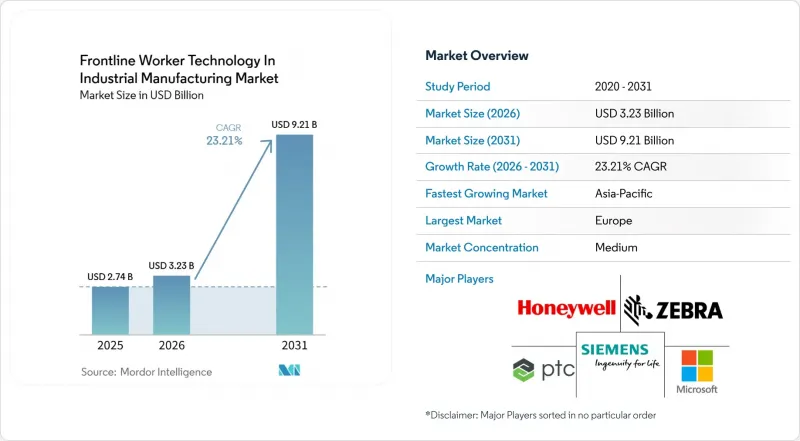
Mordor Intelligence에 의하면, 산업 제조 분야 현장 근로자 기술 시장은 2025년 27억 4,000만 달러로 평가되었습니다. 2026년에는 32억 3,000만 달러로 확대되어 2031년까지 92억 1,000만 달러에 이를 것으로 예측되며, 2026년부터 2031년에 걸쳐 CAGR 23.31%로 성장할 전망입니다.
본 보고서는 구성 요소(소프트웨어 및 서비스), 배포 방식(클라우드 기반, 하이브리드형, On-Premise형), 조직 규모(대기업 및 중소기업), 용도(직원 커뮤니케이션 및 참여도 향상 등), 최종 사용자 산업(자동차 산업 등), 그리고 지역별로 분류되어 있습니다. 시장 전망은 금액(달러)으로 표시되어 있습니다.
세계의 산업 제조 분야 현장 근로자 기술 시장 동향 및 인사이트
AI를 활용한 위험 감지 및 예측 안전 분석의 활용 확대
산업 제조 분야 현장 근로자 기술 시장은 작업 현장 바로 근처에서 영상, 음성, 센서 데이터를 직접 읽어낼 수 있는 AI 시스템의 보급으로 인해 혜택을 보고 있습니다. 2025년 최근 조사에 따르면, 랜덤 포레스트(Random Forest)나 서포트 벡터 머신(Support Vector Machine)과 같은 웨어러블 기기 기반 모델은 밀기, 당기기, 구멍 뚫기 등의 작업 중 위험한 자세를 거의 실시간으로 감지할 수 있는 것으로 나타났습니다. 이를 통해 부상이 발생한 후가 아니라 사고가 일어나기 전에 경고를 발령할 수 있게 됨에 따라, 공장의 안전 대책 방식이 변화하고 있습니다. 또한, 동일한 행동 데이터나 위치 정보 데이터를 활용함으로써 수작업 점검만으로는 발견하기 어려운 워크플로우 설계상의 미비점, 반복적으로 발생하는 혼잡 구역, 감독자의 사각지대 등을 파악할 수 있어 그 상업적 가치도 확대되고 있습니다. 이러한 모델이 공장 현장의 더 많은 데이터로부터 학습함에 따라, 조기에 도입한 기업들은 더욱 강력한 사내 데이터 세트를 구축하게 되었고, 후발 기업들이 그 성능을 따라잡기 어려워지고 있습니다. 이러한 동향으로 인해 전환 비용이 증가함에 따라, 산업 제조 분야의 현장 근로자 기술 시장에서의 구매 결정에 있어 소프트웨어의 품질이 더욱 중요한 역할을 담당하게 되었습니다.
인력 부족이 근태 관리, 규정 준수, 생산성 추적의 자동화를 가속화하고 있습니다.
산업 제조 분야 현장 근로자 기술 시장은 제조업에서 더 이상 단기적인 문제로 간주되지 않는 인력 부족에 의해서도 뒷받침되고 있습니다. 최근 보고서에 따르면, 독일 제조 기업의 17.9%가 2025년 2분기 현재 기술 인력 부족이 운영에 영향을 미치고 있다고 응답했으며, 이는 1991년부터 2010년까지 기록된 장기 평균인 3.7%를 크게 상회하는 수치입니다. 이러한 압박은 특히 공장에서 두드러지며, 이곳에서는 신입 사원 교육 기간, 자격 인증 현황, 교대 근무 출석 상황 및 업무 배정을 이전보다 더 일관성 있게 추적해야 합니다. 이러한 상황에서 숙련된 근로자를 대체하기 어려운 가운데, 안정적인 생산량을 유지하기 위한 실용적인 도구로서 근태 관리, 규정 준수 기록, 생산성 추적의 자동화가 주목받고 있습니다. 그 수요는 단순히 생산 속도에 그치지 않습니다. 제조업체는 직원의 자격 인증을 신속하게 처리하는 동시에, 중요한 업무가 자격을 갖춘 인력에 의해 수행되었음을 입증할 수 있는 보다 신뢰할 수 있는 증거도 필요로 하기 때문입니다. 이에 따라 디지털 인력 관리 시스템은 사업 연속성의 핵심 요소로 자리 잡고 있으며, 산업 제조 현장 작업자를 위한 기술이 기존의 안전 예산 범위를 넘어 주목받고 있는 이유이기도 합니다.
하드웨어, 소프트웨어 및 현장 통합에 드는 높은 초기 비용
산업 제조 현장 작업자를 위한 기술은 여전히 비용 면에서 압박을 받고 있습니다. 완전한 도입을 위해서는 일반적으로 하드웨어, 소프트웨어, 연결 인프라 및 통합 작업이 동시에 필요하기 때문입니다. 일반적인 사무용 소프트웨어와 달리, 이러한 시스템의 경우 프로젝트마다 장치 설정, 네트워크 설정 및 각 현장의 모델 보정이 필요한 경우가 많습니다. CPWR과 Dodge가 발표한 ‘2026년 안전 관리 스마트 시장’ 보고서에 따르면, 조사 대상 계약업체 중 예측 분석 도구나 웨어러블 기기를 활용하는 곳은 10% 미만으로 나타났습니다. 이는 예산이 빠듯하고 투자 회수 기간을 입증하기 어려운 상황에서는 도입이 여전히 제한적임을 보여줍니다. 중규모 도급업체 역시 연간 자본 예산과 프로젝트 기반의 지출 주기 사이에 불일치를 겪고 있으며, 이로 인해 장기적인 플랫폼 투자를 정당화하기가 어렵습니다. 벤더 측은 구독 요금제나 하드웨어-어-서비스(HaaS) 모델로 대응하고 있지만, 초기 비용 부담이 여전히 산업 제조 분야 현장 근로자 기술의 보급을 늦추고 있습니다.
부문 분석
2025년, 산업 제조 분야 현장 근로자 기술 시장 점유율 중 소프트웨어가 82.11%를 차지했으며, 이는 시간이 지남에 따라 데이터, 워크플로우, 인텔리전스를 관리하는 플랫폼으로의 지출이 얼마나 강력하게 이동하고 있는지를 보여줍니다. 산업 제조 분야의 현장 근로자 기술 시장에서 이러한 위상은 지속적인 구독의 가치, 보다 광범위한 시스템 제어, 그리고 수많은 연결 기기가 더 이상 투자 결정의 핵심이 아니라 교체 가능한 엔드포인트로 취급되게 되었습니다는 사실을 반영합니다. 구매자들은 하드웨어 자체보다 플랫폼이 작업 지시, 분석, 규정 준수 기록, 상호 운용성을 얼마나 적절하게 처리할 수 있는지를 더 중요하게 여기고 있습니다. 따라서 이 분야에서 소프트웨어는 수익 창출과 고객 유지 모두의 기반이 되고 있습니다.
서비스 시장은 2031년까지 연평균 성장률(CAGR) 24.19%를 나타낼 것으로 예측되며, 이는 도입이 심화됨에 따라 구현 지원의 중요성이 높아지고 있음을 보여줍니다. 이는 산업 제조 현장의 작업자를 위한 기술 시장에서 사용자가 꾸준히 도입을 진행하기 위해서는 워크플로우 재설계, 도입 지원 및 변경 관리가 종종 필요하다는 현실을 반영합니다. 2025년 후반에 나타난 AI와 증강현실(AR)을 결합한 플랫폼의 확장은 소프트웨어 제공업체가 새로운 기능과 커넥티드 워커를 위한 실용적인 도입 지원을 결합함으로써 어떻게 가치를 확대하고 있는지를 보여줍니다. 따라서 산업 제조 분야 현장 근로자 기술은 소프트웨어가 지속적인 수익원을 확보하고, 서비스가 도입의 질을 보장하는 모델로 전환되고 있습니다. 고객이 시범 사이트에서 더 광범위한 공장 네트워크로 규모를 확대할 때, 이 두 영역을 모두 지원할 수 있는 벤더일수록 고객 기반을 굳건히 지킬 수 있을 것입니다.
2025년 시점에서 산업 제조 분야 현장 근로자 기술 시장 규모 중 클라우드 기반 도입이 76.61%를 차지했으며, 2031년까지의 예측 연평균 성장률(CAGR)도 25.44%로 가장 높은 성장률을 기록했습니다. 이러한 조합은 산업 제조 분야 현장 근로자 기술 시장이 클라우드와 On-Premise 모델로 균등하게 나뉘어 있지 않음을 보여줍니다. 신규 도입의 대부분에서 클라우드가 이미 주류를 이루고 있기 때문입니다. 구매자들은 클라우드 도입에 따른 신속한 배포, 손쉬운 업데이트, 그리고 사내 인프라에 대한 부담 경감을 선호합니다. 또한 이는 각 거점이 시간이 지남에 따라 사용자나 기능을 추가할 수 있는 모듈식 상용 모델과도 잘 부합합니다.
제조업체가 기밀 데이터의 로컬 관리를 요구하면서도 분석 및 보고 기능은 클라우드에 유지하려는 가운데, 하이브리드 도입의 중요성은 점점 더 커지고 있습니다. 산업 제조 현장의 작업자를 위한 기술 시장에서 이러한 균형이 가장 중요한 것은 데이터 취급 규정, 사이버 보안 기준 또는 사내 IT 정책으로 인해 완전한 클라우드 전용 설계가 제한되는 규제 환경 하에서입니다. 2025년에 실시된 공동 연구에 따르면, 완전히 격리된 환경에 의존하는 대신 규정 준수를 충족하는 클라우드 환경을 통해 유지 관리 업무를 위한 안전한 커넥티드 워커 지원을 제공할 수 있음이 밝혀졌습니다. 엄격하게 관리되는 시설에서는 On-Premise 시스템이 여전히 중요하지만, 이를 이용하는 사용자층은 이전보다 좁아지고 있습니다. 따라서 산업 제조 분야 현장 근로자 기술은 ‘클라우드 퍼스트’ 아키텍처를 중심으로 통합이 진행되고 있으며, 기밀성이 높은 업무에서는 하이브리드 설계가 실용적인 중간 대안으로 기능하고 있습니다.
지역별 분석
2025년, 유럽은 산업 제조 분야의 현장 근로자 기술 시장 점유율의 33.11%를 차지하며 최대 지역 시장이 되었습니다. 유럽의 산업 제조 분야 현장 근로자 기술 시장이 견조한 이유는 해당 지역에 첨단 제조 클러스터가 밀집해 있을 뿐만 아니라, 고용주에게 작업자의 안전 및 운영 관행에 대한 철저한 문서화를 촉구하는 규제 환경이 갖춰져 있기 때문입니다. 특히 독일은 자동화 밀도가 높아 공장 현장에서 인간과 기계의 명확한 협력이 필요성이 커지고 있어 여전히 중요한 위치를 차지하고 있습니다. 최근 업계 데이터에 따르면, 2025년 독일에서는 제조업 종사자 1만 명당 449대의 로봇이 도입되어 전 세계에서 가장 자동화가 진전된 제조 경제국 중 하나로 꼽히고 있습니다. 그러나 이 정도의 자동화 수준이라 하더라도 커넥티드 워커를 위한 도구의 필요성이 줄어들지는 않습니다. 실시간 감독, 안내형 작업, 그리고 사람과 기계 간의 보다 명확한 상호작용 규칙에 대한 필요성이 높아지는 경우가 많기 때문입니다.
아시아태평양은 2031년까지 연평균 성장률(CAGR) 28.99%를 나타낼 것으로 예상되며, 예측 기간 동안 산업 제조 분야 현장 근로자 기술 시장 규모 측면에서 가장 빠르게 성장하는 지역이 될 것입니다. 이 지역에서는 대규모 제조, 인건비 상승, 스마트 팩토리 프로그램이 기업으로 하여금 보다 고도화된 디지털 기반 인력 관리를 추진하게 함에 따라, 산업 제조 분야 현장 근로자 기술 시장이 급속히 확대되고 있습니다. 일본에서는 기업들이 주도적으로 현장 업무용 AI 도구를 개발함으로써 이러한 방향성이 명확히 드러나고 있습니다. 2025년 10월에는 제조 라인 및 사회 인프라 분야의 현장 작업자를 위한 AI 에이전트 개발을 위한 주요 전략적 제휴가 확대되었습니다. 한국도 중요한 시장으로 부상하고 있습니다. 이는 로봇 도입 밀도가 높아 작업자의 감독, 의사소통, 업무 흐름에 관한 보다 강력한 소프트웨어 지원이 실무상 필요하기 때문입니다. 인도 및 동남아시아에서는 전자기기 생산 확대에 따라 새로 채용된 인력에 대한 체계적인 지도, 교육 및 대규모 감독이 필요하다는 점에서 주목받고 있습니다.
2025년, 북미는 산업 제조 분야 현장 근로자 기술 분야의 매출에서 큰 비중을 차지했습니다. 인건비 압박과 규제 강화로 인해, 특히 결근, 기계 안전, 업무 책임 소재가 생산량에 영향을 미치는 분야에서 도입에 대한 관심은 높은 수준을 유지하고 있습니다. 제조 현장에서의 절단 사고 방지를 목적으로 한 국가적 중점 프로그램은 2025년 내내 이어져 2026년까지 지속되었으며, 실시간 모니터링 및 기계 관련 안전 대책의 문서화에 대한 관심이 높아졌습니다. 남미는 여전히 시장이 성숙 단계에 이르지 않았지만, 자동차, 식품 및 음료, 화학 등 다양한 분야의 광범위한 산업 디지털화에 힘입어 시장이 발전하고 있습니다. 중동 및 아프리카 시장 점유율은 여전히 작지만, 걸프 국가들의 스마트 제조에 대한 투자와 일부 아프리카 제조 거점에서의 단계적인 디지털화가 장기적인 관심을 꾸준히 뒷받침하고 있습니다.
기타 혜택 :
- 엑셀 형식 시장 예측(ME) 시트
- 3개월간의 애널리스트 지원
자주 묻는 질문
목차
제1장 서론
제2장 조사 방법
제3장 주요 요약
제4장 시장 구도
제5장 시장 규모 및 성장 예측
제6장 경쟁 구도
제7장 시장 기회 및 향후 전망
KTH 26.08.10According to Mordor Intelligence, the frontline worker technology market in industrial manufacturing is expected to increase from USD 2.74 billion in 2025 to USD 3.23 billion in 2026 and reach USD 9.21 billion by 2031, growing at a CAGR of 23.31% over 2026-2031.
This report is Segmented by Component (Software, and Services), Deployment (Cloud-Based, Hybrid, and On-Premises), Organization Size (Large Enterprises, and Small and Medium Enterprises), Application (Employee Communication and Engagement, and More), End-User Industry (Automotive, and More), and Geography. The Market Forecasts are Provided in Terms of Value (USD).
Global Frontline Worker Technology In Industrial Manufacturing Market Trends and Insights
Growing Use of AI-Powered Hazard Detection and Predictive Safety Analytics
The frontline worker technology in industrial manufacturing market is gaining from the wider use of AI systems that can read video, audio, and sensor data directly near the workstation. Recent 2025 research showed that wearable-based models, such as random forests and support vector machines, were able to detect unsafe posture during tasks like pushing, pulling, and drilling in near real time. This is changing how factories approach safety because alerts can now be issued before an incident develops, rather than after an injury has already occurred. The commercial value is also broadening, as the same behavior and location data can reveal weak workflow design, recurring congestion points, and supervisor blind spots that are difficult to spot through manual checks alone. As these models learn from more plant-floor data, early adopters build stronger internal datasets, making it harder for later entrants to match their performance. That dynamic is raising switching costs and giving software quality a more central role in purchasing decisions across the frontline worker technology market in industrial manufacturing.
Labor Shortages Accelerating Automation of Attendance, Compliance, And Productivity Tracking
The frontline worker technology in industrial manufacturing market is also being supported by labor shortages that are no longer treated as a short cycle issue in manufacturing. Recent reports indicate that 17.9% of manufacturing enterprises in Germany said skill shortages were affecting operations in Q2 2025, far above the long-run average of 3.7% recorded between 1991 and 2010. The pressure is especially evident in plants, where onboarding time, certification status, shift attendance, and work allocation must be tracked with greater consistency than before. In that setting, automated attendance, compliance logging, and productivity tracking are becoming practical tools for maintaining stable output when skilled labor is hard to replace. The demand is not limited to production speed because manufacturers also need faster worker credentialing and more reliable proof that critical tasks were performed by qualified staff. This makes digital workforce systems part of operational resilience, which is why the frontline worker technology in industrial manufacturing market is drawing attention beyond traditional safety budgets.
High Upfront Cost of Hardware, Software, And Site Integration
The frontline worker technology in construction market still faces cost pressure because full deployment usually requires hardware, software, connectivity infrastructure, and integration work at the same time. Unlike standard office software, these systems often need project-specific device configuration, network setup, and model calibration for each site. The 2026 Safety Management SmartMarket report from CPWR and Dodge found that predictive analytics tools and wearables were used by fewer than 10% of surveyed contractors, indicating that adoption remains limited when budgets are tight and payback periods are hard to prove. Mid-sized contractors also face a mismatch between annual capital budgets and project-based spending cycles, which makes long-term platform commitments harder to justify. Vendors are responding with subscription pricing and hardware-as-a-service models, but the upfront burden still slows expansion across the frontline worker technology in construction market.
Other drivers and restraints analyzed in the detailed report include:
- Rising Demand for Real-Time Worker Visibility on Complex Manufacturing Sites
- Increasing Adoption of Connected PPE and Smart Wearables
- Privacy, Labor Relations, and Worker Acceptance Challenges
For complete list of drivers and restraints, kindly check the Table Of Contents.
Segment Analysis
Software held 82.11% of the frontline worker technology in industrial manufacturing market share in 2025, showing how strongly spending has shifted toward platforms that manage data, workflows, and intelligence over time. In the frontline worker technology in industrial manufacturing market, this position reflects recurring subscription value, broader system control, and the fact that many connected devices are now treated as replaceable endpoints rather than the center of the investment case. Buyers are putting more weight on how well platforms handle work instructions, analytics, compliance records, and interoperability than on the hardware itself. That is why software has become the anchor of both revenue capture and customer retention in this space.
Services are projected to grow at a 24.19% CAGR through 2031, indicating that implementation support is becoming increasingly important as deployments deepen. This reflects the reality that the frontline worker technology in industrial manufacturing market often requires workflow redesign, onboarding support, and change management before users see steady adoption. Recent platform expansions combining AI with augmented reality in late 2025 demonstrated how software providers are expanding their value by pairing new functionality with practical deployment support for connected workers. The frontline worker technology in industrial manufacturing industry is therefore moving toward a model where software captures the recurring layer and services help secure adoption quality. Vendors that can support both areas are better placed to defend accounts when customers scale from pilot sites to wider plant networks.
Cloud-based deployment accounted for 76.61% share of the frontline worker technology in industrial manufacturing market size in 2025, and it also recorded the fastest projected CAGR at 25.44% through 2031. That combination shows the frontline worker technology in industrial manufacturing market is not splitting evenly between cloud and on-premises models, because cloud is already the dominant direction for most new deployments. Buyers prefer the faster rollout, easier updates, and lower internal infrastructure burden that come with cloud delivery. It also aligns well with modular commercial models that let sites add users or functions over time.
Hybrid deployment is becoming increasingly relevant as manufacturers seek local control over sensitive data while keeping analytics and reporting in the cloud. In the frontline worker technology in industrial manufacturing market, that balance matters most in regulated settings where data handling rules, cybersecurity standards, or internal IT policies limit a fully cloud-only design. Recent collaborative work in 2025 showed how secure connected worker support could be delivered through compliant cloud environments for sustainment operations, rather than relying on a fully isolated build. On-premises systems still matter in tightly controlled facilities, but they are serving a narrower group of users than before. The frontline worker technology in industrial manufacturing industry is therefore consolidating around cloud-first architecture, with hybrid design acting as the practical middle ground for more sensitive operations.
Complete Report Scope:
- By Component
- Software
- Services
- By Deployment
- Cloud-Based
- Hybrid
- On-Premises
- By Organization Size
- Large Enterprises
- Small and Medium Enterprises
- By Application
- Employee Communication and Engagement
- Workforce Execution and Task Management
- Workforce Scheduling and Coordination
- Learning and Knowledge Enablement
- Workforce Analytics and Performance Management
- Safety and Compliance Management
- Other Applications
- By End-user Industry
- Automotive
- Electronics and Semiconductors
- Industrial Machinery and Equipment
- Pharmaceuticals and Chemicals
- Food and Beverage
- Aerospace and Defense
- Other End-user Industries
- By Geography
- North America
- United States
- Canada
- Mexico
- South America
- Brazil
- Argentina
- Rest of South America
- Europe
- Germany
- United Kingdom
- France
- Italy
- Spain
- Russia
- Rest of Europe
- Asia-Pacific
- China
- India
- Japan
- South Korea
- Australia
- Rest of Asia-Pacific
- Middle East and Africa
- Middle East
- Saudi Arabia
- United Arab Emirates
- Rest of Middle East
- Africa
- South Africa
- Nigeria
- Rest of Africa
- Middle East
- North America
Geography Analysis
Europe held 33.11% of the frontline worker technology in industrial manufacturing market share in 2025, which made it the largest regional market. The frontline worker technology in industrial manufacturing market has been strong in Europe because the region combines dense advanced manufacturing clusters with a regulatory environment that pushes employers toward better documentation of worker safety and operating practices. Germany remains especially important because high automation density increases the need for clear human-machine coordination on the factory floor. Recent industry data reported that Germany had 449 robots per 10,000 manufacturing employees in 2025, ranking it among the most automated manufacturing economies in the world. That level of automation does not reduce the need for connected worker tools, because it often increases the need for live supervision, guided tasks, and clearer interaction rules between people and machines.
Asia-Pacific is projected to grow at a 28.99% CAGR through 2031, and it represents the fastest-growing part of the frontline worker technology in industrial manufacturing market size over the forecast period. The frontline worker technology in industrial manufacturing market is expanding quickly in the region because large-scale manufacturing, rising labor costs, and smart factory programs are pushing companies toward more digital workforce control. Japan has shown this direction clearly through company-led development of AI tools for frontline operations. A major strategic alliance expanded in October 2025 to develop AI agents for frontline worker operations in manufacturing lines and social infrastructure. South Korea is also relevant because high robotics density creates a practical need for stronger software support around worker supervision, communication, and task flow. India and Southeast Asia are gaining attention as electronics production expands and newly onboarded workforces need structured guidance, training, and oversight at scale.
North America accounted for a significant share of revenue in 2025 across the frontline worker technology in industrial manufacturing market. Labor cost pressure and stricter enforcement have kept interest in adoption high, especially where absenteeism, machine safety, and task accountability affect output. A national emphasis program on amputations in manufacturing remained active through 2025 and into 2026, which kept attention on real-time monitoring and documented machine-related safety controls. South America remained less mature, but it is developing alongside broader industrial digitization in sectors such as automotive, food and beverage, and chemicals. Middle East and Africa still represented a smaller share, though smart manufacturing investment in Gulf economies and the gradual digitalization of selected African manufacturing sites are supporting steady long-term interest.
- 36Zero Group Ltd.
- Aatmunn, Inc.
- Aetheer, Inc.
- Augmentir, Inc.
- Epicore Biosystems, Inc.
- Zebra Technologies
- Hexagon AB
- Honeywell International Inc.
- StrongArm Technologies
- Librestream Technologies Inc.
- MakuSafe, Inc.
- Microsoft Corporation
- PTC Inc.
- ProGlove GmbH
- RealWear Inc.
- RedZone, Inc.
- Siemens AG
- SlateSafety, Inc.
- Trimble Inc.
- Vuzix Corporation
Additional Benefits:
- The market estimate (ME) sheet in Excel format
- 3 months of analyst support
TABLE OF CONTENTS
1 INTRODUCTION
- 1.1 Study Assumptions and Market Definition
- 1.2 Scope of the Study
2 RESEARCH METHODOLOGY
3 EXECUTIVE SUMMARY
4 MARKET LANDSCAPE
- 4.1 Market Overview
- 4.2 Market Drivers
- 4.2.1 Rising Demand for Real-Time Worker Visibility on Complex Jobsites
- 4.2.2 Rising Safety Compliance Pressure Across Construction Sites
- 4.2.3 Growing Use of AI-Powered Hazard Detection and Predictive Safety Analytics
- 4.2.4 Increasing Adoption of Connected PPE and Smart Wearables
- 4.2.5 Labor Shortages Accelerating Automation of Attendance, Compliance, and Productivity Tracking
- 4.2.6 Rising Demand for Digital Worker Credentialing and Site Access Control
- 4.3 Market Restraints
- 4.3.1 High Upfront Cost of Hardware, Software, and Site Integration
- 4.3.2 Privacy, Labor Relations, and Worker Acceptance Challenges
- 4.3.3 Poor Interoperability with Legacy Construction Systems
- 4.3.4 Battery Life, Durability, and Connectivity Limitations in Harsh Site Conditions
- 4.4 Impact of Macroeconomic Factors on the Market
- 4.5 Industry Value Chain Analysis
- 4.6 Technology Outlook
- 4.7 Regulatory Landscape
- 4.8 Porter's Five Forces Analysis
- 4.8.1 Threat of New Entrants
- 4.8.2 Bargaining Power of Suppliers
- 4.8.3 Bargaining Power of Buyers
- 4.8.4 Threat of Substitutes
- 4.8.5 Intensity of Competitive Rivalry
5 MARKET SIZE AND GROWTH FORECASTS (VALUE)
- 5.1 By Component
- 5.1.1 Software
- 5.1.2 Services
- 5.2 By Deployment
- 5.2.1 Cloud-Based
- 5.2.2 Hybrid
- 5.2.3 On-Premises
- 5.3 By Organization Size
- 5.3.1 Large Enterprises
- 5.3.2 Small and Medium Enterprises
- 5.4 By Application
- 5.4.1 Employee Communication and Engagement
- 5.4.2 Workforce Execution and Task Management
- 5.4.3 Workforce Scheduling and Coordination
- 5.4.4 Learning and Knowledge Enablement
- 5.4.5 Workforce Analytics and Performance Management
- 5.4.6 Safety and Compliance Management
- 5.4.7 Other Applications
- 5.5 By End-user Industry
- 5.5.1 Automotive
- 5.5.2 Electronics and Semiconductors
- 5.5.3 Industrial Machinery and Equipment
- 5.5.4 Pharmaceuticals and Chemicals
- 5.5.5 Food and Beverage
- 5.5.6 Aerospace and Defense
- 5.5.7 Other End-user Industries
- 5.6 By Geography
- 5.6.1 North America
- 5.6.1.1 United States
- 5.6.1.2 Canada
- 5.6.1.3 Mexico
- 5.6.2 South America
- 5.6.2.1 Brazil
- 5.6.2.2 Argentina
- 5.6.2.3 Rest of South America
- 5.6.3 Europe
- 5.6.3.1 Germany
- 5.6.3.2 United Kingdom
- 5.6.3.3 France
- 5.6.3.4 Italy
- 5.6.3.5 Spain
- 5.6.3.6 Russia
- 5.6.3.7 Rest of Europe
- 5.6.4 Asia-Pacific
- 5.6.4.1 China
- 5.6.4.2 India
- 5.6.4.3 Japan
- 5.6.4.4 South Korea
- 5.6.4.5 Australia
- 5.6.4.6 Rest of Asia-Pacific
- 5.6.5 Middle East and Africa
- 5.6.5.1 Middle East
- 5.6.5.1.1 Saudi Arabia
- 5.6.5.1.2 United Arab Emirates
- 5.6.5.1.3 Rest of Middle East
- 5.6.5.2 Africa
- 5.6.5.2.1 South Africa
- 5.6.5.2.2 Nigeria
- 5.6.5.2.3 Rest of Africa
- 5.6.5.1 Middle East
- 5.6.1 North America
6 COMPETITIVE LANDSCAPE
- 6.1 Market Concentration
- 6.2 Strategic Moves
- 6.3 Market Share Analysis
- 6.4 Company Profiles (includes Global Level Overview, Market Level Overview, Core Segments, Financials as available, Strategic Information, Market Rank/Share, Products and Services, Recent Developments)
- 6.4.1 36Zero Group Ltd.
- 6.4.2 Aatmunn, Inc.
- 6.4.3 Aetheer, Inc.
- 6.4.4 Augmentir, Inc.
- 6.4.5 Epicore Biosystems, Inc.
- 6.4.6 Zebra Technologies
- 6.4.7 Hexagon AB
- 6.4.8 Honeywell International Inc.
- 6.4.9 StrongArm Technologies
- 6.4.10 Librestream Technologies Inc.
- 6.4.11 MakuSafe, Inc.
- 6.4.12 Microsoft Corporation
- 6.4.13 PTC Inc.
- 6.4.14 ProGlove GmbH
- 6.4.15 RealWear Inc.
- 6.4.16 RedZone, Inc.
- 6.4.17 Siemens AG
- 6.4.18 SlateSafety, Inc.
- 6.4.19 Trimble Inc.
- 6.4.20 Vuzix Corporation
7 MARKET OPPORTUNITIES AND FUTURE OUTLOOK
- 7.1 White-Space and Unmet-Need Assessment


