

|
시장보고서
상품코드
2118033
기업 커뮤니케이션용 OTT 시장 : 시장 점유율 분석, 업계 동향 및 통계, 성장 예측(2026-2031년)OTT For Corporate Communications - Market Share Analysis, Industry Trends & Statistics, Growth Forecasts (2026 - 2031) |
||||||
 Mordor Intelligence
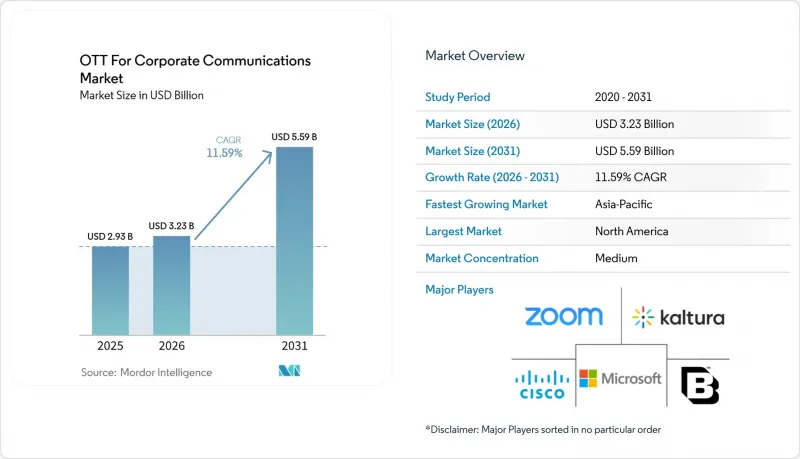
Mordor Intelligence에 의하면, 기업 커뮤니케이션용 OTT 시장 규모는 2025년 29억 3,000만 달러로 평가되었고, 2026년 32억 3,000만 달러에서 2031년까지 55억 9,000만 달러로 확대될 것으로 예측되며, 2026-2031년 CAGR 11.59%를 나타낼 전망입니다.
본 보고서는 기기 유형별(스마트폰·태블릿, 스마트 TV, 노트북·데스크톱 PC 등), 컨텐츠 유형별(라이브 스트리밍, 온디맨드 동영상, 아카이브 동영상 라이브러리), 최종 사용자 산업별(헬스케어 및 생명과학, 정보기술·통신, 제조, 교육 등) 및 지역별로 분류되어 있습니다. 시장 전망은 금액(달러) 기준으로 제시되어 있습니다.
세계의 기업 커뮤니케이션용 OTT 시장 동향 및 인사이트
안전한 사내외 화상 통신에 대한 수요 증가
규제 대상 기업들은 비디오 시스템이 다른 관리 대상 업무 기록과 동등한 기준을 충족할 것을 기대하게 되었기 때문에 보안은 기업 커뮤니케이션용 OTT 시장의 주요 구매 요인이 되었습니다. MiFID II의 적용을 받는 금융 기업은 관련 전자 통신을 기록하고, 최소 5년간 보관하며, 규제 당국이 검색 및 접근할 수 있도록 유지해야 합니다. 이와 유사한 규정 준수 요건으로 인해 기업 커뮤니케이션용 OTT 시장의 잠재 고객 기반이 확대되고 있습니다. 이는 의료, 법무, 전문 서비스 부문의 팀들도 더욱 강력한 접근 제어, 감사 로그 및 명확한 보존 규칙을 필요로 하기 때문입니다. Digital Samba에 따르면, 규정 준수를 위한 도입에는 저장 시 및 전송 중 암호화, 역할 기반 접근 제어, 감사 로그, 아카이브와의 통합이 필요하며, 이로 인해 전문적인 엔터프라이즈 플랫폼의 가치가 높아지고 있습니다. 또한, 많은 기업이 기밀성이 높은 사내 비디오 트래픽을 모두 표준 멀티테넌트 환경에 저장하기를 원하지 않기 때문에 이러한 추세는 기업 커뮤니케이션용 OTT 시장을 프라이빗 클라우드, 소버린 호스팅, 온프레미스와 같은 대안으로 이끌고 있습니다.
하이브리드 및 분산형 인력의 커뮤니케이션 수요 증가
원격 근무가 가능한 직원들이 사무실 근무와 원격 근무를 결합한 근무 방식을 지속하고 있기 때문에 하이브리드 근무는 여전히 기업 커뮤니케이션용 OTT 시장의 구조적 수요를 견인하고 있습니다. 갤럽(Gallup)의 보고서에 따르면, 2026년에는 원격 근무가 가능한 미국 직원의 53%가 하이브리드 근무 형태로 일할 것으로 예상되며, 이는 시차나 일정이 다른 환경에서의 커뮤니케이션에 있어 비동기식 사내 화상 통신의 중요성을 부각시키고 있습니다. 기업 커뮤니케이션용 OTT 시장은 이러한 추세로부터 혜택을 보고 있습니다. 전사 회의, 신입사원 교육, 경영진의 최신 정보 공유에서 실시간 참여가 더 이상 유일한 요건이 아니기 때문입니다. 또한 마이크로소프트의 조사에 따르면, 직장에서의 AI 도입은 시스템 통합 및 관리직 지원과 밀접하게 연관되어 있습니다. 이는 화상 도구가 고립된 채널로 존재하는 것이 아니라, 일상적인 워크플로우에 자연스럽게 녹아들어야 함을 의미합니다. 그 결과, 기업들은 실시간 이벤트와 다시 보기를 모두 지원하는 상시 가동형 화상 허브에 대한 투자를 늘리고 있으며, 이로 인해 기업 커뮤니케이션용 OTT 시장은 일회성 이벤트용 소프트웨어보다 안정적인 이용 패턴을 보이고 있습니다.
기존 기업 시스템과의 통합 복잡성
비디오 플랫폼은 ID 관리 시스템, 인사 도구, 학습 시스템, 아카이브 환경과 연동되어야 하기 때문에 통합 작업은 여전히 기업 커뮤니케이션용 OTT 시장의 큰 걸림돌이 되고 있습니다. 마이크로소프트의 조사에 따르면, AI 도입의 성공 여부는 도구가 기존 시스템과 얼마나 원활하게 통합되느냐에 크게 좌우되며, 이는 단편적인 도입이 아닌 워크플로우와의 심층적인 통합이 필요함을 뒷받침합니다. 기업이 SSO(단일 로그인), 규정 준수 아카이브, 직원 디렉터리를 단일 환경으로 통합할 기술 자원이 부족한 경우, 기업 커뮤니케이션용 OTT 시장의 성장은 둔화될 것입니다. 이는 중견 기업에게 더 심각한 문제입니다. 중견 기업은 엔터프라이즈급 기능을 원하는 경우가 많은 반면, 대규모 세계 기업과 같은 사내 통합 팀을 보유하고 있지 않은 경우가 많기 때문입니다. 벤더는 미리 구축된 커넥터를 사용하여 이러한 마찰의 일부를 완화할 수는 있지만, 레거시 환경이 고도로 맞춤화된 곳에서는 기업용 커뮤니케이션 시장에서 OTT의 확산이 여전히 더딘 경향이 있습니다.
부문 분석
2025년, 노트북과 데스크톱 PC는 기업 커뮤니케이션용 OTT 시장의 47.16%를 차지했으며, 관리되는 워크스테이션이 여전히 기업용 비디오의 주요 접속 지점임을 보여줍니다. 기업 커뮤니케이션용 OTT 시장에서 이러한 기기들은 기존 사무실 워크플로우에 잘 부합하기 때문에 주문형 교육, 다시 보기, 정책 업데이트 및 일상적인 사내 커뮤니케이션에 적합합니다. 스마트폰 및 태블릿은 특히 지정된 데스크톱 환경에 의존하지 않는 제조, 물류, 소매 업계의 현장 팀에서 두 번째 접속 계층을 형성하고 있습니다. 이를 통해 시청 세션이 짧고 업무 중심인 경우에도, 사무직 이외의 역할에서도 기업 커뮤니케이션용 OTT 시장의 중요성이 유지되고 있습니다.
스마트 TV는 2026-2031년 연평균 성장률(CAGR) 12.57%를 나타낼 것으로 예측되며, 기업이 회의실, 경영진 브리핑 공간, 직원 공용 구역 등으로 비디오 활용을 확대함에 따라 이 기기 부문의 기업 커뮤니케이션용 OTT 시장도 성장하고 있습니다. 이러한 변화가 중요한 이유는 스마트 TV를 활용함으로써 기업이 리더십 메시지나 사내 뉴스를 개별 사용자가 매번 로그인할 필요 없이 그룹 단위로 전달할 수 있기 때문입니다. 기업 커뮤니케이션용 OTT 시장에서 이는 업무 환경 내 개인 시청에서 공유 화면을 통한 커뮤니케이션으로의 광범위한 전환을 촉진하는 요인입니다. 다양한 화면 유형에 걸쳐 앱 배포, 기기 관리, 재생의 일관성을 최적화하는 벤더는 기업의 시청 습관이 점점 더 다양해짐에 따라 입지를 강화할 가능성이 높습니다.
지역별 분석
2025년, 북미는 기업 커뮤니케이션용 OTT 시장 점유율의 38.14%를 차지했으며, 지역별 최대 기여도를 기록했습니다. 이 지역은 대기업이 밀집된 기반, 하이브리드 근무의 광범위한 도입, 그리고 사내 비디오에 대한 공식적인 거버넌스에 대한 강력한 수요라는 이점을 누리고 있습니다. 갤럽과 마이크로소프트는 모두 하이브리드 근무의 정착과 AI를 활용한 워크플로우의 확대를 지적하고 있으며, 이러한 요인들이 이 지역의 기업들이 실시간 및 비동기식 커뮤니케이션을 모두 지원하는 비디오 시스템에 대한 투자를 지속하고 있는 이유를 설명합니다. 기업 커뮤니케이션용 OTT 시장에서 미국은 여전히 수요의 주요 원천으로 남아 있습니다. 이는 금융 서비스, 의료, 기술 분야의 구매 담당자들이 예산 여력과 규정 준수 압박을 동시에 안고 있기 때문입니다. 캐나다와 멕시코의 기업 커뮤니케이션용 OTT 시장은 규모는 작지만, 안정적인 사내 비디오 전송이 필요한 국경을 초월한 기업 활동과 분산형 팀 구조의 혜택을 받고 있습니다.
유럽은 여전히 2위의 규모를 자랑하며, 이 지역의 기업 커뮤니케이션용 OTT 시장은 GDPR(EU 개인정보보호규정) 및 규제 대상 환경에서의 영상 기록 의무에 의해 크게 형성되고 있습니다. Digital Samba에 따르면, 규정 준수를 준수하는 금융 분야의 동영상 도입에는 명확한 보존 기간, 감사 로그, EU 중심의 인프라 제어가 필요하며, 이것이 지역 고유의 호스팅 및 거버넌스 기능에 대한 수요를 뒷받침하고 있습니다. 독일, 영국, 프랑스의 기업 커뮤니케이션용 OTT 시장은 데이터 관리, 인증 및 공식적인 아카이빙 관행을 더욱 중시하는 기업 구매자들에 의해 뒷받침되고 있습니다. 이로 인해 유럽의 조달 활동은 편의성보다 규정 준수를 중시하는 경향이 있으며, 데이터 레지던시 및 정책 프레임워크가 더욱 견고한 공급업체에게 유리하게 작용할 가능성이 있습니다.
아시아태평양은 2031년까지 연평균 성장률(CAGR) 12.08%를 나타낼 것으로 예측되며, 대규모 서비스 허브와 다국적 기업이 분산된 직원을 대상으로 사내 비디오 이용을 확대함에 따라 이 지역의 기업 커뮤니케이션용 OTT 시장 규모는 확대되고 있습니다. 인도의 기업 커뮤니케이션용 OTT 시장은 거점 간 신속한 온보딩, 교육 및 팀 간 협업에 의존하는 기술 서비스와 아웃소싱 활동에 힘입어 성장하고 있습니다. 아시아태평양의 일부 국가에서는 데스크톱 중심의 컨텐츠 제공보다 모바일 시청이 더 중시되고 있으며, 이는 경량 앱이나 적응형 스트리밍과 같은 설계상의 우선순위에 영향을 미치고 있습니다. 중동 및 아프리카의 기업 커뮤니케이션용 OTT 시장은 아직 발전 초기 단계에 있지만, Mangomolo사는 2026년 유럽, 중동 및 아프리카 전역의 고객을 대상으로 AI 기반 개인화 및 워크플로우 통합 기능을 도입하여 자사의 OTT 플랫폼을 지속적으로 강화할 것이라고 보고했습니다. 이러한 플랫폼 확장은 해당 지역의 인프라가 더욱 고도화되고 있음을 보여주며, 이에 따라 도입이 진행 중인 시장에서 기업 내 스트리밍 도입의 타당성이 점차 높아질 것으로 예측됩니다.
기타 혜택 :
- 엑셀 형식 시장 예측(ME) 시트
- 3개월간의 애널리스트 지원
자주 묻는 질문
목차
제1장 서론
제2장 조사 방법
제3장 주요 요약
제4장 시장 구도
제5장 시장 규모 및 성장 예측
제6장 경쟁 구도
제7장 시장 기회 및 향후 전망
AJY 26.09.03According to Mordor Intelligence, the OTT for corporate communications market size is projected to expand from USD 2.93 billion in 2025 and USD 3.23 billion in 2026 to USD 5.59 billion by 2031, registering a CAGR of 11.59% between 2026 and 2031.
This report is Segmented by Device Type (Smartphones and Tablets, Smart TVs, Laptops and Desktops, and More), Content Type (Live Streaming, On-Demand Video, and Archived Video Libraries), End User Industry (Healthcare and Life Sciences, Information Technology and Telecommunications, Manufacturing, Education, and More), and Geography. The Market Forecasts are Provided in Terms of Value (USD).
Global OTT For Corporate Communications Market Trends and Insights
Rising Demand for Secure Internal and External Video Communications
Security has become a core buying factor in the OTT for corporate communications market, as regulated enterprises now expect video systems to meet the same standards as other controlled business records. Financial firms covered by MiFID II must record relevant electronic communications, retain them for at least 5 years, and keep them searchable and accessible for regulators. The same compliance logic is expanding the addressable base for the OTT corporate communications market, as healthcare, legal, and professional services teams also need stronger access controls, audit logs, and defined retention rules. Digital Samba states that compliant deployments require encryption at rest and in transit, role-based access control, audit logging, and archival integration, thereby enhancing the value of specialized enterprise platforms. This is also pushing the OTT for corporate communications market toward private cloud, sovereign hosting, and on-premises options, as many enterprises do not want all sensitive internal video traffic to reside in a standard multi-tenant setup.
Growth of Hybrid and Distributed Workforce Communication Needs
Hybrid work remains a structural demand driver for the OTT corporate communications market, as remote-capable employees continue to work across a mix of office and remote work patterns. Gallup reported that 53% of remote-capable U.S. employees worked in hybrid arrangements in 2026, which underscores the importance of asynchronous internal video for communication across time zones and schedules. The OTT for corporate communications market benefits from this pattern because live attendance is no longer the only expectation for all-hands meetings, onboarding, and executive updates. Microsoft also shows that AI adoption at work is tied closely to system integration and manager support, which means video tools now need to fit naturally into daily workflows rather than stand apart as isolated channels. As a result, enterprises are spending more on persistent video hubs that support both live events and replay access, which gives the OTT for corporate communications market a steadier usage pattern than one-time event software.
Integration Complexity with Legacy Enterprise Systems
Integration work remains a major brake on the OTT for corporate communications market because video platforms need to connect with identity systems, HR tools, learning systems, and archiving environments. Microsoft shows that successful AI adoption depends heavily on how well tools integrate with existing systems, reinforcing the need for deep workflow integration rather than isolated deployment. This slows the OTT for the corporate communications market when enterprises lack the technical resources to link SSO, compliance archives, and employee directories into a single experience. It is a sharper issue for mid-sized companies because they often want enterprise-grade capabilities but lack the same internal integration teams as large global buyers. Vendors can reduce some of this friction with prebuilt connectors, but the OTT for corporate communications market still faces slower rollouts wherever legacy environments remain heavily customized.
Other drivers and restraints analyzed in the detailed report include:
- AI-Enabled Video Search, Transcription, and Summarization
- Expansion of Branded Corporate Video Portals and Apps
- Data Privacy, Security, and Access Control Challenges
For complete list of drivers and restraints, kindly check the Table Of Contents.
Segment Analysis
Laptops and desktops accounted for 47.16% of OTT for corporate communications market in 2025, indicating that managed workstations remained the primary access point for enterprise video. In the OTT for corporate communications market, these devices still suit on-demand training, replay viewing, policy updates, and routine internal communications because they fit established office workflows. Smartphones and tablets formed the second access tier, especially for frontline teams in manufacturing, logistics, and retail that do not rely on assigned desktop setups. This keeps the OTT for corporate communications market relevant outside desk-based roles, even when viewing sessions are shorter and more task-driven.
Smart TVs are projected to grow at a 12.57% CAGR from 2026 to 2031, and the OTT for corporate communications market for this device segment is growing as enterprises extend video to conference rooms, executive briefing spaces, and shared employee areas. The shift matters because smart TVs enable companies to distribute leadership messages and corporate news to groups without requiring individual logins at every moment. In the OTT for corporate communications market, this also supports a broader move from personal viewing to shared-screen communication in operational settings. Vendors that optimize app delivery, device management, and playback consistency across multiple screen types are likely to strengthen their position as enterprise viewing habits become more mixed.
Complete Report Scope:
- By Device Type
- Smartphones and Tablets
- Smart TVs
- Laptops and Desktops
- Other Device Types
- By Content Type
- Live Streaming
- On-Demand Video
- Archived Video Libraries
- By End User Industry
- BFSI
- Healthcare and Life Sciences
- Information Technology and Telecommunications
- Manufacturing
- Retail and Consumer Goods
- Education
- Other End User Industries
- By Geography
- North America
- United States
- Canada
- Mexico
- South America
- Brazil
- Argentina
- Chile
- Rest of South America
- Europe
- Germany
- United Kingdom
- France
- Italy
- Spain
- Rest of Europe
- Asia-Pacific
- China
- Japan
- India
- South Korea
- Australia
- Rest of Asia-Pacific
- Middle East
- Saudi Arabia
- United Arab Emirates
- Qatar
- Rest of Middle East
- Africa
- South Africa
- Egypt
- Nigeria
- Rest of Africa
- North America
Geography Analysis
North America held 38.14% of the OTT for corporate communications market share in 2025, which made it the largest regional contributor. The region benefits from a dense base of large enterprises, broad hybrid work adoption, and stronger demand for formal governance around internal video. Gallup and Microsoft both point to persistent hybrid work and growing AI-enabled workflows, which help explain why enterprises in this region continue to invest in video systems that support both live and asynchronous communication. In the OTT for corporate communications market, the United States remains the main source of demand because financial services, healthcare, and technology buyers have both budget capacity and compliance pressure. The OTT for corporate communications market in Canada and Mexico is smaller, but it still benefits from cross-border enterprise operations and distributed team structures that require stable internal video delivery.
Europe remained the second-largest region, and the OTT for corporate communications market there is shaped strongly by GDPR and video recording obligations in regulated settings. Digital Samba states that compliant financial video deployments need clear retention, audit logging, and EU-centered infrastructure controls, which supports demand for region-specific hosting and governance features. The OTT for corporate communications market in Germany, the United Kingdom, and France is supported by enterprise buyers that place more weight on data control, certification, and formal archiving practices. This makes European procurement more compliance-led than convenience-led, which can favor vendors with stronger data residency and policy frameworks.
Asia-Pacific is projected to grow at a 12.08% CAGR through 2031, and the OTT for corporate communications market size for this region is strengthening as large service hubs and multinational employers scale internal video across dispersed workforces. The OTT for corporate communications market in India is supported by technology services and outsourcing activity that depends on rapid onboarding, training, and team alignment across locations. In several Asia-Pacific countries, mobile viewing matters more than desktop-first delivery, which affects design priorities such as lighter apps and adaptive streaming. The OTT for corporate communications market in the Middle East and Africa is earlier in development, but Mangomolo reported continued enhancement of its OTT platform in 2026 with AI personalization and workflow integration for clients across Europe, the Middle East, and Africa. That kind of platform expansion shows that regional infrastructure is becoming more capable, which should gradually improve the enterprise case for internal streaming across newer adoption markets.
- Microsoft Corporation
- Zoom Video Communications, Inc.
- Cisco Systems, Inc.
- Kaltura, Inc.
- Brightcove, Inc.
- Panopto, Inc.
- Vimeo, Inc.
- Vidyard, Inc.
- Haivision Systems Inc.
- Kollective Technology, Inc.
- Vbrick Systems, Inc.
- MediaPlatform, Inc.
- Wistia, Inc.
- Dacast, Inc.
- IBM Corporation
- Adobe Inc.
- Amazon Web Services, Inc.
- Google LLC
- RingCentral, Inc.
- Staffbase GmbH
- Firstup, Inc.
- Poppulo
- Simpplr Inc.
- LumApps
- Workvivo Limited
Additional Benefits:
- The market estimate (ME) sheet in Excel format
- 3 months of analyst support
TABLE OF CONTENTS
1 INTRODUCTION
- 1.1 Study Assumptions and Market Definition
- 1.2 Scope of The Study
2 RESEARCH METHODOLOGY
3 EXECUTIVE SUMMARY
4 MARKET LANDSCAPE
- 4.1 Market Overview
- 4.2 Market Drivers
- 4.2.1 Rising Demand for Secure Internal and External Video Communications
- 4.2.2 Growth of Hybrid and Distributed Workforce Communication Needs
- 4.2.3 Expansion of Branded Corporate Video Portals and Apps
- 4.2.4 AI-Enabled Video Search, Transcription, and Summarization
- 4.2.5 Content Governance, Archiving, and Compliance Requirements
- 4.2.6 Shift Toward Measurable Communications Analytics
- 4.3 Market Restraints
- 4.3.1 Integration Complexity With Legacy Enterprise Systems
- 4.3.2 Data Privacy, Security, and Access Control Challenges
- 4.3.3 High Cost of Managed Streaming and Broadcast-Grade Workflows
- 4.3.4 User Adoption Friction Across Multiple Communication Channels
- 4.4 Industry Value Chain Analysis
- 4.5 Regulatory Landscape
- 4.6 Technological Outlook
- 4.7 Porter's Five Forces Analysis
- 4.7.1 Bargaining Power of Buyers
- 4.7.2 Bargaining Power of Suppliers
- 4.7.3 Threat of New Entrants
- 4.7.4 Threat of Substitutes
- 4.7.5 Intensity of Competitive Rivalry
- 4.8 Impact of Macroeconomic Factors on the Market
5 MARKET SIZE AND GROWTH FORECASTS (VALUE)
- 5.1 By Device Type
- 5.1.1 Smartphones and Tablets
- 5.1.2 Smart TVs
- 5.1.3 Laptops and Desktops
- 5.1.4 Other Device Types
- 5.2 By Content Type
- 5.2.1 Live Streaming
- 5.2.2 On-Demand Video
- 5.2.3 Archived Video Libraries
- 5.3 By End User Industry
- 5.3.1 BFSI
- 5.3.2 Healthcare and Life Sciences
- 5.3.3 Information Technology and Telecommunications
- 5.3.4 Manufacturing
- 5.3.5 Retail and Consumer Goods
- 5.3.6 Education
- 5.3.7 Other End User Industries
- 5.4 By Geography
- 5.4.1 North America
- 5.4.1.1 United States
- 5.4.1.2 Canada
- 5.4.1.3 Mexico
- 5.4.2 South America
- 5.4.2.1 Brazil
- 5.4.2.2 Argentina
- 5.4.2.3 Chile
- 5.4.2.4 Rest of South America
- 5.4.3 Europe
- 5.4.3.1 Germany
- 5.4.3.2 United Kingdom
- 5.4.3.3 France
- 5.4.3.4 Italy
- 5.4.3.5 Spain
- 5.4.3.6 Rest of Europe
- 5.4.4 Asia-Pacific
- 5.4.4.1 China
- 5.4.4.2 Japan
- 5.4.4.3 India
- 5.4.4.4 South Korea
- 5.4.4.5 Australia
- 5.4.4.6 Rest of Asia-Pacific
- 5.4.5 Middle East
- 5.4.5.1 Saudi Arabia
- 5.4.5.2 United Arab Emirates
- 5.4.5.3 Qatar
- 5.4.5.4 Rest of Middle East
- 5.4.6 Africa
- 5.4.6.1 South Africa
- 5.4.6.2 Egypt
- 5.4.6.3 Nigeria
- 5.4.6.4 Rest of Africa
- 5.4.1 North America
6 COMPETITIVE LANDSCAPE
- 6.1 Market Concentration
- 6.2 Strategic Moves
- 6.3 Vendor Positioning Analysis
- 6.4 Company Profiles (includes Global Level Overview, Market Level Overview, Core Segments, Financials as available, Strategic Information, Market Rank/Share, Products and Services, Recent Developments)
- 6.4.1 Microsoft Corporation
- 6.4.2 Zoom Video Communications, Inc.
- 6.4.3 Cisco Systems, Inc.
- 6.4.4 Kaltura, Inc.
- 6.4.5 Brightcove, Inc.
- 6.4.6 Panopto, Inc.
- 6.4.7 Vimeo, Inc.
- 6.4.8 Vidyard, Inc.
- 6.4.9 Haivision Systems Inc.
- 6.4.10 Kollective Technology, Inc.
- 6.4.11 Vbrick Systems, Inc.
- 6.4.12 MediaPlatform, Inc.
- 6.4.13 Wistia, Inc.
- 6.4.14 Dacast, Inc.
- 6.4.15 IBM Corporation
- 6.4.16 Adobe Inc.
- 6.4.17 Amazon Web Services, Inc.
- 6.4.18 Google LLC
- 6.4.19 RingCentral, Inc.
- 6.4.20 Staffbase GmbH
- 6.4.21 Firstup, Inc.
- 6.4.22 Poppulo
- 6.4.23 Simpplr Inc.
- 6.4.24 LumApps
- 6.4.25 Workvivo Limited
7 MARKET OPPORTUNITIES AND FUTURE OUTLOOK
- 7.1 White-Space and Unmet-Need Assessment


