

|
시장보고서
상품코드
2099287
병원 자산 추적용 AI 시장 : 시장 점유율 분석, 업계 동향 및 통계, 성장 예측(2026-2031년)AI In Hospital Asset Tracking - Market Share Analysis, Industry Trends & Statistics, Growth Forecasts (2026 - 2031) |
||||||
 Mordor Intelligence
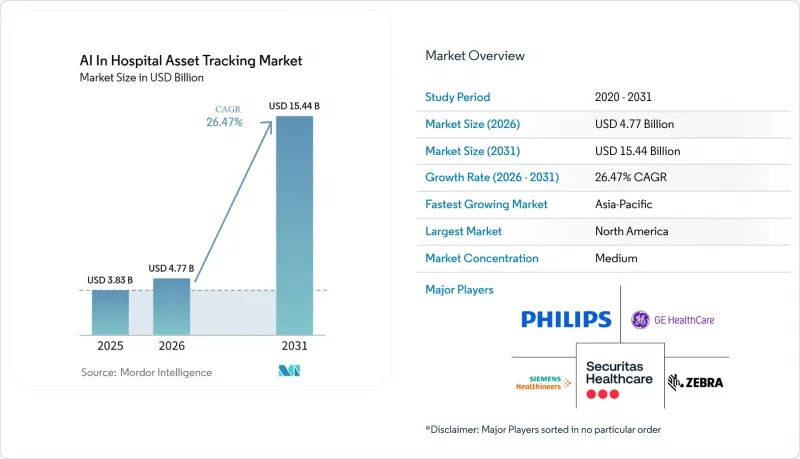
Mordor Intelligence에 의하면, 병원 자산 추적용 AI 시장 규모는 2025년에 38억 3,000만 달러로 평가되었고, 2026년 47억 7,000만 달러에서 2031년까지 154억 4,000만 달러에 이를 것으로 예측되며, 예측 기간(2026-2031년) CAGR은 26.47%를 나타낼 전망입니다.
본 보고서는 기술별(RFID, RTLS, 기타), 구성 요소별(하드웨어, 소프트웨어, 서비스), 제품 유형별(모바일 기기, 기타), 용도별(의료기기·기구 추적, 기타), 최종 사용자별(병원, 기타), 지역별(북미, 유럽, 아시아태평양, 중동 및 아프리카, 남미)로 분류되어 있습니다. 시장 전망은 금액(달러) 기준으로 제시되어 있습니다.
세계의 병원 자산 추적용 AI 시장 동향 및 인사이트
자산의 지속적인 가시화를 위한 AI 탑재 RFID 및 RTLS 도입 확대
기존 RFID 시스템은 고정된 판독 지점에서 자산을 식별했으나, 병원 자산 추적용 AI 시장은 현재 여러 병원 부서에 걸친 워크플로우 분석, 이용 현황 모델링 및 운영 알림에 활용할 수 있는 지속적인 위치 정보 스트림으로 전환되고 있습니다. RAIN Alliance의 보고서에 따르면, 2025년에는 전 세계적으로 427억 개의 RAIN RFID 태그 칩이 출하될 것으로 예상되며, 해당 단체는 의료 및 제약 분야에서 의약품 관리, 수술용 자산 관리, 규정 준수 추적 등 각 영역에서 도입이 심화되고 있다고 지적하고 있습니다. 이는 병원 내 도입이 태그 공급 기반의 광범위한 양산화의 혜택을 받고 있음을 보여줍니다. 출하 규모 확대에 따라 태그 단위당 비용이 개선됨에 따라, 대상 자산의 범위는 고가치 자본 자산에 그치지 않고, 기존의 추적 프로그램에서는 대상에서 제외되기 쉬웠던 휴대용 모니터, 수액 세트, 공유 의료기기 등 중가치 범주까지 확대되고 있습니다. HIMSS 2026에서 CenTrak이 발표한 ‘AI-Enhanced AssetsRT’는 벤더가 전체 자산군의 위치 정보를 자연어 분석 워크플로로 변환하는 과정을 보여주며, 이를 통해 병원이 과거 전문 정보과학 팀을 통해 담당하던 보고 부담이 경감되고 있습니다. 따라서 병원 자산 추적용 AI 시장은 수동적인 데이터 수집에서 능동적인 운영 인텔리전스로 전환되고 있으며, 이러한 변화로 인해 보다 정교한 분석이나 하이브리드 위치 추적 모델을 지원하지 못하는 레거시 시스템의 교체 주기가 빨라지고 있습니다. 이러한 전환은 벤더가 기존 고객사의 도입 범위를 확대하는 데에도 도움이 되고 있습니다. 자본 설비부터 도입을 시작한 병원이라도 지속적인 가시화 체계가 갖춰지면, 직원, 소모품, 워크플로우 자동화로 범위를 확대해 나가는 경향이 있기 때문입니다.
장비 검색 시간 단축과 유휴 자산으로 인한 낭비 절감의 필요성
병원 자산 관리를 위한 AI 시장의 확산은 장비 검색에 소요되는 시간으로 인한 직접적인 운영 비용과 소유·임대 자산의 활용 부족에 따른 경제적 손실에도 힘입고 있습니다. Vizzia Technologies와 조지아 주립대학교가 발표한 백서에 따르면, 간호사는 1교대당 최대 60분을 장비 검색에 소비하고 있으며, 이는 미국 병원에서 연간 약 140억 달러의 생산성 손실로 이어지고 있는 것으로 추정됩니다. 이 때문에 경영진과 임상 리더 모두에게 투자 대비 효과에 대한 명확한 이점이 지속적으로 인식되고 있습니다. 이와 유사한 운영상의 문제는 임대 장비에도 미치고 있습니다. 자산 대장이 불완전하거나 오래된 경우, 병원은 복도나 옷장, 보관 장소에 방치된 채로 있는 장비에 대해 지속적인 임대료를 지불해야 하는 경우가 많기 때문입니다. 병원 자산 관리를 위한 AI 시장 활용에서 AI 기반 검색 도구가 중요한 이유는 병상 옆에서 근무하는 직원이 치료 구역을 떠나 각 병동이나 보관실을 수작업으로 수색하는 대신, 간단한 자연어 기반 워크플로우를 통해 장비의 위치를 파악할 수 있기 때문입니다. 이는 병원이 추적 시스템을 노동 생산성 향상, 환자 처리 능력 유지, 그리고 보다 체계적인 장비 구매와 직접 연계하게 됨에 따라, 그 가치에 대한 논의가 더 이상 재고 감소에만 국한되지 않게 되었음을 의미합니다.
초기 도입 비용 및 수명 주기 유지 비용의 높음
병원 자산 관리를 위한 AI 시장은 여전히 큰 도입 장벽에 직면해 있습니다. 병원이 측정 가능한 수익을 실현하려면 캠퍼스 전체에 걸쳐 RTLS를 도입함에 있어 리더, 게이트웨이, 태그, 네트워크 설계, 시설 매핑, 시스템 통합, 워크플로우 설정 등에 대한 조율된 지출이 필요하기 때문입니다. 이러한 부담은 인프라 범위가 넓고 내부 승인 주기가 긴 대규모 교육 병원이나 공립 병원 시스템에서 특히 두드러집니다. SaaS 및 관리형 서비스 모델을 통해 소규모 시설이나 외래 진료 환경에서는 이 문제가 완화되고 있지만, 여러 건물로 구성된 네트워크의 경우 초기 구매 가격뿐만 아니라 시스템의 전체 운영 기간을 평가해야 하기 때문에 병원 자산 추적용 AI 시장에서는 여전히 의사 결정이 지연되는 현상이 나타나고 있습니다. 이로 인해 시장은 견조한 성장 궤도를 유지하고 있지만, 단계적 도입의 가치와 위험이 낮은 구현 모델을 입증할 수 있는 벤더가 유리한 입장에 있습니다.
부문 분석
2025년, RFID는 기술 매출의 43.39%를 차지했으며, 병원 자산 추적용 AI 시장에서 가장 큰 기술 분야가 되었습니다. 이는 오랜 기간에 걸친 프로토콜의 성숙도, 안정적인 판독 성능, 그리고 병원 공급망 업무 흐름과의 깊은 호환성을 반영한 결과입니다. 이러한 위상은 GS1 SGTIN 인코딩과의 호환성은 물론, 추적 가능한 식별 정보가 여전히 가장 중요하게 여겨지는 멸균 처리, 약품 캐비닛 관리, 수술 키트 관리와 같은 실무상의 요구에 의해 뒷받침되어 왔습니다. RTLS는 가장 빠르게 성장하는 기술로, 2026-2031년 연평균 성장률(CAGR) 27.83%를 나타낼 것으로 전망됩니다. 이는 병원이 배송, 사용 및 직원 안전 확보와 관련된 워크플로우에서 단순한 판독 시점의 확인뿐만 아니라 지속적인 위치 정보 스트림을 점점 더 요구하고 있기 때문입니다. 병원 자산 관리를 위한 AI 시장의 이 분야에서 주요 변화는 RFID의 유용성 저하가 아니라, 실시간 데이터 품질과 임상 워크플로우 내에서 해당 데이터를 활용할 수 있는 분석 기능에 대한 평가가 높아지고 있다는 점에 있습니다.
병원 측은 서로 연동되지 않는 여러 시스템을 구축하지 않고도 캠퍼스 전체를 가시화하고, 방 단위의 정확도를 확보하고자 하기 때문에 기술 경쟁은 하이브리드 설계로 전환되고 있습니다. 바코드 스캐너는 수동 검증이 여전히 비용 대비 효과가 높은 긴급도가 낮은 환경이나 접수 워크플로우에서 여전히 유용하며, 반면 초음파 태그나 적외선 태그는 정확도 요건이 추가적인 인프라 투자를 정당화하는 특정 소아과나 행동 의학 환경에서 그 중요성을 유지하고 있습니다. 병원 자산 추적용 AI 분야에서는 RFID가 식별 및 규정 준수의 핵심적인 역할을 계속 담당하는 반면, RTLS는 워크플로우의 지능화 및 업무 자동화 분야에서 더 빠른 성장을 이루고 있습니다.
2025년에는 소프트웨어와 분석이 구성 요소별 매출의 55.41%를 차지했습니다. 이는 병원 자산 추적용 AI 시장에서 가치의 중심이 이미 하드웨어 제공에서 위치 정보를 구체적인 행동으로 변환하는 소프트웨어 계층으로 이동하고 있음을 의미합니다. 병원에서는 자연어 검색, 예측 유지보수 로직, 이용 현황 대시보드, 워크플로우 트리거 등을 첨단 시설에만 한정된 프리미엄 모듈이 아닌 표준적인 요건으로 기대하는 경향이 강해지고 있습니다. 서비스는 가장 빠르게 성장하는 분야로, 2026-2031년 연평균 성장률(CAGR) 26.71%가 예상됩니다. 이는 도입, 모델 튜닝, 전자건강기록(EMR)과의 통합, 조직 변화 관리와 같은 업무를 병원이 전적으로 자체적으로 수행하는 것이 여전히 어렵기 때문입니다. 병원 자산 추적용 AI 시장 규모에서 이 비중은 계약액의 확대와 지속적인 수익 증가를 시사합니다. 초기 하드웨어 도입이 완료된 후에도 소프트웨어 환경과 관련된 서비스는 계속 성장하기 때문입니다.
하드웨어가 여전히 중요한 이유는 리더의 신뢰성, 태그의 형태, 그리고 판독 정확도가 소프트웨어 모델이 사용하는 데이터의 품질을 결정하기 때문입니다. 2025년 6월에 발표되었으며, 120개 이상의 병원에 걸쳐 있는 25개 의료 시스템과 공동 개발된 PartsSource사의 'Asset Uptime' 플랫폼은 소프트웨어 및 서비스가 CMMS 데이터, 장치 모니터링, 공급망 정보를 통합하여 보다 광범위한 자산 건전성 기록으로 연결하는 방법을 보여주었습니다. 그 결과, 하드웨어는 여전히 필수적이지만 소프트웨어가 최대의 수익 점유율을 차지하고, 서비스가 도입 및 최적화 업무량에서 점점 더 큰 비중을 차지하는 ‘두 가지 속도’를 지닌 구성 패턴이 형성되고 있습니다. 이는 병원 자산 관리를 위한 AI 시장이 더 이상 일회성 인프라 구매가 아닌, 지속적인 운영 플랫폼으로 평가받고 있음을 보여주는 가장 명확한 징후 중 하나입니다.
지역별 분석
2025년, 북미는 전 세계 매출의 41.52%를 차지하며 병원 자산 추적용 AI 시장에서 가장 규모가 큰 지역 기여자가 되었습니다. 이는 높은 도입 기반 밀도, 성숙한 임상 공학 기능, 그리고 RTLS 도입과 의료 시스템 워크플로우 재설계의 긴밀한 연계가 반영된 결과입니다. 또한, 에픽(Epic)을 중심으로 한 통합 경로도 병원이 추적 데이터를 독립된 운영 대시보드에 남기는 대신 임상 워크플로우에 통합하도록 용이하게 함으로써 도입 가속화에 기여했습니다. 캐나다에서는 디지털 활용 및 자산 관리 요소를 포함한 스마트 병원 시범 사업을 통해 기여하고 있는 반면, 멕시코에서는 의료 관광 및 인증 획득 목표와 연계된 민간 병원의 현대화가 호재로 작용하고 있습니다. 이를 종합해 보면, 북미는 규제적 압력, 기존 인프라, 그리고 노동 생산성에 대한 강력한 집중이 맞물려 여전히 병원 자산 추적용 AI 시장의 선두 주자 역할을 수행하고 있습니다.
유럽은 2025년에 지역별 2위 자리를 차지한 것으로 평가되었으며, 독일, 영국, 프랑스가 주도적인 역할을 하고 있습니다. 이 지역에서는 2026년 5월부터 시작되는 EUDAMED의 추적성 워크플로우에 대한 실무 요건에 대비하는 병원이 늘어나고 있어, 규정 준수를 주도하는 추진의 혜택을 받고 있습니다. 또한 프랑스에서는 SESAME 프로그램을 통해 도입을 지원하고 있으며, 이 프로그램에서는 자동화된 의약품 및 의료기기 추적성에 대한 자금 지원 대상으로 160건 이상의 신청 중 34개 병원이 선정되었습니다. 수술 기구 추적 분야에서의 Brady EMEA와 Caretag의 제휴는 유럽 병원들에게 명확한 생산성 향상 사례를 제시하고 있음을 보여줍니다. 이 솔루션은 DataMatrix 스캔에 비해 포장 시간을 33% 이상 단축할 수 있는 것으로 평가받고 있기 때문입니다. 따라서 유럽은 병원 자산 관리를 위한 AI에 대해 규제 기반 수요와, 보다 광범위한 조달을 뒷받침하는 용도 특화형 생산성 실증이라는 두 가지 요소를 모두 제공합니다.
아시아태평양은 2026-2031년 연평균 성장률(CAGR) 29.81%를 나타낼 것으로 예측되어, 가장 빠르게 성장하는 지역이 될 것으로 전망됩니다. 이에 따라 정부 및 대형 병원 그룹이 새로운 인프라 계획에 스마트 병원 기능을 통합해 나감에 따라, 병원 자산 추적용 AI 시장 규모 측면에서 이 지역은 향후 가장 강력한 성장세를 보일 것으로 예측됩니다. 중국의 스마트 병원 건설 계획, 인도의 보험 환급과 연계된 디지털 요건, 그리고 한국의 인증 취득과 연계된 디지털 병원 목표가 여러 방향에서 동시에 수요를 창출하고 있습니다. 중동 및 아프리카은 여전히 초기 단계에 있지만, GCC 시장의 신규 병원 건설 프로젝트의 혜택을 받고 있습니다. 한편, 남미 지역은 여전히 발전의 초기 단계에 있으며, 브라질과 아르헨티나의 민간 병원 투자가 주도적인 역할을 하고 있습니다. 이들 국가에서는 국제 인증 획득 목표가 IoT를 활용한 임상 업무를 뒷받침하고 있습니다.
기타 혜택 :
- 엑셀 형식 시장 예측(ME) 시트
- 3개월간의 애널리스트 지원
자주 묻는 질문
목차
제1장 서론
제2장 조사 방법
제3장 주요 요약
제4장 시장 구도
제5장 시장 규모 및 성장 예측
제6장 경쟁 구도
제7장 시장 기회 및 향후 전망
AJY 26.08.11According to Mordor Intelligence, the AI in hospital asset tracking market size was valued at USD 3.83 billion in 2025 and is estimated to grow from USD 4.77 billion in 2026 to reach USD 15.44 billion by 2031, at a CAGR of 26.47% during the forecast period (2026-2031).
This report is Segmented by Technology (RFID, RTLS, and Others), Component (Hardware, Software, Services), Product Type (Mobile Equipment, and Others), Application (Device and Instruments Tracking, and Others), End-User (Hospitals, and Others), and Geography (North America, Europe, Asia-Pacific, Middle East and Africa, South America). The Market Forecasts are Provided in Terms of Value (USD).
Global AI In Hospital Asset Tracking Market Trends and Insights
Rising Adoption of AI-Enabled RFID and RTLS for Continuous Asset Visibility
Traditional RFID systems identified assets at fixed read points, but the AI in hospital asset tracking market is now moving toward continuous location streams that can feed workflow analytics, utilization modeling, and operational alerts across multiple hospital departments. The RAIN Alliance reported 42.7 billion RAIN RFID tag chips shipped globally in 2025, and it identified healthcare and pharmaceuticals as sectors where adoption is deepening across medication management, surgical asset control, and compliance tracking, which shows that hospital deployments are benefiting from a broader volume curve in the tag supply base.As tag unit economics improve with shipment scale, the addressable pool extends beyond high-value capital assets to mid-value categories such as portable monitors, infusion sets, and shared care equipment that were often left outside earlier tracking programs. CenTrak's AI-Enhanced AssetsRT launch at HIMSS 2026 showed how vendors are turning fleet-wide location data into natural language analytics workflows, which reduces the reporting burden that hospitals once carried through specialist informatics teams. The AI in hospital asset tracking market is therefore shifting from passive capture toward active operational intelligence, and that change is increasing replacement cycles for legacy systems that cannot support richer analytics or hybrid positioning models. This same transition is helping vendors expand deployment scope inside existing accounts, because hospitals that begin with capital equipment often move toward broader staff, supplies, and workflow automation once continuous visibility is in place.
Need to Reduce Equipment Search Time and Idle Asset Waste
The AI in hospital asset tracking market is also being pushed forward by the direct operating cost of lost time around equipment search and by the financial waste tied to underused owned and rented assets. A white paper by Vizzia Technologies and Georgia State University stated that nurses can spend up to 60 minutes per shift locating equipment, contributing to an estimated USD 14 billion in annual productivity loss for U.S. hospitals, which keeps the return case visible to administrators and clinical leaders alike. The same operating problem extends to rental fleets, because hospitals often pay ongoing lease costs for devices that sit idle in hallways, closets, and storage areas when asset registries are incomplete or outdated. In the AI in hospital asset tracking market, AI-enabled search tools matter because bedside staff can locate equipment through simple natural language workflows instead of leaving the care area to conduct manual searches across units and storage rooms. This means the value discussion is no longer limited to shrink reduction, since hospitals now connect tracking directly to labor productivity, throughput protection, and more disciplined equipment purchasing.
High Upfront Installation and Lifecycle Maintenance Costs
The AI in hospital asset tracking market still faces a meaningful adoption barrier because full-campus RTLS deployments require coordinated spending on readers, gateways, tags, network design, facility mapping, systems integration, and workflow configuration before hospitals can realize any measurable return. This burden is especially relevant for large teaching hospitals and public systems where infrastructure scope is broad and internal approval cycles are long. SaaS and managed-service models are easing this issue for smaller sites and ambulatory settings, but the AI in hospital asset tracking market still sees delayed decision timelines when multi-building networks evaluate the full operating life of a system rather than the initial purchase price alone. This keeps the market on a strong growth path, but it also favors vendors that can prove phased deployment value and lower-risk implementation models.
Other drivers and restraints analyzed in the detailed report include:
- Expansion of Smart Hospital Infrastructure and IoT-Ready Clinical Operations
- Regulatory Pressure for Device Traceability and Patient Safety Compliance
- Data Privacy, Cybersecurity, and Clinical Network Integration Risks
For complete list of drivers and restraints, kindly check the Table Of Contents.
Segment Analysis
RFID held 43.39% of technology revenue in 2025, which made it the largest technology layer in the AI in hospital asset tracking market and reflected long-standing protocol maturity, stable read performance, and deep alignment with hospital supply chain workflows. This position has been supported by compatibility with GS1 SGTIN encoding and by the practical needs of sterile processing, drug cabinet control, and surgical kit management where traceable identity still matters most. RTLS is the fastest-growing technology, with a projected 27.83% CAGR from 2026 to 2031, because hospitals increasingly want continuous location streams and not just point-of-read confirmation for dispatch, utilization, and staff protection workflows. In this part of the AI in hospital asset tracking market size, the main shift is not the decline of RFID usefulness, but the widening premium attached to real-time data quality and to analytics that can act on that data within clinical workflows.
The technology contest is moving toward hybrid design because hospitals want campus-wide visibility and room-level accuracy without building multiple disconnected systems. Barcode scanners remain relevant in lower-acuity settings and receiving workflows where manual verification is still cost-effective, while ultrasound and infrared tags retain importance in selected pediatric and behavioral environments where precision requirements justify extra infrastructure. Within the AI in hospital asset tracking industry, this keeps RFID central to identity and compliance while RTLS captures the faster growth in workflow intelligence and operational automation.
Software and analytics accounted for 55.41% of component revenue in 2025, which means the AI in hospital asset tracking market has already moved its value center away from hardware provisioning and toward the software layer that translates location data into action. Hospitals increasingly expect natural language search, predictive maintenance logic, utilization dashboards, and workflow triggers as standard requirements, not as premium modules reserved for advanced sites. Services are the fastest-growing component, with a projected 26.71% CAGR from 2026 to 2031, because implementation, model tuning, EMR integration, and organizational change management remain difficult for hospitals to carry entirely in-house. In the AI in hospital asset tracking market size, this mix points to larger contract values and more recurring revenue, since services keep growing around the software environment even after the initial hardware roll-out is complete.
Hardware still matters because reader reliability, tag form factor, and read fidelity determine the quality of the data that software models use. PartsSource's Asset Uptime platform, announced in June 2025 and co-developed with 25 health systems across more than 120 hospitals, illustrated how software and services can merge CMMS data, device monitoring, and supply chain intelligence into a broader asset health record. The result is a two-speed component pattern where hardware remains essential but software holds the largest revenue share and services captures an increasing share of the implementation and optimization workload. This is one of the clearest signs that the AI in hospital asset tracking market is now being evaluated as an ongoing operational platform and not as a one-time infrastructure purchase.
Complete Report Scope:
- By Technology
- RFID
- RTLS
- Barcode Scanners
- Ultrasound and Infrared Tags
- Bluetooth Low Energy
- By Component
- Hardware
- Software and Analytics
- Services
- By Product Type
- Mobile Equipment
- Fixed Equipment
- Inventories and Consumables
- By Application
- Device and Instruments Tracking
- Staff and Supplies Tracking
- Patient and Visitor Tracking
- Environmental and Condition Monitoring
- By End-User
- Hospitals
- Ambulatory Surgical Centers
- Long-Term Care Facilities
- Other End-Users
- By Geography
- North America
- United States
- Canada
- Mexico
- Europe
- Germany
- United Kingdom
- France
- Italy
- Spain
- Rest of Europe
- Asia-Pacific
- China
- Japan
- India
- Australia
- South Korea
- Rest of Asia-Pacific
- Middle East and Africa
- GCC
- South Africa
- Rest of Middle East and Africa
- South America
- Brazil
- Argentina
- Rest of South America
- North America
Geography Analysis
North America accounted for 41.52% of global revenue in 2025, which made it the largest regional contributor to the AI in hospital asset tracking market and reflected a dense installed base, mature clinical engineering functions, and close alignment between RTLS deployments and health system workflow redesign. Epic-centered integration pathways have also helped speed adoption by making it easier for hospitals to pull tracking data into clinical workflows rather than leaving it in a separate operational dashboard. Canada is contributing through smart hospital pilots that include digital utilization and asset management elements, while Mexico is gaining from private hospital modernization linked to medical tourism and accreditation goals. Taken together, North America still sets the pace for the AI in hospital asset tracking market because it combines regulatory pressure, installed infrastructure, and a strong focus on labor productivity.
Europe held the second-largest regional position in 2025, led by Germany, the United Kingdom, and France, and the region is benefiting from a compliance-led push as hospitals prepare for the practical demands of EUDAMED traceability workflows from May 2026. France is also supporting adoption through the SESAME program, which selected 34 hospitals from more than 160 applicants for automated medication and medical device traceability funding. The Brady EMEA and Caretag partnership in surgical instrument tracking shows how European hospitals are being presented with a clear productivity case, since the solution was positioned to reduce packaging time by more than 33% compared with DataMatrix scanning. Europe therefore gives the AI in hospital asset tracking market a mix of mandate-driven demand and application-specific productivity evidence that supports broader procurement.
Asia-Pacific is projected to be the fastest-growing region, with a projected 29.81% CAGR from 2026 to 2031, and this makes it the strongest future expansion zone in the AI in hospital asset tracking market size as governments and large hospital groups build smart hospital capacity into new infrastructure programs. China's smart hospital construction agenda, India's reimbursement-linked digital requirements, and South Korea's certification-linked digital hospital goals are creating demand from several directions at once. The Middle East and Africa remain earlier-stage but benefit from greenfield hospital projects in GCC markets, while South America is still nascent and is being led by private hospital investment in Brazil and Argentina where international accreditation goals support IoT-enabled clinical operations.
- AiRISTA Flow, Inc.
- Awarepoint Corporation
- Borda Technology
- CenTrak
- Elpas Solutions Ltd.
- GE Healthcare
- Honeywell International
- Impinj, Inc.
- Infor
- Koninklijke Philips
- Midmark
- Qorvo, Inc.
- Securitas Healthcare LLC
- Siemens Healthineers
- Sonitor Technologies AS
- Stanley Black and Decker, Inc.
- TeleTracking Technologies, Inc.
- Versus Technology, Inc.
- Vizzia Technologies, Inc.
- Zebra Technologies
Additional Benefits:
- The market estimate (ME) sheet in Excel format
- 3 months of analyst support
TABLE OF CONTENTS
1 Introduction
- 1.1 Study Assumptions and Market Definition
- 1.2 Scope of the Study
2 Research Methodology
3 Executive Summary
4 Market Landscape
- 4.1 Market Overview
- 4.2 Market Drivers
- 4.2.1 Rising Adoption of AI-Enabled RFID and RTLS for Continuous Asset Visibility
- 4.2.2 Need to Reduce Equipment Search Time and Idle Asset Waste
- 4.2.3 Expansion of Smart Hospital Infrastructure and IoT-Ready Clinical Operations
- 4.2.4 Regulatory Pressure for Device Traceability and Patient Safety Compliance
- 4.2.5 Predictive Maintenance for High-Value Hospital Assets
- 4.2.6 Hybrid Cloud Analytics for Multi-Site Utilization Benchmarking
- 4.3 Market Restraints
- 4.3.1 High Upfront Installation and Lifecycle Maintenance Costs
- 4.3.2 Data Privacy, Cybersecurity, and Clinical Network Integration Risks
- 4.3.3 Radio Frequency Interference and Accuracy Loss in Dense Clinical Environments
- 4.3.4 Battery Replacement, Calibration, and Tag Governance Burden
- 4.4 Supply/Value Chain Analysis
- 4.5 Regulatory Landscape
- 4.6 Technological Outlook
- 4.7 Porter's Five Forces Analysis
- 4.7.1 Threat of New Entrants
- 4.7.2 Bargaining Power of Suppliers
- 4.7.3 Bargaining Power of Buyers
- 4.7.4 Threat of Substitutes
- 4.7.5 Competitive Rivalry
5 Market Size & Growth Forecasts (Value, USD)
- 5.1 By Technology
- 5.1.1 RFID
- 5.1.2 RTLS
- 5.1.3 Barcode Scanners
- 5.1.4 Ultrasound and Infrared Tags
- 5.1.5 Bluetooth Low Energy
- 5.2 By Component
- 5.2.1 Hardware
- 5.2.2 Software and Analytics
- 5.2.3 Services
- 5.3 By Product Type
- 5.3.1 Mobile Equipment
- 5.3.2 Fixed Equipment
- 5.3.3 Inventories and Consumables
- 5.4 By Application
- 5.4.1 Device and Instruments Tracking
- 5.4.2 Staff and Supplies Tracking
- 5.4.3 Patient and Visitor Tracking
- 5.4.4 Environmental and Condition Monitoring
- 5.5 By End-User
- 5.5.1 Hospitals
- 5.5.2 Ambulatory Surgical Centers
- 5.5.3 Long-Term Care Facilities
- 5.5.4 Other End-Users
- 5.6 By Geography
- 5.6.1 North America
- 5.6.1.1 United States
- 5.6.1.2 Canada
- 5.6.1.3 Mexico
- 5.6.2 Europe
- 5.6.2.1 Germany
- 5.6.2.2 United Kingdom
- 5.6.2.3 France
- 5.6.2.4 Italy
- 5.6.2.5 Spain
- 5.6.2.6 Rest of Europe
- 5.6.3 Asia-Pacific
- 5.6.3.1 China
- 5.6.3.2 Japan
- 5.6.3.3 India
- 5.6.3.4 Australia
- 5.6.3.5 South Korea
- 5.6.3.6 Rest of Asia-Pacific
- 5.6.4 Middle East and Africa
- 5.6.4.1 GCC
- 5.6.4.2 South Africa
- 5.6.4.3 Rest of Middle East and Africa
- 5.6.5 South America
- 5.6.5.1 Brazil
- 5.6.5.2 Argentina
- 5.6.5.3 Rest of South America
- 5.6.1 North America
6 Competitive Landscape
- 6.1 Market Concentration
- 6.2 Market Share Analysis
- 6.3 Company Profiles (includes Global level Overview, Market level overview, Core Segments, Financials as available, Strategic Information, Market Rank/Share for key companies, Products & Services, Recent Developments)
- 6.3.1 AiRISTA Flow, Inc.
- 6.3.2 Awarepoint Corporation
- 6.3.3 Borda Technology
- 6.3.4 CenTrak, Inc.
- 6.3.5 Elpas Solutions Ltd.
- 6.3.6 GE Healthcare
- 6.3.7 Honeywell International Inc.
- 6.3.8 Impinj, Inc.
- 6.3.9 Infor
- 6.3.10 Koninklijke Philips N.V.
- 6.3.11 Midmark Corporation
- 6.3.12 Qorvo, Inc.
- 6.3.13 Securitas Healthcare LLC
- 6.3.14 Siemens Healthineers AG
- 6.3.15 Sonitor Technologies AS
- 6.3.16 Stanley Black and Decker, Inc.
- 6.3.17 TeleTracking Technologies, Inc.
- 6.3.18 Versus Technology, Inc.
- 6.3.19 Vizzia Technologies, Inc.
- 6.3.20 Zebra Technologies Corporation
7 Market Opportunities & Future Outlook
- 7.1 White-space & Unmet-need Assessment


