

|
시장보고서
상품코드
2099480
마케팅 기술 서비스 시장 시장 : 점유율 분석, 업계 동향 및 통계, 성장 예측(2026-2031년)Marketing Technology Services Market - Market Share Analysis, Industry Trends & Statistics, Growth Forecasts (2026 - 2031) |
||||||
 Mordor Intelligence
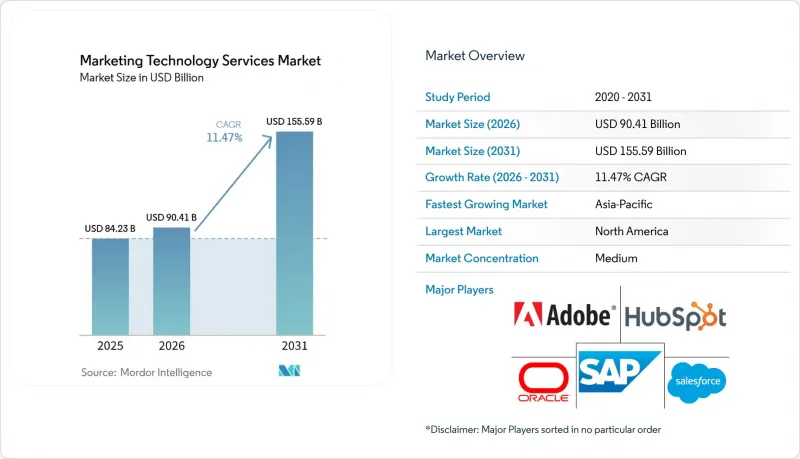
Mordor Intelligence에 의하면, 마케팅 기술 서비스 시장 규모는 2025년 842억 3,000만 달러, 2026년 904억 1,000만 달러에서 2031년까지 1,555억 9,000만 달러로 확대한다고 예측되고 있어 2026년부터 2031년까지 연평균 복합 성장률(CAGR)은 11.47%를 나타낼 전망입니다.
본 보고서는 서비스 유형(컨설팅 서비스, 도입·시스템 통합 등), 도입 형태(클라우드 기반, On-Premise형, 하이브리드형), 기술(마케팅 자동화 플랫폼 등), 기업 규모(대기업, 중소기업), 최종 사용자 산업(BFSI 등) 및 지역별로 분류되어 있습니다. 시장 전망은 금액(달러) 기준으로 제시되어 있습니다.
세계 마케팅 테크놀로지 서비스 시장 동향 및 인사이트
AI 주도 캠페인 오케스트레이션의 가속화
AI 주도 오케스트레이션을 통해 마케팅 서비스는 프로젝트 기반의 캠페인 설정에서 플랫폼에 대한 보다 면밀한 모니터링, 더욱 강력한 워크플로우 관리, 그리고 더 빈번한 모델 튜닝이 필요한 지속적인 운영으로 변화하고 있습니다. Firstsource Solutions는 2026년 4월, Typeface와 제휴하여 규제 환경 하에서 AI 네이티브 마케팅 시스템의 혁신과 운영을 지원하는 풀스택 서비스 'Agentic Marketing Services'를 출시했습니다. 또한 Salesforce도 이러한 변화를 뒷받침했습니다. Agentforce Marketing이 캠페인 관리 기능을 모델 컨텍스트 프로토콜 도구로 공개함에 따라, 팀은 정기적인 수동 설정에만 의존하지 않고 연동된 인터페이스를 통해 고객 여정을 실행할 수 있게 되었습니다. IAB에 따르면, 2026년 광고 구매자의 3분의 2가 캠페인 실행을 위한 AI 에이전트 도입에 주력하고 있으며, 이는 수요가 실험 단계에서 대규모 도입으로 급속히 전환되고 있음을 보여줍니다. 이러한 추세로 인해 서비스 제공업체의 역할은 더욱 중요해지고 있습니다. 왜냐하면 기업들은 현재 브랜드 규칙, 고객 데이터 구조, 채널 수준의 실행 기준에 따라 AI 에이전트의 훈련, 거버넌스, 개선을 수행할 수 있는 파트너를 필요로 하고 있기 때문입니다. 그 결과, 마케팅 기술 서비스 시장에서는 일회성 도입보다 상시 가동형 최적화 작업을 통해 더 큰 가치를 창출하고 있습니다.
통합형 고객 데이터 활용에 대한 수요 증가
통합된 고객 데이터 활용으로의 전환에 따라, 서비스 계약의 기술적 깊이가 더욱 높아지고 있습니다. 이는 브랜드가 고객 프로파일, 분석 환경, 캠페인 실행 계층 간의 보다 견고한 연계를 필요로 하기 때문입니다. CDP Institute의 보고서에 따르면, 컴포저블형 및 웨어하우스 네이티브형 CDP 벤더들은 2025년 하반기 직원 수를 7.8% 증가시켰습니다(업계 평균은 1.3%). 또한 현재 플랫폼의 4분의 1 이상이 웨어하우스 중심 아키텍처를 지원하고 있습니다. 이러한 구분에 따라 두 가지 서비스 트랙이 생겨났습니다. 하나는 패키지형 플랫폼의 신속한 도입에 초점을 맞춘 것이고, 다른 하나는 맞춤형 ID 로직, 리버스 ETL, 활성화 커넥터 및 장기적인 데이터 엔지니어링 지원에 중점을 둔 것입니다. 조합형 아키텍처를 선택하는 기업은 프로파일 해결, 세분화 로직 및 하류 활성화 규칙을 모든 도입 환경에서 표준화할 수 없기 때문에 더 광범위한 통합 계획이 필요한 경우가 많습니다. 따라서 데이터 통합과 실행 설계를 연계할 수 있는 서비스 제공업체는 특히 고객이 더 적은 수의 벤더로 운영 스택의 더 큰 부분을 관리하기를 원할 경우, 구매 주기에서 더 상위 단계로 진출하고 있습니다. 이로 인해 마케팅 기술 서비스 시장은 단순한 소프트웨어 도입에 그치지 않고, 데이터 아키텍처 결정과 밀접하게 연계된 상태를 유지하고 있습니다.
도구의 파편화가 통합 및 거버넌스 비용을 증가시킨다.
도구의 파편화는 여전히 현실적인 제약 요인으로 남아 있습니다. 플랫폼이 하나 늘어날 때마다 데이터 마이그레이션, 거버넌스 검토, 구현 작업, 운영 오버헤드의 계층이 하나씩 추가되기 때문입니다. Fivetran은 2026년 보고서에서 기업이 데이터 통합에 총 데이터 예산의 14%(420만 달러)를 할당하고 있는 반면, 조직은 평균 328개의 데이터 파이프라인을 운영하고 있으며, 이를 유지 관리하는 데 최대 60명의 전담 엔지니어가 투입되고 있다고 지적했습니다. 또한, 데이터 투자가 기대 수익을 상회했다고 응답한 비율은 27%에 그쳤습니다. 마케팅 환경에서는 캠페인 도구, 데이터 웨어하우스, 분석 제품, 동의 관리 시스템이 모두 거의 실시간으로 이용 가능한 정보를 교환해야 하기 때문에 이러한 압박을 통제하기가 더욱 어려워집니다. 구매 담당자들은 총 운영 비용, 공급업체 간의 중복, 그리고 구식 연결을 해소하는 데 필요한 노력을 면밀히 검토할 수 있을 때까지 새로운 도입 계획을 연기하는 경우가 많습니다. 서비스 제공업체는 여전히 합리화 프로젝트를 통해 이익을 얻을 수 있지만, 이러한 프로젝트는 일반적으로 실행에 들어가기 전에 보다 상세한 조사 작업과 광범위한 거버넌스 검토가 필요합니다. 이로 인해 의사 결정 속도가 느려지고, 마케팅 기술 서비스 시장이 수요를 계약 수익으로 전환할 수 있는 속도에 실질적인 제약이 발생합니다.
부문 분석
2025년 마케팅 기술 서비스 시장 규모 중 도입 및 시스템 통합이 31.42%를 차지했습니다. 이는 CRM 시스템, 데이터 플랫폼, 자동화 도구, 분석 계층, 컨텐츠 워크플로를 단일 운영 가능한 스택으로 통합하는 데 여전히 막대한 노력이 필요함을 반영합니다. 이 부문이 큰 비중을 계속 차지한 이유는 대부분의 기업이 기존 도구를 교체하거나, AI 기능을 추가하거나, 혹은 더욱 긴밀하게 연계된 활성화 모델로 확장할 때 여전히 파트너의 지원이 필요하기 때문입니다. 컨설팅 서비스도 여전히 중요한 위치를 차지하고 있습니다. 이는 기술적 작업이 시작되기 전에 구매자가 벤더의 아키텍처, 프로세스 설계, 거버넌스 책임 소재 및 배포 순서를 결정하기 위해 외부 지원을 필요로 하는 경우가 많기 때문입니다. 기업들이 구식 포인트 솔루션에서 더 강력한 데이터 관리 기능을 갖춘 통합 환경으로 전환함에 따라, 마이그레이션 및 현대화 서비스도 새로운 수요층을 창출했습니다. 지원 및 유지보수도 여전히 중요하게 여겨지고 있습니다. 이는 여러 도구에 걸친 안정적인 운영이 초기 도입 단계 이후의 지속적인 문제 해결, 워크플로우 개선, 그리고 사용자의 정착에 달려 있기 때문입니다.
매니지드 서비스는 2031년까지 연평균 성장률(CAGR) 14.83%를 나타낼 것으로 예측되며, 이는 구매자가 사내에서 해당 역량을 구축하기보다는 일상 업무, 플랫폼 관리, 대상 고객 관리, AI 튜닝을 외부 파트너에게 맡기기를 점점 더 원하고 있음을 보여줍니다. 이러한 변화는 마케팅 팀이 정기적인 기술 지원보다는 수많은 캠페인, 채널, 고객 데이터 소스에 걸친 지속적인 최적화가 필요한 상황에서 특히 두드러집니다. 이에 대응하여 각 제공업체들은 운영, 성과 모니터링, 규정 준수 점검, 전략적 검토를 기존의 도입 중심 계약보다 더 장기적이고 종합적인 계약에 포함시키고 있습니다. 벤더의 제품 주기에서는 새로운 AI 기능이 빠르게 출시되고 있으며, 사내 팀이 이러한 기능을 효과적으로 활용하기 위해서는 체계적인 지원이 필요하기 때문에 교육 및 역량 강화는 여전히 중요합니다. 따라서 마케팅 기술 서비스 시장에서 서비스의 성장은 일회성 프로젝트 제공에서 성과에 대한 더 깊은 책임이 수반되는 지속적인 운영 파트너십으로 전환되고 있습니다.
2025년에는 클라우드 기반 도입이 68.24%의 점유율을 차지했습니다. 이는 사용자의 도입 용이성, 신속한 업데이트, 모듈식 가격 책정, 그리고 SaaS(Software-as-a-Service)형 제공에 대한 기업의 오랜 수용 태도에 힘입은 결과입니다. 이 모델은 팀이 이메일, 커머스, 소셜, 검색, 분석 시스템을 아우르며 캠페인을 전개할 때 인프라 부담을 줄이고 설정 시간을 단축할 수 있어, 많은 브랜드에게 여전히 기본 선택지로 자리 잡고 있습니다. 또한 클라우드 환경에서는 원격 관리 및 지속적인 최적화의 표준화가 용이하기 때문에 매니지드 서비스로의 광범위한 전환 추세와도 부합합니다. On-Premise 배포는 속도보다 내부 통제, 데이터 소재지, 보다 엄격한 심사 절차가 중요시되는 규제 대상 이용 사례에서 여전히 중요한 위치를 차지하고 있습니다. 이러한 상황으로 인해 마케팅 기술 서비스 시장 전체에서는 클라우드 이용이 명백히 주류를 이루고 있음에도 불구하고, 도입 형태의 선택지는 다양성을 유지하고 있습니다.
하이브리드 도입은 2031년까지 연평균 성장률(CAGR) 13.69%를 나타낼 것으로 예측됩니다. 이는 전 세계 많은 기업이 현재 로컬 데이터 관리와 클라우드 네이티브 AI 기능에 대한 접근을 모두 필요로 하고 있다는 사실을 반영합니다. 이는 더 이상 일시적인 타협책이 아닙니다. 대기업들은 고객 기록을 엄격하게 관리되는 환경에서 운영하면서도 오케스트레이션, 컨텐츠 생성, 측정 또는 협업을 위해 클라우드 서비스를 이용하는 경우가 많기 때문입니다. 이러한 구조로 인해 서비스 수요는 증가하고 있습니다. 서비스 제공업체는 여러 환경에 걸쳐 커넥터, 워크플로우 규칙, 액세스 제어, 그리고 성능 기준을 동시에 관리해야 하기 때문입니다. 또한, 법적 검토, 시스템 상호 운용성, 그리고 여러 관할 구역에 걸친 단계적 도입 계획을 이해하고 있는 제공 파트너의 가치도 높아지고 있습니다. 따라서 마케팅 기술 서비스 시장에서 하이브리드 아키텍처는 과도기적인 도입 단계가 아닌, 지속적인 서비스 기회로 부상하고 있습니다.
지역별 분석
2025년, 북미는 마케팅 기술 서비스 시장의 34.62% 점유율을 차지하며, 기업 내 마케팅 기술 보급률이 높고, 성숙한 파트너 네트워크를 보유하고 있으며, 다른 대부분의 지역에 비해 전반적으로 도입 속도가 빠르기 때문에 주도적인 위치를 유지했습니다. 주요 브랜드들이 출시 주기 단축 및 채널 간 실행의 일관성 향상을 도모하기 위해 통합, 캠페인 운영, 최적화 업무의 아웃소싱을 지속하고 있어, 미국은 여전히 주요 수요 거점으로 남아 있습니다. 또한, 주 차원의 개인정보 보호 규제가 확대됨에 따라 거버넌스 업무가 활성화되고 있으며, 이는 데이터 관리 및 승인된 활성화와 관련된 장기 서비스 계약을 뒷받침하고 있습니다. 캐나다에서는 체계적인 디지털 참여와 보다 엄격한 운영 감독이 필요한 금융 서비스 및 공공 부문 프로그램을 통해 지역 전체 수요를 끌어올렸습니다. 남미는 절대적인 규모 면에서는 여전히 작지만, 디지털 커머스의 성장과 퍼포먼스 마케팅 도구의 보급 확대에 힘입어 마케팅 기술 서비스 시장 전체에서 도입 및 관리형 지원의 추가 확대 여지가 계속해서 넓어지고 있습니다.
아시아태평양은 2031년까지 연평균 성장률(CAGR) 13.94%를 나타낼 것으로 예측되며, 마케팅 기술 서비스 시장에서 가장 두드러진 성장을 보이는 지역이자 북미 이외의 새로운 성장 동력으로 가장 확실한 원천이 되고 있습니다. 인도는 주요 기술 서비스 제공 거점인 동시에, 브랜드들이 동의 기반의 고객 참여에 대한 투자를 확대하고 있는 국내 성장 시장이라는 이중적인 역할을 수행하고 있습니다. 동남아시아에서도 플랫폼 주도형 상거래가 확대되고 있으며, 사업자들이 대규모 온라인 마켓플레이스 전반의 성과를 관리하기 위해 더 강력한 분석, 측정 및 고객 데이터 처리 능력을 필요로 함에 따라 수요를 뒷받침하고 있습니다. 일본, 중국, 한국도 수요를 더욱 끌어올리고 있습니다. 이 시장들의 브랜드들은 현지 운영 요건과의 균형을 맞추면서 클라우드 네이티브 도입 및 AI 기반 마케팅 실행을 확대하고 있기 때문입니다. 그 결과, 이 지역에서는 현지 도입과 오프쇼어 제공의 강점이 모두 서비스 성장을 견인하고 있으며, 마케팅 기술(마테크) 서비스 시장에 더 광범위한 확장의 기반을 마련하고 있습니다.
유럽은 여전히 중요한 시장으로 남아 있습니다. 개인정보 보호 규정, 데이터 상호운용성 요건, 그리고 충분히 활용되지 않은 마케팅 기술(마테크) 기능으로 인해 도입 최적화, 교육, 관리형 업그레이드에 대한 수요가 지속적으로 발생하고 있기 때문입니다. Bitkom은 2026년 보고서에서 조사 대상 기업의 76%가 마케팅 자동화의 중요성이 높아질 것으로 예상하고 있으며, 34%가 AI 통합의 미흡함을 사내 과제로 인식하고 있다고 보고하여, 실행 및 도입 지원에 있어 외부 지원의 지속적인 필요성을 부각시키고 있습니다. 중동에서는 사우디아라비아와 아랍에미리트(UAE)가 엔터프라이즈 플랫폼 도입 및 현지 구현 지원을 촉진하는 광범위한 디지털 전환 노력을 지속하고 있어 그 중요성이 커지고 있습니다. 아프리카는 여전히 초기 단계에 있지만, 모바일 우선 상거래의 성장과 디지털 참여 증대로 인해 마케팅 기술 서비스 시장의 장기적인 기회는 꾸준히 확대되고 있습니다.
기타 혜택:
- 엑셀 형식 시장 예측(ME) 시트
- 3개월간의 애널리스트 지원
자주 묻는 질문
목차
제1장 서론
제2장 조사 방법
제3장 주요 요약
제4장 시장 구도
제5장 시장 규모와 성장 예측
제6장 경쟁 구도
제7장 시장 기회와 향후 전망
JHS 26.08.05According to Mordor Intelligence, the marketing technology services market size is projected to expand from USD 84.23 billion in 2025 and USD 90.41 billion in 2026 to USD 155.59 billion by 2031, registering a CAGR of 11.47% between 2026 and 2031.
This report is Segmented by Service Type (Consulting Services, Implementation and System Integration, and More), Deployment (Cloud-Based, On-Premise, and Hybrid), Technology (Marketing Automation Platforms, and More), Enterprise Size (Large Enterprises, and Small and Medium Enterprises), End-User Industry (BFSI, and More), and Geography. The Market Forecasts are Provided in Terms of Value (USD).
Global Marketing Technology Services Market Trends and Insights
Accelerating AI-Led Campaign Orchestration
AI-led orchestration is changing marketing services from project-based campaign setup to continuous operations that require closer platform oversight, stronger workflow controls, and more frequent model tuning. Firstsource Solutions partnered with Typeface in April 2026 to launch Agentic Marketing Services, a full-stack service for transforming and operating AI-native marketing systems in regulated environments. Salesforce also expanded this shift when Agentforce Marketing exposed campaign management functions as model context protocol tools, which lets teams execute journeys from connected interfaces instead of relying only on periodic manual setup. The IAB stated that two-thirds of ad buyers in 2026 are focused on deploying AI agents for campaign execution, which shows that demand is moving quickly from experimentation to scaled deployment. That pattern gives service providers a larger role because enterprises now need partners who can train, govern, and improve AI agents in line with brand rules, customer data structures, and channel-level execution standards. In turn, the Marketing Technology Services Market is drawing more value from always-on optimization work than from one-time deployment alone.
Rising Demand for Unified Customer Data Activation
The move toward unified customer data activation is raising the technical depth of service engagements because brands now need stronger links between customer profiles, analytics environments, and campaign execution layers. The CDP Institute reported that composable and warehouse-native CDP vendors grew headcount by 7.8% in the second half of 2025, compared with an industry average of 1.3%, and more than one-quarter of platforms now support warehouse-centric architecture. That split creates two service tracks: one focused on faster deployment of packaged platforms, and another on custom identity logic, reverse ETL, activation connectors, and long-term data engineering support. Enterprises that choose composable architectures often need broader integration planning because profile resolution, segmentation logic, and downstream activation rules cannot be standardized across every deployment. Service providers that can connect data unification with execution design are therefore moving higher in the buying cycle, especially when clients want fewer vendors managing a larger share of the operating stack. This keeps the Marketing Technology Services Market closely tied to data architecture decisions rather than solely to software deployment.
Fragmented Tool Stacks Increase Integration and Governance Costs
Tool fragmentation remains a real restraint because every extra platform adds another layer of data movement, governance review, implementation effort, and operating overhead. Fivetran reported in 2026 that enterprises allocate 14% of total data budgets, or USD 4.2 million, to data integration, while organizations run an average of 328 data pipelines maintained by up to 60 full-time engineers, and only 27% said their data investments exceeded return expectations. In marketing environments, this pressure becomes harder to control when campaign tools, data warehouses, analytics products, and consent systems all need to exchange usable information in near real time. Buyers often respond by delaying new implementation mandates until they can review total operating cost, vendor overlap, and the effort needed to unwind older connections. Service providers can still benefit from rationalization projects, but these projects usually require more discovery work and broader governance review before execution begins. That slows decision speed and creates a practical limit on how quickly the Marketing Technology Services Market can convert demand into booked revenue.
Other drivers and restraints analyzed in the detailed report include:
- Expansion of First-Party Data And Consent-Driven Personalization
- Omnichannel Measurement and Attribution Migration
- Data Privacy And Cross-Border Consent Constraints Limit Activation Depth
For complete list of drivers and restraints, kindly check the Table Of Contents.
Segment Analysis
Implementation and system integration accounted for 31.42% of the Marketing Technology Services Market size in 2025, reflecting the significant effort still required to connect CRM systems, data platforms, automation tools, analytics layers, and content workflows into a single usable operating stack. This segment remained large because most enterprises still need partner support when replacing older tools, adding AI capabilities, or expanding into more connected activation models. Consulting services also stayed relevant because buyers often need external help to decide vendor architecture, process design, governance ownership, and rollout sequencing before technical work begins. Migration and modernization services added another layer of demand as companies moved from older point solutions toward more unified environments with stronger data controls. Support and maintenance continued to matter because stable operation across multiple tools depends on ongoing issue resolution, workflow refinement, and user adoption after the initial implementation phase.
Managed services are projected to grow at a 14.83% CAGR through 2031, indicating that buyers increasingly want external partners to handle daily operations, platform administration, audience management, and AI tuning rather than building those skills in-house. This shift is especially visible where marketing teams need continuous optimization across many campaigns, channels, and customer data sources rather than periodic technical support. Providers are responding by bundling operations, performance monitoring, compliance checks, and strategic reviews into broader contracts that last longer than older implementation-heavy engagements. Training and enablement remain important because vendor product cycles are releasing new AI functions quickly, and internal teams need structured support to use those features well. In the Marketing Technology Services Market, service type growth is therefore moving from one-off project delivery toward recurring operating partnerships with deeper accountability for outcomes.
Cloud-based deployment held a 68.24% share in 2025, supported by ease of user onboarding, faster updates, modular pricing, and a long-standing enterprise comfort with software-as-a-service delivery. This model remained the default option for many brands because it lowers infrastructure burden and shortens setup time when teams want to launch campaigns across email, commerce, social, search, and analytics systems. It also fits well with the broader shift toward managed services, since remote administration and continuous optimization are easier to standardize in cloud environments. On-premises deployment still holds importance in regulated use cases, where internal controls, data residency, and tighter review processes remain more important than speed. These conditions kept deployment choices varied even as cloud usage stayed clearly dominant across the broader Marketing Technology Services Market.
Hybrid deployment is projected to grow at a 13.69% CAGR through 2031, which reflects the fact that many global organizations now need both local data control and access to cloud-native AI capabilities. This is no longer a temporary compromise, because large organizations often run customer records in tightly controlled environments while using cloud services for orchestration, content generation, measurement, or collaboration. That structure increases service demand because providers must manage connectors, workflow rules, access controls, and performance standards across multiple environments simultaneously. It also increases the value of delivery partners who understand legal review, system interoperability, and phased rollout planning across multiple jurisdictions. The Marketing Technology Services Market is therefore seeing hybrid architecture emerge as a durable service opportunity rather than a transitional deployment stage.
Complete Report Scope:
- By Service Type
- Consulting Services
- Implementation and System Integration
- Managed Services
- Support and Maintenance
- Training and Enablement
- Migration and Modernization Services
- By Deployment
- Cloud-Based
- On-Premise
- Hybrid
- By Technology
- Marketing Automation Platforms
- Customer Data Platforms (CDPs)
- Analytics and Attribution Platforms
- Social Media Management Platforms
- Content Management Systems (CMS)
- SEO and SEM Platforms
- By Enterprise Size
- Large Enterprises
- Small And Medium Enterprises
- By End-User Industry
- Retail and E-Commerce
- BFSI
- Healthcare and Life Sciences
- IT and Telecom
- Media and Entertainment
- Industrial Manufacturing
- Government and Public Administration
- Other End-User Industries
- By Geography
- North America
- United States
- Canada
- Mexico
- South America
- Brazil
- Argentina
- Rest of South America
- Europe
- Germany
- United Kingdom
- France
- Italy
- Spain
- Russia
- Rest of Europe
- Asia-Pacific
- China
- India
- Japan
- South Korea
- Australia
- Rest of Asia-Pacific
- Middle East and Africa
- Middle East
- Saudi Arabia
- United Arab Emirates
- Rest of Middle East
- Africa
- South Africa
- Nigeria
- Rest of Africa
- Middle East
- North America
Geography Analysis
North America held 34.62% of the Marketing Technology Services Market share in 2025, maintaining its leading position due to dense enterprise martech adoption, mature partner networks, and generally higher implementation speed than in most other regions. The United States remained the main demand center because large brands continue to outsource integration, campaign operations, and optimization work to shorten launch cycles and improve execution consistency across channels. State-level privacy expansion also keeps governance work active, which supports longer service engagements tied to data controls and permitted activation. Canada added to regional demand through financial services and public-sector programs that require structured digital engagement and tighter operational oversight. South America remained smaller in absolute terms, but digital commerce growth and wider adoption of performance marketing tools continued to open more room for implementation and managed support across the Marketing Technology Services Market.
Asia-Pacific is projected to grow at a 13.94% CAGR through 2031, making it the fastest-growing region in the Marketing Technology Services Market and the clearest source of new expansion outside North America. India plays a dual role as both a major technology services delivery hub and a domestic growth market, where brands are increasing investment in consent-aware customer engagement. Southeast Asia is also supporting demand as platform-led commerce grows and merchants need stronger analytics, measurement, and customer data capabilities to manage performance across large online marketplaces. Japan, China, and South Korea add another layer of demand, as brands in those markets are increasing cloud-native deployments and AI-driven marketing execution while balancing local operating requirements. The result is a region where service growth is driven by both local adoption and offshore delivery strength, giving the Marketing Technology Services Market a broader base for expansion.
Europe remained important because privacy rules, data interoperability requirements, and underused martech capabilities continue to create demand for implementation refinement, training, and managed upgrades. Bitkom reported in 2026 that 76% of surveyed companies expect marketing automation to grow in importance, and 34% see inadequate AI integration as an internal challenge, underscoring the continued need for external support in execution and enablement. The Middle East is gaining relevance as Saudi Arabia and the UAE continue broader digital transformation efforts that encourage enterprise platform deployment and local implementation support. Africa remains earlier stage, but mobile-first commerce growth and rising digital engagement are steadily widening the long-term opportunity for the Marketing Technology Services Market.
- Adobe Inc.
- Salesforce, Inc.
- HubSpot, Inc.
- Oracle Corporation
- SAP SE
- Microsoft Corporation
- Alphabet Inc.
- Amazon Web Services, Inc.
- The Trade Desk, Inc.
- Braze, Inc.
- Klaviyo, Inc.
- Sprinklr, Inc.
- ActiveCampaign, LLC
- Acoustic, L.P.
- Iterable, Inc.
- Insider, Inc.
- Contentsquare SAS
- Amdocs Limited
- Aptean, Inc.
- Zoho Corporation Pvt. Ltd.
Additional Benefits:
- The market estimate (ME) sheet in Excel format
- 3 months of analyst support
TABLE OF CONTENTS
1 INTRODUCTION
- 1.1 Study Assumptions and Market Definition
- 1.2 Scope of the Study
2 RESEARCH METHODOLOGY
3 EXECUTIVE SUMMARY
4 MARKET LANDSCAPE
- 4.1 Market Overview
- 4.2 Market Drivers
- 4.2.1 Accelerating AI-Led Campaign Orchestration
- 4.2.2 Rising Demand for Unified Customer Data Activation
- 4.2.3 Expansion of First-Party Data and Consent-Driven Personalization
- 4.2.4 Omnichannel Measurement and Attribution Migration
- 4.2.5 Growth of Embedded Martech Services in Enterprise Transformation Programs
- 4.2.6 Verticalized Compliance-Ready Marketing Operations
- 4.3 Market Restraints
- 4.3.1 Fragmented Tool Stacks Increase Integration and Governance Costs
- 4.3.2 Data Privacy and Cross-Border Consent Constraints Limit Activation Depth
- 4.3.3 Underinvestment in Attribution and Experimentation Talent Slows ROI Realization
- 4.3.4 Vendor Overlap and License Sprawl Delay Suite Consolidation Decisions
- 4.4 Impact of Macroeconomic Factors on the Market
- 4.5 Industry Value Chain Analysis
- 4.6 Technology Outlook
- 4.7 Regulatory Landscape
- 4.8 Porter's Five Forces Analysis
- 4.8.1 Threat of New Entrants
- 4.8.2 Bargaining Power of Suppliers
- 4.8.3 Bargaining Power of Buyers
- 4.8.4 Threat of Substitutes
- 4.8.5 Intensity of Competitive Rivalry
5 MARKET SIZE AND GROWTH FORECASTS (VALUE)
- 5.1 By Service Type
- 5.1.1 Consulting Services
- 5.1.2 Implementation and System Integration
- 5.1.3 Managed Services
- 5.1.4 Support and Maintenance
- 5.1.5 Training and Enablement
- 5.1.6 Migration and Modernization Services
- 5.2 By Deployment
- 5.2.1 Cloud-Based
- 5.2.2 On-Premise
- 5.2.3 Hybrid
- 5.3 By Technology
- 5.3.1 Marketing Automation Platforms
- 5.3.2 Customer Data Platforms (CDPs)
- 5.3.3 Analytics and Attribution Platforms
- 5.3.4 Social Media Management Platforms
- 5.3.5 Content Management Systems (CMS)
- 5.3.6 SEO and SEM Platforms
- 5.4 By Enterprise Size
- 5.4.1 Large Enterprises
- 5.4.2 Small And Medium Enterprises
- 5.5 By End-User Industry
- 5.5.1 Retail and E-Commerce
- 5.5.2 BFSI
- 5.5.3 Healthcare and Life Sciences
- 5.5.4 IT and Telecom
- 5.5.5 Media and Entertainment
- 5.5.6 Industrial Manufacturing
- 5.5.7 Government and Public Administration
- 5.5.8 Other End-User Industries
- 5.6 By Geography
- 5.6.1 North America
- 5.6.1.1 United States
- 5.6.1.2 Canada
- 5.6.1.3 Mexico
- 5.6.2 South America
- 5.6.2.1 Brazil
- 5.6.2.2 Argentina
- 5.6.2.3 Rest of South America
- 5.6.3 Europe
- 5.6.3.1 Germany
- 5.6.3.2 United Kingdom
- 5.6.3.3 France
- 5.6.3.4 Italy
- 5.6.3.5 Spain
- 5.6.3.6 Russia
- 5.6.3.7 Rest of Europe
- 5.6.4 Asia-Pacific
- 5.6.4.1 China
- 5.6.4.2 India
- 5.6.4.3 Japan
- 5.6.4.4 South Korea
- 5.6.4.5 Australia
- 5.6.4.6 Rest of Asia-Pacific
- 5.6.5 Middle East and Africa
- 5.6.5.1 Middle East
- 5.6.5.1.1 Saudi Arabia
- 5.6.5.1.2 United Arab Emirates
- 5.6.5.1.3 Rest of Middle East
- 5.6.5.2 Africa
- 5.6.5.2.1 South Africa
- 5.6.5.2.2 Nigeria
- 5.6.5.2.3 Rest of Africa
- 5.6.5.1 Middle East
- 5.6.1 North America
6 COMPETITIVE LANDSCAPE
- 6.1 Market Concentration
- 6.2 Strategic Moves
- 6.3 Market Share Analysis
- 6.4 Company Profiles (includes Global Level Overview, Market Level Overview, Core Segments, Financials as available, Strategic Information, Market Rank/Share, Products and Services, Recent Developments)
- 6.4.1 Adobe Inc.
- 6.4.2 Salesforce, Inc.
- 6.4.3 HubSpot, Inc.
- 6.4.4 Oracle Corporation
- 6.4.5 SAP SE
- 6.4.6 Microsoft Corporation
- 6.4.7 Alphabet Inc.
- 6.4.8 Amazon Web Services, Inc.
- 6.4.9 The Trade Desk, Inc.
- 6.4.10 Braze, Inc.
- 6.4.11 Klaviyo, Inc.
- 6.4.12 Sprinklr, Inc.
- 6.4.13 ActiveCampaign, LLC
- 6.4.14 Acoustic, L.P.
- 6.4.15 Iterable, Inc.
- 6.4.16 Insider, Inc.
- 6.4.17 Contentsquare SAS
- 6.4.18 Amdocs Limited
- 6.4.19 Aptean, Inc.
- 6.4.20 Zoho Corporation Pvt. Ltd.
7 MARKET OPPORTUNITIES AND FUTURE OUTLOOK
- 7.1 White-Space and Unmet-Need Assessment


