

|
시장보고서
상품코드
2099501
AI 기반 마케팅 플랫폼 시장 : 점유율 분석, 업계 동향 및 통계, 성장 예측(2026-2031년)AI-Powered Marketing Platform Market - Market Share Analysis, Industry Trends & Statistics, Growth Forecasts (2026 - 2031) |
||||||
 Mordor Intelligence
Mordor Intelligence에 의하면, AI 기반 마케팅 플랫폼 시장 규모는 2025년 103억 8,000만 달러에서 2026년에는 119억 7,000만 달러로 확대되어 2026년부터 2031년까지 CAGR 18.84%로 성장을 지속하여, 2031년에는 283억 7,000만 달러에 이를 것으로 예측됩니다.
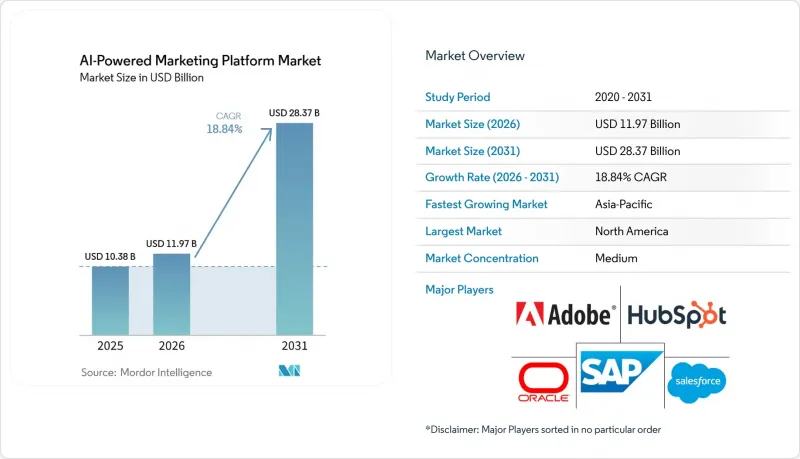
본 보고서는 구성 요소(소프트웨어 및 서비스), 도입 형태(클라우드 기반, On-Premise형, 하이브리드형), 용도(AI 기반 컨텐츠 생성, 예측 마케팅 분석 등), 기업 규모(대기업, 중소기업), 최종 사용자 산업(BFSI 등) 및 지역별로 분류되어 있습니다. 시장 전망은 금액(달러) 기준으로 제시되어 있습니다.
전 세계 AI 기반 마케팅 플랫폼 시장 동향 및 인사이트
전체 고객 여정에 걸친 초개인화
AI 기반 마케팅 플랫폼 시장은 구매자의 기대치가 광범위하게 재정의된 혜택을 누리고 있습니다. 이는 마케터들이 캠페인 설계 시, 대상 고객 부문을 그 자체로 목적인 것처럼 취급하는 것을 중단했기 때문입니다. 기업들은 의도 신호, 행동 이벤트, 참여 맥락을 발생 즉시 파악하고, 수동적인 캠페인 주기를 기다리지 않고 다음 메시지를 업데이트하는 시스템을 점점 더 요구하고 있습니다. 이러한 요구 사항에 따라 AI 기반 마케팅 플랫폼 시장은 고객 데이터, 컨텐츠 생성 및 활성화를 단일 운영 계층 내에서 통합하는 아키텍처로 나아가고 있습니다. 어도비는 ‘CX Enterprise Coworker’를 Experience Cloud, Real-Time CDP, GenStudio를 아우르는 오케스트레이션 계층으로 포지셔닝했습니다. 이는 주요 벤더들이 개인화를 독립적인 기능이 아닌, 연계된 운영 프로세스로 전환하고 있음을 보여줍니다. 이 모델이 보편화됨에 따라 워크플로우 연계 및 실시간 데이터 처리에서 강점을 가진 벤더가 대규모 플랫폼 도입 프로젝트를 수주할 가능성이 높아집니다. 또한, 개인화된 상호작용은 컨텐츠 품질, 접근 권한 관리, 데이터 일관성을 동시에 필요로 하게 되었기 때문에 거버넌스의 중요성도 높아지고 있습니다.
규칙 기반 캠페인에서 에이전트형 AI 워크플로우로의 전환
AI 기반 마케팅 플랫폼 시장 또한 어시스턴트 주도형 기능에서 수동 개입을 최소화하면서 계획, 생성, 테스트, 최적화를 수행할 수 있는 자율적인 워크플로우로 전환되고 있습니다. 이러한 변화는 플랫폼의 역할을 캠페인 팀을 지원하는 도구에서 운영 워크로드의 일부를 직접 실행하는 시스템으로 전환한다는 점에서 중요합니다. 어도비의 2026년 제품 전략은 고객 경험 워크플로우 전반에 걸친 에이전트 기반 오케스트레이션에 중점을 두고 있으며, 이는 AI 기반 마케팅 플랫폼 시장이 고립된 자동화 규칙이 아닌 에이전트를 중심으로 재설계되고 있음을 반영합니다. 마이크로소프트와 퍼블리시스도 2026년에 제휴를 확대하여 풀스택 AI 마케팅 솔루션을 구축했습니다. 이는 대기업의 구매 담당자들이 제한적인 파일럿 프로그램이 아닌, 엔드투엔드 운영 모델을 향해 준비를 진행하고 있음을 보여줍니다. 그 결과, 계획과 실행 간의 간격이 좁혀져 더 빈번한 테스트, 캠페인의 신속한 조정, 그리고 지속적인 투자에 대한 내부적 정당성 확보가 촉진됩니다. 또한 여전히 구식 규칙 세트에 의존하고 있는 벤더에 대한 압박도 커지고 있습니다. 왜냐하면 그러한 시스템은 에이전트 주도형 대안에 비해 유연성이 부족한 것으로 보이기 때문입니다.
데이터 개인정보 보호, 동의 및 국경을 초월한 거버넌스상의 제약
AI 기반 마케팅 플랫폼 시장은 동의 관리, 데이터 이용 규정, 그리고 국경을 초월한 운영 요건의 복잡화로 인해 큰 제약에 직면해 있습니다. 대기업은 종종 여러 시장에서 캠페인을 전개하지만, 고객 데이터 취급 방침, 승인 절차, 보관 요건이 모든 지역에서 반드시 통일되어 있는 것은 아닙니다. 그 결과, 플랫폼 선정이 기능의 충실도뿐만 아니라 법적 대응 체계의 구축 상황 및 운영 설계에도 좌우되게 되면서, AI 기반 마케팅 플랫폼 시장의 성장이 둔화되고 있습니다. 관리 체제가 잘 갖춰진 벤더는 이를 강점으로 전환할 수 있지만, 많은 구매 기업은 ID 시스템, 승인 체계, 지역별 데이터 취급 규정을 조율하는 과정에서 여전히 지연을 겪고 있습니다. 이 문제는 규제가 엄격한 업계에서 특히 두드러지며, 리스크 관리, 컴플라이언스, 데이터 담당 팀이 동일한 워크플로우를 승인하지 않는 한 마케팅 팀은 신속하게 움직일 수 없습니다. 또한, 구매 기업들은 데이터 저장 위치나 활성화 방법에 대해 보다 세밀한 제어를 원하기 때문에 하이브리드형이나 컴포저블형 도입을 선호하는 경향이 있습니다.
부문 분석
2025년, AI 기반 마케팅 플랫폼 시장에서 소프트웨어의 점유율은 68.41%를 차지하여, 라이선싱형 플랫폼이 여전히 이 카테고리 전체의 주요 수익원임을 입증하고 있습니다. 데이터 가져오기, 오디언스 로직, 캠페인 설정, 보고서 작성 등이 모두 플랫폼 계층에 기반을 두고 있기 때문에 AI 기반 마케팅 플랫폼 시장은 여전히 소프트웨어를 핵심 실행 시스템으로 의존하고 있습니다. 한편, AI 기반 마케팅 플랫폼의 서비스 시장 규모는 2031년까지 연평균 성장률(CAGR) 21.82%로 확대될 것으로 예측되며, 이는 구매자들이 라이선스 구매 후 지원을 점점 더 필요로 하고 있음을 나타냅니다. 이러한 변화는 많은 도입 사례에서 팀이 AI 기능을 일관되게 활용할 수 있게 되기 전에 데이터 정제, 워크플로우 재설계, 접근 제어 설정 및 변경 관리가 필요하다는 현실을 반영합니다. 또한 기업이 마케팅 도구를 CRM, CDP, 애널리틱스, 커머스 환경과 연동하려고 할 때에도 서비스 수요가 증가합니다. 이러한 통합에는 대개 전문적인 도입 노하우가 필요하기 때문입니다.
서비스 기회는 도입 작업에만 국한되지 않습니다. 구매자들이 플랫폼 가동 시작 후에도 장기적인 운영 지원을 점점 더 요구하고 있기 때문입니다. AI 기반 마케팅 플랫폼 업계에서 이는 고객이 프롬프트를 정교화하고, 검토 로직을 설정하며, 장기적으로 컨텐츠 품질을 모니터링할 수 있도록 지원하는 자문 서비스 및 관리형 서비스의 중요성을 높이고 있습니다. 또한, 초기 도입 기간을 훨씬 넘어 고객 계정에 깊이 관여할 수 있는 벤더나 파트너에게는 새로운 수익원을 창출하고 있습니다. 구매자 입장에서는 특히 사내 팀에 AI 운영에 대한 깊은 경험이 부족한 경우, 이 모델을 통해 시범 운영에서 일상적인 운영으로 전환하는 데 필요한 시간을 단축할 수 있습니다. 벤더 입장에서는 서비스 관계를 통해 플랫폼이 고객의 운영 프로세스와 더욱 긴밀하게 연계되므로, 고객 유지가 더욱 지속 가능해집니다. 따라서 예측 기간 동안 소프트웨어가 여전히 수익의 대부분을 차지하더라도, 각 구성 요소의 비중은 보다 균형 잡힌 형태가 될 가능성이 높습니다.
2025년 매출 중 클라우드 기반 아키텍처가 72.19%를 차지하고 있어, 초기 인프라 비용을 절감하면서도 확장성이 뛰어난 도입을 선호하는 구매자의 경향이 두드러지게 나타나고 있습니다. AI 기반 마케팅 플랫폼 시장은 기능의 신속한 제공, 업데이트의 용이성, 외부 AI 서비스와의 긴밀한 연동이 가능하다는 점에서 계속해서 클라우드 모델로 기울고 있습니다. 그럼에도 불구하고 하이브리드 구성은 2031년까지 연평균 성장률(CAGR) 20.43%를 나타낼 것으로 예측되며, 보다 엄격한 관리가 필요한 구매자들 사이에서는 다른 우선순위가 시사되고 있습니다. AI 기반 마케팅 플랫폼 시장에서 고객 데이터가 시스템 간이나 관할 구역 간에 자유롭게 이동할 수 없는 경우, 하이브리드 모델의 중요성은 더욱 커집니다. 이는 팀이 최신 활성화 도구와 기밀성이 높은 기록에 대한 엄격한 관리를 모두 필요로 하는 은행, 의료, 정부 기관 등의 분야에서 특히 중요합니다.
이러한 추세에 따라 각 벤더들은 단순한 퍼블릭 클라우드 옵션이 아닌, 보다 유연한 아키텍처를 제공해야 하는 압박을 받고 있습니다. Databricks는 2026년, 자사의 레이크하우스 환경에 네이티브로 구축된 에이전트형 고객 데이터 플랫폼 ‘CustomerLake’를 출시했습니다. 이는 기존 엔터프라이즈 데이터 자산에서 완전한 마이그레이션을 강요하지 않으면서도, 거버넌스가 적용된 데이터 활용을 원하는 광범위한 수요를 반영한 것입니다. AI 기반 마케팅 플랫폼 시장 전체에서는 여전히 클라우드 도입이 주류를 이루고 있지만, 하이브리드 설계가 주목받고 있습니다. 이는 고도의 오케스트레이션 및 자동화 레이어를 활용하면서도 중요한 기록을 사내에 가까운 곳에 보관할 수 있기 때문입니다. 이를 통해 플랫폼의 광범위한 도입을 저해할 수 있는 리스크 관리 팀의 저항도 완화됩니다. 향후에는 하이브리드형이 과거에는 완전히 On-Premise에 머물렀던 수요의 일부를 흡수할 가능성이 있습니다. 따라서 도입의 유연성은 기존의 ‘클라우드 대 On-Premise’라는 논의에 그치지 않고, 더욱 중요한 구매 결정 요인이 되고 있습니다.
지역별 분석
2025년, 북미는 AI 기반 마케팅 플랫폼 시장 점유율의 34.62%를 차지하며 지역별로는 가장 큰 기여도를 보였습니다. 이 지역은 활발한 디지털 광고 활동, 기업용 소프트웨어의 방대한 도입 기반, 그리고 여러 주요 플랫폼 벤더 및 클라우드 제공업체와의 지리적 근접성이라는 이점을 누리고 있습니다. AI 기반 마케팅 플랫폼 시장에서 이러한 요소들의 조합은 제품의 신속한 전개, 강력한 파트너 네트워크 구축, 그리고 마케팅 기술(마테크) 구매 모델에 대한 기업의 이해 증진을 뒷받침하고 있습니다. 미국은 국내 대기업들이 AI 기능의 시범 운영에서 이를 중심으로 한 워크플로우 재설계로 신속하게 전환하고 있기 때문에 계속해서 이 지역의 주요 견인차 역할을 하고 있습니다. 캐나다와 멕시코도 특히 소매, 금융 서비스, 고객 참여 분야의 디지털화가 진행되고 있는 분야에서 수요를 서서히 끌어올리고 있습니다. 하지만 다른 지역들도 각자 수요 패턴을 통해 도입 기반을 확대하고 있어, 북미가 성장의 중심이었던 상황은 이제 과거의 일이 되었습니다.
아시아태평양은 2031년까지 연평균 성장률(CAGR) 22.93%로 확대될 것으로 예측되며, 예측 기간 동안 AI 기반 마케팅 플랫폼 시장 규모에서 가장 높은 성장률을 보일 것으로 전망됩니다. 이러한 성장은 중소기업의 디지털화 가속화, 온라인 상거래 활동 확대, 그리고 기존 인프라에 대한 의존도가 낮은 새로운 운영 도구 도입에 대한 의욕 고조에 힘입고 있습니다. 중국은 AI 기반 마케팅 플랫폼 시장에서 독특한 환경으로 두드러집니다. 이는 국내 생태계와 현지 플랫폼 구조가 개방된 세계 시장과는 다른 방식으로 벤더 시장 진입을 좌우하기 때문입니다. 인도는 디지털 비즈니스 기반의 확대와 중소기업의 기술 도입 진전에 힘입어 개방된 시장 진입 기회로 부상하고 있습니다. 일본과 한국은 디지털에 대한 높은 기대와 성숙한 소비자 참여 환경을 모두 갖추고 있어 여전히 중요한 시장입니다. 동남아시아와 호주 역시 지역 기업 전반에 걸친 고객 데이터 기반에 대한 투자 확대와 캠페인 현대화를 통해 시장 성장에 기여하고 있습니다.
유럽은 전 세계 AI 기반 마케팅 플랫폼 시장에서 여전히 주요 부분을 차지하고 있지만, 이 지역의 구매 행동은 더 엄격한 거버넌스에 대한 기대와 보다 신중한 도입 과정에 의해 형성되는 경우가 많습니다. 독일과 영국은 대규모 기업 기반과 고객 참여 및 디지털 경험 도구에 대한 상당한 수요를 모두 갖추고 있어, 이 지역의 핵심 시장으로 자리 잡고 있습니다. 따라서 유럽의 AI 기반 마케팅 플랫폼 시장은 매력적이지만, 벤더가 꾸준히 성장하기 위해서는 보다 견고한 규정 준수 체계를 구축하고, 보다 신중한 도입 계획을 수립해야 하는 경우가 많습니다. 남미 시장은 규모는 작지만, 디지털 커머스의 성장과 측정 가능한 마케팅 전략에 대한 관심 증가를 통해 그 중요성이 지속적으로 높아지고 있습니다. 중동 및 아프리카는 여전히 발전 단계에 있지만, 브랜드와 대행사가 고객 참여 모델을 현대화함에 따라 투자는 증가하는 추세입니다. 이 세 지역 전반에 걸쳐 AI 기반 마케팅 플랫폼 시장의 발전 상황은 지역별로 편차를 보이고 있으며, 이는 벤더에게 단일한 세계 전략이 아닌 지역에 맞춘 상업 전략이 필요함을 시사합니다.
기타 혜택:
- 엑셀 형식 시장 예측(ME) 시트
- 3개월간의 애널리스트 지원
자주 묻는 질문
목차
제1장 서론
제2장 조사 방법
제3장 주요 요약
제4장 시장 구도
제5장 시장 규모와 성장 예측
제6장 경쟁 구도
제7장 시장 기회와 향후 전망
JHS 26.08.05According to Mordor Intelligence, the AI-powered marketing platform market size is expected to grow from USD 10.38 billion in 2025 to USD 11.97 billion in 2026 and is forecast to reach USD 28.37 billion by 2031 at 18.84% CAGR over 2026-2031.
This report is Segmented by Component (Software, and Services), Deployment Mode (Cloud-Based, On-Premise, and Hybrid), Application (AI Content Generation, Predictive Marketing Analytics, and More), Enterprise Size (Large Enterprises, and Small and Medium Enterprises), End-User Industry (BFSI, and More), and Geography. The Market Forecasts are Provided in Terms of Value (USD).
Global AI-Powered Marketing Platform Market Trends and Insights
Hyper-Personalization Across Customer Journeys
The AI-powered marketing platform market is benefiting from a broad reset in buyer expectations, as marketers no longer treat audience segments as ends in themselves in campaign design. Enterprises increasingly want systems that read intent signals, behavioral events, and engagement context as they happen, then update the next message without waiting for a manual campaign cycle. That requirement is pushing the AI-powered marketing platform market toward architectures that combine customer data, content generation, and activation within a single operating layer. Adobe positioned CX Enterprise Coworker as an orchestration layer across Experience Cloud, Real-Time CDP, and GenStudio, which shows how leading vendors are turning personalization into a connected operating process rather than a standalone feature. As this model becomes more common, vendors with deeper workflow coordination and real-time data handling are likely to win larger platform decisions. It also raises the value of governance, because personalized interactions now depend on content quality, permission controls, and data consistency simultaneously.
Shift From Rule-Based Campaigns to Agentic AI Workflows
The AI-powered marketing platform market is also moving from assistant-led features toward autonomous workflows that can plan, generate, test, and optimize with less manual intervention. This shift matters because it changes the platform's role from a tool that supports campaign teams to a system that directly carries out parts of the operating workload. Adobe's 2026 product direction centered on agent-enabled orchestration across customer experience workflows, reflecting how the AI-powered marketing platform market is being redesigned around agents rather than isolated automation rules. Microsoft and Publicis also expanded their partnership in 2026 to build a full-stack AI marketing solution, showing that large enterprise buyers are preparing for end-to-end operating models rather than narrow pilot programs. The result is a shorter distance between planning and execution, which supports more frequent testing, faster campaign adjustments, and stronger internal justification for follow-on investment. It also increases pressure on vendors that still rely on older rule sets, as those systems can appear rigid compared with agent-led alternatives.
Data Privacy, Consent, and Cross-Border Governance Constraints
The AI-powered marketing platform market faces a significant restraint due to the growing complexity of consent management, data use rules, and cross-border operating requirements. Large organizations often run campaigns across several markets, yet their customer data practices, approval processes, and storage requirements do not always align across those regions. That slows the AI-powered marketing platform market because platform selection now depends on legal readiness and operating design, not only on feature depth. Vendors with stronger controls can turn this into an advantage, but many buyers still face delays as they reconcile identity systems, approval structures, and regional data-handling rules. This issue is especially visible in highly regulated sectors, where marketing teams cannot move quickly unless risk, compliance, and data teams approve the same workflow. It also favors hybrid and composable deployments because buyers often want more control over where data sits and how activation occurs.
Other drivers and restraints analyzed in the detailed report include:
- First-Party Data Activation as Third-Party Cookies Recede
- Generative Content Production at Enterprise Scale
- Model Hallucination and Brand-Safety Risk in Automated Content Generation
For complete list of drivers and restraints, kindly check the Table Of Contents.
Segment Analysis
Software held 68.41% of the AI-powered marketing platform market share in 2025, which confirms that licensed platforms remained the main revenue base across the category. The AI-powered marketing platform market still relies on software as its core execution system, since data ingestion, audience logic, campaign setup, and reporting are all anchored in the platform layer. At the same time, the AI-powered marketing platform market size for services is projected to expand at a 21.82% CAGR through 2031, indicating that buyers increasingly need support after the license is purchased. This shift reflects the reality that many deployments require data cleanup, workflow redesign, access control setup, and change management before teams can use AI functions consistently. Service demand also rises when enterprises try to connect marketing tools with CRM, CDP, analytics, and commerce environments, because these integrations often require dedicated implementation expertise.
The service opportunity is not limited to installation work, because buyers increasingly want long-term operating support after the platform goes live. In the AI-powered marketing platform industry, this raises the importance of advisory and managed services that help customers refine prompts, set review logic, and monitor content quality over time. It also creates a revenue path for vendors and partners that can stay embedded in the customer account well beyond the initial deployment window. For buyers, this model can reduce the time needed to move from pilot use to daily use, especially when internal teams lack deep AI operating experience. For vendors, it makes retention more durable because service relationships tie the platform more tightly to the customer's operating process. Over the forecast period, the component mix is therefore likely to become more balanced even if software remains the larger revenue base.
Cloud-based architectures accounted for 72.19% of 2025 revenue, underscoring buyers' preference for scalable deployments with lower upfront infrastructure costs. The AI-powered marketing platform market continues to lean toward cloud models because they support faster feature delivery, easier updates, and tighter links with external AI services. Even so, hybrid configurations are projected to grow at a 20.43% CAGR through 2031, suggesting a different priority among buyers with stricter control needs. In the AI-powered marketing platform market, hybrid models are becoming more relevant where customer data cannot move freely across systems or jurisdictions. That is especially important in banking, healthcare, government, and other settings where teams need both modern activation tools and closer control over sensitive records.
This trend is pushing vendors to offer more flexible architecture rather than a simple public-cloud choice. Databricks launched CustomerLake in 2026 as an agentic customer data platform built natively on its lakehouse environment, which reflects wider demand for governed data activation without forcing a full shift away from existing enterprise data estates. Although the broader AI-powered marketing platform market still favors cloud deployment, hybrid designs are gaining traction because they let buyers keep critical records closer to home while still using advanced orchestration and automation layers. This also reduces resistance from risk teams that might otherwise block broader platform adoption. Over time, a hybrid may absorb part of the demand that would once have remained fully on-premise. That makes deployment flexibility a more important buying factor than the older cloud-versus-on-premises debate alone.
Complete Report Scope:
- By Component
- Software
- Services
- By Deployment Mode
- Cloud-Based
- On-Premise
- Hybrid
- By Application
- AI Content Generation
- Predictive Marketing Analytics
- Customer Intelligence and Personalization
- Campaign Management and Optimization
- Marketing Automation
- Conversational Marketing
- By Enterprise Size
- Large Enterprises
- Small And Medium Enterprises
- By End-User Industry
- Retail and E-Commerce
- BFSI
- Healthcare and Life Sciences
- IT and Telecom
- Media and Entertainment
- Industrial Manufacturing
- Government and Public Administration
- Other End-User Industries
- By Geography
- North America
- United States
- Canada
- Mexico
- South America
- Brazil
- Argentina
- Rest of South America
- Europe
- Germany
- United Kingdom
- France
- Italy
- Spain
- Russia
- Rest of Europe
- Asia-Pacific
- China
- India
- Japan
- South Korea
- Australia
- Rest of Asia-Pacific
- Middle East and Africa
- Middle East
- Saudi Arabia
- United Arab Emirates
- Rest of Middle East
- Africa
- South Africa
- Nigeria
- Rest of Africa
- Middle East
- North America
Geography Analysis
North America held 34.62% of the AI-powered marketing platform market share in 2025, which made it the largest regional contributor. The region benefits from dense digital advertising activity, a large installed base of enterprise software, and proximity to several major platform vendors and cloud providers. In the AI-powered marketing platform market, that combination supports faster product rollout, stronger partner networks, and broader enterprise familiarity with martech buying models. The United States remains the main regional driver because large organizations there are moving quickly from testing AI features to redesigning workflows around them. Canada and Mexico add incremental demand, particularly where retail, financial services, and customer engagement use cases continue to digitize. Even so, North America is no longer the only center of momentum, as other regions are expanding their adoption base through distinct demand patterns.
Asia-Pacific is projected to expand at 22.93% CAGR through 2031, giving it the strongest growth rate in the AI-powered marketing platform market size during the forecast period. Growth is being supported by faster SME digitization, expanding online commerce activity, and a broader willingness to adopt newer operating tools that rely on lighter legacy infrastructure. China stands out as a distinct environment within the AI-powered marketing platform market because domestic ecosystems and local platform structures shape vendor access differently from open global markets. India is emerging as a major open-access opportunity, helped by a broadening digital business base and more technology adoption among smaller firms. Japan and South Korea remain important because they combine high digital expectations with mature consumer engagement environments. Southeast Asia and Australia also contribute through rising investment in customer data foundations and campaign modernization across regional businesses.
Europe remains a major part of the global AI-powered marketing platform market, although buying behavior there is often shaped by stricter governance expectations and more deliberate rollout processes. Germany and the United Kingdom are central regional markets because they combine large enterprise bases with meaningful demand for customer engagement and digital experience tools. The AI-powered marketing platform market in Europe is therefore attractive, but vendors often need stronger compliance positioning and more careful deployment planning to grow consistently. South America is smaller, yet it continues to build relevance through digital commerce growth and rising interest in measurable marketing activation. The Middle East and Africa are still emerging, though investment is improving as brands and agencies modernize customer engagement models. Across all three regions, the AI-powered marketing platform market is advancing unevenly, indicating that vendors need localized commercial strategies rather than a single global playbook.
- Adobe Inc.
- Salesforce, Inc.
- HubSpot, Inc.
- Braze, Inc.
- Oracle Corporation
- SAP SE
- SAS Institute Inc.
- ActiveCampaign, LLC
- Acoustic, L.P.
- Insider FZ-LLC
- Emarsys eMarketing Systems AG
- Klaviyo, Inc.
- Zendesk, Inc.
- Mailchimp, a division of Intuit Inc.
- Pega Systems Inc.
- HCL Technologies Limited
- Microsoft Corporation
- Google LLC
- Amazon Web Services, Inc.
- Sprinklr, Inc.
Additional Benefits:
- The market estimate (ME) sheet in Excel format
- 3 months of analyst support
TABLE OF CONTENTS
1 INTRODUCTION
- 1.1 Study Assumptions and Market Definition
- 1.2 Scope of the Study
2 RESEARCH METHODOLOGY
3 EXECUTIVE SUMMARY
4 MARKET LANDSCAPE
- 4.1 Market Overview
- 4.2 Market Drivers
- 4.2.1 Hyper-Personalization Demand Across Customer Journeys
- 4.2.2 Rapid Shift From Rule-Based Campaigns to Agentic AI Workflows
- 4.2.3 First-Party Data Activation as Third-Party Cookies Recede
- 4.2.4 Generative Content Production at Enterprise Scale
- 4.2.5 Closed-Loop Attribution Pressure from CFO-Led Marketing ROI Scrutiny
- 4.2.6 Embedded AI in Marketing Cloud Suites Reducing Procurement Friction
- 4.3 Market Restraints
- 4.3.1 Data Privacy, Consent, and Cross-Border Governance Constraints
- 4.3.2 Model Hallucination and Brand-Safety Risk in Automated Content Generation
- 4.3.3 Integration Complexity Across CRM, CDP, and MarTech Stacks
- 4.3.4 Limited In-House AI Operating Skills Among Mid-Market Buyers
- 4.4 Impact of Macroeconomic Factors on the Market
- 4.5 Industry Value Chain Analysis
- 4.6 Technology Outlook
- 4.7 Regulatory Landscape
- 4.8 Porter's Five Forces Analysis
- 4.8.1 Threat of New Entrants
- 4.8.2 Bargaining Power of Suppliers
- 4.8.3 Bargaining Power of Buyers
- 4.8.4 Threat of Substitutes
- 4.8.5 Intensity of Competitive Rivalry
5 MARKET SIZE AND GROWTH FORECASTS (VALUE)
- 5.1 By Component
- 5.1.1 Software
- 5.1.2 Services
- 5.2 By Deployment Mode
- 5.2.1 Cloud-Based
- 5.2.2 On-Premise
- 5.2.3 Hybrid
- 5.3 By Application
- 5.3.1 AI Content Generation
- 5.3.2 Predictive Marketing Analytics
- 5.3.3 Customer Intelligence and Personalization
- 5.3.4 Campaign Management and Optimization
- 5.3.5 Marketing Automation
- 5.3.6 Conversational Marketing
- 5.4 By Enterprise Size
- 5.4.1 Large Enterprises
- 5.4.2 Small And Medium Enterprises
- 5.5 By End-User Industry
- 5.5.1 Retail and E-Commerce
- 5.5.2 BFSI
- 5.5.3 Healthcare and Life Sciences
- 5.5.4 IT and Telecom
- 5.5.5 Media and Entertainment
- 5.5.6 Industrial Manufacturing
- 5.5.7 Government and Public Administration
- 5.5.8 Other End-User Industries
- 5.6 By Geography
- 5.6.1 North America
- 5.6.1.1 United States
- 5.6.1.2 Canada
- 5.6.1.3 Mexico
- 5.6.2 South America
- 5.6.2.1 Brazil
- 5.6.2.2 Argentina
- 5.6.2.3 Rest of South America
- 5.6.3 Europe
- 5.6.3.1 Germany
- 5.6.3.2 United Kingdom
- 5.6.3.3 France
- 5.6.3.4 Italy
- 5.6.3.5 Spain
- 5.6.3.6 Russia
- 5.6.3.7 Rest of Europe
- 5.6.4 Asia-Pacific
- 5.6.4.1 China
- 5.6.4.2 India
- 5.6.4.3 Japan
- 5.6.4.4 South Korea
- 5.6.4.5 Australia
- 5.6.4.6 Rest of Asia-Pacific
- 5.6.5 Middle East and Africa
- 5.6.5.1 Middle East
- 5.6.5.1.1 Saudi Arabia
- 5.6.5.1.2 United Arab Emirates
- 5.6.5.1.3 Rest of Middle East
- 5.6.5.2 Africa
- 5.6.5.2.1 South Africa
- 5.6.5.2.2 Nigeria
- 5.6.5.2.3 Rest of Africa
- 5.6.5.1 Middle East
- 5.6.1 North America
6 COMPETITIVE LANDSCAPE
- 6.1 Market Concentration
- 6.2 Strategic Moves
- 6.3 Market Share Analysis
- 6.4 Company Profiles (includes Global Level Overview, Market Level Overview, Core Segments, Financials as available, Strategic Information, Market Rank/Share, Products and Services, Recent Developments)
- 6.4.1 Adobe Inc.
- 6.4.2 Salesforce, Inc.
- 6.4.3 HubSpot, Inc.
- 6.4.4 Braze, Inc.
- 6.4.5 Oracle Corporation
- 6.4.6 SAP SE
- 6.4.7 SAS Institute Inc.
- 6.4.8 ActiveCampaign, LLC
- 6.4.9 Acoustic, L.P.
- 6.4.10 Insider FZ-LLC
- 6.4.11 Emarsys eMarketing Systems AG
- 6.4.12 Klaviyo, Inc.
- 6.4.13 Zendesk, Inc.
- 6.4.14 Mailchimp, a division of Intuit Inc.
- 6.4.15 Pega Systems Inc.
- 6.4.16 HCL Technologies Limited
- 6.4.17 Microsoft Corporation
- 6.4.18 Google LLC
- 6.4.19 Amazon Web Services, Inc.
- 6.4.20 Sprinklr, Inc.
7 MARKET OPPORTUNITIES AND FUTURE OUTLOOK
- 7.1 White-Space and Unmet-Need Assessment


