|
시장보고서
상품코드
2099483
중동 및 아프리카의 민간 항공기 : 시장 점유율 분석, 업계 동향 및 통계, 성장 예측(2026-2031년)Middle East and Africa Commercial Aircraft - Market Share Analysis, Industry Trends & Statistics, Growth Forecasts (2026 - 2031) |
||||||
 Mordor Intelligence
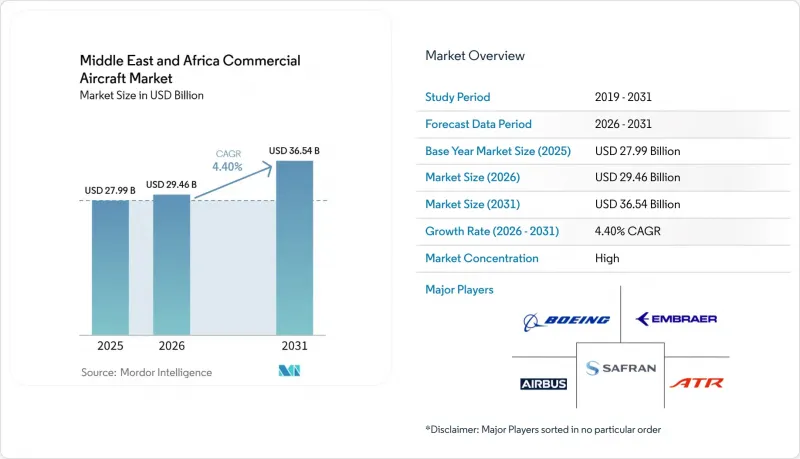
Mordor Intelligence에 의하면, 중동 및 아프리카의 민간 항공기 시장 규모는 2025년 279억 9,000만 달러로 평가되었습니다. 2026년에는 294억 6,000만 달러로 확대되어 2026년부터 2031년에 걸쳐 CAGR 4.40%로 성장을 지속하여, 2031년에는 365억 4,000만 달러에 이를 것으로 예측됩니다.
본 보고서는 항공기 유형(나로우드, 와이드바디, 리저널 제트), 용도(여객기 및 화물기), 추진 방식(터보팬 및 터보프롭), 구성 요소(기체 구조, 항공 엔진, 항공전자 및 비행 제어, 객실 내장재 및 기내 엔터테인먼트·통신 시스템(IFEC) 등) 및 지역(중동 및 아프리카)별로 분류되어 있습니다. 시장 전망은 금액(달러) 기준으로 제시되어 있습니다.
중동 및 아프리카의 민간 항공기 시장 동향 및 인사이트
GCC 전역에서의 기체 교체 주기 가속화
GCC 항공사들은 2025년을 맞이하여 기체 수명 연장보다 교체 필요성이 높아졌으며, 이는 중동 및 아프리카의 민간 항공기 시장 전체의 조달 활동을 뒷받침하고 있습니다. 플라이두바이는 2025년 11월, A321neo 기종 150대에 대한 획기적인 계약을 체결하며, 이번 발주를 통해 에어버스의 신규 고객이 되었습니다. 이러한 변화가 중요한 이유는 기체 교체가 더 이상 기체의 노후화에만 좌우되는 것이 아니라, 연료 효율, 좌석당 수익성, 그리고 편당 비용 측면에서 경쟁사의 기체 구성에 부응해야 할 필요성에도 좌우되게 되었기 때문입니다. 또한, 사우디아 그룹은 2025년 4월, 플라이딜(flyadeal)을 대상으로 A330-900 기종 10대의 수주를 발표했습니다. 이는 걸프 지역에서의 기체 갱신이 단순한 협폭기 교체에서 장거리 노선망 계획으로 확대되고 있음을 보여줍니다. 그 결과, 중동 및 아프리카의 민간 항공기 시장에서는 2020년대 후반까지 기다리지 않고, 기체 교체 주기가 가속화되고 있습니다.
제6자유권 허브 교통량의 성장
걸프 지역의 와이드바디기 수요는 여전히 소수의 대규모 환승 공항을 통해 승객을 유도하는 오랜 허브 모델에 의해 뒷받침되고 있으며, 이것이 중동 및 아프리카의 민간 항공기 시장을 계속 지탱하고 있습니다. 보잉사는 2025년, 중동 항공사들이 2044년까지 1,370대의 와이드바디 항공기가 필요할 것이라는 전망을 제시했는데, 이는 장거리 허브 교통이 여전히 지역 항공기 계획에서 극히 중요하다는 것을 보여주는 가장 명확한 징후 중 하나입니다. 사우디아라비아도 ‘비전 2030’에 따라 항공 분야의 추가 확장을 추진하고 있으며, 공항 현대화와 항공사 육성을 통해 2030년까지 연간 항공 여객 수 3억 3,000만 명을 달성하는 것을 목표로 하고 있습니다. 이러한 정책 방향은 국적 항공사뿐만 아니라 대륙 간 노선에서의 경쟁을 목표로 하는 새로운 수송 능력 플랫폼에서도 향후 기체 증강을 뒷받침할 것입니다. 그 결과, 국내 및 지역 노선에서의 협폭기 확충과 장거리 환승 수요를 위한 광폭기에 대한 지속적인 투자가 병행되는 시장이 형성되고 있습니다.
항공기 인도 지연이 기체 교체 일정을 늦추고 있습니다.
중동 및 아프리카의 민간 항공기 시장의 큰 걸림돌은 항공사가 예상했던 것보다 예정대로 항공기를 확보하기 어렵다는 단순한 사실입니다. 주요 OEM 각사의 막대한 미인도 주문량으로 인해 기체 갱신 일정이 장기화되고 있으며, 이는 신속한 현대화를 도모하려는 항공사나 특정 기종을 활용해 신규 노선을 개설하려는 항공사에게 특히 어려운 상황입니다. 그 결과, 일부 항공사는 당초 희망했던 직접적인 전환 대신, 리스 계약 연장, 중고 항공기 도입, 단계적인 기체 교체 계획으로 방향을 전환할 수밖에 없는 상황에 처해 있습니다. 이 지역에서 이 문제가 더욱 중요하게 여겨지는 이유는 많은 항공사의 전략이 공식적인 확장 계획과 밀접하게 연결되어 있기 때문입니다. 따라서 인도 지연이 발생하면 노선 개설, 인력 배치 계획, 공항 이용 계획도 지연될 수밖에 없으며, 수요 자체는 유지되더라도 그 수요가 가동 중인 기체 용량으로 전환되는 속도가 둔화될 것입니다.
부문 분석
2025년, 협폭기(Narrow-body)는 시장의 76.49%를 차지하며 중동 및 아프리카의 민간 항공기 시장에서 가장 큰 기체 카테고리가 되었습니다. 또한, 해당 부문은 2031년까지 연평균 성장률(CAGR) 5.65%로 가장 높은 성장률을 나타낼 것으로 예측되며, 현재 기단 구성에서 주도적인 지위가 뒤바뀌지 않고 지속될 것으로 전망됩니다. 이러한 경향은 두 하위 지역의 운항 실태를 반영하고 있습니다. 이 지역에서는 단거리 및 중거리 노선이 여전히 노선 운항의 대부분을 차지하고 있어, 단일 통로 항공기의 경제성이 가장 유연한 상황이 지속되고 있습니다. 보잉의 2025년 중동 전망에 따르면, 2044년까지 1,430대의 단일 통로 항공기가 인도될 것으로 예상되며, 이는 지역 확장에 있어 협폭기 기단의 장기적인 역할을 뒷받침하고 있습니다. 또한 보잉사는 2044년까지 아프리카에서 인도될 신규 항공기의 70%가 단일 통로 항공기가 될 것이라고 밝혔으며, 이는 아프리카 시장에서도 유사한 기종 선호 경향이 지지받고 있음을 뒷받침합니다. 따라서 중동 및 아프리카의 민간 항공기 시장은 주요 기체 구성의 논리에 따라 형성되고 있습니다. 즉, 고밀도 국내 노선, 지역 노선 및 위험이 낮은 국제 노선에 대응할 수 있는 항공기를 활용하여 수송 능력을 확대하는 것입니다.
이 부문에서 A321neo 시리즈는 항공사가 표준적인 지역 노선과 수요가 적은 장거리 노선 모두에 활용할 수 있기 때문에 더욱 강력한 전략적 역할을 수행하게 되었습니다. 플라이두바이가 2025년에 체결한 A321neo 150대 발주 계약은 협폭기 교체가 걸프 지역 기단 전략의 중심이 되고 있음을 보여주는 가장 명확한 신호 중 하나였습니다. 와이드바디 항공기는 여전히 걸프 지역의 환승 허브에서 필수적인 역할을 수행하고 있지만, 그 역할은 장거리 간선 노선이나 대륙 간 노선에 집중되어 있습니다. 지역 제트기 시장 규모는 여전히 작지만, 터보프롭기와 대형 협폭기 사이의 중간적인 선택지가 필요한 항공사가 존재하는 아프리카에서는 중요한 역할을 하고 있습니다. 전반적으로 보면, 협폭기 시장은 양극화되어 있으며, 걸프 지역 항공사들은 고빈도 운항을 통한 규모 확대에, 아프리카 항공사들은 대형기가 경제적으로 부적합한 지역 내를 연결하는 수단으로서 각각 이러한 기체를 활용하고 있습니다.
2025년에는 여객 운항이 시장의 90.34%를 차지하여, 중동 및 아프리카의 민간 항공기 시장에서 화물기 운항을 크게 앞질렀습니다. 또한 여객기는 2031년까지 연평균 성장률(CAGR) 5.35%를 나타낼 것으로 예측되며, 최대 용도 부문이 가장 빠르게 성장할 전망입니다. 이 결과는 해당 지역의 항공사 구조와 일치합니다. 해당 지역에서는 네트워크 확대, 연결성 향상, 공항 투자가 여전히 화물 단독이 아닌 주로 여객 수송을 중심으로 진행되고 있기 때문입니다. 보잉사는 아프리카의 여객 수송량이 2044년까지 연평균 6% 성장할 것으로 예측하고 있으며, 이는 대륙 전체 항공사들의 기체 확충을 위한 장기적인 성장 기반을 뒷받침하는 것입니다. 따라서 노선 계획에서 화물 수송의 경제성이 점점 더 중요해지고 있음에도 불구하고, 중동 및 아프리카의 민간 항공기 시장은 여전히 여객 중심의 경향이 강하게 남아 있습니다.
화물 전용기는 여객기에 비해 가치는 훨씬 낮지만, 네트워크의 회복력과 항공기 가동률을 향상시킨다는 점에서 전략적 중요성을 지닙니다. IATA 보고서에 따르면, 2025년 아프리카 항공사들의 항공 화물량은 6% 증가했으며, 특히 화물 수입이 운항 횟수가 적은 노선의 운영을 지탱하고 있는 노선에서는 화물 수요가 단순한 부수적인 문제가 아님을 보여주었습니다. 따라서 일부 항공사에서는 여객과 화물을 별도의 기종 결정 사항이 아닌, 하나의 통합된 체계로 파악하는 경향이 강해지고 있습니다. 실무적인 관점에서 볼 때, 화물 전용기 하위 부문은 수요 변동이 심한 노선에서 수익의 질을 향상시킴으로써 여객 수송 시스템 전체의 안정화에 기여하고 있습니다. 중동 및 아프리카의 민간 항공기 시장은 여전히 여객기가 주류를 이루고 있지만, 화물 운송은 그 가치 점유율만으로는 짐작할 수 있는 것 이상으로 중요한 지원 기반이 되고 있습니다.
기타 혜택 :
- 엑셀 형식 시장 예측(ME) 시트
- 3개월간의 애널리스트 지원
자주 묻는 질문
목차
제1장 서론
제2장 조사 방법
제3장 주요 요약
제4장 시장 구도
제5장 시장 규모 및 성장 예측
제6장 경쟁 구도
제7장 시장 기회 및 향후 전망
KTH 26.08.10According to Mordor Intelligence, the Middle East and Africa commercial aircraft market size is expected to grow from USD 27.99 billion in 2025 to USD 29.46 billion in 2026, and is forecasted to reach USD 36.54 billion by 2031 at a 4.40% CAGR over 2026-2031.
This report is Segmented by Aircraft Type (Narrowbody, Widebody, and Regional Jets), Application (Passenger and Freighter), Propulsion Type (Turbofan and Turboprop), Component (Airframe Structures, Aero-Engines, Avionics and Flight Control, Cabin Interior and IFEC, and More), and Geography (Middle East and Africa). The Market Forecasts are Provided in Terms of Value (USD).
Middle East and Africa Commercial Aircraft Market Trends and Insights
Rising Fleet Replacement Cycles Across GCC
GCC airlines entered 2025 with a stronger case for renewal than for life extension, which is lifting procurement activity across the Middle East and Africa commercial aircraft market. flydubai signed a landmark agreement for 150 A321neo aircraft in November 2025, becoming a new Airbus customer through that order. The change is important because replacement is no longer tied solely to aircraft age but also to fuel efficiency, seat economics, and the need to match competitors' fleets on cost per trip. Saudia Group also disclosed an order for 10 A330-900 aircraft for flyadeal in April 2025, indicating that renewal in the Gulf is broadening from simple narrowbody replacement to longer-haul network planning. As a result, the Middle East and Africa commercial aircraft market is seeing replacement cycles accelerate rather than waiting until the late 2020s.
Growth In Sixth-Freedom Hub Traffic
Widebody demand in the Gulf still rests on the long-standing hub model that channels passengers through a few large transfer airports, and that continues to support the Middle East and Africa commercial aircraft market. Boeing said in 2025 that Middle East airlines will need 1,370 widebody jets by 2044, which is one of the clearest signs that long-haul hub traffic still matters deeply in regional fleet planning. Saudi Arabia is also pushing a larger aviation build-out under Vision 2030, with a target of reaching 330 million annual air passengers by 2030 through airport modernization and airline development. That policy direction supports future fleet growth not only for flagship carriers but also for new capacity platforms designed to compete for intercontinental flows. The result is a market where narrowbody expansion in domestic and regional systems can sit alongside continued widebody investment for long-haul transfer traffic.
Aircraft Delivery Backlogs Extending Fleet Renewal Timelines
A major brake on the Middle East and Africa commercial aircraft market is the simple fact that aircraft are harder to obtain on schedule than airlines had expected. Large order queues at major OEMs are stretching renewal timelines, which is especially difficult for carriers trying to modernize quickly or launch new routes with a specific aircraft type. That pushes some operators toward lease extensions, used aircraft, and phased fleet plans instead of the direct transition they originally preferred. The issue matters more in this region because many airlines' strategies are tied to formal expansion programs, so any delivery slippage can also delay route launches, staffing plans, and airport utilization, keeping demand intact but slowing the rate at which that demand converts into active fleet capacity.
Other drivers and restraints analyzed in the detailed report include:
- Expansion Of Low-Cost And Narrowbody Networks
- Cargo Capacity Addition For E-Commerce And Freight
- USD-Denominated Financing Pressure On African Carriers
For complete list of drivers and restraints, kindly check the Table Of Contents.
Segment Analysis
Narrowbody aircraft accounted for 76.49% of the market in 2025, making them the largest aircraft category in the Middle East and Africa commercial aircraft market. The same segment is also projected to record the fastest 5.65% CAGR through 2031, which shows that current fleet leadership is expected to continue rather than reverse. That pattern reflects the operational reality of both sub-regions, where short- and medium-haul flying still accounts for most route activity and where single-aisle economics remain the most flexible. Boeing's 2025 outlook for the Middle East pointed to 1,430 single-aisle deliveries through 2044, reinforcing the long-term role of narrowbody fleets in regional expansion. Boeing also said that 70% of new African aircraft deliveries through 2044 will be single-aisle aircraft, which supports the same aircraft preference from the African side of the market. The Middle East and Africa commercial aircraft market is therefore being shaped by a dominant fleet logic: adding capacity with aircraft that can serve dense domestic links, regional services, and lower-risk international routes.
Within this category, the A321neo family has taken on a stronger strategic role because airlines can use it across both standard regional missions and longer thin routes. flydubai's 2025 agreement for 150 A321neo aircraft was one of the clearest signals that narrowbody replacement has become central to fleet strategy in the Gulf. Widebody aircraft still play a necessary role at Gulf transfer hubs, but their role is more concentrated on long-haul trunk routes and intercontinental connectivity. Regional jets remain smaller in value, yet they are relevant in Africa, where some carriers need a step between turboprops and larger narrowbodies. The full picture is a bifurcated narrowbody market, with Gulf operators using aircraft for high-frequency scale and African operators using them as sub-regional connectors where larger aircraft are not economical.
Passenger operations accounted for 90.34% of the market in 2025, keeping them far ahead of freighter activity in the Middle East and Africa commercial aircraft market. Passenger aircraft are also projected to grow at a 5.35% CAGR through 2031, making the largest application segment the fastest-growing. That result aligns with the region's airline structure, where network growth, connectivity goals, and airport investment are still centered mainly on carrying people rather than cargo alone. Boeing projected that Africa's passenger traffic will grow at 6% annually through 2044, supporting a long runway for airline fleet growth across the continent. The Middle East and Africa commercial aircraft market, therefore, remains heavily passenger-led, even as freight economics become more important in route planning.
Freighter aircraft are much less valuable, but they carry strategic weight by improving network resilience and aircraft utilization. IATA's report of 6% air cargo growth for African airlines in 2025 showed that freight demand is not a side issue, especially in corridors where cargo revenue helps support thinner schedules. That is why some carriers increasingly view passenger and freight planning together rather than as separate fleet decisions. In practical terms, the freighter sub-segment helps stabilize the broader passenger system by improving revenue quality on routes with less even demand patterns. The Middle East and Africa commercial aircraft market is still dominated by passenger aircraft. Still, cargo has become a more meaningful support layer than its share of value alone would suggest.
Complete Report Scope:
- By Aircraft Type
- Narrowbody
- Widebody
- Regional Jets
- By Application
- Passenger
- Freighter
- By Propulsion Type
- Turbofan
- Turboprop
- By Component
- Airframe Structures
- Aero-Engines
- Avionics and Flight Control
- Cabin Interior and IFEC
- Other Components
- By Geography
- Middle East
- Saudi Arabia
- United Arab Emirates
- Qatar
- Kuwait
- Israel
- Turkey
- Rest of Middle East
- Africa
- South Africa
- Egypt
- Algeria
- Nigeria
- Rest of Africa
- Middle East
List of Companies Covered in this Report:
- Airbus SE
- The Boeing Company
- Embraer S.A.
- Avions de Transport Regional GIE
- Commercial Aircraft Corporation of China, Ltd.
- Safran SA
- RTX Corporation
- Honeywell Aerospace Inc.
- Leonardo S.p.A.
- Diehl Stiftung & Co. KG,
- Rolls-Royce Holdings plc
- GE Aerospace (General Electric Company)
- De Havilland Aircraft of Canada Limited
Additional Benefits:
- The market estimate (ME) sheet in Excel format
- 3 months of analyst support
TABLE OF CONTENTS
1 INTRODUCTION
- 1.1 Study Assumptions and Market Definition
- 1.2 Scope of the Study
2 RESEARCH METHODOLOGY
3 EXECUTIVE SUMMARY
4 MARKET LANDSCAPE
- 4.1 Market Overview
- 4.2 Market Drivers
- 4.2.1 Rising fleet replacement cycles across GCC carriers
- 4.2.2 Growth in sixth-freedom hub traffic through the Gulf countries
- 4.2.3 Expansion of low-cost and narrowbody networks
- 4.2.4 Cargo capacity addition for e-commerce and perishables
- 4.2.5 CORSIA and fuel-burn pressure accelerating new aircraft uptake
- 4.2.6 Thin-route expansion in Africa requiring right-sized aircraft
- 4.3 Market Restraints
- 4.3.1 Aircraft delivery backlogs extending fleet renewal timelines
- 4.3.2 USD-denominated financing pressure on African operators
- 4.3.3 Infrastructure and runway constraints beyond major hubs
- 4.3.4 Pilot, crew, and simulator capacity shortages
- 4.4 Value / Supply-Chain Analysis
- 4.5 Regulatory Landscape
- 4.6 Technological Outlook
- 4.7 Porter's Five Forces Analysis
- 4.7.1 Threat of New Entrants
- 4.7.2 Bargaining Power of Suppliers
- 4.7.3 Bargaining Power of Buyers
- 4.7.4 Threat of Substitutes
- 4.7.5 Intensity of Competitive Rivalry
5 MARKET SIZE AND GROWTH FORECASTS (VALUE)
- 5.1 By Aircraft Type
- 5.1.1 Narrowbody
- 5.1.2 Widebody
- 5.1.3 Regional Jets
- 5.2 By Application
- 5.2.1 Passenger
- 5.2.2 Freighter
- 5.3 By Propulsion Type
- 5.3.1 Turbofan
- 5.3.2 Turboprop
- 5.4 By Component
- 5.4.1 Airframe Structures
- 5.4.2 Aero-Engines
- 5.4.3 Avionics and Flight Control
- 5.4.4 Cabin Interior and IFEC
- 5.4.5 Other Components
- 5.5 By Geography
- 5.5.1 Middle East
- 5.5.1.1 Saudi Arabia
- 5.5.1.2 United Arab Emirates
- 5.5.1.3 Qatar
- 5.5.1.4 Kuwait
- 5.5.1.5 Israel
- 5.5.1.6 Turkey
- 5.5.1.7 Rest of Middle East
- 5.5.2 Africa
- 5.5.2.1 South Africa
- 5.5.2.2 Egypt
- 5.5.2.3 Algeria
- 5.5.2.4 Nigeria
- 5.5.2.5 Rest of Africa
- 5.5.1 Middle East
6 COMPETITIVE LANDSCAPE
- 6.1 Market Concentration
- 6.2 Strategic Moves
- 6.3 Market Share Analysis
- 6.4 Company Profiles (includes Global level Overview, Market level overview, Core Segments, Financials as available, Strategic Information, Market Rank/Share for key companies, Products and Services, and Recent Developments)
- 6.4.1 Airbus SE
- 6.4.2 The Boeing Company
- 6.4.3 Embraer S.A.
- 6.4.4 Avions de Transport Regional GIE
- 6.4.5 Commercial Aircraft Corporation of China, Ltd.
- 6.4.6 Safran SA
- 6.4.7 RTX Corporation
- 6.4.8 Honeywell Aerospace Inc.
- 6.4.9 Leonardo S.p.A.
- 6.4.10 Diehl Stiftung & Co. KG,
- 6.4.11 Rolls-Royce Holdings plc
- 6.4.12 GE Aerospace (General Electric Company)
- 6.4.13 De Havilland Aircraft of Canada Limited
7 MARKET OPPORTUNITIES AND FUTURE OUTLOOK
- 7.1 White-space and Unmet-Need Assessment