

|
시장보고서
상품코드
2099536
2형 당뇨병 치료 시장 : 점유율 분석, 업계 동향 및 통계, 성장 예측(2026-2031년)Type 2 Diabetes Treatment - Market Share Analysis, Industry Trends & Statistics, Growth Forecasts (2026 - 2031) |
||||||
 Mordor Intelligence
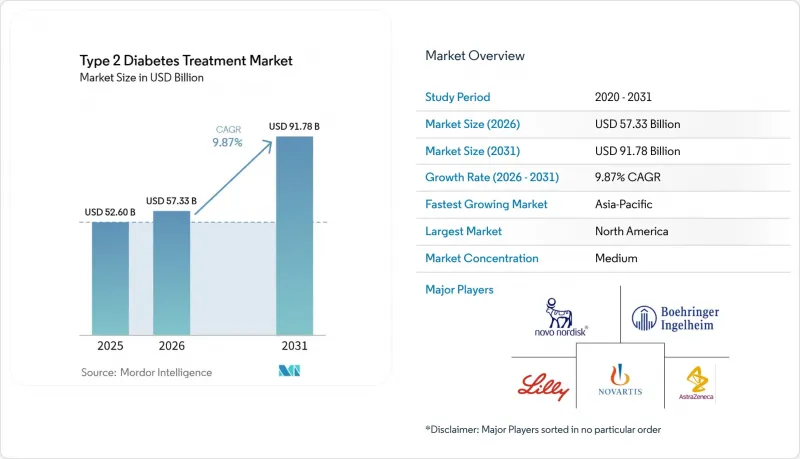
Mordor Intelligence에 의하면, 2형 당뇨병 치료 시장 규모는 2025년 526억 달러에서 2026년에는 573억 3,000만 달러로 확대되어 2026년부터 2031년까지 CAGR 9.87%로 성장을 지속하여, 2031년에는 917억 8,000만 달러에 이를 것으로 예측됩니다.
본 보고서는 약물 분류별(비구아나이드계, 설포닐우레아계, 티아졸리딘디온계, DPP-4 억제제, GLP-1 수용체 작용제, SGLT2 억제제, 인슐린), 투여 경로(경구, 주사, 정맥 내), 유통 채널(병원, 소매, 온라인 약국) 및 지역(북미, 유럽, 아시아태평양, 중동 및 아프리카, 남미)별로 분류되어 있습니다. 시장 전망은 금액(달러)으로 표시되어 있습니다.
전 세계 2형 당뇨병 치료 시장 동향 및 인사이트
비만과 관련된 인슐린 저항성 유병률 증가
비만과 관련된 인슐린 저항성은 2형 당뇨병 치료 시장 수요를 견인하는 주요 요인입니다. 이는 이 상태가 성숙한 의료 시스템과 신흥 의료 시스템 모두에서 신규 진단 건수 증가를 초래하고 있기 때문입니다. 『Frontiers in Public Health』 저널의 2025년 분석에 따르면, 높은 BMI로 인한 2형 당뇨병 사망자 수는 1990년부터 2021년 사이 203.9% 증가한 반면, 장애 조정 생명년(DALY)은 연평균 8.9%의 속도로 증가했습니다. 또한, 국제당뇨병연맹(IDF)은 2050년까지 전 세계 당뇨병 환자 수가 8억 5,300만 명에 달할 것으로 예측하고 있으며, 이는 2형 당뇨병 치료 시장에서 치료 수요의 성장 여지가 장기적으로 지속될 것임을 시사합니다. 이러한 부담이 가장 빠르게 증가하고 있는 곳은 중소득 국가들로, 이곳에서는 진단 미비, 치료 미비, 그리고 의약품비 급등이 서로 점점 더 큰 영향을 주고받고 있습니다. 또한, 젊은 성인층의 중요성이 커지고 있습니다. 이는 발병 연령이 낮아짐에 따라 평생 치료 기간이 길어지고, 장기적인 심혈관 및 대사 관리의 필요성이 확대되고 있기 때문입니다.
GLP-1 수용체 작용제의 급속한 보급
GLP-1 수용체 작용제의 급속한 보급은 2형 당뇨병 치료 시장의 수익 구성을 변화시키고 있습니다. 이는 이러한 약제가 현재 체중, 심혈관, 혈당 수치 등 각 결과 지표를 종합적으로 개선한다는 점에서 높이 평가받고 있기 때문입니다. 2025년 10월, FDA는 2형 당뇨병 고위험 성인을 대상으로 심혈관 위험 감소를 목적으로 하는 경구용 세마글루타이드를 승인했으며, 이를 통해 심혈관 유익성이 입증된 최초의 경구용 GLP-1 수용체 작용제가 되었습니다. 2026년 5월, 노보노르디스크는 미국에서 오젠픽 정제의 판매를 시작했으며, 2026년 4월에는 FDA가 일라이 릴리의 파운다요를 승인했습니다. 이는 최초의 비펩타이드계 경구용 GLP-1 치료제가 됩니다. 이러한 신제품의 출시로 자가 주사에 따른 주저함이 줄어들면서, 2형 당뇨병 치료 시장 내 대상 환자층이 확대되고 있습니다. 또한, 이는 경구 투여의 전략적 가치를 높이고 있습니다. 프리미엄 인크레틴 요법이 과거에는 주로 성숙한 제네릭 의약품이 주도하던 부문에 더욱 깊이 침투하고 있기 때문입니다.
신규 GLP-1 치료제 및 스마트 투여 요법의 높은 비용
임상적 수요는 여전히 견조함에도 불구하고, 첨단 GLP-1 제제나 스마트 인슐린 투여 시스템의 높은 가격이 2형 당뇨병 치료 시장의 성장을 계속해서 억제하고 있습니다. 2025년 11월 미국의 가격 합의에 따라 일부 환자의 초기 투여 가격은 인하되었으나, 무보험자나 보험 적용 범위가 불충분한 계층에게는 여전히 경제적 부담의 격차가 남아 있습니다. 폐쇄형 투여 시스템은 약제비에 더해 기기 비용이 발생하기 때문에 많은 국가에서 고소득층 환자 그룹 이외로의 보급이 제한되고 있습니다. 또한, 보험사 측은 단계별 편집(step edit), 치료 순서 규정, 바이오시밀러 도입 압력 등을 활용하여 지출을 억제하고 있으며, 이는 임상적 필요성이 명확하더라도 프리미엄 치료법의 이용을 지연시키는 요인이 되고 있습니다. 실질적으로 2형 당뇨병 치료 시장에서는 강력한 혁신이 진행되고 있지만, 치료 스택의 프리미엄 분야에서는 여전히 큰 경제적 장벽이 존재합니다.
부문 분석
2025년, GLP-1 수용체 작용제는 2형 당뇨병 치료 시장에서 41.83%의 점유율을 차지하며, 약물 분류별 1위를 유지했습니다. 이러한 우위는 장기적인 심혈관계 데이터와 고위험 환자군에서 1차 선택 약물로 사용될 수 있도록 한 새로운 적응증 확장에 힘입은 것입니다. 또한, 2025년 및 2026년의 규제 사이클을 통해 경구 투여제와의 격차도 좁혀졌습니다. 경구용 세마글루티드는 심혈관 분야에서 그 역할을 확대했으며, 비펩타이드 계열 최초의 경구용 GLP-1 치료제인 ‘파운다요’가 시장에 진입했습니다. 2형 당뇨병 업계에서 이로 인해 해당 계열은 전문적인 프리미엄 치료 옵션에서 보다 광범위한 주류 치료군으로 전환되고 있습니다. 메트포르민 제네릭 의약품을 필두로 하는 비구아나이드 계열 약물은 저렴하고 사용에 익숙한 약제이며, 1차 치료 경로에서 널리 사용되고 내약성이 높아 여전히 임상 현장에서 큰 존재감을 유지하고 있습니다.
SGLT2 억제제는 2026년부터 2031년까지 연평균 성장률(CAGR) 10.09%를 나타낼 것으로 예측되며, 2형 당뇨병 치료 시장에서 가장 빠르게 성장하는 약물 군이 될 것입니다. 이러한 성장은 단순한 혈당 조절에 그치지 않고, 심부전 및 신장 질환에서의 사용 증가와 밀접한 관련이 있으며, 2026년 메타분석에서는 임상시험 데이터 전반에 걸쳐 전사인 사망률 및 심부전으로 인한 입원율이 감소한 것으로 확인되었습니다. 또한, 2026년 1월 오롤리글리플로진 캡슐이 중국 국가약품감독관리국(NMPA)의 승인을 획득함에 따라 중국 시장에서도 성장세가 가속화되어, 이 약물군 내 국내 경쟁이 심화될 것으로 예측됩니다. DPP-4 억제제는 일본이나 인도 등 비용을 중시하는 시장에서 여전히 중요한 위치를 차지하고 있지만, SGLT2 억제제나 GLP-1 수용체 작용제에 비해 장기적인 시장 입지 확립 속도는 둔화되고 있습니다. 설포닐우레아계 약물이나 티아졸리딘디온계 약물은 상대적인 매력을 계속 잃어가고 있지만, 인슐린은 중증 사례에서는 여전히 필수적입니다. 다만, 고소득 시장에서는 치료 초기 단계부터 새로운 치료 옵션이 도입되는 경향이 있어 인슐린 사용량에 압박이 가해지고 있습니다.
지역별 분석
2025년, 북미는 2형 당뇨병 치료 시장 점유율의 39.91%를 차지하며, 지역별로는 가장 큰 기여도를 보였습니다. 이 지역은 치료에 대한 적극성이 높고, 첨단 치료법에 대한 인지도가 널리 확산되어 있을 뿐만 아니라, 다른 대부분 시장에 비해 GLP-1 수용체 작용제 및 SGLT2 억제제의 보급 속도가 빠르다는 장점이 있습니다. 또한, 연속 혈당 모니터링(CGM)에 대한 보험 급여 범위도 확대되고 있으며, 공적·민간 보험 적용 범위의 변경으로 인해 전체 치료 경로에서의 접근성과 데이터 가시성이 향상되고 있습니다. 심사 절차의 신속화도 이 지역을 뒷받침하고 있으며, 2026년 4월에는 FDA가 ‘국가 우선 바우처(National Priority Voucher)’ 프로그램에 따라 불과 50일 만에 ‘Foundayo’를 승인했습니다. 캐나다와 멕시코도 중요한 수요원이 되고 있지만, 두 나라 모두 처방약 목록 관리가 엄격하기 때문에 미국에 비해 프리미엄 치료법의 보급이 더디게 진행될 가능성이 있습니다.
유럽은 주요 국가들이 체계적인 보험 급여 제도와 확립된 만성 질환 치료 경로를 유지하고 있어, 2형 당뇨병 치료 시장에서 중요한 위치를 차지하고 있습니다. 독일, 영국, 프랑스, 이탈리아, 스페인은 심혈관 보호 요법 및 프리미엄 브랜드 제품에 대한 수요의 기반이 되고 있습니다. 2025년 9월, 경구용 세마글루티드는 유럽에서 심혈관 질환에 대한 적응증 확대를 획득했으며, 이를 통해 해당 지역 전체에서 경구용 GLP-1 요법의 역할이 강화되었습니다. 또한, 기업들이 치료 참여도와 지속성을 높이기 위해 디지털 지원 프로그램을 지속적으로 활용함에 따라, 유럽은 커넥티드 케어 모델에서도 중요한 역할을 수행하고 있습니다. 바이오시밀러의 접근성이 향상됨에 따라, 해당 지역의 저소득 지역에서는 인슐린 및 관련 치료에 대한 접근성이 확대되고 있습니다.
아시아태평양은 2031년까지 연평균 성장률(CAGR) 13.34%를 나타낼 것으로 예측되며, 2형 당뇨병 치료 시장에서 가장 빠르게 성장하는 지역 블록이 되고 있습니다. 이 지역은 특히 중국과 인도에서 대규모 환자층과 가속화되는 규제 활동이 맞물려 있으며, 중국에서는 2026년 1월에 에크노글루티드 및 오롤리글리플로진과 같은 차별화된 치료법이 승인되었고, GLP-1 및 SGLT2 두 경로 모두에서 국내 혁신 사이클이 강화되고 있음을 보여주고 있습니다. 인도는 그 규모가 크고, 대사 질환의 부담이 증가하며, 도시 지역 의료 현장에서 새로운 치료법의 채택이 확대되고 있다는 점 등으로 인해 여전히 중요한 시장으로 남아 있습니다. 일본, 한국, 호주에서는 고가 제품군이 판매량을 지탱하고 있는 반면, 중동 및 아프리카 및 남미는 여전히 기여도가 낮은 편이지만, 의료 접근성 개선과 만성 질환 치료 수요 증가로 인해 지속적인 성장이 예상됩니다.
기타 혜택:
- 엑셀 형식 시장 예측(ME) 시트
- 3개월간의 애널리스트 지원
자주 묻는 질문
목차
제1장 서론
제2장 조사 방법
제3장 주요 요약
제4장 시장 구도
제5장 시장 규모와 성장 예측
제6장 경쟁 구도
제7장 시장 기회와 향후 전망
JHS 26.08.05According to Mordor Intelligence, the type 2 diabetes treatment market size is expected to grow from USD 52.60 billion in 2025 to USD 57.33 billion in 2026 and is forecast to reach USD 91.78 billion by 2031 at 9.87% CAGR over 2026-2031.
This report is Segmented by Drug Class (Biguanides, Sulfonylureas, Thiazolidinediones, DPP-4 Inhibitors, GLP-1 Receptor Agonists, SGLT2 Inhibitors, Insulin), Route of Administration (Oral, Injectable, Intravenous), Distribution Channel (Hospital, Retail, Online Pharmacies), and Geography (North America, Europe, Asia-Pacific, MEA, South America). The Market Forecasts are Provided in Value (USD).
Global Type 2 Diabetes Treatment Market Trends and Insights
Rising Prevalence of Obesity-Linked Insulin Resistance
Obesity-linked insulin resistance is a core demand driver for the type 2 diabetes treatment market, because the condition is driving new diagnoses across both mature and emerging healthcare systems. A 2025 analysis in Frontiers in Public Health found that deaths from type 2 diabetes attributable to high BMI rose 203.9% between 1990 and 2021, while disability-adjusted life years increased at an annual rate of 8.9%. The International Diabetes Federation also projects that the global diabetes population will reach 853 million by 2050, which points to a long runway for treatment demand in the type 2 diabetes treatment market. The burden is rising fastest in middle-income countries, where underdiagnosis, undertreatment, and rising medicine costs increasingly interact with one another. A younger adult cohort is also becoming more important, because earlier onset of the disease extends lifetime exposure to therapy and broadens the need for long-term cardiometabolic management.
Rapid Uptake of GLP-1 Receptor Agonists
Rapid adoption of GLP-1 receptor agonists is changing the revenue mix of the type 2 diabetes treatment market, because these drugs are now valued for weight, cardiovascular, and glycemic outcomes together. In October 2025, the FDA approved oral semaglutide for cardiovascular risk reduction in high-risk adults with type 2 diabetes, making it the first oral GLP-1 receptor agonist with proven cardiovascular benefit. In May 2026, Novo Nordisk made Ozempic tablets available in the United States, and in April 2026 the FDA approved Eli Lilly's Foundayo, the first non-peptide oral GLP-1 therapy. These launches are widening the addressable patient base in the type 2 diabetes treatment market by reducing the hesitation linked to self-injection. They are also raising the strategic value of oral delivery, because premium incretin therapy is now moving deeper into a segment once led mainly by mature generic products.
High Cost of Novel GLP-1 and Smart Delivery Therapies
High prices for advanced GLP-1 products and smart insulin delivery systems continue to restrain the type 2 diabetes treatment market, even as clinical demand remains strong. The November 2025 U.S. pricing agreements lowered starter prices for some patients, but affordability gaps still remain for uninsured and underinsured groups. Closed-loop delivery systems add device spending on top of medicine costs, which limits adoption beyond higher-income patient groups in many countries. Payers also use step edits, therapy sequencing, and biosimilar pressure to contain spending, which can slow the use of premium treatments even when clinical need is clear. In practical terms, the type 2 diabetes treatment market is seeing strong innovation, but the premium end of the therapy stack still faces a meaningful affordability ceiling.
Other drivers and restraints analyzed in the detailed report include:
- Cardiometabolic Label Expansion for Existing Therapies
- Expansion of Continuous Glucose Monitoring Reimbursement
- Reimbursement Friction in Step-Therapy and Prior Authorization
For complete list of drivers and restraints, kindly check the Table Of Contents.
Segment Analysis
GLP-1 receptor agonists held 41.83% of the type 2 diabetes treatment market share in 2025, which kept them in the leading position across drug classes. Their lead was supported by long-running cardiovascular data and by newer label expansions that moved them closer to first-line use in high-risk patient groups. The 2025 and 2026 regulatory cycle also reduced the oral delivery gap, with oral semaglutide gaining a wider cardiovascular role and Foundayo entering the market as the first non-peptide oral GLP-1 therapy. In the type 2 diabetes industry, this shifts the class from a specialist premium option toward a broader mainstream therapy set. Biguanides, led by metformin generics, still keep a large clinical footprint because they remain cheap, familiar, and widely tolerated in first-line treatment pathways.
SGLT2 inhibitors are projected to grow at 10.09% CAGR from 2026 to 2031, which makes them the fastest-growing drug class in the type 2 diabetes treatment market. Their growth is tied to rising use in heart failure and kidney disease, not just blood sugar control, and a 2026 meta-analysis confirmed lower all-cause mortality and heart failure hospitalization across trial data. China also added momentum in January 2026, when Olorigliflozin Capsules received NMPA approval, pointing to stronger domestic competition in the class. DPP-4 inhibitors still retain relevance in cost-sensitive settings such as Japan and India, although they face slower long-term positioning than SGLT2 and GLP-1 therapies. Sulfonylureas and thiazolidinediones continue to lose relative appeal, while insulin remains necessary in advanced cases but faces volume pressure in higher-income markets where newer options are moving earlier in the care pathway.
Complete Report Scope:
- By Drug Class
- Biguanides
- Sulfonylureas
- Thiazolidinediones
- DPP-4 Inhibitors
- GLP-1 Receptor Agonists
- SGLT2 Inhibitors
- Insulin
- Others by Drug Class
- By Route of Administration
- Oral
- Injectable
- Intravenous
- By Distribution Channel
- Hospital Pharmacies
- Retail Pharmacies
- Online Pharmacies
- By Geography
- North America
- United States
- Canada
- Mexico
- Europe
- Germany
- United Kingdom
- France
- Italy
- Spain
- Rest of Europe
- Asia-Pacific
- China
- Japan
- India
- Australia
- South Korea
- Rest of Asia-Pacific
- Middle East & Africa
- GCC
- South Africa
- Rest of Middle East & Africa
- South America
- Brazil
- Argentina
- Rest of South America
- North America
Geography Analysis
North America accounted for 39.91% of type 2 diabetes treatment market share in 2025, which made it the largest regional contributor. The region benefits from high treatment intensity, broad familiarity with premium therapies, and faster uptake of GLP-1 receptor agonists and SGLT2 inhibitors than most other markets. Reimbursement for continuous glucose monitoring is also widening, with public and private coverage changes improving access and data visibility across care pathways. Faster review pathways also support the region, as the FDA approved Foundayo under the National Priority Voucher program in 50 days during April 2026. Canada and Mexico add meaningful demand, although tighter formulary controls in both countries can slow premium therapy penetration relative to the United States.
Europe holds a substantial position in the type 2 diabetes treatment market because major countries maintain structured reimbursement systems and established chronic care pathways. Germany, the United Kingdom, France, Italy, and Spain continue to anchor demand for cardioprotective therapies and premium branded products. In September 2025, oral semaglutide gained an expanded cardiovascular label in Europe, which strengthened the role of oral GLP-1 treatment across the region. Europe is also relevant for connected care models, as companies continue to use digital support programs to strengthen treatment engagement and persistence. Lower-income parts of the region benefit from wider access to insulin and related therapies as biosimilar availability improves.
Asia-Pacific is projected to grow at 13.34% CAGR through 2031, which makes it the fastest-growing regional block in the type 2 diabetes treatment market. The region combines large patient pools with accelerating regulatory activity, especially in China and India . China approved differentiated therapies such as ecnoglutide in January 2026 and Olorigliflozin in the same month, which shows a stronger domestic innovation cycle across both GLP-1 and SGLT2 pathways. India remains important because of its scale, rising metabolic burden, and increasing adoption of newer therapies in urban care settings. Japan, South Korea, and Australia support premium-price volumes, while the Middle East and Africa and South America remain smaller contributors but continue to gain from improving access and rising chronic disease treatment needs.
- Abbott Laboratories
- Astellas Pharma
- AstraZeneca
- Beckton Dickinson
- Biocon
- Boehringer Ingelheim
- Dexcom
- Eli Lilly and Company
- Insulet
- Johnson & Johnson
- Medtronic
- Merck
- MicroPort
- Novartis
- Novo Nordisk
- Pfizer
- Roche
- Sanofi
- Takeda Pharmaceuticals
- Tandem Diabetes Care
- Ypsomed
Additional Benefits:
- The market estimate (ME) sheet in Excel format
- 3 months of analyst support
TABLE OF CONTENTS
1 Introduction
- 1.1 Study Assumptions & Market Definition
- 1.2 Scope of the Study
2 Research Methodology
3 Executive Summary
4 Market Landscape
- 4.1 Market Overview
- 4.2 Market Drivers
- 4.2.1 Rising Prevalence of Obesity-Linked Insulin Resistance
- 4.2.2 Rapid Uptake of GLP-1 Receptor Agonists
- 4.2.3 Expansion of Continuous Glucose Monitoring Reimbursement
- 4.2.4 Pharma-Tech Partnerships for Connected Care
- 4.2.5 Closed-Loop Insulin Delivery in Consumer Wearables
- 4.2.6 Cardiometabolic Label Expansion for Existing Therapies
- 4.3 Market Restraints
- 4.3.1 High Cost of Novel GLP-1 and Smart Delivery Therapies
- 4.3.2 Reimbursement Friction in Step-Therapy and Prior Authorization
- 4.3.3 Supply Constraints for Injectable Formats and Pen Components
- 4.3.4 Connectivity, Cybersecurity, and Data-Privacy Burden on Connected Devices
- 4.4 Value / Supply-Chain Analysis
- 4.5 Regulatory Landscape
- 4.6 Technological Outlook
- 4.7 Porter's Five Forces Analysis
- 4.7.1 Threat of New Entrants
- 4.7.2 Bargaining Power of Suppliers
- 4.7.3 Bargaining Power of Buyers
- 4.7.4 Threat of Substitutes
- 4.7.5 Industry Rivalry
5 Market Size & Growth Forecasts
- 5.1 By Drug Class
- 5.1.1 Biguanides
- 5.1.2 Sulfonylureas
- 5.1.3 Thiazolidinediones
- 5.1.4 DPP-4 Inhibitors
- 5.1.5 GLP-1 Receptor Agonists
- 5.1.6 SGLT2 Inhibitors
- 5.1.7 Insulin
- 5.1.8 Others by Drug Class
- 5.2 By Route of Administration
- 5.2.1 Oral
- 5.2.2 Injectable
- 5.2.3 Intravenous
- 5.3 By Distribution Channel
- 5.3.1 Hospital Pharmacies
- 5.3.2 Retail Pharmacies
- 5.3.3 Online Pharmacies
- 5.4 By Geography
- 5.4.1 North America
- 5.4.1.1 United States
- 5.4.1.2 Canada
- 5.4.1.3 Mexico
- 5.4.2 Europe
- 5.4.2.1 Germany
- 5.4.2.2 United Kingdom
- 5.4.2.3 France
- 5.4.2.4 Italy
- 5.4.2.5 Spain
- 5.4.2.6 Rest of Europe
- 5.4.3 Asia-Pacific
- 5.4.3.1 China
- 5.4.3.2 Japan
- 5.4.3.3 India
- 5.4.3.4 Australia
- 5.4.3.5 South Korea
- 5.4.3.6 Rest of Asia-Pacific
- 5.4.4 Middle East & Africa
- 5.4.4.1 GCC
- 5.4.4.2 South Africa
- 5.4.4.3 Rest of Middle East & Africa
- 5.4.5 South America
- 5.4.5.1 Brazil
- 5.4.5.2 Argentina
- 5.4.5.3 Rest of South America
- 5.4.1 North America
6 Competitive Landscape
- 6.1 Market Concentration
- 6.2 Market Share Analysis
- 6.3 Company Profiles (includes Global Level Overview, Market-level Overview, Core Segments, Financials, Strategic Information, Market Rank/Share, Products & Services, Recent Developments)
- 6.3.1 Abbott Laboratories
- 6.3.2 Astellas Pharma Inc.
- 6.3.3 AstraZeneca plc
- 6.3.4 Becton, Dickinson and Company
- 6.3.5 Biocon Limited
- 6.3.6 Boehringer Ingelheim International GmbH
- 6.3.7 Dexcom, Inc.
- 6.3.8 Eli Lilly and Company
- 6.3.9 Insulet Corporation
- 6.3.10 Johnson and Johnson
- 6.3.11 Medtronic plc
- 6.3.12 Merck and Co., Inc.
- 6.3.13 MicroPort Scientific Corporation
- 6.3.14 Novartis AG
- 6.3.15 Novo Nordisk A/S
- 6.3.16 Pfizer Inc.
- 6.3.17 Roche Holding AG
- 6.3.18 Sanofi
- 6.3.19 Takeda Pharmaceutical Company Limited
- 6.3.20 Tandem Diabetes Care, Inc.
- 6.3.21 Ypsomed Holding AG
7 Market Opportunities & Future Outlook
- 7.1 White-space & Unmet-need Assessment


