

|
시장보고서
상품코드
2099742
메틸 메타크릴레이트 시장 : 시장 점유율 분석, 업계 동향 및 통계, 성장 예측(2026-2031년)Methyl Methacrylate - Market Share Analysis, Industry Trends & Statistics, Growth Forecasts (2026 - 2031) |
||||||
 Mordor Intelligence
Mordor Intelligence에 의하면, 메틸 메타크릴레이트 시장 규모는 2025년 137억 2,000만 달러로 평가되었고, 2026년에는 153억 9,000만 달러로 확대될 것으로 추정되고, 2026-2031년 CAGR 4.76%로 성장을 지속할 전망이며, 2031년에는 194억 2,000만 달러에 이를 것으로 예측됩니다.
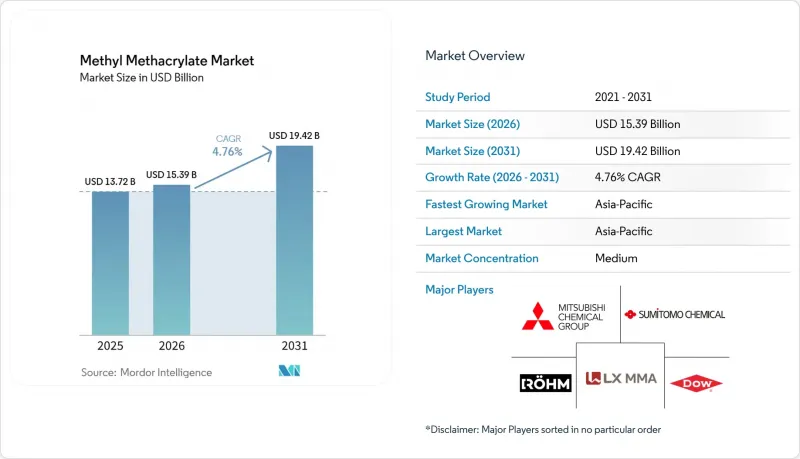
본 보고서는 용도별(PMMA 및 아크릴 수지, 표면 코팅 등), 최종 이용 산업별(건축 및 건설, 자동차 및 운송 등), 제조 공정별(ACH 공정, C4 및 이소부틸렌 경로 등), 지역별(아시아태평양, 북미, 유럽, 남미, 중동 및 아프리카)로 분류되어 있습니다. 시장 예측은 금액(달러) 기준으로 제시되어 있습니다.
세계의 메틸 메타크릴레이트 시장 동향 및 인사이트
건축 및 건설 : 인프라 확충과 디지털화 진전이 MMA 소비 확대
건축 및 건설 분야는 메틸 메타크릴레이트 시장에 있어 여전히 가장 광범위한 수요 기반을 형성하고 있습니다. MMA 기반 소재는 상업시설 및 인프라 자산의 유리 외장, 외장재, 콘크리트 보수, 기타 내구성이 요구되는 용도에 활용되고 있습니다. 수요는 더 이상 표준적인 아크릴 유리 외장에만 국한되지 않고, 급속한 경화나 균열 브릿징이 요구되는 인프라 개보수 공사에서도 고분자량 메타크릴레이트계 소재가 사용되고 있습니다. 긴 수명, 구조 중량 경감, 그리고 장기 운영 주기에서의 내후성을 중시하는 상업 프로젝트에서 PMMA를 기판으로 하는 파사드 및 유리 외장 사양이 확대되고 있습니다. 또한, 데이터 인프라 분야에서도 새로운 수요가 발생하고 있습니다. 미쓰비시 화학 그룹은 2026년도 전략 방침의 일환으로, 광섬유 및 수냉식 데이터센터의 구성 부품에 PMMA를 사용할 것을 확정했습니다. 이는 메틸 메타크릴레이트 시장이 물리적 건설과 디지털 인프라 확충 양쪽 모두로부터 뒷받침받고 있으며, 단일 건설 주기에 대한 의존도를 낮추고 있다는 점에서 중요합니다. 또한, 초기 소재 비용의 저렴함보다는 내구성, 투명성, 수명 주기 성능이 중시되는 프로젝트에서 메틸 메타크릴레이트 시장이 여전히 중요한 역할을 하고 있는 이유를 설명하는 한 가지 요인이기도 합니다.
자동차 경량화 : MMA계 접착제와 PMMA가 전기차(EV) 구조에 침투
전기차(EV)로의 전환에 따라, 기존의 트림 용도에 대한 의존에서 벗어나 접착제 및 광학용 PMMA의 중요성이 높아짐에 따라 메틸 메타크릴레이트 시장은 변화하고 있습니다. 구조용 MMA 접착제는 제조업체가 알루미늄, 탄소섬유 강화 폴리머, 유리섬유 복합재 및 기존의 용접 방법으로는 접합하기 어려운 기타 이종 재료를 접합해야 하는 상황에서 사용됩니다. ITW Performance Polymers사는 이러한 다중 소재 접합에서의 역할을 보고하며, MMA 수요가 단순한 생산 대수보다 설계 아키텍처와 더욱 밀접하게 연결되고 있다는 견해를 뒷받침하고 있습니다. 또한, 배터리 팩 조립에서도 재료 간의 열팽창률 차이에 대응할 수 있는 접착 라인이 필요하며, EV 플랫폼에서 접착제의 성능 요구 사항이 높아지고 있습니다. EV의 보급이 확대됨에 따라, 특정 조립 공정에서 차량 1대당 MMA 사용량이 차량 생산 대수 자체 증가율을 상회하는 속도로 늘어날 가능성이 있어, 메틸 메타크릴레이트 시장은 그 혜택을 누리고 있습니다. 이로 인해 성숙한 PMMA 트림 용도에 의한 증분 성장이 특수 접착제 시스템만큼 크지 않더라도, 자동차 분야 수요는 계속해서 중요한 위치를 차지하고 있습니다.
원자재 및 에너지 비용 변동 : ACH 생산자가 직면한 구조적인 투입 비용 리스크
원자재 및 에너지 비용 변동은 메틸 메타크릴레이트 시장에 여전히 제약 요인으로 작용하고 있습니다. 이는 ACH(암모니아·시안화수소) 기반 생산자들이 다른 제조 경로에 비해 균형을 맞추기 어려운 원자재 공급망에 의존하고 있기 때문입니다. 이 제조 공정은 아세톤과 시안화수소에 의존하고 있지만, 이 두 원료의 가격이 반드시 서로 연동되는 것은 아니며, 완성된 MMA의 판매 상황과도 일치하지 않는 경우가 있습니다. 따라서 원료 공급망의 일부만이라도 공급이 차질을 빚어도 생산자는 이익률 압박에 직면하게 되며, 에너지 비용이 높은 수준을 유지하는 지역에서는 계획 수립이 복잡해집니다. 또한, 황산암모늄과 관련된 폐기물 처리 의무는 C2 공정과는 제조 공정이 다른 기존 플랜트에 있어 추가적인 비용 부담이 되고 있습니다. 그 결과, 메틸 메타크릴레이트 시장에서는 원료 의존도를 낮추고 환경 부하를 줄이는 기술에 대한 투자가 점차 확대되고 있습니다. 이러한 변화에 대한 대응을 늦추는 생산자는 단기적인 후퇴에 그치지 않고, 지속적인 이익률 압박에 직면할 가능성이 높아집니다.
부문 분석
2025년 시점에서 PMMA 및 아크릴 수지는 메틸 메타크릴레이트 시장 점유율의 52.44%를 차지했으며, 최대 용도 기반이 여전히 하류 폴리머 체인 내에 있음을 확인했습니다. 인조석 및 솔리드 서페이스는 2031년까지 연평균 성장률(CAGR) 5.62%를 나타낼 것으로 예측되며, 기존 수지 부문을 뛰어넘는 더 빠르게 성장하는 이용 사례가 되고 있습니다. 이러한 변화가 주목받는 이유는 병원이나 연구소의 설계 담당자들이 이음매 없는 표면이나 위생 성능이 요구되는 장소에 PMMA 복합재 카운터탑이나 비품을 지정하고 있기 때문입니다. 이러한 조달 패턴은 일반적인 주택 리모델링 주기보다 안정적인 수요 흐름을 뒷받침하고 있습니다. 또한, 대량의 리신 수요와 더욱 엄격한 성능 요건이 요구되는 특수한 표면 용도 모두에 대응할 수 있는 공급업체에게 새로운 기회를 창출하고 있습니다.
표면 코팅 및 에멀젼 폴리머는 여전히 중요하며, 건축 및 산업용도에 걸친 MMA 소비의 광범위한 2차 기반을 제공합니다. 수성 및 고고형분 코팅으로의 전환은 광택 유지력과 내후성이 요구되는 바인더의 메타크릴레이트 함량을 촉진하고 있으며, 이로 인해 이 부문은 메틸 메타크릴레이트 시장에서 지속적인 중요성을 갖게 되었습니다. 도료에 대한 배출 규제 압력 또한 MMA 기반 화학 기술이 여전히 적용 가능한 배합으로의 전환을 촉진하고 있습니다. 접착제 및 실란트는 전기자동차(EV) 및 재생 에너지 관련 조립 과정에서 구조용 접착에 표준 벌크 용도를 뛰어 넘는 특수 화학 기술이 요구되기 때문에 고부가가치 카테고리가 되고 있습니다. 에멀젼 폴리머는 여전히 광범위한 산업 생산과 연계되어 있지만, 메틸 메타크릴레이트 업계에서 가장 강력한 수요 모멘텀을 보이고 있는 것은 성숙한 범용 부문이 아니라 솔리드 서피스 및 첨단 접착제 분야입니다. 메틸 메타크릴레이트 시장의 순도별 구분은 프리미엄 등급이 통합형 공급업체에 점점 더 집중되는 반면, 표준 등급은 더 강한 가격 압박에 직면하고 있음을 의미합니다.
지역별 분석
2025년 기준, 아시아태평양은 메틸 메타크릴레이트 시장 점유율의 46.85%를 차지했으며, 해당 지역 시장 규모는 2031년까지 연평균 성장률(CAGR) 5.34%로 확대될 것으로 예측됩니다. 이 지역은 수요 및 공급 모두에서 가장 큰 점유율을 차지하고 있으며, 가격 책정, 무역 흐름, 투자 우선순위에 큰 영향력을 행사하고 있습니다. 중국은 여전히 이 지역 최대 시장이지만, 공급망의 일부에서는 공급 증가가 국내 흡수량을 초과하고 있습니다. 이러한 불균형으로 인해 표준 등급의 가격은 지속적인 압박을 받고 있으며, 국내 상황이 완화되면 생산자들은 수출 시장 개척을 모색하고 있습니다. 인도 및 동남아시아는 도시화, 자동차 산업의 확대, 아크릴 간판 수요가 꾸준한 소비 증가를 뒷받침하고 있어 메틸 메타크릴레이트 시장에서 점점 더 중요한 위치를 차지하고 있습니다. 미쓰비시 화학 그룹도 파트너십 주도형 공급 확대의 목표로 인도를 선정했으며, 이는 해당 지역의 성장이 기존의 동북아시아라는 기반을 넘어 확대되고 있다는 관점을 뒷받침하고 있습니다.
북미에서는 현지 생산 능력이 강화되고, 저탄소 경로를 통한 제조 옵션이 상업적으로 이용 가능해짐에 따라 공급 상황이 변화하고 있습니다. 로옴(Rohm)의 베이시티 공장은 C2 경로를 통한 생산 능력을 25만 톤 증설하여, 2026년 6월 새로운 국내 공급원으로 가동을 시작했습니다. 이를 통해 자동차, 전자, 건설, 의료 분야의 고객들은 제조 경로의 효율성과 제품의 환경 부하를 중시하는 조달 기준에 부합하는 지역 내 공급원을 확보할 수 있게 되었습니다. 북미의 메틸 메타크릴레이트 시장은 VOC(휘발성 유기 화합물)와 관련된 배합 전환이 지속되고 있는 데 힘입어, 도료 및 유도체 수요의 혜택도 받고 있습니다. 한편, 유럽의 상황은 달라서 수요 증가는 생산량 확대라기보다는 조달 경로의 전환에 기인하고 있습니다. REACH 규제와 관련된 폐기물 처리 의무 및 보다 광범위한 지속가능성 보고에 대한 기대에 힘입어, 유럽의 메틸 메타크릴레이트 시장은 인증을 받았으며 저탄소이고 추적성이 높은 공급 경로로 전환되고 있습니다.
남미, 중동 및 아프리카를 합친 메틸 메타크릴레이트 시장 점유율은 작지만, 각 지역은 고유한 전략적 역할을 담당하고 있습니다. 남미는 국내 MMA 생산이 지역 공급을 뒷받침하며, 대규모 인프라 및 상업 개발 계획과 연계되어 있다는 점에서 두드러집니다. 중동 전체의 건설 프로젝트 파이프라인은 상업시설 및 호텔·리조트 시설에서 PMMA로 제작된 유리 외장, 파사드, 코팅, 솔리드 서페이스에 대한 수요를 지속적으로 뒷받침하고 있습니다. 남미 수요는 여전히 소폭에 그치고 있으며, 코팅, 접착제, 소비재를 중심으로 전개되고 있으나, 수입 의존도와 환율 상황에 따라 단기적인 확대는 제한되고 있습니다.
기타 혜택 :
- 엑셀 형식 시장 예측(ME) 시트
- 3개월간의 애널리스트 지원
자주 묻는 질문
목차
제1장 서론
제2장 조사 방법
제3장 주요 요약
제4장 시장 구도
제5장 시장 규모 및 성장 예측
제6장 경쟁 구도
제7장 시장 기회 및 향후 전망
AJY 26.08.07According to Mordor Intelligence, the methyl methacrylate market size is expected to grow from USD 13.72 billion in 2025 to USD 15.39 billion in 2026 and is forecast to reach USD 19.42 billion by 2031 at 4.76% CAGR over 2026-2031.
This report is Segmented by Application (PMMA and Acrylic Resins, Surface Coatings, and More), End-Use Industry (Building and Construction, Automotive and Transportation, and More), Production Process (ACH Process, C4 and Isobutylene Route, and More), and Geography (Asia-Pacific, North America, Europe, South America, and Middle-East and Africa). The Market Forecasts are Provided in Terms of Value (USD).
Global Methyl Methacrylate Market Trends and Insights
Building and Construction: Infrastructure and Digital Build-Out Extend MMA Consumption
Building and construction remains the broadest demand base for the methyl methacrylate market. MMA-based materials serve glazing, cladding, concrete repair, and other durable applications across commercial and infrastructure assets. Demand is no longer limited to standard acrylic glazing; high-molecular-weight methacrylate systems are also being used in infrastructure rehabilitation where rapid curing and crack bridging are required. PMMA-based facade and glazing specifications are advancing in commercial projects that prioritize long service life, lower structural weight, and weather resistance over long operating cycles. Additional demand is emerging from data infrastructure, where Mitsubishi Chemical Group identified PMMA use in optical fiber and water-cooled data center components as part of its FY2026 strategic direction. This is significant because the methyl methacrylate market draws support from both physical construction and digital build-out, reducing dependence on a single construction cycle. It also helps explain why the methyl methacrylate market remains relevant in projects where durability, transparency, and lifecycle performance carry more weight than low upfront material cost.
Automotive Lightweighting: MMA Adhesives and PMMA Penetrate EV Architecture
The shift toward electric vehicles is changing the methyl methacrylate market by increasing the importance of adhesives and optical PMMA, rather than relying on older trim applications. Structural MMA adhesives are being used where manufacturers need to bond aluminum, carbon fiber-reinforced polymer, glass fiber composites, and other dissimilar materials that are not suited to conventional welding methods. ITW Performance Polymers documented this role in multi-material bonding, supporting the view that MMA demand is becoming more tied to design architecture than to unit output alone. Battery pack assemblies also require bond lines that can manage thermal expansion differences across materials, raising adhesive performance requirements in EV platforms. As EV penetration increases, the methyl methacrylate market benefits because MMA use per vehicle can grow faster than vehicle production itself in selected assemblies. This keeps automotive demand relevant even as mature PMMA trim applications contribute less incremental growth than specialty adhesive systems.
Raw Material and Energy Cost Volatility: ACH Producers Face a Structural Input Risk
Raw material and energy cost volatility remains a restraint for the methyl methacrylate market, as ACH-based producers depend on a feedstock chain that is more difficult to balance than alternative routes. The process relies on acetone and hydrogen cyanide, which do not necessarily move in line with each other or with finished MMA selling conditions. This exposes producers to margin pressure even when only one part of the input chain tightens, and complicates planning in regions where energy costs remain elevated. Waste handling obligations tied to ammonium bisulfate add another cost layer for legacy plants that do not share the same route profile as C2 operations. As a result, the methyl methacrylate market is seeing investment redirect toward technologies that reduce feedstock exposure and environmental burden. Producers that delay these changes are more likely to face persistent margin compression rather than a short-term setback.
Other drivers and restraints analyzed in the detailed report include:
- Electronics and Displays: Optical-Grade PMMA Demand Tightens Supply Specifications
- PMMA-to-MMA Chemical Recycling: Circular Economy Pressure Reshapes Procurement
- China Overcapacity: Export-Led Pricing Pressure Redraws the Competitive Map
For complete list of drivers and restraints, kindly check the Table Of Contents.
Segment Analysis
PMMA and acrylic resins held 52.44% of the methyl methacrylate market share in 2025, confirming that the largest application base remains within the downstream polymer chain. Artificial stone and solid surfaces are projected to grow at a 5.62% CAGR through 2031, representing a faster-growing use case beyond the traditional resin segment. This shift is notable because hospital and laboratory planners are specifying PMMA composite countertops and fixtures where seamless surfaces and hygiene performance are required. That procurement pattern supports a more stable demand stream than a standard residential remodeling cycle. It also creates opportunities for suppliers that can serve both volume resin demand and more specialized surface applications with tighter performance requirements.
Surface coatings and emulsion polymers remain important, providing a broad secondary base for MMA consumption across architectural and industrial uses. The move toward waterborne and high-solids coatings is supporting methacrylate loading in binders that require gloss retention and weathering performance, giving this segment durable relevance in the methyl methacrylate market. Regulatory pressure on emissions in coatings is also supporting conversion toward formulations where MMA-based chemistry remains applicable. Adhesives and sealants represent a higher-value category, as structural bonding in electric vehicle (EV) and renewable energy assemblies requires specialized chemistries beyond standard bulk applications. Emulsion polymers continue to track broad industrial production, but the strongest application momentum in the methyl methacrylate industry is centered on solid surfaces and advanced adhesives rather than on the more mature commodity segments. The purity split within the methyl methacrylate market also means premium grades are becoming more concentrated with integrated suppliers, while standard grades face stronger price pressure.
Complete Report Scope:
- By Application
- PMMA and Acrylic Resins
- Surface Coatings
- Emulsion Polymers and Latex
- Adhesives and Sealants
- Artificial Stone and Solid Surface
- Other Applications
- By End-use Industry
- Building and Construction
- Automotive and Transportation
- Electrical and Electronics
- Healthcare and Medical
- Consumer Goods
- Other End-use Industries
- By Production Process
- ACH Process
- C4 and Isobutylene Route
- Ethylene and C2 Route
- By Geography
- Asia-Pacific
- China
- India
- Japan
- South Korea
- ASEAN
- Australia and New Zealand
- Rest of Asia-Pacific
- North America
- United States
- Canada
- Mexico
- Europe
- Germany
- United Kingdom
- France
- Italy
- Spain
- Russia
- Rest of Europe
- South America
- Brazil
- Argentina
- Rest of South America
- Middle-East and Africa
- Saudi Arabia
- United Arab Emirates
- South Africa
- Rest of Middle-East and Africa
- Asia-Pacific
Geography Analysis
Asia-Pacific held 46.85% of the methyl methacrylate market share in 2025, and the region's market size is projected to expand at a CAGR of 5.34% through 2031. The region accounts for the largest share of both demand and supply, giving it significant influence over pricing, trade flows, and investment priorities. China remains the largest market within the region, though supply additions have outpaced local absorption in parts of the chain. This imbalance keeps standard-grade pricing under pressure and encourages producers to seek export markets when domestic conditions soften. India and Southeast Asia are becoming more important to the methyl methacrylate market, as urbanization, automotive expansion, and acrylic signage demand support steady incremental consumption. Mitsubishi Chemical Group has also identified India as a target for partnership-led supply development, reinforcing the view that regional growth is spreading beyond the traditional Northeast Asia base.
North America is moving into a different supply position as local production capability strengthens and lower-carbon route options become commercially available. Rohm's Bay City facility added 250,000 tons of C2 route capacity and brought a new domestic supply option into operation in June 2026. This gives automotive, electronics, construction, and medical customers a regional source that aligns with procurement criteria focused on route efficiency and product footprint. The methyl methacrylate market in North America also benefits from coatings and derivative demand supported by ongoing VOC-related formulation shifts. Europe presents a different picture, as demand growth is tied less to volume expansion and more to sourcing conversion. REACH-related waste handling obligations and broader sustainability reporting expectations are pushing the European methyl methacrylate market toward certified, lower-carbon, and more traceable supply pathways.
South America, the Middle East, and Africa together account for a smaller share of the methyl methacrylate market, but each carries a distinct strategic role. Saudi Arabia stands out because domestic MMA production supports regional supply and connects to large-scale infrastructure and commercial development plans. The broader Middle East construction pipeline continues to support demand for PMMA glazing, facades, coatings, and solid surfaces across commercial and hospitality projects. South American demand remains more modest and is centered on coatings, adhesives, and consumer goods, with import exposure and currency conditions limiting near-term expansion.
- Dow
- Formosa Plastics Corporation
- Heilongjiang Zhongmeng Longxin Chemical Co., Ltd.
- Jiangsu Sierbang Petrochemical Co., Ltd.
- Kaohsiung Monomer Company
- Kuraray Co., Ltd.
- LOTTE MCC
- Lucite International
- LX MMA
- Mitsubishi Chemical Group Corporation
- Mitsubishi Gas Chemical Company, Inc.
- PTT Asahi Chemical Company Limited
- Rohm GmbH
- SABIC
- Saudi Methacrylates Company (SAMAC)
- Shandong Longze Chemical Co., Ltd.
- Sumitomo Chemical Co., Ltd.
- Wanhua Chemical Group
Additional Benefits:
- The market estimate (ME) sheet in Excel format
- 3 months of analyst support
TABLE OF CONTENTS
1 Introduction
- 1.1 Study Assumptions & Market Definition
- 1.2 Scope of the Study
2 Research Methodology
3 Executive Summary
4 Market Landscape
- 4.1 Market Overview
- 4.2 Market Drivers
- 4.2.1 Building and construction demand for acrylic sheets and surfaces
- 4.2.2 Automotive lightweighting and lighting demand
- 4.2.3 Electronics and display optics demand
- 4.2.4 Growth in paints, coatings, adhesives, and engineered surfaces
- 4.2.5 Shift toward C2 route capacity and cost-carbon advantage
- 4.2.6 PMMA-to-MMA recycling commercialization
- 4.3 Market Restraints
- 4.3.1 Raw material and energy cost volatility
- 4.3.2 Substitute pressure from polycarbonate and other transparent polymers
- 4.3.3 China overcapacity and merchant-market margin squeeze
- 4.3.4 ACH waste burden and cyanide compliance intensity
- 4.4 Value Chain Analysis
- 4.5 Regulatory Landscape
- 4.6 Technological Outlook
- 4.7 Porter's Five Forces Analysis
- 4.7.1 Bargaining Power of Suppliers
- 4.7.2 Bargaining Power of Buyers
- 4.7.3 Threat of New Entrants
- 4.7.4 Threat of Substitutes
- 4.7.5 Industry Rivalry
5 Market Size & Growth Forecasts (Value)
- 5.1 By Application
- 5.1.1 PMMA and Acrylic Resins
- 5.1.2 Surface Coatings
- 5.1.3 Emulsion Polymers and Latex
- 5.1.4 Adhesives and Sealants
- 5.1.5 Artificial Stone and Solid Surface
- 5.1.6 Other Applications
- 5.2 By End-use Industry
- 5.2.1 Building and Construction
- 5.2.2 Automotive and Transportation
- 5.2.3 Electrical and Electronics
- 5.2.4 Healthcare and Medical
- 5.2.5 Consumer Goods
- 5.2.6 Other End-use Industries
- 5.3 By Production Process
- 5.3.1 ACH Process
- 5.3.2 C4 and Isobutylene Route
- 5.3.3 Ethylene and C2 Route
- 5.4 By Geography
- 5.4.1 Asia-Pacific
- 5.4.1.1 China
- 5.4.1.2 India
- 5.4.1.3 Japan
- 5.4.1.4 South Korea
- 5.4.1.5 ASEAN
- 5.4.1.6 Australia and New Zealand
- 5.4.1.7 Rest of Asia-Pacific
- 5.4.2 North America
- 5.4.2.1 United States
- 5.4.2.2 Canada
- 5.4.2.3 Mexico
- 5.4.3 Europe
- 5.4.3.1 Germany
- 5.4.3.2 United Kingdom
- 5.4.3.3 France
- 5.4.3.4 Italy
- 5.4.3.5 Spain
- 5.4.3.6 Russia
- 5.4.3.7 Rest of Europe
- 5.4.4 South America
- 5.4.4.1 Brazil
- 5.4.4.2 Argentina
- 5.4.4.3 Rest of South America
- 5.4.5 Middle-East and Africa
- 5.4.5.1 Saudi Arabia
- 5.4.5.2 United Arab Emirates
- 5.4.5.3 South Africa
- 5.4.5.4 Rest of Middle-East and Africa
- 5.4.1 Asia-Pacific
6 Competitive Landscape
- 6.1 Market Concentration
- 6.2 Strategic Moves
- 6.3 Market Share/Ranking Analysis
- 6.4 Company Profiles {(includes Global level Overview, Market level overview, Core Segments, Financials as available, Strategic Information, Market Rank/Share for key companies, Products & Services, and Recent Developments)}
- 6.4.1 Dow
- 6.4.2 Formosa Plastics Corporation
- 6.4.3 Heilongjiang Zhongmeng Longxin Chemical Co., Ltd.
- 6.4.4 Jiangsu Sierbang Petrochemical Co., Ltd.
- 6.4.5 Kaohsiung Monomer Company
- 6.4.6 Kuraray Co., Ltd.
- 6.4.7 LOTTE MCC
- 6.4.8 Lucite International
- 6.4.9 LX MMA
- 6.4.10 Mitsubishi Chemical Group Corporation
- 6.4.11 Mitsubishi Gas Chemical Company, Inc.
- 6.4.12 PTT Asahi Chemical Company Limited
- 6.4.13 Rohm GmbH
- 6.4.14 SABIC
- 6.4.15 Saudi Methacrylates Company (SAMAC)
- 6.4.16 Shandong Longze Chemical Co., Ltd.
- 6.4.17 Sumitomo Chemical Co., Ltd.
- 6.4.18 Wanhua Chemical Group
7 Market Opportunities & Future Outlook
- 7.1 White-space and Unmet-need Assessment


