

|
시장보고서
상품코드
2099775
AI 워크로드용 CXL 메모리 확장 : 시장 점유율 분석, 업계 동향 및 통계, 성장 예측(2026-2031년)CXL Memory Expansion For AI Workloads - Market Share Analysis, Industry Trends & Statistics, Growth Forecasts (2026 - 2031) |
||||||
 Mordor Intelligence
Mordor Intelligence에 의하면, AI 워크로드용 CXL 메모리 확장 시장 규모는 2025년에 3억 4,000만 달러로 평가되었습니다. 2026년 7억 4,000만 달러, 2031년 27억 9,000만 달러에 이를 것으로 예측되며, 2026년부터 2031년에 걸쳐 CAGR 30.16%로 성장할 전망입니다.
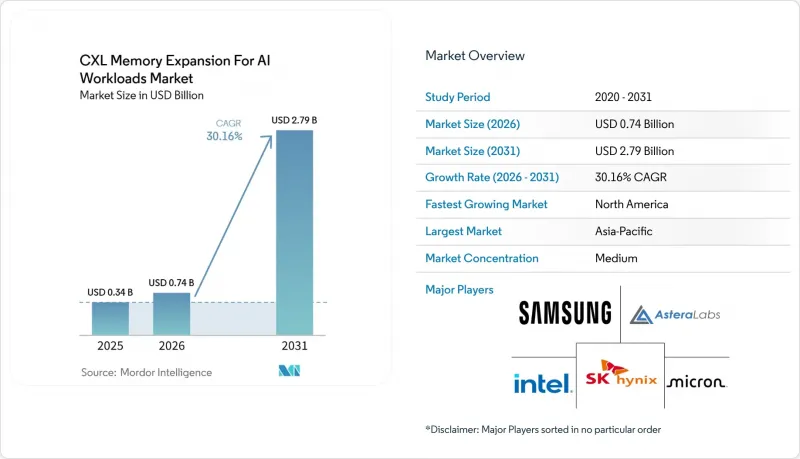
본 보고서는 구성 요소별(직접 어태치형 CXL 유형 3 메모리 확장 디바이스 등), 물리적 폼 팩터별(EDSFF/E3. S CXL 메모리 모듈 등), 용도별(AI 훈련 및 모델 개발 등), 최종 사용자별(하이퍼스케일러 등), CXL 사양별(CXL 1.1 및 그 이전 버전 등), 지역별로 분류되어 있습니다. 시장 전망은 금액(달러) 기준으로 제시되어 있습니다.
세계의 AI 워크로드용 CXL 메모리 확장 시장 동향 및 인사이트
HBM 및 DIMM 용량을 능가하는 AI 모델 매개변수 증가
AI 워크로드용 CXL 메모리 확장 시장은 단순한 가속기의 처리량을 초과하는 문제로 인해 가속화되고 있습니다. 이는 많은 AI 워크로드가 연산 능력의 한계에 도달하기 전에 메모리 한계에 직면하기 때문입니다. BF16 정밀도로 학습된 700억 파라미터 모델의 경우, 가중치만으로도 140GB에 가까운 메모리가 필요하며, 여기에 KV 캐시 증가가 더해지면 장문 컨텍스트 추론에 따른 실질적인 메모리 수요는 더욱 높아집니다. 동 조사에 따르면, 100만 토큰의 컨텍스트에서는 70억 파라미터 모델의 경우 KV 캐시 필요량이 330GB 가까이까지 증가할 가능성이 있으며, 이는 현재 어떤 GPU에서도 이용 가능한 HBM 용량을 상회합니다. 이로 인해 AI 워크로드용 CXL 메모리 확장 시장은 추론의 경제성과 밀접하게 연결되어 있습니다. 왜냐하면 코히런트 외부 메모리를 추가함으로써 가속기 패키지나 호스트 소켓을 재설계하지 않고도 사용 가능한 모델 컨텍스트를 확장할 수 있기 때문입니다. Penguin Solutions는 2026년에 추론 워크로드가 순수한 연산 부하보다는 메모리 부하에 의해 크게 좌우될 것이라고 밝혔으며, 이는 프로덕션 환경의 클러스터에서 GPU의 유휴 시간이 직접적인 비용 문제로 대두되고 있다는 견해를 뒷받침합니다. 그 결과, AI 워크로드용 CXL 메모리 확장 시장은 단순한 하드웨어 카테고리로서뿐만 아니라, 고가의 기존 가속기 가동률을 회복시키는 수단으로서도 지지를 얻고 있습니다.
이용률 향상을 위한 메모리 분산화로의 하이퍼스케일러 전환
AI 워크로드용 CXL 메모리 확장 시장이 발전하고 있는 배경에는 각 하이퍼스케일러 기업들이 메모리 디스어그리게이션을 단순한 실험 단계의 시도로만 취급하지 않게 된 점도 꼽힙니다. Microsoft Research는 ‘Octopus’ 아키텍처를 발표하며, 희소 CXL 포드 토폴로지라면 고비용의 풀 메쉬 스위칭 모델 없이도 대규모 메모리 도메인을 연결할 수 있음을 입증했습니다. 이를 통해 확장 가능한 풀링에 대한 비용 장벽이 낮아졌습니다. 이것이 중요한 이유는 AI 워크로드용 CXL 메모리 확장 시장의 상용화 여부가, 확장의 각 단계에서 비례적인 스위칭 비용을 부과하지 않으면서 메모리 풀링을 확대할 수 있는지에 달려 있기 때문입니다. Astera Labs는 2025년 11월, 자사의 ‘Leo’ 컨트롤러가 Microsoft Azure M 시리즈 가상 머신에서 사용 가능해졌다고 발표했습니다. 이는 CXL 연결 메모리의 상용 클라우드 배포 사례로서는 최초로 공개된 사례입니다. 이번 공개 도입을 통해 사내 하이퍼스케일러 프로젝트 이외의 실증 사례를 고대해 온 기업의 구매 담당자나 소규모 클라우드 사업자에게 실용적인 참고 사례가 제공되었습니다. 상업적인 측면에서 볼 때, AI 워크로드용 CXL 메모리 확장 시장의 벤더들은 범용적인 도입과 맞춤형 클라우드 아키텍처를 동시에 지원해야 한다는 것을 의미합니다.
양산 인증을 받은 CXL Type 3공급 기반이 제한적
AI 워크로드용 CXL 메모리 확장 시장은 양산 인증을 받은 Type 3 메모리 벤더의 수가 여전히 제한적이기 때문에 공급 측면의 제약에 직면해 있습니다. 인증된 공급업체 기반은 Samsung Electronics, SK하이닉스, 마이크론 테크놀로지를 중심으로 구성되어 있지만, 테스트를 마친 용량, 폼 팩터, 사양의 조합 범위는 데이터센터 구매자가 광범위한 도입에 요구하는 수준에 비해 여전히 훨씬 좁은 상태입니다. SK하이닉스는 2025년에 자사의 96GB CMM-DDR5 CXL 2.0 모듈이 고객 검증을 완료했음을 확인하고, 128GB 버전도 병행하여 검증 중임을 밝혔습니다. 이는 진전을 보여주는 것이지만, 전체 도입 옵션을 포괄하는 것은 아닙니다. 이 점이 중요한 이유는 AI 워크로드용 CXL 메모리 확장 시장이 표준 DDR5나 HBM 수요에도 대응하는 동일한 기반 메모리 생산 능력을 놓고 경쟁하고 있기 때문입니다. HBM 출하량이 증가하면, 고객의 관심이 여전히 높더라도 내부 할당량이 신흥 CXL 제품에서 다른 곳으로 이동할 가능성이 있습니다. 그 결과, AI 워크로드용 CXL 메모리 확장 시장에서는 출하 가능한 물량보다 수요가 급격히 증가할 가능성이 있으며, 기술적 타당성이 이미 인정된 경우라도 실제 도입이 지연될 수 있습니다.
부문 분석
2025년, AI 워크로드용 CXL 메모리 확장 시장에서 직접 어태치형 CXL Type-3 메모리 확장 디바이스는 47.32%의 점유율을 차지했습니다. 이는 초기 수요 단계에서 더 복잡한 풀형 설계보다 단순한 단일 호스트 배포가 선호되었음을 보여줍니다. 이러한 상황은 초기 추론 배포 시 랙 아키텍처의 전면적인 변경을 강요하지 않으면서도 추가 메모리 용량이 필요했기 때문에 단기적인 구매 행동을 반영한 것입니다. AI 워크로드용 CXL 메모리 확장 업계에서 직접 어태치형 디바이스는 Intel Xeon 6 및 AMD EPYC Turin 플랫폼에서 검증하기 쉬웠기 때문에 1차 구매자들에게 도입 장벽이 낮아졌습니다. 메모리 풀링 어플라이언스나 인클로저와 같은 중간 계층 제품은 단일 호스트용 카드로는 제공할 수 없는 유연성을 필요로 하는 한편, 완전한 패브릭 구현에 아직 준비가 되어 있지 않은 고객을 지원했습니다. 메모리 관리 및 오케스트레이션 소프트웨어의 점유율은 비교적 작았지만, 변화하는 워크로드 전체에 동적으로 할당되지 않는 한 풀링된 메모리의 가치는 제한적이기 때문에 상업적 유용성 측면에서 여전히 핵심적인 역할을 수행했습니다. MemVerge는 이 계층을 투명한 메모리 계층화와 GPU 클러스터 효율화에 중점을 두고 포지셔닝하고 있으며, 이는 해당 소프트웨어 스택이 아직 최대 수익원이 아님에도 불구하고 전략적으로 중요한 이유를 설명해 줍니다.
CXL 메모리 패브릭 및 랙 스케일 시스템은 2031년까지 연평균 성장률(CAGR) 30.96%를 나타낼 것으로 예측되며, AI 워크로드용 CXL 메모리 확장 시장에서 가장 빠르게 성장하는 구성 요소 부문이 될 것입니다. 이러한 성장세는 여러 컴퓨팅 호스트가 공유 메모리 풀에서 메모리를 끌어올 수 있는 기능에서 비롯되며, 이를 통해 랙 수준에서 GPU 대 메모리 비율을 설정하는 방식이 완전히 달라집니다. XConn Technologies와 MemVerge는 2025년 10월 100TB 규모의 상용 CXL 풀을 시연하며, AI 추론 워크로드에서 SSD 기반 KV 캐시 오프로드와 비교해 5배 이상의 성능 향상을 달성했다고 보고했습니다. 그 후, Marvell은 2026년 3월, Structera S 30260 스위치가 16-32대의 호스트 간에 최대 48 TB의 공유 메모리를 4 TB/s의 총 대역폭으로 지원한다고 발표하며, 랙 규모의 풀링을 향한 보다 명확한 상용 로드맵을 제시했습니다. 디바이스 수준의 확장에서 공유 패브릭 아키텍처로의 전환이 중요한 이유는 이를 통해 클러스터 전체의 워크로드 수요에 용량을 더 밀접하게 맞출 수 있기 때문입니다. 따라서 AI 워크로드용 CXL 메모리 확장 시장에서는 예측 기간 동안 단순한 연결 제품에서 더 높은 수준의 풀링 시스템으로 가치가 점진적으로 이동할 것으로 예측됩니다.
2025년에는 EDSFF/E3.S CXL 메모리 모듈이 49.84%의 점유율을 차지하며, AI 워크로드용 CXL 메모리 확장 시장에서 주요 물리적 폼 팩터가 되었습니다. 이러한 우위는 표준 서버 NVMe 베이와 호환성, 낮은 발열량, 그리고 주류 서버 통합 경로와의 긴밀한 호환성 덕분입니다. 인텔은 AI 및 HPC 워크로드를 위해 제온 6 6900P 프로세서와 여러 CXL E3.S 모듈을 조합한 이용 사례를 시연하며, 이 폼 팩터가 OEM 서버 구성에 실용적으로 적합함을 입증했습니다. AI 워크로드용 CXL 메모리 확장 업계에서 이로 인해 기계적 적합성과 플랫폼 숙련도가 중요한 엔터프라이즈 및 OEM 인증 과정에서 EDSFF/E3.S 모듈이 우위를 점하게 되었습니다. 독자적인 사양의 통합 포맷도 여전히 그 역할을 하고 있으며, 특히 맞춤형 클라우드 시스템의 경우, 벤더가 범용 서버 포맷으로는 불가능한 수준으로 기판 설계나 레이턴시 경로를 보다 정밀하게 최적화할 수 있다는 점이 꼽힙니다.
PCIe 애드인 카드는 2026년부터 2031년까지 연평균 성장률(CAGR) 30.92%를 나타낼 것으로 예측되며, AI 워크로드용 CXL 메모리 확장 시장 전체에서 성장률 상위권에 속하는 위치를 차지할 것으로 보입니다. Penguin Solutions는 2026년 3월, 최대 8장의 1TB CXL 애드인 카드를 탑재하고 4U 섀시 내에 총 11TB의 CXL 기반 메모리를 갖춘 ‘MemoryAI KV 캐시 서버’를 출시했습니다. 이를 통해 추론 인프라에서 AIC의 역할이 매우 명확해졌습니다. 이는 도입 경로의 분화를 시사합니다. AIC는 전용 설계된 추론 어플라이언스에 적합한 반면, EDSFF/E3.S 모듈은 주류 서버의 교체 주기에 적합합니다. 따라서 AI 워크로드용 CXL 메모리 확장 시장은 단일한 범용 물리적 형식으로 수렴하고 있는 것은 아닙니다. 엔터프라이즈 서버와 맞춤형 추론 시스템이 각각 서로 다른 패키징 옵션을 선호하는 듀얼 트랙 모델로 전환되고 있습니다. 이러한 폼 팩터의 분화는 표준 데이터센터 서버 군과 AI 전용 랙 간에 열 설계, 유지보수성, 도입 모델에 대한 요구 사항이 현저히 다르기 때문에 앞으로도 지속될 가능성이 높습니다.
지역별 분석
북미는 2025년에 61.44%의 점유율을 차지하며, AI 워크로드용 CXL 메모리 확장 시장에서 계속해서 가장 큰 기여를 한 지역이 되었습니다. 이는 해당 지역에 하이퍼스케일 클라우드 사업자, 첨단 검증 역량, 그리고 초기 본격적인 도입 사례가 존재하기 때문입니다. 2025년 11월, Microsoft Azure가 M 시리즈 가상 머신에서 Astera Labs의 Leo 컨트롤러를 지원한 것은 해당 지역에서 CXL 연결 메모리의 상용 클라우드 도입이 공식적으로 발표된 첫 번째 사례가 되었습니다. 미국은 주요 클라우드 사업자와 시스템 파트너가 맞춤형 설계와 장기적인 검증 주기를 모두 정당화할 수 있기 때문에 지역별 수요를 주도하고 있습니다. 또한, 인텔(Intel)의 2026년 제온 6+ 플랫폼 출시는 AI 및 스케일아웃형 인프라 전반에 걸친 CXL 기반 도입에 대한 운영 호스트 지원을 확대하여 북미의 입지를 더욱 공고히 했습니다.
아시아태평양은 2031년까지 연평균 성장률(CAGR) 31.08%를 나타낼 것으로 예측되며, AI 워크로드용 CXL 메모리 확장 시장에서 가장 빠르게 성장하는 지역 블록이 될 전망입니다. 한국은 SK하이닉스와 Samsung Electronics가 인증된 메모리 공급에서 중심적인 역할을 수행하고 있어 지역 공급의 핵심 거점입니다. 또한, 이러한 공급 역할은 현지 수요 증가와 점점 더 밀접하게 맞물리고 있습니다. SK하이닉스는 2025년에 96GB CMM-DDR5 CXL 2.0 모듈에 대한 고객 검증을 완료했습니다. 이는 인증된 메모리를 실용 가능한 구성으로 전환하려는 해당 지역의 노력을 뒷받침하는 것입니다. 일본과 인도는 본 보고서에서 언급한 국가 주도의 AI 인프라 프로그램과 더 광범위한 데이터센터 확장 우선순위를 통해 이 지역의 성장 동력을 뒷받침하고 있습니다. 중국은 국내 AI 인프라 수요와 더불어 국내 컨트롤러 개발이 진행되고 있어 이 지역의 상황에 새로운 측면을 더하고 있습니다. 몽타주 테크놀로지의 CXL 3.1 컨트롤러는 2025년에 고객 대상 샘플 공급을 시작했으며, 이는 아시아태평양이 메모리 제조 거점일 뿐만 아니라 컨트롤러 혁신의 원천으로도 성장하고 있음을 보여줍니다.
유럽은 AI 워크로드용 CXL 메모리 확장 시장에서 확고한 입지를 차지하고 있음에도 불구하고, 보다 신중한 태도를 유지하고 있습니다. 초기 이용 사례는 AI 추론이 널리 채택되기 전에 대규모 인메모리 데이터베이스 환경을 운영하는 엔터프라이즈 데이터센터에 집중되어 있습니다. 이를 통해 CXL 메모리 확장을 위한 실질적인 진입점이 마련됩니다. 구매자는 이미 표준 DRAM의 한계에 다다른 데이터베이스 및 분석 워크로드를 처리함으로써 우선 도입의 타당성을 입증할 수 있기 때문입니다. 또한 이 지역에서는 에너지 효율 관련 규제 및 지속가능성 보고의 관점에서 과도하게 할당된 전용 메모리를 줄이는 아키텍처가 권장되고 있어, 메모리 활용도 향상에 대한 구조적인 관심이 있습니다. 유럽에서는 영국, 독일, 프랑스가 여전히 가장 중요한 시장을 차지하고 있지만, 남미, 중동 및 아프리카에서는 도입이 아직 초기 단계에 있어, 보다 광범위한 AI 데이터센터 구축 속도에 발맞출 것으로 보입니다. 전반적인 지역별 동향을 살펴보면, AI 워크로드용 CXL 메모리 확장 시장은 연산 밀도, 검증 능력, 메모리 공급에 대한 접근성이 이미 갖춰진 지역부터 확대되고 있습니다.
기타 혜택 :
- 엑셀 형식 시장 예측(ME) 시트
- 3개월간의 애널리스트 지원
자주 묻는 질문
목차
제1장 서론
제2장 조사 방법
제3장 주요 요약
제4장 시장 구도
제5장 시장 규모 및 성장 예측
제6장 경쟁 구도
제7장 시장 기회 및 향후 전망
KTH 26.08.10According to Mordor Intelligence, the CXL memory expansion for AI workloads market size is projected to be USD 0.34 billion in 2025, USD 0.74 billion in 2026, and reach USD 2.79 billion by 2031, growing at a CAGR of 30.16% from 2026 to 2031.
This report is Segmented by Component (Direct-Attached CXL Type-3 Memory Expansion Devices, and More), Physical Form Factor (EDSFF / E3. S CXL Memory Modules, and More), Application (AI Training and Model Development, and More), End User (Hyperscalers, and More), CXL Specification (CXL 1. 1 and Earlier, and More), and Geography. The Market Forecasts are Provided in Terms of Value (USD).
Global CXL Memory Expansion For AI Workloads Market Trends and Insights
AI Model Parameter Growth Outpacing HBM and DIMM Capacity
The CXL memory expansion for AI workloads market is being accelerated by a problem that lies above raw accelerator throughput, because many AI workloads run into memory limits before compute limits. A 70-billion-parameter model trained in BF16 precision requires close to 140 GB of memory for weights alone, and long-context inference pushes practical memory needs much higher once KV cache growth is added. The same research path also shows that 1-million-token contexts can drive KV cache needs to nearly 330 GB for a 70-billion-parameter model, which is beyond the HBM capacity available on any current GPU. This keeps the CXL memory expansion for AI workloads market closely tied to inference economics, because adding coherent external memory can extend usable model contexts without redesigning the accelerator package or the host socket. Penguin Solutions stated in 2026 that inference workloads are heavily shaped by memory pressure rather than pure compute pressure, which supports the view that idle GPU time has become a direct cost problem in production clusters. As a result, the CXL memory expansion for the AI workloads market is gaining support not only as a hardware category, but also as a way to recover utilization from expensive deployed accelerators.
Hyperscaler Shift Toward Memory Disaggregation to Improve Utilization
The CXL memory expansion for AI workloads market is also advancing because hyperscalers are no longer treating memory disaggregation as a lab exercise. Microsoft Research published its Octopus architecture to demonstrate that sparse CXL pod topologies can connect large memory domains without requiring an expensive full-mesh switching model, thereby lowering the cost barrier to scaled pooling. That matters because the commercial path for the CXL memory expansion for AI workloads market depends on whether memory pooling can grow without forcing proportional switch cost at every expansion step. Astera Labs announced in November 2025 that its Leo controllers were enabled on Microsoft Azure M-series virtual machines, which marked the first publicly announced commercial cloud deployment of CXL-attached memory. This public deployment created a usable reference point for enterprise buyers and smaller cloud operators that had been waiting for evidence beyond internal hyperscaler projects. The commercial implication is that vendors in the CXL memory expansion for AI workloads market now need to support both merchant deployments and custom cloud-architecture paths simultaneously.
Limited Production-Qualified CXL Type 3 Supply Base
The CXL memory expansion for AI workloads market still faces a supply ceiling because the pool of production-qualified Type-3 memory vendors remains narrow. The qualified supplier base is centered on Samsung Electronics, SK hynix, and Micron Technology, yet the range of tested densities, form factors, and specification combinations is still much smaller than data center buyers want for broad deployment. SK hynix confirmed customer validation of its 96 GB CMM-DDR5 CXL 2.0 module in 2025 and noted a 128 GB variant in parallel validation, which shows progress but not full breadth across deployment options. This matters because the CXL memory expansion for the AI workloads market competes for the same underlying memory manufacturing capacity that also serves standard DDR5 and HBM demand. When HBM volumes rise, internal allocation can shift away from emerging CXL products even if customer interest remains strong. The result is that the CXL memory expansion for AI workloads market can see demand faster than shippable volume, which slows real deployment even when the technology case is already accepted.
Other drivers and restraints analyzed in the detailed report include:
- CXL 2.0 and CXL 3.x Ecosystem Maturity
- PCIe Gen 5 and Gen 6 Platform Rollout
- Platform Interoperability and Validation Complexity
For complete list of drivers and restraints, kindly check the Table Of Contents.
Segment Analysis
Direct-attached CXL Type-3 memory expansion devices held a 47.32% share of the CXL memory expansion for AI workloads market in 2025, indicating that early demand favored simple single-host deployments over more complex pooled designs. This position reflected near-term buying behavior because initial inference deployments required additional memory capacity without forcing a full change in rack architecture. In the CXL memory expansion for AI workloads industry, direct-attached devices were easier to validate on Intel Xeon 6 and AMD EPYC Turin platforms, which reduced deployment friction for first-wave buyers. Mid-layer products, such as memory pooling appliances and enclosures, served customers who needed more flexibility than single-host cards could offer, but were not ready for full fabric implementations. Memory management and orchestration software held a smaller share, yet it remained central to commercial usefulness because pooled memory has limited value unless it can be assigned dynamically across changing workloads. MemVerge positions this layer around transparent memory tiering and GPU cluster efficiency, which helps explain why the software stack is strategically important even when it is not yet the largest revenue contributor.
CXL memory fabric and rack-scale systems are projected to grow at a 30.96% CAGR through 2031, which makes them the fastest-expanding component segment in the CXL memory expansion for AI workloads market. Their momentum comes from the ability to let multiple compute hosts draw from a shared memory pool, which changes how GPU-to-memory ratios can be set at the rack level. XConn Technologies and MemVerge demonstrated a 100 TB commercial CXL pool in October 2025 and reported more than 5x performance improvement over SSD-based KV cache offload for AI inference workloads. Marvell then announced in March 2026 that the Structera S 30260 switch would support up to 48 TB of shared memory across 16 to 32 hosts at 4 TB/s aggregate bandwidth, providing a clearer commercial roadmap for rack-scale pooling. The shift from device-level expansion to shared-fabric architectures matters because it allows capacity to more closely follow workload demand across the cluster. That is why the CXL memory expansion for the AI workloads market is likely to see value move gradually from simple attachment products toward higher-level pooling systems over the forecast period.
EDSFF/E3.S CXL memory modules held 49.84% share in 2025, which made them the leading physical form factor within the CXL memory expansion for AI workloads market. Their lead came from compatibility with standard server NVMe bays, a lower thermal footprint, and closer alignment with mainstream server integration paths. Intel demonstrated the use of Xeon 6 6900P processors with multiple CXL E3.S modules for AI and HPC workloads, which reinforced this form factor as a practical fit for OEM server configurations. In the CXL memory expansion for AI workloads industry, this gave EDSFF/E3.S modules an advantage in enterprise and OEM qualification pipelines where mechanical fit and platform familiarity matter. Proprietary integrated formats still have a role, especially in custom cloud systems where vendors can optimize board design and latency paths more tightly than commodity server formats allow.
PCIe add-in cards are projected to grow at a 30.92% CAGR from 2026 to 2031, which places them just behind the leading growth tiers in the overall CXL memory expansion for AI workloads market. Penguin Solutions launched its MemoryAI KV cache server in March 2026 with up to 8 x 1 TB CXL add-in cards and a total of 11 TB of CXL-based memory in a 4U chassis, which made the AIC role in inference infrastructure very clear. This points to a split in adoption paths, AICs fit purpose-built inference appliances, while EDSFF/E3.S modules fit mainstream server refresh cycles. The CXL memory expansion for AI workloads market, therefore, is not moving toward a single universal physical format. It is moving toward a dual-track model where enterprise servers and custom inference systems favor different packaging choices. That form factor split is likely to persist because thermal, serviceability, and deployment model needs differ sharply between standard data center fleets and AI-specialized racks.
Complete Report Scope:
- By Component
- Direct-Attached CXL Type-3 Memory Expansion Devices
- CXL Memory Pooling Appliances
- CXL Memory Fabric and Rack-Scale Systems
- CXL Memory Management and Orchestration Software
- By Physical Form Factor
- EDSFF / E3.S CXL Memory Modules
- PCIe Add-In Cards
- Proprietary or Server-Integrated Form Factors
- Other Form Factors
- By Application
- AI Training and Model Development
- AI Inference and Model Serving
- AI Data Preparation, Vector Databases, and RAG
- AI-Enabled HPC and Scientific Computing
- Large-Scale In-Memory Databases and Analytics
- By End User
- Hyperscalers
- AI Cloud, GPU Cloud, and Neo-Cloud Providers
- Tier-2 Cloud and Managed Service Providers
- Enterprise Data Centers
- Telecom, Network, and Edge Cloud Operators
- Research Institutions, National Laboratories, and Academic HPC Centers
- By CXL Specification
- CXL 1.1 and Earlier
- CXL 2.0
- CXL 3.x
- CXL 4.0
- By Geography
- North America
- United States
- Canada
- Mexico
- Europe
- Germany
- United Kingdom
- France
- Italy
- Rest of Europe
- Asia-Pacific
- China
- Japan
- South Korea
- India
- Southeast Asia
- Rest of Asia-Pacific
- South America
- Middle East and Africa
- North America
Geography Analysis
North America held a 61.44% share in 2025 and remained the largest regional contributor to the CXL memory expansion for AI workloads market, as the region hosts hyperscale cloud operators, advanced validation capacity, and early production deployments. Microsoft Azure's November 2025 enablement of Astera Labs' Leo controllers on M-series virtual machines marked the region's first publicly announced commercial cloud deployment of CXL-attached memory. The United States leads regional demand because major cloud operators and system partners can justify both bespoke designs and long validation cycles. Intel's 2026 Xeon 6+ platform rollout also reinforced North America's position by increasing live host support for CXL-based deployments across AI and scale-out infrastructure.
Asia-Pacific is projected to grow at a 31.08% CAGR through 2031, which makes it the fastest-growing regional block in the CXL memory expansion for AI workloads market. South Korea sits at the center of regional supply because SK hynix and Samsung Electronics are central to the availability of qualified memory, and that supply role increasingly overlaps with local demand growth. SK hynix completed customer validation of its 96 GB CMM-DDR5 CXL 2.0 module in 2025, which supports the region's efforts to move qualified memory into deployable configurations. Japan and India support regional momentum through sovereign AI infrastructure programs and broader data center expansion priorities described in the input. China adds a different layer to the regional picture because domestic controller activity is forming alongside demand for local AI infrastructure. Montage Technology's CXL 3.1 controller entered customer sampling in 2025, which shows that Asia-Pacific is not only a memory manufacturing base but also a growing source of controller innovation.
Europe remains an established but more cautious part of the CXL memory expansion for AI workloads market, with early use cases centered on enterprise data centers running large in-memory database environments before wider AI inference adoption. This creates a practical entry point for CXL memory expansion, as buyers can first justify adoption by addressing database and analytics workloads that already strain standard DRAM limits. The region also has a structural interest in improving memory utilization because energy-efficiency rules and sustainability reporting favor architectures that reduce overprovisioned dedicated memory. The United Kingdom, Germany, and France remain the most important country markets in Europe, while South America, the Middle East, and Africa are still earlier in adoption and are likely to follow the pace of broader AI data center build-out. The overall geographic picture shows that CXL memory expansion for AI workloads market is scaling first, where compute density, validation capacity, and memory supply access are already in place.
- Samsung Electronics Co., Ltd.
- SK hynix Inc.
- Micron Technology, Inc.
- Intel Corporation
- Advanced Micro Devices, Inc.
- NVIDIA Corporation
- Marvell Technology, Inc.
- Astera Labs, Inc.
- Rambus Inc.
- Broadcom Inc.
- Microchip Technology Incorporated
- Renesas Electronics Corporation
- SMART Modular Technologies, Inc.
- Montage Technology Co., Ltd.
- MemVerge, Inc.
- GigaIO, Inc.
- Liqid, Inc.
- Dell Technologies Inc.
- Hewlett Packard Enterprise Company
- Super Micro Computer, Inc.
Additional Benefits:
- The market estimate (ME) sheet in Excel format
- 3 months of analyst support
TABLE OF CONTENTS
1 INTRODUCTION
- 1.1 Study Assumptions and Market Definition
- 1.2 Scope of the Study
2 RESEARCH METHODOLOGY
3 EXECUTIVE SUMMARY
4 MARKET LANDSCAPE
- 4.1 Market Overview
- 4.2 Market Drivers
- 4.2.1 AI Model Parameter Growth Outpacing HBM and DIMM Capacity
- 4.2.2 Hyperscaler Shift Toward Memory Disaggregation to Improve Utilization
- 4.2.3 CXL 2.0 and CXL 3.x Ecosystem Maturity
- 4.2.4 PCIe Gen 5 and Gen 6 Platform Rollout
- 4.2.5 Multi-Tenant AI Infrastructure Needs for Dynamic Memory Allocation
- 4.2.6 AI Inference Cost Pressure Driving Lower TCO Memory Pooling
- 4.3 Market Restraints
- 4.3.1 Limited Production-Qualified CXL Type 3 Supply Base
- 4.3.2 Platform Interoperability and Validation Complexity
- 4.3.3 Software Stack Immaturity for Memory Orchestration
- 4.3.4 High Initial Platform Re-Qualification Cost for AI Data Centers
- 4.4 Supply Chain Analysis
- 4.5 Technological Outlook
- 4.6 Regulatory Landscape
- 4.7 Porter's Five Forces Analysis
- 4.7.1 Bargaining Power of Suppliers
- 4.7.2 Bargaining Power of Buyers
- 4.7.3 Threat of New Entrants
- 4.7.4 Threat of Substitutes
- 4.7.5 Intensity of Competitive Rivalry
5 MARKET SIZE AND GROWTH FORECASTS (VALUE)
- 5.1 By Component
- 5.1.1 Direct-Attached CXL Type-3 Memory Expansion Devices
- 5.1.2 CXL Memory Pooling Appliances
- 5.1.3 CXL Memory Fabric and Rack-Scale Systems
- 5.1.4 CXL Memory Management and Orchestration Software
- 5.2 By Physical Form Factor
- 5.2.1 EDSFF / E3.S CXL Memory Modules
- 5.2.2 PCIe Add-In Cards
- 5.2.3 Proprietary or Server-Integrated Form Factors
- 5.2.4 Other Form Factors
- 5.3 By Application
- 5.3.1 AI Training and Model Development
- 5.3.2 AI Inference and Model Serving
- 5.3.3 AI Data Preparation, Vector Databases, and RAG
- 5.3.4 AI-Enabled HPC and Scientific Computing
- 5.3.5 Large-Scale In-Memory Databases and Analytics
- 5.4 By End User
- 5.4.1 Hyperscalers
- 5.4.2 AI Cloud, GPU Cloud, and Neo-Cloud Providers
- 5.4.3 Tier-2 Cloud and Managed Service Providers
- 5.4.4 Enterprise Data Centers
- 5.4.5 Telecom, Network, and Edge Cloud Operators
- 5.4.6 Research Institutions, National Laboratories, and Academic HPC Centers
- 5.5 By CXL Specification
- 5.5.1 CXL 1.1 and Earlier
- 5.5.2 CXL 2.0
- 5.5.3 CXL 3.x
- 5.5.4 CXL 4.0
- 5.6 By Geography
- 5.6.1 North America
- 5.6.1.1 United States
- 5.6.1.2 Canada
- 5.6.1.3 Mexico
- 5.6.2 Europe
- 5.6.2.1 Germany
- 5.6.2.2 United Kingdom
- 5.6.2.3 France
- 5.6.2.4 Italy
- 5.6.2.5 Rest of Europe
- 5.6.3 Asia-Pacific
- 5.6.3.1 China
- 5.6.3.2 Japan
- 5.6.3.3 South Korea
- 5.6.3.4 India
- 5.6.3.5 Southeast Asia
- 5.6.3.6 Rest of Asia-Pacific
- 5.6.4 South America
- 5.6.5 Middle East and Africa
- 5.6.1 North America
6 COMPETITIVE LANDSCAPE
- 6.1 Market Concentration
- 6.2 Strategic Moves
- 6.3 Vendor Positioning Analysis
- 6.4 Company Profiles (includes Global Level Overview, Market Level Overview, Core Segments, Financials as available, Strategic Information, Market Rank/Share, Products and Services, Recent Developments)
- 6.4.1 Samsung Electronics Co., Ltd.
- 6.4.2 SK hynix Inc.
- 6.4.3 Micron Technology, Inc.
- 6.4.4 Intel Corporation
- 6.4.5 Advanced Micro Devices, Inc.
- 6.4.6 NVIDIA Corporation
- 6.4.7 Marvell Technology, Inc.
- 6.4.8 Astera Labs, Inc.
- 6.4.9 Rambus Inc.
- 6.4.10 Broadcom Inc.
- 6.4.11 Microchip Technology Incorporated
- 6.4.12 Renesas Electronics Corporation
- 6.4.13 SMART Modular Technologies, Inc.
- 6.4.14 Montage Technology Co., Ltd.
- 6.4.15 MemVerge, Inc.
- 6.4.16 GigaIO, Inc.
- 6.4.17 Liqid, Inc.
- 6.4.18 Dell Technologies Inc.
- 6.4.19 Hewlett Packard Enterprise Company
- 6.4.20 Super Micro Computer, Inc.
7 MARKET OPPORTUNITIES AND FUTURE OUTLOOK
- 7.1 White-Space and Unmet-Need Assessment


