

|
시장보고서
상품코드
2099847
AI 가속기용 DRAM 시장 : 시장 점유율 분석, 업계 동향 및 통계, 성장 예측(2026-2031년)DRAM For AI Accelerator - Market Share Analysis, Industry Trends & Statistics, Growth Forecasts (2026 - 2031) |
||||||
 Mordor Intelligence
Mordor Intelligence에 의하면, AI 가속기용 DRAM 시장 규모는 2025년에 188억 달러로 평가되었고, 2026-2031년 CAGR 27.3%로 확대될 전망이며, 2031년에는 829억 달러에 이를 것으로 예측됩니다.
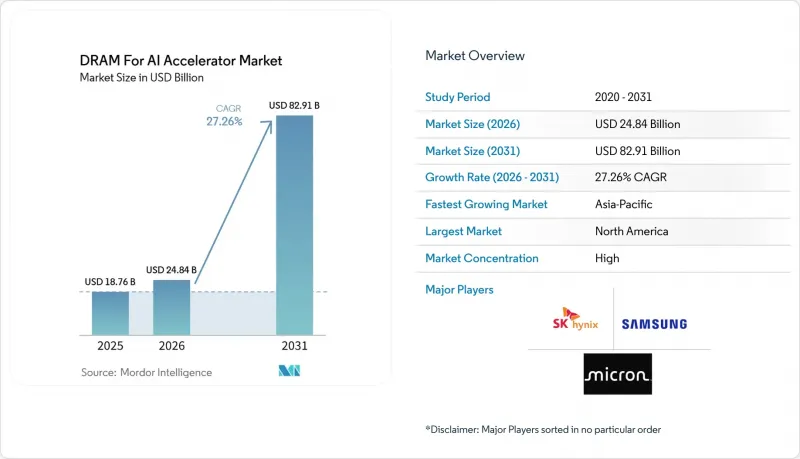
본 보고서는 메모리 아키텍처별(HBM 기반 DRAM, GDDR 기반 DRAM, DDR 기반 DRAM), AI 가속기 유형별(GPU, AI 가속기 ASIC, FPGA, AI 가속 기능이 탑재된 CPU), 모듈 및 스택당 용량별(최대 16GB, 16GB-32 GB, 32 GB-64GB, 64GB-128 GB 및 그 이상), 용도별(훈련, 추론 및 기타), 그리고 지역별로 분류되어 있습니다. 시장 전망은 금액(달러) 기준으로 제시되어 있습니다.
세계의 AI 가속기용 DRAM 시장 동향 및 인사이트
AI GPU 플랫폼에서의 HBM 탑재율 상승
주요 AI GPU가 HBM을 단순한 옵션 메모리 선택지가 아닌 핵심 요구 사항으로 취급하게 됨에 따라, AI 가속기 내 DRAM 시장은 확대를 거듭하고 있습니다. NVIDIA의 B200은 8 TB/s의 대역폭을 가진 192 GB의 HBM3e를 탑재하고 있으며, Rubin 세대에서는 GPU당 최대 288 GB의 HBM4까지 확장 가능합니다. 랙스케일(Rackscale)에 따르면, NVIDIA는 72개의 Rubin GPU가 HBM을 통합하여 13.5 TB의 코히런트 메모리 패브릭을 형성한다고 밝혔으며, 이는 메모리 용량과 상호 연결 설계가 모두 진화하고 있음을 보여줍니다. 이 아키텍처로 인해 도입되는 각 디바이스에 탑재되는 메모리 용량이 증가하고 있으므로, 가속기의 출하 대수 증가세가 선형적이지 않더라도 HBM 수요는 높은 수준을 유지할 것입니다. 또한, 구글이 2026년 6월에 발표한 TPU 시스템의 진화에 관한 논문에서도 5세대에 걸쳐 훈련 노드당 HBM 용량과 대역폭이 10배 증가한 것으로 확인되었습니다. AI 가속기의 DRAM 시장에서 이러한 추세는 플랫폼 주기마다 연산 노드당 메모리 용량이 지속적으로 증가함에 따라, 지속적인 가치 성장을 뒷받침할 것입니다.
범용 DRAM에서 대역폭 최적화 메모리 스택으로의 전환
AI 가속기 분야의 DRAM 시장은 메모리에 대한 논의가 단순한 용량에서 대역폭 효율 및 스택 아키텍처로 전환된 점에 힘입어 더욱 발전하고 있습니다. JEDEC은 2025년 4월 JESD270-4 HBM4 규격을 공개하며, 2,048비트 인터페이스, 32개의 독립 채널, 최대 8 Gbps의 데이터 전송 속도, 그리고 스택당 최대 64GB 지원을 정의했습니다. 이 규격의 발표는 구매자 및 시스템 설계자에게 차세대 메모리에 대한 명확한 상호 운용성 기준을 제공한다는 점에서 중요합니다. 2025년 12월에는 JEDEC이 핀 수를 줄이면서도 HBM4 수준의 처리량을 실현하는 SPHBM4에 대한 계획을 발표하며, 이와 유사한 표준화 과정이 지속되었습니다. 그 결과, AI 가속기 분야의 DRAM 시장은 기존의 DRAM 형식을 반복적으로 조정하는 대신, 대역폭에 최적화된 스택으로의 보다 체계적인 전환의 혜택을 누리고 있습니다. 이러한 변화는 HBM 플랫폼의 제품 수명 주기를 연장하는 데에도 기여하고 있습니다. 고객은 일회성 구현 방식이 아닌, 표준에 기반한 확장을 전제로 계획을 수립할 수 있게 되었기 때문입니다.
HBM 패키징의 병목 현상과 첨단 기판 생산 능력의 제약
AI 가속기 분야의 DRAM 시장은 메모리 수요가 계속해서 견조함에도 불구하고, 첨단 패키징 기술 및 기판 준비 상황 측면에서 여전히 현실적인 제약에 직면해 있습니다. 삼성의 상용 HBM4 프로그램은 4nm 베이스 다이를 채택하여 스택당 최대 3.3 TB/s를 달성함으로써, 최첨단 AI 메모리 제품에 현재 요구되는 공정 집적도 수준을 입증하고 있습니다. 2026년 7월, Samsung Electronics와 SK하이닉스는 충청 지역에 새로운 HBM 제조 공장 및 첨단 패키징 시설 건설을 위해 240조 원(155억 달러)을 투자하겠다고 밝혔습니다. 이는 여전히 구축이 필요한 다운스트림 공정의 생산 능력 규모를 여실히 보여줍니다. 이러한 투자 규모는 패키징이 여전히 공급업체의 전략과 지역별 자본 배분에 영향을 미칠 만큼 큰 병목 현상임을 시사합니다. 패키징 라인의 생산 능력이 웨이퍼 생산량을 따라가지 못하면, 메모리 다이만으로는 완성된 가속기를 공급할 수 없습니다. 따라서 생산 능력에 대한 투자가 가속화되고 있음에도 불구하고, AI 가속기 분야의 DRAM 시장은 여전히 단기적인 공급 부족에 직면해 있습니다.
부문 분석
HBM 기반 DRAM은 2025년에 AI 가속기용 DRAM 시장 점유율의 78.4%를 차지할 것으로 예상되며, 2031년까지 연평균 성장률(CAGR) 28.2%로 확대될 것으로 전망됩니다. 이러한 선두 위상은 AI 가속기용 메모리가 기존의 비트당 가격이라는 논리뿐만 아니라 대역폭, 밀도, 시스템 효율을 바탕으로 선정되고 있음을 반영합니다. 2026년 6월 구글이 발표한 TPU 관련 논문에서는 5세대에 걸쳐 훈련 노드당 HBM 용량과 대역폭이 10배 증가했음이 밝혀졌으며, 이는 HBM이 프리미엄 옵션에서 플랫폼의 핵심 요건으로 전환된 이유를 설명해 줍니다. JEDEC의 HBM4 규격 또한 이러한 전환의 다음 단계를 공식적으로 규정하고 있으며, 스택당 최대 64GB의 용량과 고처리량 컴퓨팅을 위한 대폭 확장된 인터페이스 구조를 갖추고 있습니다. AI 가속기 분야의 DRAM 업계에서 이러한 조합을 통해 HBM은 최첨단 AI 도입의 표준 아키텍처로 자리 잡았습니다.
GDDR 기반 DRAM은 AI 가속기용 DRAM 시장에서 여전히 중요한 위치를 차지하고 있습니다. 이 시장에서는 비용에 민감한 추론 시스템에서 HBM을 많이 사용하는 훈련용 하드웨어보다 메모리 비용을 절감해야 합니다. 이러한 역할은 패키징의 복잡성을 어느 정도 용인하면서도 충분한 대역폭이 필요한 워크로드에서 가장 두드러집니다. DDR 기반 DRAM은 AI 서버의 시스템 메모리 계층에 계속해서 배치되어 있으며, 직접적인 고대역폭 가속기 실행보다는 오케스트레이션, 데이터 마이그레이션, 그리고 호스트 측 버퍼링을 지원합니다. 랙 스케일 AI 시스템의 통합이 진행됨에 따라 DDR의 중요성은 여전히 남아 있지만, 그 전략적 역할은 코어 가속기 메모리에서 서버 설계 전반에 걸친 지원 메모리로 전환되고 있습니다. 그 결과, AI 가속기 내 DRAM 시장은 다른 메모리 유형과 완전히 분리된 것은 아니지만, HBM을 중심으로 한 아키텍처 스택 내에서 그들에게 할당되는 역할을 명확히 축소하고 있습니다.
2025년 AI 가속기용 DRAM 시장 규모에서 GPU 플랫폼이 74.4%를 차지한 반면, AI 가속기 ASIC은 2031년까지 연평균 28.2%의 성장률이 예상됩니다. GPU가 계속해서 주도적인 위치를 유지하는 이유는 하이퍼스케일러의 트레이닝 클러스터에서 여전히 기본 선택지로 자리 잡고 있으며, 광범위한 AI 소프트웨어와의 호환성을 갖추고 있기 때문입니다. 반면, 주요 클라우드 제공업체들이 비용 관리 강화와 메모리, 상호 연결, 모델 서빙 작업 간의 보다 긴밀한 연동을 요구함에 따라 맞춤형 ASIC 프로그램이 탄력을 받고 있습니다. 구글의 TPU 8i는 288GB의 HBM과 8,601GB/s의 대역폭을 갖추고 있어, 자체 개발 가속기가 주류 GPU 플랫폼과의 성능 격차를 얼마나 빠르게 좁혀가고 있는지를 보여줍니다. AI 가속기용 DRAM 시장에서 이는 GPU가 여전히 가장 큰 도입 기반을 차지하고 있음에도 불구하고, 조달 증가세가 단일 지배적 가속기 카테고리를 넘어 확대되고 있음을 의미합니다.
FPGA 기반 가속기는 점유율은 작지만, 저지연 통신, 금융 계산 및 재구성 가능성이 여전히 중요한 특정 도입 환경에서 그 가치를 유지하고 있습니다. AI 가속 기능을 갖춘 CPU 역시 기존 서버 인프라와의 호환성이나 폭넓은 소프트웨어 지원을 우선시하는 엔터프라이즈 추론 환경에서 그 입지를 유지하고 있습니다. 이로 인해 AI 가속기 분야의 DRAM 시장은 단일 하드웨어 템플릿이 아닌, 여러 컴퓨팅 경로로 연결된 형태를 띠고 있습니다. 그럼에도 불구하고, 가장 강력한 성장 동력은 여전히 대규모 HBM 실적와 높은 병렬 메모리 처리량을 지원할 수 있는 제품으로 이동하고 있습니다. 그 결과, GPU가 현재 출하량을 계속 주도하는 한편, ASIC은 AI 가속기 내 DRAM 시장에서 향후 메모리 수요가 가장 빠르게 확대될 분야를 형성하고 있습니다.
지역별 분석
2025년, 북미는 AI 가속기용 DRAM 시장 규모의 44.9%를 차지했습니다. 이 지역이 선두를 차지하는 이유는 최대 규모의 하이퍼스케일러들의 자본 투자 프로그램이 여전히 미국에 집중되어 있으며, 모델 개발 및 AI 인프라 구축도 여전히 미국을 중심으로 진행되고 있기 때문입니다. 이러한 수요 패턴으로 인해, 설령 생산이 다른 국가에서 이루어지더라도 AI 가속기용 DRAM 시장은 마이크로소프트, 구글, 아마존, 메타의 구매 동향과 밀접하게 연결되어 있습니다. 또한, 미국은 첨단 메모리에 관한 규제 환경을 형성하고 있습니다. 산업안보국(BIS)은 2024년 12월 규정을 통해 HBM을 ECCN 3A090.c에 추가하고, 관련 수출 규제를 중국 및 마카오로 향하는 출하까지 확대했습니다. 이로 인해 동맹국들이 공급망에서 차지하는 북미의 중심적 역할이 더욱 강화되었습니다.
유럽은 AI 가속기용 DRAM 시장에서 여전히 소규모 지역 블록이지만, 그 수요는 낮은 수준에서 증가하고 있습니다. 이 지역은 국가 주도의 AI 프로그램, 현지 데이터센터에 대한 투자, 그리고 데이터 상주 요건을 충족하는 추론 인프라에 대한 기업의 관심에 힘입어 성장하고 있습니다. 이에 따라 유럽에서는 최대 규모의 프론티어 트레이닝 클러스터보다는 관리된 도입 및 규정 준수를 중시하는 보다 점진적인 도입 경향이 나타나고 있습니다. 이 지역의 지출 규모는 현재로서는 북미에 미치지 못하지만, 현지 도입 요건으로 인해 고대역폭 AI 시스템에 대한 수요가 지속적으로 발생하고 있어 여전히 중요한 시장으로 남아 있습니다.
아시아태평양은 AI 가속기용 DRAM 시장에서 가장 빠르게 성장하는 지역 부문으로, 2031년까지 연평균 성장률(CAGR)이 28.1%를 나타낼 것으로 예측됩니다. 이 지역은 첨단 DRAM의 주요 생산 거점인 동시에, AI 컴퓨팅 인프라에 대한 수요가 확대되고 있는 중심지로서 이중적인 역할을 수행하고 있습니다. 2026년 7월, Samsung Electronics 및 SK하이닉스는 한국 충청 지역에서 새로운 HBM 제조 공장 및 첨단 패키징 시설 건설을 위해 240조 원(155억 달러)을 투자하기로 결정했습니다. 또한 마이크론도 2026년 7월, 일본 내 HBM 생산 능력을 강화하기 위해 히로시마에서 확장 프로젝트 착공에 들어갔습니다. '세계 기타 지역' 부문은 여전히 초기 단계에 있지만, 중동 일부 지역의 정부 주도 AI 투자로 인해 AI 가속기 분야의 DRAM 시장 수요가 새로운 도입 지역으로 확대되기 시작하고 있습니다.
기타 혜택 :
- 엑셀 형식 시장 예측(ME) 시트
- 3개월간의 애널리스트 지원
자주 묻는 질문
목차
제1장 서론
제2장 조사 방법
제3장 주요 요약
제4장 시장 구도
제5장 시장 규모 및 성장 예측
제6장 경쟁 구도
제7장 시장 기회 및 향후 전망
AJY 26.08.11According to Mordor Intelligence, the DRAM for AI accelerator market size was valued at USD 18.8 billion in 2025 and is forecast to reach USD 82.9 billion by 2031, at a CAGR of 27.3% from 2026 to 2031.
This report is Segmented by Memory Architecture (HBM-Based DRAM, GDDR-Based DRAM, and DDR Based DRAM), AI Accelerator Type (GPU, AI Accelerator ASIC, FPGA, and CPU With AI Acceleration), Capacity Per Module/Stack (Up To 16 GB, 16 GB To 32 GB, 32 GB To 64 GB, 64 GB To 128 GB, and More), Application (Training, Inference, and More), and Geography. The Market Forecasts are Provided in Terms of Value (USD).
Global DRAM For AI Accelerator Market Trends and Insights
Rising HBM Attach Rates in AI GPU Platforms
The DRAM for AI accelerator market is being pushed higher as leading AI GPUs now treat HBM as a core requirement rather than an optional memory choice. NVIDIA's B200 carries 192 GB of HBM3e at 8 TB/s bandwidth, and the Rubin generation scales to 288 GB of HBM4 per GPU. At rack scale, NVIDIA stated that 72 Rubin GPUs pool their HBM into a 13.5 TB coherent memory fabric, demonstrating how memory capacity and interconnect design are advancing together. That architecture keeps HBM demand high even if accelerator shipment growth becomes less linear, because more memory is being attached to each deployed device. Google's June 2026 paper on TPU system evolution also confirmed a 10x increase in HBM capacity and bandwidth per training node across five generations. In the DRAM for AI accelerator market, that pattern supports sustained value growth because memory content per compute node continues to increase with each platform cycle.
Shift From General-Purpose DRAM to Bandwidth-Optimized Memory Stacks
The DRAM for AI accelerator market is also advancing because the memory discussion has shifted from raw capacity toward bandwidth efficiency and stack architecture. JEDEC released the JESD270-4 HBM4 standard in April 2025, defining a 2,048-bit interface, 32 independent channels, data rates up to 8 Gbps, and support for up to 64 GB per stack. That publication matters because it gives buyers and system designers a clear interoperability baseline for the next memory generation. The same standards path continued in December 2025, when JEDEC disclosed work on SPHBM4 to deliver HBM4-level throughput with reduced pin count. As a result, DRAM for AI accelerator market is benefiting from a more formal migration toward bandwidth-optimized stacks rather than repeated tuning of conventional DRAM formats. This change also supports longer product cycles for HBM platforms because customers can now plan around standards-based scaling rather than one-off implementation paths.
HBM Packaging Bottlenecks and Limited Advanced Substrate Capacity
The DRAM for AI accelerator market continues to face a real cap from advanced packaging and substrate readiness, even as memory demand remains strong. Samsung's commercial HBM4 program uses a 4nm base die and achieves up to 3.3 TB/s per stack, demonstrating the level of process integration now required for leading AI memory products. In July 2026, Samsung Electronics and SK Hynix committed KRW 240 trillion (USD 155 billion) in the Chungcheong region to new HBM fabrication plants and advanced packaging facilities, underscoring the extent of downstream capacity that still needs to be built. The scale of that investment shows that packaging remains a bottleneck large enough to shape supplier strategy and regional capital allocation. When packaging lines lag wafer output, memory dies alone do not translate into a finished accelerator supply. That is why the DRAM for AI accelerator market still faces near-term supply friction, even while spending on capacity is accelerating.
Other drivers and restraints analyzed in the detailed report include:
- Rapid Growth in AI Server Cluster Memory Density Requirements
- Increase in Multi-GPU Server Configurations and Memory Pooling Demand
- High Qualification Barriers for New DRAM Suppliers
For complete list of drivers and restraints, kindly check the Table Of Contents.
Segment Analysis
HBM-Based DRAM held 78.4% of the DRAM for AI accelerator market share in 2025, and is also projected to expand at a 28.2% CAGR through 2031. That lead reflects how AI accelerator memory is now being selected on bandwidth, density, and system efficiency rather than on conventional cost-per-bit logic alone. Google's June 2026 TPU paper showed a 10x increase in HBM capacity and bandwidth per training node across five generations, which helps explain why HBM has moved from a premium option to a core platform requirement. JEDEC's HBM4 standard also formalized the next step in this migration, with up to 64 GB per stack and a much wider interface structure for high-throughput computing. In the DRAM for AI accelerator industry, that combination makes HBM the reference architecture for frontier AI deployments.
GDDR-Based DRAM remains relevant in the DRAM for AI accelerator market, where cost-sensitive inference systems need a lower memory bill than HBM-heavy training hardware. Its role is strongest in workloads that can accept lower packaging complexity while still requiring meaningful bandwidth. DDR-Based DRAM continues to sit in the system memory layer of AI servers, where it supports orchestration, data movement, and host-side buffering rather than direct high-bandwidth accelerator execution. As rack-scale AI systems become more coherent, DDR still matters, but its strategic role is shifting from core accelerator memory toward support memory across the full server design. The result is that the DRAM for AI accelerator market is not moving entirely away from other memory types, but it is clearly assigning them narrower roles within an HBM-centered architecture stack.
GPU platforms accounted for 74.4% of the DRAM for AI accelerator market size in 2025, while AI accelerator ASICs are forecast to grow at 28.2% through 2031. GPUs keep the lead because they remain the default choice for hyperscaler training clusters and broad AI software compatibility. At the same time, custom ASIC programs are gaining traction because large cloud providers want better cost control and tighter alignment between memory, interconnect, and model-serving behavior. Google's TPU 8i features 288 GB of HBM and 8,601 GB/s of bandwidth, demonstrating how quickly proprietary accelerator programs are closing the capability gap with mainstream GPU platforms. In the DRAM for AI accelerator market, this means procurement growth is expanding beyond a single dominant accelerator category, even as GPUs still control the largest installed base.
FPGA-based accelerators hold a smaller position, but they retain value in low-latency communications, financial computing, and targeted deployment environments where reconfigurability remains important. CPUs with AI acceleration also maintain a place in enterprise inference setups that prioritize compatibility with established server infrastructure and broader software support. That keeps the DRAM for AI accelerator market tied to multiple compute paths rather than a single hardware template. Even so, the strongest growth pressure is still shifting toward products that can support large HBM footprints and high parallel memory throughput. The net effect is that GPUs continue to define present-day volume, while ASICs are shaping where future memory demand expands fastest in the DRAM for AI accelerator market.
Complete Report Scope:
- By Memory Architecture
- HBM Based DRAM
- GDDR Based DRAM
- DDR Based DRAM
- By AI Accelerator Type
- GPU
- AI Accelerator ASIC
- FPGA
- CPU with AI Acceleration
- By Capacity Per Module or Stack
- Up to 16 GB
- 16 GB to 32 GB
- 32 GB to 64 GB
- 64 GB to 128 GB
- Above 128 GB
- By Application
- Training
- Inference
- High Performance Computing
- Professional Visualization
- By End User
- Hyperscale Cloud Service Providers
- AI Server and System OEMs
- Semiconductor Companies
- Research and Academic Institutions
- By Geography
- North America
- Europe
- Asia Pacific
- China
- Japan
- South Korea
- Taiwan
- Rest of Asia Pacific
- Rest of the World
Geography Analysis
North America represented 44.9% of the DRAM for AI accelerator market size in 2025. The region leads because the largest hyperscaler capital programs remain concentrated in the United States, where model development and AI infrastructure build-outs are still centered. That demand pattern keeps the DRAM for AI accelerator market closely tied to the purchasing behavior of Microsoft, Google, Amazon, and Meta, even when production takes place elsewhere. The United States also shapes the regulatory environment for advanced memory. The Bureau of Industry and Security added HBM to ECCN 3A090.c in its December 2024 rule and extended related export controls to shipments involving China and Macau, thereby reinforcing North America's central role in the allied-country supply chain.
Europe remains a smaller regional block in the DRAM for AI accelerator market, and its demand is rising from a lower starting base. The region is supported by sovereign AI programs, local data center investments, and enterprise interest in inference infrastructure that meets data residency requirements. That gives Europe a steadier adoption profile, with greater emphasis on controlled deployment and compliance-readiness than on the largest frontier training clusters. The region does not yet match North America on spending scale, but it remains relevant because local deployment requirements continue to create demand for high-bandwidth AI systems.
Asia-Pacific is the fastest-growing regional segment in the DRAM for AI accelerator market, with a projected CAGR of 28.1% through 2031. The region plays a dual role as both the main production base for advanced DRAM and a rising demand center for AI compute infrastructure. In July 2026, Samsung Electronics and SK Hynix committed KRW 240 trillion, or USD 155 billion, in South Korea's Chungcheong region for new HBM fabrication plants and advanced packaging facilities. Micron also broke ground on its Hiroshima expansion in July 2026 to strengthen HBM production capacity in Japan. The Rest of the World segment remains early-stage, but sovereign AI spending in parts of the Middle East is beginning to pull more of the DRAM for AI accelerator market into new deployment geographies.
- SK Hynix Inc.
- Samsung Electronics Co., Ltd.
- Micron Technology, Inc.
- NVIDIA Corporation
- Advanced Micro Devices, Inc.
- Intel Corporation
- SK Hynix System IC Inc.
- Rambus Inc.
- United Microelectronics Corporation
- Taiwan Semiconductor Manufacturing Company Limited
- Amkor Technology, Inc.
- ASE Technology Holding Co., Ltd.
- Micron Semiconductor Asia Pte. Ltd.
- Samsung Semiconductor, Inc.
- Kingston Technology Company, Inc.
- G.SKILL International Enterprise Co., Ltd.
- Corsair Gaming, Inc.
- Team Group Inc.
- Powerchip Semiconductor Manufacturing Corporation
- Nanya Technology Corporation
Additional Benefits:
- The market estimate (ME) sheet in Excel format
- 3 months of analyst support
TABLE OF CONTENTS
1 INTRODUCTION
- 1.1 Study Assumptions and Market Definition
- 1.2 Scope of the Study
2 RESEARCH METHODOLOGY
3 EXECUTIVE SUMMARY
4 MARKET LANDSCAPE
- 4.1 Market Overview
- 4.2 Market Drivers
- 4.2.1 Rising HBM Attach Rates in AI GPU Platforms
- 4.2.2 Shift From General Purpose DRAM to Bandwidth Optimized Memory Stacks
- 4.2.3 Rapid Growth in AI Server Cluster Memory Density Requirements
- 4.2.4 Increase in Multi-GPU Server Configurations and Memory Pooling Demand
- 4.2.5 Yield Improvement and Capacity Expansion in HBM Supply Chains
- 4.2.6 Expanding Use of GDDR in Cost Sensitive AI Inference GPUs
- 4.3 Market Restraints
- 4.3.1 HBM Packaging Bottlenecks and Limited Advanced Substrate Capacity
- 4.3.2 High Qualification Barriers for New DRAM Suppliers
- 4.3.3 Memory Allocation Competition From General Server DDR Demand
- 4.3.4 Export Controls and Geopolitical Constraints on Advanced Memory Supply
- 4.4 Industry Supply Chain Analysis
- 4.5 Regulatory Landscape
- 4.6 Technological Outlook
- 4.7 Impact of Macroeconomic Factors on the Market
- 4.8 Porter's Five Forces Analysis
- 4.8.1 Bargaining Power of Suppliers
- 4.8.2 Bargaining Power of Buyers
- 4.8.3 Threat of New Entrants
- 4.8.4 Threat of Substitutes
- 4.8.5 Intensity of Competitive Rivalry
5 MARKET SIZE AND GROWTH FORECASTS (VALUE)
- 5.1 By Memory Architecture
- 5.1.1 HBM Based DRAM
- 5.1.2 GDDR Based DRAM
- 5.1.3 DDR Based DRAM
- 5.2 By AI Accelerator Type
- 5.2.1 GPU
- 5.2.2 AI Accelerator ASIC
- 5.2.3 FPGA
- 5.2.4 CPU with AI Acceleration
- 5.3 By Capacity Per Module or Stack
- 5.3.1 Up to 16 GB
- 5.3.2 16 GB to 32 GB
- 5.3.3 32 GB to 64 GB
- 5.3.4 64 GB to 128 GB
- 5.3.5 Above 128 GB
- 5.4 By Application
- 5.4.1 Training
- 5.4.2 Inference
- 5.4.3 High Performance Computing
- 5.4.4 Professional Visualization
- 5.5 By End User
- 5.5.1 Hyperscale Cloud Service Providers
- 5.5.2 AI Server and System OEMs
- 5.5.3 Semiconductor Companies
- 5.5.4 Research and Academic Institutions
- 5.6 By Geography
- 5.6.1 North America
- 5.6.2 Europe
- 5.6.3 Asia Pacific
- 5.6.3.1 China
- 5.6.3.2 Japan
- 5.6.3.3 South Korea
- 5.6.3.4 Taiwan
- 5.6.3.5 Rest of Asia Pacific
- 5.6.4 Rest of the World
6 COMPETITIVE LANDSCAPE
- 6.1 Market Concentration
- 6.2 Strategic Moves
- 6.3 Market Share Analysis
- 6.4 Company Profiles (includes Global Level Overview, Market Level Overview, Core Segments, Financials as available, Strategic Information, Products and Services, Recent Developments)
- 6.4.1 SK Hynix Inc.
- 6.4.2 Samsung Electronics Co., Ltd.
- 6.4.3 Micron Technology, Inc.
- 6.4.4 NVIDIA Corporation
- 6.4.5 Advanced Micro Devices, Inc.
- 6.4.6 Intel Corporation
- 6.4.7 SK Hynix System IC Inc.
- 6.4.8 Rambus Inc.
- 6.4.9 United Microelectronics Corporation
- 6.4.10 Taiwan Semiconductor Manufacturing Company Limited
- 6.4.11 Amkor Technology, Inc.
- 6.4.12 ASE Technology Holding Co., Ltd.
- 6.4.13 Micron Semiconductor Asia Pte. Ltd.
- 6.4.14 Samsung Semiconductor, Inc.
- 6.4.15 Kingston Technology Company, Inc.
- 6.4.16 G.SKILL International Enterprise Co., Ltd.
- 6.4.17 Corsair Gaming, Inc.
- 6.4.18 Team Group Inc.
- 6.4.19 Powerchip Semiconductor Manufacturing Corporation
- 6.4.20 Nanya Technology Corporation
7 MARKET OPPORTUNITIES AND FUTURE OUTLOOK
- 7.1 White-Space and Unmet-Need Assessment


