

|
시장보고서
상품코드
2099813
실리카 분말 시장 : 시장 점유율 분석, 업계 동향 및 통계, 성장 예측(2026-2031년)Silica Flour - Market Share Analysis, Industry Trends & Statistics, Growth Forecasts (2026 - 2031) |
||||||
 Mordor Intelligence
Mordor Intelligence에 의하면, 실리카 분말 시장 규모는 2025년 6억 7,952만 달러로 평가되었고, 2026년 7억 726만 달러에서 2031년까지 8억 6,941만 달러로 확대될 것으로 예측되며, 2026-2031년 CAGR 4.21%를 나타낼 전망입니다.
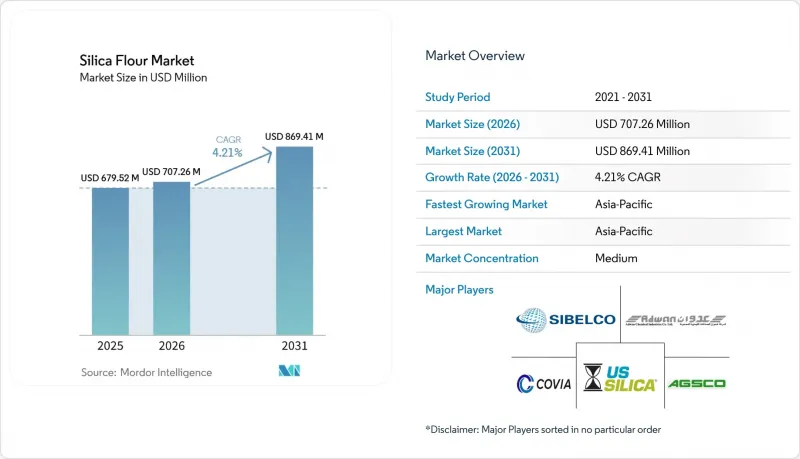
본 보고서는 유형별(석영 및 크리스토발라이트), 최종 이용 산업별(유리, 주조, 유리 섬유, 유정 시멘트 등), 지역별(아시아태평양, 북미, 유럽, 남미, 중동 및 아프리카)로 분류되어 있습니다. 시장 전망은 금액(달러) 기준으로 제시되어 있습니다.
세계의 실리카 분말 시장 동향 및 인사이트
유리 산업 수요 증가
유리는 판유리, 용기용 유리, 특수 유리, 태양광 발전용 유리에 이르기까지 실리카 분말 시장의 주요 수요 견인 요인 중 하나입니다. 구매자들은 고성능 유리 제품을 뒷받침하기 위해 더욱 엄격한 입자 크기 관리와 철분 함량 감소를 요구하고 있습니다. 이는 품질 기준이나 인증 기준이 더욱 엄격한 태양광 발전 관련 용도에서 특히 중요합니다. 그 결과, 실리카 분말 시장은 수량 면에서 확대되고 있으며, 가격 경쟁력이 높은 고순도 제품 라인으로 전환되고 있습니다. 산 침출 및 미세 분급을 통해 품질 향상을 도모할 수 있는 생산자는 장기 계약을 확보하고 보다 안정적인 수익을 창출할 수 있습니다. 반면, 그러한 역량을 갖추지 못한 생산자는 경기 순환에 좌우되기 쉬운 유리 수요와 밀접하게 연결된 상태가 지속되어, 표준 등급에서 더 큰 가격 압박에 직면하게 될 것입니다.
유리섬유 생산 확대
유리섬유 생산은 단열재, 복합재료, 풍력 발전 설비 제조 분야에서 실리카 분말 수요를 견인하고 있습니다. 유리섬유 고객들은 일관성, 청정도 및 관리된 입자 분포를 매우 중요하게 여깁니다. 풍력 터빈 블레이드의 대형화와 더욱 고도화된 복합재료 용도의 확대에 따라, 수지의 ?아웃 및 다운스트림 공정에서 확실한 성능을 발휘하는 인증된 실리카 원료에 대한 수요가 증가하고 있습니다. 이러한 요건으로 인해 인증 공급업체의 수가 제한되며, 품질이 안정적인 재료에 대한 가격 프리미엄이 유지되고 있습니다. 따라서 실리카 분말 시장은 생산량 수요 증가와 더욱 엄격해진 공급업체 선정 절차라는 두 가지 측면을 통해 유리섬유로부터 혜택을 받고 있습니다. 이로 인해 범용 제품 중심의 용도가 부진한 국면에서도 유리섬유는 실리카 분말 시장을 안정시키는 요인이 되고 있습니다.
결정질 실리카에 대한 노출 및 규제 준수 비용
가공 및 취급 과정에서 지속적인 관리 시스템이 필요한 직접적인 노출 위험이 발생하기 때문에 건강 및 산업안전보건 관련 규제가 실리카 분말 시장에 제약을 가하고 있습니다. 미국 직업안전보건청(OSHA)은 8시간 시간가중평균 50μg/m³라는 허용 노출 한계치를 의무화하고 있을 뿐만 아니라, 서면 노출 관리 계획, 공학적 대책, 25μg/m³의 행동 수준에서의 건강 모니터링, 그리고 장기적인 기록 보관 의무를 규정하고 있습니다. 이러한 요건들은 생산자에게 초기 비용과 지속적인 비용 모두를 증가시켜, 규정 준수를 경영상의 핵심 과제로 만들고 있습니다. 또한, 실리카 분말 시장은 구조적인 이익률 제약에도 직면해 있습니다. 이는 고품위 원료에 비해 저품위 등급에서는 이러한 비용을 흡수하기가 더 어렵기 때문입니다. 미국 지질조사국(USGS)은 결정질 실리카 노출 규제를 산업용 모래·자갈 사업 분야의 지속적인 우려 사항으로 꼽고 있으며, 이 문제는 실리카 밸류체인 전반에 걸쳐 지속될 것으로 시사되고 있습니다. 그 결과, 실리카 분말 시장에서는 강력한 공학적 대책과 규정 준수 체계를 갖춘 사업자가 유리한 입지를 차지할 가능성이 높을 것으로 보입니다.
부문 분석
2025년, 석영은 매출의 72.44%를 차지하며 실리카 분말 시장에서 유형별 최대 시장 점유율을 기록했습니다. 이는 비용 효율성과 안정적인 공급이 여전히 최우선 과제인 유리, 주조, 유리 섬유 및 기타 확립된 용도 분야에서 석영이 폭넓게 적용되고 있음을 반영합니다. 실리카 분말 시장은 기존 수요와 다수의 고부가가치 제품 라인을 모두 뒷받침하는 주요 원료로서 계속해서 석영에 의존하고 있습니다. 그러나 고객이 불순물 허용 한도를 엄격히 하고, 더 정밀하게 관리된 입자 크기 분포를 요구함에 따라 석영 부문은 사양 요건의 강화에 직면하고 있습니다. 시장이 석영을 외면하는 것은 아니지만, 석영 카테고리 자체 내에서 더 고도화된 가공 기술이 요구되고 있습니다.
건식 분류, 부유 선별, 산 침출에 투자해 온 생산자들은 더 높은 부가가치를 지닌 계약이나 장기 공급 계약을 확보해 나가고 있습니다. 이러한 운영 측면의 격차로 인해 표준 석영 분말과 더 까다로운 산업용도에 대응하는 고등급 제품 사이에 점차 차이가 벌어지고 있습니다. 크리스토발라이트는 가장 빠르게 성장하는 유형로, 해당 실리카 분말 시장 규모는 2031년까지 연평균 성장률(CAGR) 5.18%로 확대될 것으로 예측됩니다. 건축용 도료, 건설용 화학약품 및 특정 주조 용도의 고객들이 크리스토발라이트의 낮은 부피 밀도, 백도 프로파일, 그리고 설비 마모를 줄여주는 특성을 높이 평가함에 따라 크리스토발라이트에 대한 수요가 증가하고 있습니다. 크리스토발라이트는 특수 용도 분야에서 점유율을 확대하고 있지만, 보다 광범위한 실리카 분말 시장 전체에서는 석영이 여전히 매출의 핵심을 차지하고 있습니다.
지역별 분석
아시아태평양은 2025년 실리카 분말 시장 점유율의 45.27%를 차지했으며, 2031년까지 연평균 성장률(CAGR) 6.18%라는 가장 높은 성장률을 나타낼 것으로 예측됩니다. 이 지역이 주도적인 위치를 차지하는 것은 중국, 인도, 일본, 한국 및 동남아시아 전역에서 유리, 세라믹, 유리 섬유, 건설용 화학제품에 대한 수요가 증가하기 때문입니다. 실리카 분말 시장이 이 지역에 집중되어 있는 이유는 하류 산업이 클러스터화되어 있고, 수출 지향적이며, 제품의 품질과 규모에 중점을 두고 있기 때문입니다. 중국은 여전히 주요 지역 거점이지만, 해당 시장에서 중국의 역할은 대량 흡수에서 순도 및 제품 일관성에 대한 보다 엄격한 사양 설정으로 전환되고 있습니다. 인도는 구매자들이 대체 공급 플랫폼을 모색하고 있으며, 현지 하류 수요가 지속적으로 확대됨에 따라 실리카 분말 시장에서 그 중요성이 높아지고 있습니다.
북미와 유럽은 특수 유리, 여과, 반도체 관련 및 고성능 건설 용도에 의한 지역 수요에 힘입어 실리카 분말 시장의 프리미엄 가치 핵심을 형성하고 있습니다. 미국의 Silica사는 2025년 9월 일리노이주에 로셸 이노베이션 센터를 개설하고, 여과, 재생 가능 디젤 및 산업용 오일 용도를 위한 제품 개발을 지원함으로써 특수 분야에 대한 집중을 확대했습니다. 시벨코(Sibelco)는 2025년 상반기(H1) 매출이 11억 5,300만 유로(13억 달러 상당)였습니다고 보고했으며, 그 성장 요인으로 핵심 시장인 유럽 및 아시아태평양의 실적을 꼽았습니다. 이 지역들은 판매량, 톤당 매출액의 높음, 그리고 차별화된 등급의 제품 라인업이라는 측면에서 실리카 분말 시장에서 여전히 중요한 위치를 차지하고 있습니다.
남미, 중동 및 아프리카 및 기타 유럽은 실리카 분말 시장에서의 점유율은 작지만, 각 지역마다 고유한 수요 특성을 가지고 있습니다. 브라질은 건설 활동과 심해 유정의 시멘트 충진이 단일 국내 시장 내에서 특수 실리카의 이용을 뒷받침하고 있다는 점에서 주목받고 있습니다. 중동 및 아프리카에서는 유리, 세라믹, 건설 분야 수요가 주도적인 역할을 하고 있으며, 지역 공급업체들은 짧은 배송 경로와 현지 고객과의 관계로 인해 혜택을 보고 있습니다. 기타 유럽의 경우, 조달 패턴의 변화에 따라 구매자들이 혼란스러운 무역 경로 이외의 신뢰할 수 있는 공급원을 모색하는 가운데, 여전히 중요한 위치를 차지하고 있습니다.
기타 혜택 :
- 엑셀 형식 시장 예측(ME) 시트
- 3개월간의 애널리스트 지원
자주 묻는 질문
목차
제1장 서론
제2장 조사 방법
제3장 주요 요약
제4장 시장 구도
제5장 시장 규모 및 성장 예측
제6장 경쟁 구도
제7장 시장 기회 및 향후 전망
AJY 26.08.07According to Mordor Intelligence, the silica flour market size is projected to expand from USD 679.52 million in 2025 and USD 707.26 million in 2026 to USD 869.41 million by 2031, and is expected to register a CAGR of 4.21% between 2026 and 2031.
This report is Segmented by Type (Quartz and Cristobalite), End-Use Industry (Glass, Foundry, Fiberglass, Oil Well Cement, and More), and Geography (Asia-Pacific, North America, Europe, South America, and Middle-East and Africa). The Market Forecasts are Provided in Terms of Value (USD).
Global Silica Flour Market Trends and Insights
Rising Demand from the Glass Industry
Glass is one of the key demand drivers for the silica flour market, spanning flat glass, container glass, specialty glass, and solar photovoltaic glass. Buyers are requesting tighter particle-size control and lower iron content to support higher-performance glass products. This is particularly relevant in solar-related applications, where quality thresholds and qualification standards are more stringent. As a result, the silica flour market is growing in volume and shifting toward higher-purity product lines with stronger pricing. Producers that can upgrade through acid leaching and fine classification are positioned to secure longer contracts and more stable returns. Producers without that capability remain more closely tied to cyclical glass demand and face greater price pressure in standard grades.
Growth in Fiberglass Production
Fiberglass production is driving demand for silica flour across insulation, composites, and wind energy manufacturing. Fiberglass customers place a high value on consistency, cleanliness, and controlled particle distribution. Longer wind turbine blades and more demanding composite applications are increasing the need for qualified silica inputs that perform reliably during resin wet-out and downstream processing. This requirement narrows the pool of approved suppliers and supports a price premium for consistent material. The silica flour market is therefore gaining from fiberglass through both tonnage demand and a stricter supplier selection process. This makes fiberglass a stabilizing factor for the silica flour market when commodity-driven applications weaken.
Crystalline Silica Exposure and Regulatory Compliance Costs
Health and workplace regulations constrain the silica flour market, as processing and handling create direct exposure risks requiring permanent control systems. The Occupational Safety and Health Administration (OSHA) mandates a permissible exposure limit of 50 μg/m3 as an 8-hour time-weighted average, along with written exposure control plans, engineering controls, medical surveillance at the action level of 25 μg/m3, and long-term recordkeeping obligations. These requirements raise both upfront and recurring costs for producers, making compliance a core operating issue. The silica flour market also faces a structural margin constraint, as these costs are harder to absorb in lower-value grades than in premium material. The U.S. Geological Survey (USGS) identifies crystalline silica exposure regulation as an ongoing concern for industrial sand and gravel operations, indicating that this issue will persist across the silica value chain. Consequently, the silica flour market is likely to favor operators with strong engineering controls and compliance systems.
Other drivers and restraints analyzed in the detailed report include:
- Expansion of Foundry Applications
- Increasing Demand for Oil Well Cement
- Volatility in Mining Costs and Raw Material Supply
For complete list of drivers and restraints, kindly check the Table Of Contents.
Segment Analysis
Quartz accounted for 72.44% of revenue in 2025, the largest market share by type in the silica flour market. This reflects quartz's broad applicability across glass, foundry, fiberglass, and other established applications where cost efficiency and reliable availability remain priorities. The silica flour market continues to rely on quartz as its primary source, supporting both legacy demand and many upgraded product lines. However, the quartz segment is facing increasing specification requirements, as customers tighten impurity limits and demand more controlled particle distributions. The market is not moving away from quartz, but is requiring greater processing sophistication within the quartz category itself.
Producers that have invested in dry classification, flotation, and acid leaching are gaining access to higher-value contracts and longer supply arrangements. This operational gap is gradually creating a divide between standard quartz flour and upgraded grades that serve more demanding industrial applications. Cristobalite is the fastest-growing type, with its silica flour market size projected to expand at a 5.18% CAGR through 2031. Demand for cristobalite is rising as customers in architectural coatings, construction chemicals, and selected casting applications value its lower bulk density, whiteness profile, and reduced equipment abrasion characteristics. Cristobalite is gaining ground in specialty applications, while quartz remains the core revenue foundation across the broader silica flour market.
Complete Report Scope:
- By Type
- Quartz
- Cristobalite
- By End-Use Industry
- Glass
- Foundry
- Fiberglass
- Oil Well Cement
- Ceramics and Refractory
- Paints & Coatings
- Construction Chemicals
- Other End-use Industries
- By Geography
- Asia-Pacific
- China
- India
- Japan
- South Korea
- Rest of Asia-Pacific
- North America
- United States
- Canada
- Mexico
- Europe
- Germany
- United Kingdom
- France
- Italy
- Russia
- Rest of Europe
- South America
- Brazil
- Argentina
- Rest of South America
- Middle-East and Africa
- Saudi Arabia
- South Africa
- Rest of Middle-East and Africa
- Asia-Pacific
Geography Analysis
Asia-Pacific held 45.27% of the silica flour market share in 2025 and is forecast to register the fastest CAGR of 6.18% through 2031. The region leads due to demand for glass, ceramics, fiberglass, and construction chemicals across China, India, Japan, South Korea, and Southeast Asia. The silica flour market is concentrated in this region because downstream industries are clustered, export-oriented, and focused on product quality and scale. China remains the primary regional hub, though its market role is shifting from volume absorption toward tighter specification-setting for purity and product consistency. India is growing in importance to the silica flour market, as buyers seek alternative supply platforms and local downstream demand continues to expand.
North America and Europe form the premium-value core of the silica flour market, as regional demand is driven by specialized glass, filtration, semiconductor-related, and high-performance construction applications. U.S. Silica expanded its specialty focus by opening the Rochelle Innovation Center in Illinois in September 2025, which supports product development for filtration, renewable diesel, and industrial oil applications. Sibelco reported first half (H1) 2025 revenue of EUR 1,153 million (equivalent to USD 1.3 billion), attributing growth to performance in core European markets and Asia-Pacific. These regions remain significant to the silica flour market for volume, higher revenue per ton, and a mix of differentiated grades.
South America, the Middle East and Africa, and the rest of Europe account for smaller shares of the silica flour market, with each region having a distinct demand profile. Brazil is notable because construction activity and deepwater oil well cementing support specialized silica use within a single national market. The Middle East and Africa are driven by glass, ceramics, and construction demand, with regional suppliers benefiting from shorter delivery routes and local customer relationships. The rest of Europe remains relevant as sourcing patterns shift and buyers seek dependable supply outside disrupted trade corridors.
- Adwan Chemical Industries Co. Ltd. (ACIC)
- AGSCO Corp
- Australian Silica Quartz Group Ltd
- Capital Sand Company, LLC
- Covia Holdings LLC
- Delmon.co.ltd
- Euroquarz GmbH
- Fineton Industrial Minerals Limited.
- Hoben International Ltd.
- Minerali Industriali S.r.l.
- Quarzwerke GmbH
- Sibelco
- Sil Industrial Minerals, Inc.
- U.S. Silica
Additional Benefits:
- The market estimate (ME) sheet in Excel format
- 3 months of analyst support
TABLE OF CONTENTS
1 Introduction
- 1.1 Study Assumptions and Market Definition
- 1.2 Scope of the Study
2 Research Methodology
3 Executive Summary
4 Market Landscape
- 4.1 Market Overview
- 4.2 Market Drivers
- 4.2.1 Rising Demand from Glass Industry
- 4.2.2 Expansion of Foundry Activity in Manufacturing Hubs
- 4.2.3 Growth in Fiberglass Production for Industrial and Construction Uses
- 4.2.4 Increasing Demand from Oil Well Cement Formulations
- 4.2.5 Expansion of ceramics and sanitaryware production
- 4.3 Market Restraints
- 4.3.1 Crystalline Silica Exposure Compliance Requirements
- 4.3.2 Volatility in mining and energy costs
- 4.3.3 Environmental Restrictions on Mining and Quarrying
- 4.4 Value Chain Analysis
- 4.5 Porter's Five Forces Analysis
- 4.5.1 Threat of New Entrants
- 4.5.2 Bargaining Power of Suppliers
- 4.5.3 Bargaining Power of Buyers
- 4.5.4 Threat of Substitutes
- 4.5.5 Competitive Rivalry
5 Market Size and Growth Forecasts (Value)
- 5.1 By Type
- 5.1.1 Quartz
- 5.1.2 Cristobalite
- 5.2 By End-Use Industry
- 5.2.1 Glass
- 5.2.2 Foundry
- 5.2.3 Fiberglass
- 5.2.4 Oil Well Cement
- 5.2.5 Ceramics and Refractory
- 5.2.6 Paints & Coatings
- 5.2.7 Construction Chemicals
- 5.2.8 Other End-use Industries
- 5.3 By Geography
- 5.3.1 Asia-Pacific
- 5.3.1.1 China
- 5.3.1.2 India
- 5.3.1.3 Japan
- 5.3.1.4 South Korea
- 5.3.1.5 Rest of Asia-Pacific
- 5.3.2 North America
- 5.3.2.1 United States
- 5.3.2.2 Canada
- 5.3.2.3 Mexico
- 5.3.3 Europe
- 5.3.3.1 Germany
- 5.3.3.2 United Kingdom
- 5.3.3.3 France
- 5.3.3.4 Italy
- 5.3.3.5 Russia
- 5.3.3.6 Rest of Europe
- 5.3.4 South America
- 5.3.4.1 Brazil
- 5.3.4.2 Argentina
- 5.3.4.3 Rest of South America
- 5.3.5 Middle-East and Africa
- 5.3.5.1 Saudi Arabia
- 5.3.5.2 South Africa
- 5.3.5.3 Rest of Middle-East and Africa
- 5.3.1 Asia-Pacific
6 Competitive Landscape
- 6.1 Market Concentration
- 6.2 Strategic Moves
- 6.3 Market Share (%)/Ranking Analysis
- 6.4 Company Profiles (includes Global Overview, Market Overview, Core Segments, Financials as available, Strategic Information, Products and Services, and Recent Developments)
- 6.4.1 Adwan Chemical Industries Co. Ltd. (ACIC)
- 6.4.2 AGSCO Corp
- 6.4.3 Australian Silica Quartz Group Ltd
- 6.4.4 Capital Sand Company, LLC
- 6.4.5 Covia Holdings LLC
- 6.4.6 Delmon.co.ltd
- 6.4.7 Euroquarz GmbH
- 6.4.8 Fineton Industrial Minerals Limited.
- 6.4.9 Hoben International Ltd.
- 6.4.10 Minerali Industriali S.r.l.
- 6.4.11 Quarzwerke GmbH
- 6.4.12 Sibelco
- 6.4.13 Sil Industrial Minerals, Inc.
- 6.4.14 U.S. Silica
7 Market Opportunities and Future Outlook
- 7.1 White-Space and Unmet-Need Assessment


