

|
시장보고서
상품코드
2099858
SRAM 근접 메모리 캐시 컴퓨팅 시장 : 시장 점유율 분석, 업계 동향 및 통계, 성장 예측(2026-2031년)SRAM Near-Memory Cache Compute - Market Share Analysis, Industry Trends & Statistics, Growth Forecasts (2026 - 2031) |
||||||
 Mordor Intelligence
Mordor Intelligence에 의하면, SRAM 근접 메모리 캐시 컴퓨팅 시장 규모는 2025년에 23억 4,000만 달러로 평가되었고, 2026-2031년 예측 기간 CAGR 24.70%로 확대될 전망이며, 2031년에는 89억 1,000만 달러에 이를 것으로 추정되고 있습니다.
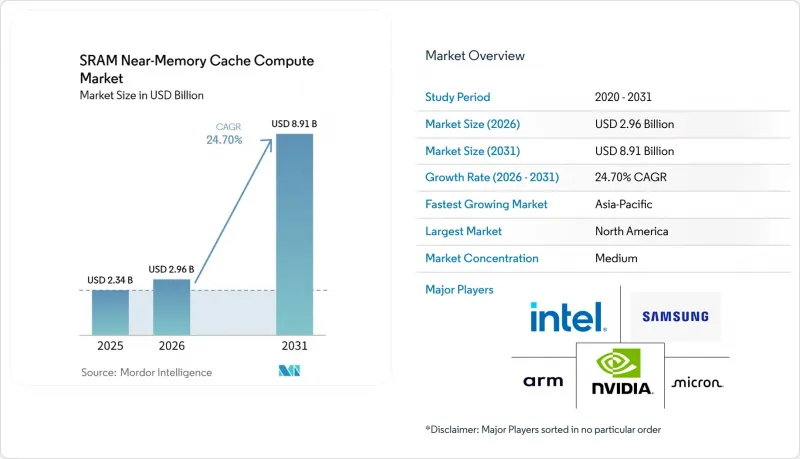
본 보고서는 메모리 유형별(임베디드 SRAM(eSRAM), 스탠드얼론 SRAM, 멀티포트 SRAM 등), 프로세서 통합별(CPU 캐시 통합, GPU 캐시 통합 등), 용도별(AI 훈련, 추론, 엣지 AI 등), 최종 사용자별(클라우드 및 하이퍼스케일 제공업체, 엔터프라이즈 데이터센터 등), 그리고 지역별로 분류되어 있습니다. 시장 전망은 금액(달러) 기준으로 제시되어 있습니다.
세계의 SRAM 근접 메모리 캐시 컴퓨팅 시장 동향 및 인사이트
온칩 캐시 근접성에 대한 AI 가속기 수요 증가
SRAM 근접 메모리 캐시 컴퓨팅 시장에서 AI 추론은 캐시를 연산 엔진에 더 가깝게 배치하도록 촉진하고 있습니다. 이는 배포된 모델이 실행 시간의 대부분을 순수한 연산 처리가 아닌 메모리 액세스를 기다리는 데 소비하기 때문입니다. 검토를 거친 연구에 따르면, 현대 신경망에서 메모리 액세스에 수반되는 에너지 소비의 상당 부분은 고속 상호 연결을 통한 데이터 전송에서 발생하며, 이로 인해 니어 메모리 캐시의 배치는 부차적인 설계 선택 사항이 아니라 효율성을 직접 향상시키는 중요한 요소가 되었습니다. SRAM이 연산 블록 옆에 배치되고, 반복되는 토큰 연산이 다이 내에서 이루어짐으로써 이러한 부하가 경감됩니다. 따라서 많은 AI 가속기에서 로컬 대역폭은 피크 연산 밀도와 마찬가지로 중요하게 여겨지고 있습니다. NVIDIA의 Hopper 아키텍처는 이미 이러한 개념을 반영하고 있으며, AI 워크로드에서 외부 메모리에 대한 반복적인 액세스를 줄이도록 설계된 대규모 온다이 SRAM 캐시를 탑재하고 있습니다. SRAM을 통한 LLM 추론 가속화에 관한 연구에서는 메모리 근방에서의 버퍼링이 디코딩 단계의 개선으로 이어진다는 사실도 밝혀졌습니다. 디코딩 단계는 실제 운영 중인 언어 모델에서 토큰별 지연이 가장 두드러지게 나타나는 단계입니다. 따라서 SRAM을 활용한 메모리 근접 캐시를 통한 연산 시장은 로컬 메모리의 근접성을 측정 가능한 처리량 향상으로 연결할 수 있는 가속기 프로그램을 중심으로 전개되고 있습니다.
고성능 CPU, GPU 및 NPU의 성장
고성능 프로세서의 성장은 SRAM 근접 메모리 캐시 컴퓨팅 시장의 확장을 지속적으로 뒷받침하고 있습니다. 이는 추가되는 각 연산 블록이 스톨이나 외부 메모리에 대한 반복적인 액세스를 피하기 위해 로컬 캐시가 필요하기 때문입니다. NVIDIA는 각 스트리밍 멀티프로세서가 SRAM 기반 L1 메모리를 탑재하고 있기 때문에 아키텍처의 스케일업에 따라 온다이 캐시 수요도 증가할 것이라고 설명하고 있습니다. H100은 SRAM에 50MB의 L2 캐시도 채택하고 있어, 이를 통해 AI 실행 중에 더 대규모의 모델이나 데이터셋의 일부를 프로세서 근처에 유지할 수 있게 됩니다. Arm의 3nm 의사 2포트 SRAM 매크로 개발 현황을 보아도, 각 IP 공급업체들이 고정된 전력 소비 및 면적 제약 내에서 더 높은 대역폭을 실현할 수 있도록 SRAM 설계를 최적화하고 있으며, 이를 통해 더 광범위한 첨단 칩 프로그램이 지원될 것임을 알 수 있습니다. 이 점이 중요한 이유는 SRAM을 활용한 니어 메모리 캐시를 통한 연산 시장이 데이터센터용 GPU뿐만 아니라, 영구적인 로컬 모델 실행이 필요한 CPU, NPU, 엣지 프로세서와도 관련이 있기 때문입니다. 프로세서 수와 코어 밀도가 지속적으로 증가하는 가운데, 예측 가능한 응답 시간을 유지하기 위한 실용적인 수단으로서 로컬 SRAM은 여전히 몇 안 되는 선택지 중 하나입니다.
근접 메모리 컴퓨팅 통합의 높은 설계 복잡성
근접 메모리 컴퓨팅의 통합이 여전히 어려운 이유는 SRAM 어레이, 로직 블록, 물리적 레이아웃 및 패키지 아키텍처를 개별 설계 단계가 아닌 하나의 통합된 시스템으로 최적화해야 하기 때문입니다. 현재의 SRAM 근접 메모리 캐시 컴퓨팅 시장에서 이는 첨단 노드의 XPU 프로젝트가 허용 가능한 수율과 열 거동 수준에 도달하기까지 더 긴 검증 주기와 더 높은 엔지니어링 오버헤드를 겪게 되는 경우가 많음을 의미합니다. 2026년 IEEE와 JEDEC이 공동으로 수행한 분석에 따르면, 어텐션 커널에 의한 고듀티 SRAM 동작이 고밀도 AI 설계에서 국부적인 열 스트레스를 표준 인증 요건의 예상치를 초과하여 높일 우려가 있다고 경고하고 있습니다. 이 분석에서는 이러한 스트레스가 지속적인 작동 부하 하에서 바이어스 온도 불안정성(BTI) 및 사일런트 데이터 손상의 위험 증가로 이어질 수 있다고 지적하고 있습니다. 또한, 최첨단 로직 및 고밀도 SRAM 노드는 TSMC의 최첨단 로드맵을 포함한 소수의 제조 생태계에 집중되어 있어 파운드리 의존도 역시 장벽으로 작용하고 있습니다. 이러한 제약으로 인해 SRAM 니어 메모리 캐시 컴퓨트 시장에서 새로운 프로젝트를 신속하게 확장할 수 있는 팀의 수는 제한적입니다.
부문 분석
2025년, 임베디드 SRAM은 SRAM 근접 메모리 캐시 컴퓨팅 시장의 73.84%를 차지했으며, 메모리 유형별 시장 세분화에서 여전히 압도적인 주도적 위치를 유지했습니다. 이러한 우위는 동일한 공정 흐름에서 로직과 함께 제조된다는 점에 기인하며, 이를 통해 패키지 오버헤드가 제거되어 고속 로컬 메모리가 필요한 첨단 SoC에 있어 기본 선택지가 되고 있습니다. Marvell사의 2nm 맞춤형 eSRAM은 이 부문이 기본적인 캐시 기능의 범위를 넘어 진화하고 있음을 보여줍니다. 최대 6Gb의 고속 온칩 메모리를 탑재하여, 동등한 밀도의 표준 SRAM에 비해 대기 전력을 66% 절감하고, 2nm XPU 설계에서 다이 면적을 15% 줄였습니다. 이는 중요한 점입니다. eSRAM은 이미 모바일 NPU, 자동차용 프로세서, 데이터센터용 가속기에 널리 탑재되어 있어, 설계상의 개선이 매우 광범위한 도입 기반 전반에 파급 효과를 미치기 때문입니다. 실제로, 이로 인해 다른 메모리 변형이 개선되더라도 임베디드 SRAM은 SRAM 기반의 니어 메모리 캐시 컴퓨팅 시장에서 확고한 입지를 다지게 될 것입니다.
고밀도 SRAM은 2031년까지 연평균 성장률(CAGR) 25.49%로 확대될 것으로 예측되며, 메모리 유형 중 가장 성장세가 두드러지는 하위 부문이 될 전망입니다. 5nm 디지털 SRAM을 활용한 인메모리 컴퓨팅 매크로에 대한 IEEE 조사에서는 5.67Mb/mm²의 밀도가 보고되었으며, 이는 향후 설계에서 고밀도 로컬 모델 스토리지를 위한 중요한 벤치마크가 될 것입니다. 스탠드얼론형 SRAM은 L2 캐시나 최상위 레벨 캐시 구조, 그리고 네트워크용 반도체 분야에서 여전히 중요한 역할을 수행하고 있으며, 이러한 분야에서는 반복적으로 이루어지는 랜덤 액세스 시 저지연 로컬 메모리가 여전히 유리하게 작용합니다. 또한, 처리량 병목 현상을 유발하지 않으면서 병렬 연산 클러스터 전체에서 동시 읽기 및 쓰기 액세스가 필요한 프로세서에서도 멀티포트 SRAM의 중요성이 높아지고 있습니다. 이를 종합해 보면, SRAM 니어 메모리 캐시 연산 업계는 표준 캐시 블록에서 다양한 대역폭 및 데이터 흐름 요구 사항에 대응하는 보다 전문화된 메모리 형태로 확대되고 있음을 알 수 있습니다.
AI 가속기의 캐시 통합은 2025년 SRAM 근접 메모리 캐시 컴퓨팅 시장 규모에서 43.17%의 점유율을 차지한 것으로 평가되었으며, 2031년까지 연평균 성장률(CAGR) 25.43%로 성장할 것으로 전망됩니다. 이 두 분야가 주도적인 역할을 하는 이유는 전용 훈련 및 추론용 칩이 대부분의 범용 프로세서보다 다이 면적의 더 큰 비율을 SRAM에 할당하고 있기 때문입니다. 그 결과, 이 부문은 현재 더 광범위한 SRAM 근접 메모리 캐시 컴퓨팅 시장의 대부분에서 SRAM 컴파일러, 파운드리 튜닝 및 캐시 계층 설계의 속도를 주도하고 있습니다. NVIDIA의 Hopper 아키텍처가 대표적인 예로, AI 실행 중 HBM에 대한 반복적인 액세스를 줄이도록 설계된 50MB의 SRAM 내 L2 캐시를 탑재하고 있습니다. 가속기 프로그램이 확대됨에 따라, 캐시 밀도부터 전력 예산 설정에 이르기까지 광범위한 업스트림 설계 옵션이 이에 따라 변화해 나갈 것입니다.
GPU 캐시 통합은 각 스트리밍 멀티프로세서가 효율적인 데이터 재사용을 유지하기 위해 로컬 SRAM 기반 L1 메모리에 의존하기 때문에 여전히 주요 출하량 원천으로 남아 있습니다. 반면, CPU 캐시 통합은 특히 호스트 프로세서가 여전히 오케스트레이션, 제어 및 메모리 조정을 관리하고 있는 AI 서버 플랫폼에서 보다 안정적인 출하량 기반을 제공합니다. Arm의 3nm 가상 2포트 SRAM 매크로 개발은 IP 생태계가 여전히 엄격한 면적 및 전력 소비 제약 속에서 대역폭을 지속적으로 향상시키고 있음을 보여주며, 이 분야의 지속적인 최적화를 뒷받침하고 있습니다. 네트워크 및 엣지 ASIC에의 통합은 다양한 이용 사례를 지원하며, SRAM은 시스템 엣지에서의 패킷 버퍼링, 실시간 추론 및 저지연 제어를 지원합니다. 이를 통해 프로세서와의 통합은 급속히 진화하는 가속기 코어와 GPU, CPU, 전용 ASIC에 걸친 안정적인 지원 기반 사이에서 균형을 이루고 있습니다.
지역별 분석
2025년, 북미는 SRAM 근접 메모리 캐시 컴퓨팅 시장의 42.77%를 차지했으며, 설계 및 도입 측면에서 가장 규모가 큰 지역 거점이 될 것입니다. 이 지역은 SRAM 근접 메모리 캐시 컴퓨팅 시장의 제품 우선순위를 결정하는 주요 칩 설계 회사, 플랫폼 벤더 및 하이퍼스케일 AI 구매 기업이 집중되어 있다는 이점이 있습니다. 이로 인해 웨이퍼 제조가 다른 지역에서 이루어지더라도 북미는 캐시 아키텍처, 소프트웨어 요구 사항 및 패키징 선택에 대해 강력한 영향력을 행사하고 있습니다. 주요 제약 요인은 최첨단 SRAM을 다량으로 사용하는 노드에서 아시아 파운드리への 의존이 지속되고 있다는 점이며, 이로 인해 해외 제조 능력과 연계된 공급 리스크가 남아 있습니다.
아시아태평양은 SRAM 근접 메모리 캐시 컴퓨팅 시장에서 2031년까지 25.58%라는 가장 높은 연평균 성장률(CAGR)을 나타낼 전망입니다. 이 지역은 대만의 파운드리 역량, 한국의 메모리 제조 능력, 그리고 여러 국가 생태계에 걸친 AI 실리콘 설계 업무의 확대를 모두 갖추고 있습니다. TSMC의 N2 공정은 2025년 4분기에 양산을 시작하여 약 0.019MB/mm²의 SRAM 밀도를 실현했습니다. 이를 통해 첨단 노드에서 고밀도 캐시 통합이 가능해집니다. 니어 메모리 아키텍처는 용납할 수 없는 수준의 다이 면적 증가를 초래하지 않으면서 고밀도 로컬 SRAM에 의존하기 때문에 이러한 공급상의 우위는 중요합니다. 더 첨단 노드의 설계가 구상 단계에서 양산 단계로 전환됨에 따라, 아시아태평양은 SRAM 근접 메모리 캐시 컴퓨팅 시장에서 아키텍처상 수요를 출하 가능한 실리콘으로 전환하는 주요 생산 거점으로 계속 자리 잡고 있습니다.
SRAM 근접 메모리 캐시 컴퓨팅 시장에서 유럽의 역할은 메모리 신뢰성과 로컬 AI의 응답성이 중요한 자동차 및 임베디드 처리 분야와 가장 밀접하게 연관되어 있습니다. NXP, ST마이크로일렉트로닉스, 르네사스는 각각 자동차 및 엣지 이용 사례를 위해 AI 가속화와 온칩 SRAM을 결합한 제품을 시장에 출시하고 있습니다. 남미, 중동 및 아프리카는 여전히 도입 초기 단계에 있으며, 수요는 자국 내 칩 설계보다는 통신, 클라우드 구축, 산업 현대화와 관련이 있습니다. 이로 인해 북미가 설계 수요를 견인하고, 아시아태평양이 제조의 성장세를 주도하며, 유럽이 자동차 분야의 전문성을 더하는 한편, 남미, 중동 및 아프리카는 점차 기반을 다져나가는 등 지역별 특성이 나타나고 있습니다.
기타 혜택 :
- 엑셀 형식 시장 예측(ME) 시트
- 3개월간의 애널리스트 지원
자주 묻는 질문
목차
제1장 서론
제2장 조사 방법
제3장 주요 요약
제4장 시장 구도
제5장 시장 규모 및 성장 예측
제6장 경쟁 구도
제7장 시장 기회 및 향후 전망
AJY 26.08.11According to Mordor Intelligence, the SRAM near-memory cache compute market size was valued at USD 2.34 billion in 2025 and is estimated to grow to USD 8.91 billion by 2031, at a CAGR of 24.70% during the forecast period from 2026 to 2031.
This report is Segmented by Memory Type (Embedded SRAM (eSRAM), Standalone SRAM, Multi-Port SRAM, and More), Processor Integration (CPU Cache Integration, GPU Cache Integration, and More), Application (AI Training, Inference, Edge AI, and More), End User (Cloud and Hyperscale Providers, Enterprise Data Centers, and More), and Geography. The Market Forecasts are Provided in Terms of Value (USD).
Global SRAM Near-Memory Cache Compute Market Trends and Insights
Rising AI Accelerator Demand For On-Chip Cache Proximity
In the SRAM near-memory cache compute market, AI inference is pushing cache closer to the math engine because deployed models spend a large share of runtime waiting on memory access instead of raw compute. Peer-reviewed work showed that memory-access energy in modern neural networks can be heavily consumed by driving data across high-speed interconnects, which makes near-memory cache placement a direct efficiency lever rather than a secondary design choice. That burden falls when SRAM sits beside the compute block and repeated token operations stay on die, which is why local bandwidth now matters as much as peak compute density in many AI accelerators. NVIDIA's Hopper architecture already reflects this logic, with large on-die SRAM caches designed to reduce repeated trips to external memory in AI workloads. Research on SRAM-accelerated LLM inference also showed that near-memory buffering can improve the decode stage, which is the stage most exposed to token-by-token delay in deployed language models. This is keeping the SRAM near-memory cache compute market centered on accelerator programs that can turn local memory proximity into measurable throughput gains.
Growth In High-Performance CPUs, GPUs, And NPUs
Growth in high-performance processors continues to lift the SRAM near-memory cache compute market because each additional compute block needs local cache to avoid stalls and repeated external memory calls. NVIDIA explained that each streaming multiprocessor carries SRAM-based L1 memory, so scaling the architecture raises on-die cache needs along with it. The H100 also uses a 50MB L2 cache in SRAM, which helps keep larger model and dataset fragments closer to the processor during AI execution. Arm's 3nm pseudo-two-port SRAM macro work shows that IP suppliers are also tuning SRAM designs for higher bandwidth within fixed power and area budgets, which supports a wider set of advanced chip programs. This matters because the SRAM near-memory cache compute market is tied not only to data-center GPUs, but also to CPUs, NPUs, and edge processors that need persistent local model execution. As processor counts and core densities keep rising, local SRAM remains one of the few practical ways to preserve predictable response time.
High Design Complexity For Near-Memory Compute Integration
Near-memory compute integration remains difficult because SRAM arrays, logic blocks, physical layout, and package architecture have to be optimized together instead of in separate design stages. In the current SRAM near-memory cache compute market, that means advanced-node XPU programs often face longer validation cycles and higher engineering overhead before they reach acceptable yield and thermal behavior. A 2026 IEEE and JEDEC-linked analysis warned that high-duty SRAM activity from attention kernels can push local thermal stress beyond standard qualification assumptions in dense AI designs. The same analysis linked that stress to a higher risk of bias temperature instability and silent data corruption under sustained operating load. Foundry dependence also raises the barrier because the most advanced logic and dense SRAM nodes remain concentrated in a small number of fabrication ecosystems, including TSMC's leading-edge roadmap. These constraints limit the number of teams that can scale new programs quickly inside the SRAM near-memory cache compute market.
Other drivers and restraints analyzed in the detailed report include:
- Shift Toward Energy-Efficient Data Movement Reduction
- Increasing Use Of Embedded SRAM In Advanced SoCs
- Limited Software Toolchain And Programmability Support
For complete list of drivers and restraints, kindly check the Table Of Contents.
Segment Analysis
Embedded SRAM held 73.84% of the SRAM near-memory cache compute market in 2025, which kept it as the clear anchor across memory type segmentation. Its lead comes from the fact that it is co-fabricated with logic in the same process flow, which removes package overhead and makes it the default option for advanced SoCs that need fast local memory. Marvell's 2nm custom eSRAM shows how this segment is moving beyond basic cache utility, with up to 6Gb of high-speed on-chip memory, 66% lower standby power than standard SRAM at similar density, and 15% die area savings in a 2nm XPU design. That matters because eSRAM is already embedded across mobile NPUs, automotive processors, and data-center accelerators, so each design improvement scales across a very broad installed base. In practice, this gives embedded SRAM a durable position in the SRAM near-memory cache compute market, even as other memory variants improve.
High-density SRAM is projected to expand at 25.49% CAGR through 2031, making it the fastest-growing subsegment within memory type. IEEE research on 5nm digital SRAM in-memory computing macros reported a density of 5.67Mb/mm2, which sets a meaningful benchmark for denser local model storage in future designs. Standalone SRAM remains relevant in L2 and last-level cache structures and in networking silicon, where repeated random access still rewards low-latency local memory. Multi-port SRAM is also becoming more important in processors that need simultaneous read and write access across parallel compute clusters without bottlenecking throughput. Taken together, these subsegments show that the SRAM near-memory cache compute industry is widening from standard cache blocks into more specialized memory forms that match different bandwidth and dataflow needs.
AI accelerator cache integration held 43.17% share of the SRAM near-memory cache compute market size in 2025 and is projected to grow at 25.43% CAGR through 2031. This dual lead matters because dedicated training and inference chips allocate a larger portion of die area to SRAM than most general-purpose processors do. As a result, this segment now sets the pace for SRAM compilers, foundry tuning, and cache hierarchy design across much of the broader SRAM near-memory cache compute market. NVIDIA's Hopper architecture illustrates the point, with a 50MB L2 cache in SRAM that is designed to reduce repeated trips to HBM during AI execution. When accelerator programs expand, they pull a wide range of upstream design choices with them, from cache density to power budgeting.
GPU cache integration remains a major volume contributor because each streaming multiprocessor depends on local SRAM-based L1 memory to maintain efficient data reuse. CPU cache integration provides a steadier volume base, especially in AI server platforms where host processors still manage orchestration, control, and memory coordination. Arm's 3nm pseudo-two-port SRAM macro work shows that the IP ecosystem is still improving bandwidth within strict area and power limits, which supports continued optimization in this segment. Network and edge ASIC integration serves a different use case, with SRAM helping packet buffering, real-time inference, and low-latency control at the system edge. This leaves processor integration balanced between a fast-moving accelerator core and a stable supporting base across GPUs, CPUs, and specialized ASICs.
Complete Report Scope:
- By Memory Type
- Embedded SRAM (eSRAM)
- Standalone SRAM
- Multi-Port SRAM
- High-Density SRAM
- By Processor Integration
- CPU Cache Integration
- GPU Cache Integration
- AI Accelerator Cache Integration
- Network And Edge ASIC Integration
- By Application
- AI Training
- AI Inference
- HPC
- Networking
- Edge AI
- Automotive
- By End User
- Cloud and Hyperscale Providers
- Enterprise Data Centers
- Automotive OEMs and Tier-1 Suppliers
- Industrial Enterprises
- Telecommunications Equipment Providers
- By Geography
- North America
- United States
- Canada
- Mexico
- Europe
- Germany
- United Kingdom
- France
- Italy
- Rest of Europe
- Asia-Pacific
- China
- Japan
- South Korea
- Taiwan
- India
- Rest of Asia-Pacific
- South America
- Middle East and Africa
- North America
Geography Analysis
North America held 42.77% of the SRAM near-memory cache compute market share in 2025, making it the largest regional base for design and deployment. The region benefits from the concentration of leading chip designers, platform vendors, and hyperscale AI buyers that shape product priorities for the SRAM near-memory cache compute market. This gives North America strong influence over cache architecture, software requirements, and packaging choices, even when wafer fabrication happens elsewhere. Its main constraint is continued reliance on Asian foundries for the most advanced SRAM-heavy nodes, which keeps supply risk tied to offshore manufacturing capacity.
Asia-Pacific is projected to record the fastest 25.58% CAGR through 2031 in the SRAM near-memory cache compute market. The region combines foundry depth in Taiwan, memory manufacturing strength in South Korea, and expanding AI silicon design work across several national ecosystems. TSMC's N2 process entered volume production in Q4 2025 and enabled SRAM density of around 0.019MB/mm2, which supports denser cache integration at advanced nodes . That supply advantage matters because near-memory architectures depend on dense local SRAM without unacceptable die growth. As more advanced-node designs move from concept to volume, Asia-Pacific remains the main production base that turns architectural demand into shippable silicon for the SRAM near-memory cache compute market.
Europe's role in the SRAM near-memory cache compute market is tied most closely to automotive and embedded processing, where memory reliability and local AI response matter. NXP, STMicroelectronics, and Renesas have each brought forward products that combine AI acceleration with on-chip SRAM for vehicle and edge use cases. South America and Middle East, and Africa remain earlier-stage adoption zones, with demand linked more to telecommunications, cloud rollout, and industrial modernization than to indigenous chip design. This creates a regional mix in which North America leads design demand, Asia-Pacific leads manufacturing momentum, and Europe adds automotive specialization, while South America and Middle East, and Africa build gradually.
- NVIDIA Corporation
- Intel Corporation
- Advanced Micro Devices, Inc.
- Arm Holdings plc
- Samsung Electronics Co., Ltd.
- SK hynix Inc.
- Micron Technology, Inc.
- Taiwan Semiconductor Manufacturing Company Limited
- Qualcomm Incorporated
- Broadcom Inc.
- Marvell Technology, Inc.
- Synopsys, Inc.
- Cadence Design Systems, Inc.
- IBM Corporation
- MediaTek Inc.
- NXP Semiconductors N.V.
- STMicroelectronics N.V.
- Renesas Electronics Corporation
- Bosch Sensortec GmbH
- Cerebras Systems, Inc.
Additional Benefits:
- The market estimate (ME) sheet in Excel format
- 3 months of analyst support
TABLE OF CONTENTS
1 INTRODUCTION
- 1.1 Study Assumptions And Market Definition
- 1.2 Scope Of The Study
2 RESEARCH METHODOLOGY
3 EXECUTIVE SUMMARY
4 MARKET LANDSCAPE
- 4.1 Market Overview
- 4.2 Market Drivers
- 4.2.1 Rising AI Accelerator Demand For On-Chip Cache Proximity
- 4.2.2 Growth In High-Performance CPUs, GPUs, And NPUs
- 4.2.3 Shift Toward Energy-Efficient Data Movement Reduction
- 4.2.4 Increasing Use Of Embedded SRAM In Advanced SoCs
- 4.2.5 Expansion Of Edge Compute And Real-Time Analytics Workloads
- 4.2.6 Foundry And IP Ecosystem Readiness For SRAM-Heavy Designs
- 4.3 Market Restraints
- 4.3.1 High Design Complexity For Near-Memory Compute Integration
- 4.3.2 Limited Software Toolchain And Programmability Support
- 4.3.3 SRAM Area Cost And Density Constraints Versus Alternative Memories
- 4.3.4 Thermal And Power Management Challenges In Dense Compute Dies
- 4.4 Industry Value Chain Analysis
- 4.5 Impact Of Macroeconomic Factors On The Market
- 4.6 Technological Outlook
- 4.7 Regulatory Landscape
- 4.8 Porter's Five Forces Analysis
- 4.8.1 Bargaining Power Of Suppliers
- 4.8.2 Bargaining Power Of Buyers
- 4.8.3 Threat Of New Entrants
- 4.8.4 Threat Of Substitutes
- 4.8.5 Intensity of Competitive Rivalry
5 MARKET SIZE AND GROWTH FORECASTS (VALUE)
- 5.1 By Memory Type
- 5.1.1 Embedded SRAM (eSRAM)
- 5.1.2 Standalone SRAM
- 5.1.3 Multi-Port SRAM
- 5.1.4 High-Density SRAM
- 5.2 By Processor Integration
- 5.2.1 CPU Cache Integration
- 5.2.2 GPU Cache Integration
- 5.2.3 AI Accelerator Cache Integration
- 5.2.4 Network And Edge ASIC Integration
- 5.3 By Application
- 5.3.1 AI Training
- 5.3.2 AI Inference
- 5.3.3 HPC
- 5.3.4 Networking
- 5.3.5 Edge AI
- 5.3.6 Automotive
- 5.4 By End User
- 5.4.1 Cloud and Hyperscale Providers
- 5.4.2 Enterprise Data Centers
- 5.4.3 Automotive OEMs and Tier-1 Suppliers
- 5.4.4 Industrial Enterprises
- 5.4.5 Telecommunications Equipment Providers
- 5.5 By Geography
- 5.5.1 North America
- 5.5.1.1 United States
- 5.5.1.2 Canada
- 5.5.1.3 Mexico
- 5.5.2 Europe
- 5.5.2.1 Germany
- 5.5.2.2 United Kingdom
- 5.5.2.3 France
- 5.5.2.4 Italy
- 5.5.2.5 Rest of Europe
- 5.5.3 Asia-Pacific
- 5.5.3.1 China
- 5.5.3.2 Japan
- 5.5.3.3 South Korea
- 5.5.3.4 Taiwan
- 5.5.3.5 India
- 5.5.3.6 Rest of Asia-Pacific
- 5.5.4 South America
- 5.5.5 Middle East and Africa
- 5.5.1 North America
6 COMPETITIVE LANDSCAPE
- 6.1 Market Concentration
- 6.2 Strategic Moves
- 6.3 Vendor Positioning Analysis
- 6.4 Company Profiles (includes Global Level Overview, Market Level Overview, Core Segments, Financials as available, Strategic Information, Market Rank/Share, Products and Services, Recent Developments)
- 6.4.1 NVIDIA Corporation
- 6.4.2 Intel Corporation
- 6.4.3 Advanced Micro Devices, Inc.
- 6.4.4 Arm Holdings plc
- 6.4.5 Samsung Electronics Co., Ltd.
- 6.4.6 SK hynix Inc.
- 6.4.7 Micron Technology, Inc.
- 6.4.8 Taiwan Semiconductor Manufacturing Company Limited
- 6.4.9 Qualcomm Incorporated
- 6.4.10 Broadcom Inc.
- 6.4.11 Marvell Technology, Inc.
- 6.4.12 Synopsys, Inc.
- 6.4.13 Cadence Design Systems, Inc.
- 6.4.14 IBM Corporation
- 6.4.15 MediaTek Inc.
- 6.4.16 NXP Semiconductors N.V.
- 6.4.17 STMicroelectronics N.V.
- 6.4.18 Renesas Electronics Corporation
- 6.4.19 Bosch Sensortec GmbH
- 6.4.20 Cerebras Systems, Inc.
7 MARKET OPPORTUNITIES AND FUTURE OUTLOOK
- 7.1 White-Space And Unmet-Need Assessment


