
|
시장보고서
상품코드
2117625
Compute-in-Memory(CIM) 및 Processing-in-Memory(PIM) 시장 : 점유율 분석, 업계 동향과 통계, 성장 예측(2026-2031년)Compute In Memory (CIM) and Processing In Memory (PIM) - Market Share Analysis, Industry Trends & Statistics, Growth Forecasts (2026 - 2031) |
||||||
 Mordor Intelligence
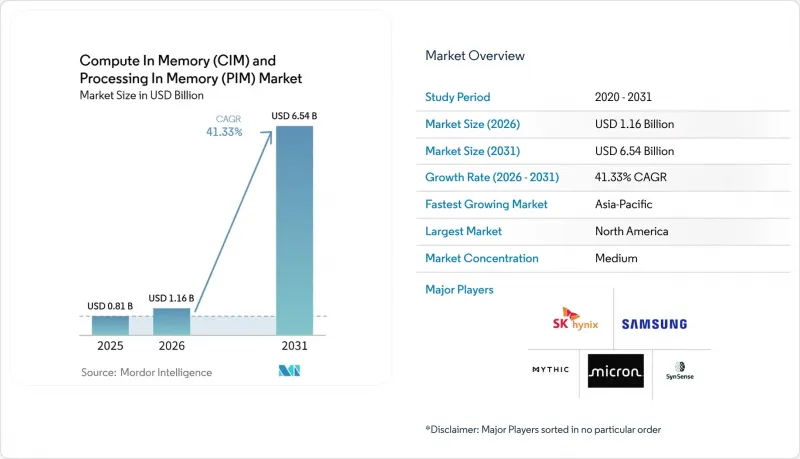
Mordor Intelligence에 의하면, Compute-in-Memory(CIM) 및 Processing-in-Memory(PIM) 시장 규모는 2025년에는 8억 1,000만 달러, 2026년에는 11억 6,000만 달러, 2031년까지 65억 4,000만 달러에 이르고, 2026년부터 2031년까지 CAGR 41.33%로 성장할 전망입니다.
본 보고서는 구성 요소(하드웨어, 소프트웨어 스택, 서비스), 메모리 기술(SRAM, DRAM, HBM, MRAM, RRAM/ReRAM, PCM),용도(AI 및 ML, 엣지 AI, 데이터센터, 자동차 및 ADAS, 산업용 자동화, 사물인터넷(IoT)), 그리고 지역(북미, 유럽, 아시아태평양, 기타 지역)별로 분류되어 있습니다. 시장 전망은 금액(달러)으로 표시되어 있습니다.
세계 Compute-in-Memory(CIM) 및 Processing-in-Memory(PIM) 시장 동향 및 인사이트
AI 워크로드가 ‘메모리 장벽’에 직면하고 있습니다.
Compute-in-Memory(CIM) 및 Processing-in-Memory(PIM) 시장은 AI 시스템에서 프로세서의 처리량과 메모리 대역폭 간의 불일치가 확대되고 있는 데 힘입어 성장하고 있습니다. 현재 에너지 소비는 단순한 연산 처리량뿐만 아니라 데이터 마이그레이션에 크게 의존하고 있기 때문에 메모리의 근접성은 AI 인프라의 실용적인 설계 우선순위가 되고 있습니다. 이는 대규모 추론 환경에서 가장 중요한데, 이러한 환경에서는 가속기의 용량이 확보되어 있더라도 반복적인 메모리 액세스가 성능을 제한할 가능성이 있습니다. 따라서 Compute-in-Memory(CIM) 및 Processing-in-Memory(PIM) 시장은 도입 장벽이 낮다는 장점이 있습니다. 이러한 아키텍처는 보급되기 위해 스택 내의 모든 가속기를 교체할 필요가 없기 때문입니다. 대신, 기존 아키텍처로는 효율적으로 처리할 수 없었던 메모리 제약이 있는 연산을 담당할 수 있습니다. 이를 통해 AI 서버, 엔터프라이즈 추론 시스템, 그리고 미래의 혼합 아키텍처 플랫폼에서 조기 도입의 여지가 생깁니다.
클라우드 네이티브 분석이 컴퓨팅을 데이터에 더 가깝게 만들고 있습니다.
또한, ‘Compute-in-Memory(CIM)’ 및 ‘Processing-in-Memory(PIM)’ 시장은 실시간 추론 인프라에서 와트당 성능 향상을 추구하는 클라우드 사업자들에 의해 주도되고 있습니다. NVIDIA는 풀스택 최적화가 AI 팩토리의 효율성에서 핵심이 되고 있다고 밝혔으며, 이는 메모리 인터페이스를 가로지르는 트래픽의 반복을 줄이는 아키텍처의 유효성을 뒷받침합니다. IEEE ASICON 2025에서 발표된 조사에 따르면, 트랜스포머 추론을 위한 하이브리드 DRAM-PIM 및 SRAM-CIM 설계는 28nm 공정에서 Llama2-7B에 대해,DRAM-PIM만 사용한 기준 설계와 비교해 1.51배의 속도 향상과 1.24배의 에너지 절감을 실현했습니다. 이 결과는 서로 보완하는 메모리 기술을 단일 아키텍처에 억지로 통합하는 것이 아니라, 서로 다른 모델 기능에 매핑할 수 있음을 보여준다는 점에서 중요합니다. 2026년 6월, 마이크론과 앤트로픽은 수년에 걸친 메모리 및 스토리지 공급 계약과 전략적 투자를 결합한 전략적 합의를 발표했습니다. 이는 메모리 로드맵이 미래의 AI 인프라 계획과 직접 연계되고 있음을 보여줍니다. 이러한 협력을 통해 인프라 구매자와 메모리 공급업체가 공통된 도입 일정을 공유할 수 있게 됨에 따라, ‘Compute-in-Memory(CIM)’ 및 ‘Processing-in-Memory(PIM)’ 시장의 신속한 상용화가 촉진될 것입니다.
PIM 도입에 있어 툴체인 및 컴파일러 지원 부족
Compute-in-Memory(CIM) 및 Processing-in-Memory(PIM) 시장은 용도 이식에 기존 가속기 환경과는 다른 프로그래밍 모델이 필요하기 때문에 여전히 큰 소프트웨어적 제약에 직면해 있습니다. 취리히 ETH 및 SAFARI 연구 그룹은 Processing-in-Memory 아키텍처를 위해 새로운 도구, 프로그래밍 모델, 시스템 지원이 필요하다고 밝혔으며, 이는 소프트웨어 계층이 하드웨어의 기회에 여전히 뒤처져 있음을 보여줍니다. 밀라노 공과대학의 2026년 컴파일러 조사에서도 성능 향상 정도는 워크로드에 따라 크게 다르며, 코드를 심층적으로 최적화하지 않는 한 범용적인 이식에서는 제한된 이점만 얻을 수 있을 가능성이 있는 것으로 밝혀졌습니다. 이는 도입이 단순히 새로운 반도체를 구매하는 것뿐만 아니라, 기업에는 컴파일러, API, 런타임 계층, 그리고 검증된 매핑 흐름도 필요함을 의미합니다. 이러한 상황에서도 Compute-in-Memory(CIM) 및 Processing-in-Memory(PIM) 시장은 여전히 빠르게 성장할 가능성이 있습니다. 하지만 상용 규모의 배포는 광범위한 개방형 소프트웨어 생태계보다는 엄격하게 관리되는 환경에서 더 용이하다는 사실은 변함이 없습니다. 따라서 소프트웨어의 성숙도는 유망한 하드웨어와 실용 가능한 플랫폼을 구분하는 가장 명확한 경계선 중 하나로 자리 잡고 있습니다.
부문 분석
2025년에는 CIM 및 PIM 하드웨어가 매출의 83.45%를 차지했습니다. 이는 Compute-in-Memory(CIM) 및 Processing-in-Memory(PIM) 시장의 초기 투자가 여전히 반도체 칩과 플랫폼 구축에 집중되어 있었음을 보여줍니다. 이러한 경향은 특히 수요의 대부분이 여전히 AI 인프라 프로그램과 전문 시스템 개발자에서 발생하고 있는 상황에서 칩 설계, 패키징, 메모리 통합의 자본 집약성을 반영한 것입니다. 하드웨어가 주도적인 위치를 차지하고 있다는 점은 대규모 소프트웨어 표준화가 실현되기 전에 고객이 핵심 아키텍처를 검증하고 있는 현재의 상용화 단계와도 일치합니다. 동시에 매출 구성 비율을 보면, 시장이 이미 광범위한 지속적 수익 모델로 성숙해졌기보다는 여전히 도입 기반을 구축하는 단계에 있음을 알 수 있습니다. 이 도입 기반은 향후 소프트웨어 및 서비스 수익이 확대되기 위한 기술적 토대를 마련한다는 점에서 중요합니다.
소프트웨어 스택 분야는 2031년까지 41.56%의 성장률이 예상되며, Compute-in-Memory(CIM) 및 Processing-in-Memory(PIM) 시장에서 가장 빠르게 성장하는 구성 요소가 될 전망입니다. 이러한 성장은 특수한 메모리 중심 하드웨어를 프로덕션 환경의 AI 워크로드에 연결할 수 있는 컴파일러, 모델 매핑 도구, 하드웨어 추상화 계층 및 배포 프레임워크에 대한 수요 증가를 반영합니다. 비슷한 추세는 연구 활동에서도 나타나고 있으며, 아날로그 및 디지털 플랫폼이 실험실 수준의 구성을 벗어나기 위해서는 소프트웨어 지원이 필수적이어지고 있습니다. 서비스 분야의 규모는 여전히 작지만, 많은 기업이 자동차, 산업용 및 안전이 중시되는 시스템에 새로운 메모리 아키텍처를 통합하는 데 필요한 사내 전문 지식을 갖추지 못하고 있기 때문에 서비스에는 진정한 전략적 가치가 있습니다. 향후 Compute-in-Memory(CIM) 및 Processing-in-Memory(PIM) 업계는 하드웨어 중심의 수익 구조에서 보다 종합적인 플랫폼 경제 모델로 전환될 가능성이 높지만, 현재의 구성을 살펴보면 실리콘이 여전히 상업적 수요의 기반을 이루고 있음을 알 수 있습니다.
지역별 분석
2025년, 북미는 ‘Compute-in-Memory(CIM)’ 및 ‘Processing-in-Memory(PIM)’ 시장 점유율의 42.77%를 차지하며 최대 지역 시장이 되었습니다. 이러한 위상은 하이퍼스케일 AI 인프라의 집중, 첨단 메모리에 대한 투자, 그리고 모델 개발자와 반도체 공급업체 간의 긴밀한 협력에 기인합니다. 2026년 7월, 마이크론은 2035년까지 예정되어 있던 미국 내 투자 규모를 2,500억 달러 이상으로 앞당기겠다고 발표했으며, 뉴욕주 클레이에 위치한 거점에서 예정보다 4분의 1 이상 빠르게 첫 콘크리트 타설을 완료했습니다. 또한 북미 통신 사업자들은 ‘와트당 성능’을 더욱 중시하게 되었으며, 이로 인해 메모리 인터페이스를 통한 반복적인 데이터 마이그레이션을 줄이는 아키텍처의 상업적 타당성이 높아지고 있습니다. 따라서 이 지역의 ‘Compute-in-Memory(CIM)’ 및 ‘Processing-in-Memory(PIM)’ 시장은 풍부한 자본력과 직접적인 인프라 수요 모두로부터 혜택을 받고 있습니다.
아시아태평양은 2031년까지 연평균 42.14%의 성장률을 보일 것으로 예상되며, Compute-in-Memory(CIM) 및 Processing-in-Memory(PIM) 시장에서 가장 빠르게 성장하는 지역이 될 전망입니다. 이 지역은 파운드리 분야의 리더십, 첨단 패키징 기술, 고대역폭 메모리 생산 능력, 그리고 반도체 연구에 대한 적극적인 정부 지원을 모두 갖추고 있습니다. TSMC가 2026년 6월에 발표한 기술 업데이트에서는 더 대규모의 집적 실적로 확장되는 CoWoS 로드맵과 다이 적층 밀도를 높이는 SoIC로의 발전 방향이 제시되었습니다. 이 두 가지 모두 칩렛 기반의 메모리 중심 설계에서 중요한 요소입니다. 삼성 반도체의 HBM4E 샘플 출하로 인해 상용 메모리 로드맵 실행에 있어 아시아태평양의 중심적인 역할이 더욱 공고해졌습니다. 일본은 NEDO가 자금을 지원하는 CMOS 및 스핀트로닉스 MRAM 연구와 내구성이 뛰어난 ReRAM 기반 CiM에 관한 도쿄대학의 연구 등, 공공 자금에 의한 연구 지원을 통해 자동차 및 엣지 컴퓨팅 분야에서 독자적인 측면을 더하고 있습니다.
유럽 및 기타 지역은 현재 매출 규모는 여전히 작지만, 중요한 자동차, 산업 및 방위 분야 수요 경로를 제공하기 때문에 Compute-in-Memory(CIM) 및 Processing-in-Memory(PIM) 시장에서 여전히 중요한 위치를 차지하고 있습니다. 유럽의 활동은 엣지 AI, 자동차용 전자기기, 그리고 연구와 연계된 상용화에 집중되어 있습니다. Mythic사는 2026년 5월, 자동차 분야에서 폭넓은 시장 점유율을 차지하고 있는 독일의 디지털 프로세서 IP 기업 Videantis를 인수하고, 아날로그 Compute-in-Memory와 디지털 처리를 하이브리드 플랫폼 상에서 통합할 것이라고 발표했습니다. 이러한 움직임으로 인해 Compute-in-Memory(CIM) 및 Processing-in-Memory(PIM) 시장은 기존 프로세서 IP의 배포 기반을 통해 유럽의 자동차 및 로봇 공학 프로그램에 진입할 수 있는 경로가 더욱 명확해졌습니다.
기타 혜택:
- 엑셀 형식 시장 예측(ME) 시트
- 3개월간의 애널리스트 지원
자주 묻는 질문
목차
제1장 서론
제2장 조사 방법
제3장 개요
제4장 시장 구도
제5장 시장 규모와 성장 예측
제6장 경쟁 구도
제7장 시장 기회와 향후 전망
JHS 26.09.01According to Mordor Intelligence, the compute in memory (CIM) and processing in memory (PIM) market size is projected to be USD 0.81 billion in 2025, USD 1.16 billion in 2026, and reach USD 6.54 billion by 2031, growing at a CAGR of 41.33% from 2026 to 2031.
This report is Segmented by Component (Hardware, Software Stack, and Services), Memory Technology (SRAM, DRAM, HBM, MRAM, RRAM/ReRAM, and PCM), Application (AI and ML, Edge AI, Data Centers, Automotive and ADAS, Industrial Automation, and Internet of Things (IoT)), and Geography (North America, Europe, Asia-Pacific, Rest of the World). Market Forecasts are in Value (USD).
Global Compute In Memory (CIM) and Processing In Memory (PIM) Market Trends and Insights
AI Workloads Are Hitting the Memory Wall
The compute in memory (CIM) and processing in memory (PIM) market is driven by a growing mismatch between processor throughput and memory bandwidth in AI systems. Energy use now depends heavily on data movement, not just arithmetic throughput, making memory proximity a practical design priority for AI infrastructure. This matters most in large inference environments, where repeated memory access can limit performance even when accelerator capacity is available. The compute in memory (CIM) and processing in memory (PIM) market, therefore, benefits from a lower adoption hurdle, as these architectures do not need to replace every accelerator in the stack to gain traction. They can instead take on memory-bound operations that conventional architectures handle less efficiently. That creates room for earlier deployment in AI servers, enterprise inference systems, and future mixed-architecture platforms.
Cloud-Native Analytics Is Pushing Compute Closer To Data
The compute in memory (CIM) and processing in memory (PIM) market is also being driven by cloud operators seeking better performance per watt from real-time inference infrastructure. NVIDIA stated that full-stack optimization is becoming central to AI factory efficiency, which supports the case for architectures that reduce repeated traffic across the memory interface. Research presented at IEEE ASICON 2025 showed that a hybrid DRAM-PIM and SRAM-CIM design for transformer inference delivered a 1.51x speedup and 1.24x energy reduction compared to a DRAM-PIM-only baseline for Llama2-7B at 28nm. That result is important because it shows that complementary memory technologies can be mapped to different model functions rather than forced into a single architecture. In June 2026, Micron and Anthropic announced a strategic agreement that combined a multi-year memory and storage supply commitment with a strategic investment, showing that memory roadmaps are now being tied directly to future AI infrastructure planning. This kind of alignment supports faster commercialization of the compute in memory (CIM) and processing in memory (PIM) market because infrastructure buyers and memory suppliers share common deployment timelines.
Limited Toolchains And Compiler Support For PIM Adoption
The compute in memory (CIM) and processing in memory (PIM) market still faces a major software constraint because application porting requires different programming models from conventional accelerator environments. ETH Zurich and the SAFARI Research Group described the need for new tools, programming models, and system support for processing-in-memory architectures, which shows that the software layer is still catching up with the hardware opportunity. A 2026 compiler study from Politecnico di Milano also found that performance gains can vary strongly by workload and that general-purpose ports may deliver limited benefit without deeper code adaptation. This means adoption is not only about buying new silicon; enterprises also need compilers, APIs, runtime layers, and validated mapping flows. The compute in memory (CIM) and processing in memory (PIM) market could still grow quickly under these conditions, but commercial scale will remain easier in tightly controlled environments than in broad open software ecosystems. That is why software maturity is becoming one of the clearest dividing lines between promising hardware and deployable platforms.
Other drivers and restraints analyzed in the detailed report include:
- Edge Inference Is Raising The Value Of Localized Compute
- Sub-10nm And 3D-Stacked Memory Roadmaps Are Improving CIM Feasibility
- Yield, Test, And Packaging Complexity In Heterogeneous Memory-Logic Integration
For complete list of drivers and restraints, kindly check the Table Of Contents.
Segment Analysis
CIM and PIM hardware accounted for 83.45% of revenue in 2025, indicating that early spending in the compute in memory (CIM) and processing in memory (PIM) market remained focused on silicon and platform buildout. This pattern reflects the capital intensity of chip design, packaging, and memory integration, especially when demand still comes largely from AI infrastructure programs and specialist system developers. The hardware lead also aligns with the current stage of commercialization, where customers are validating core architectures before large-scale software standardization becomes feasible. At the same time, the revenue mix points to a market that is still building out its installed base rather than one that has already matured into a broad recurring software model. That installed base is important because it creates the technical footprint on which later software and service revenue can expand.
The software stack segment is forecast to grow at 41.56% through 2031, making it the fastest-growing component of the compute in memory (CIM) and processing in memory (PIM) market. That growth reflects rising demand for compilers, model mapping tools, hardware abstraction layers, and deployment frameworks that can connect specialized memory-centric hardware to production AI workloads. The same trend is visible in research activity, where software support is becoming necessary for analog and digital platforms to move beyond laboratory configurations. Services remain smaller, yet they carry real strategic value because many enterprises lack the internal expertise needed to integrate new memory architectures into automotive, industrial, and safety-sensitive systems. Over time, the compute in memory (CIM) and processing in memory (PIM) industry is likely to shift from hardware-led revenue to a fuller platform economics model, but the current mix shows that silicon still anchors commercial demand.
Complete Report Scope:
- By Component
- CIM/PIM Hardware
- Software Stack
- Services
- By Memory Technology
- SRAM-Based CIM
- DRAM-Based PIM
- HBM-Based PIM
- MRAM-Based CIM
- RRAM/ReRAM-Based CIM
- PCM-Based CIM
- By Application
- Artificial Intelligence and Machine Learning
- Edge AI and Embedded Intelligence
- Data Centers and Hyperscale AI Infrastructure
- Automotive and ADAS
- Industrial Automation and Robotics
- Internet of Things (IoT)
- Other Applications
- By Geography
- North America
- Europe
- Asia Pacific
- China
- Japan
- South Korea
- Taiwan
- Rest of Asia Pacific
- Rest of the World
Geography Analysis
North America held 42.77% of the compute in memory (CIM) and processing in memory (PIM) market share in 2025, making it the largest regional base. This position is tied to the concentration of hyperscale AI infrastructure, advanced memory investment, and close links between model developers and semiconductor suppliers. In July 2026, Micron announced that it had accelerated planned U.S. investments to more than USD 250 billion through 2035 and that it had completed the first concrete pour at its Clay, New York, site more than a quarter ahead of schedule. North American operators are also placing greater emphasis on performance per watt, which strengthens the commercial case for architectures that reduce repeated movement across the memory interface. The compute in memory (CIM) and processing in memory (PIM) market in this region, therefore, benefits from both capital depth and a direct infrastructure need.
Asia-Pacific is projected to grow at 42.14% through 2031, making it the fastest-growing geography in the compute in memory (CIM) and processing in memory (PIM) market. The region combines foundry leadership, advanced packaging capability, high-bandwidth memory production, and active public support for semiconductor research. TSMC's June 2026 technology update outlined a CoWoS roadmap extending to larger integration footprints and a SoIC path toward tighter die stackingboth of, both of which are important for chiplet-based memory-centric designs. Samsung Semiconductor's HBM4E sample shipment further reinforced Asia-Pacific's central role in the execution of the n commercial memory roadmap. Japan adds a distinct automotive and edge dimension through public research backing, including NEDO-funded CMOS and spintronics MRAM work and University of Tokyo research on durable ReRAM-based CiM.
Europe and the rest of the world remain smaller in current revenue, but they still matter to the compute in memory (CIM) and processing in memory (PIM) market because they add important automotive, industrial, and defense-oriented demand paths. Europe's activity is concentrated in edge AI, automotive electronics, and research-linked commercialization. Mythic announced in May 2026 that it had acquired Videantis, a German digital processor IP company with broad automotive penetration, to combine analog compute-in-memory with digital processing in a hybrid platform. That move gives the compute in memory (CIM) and processing in memory (PIM) market a clearer route into European automotive and robotics programs through an existing processor IP footprint.
- Samsung Electronics Co., Ltd.
- SK hynix Inc.
- Micron Technology, Inc.
- IBM Corporation
- Intel Corporation
- TSMC
- Qualcomm Incorporated
- NVIDIA Corporation
- Analog Devices, Inc.
- Renesas Electronics Corporation
- GSI Technology, Inc.
- Mythic Inc.
- TetraMem Inc.
- SynSense AG
- BrainChip Holdings Ltd
- SAP SE
- Oracle Corporation
- Microsoft Corporation
- Amazon Web Services, Inc.
- Redis Ltd.
- GridGain Systems, Inc.
- GigaSpaces Technologies Ltd.
- Fujitsu Limited
- Hewlett Packard Enterprise Company
Additional Benefits:
- The market estimate (ME) sheet in Excel format
- 3 months of analyst support
TABLE OF CONTENTS
1 INTRODUCTION
- 1.1 Study Assumptions and Market Definition
- 1.2 Scope of the Study
2 RESEARCH METHODOLOGY
3 EXECUTIVE SUMMARY
4 MARKET LANDSCAPE
- 4.1 Market Overview
- 4.2 Market Drivers
- 4.2.1 AI Workloads Are Hitting the Memory Wall
- 4.2.2 Cloud-Native Analytics Is Pushing Compute Closer To Data
- 4.2.3 Edge Inference Is Raising The Value Of Localized Compute
- 4.2.4 Sub-10nm And 3D-Stacked Memory Roadmaps Are Improving CIM Feasibility
- 4.2.5 Power Efficiency Pressure In Data Centers And Edge Devices
- 4.2.6 Neuromorphic And Sparse Computing Use Cases Are Expanding The TAM Beyond Conventional Analytics
- 4.3 Market Restraints
- 4.3.1 Limited Toolchains And Compiler Support For PIM Adoption
- 4.3.2 Yield, Test, And Packaging Complexity In Heterogeneous Memory-Logic Integration
- 4.3.3 Fragmented Standards Across Memory, Interconnect, And Software Stacks
- 4.3.4 High Qualification Risk For Mission-Critical Enterprise And Automotive Use Cases
- 4.4 Industry Supply Chain Analysis
- 4.5 Impact of Macroeconomic Factors on the Market
- 4.6 Regulatory Landscape
- 4.7 Technological Outlook
- 4.8 Porter's Five Forces Analysis
- 4.8.1 Bargaining Power of Suppliers
- 4.8.2 Bargaining Power of Buyers
- 4.8.3 Threat of New Entrants
- 4.8.4 Threat of Substitutes
- 4.8.5 Intensity of Competitive Rivalry
5 MARKET SIZE AND GROWTH FORECASTS (VALUE)
- 5.1 By Component
- 5.1.1 CIM/PIM Hardware
- 5.1.2 Software Stack
- 5.1.3 Services
- 5.2 By Memory Technology
- 5.2.1 SRAM-Based CIM
- 5.2.2 DRAM-Based PIM
- 5.2.3 HBM-Based PIM
- 5.2.4 MRAM-Based CIM
- 5.2.5 RRAM/ReRAM-Based CIM
- 5.2.6 PCM-Based CIM
- 5.3 By Application
- 5.3.1 Artificial Intelligence and Machine Learning
- 5.3.2 Edge AI and Embedded Intelligence
- 5.3.3 Data Centers and Hyperscale AI Infrastructure
- 5.3.4 Automotive and ADAS
- 5.3.5 Industrial Automation and Robotics
- 5.3.6 Internet of Things (IoT)
- 5.3.7 Other Applications
- 5.4 By Geography
- 5.4.1 North America
- 5.4.2 Europe
- 5.4.3 Asia Pacific
- 5.4.3.1 China
- 5.4.3.2 Japan
- 5.4.3.3 South Korea
- 5.4.3.4 Taiwan
- 5.4.3.5 Rest of Asia Pacific
- 5.4.4 Rest of the World
6 COMPETITIVE LANDSCAPE
- 6.1 Market Concentration
- 6.2 Strategic Moves
- 6.3 Market Share Analysis
- 6.4 Company Profiles (includes Global Level Overview, Market Level Overview, Core Segments, Financials as available, Strategic Information, Products and Services, Recent Developments)
- 6.4.1 Samsung Electronics Co., Ltd.
- 6.4.2 SK hynix Inc.
- 6.4.3 Micron Technology, Inc.
- 6.4.4 IBM Corporation
- 6.4.5 Intel Corporation
- 6.4.6 TSMC
- 6.4.7 Qualcomm Incorporated
- 6.4.8 NVIDIA Corporation
- 6.4.9 Analog Devices, Inc.
- 6.4.10 Renesas Electronics Corporation
- 6.4.11 GSI Technology, Inc.
- 6.4.12 Mythic Inc.
- 6.4.13 TetraMem Inc.
- 6.4.14 SynSense AG
- 6.4.15 BrainChip Holdings Ltd
- 6.4.16 SAP SE
- 6.4.17 Oracle Corporation
- 6.4.18 Microsoft Corporation
- 6.4.19 Amazon Web Services, Inc.
- 6.4.20 Redis Ltd.
- 6.4.21 GridGain Systems, Inc.
- 6.4.22 GigaSpaces Technologies Ltd.
- 6.4.23 Fujitsu Limited
- 6.4.24 Hewlett Packard Enterprise Company
7 MARKET OPPORTUNITIES AND FUTURE OUTLOOK
- 7.1 White-Space and Unmet-Need Assessment