

|
시장보고서
상품코드
2099861
보행식 잔디깎기기계 시장 : 시장 점유율 분석, 업계 동향 및 통계, 성장 예측(2026-2031년)Walk Behind Lawn Mowers - Market Share Analysis, Industry Trends & Statistics, Growth Forecasts (2026 - 2031) |
||||||
 Mordor Intelligence
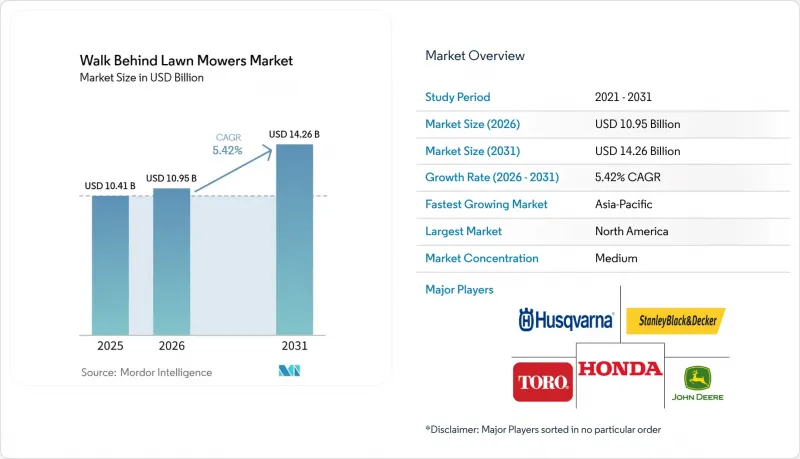
Mordor Intelligence에 의하면, 보행식 잔디깎기기계 시장 규모는 2025년 104억 1,000만 달러로 평가되었고, 2026년 109억 5,000만 달러에서 2031년까지 142억 6,000만 달러에 이를 것으로 추정되고 있으며, 예측 기간(2026-2031년) CAGR은 5.42%를 나타낼 전망입니다.
본 보고서는 동력원별(가솔린식, 유선 전동식 등), 제품 유형별(수동식, 자가 주행식 등), 판매 채널별(온라인 판매 채널 등), 최종 사용자별(주거용, 상업용 조경, 정부 및 공공 공간 등), 지역별(북미, 남미 등)로 분류되어 있습니다. 시장 전망은 금액 기준으로 제시되어 있습니다.
세계의 보행식 잔디깎기기계 시장 동향 및 인사이트
저소음 및 저유지보수형 잔디깎기기계에 대한 수요 증가
보행식 잔디깎기기계 시장에서는 이웃에 미치는 소음과 일상적인 유지보수를 줄여주는 제품에 대한 수요 전환이 뚜렷하게 나타나고 있습니다. 과거에는 단순한 편의 기능으로 여겨졌던 요소가 현재는 특히 교외나 도시 주거 지역에서 구매 결정에 영향을 미치는 요인으로 작용하고 있습니다. 유럽연합 집행위원회는 위임규정(EU) 2024/1208을 통해 잔디깎기기계 소음 측정 규정을 개정했으며, 개정된 규정은 2025년 5월 22일에 발효되었습니다. 이에 따라 유럽연합(EU)으로 수입되는 가솔린식 기기의 규정 준수 부담이 증가했습니다. 이 변경이 중요한 이유는 보증된 음향 출력 표시가 더욱 눈에 띄게 되어, 제조업체들이 소음이 큰 동력 방식의 계속된 사용을 정당화하도록 압박하기 때문입니다. 또한, 배터리식 손수레형 잔디깎기는 연료 취급, 엔진 정비, 그리고 많은 일반 가정 구매자들이 꺼리는 정기적인 유지보수 작업을 불필요하게 만들어 일상적인 관리의 번거로움을 줄여줍니다. 이러한 장점은 더 간편한 조작과 신속한 설치를 원하는 첫 구매자에게 특히 중요합니다. 그 결과, 소음에 대한 배려와 편의성이 잔디 깎기 성능과 동등한 중요성을 차지하는 시장에서 무선형에 대한 수요가 더욱 높아지고 있습니다.
야외용 전동 공구 브랜드 간 배터리 생태계의 락인
배터리 플랫폼의 보유는 손수레식 잔디깎기기계 시장에서 가장 강력한 숨은 원동력 중 하나로 자리 잡고 있습니다. 일반 가정이나 업자들이 송풍기, 트리머, 전기톱 등을 통해 특정 배터리 제품군을 도입하면, 이미 충전기나 배터리에 대한 투자가 완료된 상태이므로 다음에 잔디깎기를 구매할 때의 진입 장벽이 낮아집니다. 일본에 본사를 두고 전 세계적으로 사업을 전개하는 전문가용 전동 공구 및 아웃도어 장비 제조업체인 마키타 주식회사는 2025년에도 무선 생태계의 확장을 이어갔습니다. 이 회사의 40V XGT 플랫폼은 170종 이상의 호환 도구를 지원하며, 통합된 배터리 플랫폼이 야외 동력 기기 업계 전체에서 얼마나 중요한 경쟁적 차별화 요소가 되고 있는지를 보여줍니다. 이로 인해 구매자들이 더 이상 데크 폭, 작동 시간, 가격만을 비교하는 것이 아니라, 차고나 트레일러에 이미 보관되어 있는 공구와 잔디깎기기계가 얼마나 잘 어울리는지도 비교하게 되면서 경쟁 구도가 변화하고 있습니다. 스탠리 블랙 앤 데커(Stanley Black & Decker)는 테크트로닉 인더스트리즈(Tectronic Industries) 산하 브랜드와 함께, 가솔린 제품에 중점을 두는 공급업체들이 따라잡기 어려운 방식으로 이 플랫폼 효과의 혜택을 누리고 있습니다. 배터리 생태계에 대한 락인 효과로 인해 브랜드에 대한 친근감이 여러 번의 교체 주기에 걸쳐 지속되는 재구매 행동으로 이어지고 있습니다. 따라서 배터리 플랫폼을 조기에 도입하는 것은 장기적인 시장 점유율을 유지하기 위한 가장 강력한 방어 수단 중 하나가 되고 있습니다.
계절적 수요 집중과 기상 조건에 따른 구매 연기
보행식 잔디깎기기계 시장은 여전히 북미와 유럽의 짧은 판매 시즌에 크게 의존하고 있습니다. 연간 수요의 상당 부분은 봄부터 초여름에 걸쳐 집중되어 있으며, 매출 시기는 제조업체가 통제할 수 없는 기상 패턴에 좌우되기 쉬운 상황입니다. 봄이 늦게 오거나, 장마가 길어지거나, 가뭄이 장기화되면 구매 시기가 몇 주 늦어지며, 판매점의 판매 실적에 차질을 빚을 가능성이 있습니다. 이러한 영향은 프리미엄 배터리 제품에서 더욱 두드러집니다. 구매자들은 저가형 기존 기기에 비해 고가 제품을 구매하기로 결정하는 데 더 많은 시간이 걸리는 경향이 있기 때문입니다. 소매업체들은 봄 프로모션 기간 연장, 온라인 주문 후 매장 수령, 시즌 초반 할인 등의 대책으로 대응해 왔지만, 이러한 조치만으로는 수요의 계절적 구조를 완전히 바꿀 수는 없었습니다. 즉, 카테고리의 펀더멘털이 건전한 상태라 하더라도 재고 계획이나 가격 책정은 여전히 시기에 따른 변동 영향을 받기 쉬운 상황입니다. 그 결과, 수요가 급감하는 것은 아니지만 분기별 실적에 편차가 발생하여 제조업체와 소매업체 양측의 이익률을 압박할 가능성이 있습니다.
부문 분석
2025년, 가솔린식 모델은 손수레식 잔디깎기기계 시장 규모의 41.3%를 차지했습니다. 이 부문이 최대 점유율을 유지한 것은 광대한 부지에서 장시간 가동, 높은 깎기 능력, 그리고 신뢰성 높은 성능이 요구되는 주거용 및 상업용 분야에서 확고한 입지를 구축하고 있기 때문입니다. 배터리식 기기는 저소음이며 유지보수 부담이 적은 잔디 관리 솔루션에 대한 소비자의 선호도가 높아짐에 힘입어 시장에서 큰 점유율을 차지했습니다. 전원 코드식 제품은 특히 잔디 면적이 작고 전원 콘센트에 접근하기 편리한 가구를 중심으로, 보다 좁은 틈새 시장을 공략했습니다. 수동식 릴 잔디깎기기계는 간단하고 비용 대비 효과가 높으며 친환경적인 잔디깎기 옵션을 찾는 소비자들의 지지를 받아, 제한적이긴 하지만 안정적인 시장 점유율을 유지했습니다.
배터리 구동 모델은 가장 빠른 성장이 예상되며, 2031년까지 연평균 성장률(CAGR) 11.1%로 성장할 것으로 전망됩니다. 캘리포니아주가 2024년에 도입한 ‘제로 배출 소형 엔진 규제’는 주요 야외 동력 장비 시장 수요 방향을 바꾸었으며, 배터리 투자에 대한 장기적인 근거를 공고히 했습니다. 또한, 혼다 모터도 2025년에 새로운 배터리식 손수레형 잔디깎기기계 라인업을 출시하고, 무선 제품에 대한 집중을 강화함으로써 이러한 전환을 가속화했습니다. 이러한 전환이 진행됨에 따라, 가솔린식은 더 무거운 작업 분야에서 역할을 유지하는 한편, 유선식 및 수동식은 소규모 이용 사례에 집중된 상태가 지속될 전망입니다.
2025년, 손수레형 잔디깎기기계 시장에서 푸시형 잔디깎기기계는 45.2%의 점유율을 차지했으며, 금액 기준으로 가장 큰 제품 유형이 되었습니다. 이러한 우위는 합리적인 가격, 보관의 용이성, 그리고 0.5에이커 미만의 주택 부지와의 높은 적합성에서 기인합니다. 호버식 잔디깎기는 특히 기복이 심한 지형, 경사가 있는 정원, 불규칙한 형태의 잔디밭 등 높은 조작성이 요구되는 장소를 유지 관리하는 주택 소유주에게 중요한 두 번째 선택지로 자리매김했습니다. 자가 주행식 모델이 그 다음으로 큰 수요층을 형성한 반면, 기타 제품 유형은 규모가 작고 보다 전문적인 용도로 한정되어 있었습니다.
자가 주행식 모델은 가장 빠른 성장세를 기록할 것으로 예상되며, 이 시장 부문은 2031년까지 연평균 성장률(CAGR) 6.8%로 확대될 것으로 추정됩니다. 수요를 뒷받침하는 요인으로는 주택 소유자의 고령화, 작업자의 노동력 경감, 그리고 밀집된 경로에서의 생산성 향상에 대한 상업적 관심 증가가 있습니다. Toro사는 기동성과 안정적인 잔디 깎기 성능이 필요한 전문 조경 작업자를 위해 2025년 3월 캐스터가 장착된 ‘TurfMaster HDX 30인치’를 출시하며 이러한 추세를 뒷받침했습니다. 손수레식 잔디깎기는 계속해서 판매량의 주류를 차지할 것으로 보이며, 호버식 및 기타 특수 유형은 소규모 기반에서 성장을 이어갈 전망입니다.
지역별 분석
2025년, 북미는 전 세계 매출의 44.5%를 차지했으며, 보행식 잔디깎기기계 시장에서 가장 규모가 큰 지역이 되었습니다. 이 지역은 단독주택 기반이 넓고, DIY를 통한 잔디 관리 문화가 정착되어 있는 점이 뒷받침되고 있습니다. 캘리포니아주가 2024년에 제정한 가솔린식 소형 오프로드 엔진에 관한 신규 규제는 주목도가 높은 해당 주의 구매 행태에 변화를 가져왔으며, 배터리로의 전환에 대한 시급성을 높였습니다. 미국은 주택 소유 패턴이 예측 가능한 연간 교체 수요를 창출하고 있어 여전히 시장을 주도하는 주요 국가로 자리 잡고 있습니다. 캐나다에서는 도시 지역에서 무선 제품의 보급이 진행되고 있지만, 멕시코에서는 인구 밀도가 낮은 지역에서 가격에 대한 민감성과 인프라 제약이 계속해서 과제로 남아 있습니다.
아시아태평양은 시장에서 가장 빠르게 성장하는 지역으로, 2031년까지 연평균 성장률(CAGR)은 7.1%로 예측됩니다. 주거지 확대와 녹지 보전이 민간 및 상업 분야 모두에서 새로운 수요를 창출하고 있어, 도시화가 여전히 주요 촉진요인으로 작용하고 있습니다. 세계은행에 따르면, 2025년에는 남아시아 인구의 약 36%가 도시 지역에 거주할 것으로 예상되며, 이는 이 지역 전체에 걸쳐 형성되고 있는 경관의 규모를 여실히 보여주고 있습니다. 남미, 중동 및 아프리카는 여전히 기여도가 낮으며, 소매 구조의 세분화, 서비스 격차, 그리고 상업 및 호텔업 분야 외 조경 분야에서의 배터리 도입 지연으로 인해 성장이 제한되고 있습니다.
유럽에서는 야외용 장비에 대한 소음 규제가 개정되어 소음이 큰 잔디깎기에 대한 규정 준수 부담이 증가함에 따라 가솔린 제품의 대체가 가속화되고 있으며, 이로 인해 혜택을 보고 있습니다. 독일, 영국, 프랑스, 이탈리아는 주거용 잔디 관리와 잘 갖춰진 조경 서비스 생태계가 결합되어 있어 해당 지역 수요를 주도하고 있습니다. 또한, 이탈리아는 STIGA S.p.A.나 Emak S.p.A.와 같은 브랜드의 제조 거점으로서도 두드러지며, 이는 남유럽 전역에 걸친 제품 공급을 뒷받침하고 있습니다. 북유럽 국가들에서는 프리미엄 무선 모델의 보급이 진행되고 있지만, 중·동유럽에서는 가솔린 제품에서 배터리 제품으로의 전환이 아직 초기 단계에 있습니다.
기타 혜택 :
- 엑셀 형식 시장 예측(ME) 시트
- 3개월간의 애널리스트 지원
자주 묻는 질문
목차
제1장 서론
제2장 조사 방법
제3장 주요 요약
제4장 시장 구도
제5장 시장 규모 및 성장 예측
제6장 경쟁 구도
제7장 시장 기회 및 향후 동향
AJY 26.08.07According to Mordor Intelligence, the walk-behind lawn mowers market size is estimated to grow from USD 10.41 billion in 2025 and USD 10.95 billion in 2026 to reach USD 14.26 billion by 2031, at a CAGR of 5.42% during the forecast period (2026-2031).
This report is Segmented by Power Source (Gasoline-Powered, Electric Corded, and More), by Product Type (Push, Self-Propelled, and More), by Distribution Channel (Online Sales Channels and More), by End User (Residential, Commercial Landscaping, Government & Public Spaces, and More), and by Geography (North America, South America, and More). The Market Forecasts are Provided in Terms of Value.
Global Walk Behind Lawn Mowers Market Trends and Insights
Rising Demand for Low-Noise and Low-Maintenance Lawn Care Equipment
The walk-behind lawn mowers market is seeing a clear demand shift toward products that reduce neighborhood noise and routine upkeep. What was once treated as a comfort feature is now influencing buying decisions at the point of sale, especially in suburban and urban residential areas. The European Commission updated lawn mower noise measurement rules through Delegated Regulation (EU) 2024/1208, and the revised framework took effect on May 22, 2025, which raised the compliance burden for gasoline-based equipment entering the European Union. That change matters because it makes guaranteed sound power labeling more visible and pushes manufacturers to justify the continued use of louder power formats. Battery walk-behind mowers also reduce day-to-day maintenance because they avoid fuel handling, engine servicing, and several recurring upkeep tasks that many household buyers dislike. This benefit is especially important for first-time buyers who want simpler operation and faster setup. The result is a stronger pull toward cordless formats in markets where noise sensitivity and convenience now carry as much weight as cutting performance.
Battery Ecosystem Lock-In Across Outdoor Power Tool Brands
Battery platform ownership is becoming one of the strongest hidden forces inside the walk-behind lawn mowers market. Once a household or contractor buys into a battery family through a blower, trimmer, or chainsaw, the next mower purchase becomes easier because the charger and battery investment are already in place. Makita Corporation, a Japan-headquartered manufacturer of professional power tools and outdoor equipment with a global presence, continued to expand its cordless ecosystem in 2025. The company's 40V XGT platform supported over 170 compatible tools, illustrating how integrated battery platforms have become an important competitive differentiator across the outdoor power equipment industry. This changes the competition because buyers are no longer comparing only deck width, runtime, and price. They are also comparing how well a mower fits the tools already stored in the garage or trailer. Stanley Black & Decker, Inc., along with brands under Techtronic Industries, benefits from this platform effect in ways that gasoline-focused suppliers struggle to match. Battery ecosystem lock-in is turning brand familiarity into repeat purchasing behavior that may last across several replacement cycles. That makes early adoption of the battery platform one of the most defensible ways to retain long-term share.
Seasonal Demand Concentration and Weather-Linked Purchase Deferrals
The walk-behind lawn mowers market still depends heavily on a narrow selling season in North America and Europe. Much of the annual demand is concentrated in the spring and early summer window, making revenue timing sensitive to weather patterns beyond the manufacturer's control. A delayed spring, extended rainfall, or a prolonged drought can shift purchases by weeks and disrupt dealer sell-through. This pressure is more noticeable in premium battery products because buyers tend to take longer to make higher-ticket decisions than for lower-cost legacy equipment. Retailers have responded with longer spring promotions, online order pickup, and earlier-season discounts, but those tactics have not fully altered the seasonal structure of demand. That means inventory planning and pricing remain exposed to timing volatility even when category fundamentals stay healthy. The result is not a collapse in demand, but rather uneven quarterly performance that can compress margins for both manufacturers and retailers.
Other drivers and restraints analyzed in the detailed report include:
- Municipal and Commercial Electrification in Noise-Sensitive Zones
- Growth of Compact-Lot Housing and Smaller Lawn Ownership
- Battery Replacement Cost and Runtime Anxiety in High-Duty Use Cases
For complete list of drivers and restraints, kindly check the Table Of Contents.
Segment Analysis
Gasoline-powered models accounted for 41.3% of the walk-behind lawn mowers market size in 2025. This segment maintained the largest share due to its established presence in residential and commercial applications that require extended runtime, higher cutting power, and reliable performance across larger properties. Battery-powered equipment accounted for a significant share of the market, driven by growing consumer preference for lower-noise, lower-maintenance lawn care solutions. Electric corded products catered to a smaller niche, particularly among households with compact lawns and convenient access to power outlets. Manual reel mowers retained a limited but stable market presence, appealing to consumers seeking simple, cost-effective, and environmentally friendly mowing options.
Battery-powered models are anticipated to expand at the fastest pace, advancing at a 11.1% CAGR through 2031. California's 2024 zero-emission small engine rule changed the direction of demand in a major outdoor power market and strengthened the long-term case for battery investment. Honda Motor Co., Ltd. also accelerated the shift by introducing new battery-powered walk-behind lineups and deepening its focus on cordless products in 2025. As this transition continues, gasoline will retain a role in heavier-duty work, while corded and manual formats will stay concentrated in smaller use cases.
Push mowers held 45.2% of the walk-behind lawn mowers market share in 2025, which made them the largest product type by value. Their lead came from price accessibility, easy storage, and a strong fit with sub-half-acre residential lots. Hover mowers followed as a meaningful secondary choice, particularly for homeowners maintaining uneven terrain, sloped gardens, and irregularly shaped lawns where enhanced maneuverability is valued. Self-propelled units formed the next major layer of demand, while other product types remained smaller and more specialized.
Self-propelled models are anticipated to record the fastest growth, with the market segment estimated to grow at a 6.8% CAGR through 2031. Demand is being helped by aging homeowner demographics, reduced operator effort, and stronger commercial interest in productivity gains on dense routes. The Toro Company supported that direction with the TurfMaster HDX 30-inch with casters, introduced in March 2025 for professional landscaping crews that need maneuverability and stable cutting performance. Push mowers should remain the volume anchor, while hover and other specialized formats will continue to grow from a smaller base.
Complete Report Scope:
- By Power Source
- Gasoline-Powered
- Electric Corded
- Battery-Powered
- Manual Reel
- By Product Type
- Push
- Self-Propelled
- Hover
- Other Types
- By Distribution Channel
- Online Sales Channels
- Specialty Retailers and Authorized Dealers
- By End User
- Residential
- Commercial Landscaping
- Government and Public Spaces
- Golf Courses and Sports Turf
- By Geography
- North America
- United States
- Canada
- Mexico
- Rest of North America
- South America
- Brazil
- Argentina
- Chile
- Colombia
- Rest of South America
- Europe
- Germany
- United Kingdom
- France
- Italy
- Russia
- Rest of Europe
- Asia-Pacific
- China
- Japan
- India
- Australia
- South Korea
- Rest of Asia-Pacific
- Middle East
- Saudi Arabia
- United Arab Emirates
- Rest of Middle East
- Africa
- South Africa
- Nigeria
- Egypt
- Rest of Africa
- North America
Geography Analysis
North America accounted for 44.5% of global revenue in 2025, making it the largest region in the walk-behind lawn mowers market. The region is supported by a large base of single-family homes and a well-established do-it-yourself lawn care culture. California's 2024 rule on new gasoline-powered small off-road engines changed purchase behavior in a highly visible state and increased the urgency around battery conversion. The United States remains the dominant national contributor because residential ownership patterns create predictable annual replacement demand. Canada is stronger in urban cordless adoption, while Mexico continues to face more price sensitivity and infrastructure constraints in lower-density areas.
Asia-Pacific is the fastest-growing region in the market, with a projected CAGR of 7.1% through 2031. Urbanization remains the primary driver, as expanding residential communities and the preservation of green spaces create new demand across both private and commercial settings. According to the World Bank, about 36% of South Asia's population lived in urban areas in 2025, highlighting the scale of the landscape being formed across the region. South America, the Middle East, and Africa remain smaller contributors, with growth limited by fragmented retail structures, service gaps, and slower battery adoption outside commercial and hospitality landscaping.
Europe is benefiting from faster gasoline displacement as revised outdoor equipment noise rules increase the compliance burden on louder mower formats. Germany, the United Kingdom, France, and Italy form the core of regional demand because they combine residential lawn maintenance with stronger landscaping service ecosystems. Italy also stands out as a manufacturing base for brands such as STIGA S.p.A. and Emak S.p.A., which helps support product availability across Southern Europe. Nordic countries show stronger adoption of premium cordless models, while Central and Eastern Europe remain earlier in the shift from gasoline to battery products.
- Deere & Company
- The Toro Company
- Husqvarna Group
- Stanley Black & Decker, Inc.
- Honda Motor Co., Ltd.
- Kubota Corporation
- STIHL Holding AG and Co. KG
- Ariens Company
- KPS Capital Partners (Briggs & Stratton)
- STIGA S.p.A
- Robert Bosch GmbH
- Techtronic Industries Co. Ltd.
- AL-KO GERTE GMBH
- Fiskars Corporation
- Falcon Garden Tools Pvt. Ltd.
- Emak S.p.A.
Additional Benefits:
- The market estimate (ME) sheet in Excel format
- 3 months of analyst support
TABLE OF CONTENTS
1 Introduction
- 1.1 Study Assumptions and Market Definition
- 1.2 Scope of the Study
2 Research Methodology
3 Executive Summary
4 Market Landscape
- 4.1 Market Overview
- 4.2 Market Drivers
- 4.2.1 Rising demand for low-noise and low-maintenance lawn care equipment
- 4.2.2 Battery ecosystem lock-in across outdoor power tool brands
- 4.2.3 Municipal and commercial electrification in noise-sensitive zones
- 4.2.4 Dealer bundling and retail shelf expansion for cordless platforms
- 4.2.5 Growth of compact-lot housing and smaller lawn ownership
- 4.2.6 Faster replacement cycles for premium battery models
- 4.3 Market Restraints
- 4.3.1 Seasonal demand concentration and weather-linked purchase deferrals
- 4.3.2 Battery replacement cost and runtime anxiety in high-duty use cases
- 4.3.3 Fragmented aftermarket service coverage in rural and semi-urban markets
- 4.3.4 Emissions and noise compliance pressure on gasoline models
- 4.4 Regulatory Landscape
- 4.5 Technological Outlook
- 4.6 Porter's Five Forces Analysis
- 4.6.1 Threat of New Entrants
- 4.6.2 Bargaining Power of Buyers
- 4.6.3 Bargaining Power of Suppliers
- 4.6.4 Threat of Substitutes
- 4.6.5 Intensity of Competitive Rivalry
5 Market Size and Growth Forecasts (Value)
- 5.1 By Power Source
- 5.1.1 Gasoline-Powered
- 5.1.2 Electric Corded
- 5.1.3 Battery-Powered
- 5.1.4 Manual Reel
- 5.2 By Product Type
- 5.2.1 Push
- 5.2.2 Self-Propelled
- 5.2.3 Hover
- 5.2.4 Other Types
- 5.3 By Distribution Channel
- 5.3.1 Online Sales Channels
- 5.3.2 Specialty Retailers and Authorized Dealers
- 5.4 By End User
- 5.4.1 Residential
- 5.4.2 Commercial Landscaping
- 5.4.3 Government and Public Spaces
- 5.4.4 Golf Courses and Sports Turf
- 5.5 By Geography
- 5.5.1 North America
- 5.5.1.1 United States
- 5.5.1.2 Canada
- 5.5.1.3 Mexico
- 5.5.1.4 Rest of North America
- 5.5.2 South America
- 5.5.2.1 Brazil
- 5.5.2.2 Argentina
- 5.5.2.3 Chile
- 5.5.2.4 Colombia
- 5.5.2.5 Rest of South America
- 5.5.3 Europe
- 5.5.3.1 Germany
- 5.5.3.2 United Kingdom
- 5.5.3.3 France
- 5.5.3.4 Italy
- 5.5.3.5 Russia
- 5.5.3.6 Rest of Europe
- 5.5.4 Asia-Pacific
- 5.5.4.1 China
- 5.5.4.2 Japan
- 5.5.4.3 India
- 5.5.4.4 Australia
- 5.5.4.5 South Korea
- 5.5.4.6 Rest of Asia-Pacific
- 5.5.5 Middle East
- 5.5.5.1 Saudi Arabia
- 5.5.5.2 United Arab Emirates
- 5.5.5.3 Rest of Middle East
- 5.5.6 Africa
- 5.5.6.1 South Africa
- 5.5.6.2 Nigeria
- 5.5.6.3 Egypt
- 5.5.6.4 Rest of Africa
- 5.5.1 North America
6 Competitive Landscape
- 6.1 Market Concentration
- 6.2 Strategic Moves
- 6.3 Market Share Analysis
- 6.4 Company Profiles (Includes Global Level Overview, Market Level Overview, Core Segments, Financials as Available, Strategic Information, Market Rank/Share, Products and Services, Recent Developments)
- 6.4.1 Deere & Company
- 6.4.2 The Toro Company
- 6.4.3 Husqvarna Group
- 6.4.4 Stanley Black & Decker, Inc.
- 6.4.5 Honda Motor Co., Ltd.
- 6.4.6 Kubota Corporation
- 6.4.7 STIHL Holding AG and Co. KG
- 6.4.8 Ariens Company
- 6.4.9 KPS Capital Partners (Briggs & Stratton)
- 6.4.10 STIGA S.p.A
- 6.4.11 Robert Bosch GmbH
- 6.4.12 Techtronic Industries Co. Ltd.
- 6.4.13 AL-KO GERTE GMBH
- 6.4.14 Fiskars Corporation
- 6.4.15 Falcon Garden Tools Pvt. Ltd.
- 6.4.16 Emak S.p.A.


