
|
시장보고서
상품코드
2125722
미국의 잔디깎기기계 시장 : 점유율 분석, 업계 동향과 통계, 성장 예측(2026-2031년)United States Lawn Mowers - Market Share Analysis, Industry Trends & Statistics, Growth Forecasts (2026 - 2031) |
||||||
 Mordor Intelligence
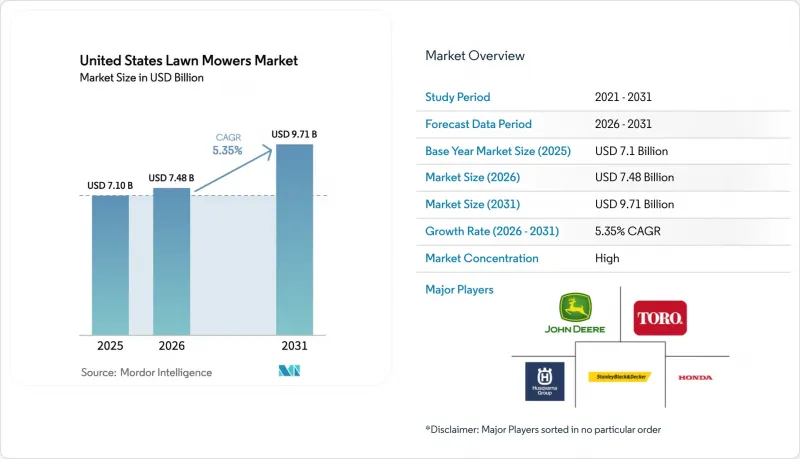
Mordor Intelligence에 의하면, 미국 잔디깎기기계 시장 규모는 2025년에 71억 달러로 평가되었고 2026년 74억 8,000만 달러에서 2031년까지 97억 1,000만 달러에 이를 것으로 예측되며, 예측 기간(2026-2031년) CAGR은 5.35%를 나타낼 전망입니다.
본 보고서는 제품 유형(수동식, 전동식, 가솔린식, 로봇식, 기타 제품 유형) 및 최종 사용자(주거용, 상업용 또는 정부 기관)별로 분류되어 있습니다. 시장 예측은 금액(달러) 기준으로 제시되어 있습니다.
미국 잔디깎기기계 시장 동향 및 인사이트
주거용 정원 조경 수요 증가
2024년, 주택 소유율은 66% 전후로 안정세를 보이며, 단독주택에서의 잔디 관리 장비에 대한 기초적인 수요가 유지되고 있습니다. 전략적 측면에서는 선벨트 지역 시장에서 더 넓은 부지를 가진 교외형 개발로의 전환을 들 수 있습니다. 이 지역에서는 정원 면적의 중앙값이 0.25에이커를 초과하여, 손수레식이 아닌 승용형 또는 제로 턴형 잔디깎기가 필요합니다. 이러한 지리적 편중으로 인해 평균 판매 가격이 상승하여, 텍사스주, 플로리다주, 애리조나주에서 강력한 딜러 네트워크를 보유한 OEM(자사 브랜드 제조업체)에 유리하게 작용하고 있습니다. 외관의 매력은 여전히 재판매 가치를 높이는 중요한 요인이며, 조경이 잘 갖춰진 부동산은 경쟁이 치열한 주택 시장에서 5%에서 10%의 프리미엄 가격이 붙기 때문에 경제 상황이 불투명한 시기에도 주택 교체 주기가 지속될 것이 보장됩니다. 미국 환경보호청(EPA)의 ‘워터센스(WaterSense)’ 파트너십은 가뭄에 강한 잔디 대체안을 추진하고 있으며, 이를 통해 건조한 지역의 잔디 깎기 빈도를 줄일 수 있을 것으로 보입니다.
주 차원의 신규 소형 오프로드용 가솔린 엔진 판매 금지
2024년, 캘리포니아주 대기자원국은 2024년형 모델 이후의 장비를 대상으로 가솔린식 소형 오프로드 엔진의 신규 판매를 금지하는 규정을 최종 확정하고, 2026년부터 전면 시행할 예정입니다. 2025년 1월, 미국 환경보호청(EPA)은 캘리포니아주에 ‘대기정화법’ 적용 면제를 승인하여, 해당 주가 연방 규정에 의무화된 기준보다 더 엄격한 기준을 시행할 수 있도록 허용했습니다. 이 면제로 인해 다른 주들도 연방 정부의 별도 승인 없이 캘리포니아주의 체계를 채택할 수 있게 되었습니다. 오리건주와 워싱턴주를 비롯해 북동부 일부 주에서도 유사한 조치가 검토되고 있습니다. 이러한 규제의 영향은 막대합니다. 경제적 제약으로 인해 OEM(주문자 상표 제조업체)이 두 개의 생산 라인을 유지하는 것은 어렵기 때문에 사실상 2026년 이후 판매되는 기기에 대해서는 캘리포니아주의 규정이 전미 표준이 될 것입니다. 또한, 규제 준수 대상은 배기가스뿐만 아니라 소음 규제에도 미칩니다. 가솔린 모델이 90데시벨을 초과하는 반면, 60-70데시벨로 작동하는 배터리식 잔디깎기는 소음 규제가 있는 지자체에서도 이른 아침이나 늦은 밤에 잔디를 깎을 수 있게 해줍니다.
조경 작업 숙련된 인력 부족이 서비스 비용을 끌어올리고 있다.
조경 서비스 시장에서는 2024년에 12%의 결원율을 기록했으며, 이는 지난 10년 동안 최고 수준이었습니다. 이러한 인력 부족은 이민 제한과 인구 동향의 변화로 인해 이용 가능한 노동력이 감소한 것이 원인입니다. 이에 대응하여 사업자들은 서비스 단가를 인상했습니다. 대도시권에서는 시간당 50-75달러로, 2022년의 40-60달러에서 상승했습니다. 인건비 급등으로 인해 주택 소유자들은 잔디 관리를 ‘DIY’ 방식으로 전환하게 되었고, 그 결과 일반 소비자용 잔디깎기기계 시장이 확대되고 있습니다. 전문 조경업체들은 가격에 민감한 고객들에게 비용 상승분을 완전히 전가할 수 없어 이익률 압박에 직면해 있습니다. 또한, 인력 부족으로 인해 작업자의 피로를 줄이고 한 명의 작업자가 더 넓은 범위를 담당할 수 있는 자율 주행형이나 제로 턴 방식의 전동 잔디깎기에 대한 관심이 높아지고 있습니다. 그럼에도 불구하고, 중소규모 조경 회사가 직면한 자금적 제약으로 인해 그 도입은 여전히 제한적인 수준에 머물러 있습니다.
부문 분석
가솔린식 제품이 가장 큰 점유율을 차지하고 있으며, 2025년 미국 잔디깎기기계 시장 규모의 39.30%를 차지하고 있습니다. 이는 주거용 및 소규모 상업용 분야에서 가솔린식 제품이 확고한 입지를 확보하고 있음을 반영한 것입니다. 캘리포니아주에서 2024년부터 가솔린 차량 신규 판매 금지 조치가 시행됨에 따라, 교체 수요는 배터리식 전동 잔디깎기기계기로 이동하고 있습니다. 주 차원의 배기가스 규제 및 소음 조례로 인해 가솔린식 잔디깎기기계의 가치 제안이 약화되면서, 해당 제품은 가장 큰 역풍에 직면해 있지만, 규제 압력이 적은 주에서는 예산을 중시하는 구매자에게 여전히 가장 저렴한 선택지로 남아 있습니다.
로봇 잔디깎기는 지자체 도입 및 상업용 조경 분야의 시범 도입에 힘입어 2031년까지 연평균 성장률(CAGR) 18.4%를 나타낼 것으로 예측되며, 이는 모든 제품 카테고리 중 가장 빠른 성장 속도입니다. 로봇 잔디깎기기계 부문은 눈부신 성장을 이루며 시장에서 가장 빠르게 성장하는 카테고리로 부상하고 있습니다. 이러한 눈부신 성장은 인공지능, 사물인터넷(IoT), 그리고 머신러닝 역량 분야의 급속한 기술 발전에 힘입은 것입니다.
기타 혜택:
- 엑셀 형식 시장 예측(ME) 시트
- 3개월간의 애널리스트 지원
자주 묻는 질문
목차
제1장 서론
제2장 조사 방법
제3장 주요 요약
제4장 시장 구도
제5장 시장 규모와 성장 예측
제6장 경쟁 구도
제7장 시장 기회와 향후 전망
JHSAccording to Mordor Intelligence, the United States lawn mowers market size was valued at USD 7.1 billion in 2025 and estimated to grow from USD 7.48 billion in 2026 to reach USD 9.71 billion by 2031, at a CAGR of 5.35% during the forecast period (2026-2031).
This report is Segmented by Product Type (Manual, Electric, Petrol, Robotics, and Other Product Types) and by End User (Residential and Commercial or Government). The Market Forecasts are Provided in Terms of Value (USD).
United States Lawn Mowers Market Trends and Insights
Rising Demand for Landscaped Residential Yards
Homeownership rates stabilized near 66% in 2024, sustaining baseline demand for lawn maintenance equipment across single-family properties. The strategic implication lies in the shift toward larger-lot suburban development in Sun Belt markets, where median yard sizes exceed 0.25 acres and require ride-on or zero-turn platforms rather than walk-behind units. This geographic skew elevates average selling prices and favors Original Equipment Manufacturer (OEMs) with strong dealer networks in Texas, Florida, and Arizona. Curb appeal remains a key driver of resale value, with landscaped properties commanding premiums of 5% to 10% in competitive housing markets, ensuring replacement cycles continue even during economic uncertainty. The Environmental Protection Agency's (EPA) WaterSense partnership is promoting drought-tolerant turf alternatives, which could reduce mowing frequency in arid regions.
State-Level Bans on New Small Off-Road Gas Engines
In 2024, California's Air Resources Board finalized regulations prohibiting the sale of new gasoline-powered small off-road engines starting with model year 2024 equipment, with full enforcement planned for 2026. In January 2025, the Environmental Protection Agency (EPA) granted California a Clean Air Act waiver, allowing the state to implement stricter standards than those mandated by federal regulations. This waiver allows other states to adopt California's framework without requiring separate federal approval. States such as Oregon and Washington, as well as several in the Northeast, are considering similar measures. The impact of these regulations is significant. Original Equipment Manufacturers (OEMs) are unlikely to sustain dual production lines due to economic constraints, effectively making California's rules a national standard for equipment sold after 2026. Additionally, compliance extends beyond emissions to noise regulations. Battery-powered mowers, which operate at 60 to 70 decibels compared to over 90 decibels for gasoline models, enable mowing during early-morning and late-evening hours in municipalities with noise restrictions.
Shortage of Skilled Landscaping Labor Inflating Service Costs
The landscaping services market experienced a 12% vacancy rate in 2024, marking the highest level in a decade. This shortage was driven by immigration restrictions and demographic changes that reduced the available workforce. In response, operators increased hourly service rates, which ranged from USD 50 to USD 75 per hour in metropolitan areas, compared to USD 40 to USD 60 in 2022 . Rising labor costs have prompted residential customers to shift toward do-it-yourself lawn care, thereby expanding the market for consumer-grade mowers. Professional landscapers face compressed margins as they are unable to fully pass on cost increases to price-sensitive clients. The labor shortage has also heightened interest in autonomous and zero-turn electric mowers, which help reduce operator fatigue and allow a single worker to cover larger areas. Despite this, adoption remains limited due to capital constraints faced by small and mid-sized landscaping firms.
Other drivers and restraints analyzed in the detailed report include:
- Accelerating Adoption of Battery-Powered Platforms by Major OEMs
- Rapid Cost Declines in Lithium-Ion Packs
- High Upfront Price of Robotic and Commercial Zero-Turn Units
For complete list of drivers and restraints, kindly check the Table Of Contents.
Segment Analysis
Petrol holds the largest share, accounting for 39.30% of the United States lawn mower market size in 2025, reflecting its entrenched position in residential and small commercial applications. Replacement demand is shifting toward battery-electric alternatives as California's 2024 ban on new gasoline-powered vehicles takes effect. Petrol mowers face the steepest headwinds, as state-level emission bans and noise ordinances erode their value proposition, yet they remain the lowest-cost option for budget-conscious buyers in states without regulatory pressure.
Robotic lawn mowers are forecast to grow at a 18.4% CAGR through 2031, the fastest expansion across all product categories, driven by municipal fleet adoptions and commercial landscaping trials. The robotic lawn mower segment is experiencing remarkable growth, emerging as the fastest-growing category in the market. This impressive growth is driven by rapid technological advancements in artificial intelligence, the Internet of Things (IoT), and machine learning capabilities.
Complete Report Scope:
- Product Type
- Manual
- Electric
- Petrol
- Robotics
- Other Product Types
- End User
- Residential
- Commercial or Government
List of Companies Covered in this Report:
- Deere & Company
- The Toro Company
- Husqvarna AB
- Stanley Black & Decker Outdoor Power Equipment, Inc.
- American Honda Motor Co., Inc.
- Kubota Corporation
- Makita Corporation
- Stihl Holding AG & Co. KG
- Briggs & Stratton, LLC
- Ariens Company
- Textron Specialty Vehicles Inc.
- Yamabiko Corporation
- Bad Boy Mowers, Inc.
- Globe Technologies, LLC
- Robert Bosch Power Tools GmbH
Additional Benefits:
- The market estimate (ME) sheet in Excel format
- 3 months of analyst support
TABLE OF CONTENTS
1 INTRODUCTION
- 1.1 Study Assumptions and Market Definition
- 1.2 Scope of the Study
2 RESEARCH METHODOLOGY
3 EXECUTIVE SUMMARY
4 MARKET LANDSCAPE
- 4.1 Market Overview
- 4.2 Market Drivers
- 4.2.1 Rising demand for landscaped residential yards
- 4.2.2 State-level bans on new small-off-road gas engines
- 4.2.3 Accelerating adoption of battery-powered platforms by major OEMs
- 4.2.4 Rapid cost declines in lithium-ion packs
- 4.2.5 Subscription-based autonomous mower fleets for municipalities
- 4.2.6 Turf-analytics platforms boosting mower replacement cycles
- 4.3 Market Restraints
- 4.3.1 Shortage of skilled landscaping labor inflating service costs
- 4.3.2 High upfront price of robotic and commercial zero-turn units
- 4.3.3 Grid-capacity limits for large charging depots in suburbs
- 4.3.4 Theft and vandalism risk for unattended robotic mowers
- 4.4 Regulatory Landscape
- 4.5 Technological Outlook
- 4.6 Porter's Five Forces Analysis
- 4.6.1 Threat of New Entrants
- 4.6.2 Bargaining Power of Buyers
- 4.6.3 Bargaining Power of Suppliers
- 4.6.4 Threat of Substitutes
- 4.6.5 Intensity of Competitive Rivalry
5 MARKET SIZE AND GROWTH FORECASTS (VALUE)
- 5.1 Product Type
- 5.1.1 Manual
- 5.1.2 Electric
- 5.1.3 Petrol
- 5.1.4 Robotics
- 5.1.5 Other Product Types
- 5.2 End User
- 5.2.1 Residential
- 5.2.2 Commercial or Government
6 COMPETITIVE LANDSCAPE
- 6.1 Market Concentration
- 6.2 Strategic Moves
- 6.3 Market Share Analysis
- 6.4 Company Profiles (Includes Global-level Overview, Market-level Overview, Core Segments, Financials, Strategic Information, Market Rank/Share, Products and Services, Recent Developments)
- 6.4.1 Deere & Company
- 6.4.2 The Toro Company
- 6.4.3 Husqvarna AB
- 6.4.4 Stanley Black & Decker Outdoor Power Equipment, Inc.
- 6.4.5 American Honda Motor Co., Inc.
- 6.4.6 Kubota Corporation
- 6.4.7 Makita Corporation
- 6.4.8 Stihl Holding AG & Co. KG
- 6.4.9 Briggs & Stratton, LLC
- 6.4.10 Ariens Company
- 6.4.11 Textron Specialty Vehicles Inc.
- 6.4.12 Yamabiko Corporation
- 6.4.13 Bad Boy Mowers, Inc.
- 6.4.14 Globe Technologies, LLC
- 6.4.15 Robert Bosch Power Tools GmbH