
|
시장보고서
상품코드
2123603
전동 잔디깎기기계 시장 : 시장 점유율 분석, 업계 동향 및 통계, 성장 예측(2026-2031년)Electric Lawn Mowers - Market Share Analysis, Industry Trends & Statistics, Growth Forecasts (2026 - 2031) |
||||||
 Mordor Intelligence
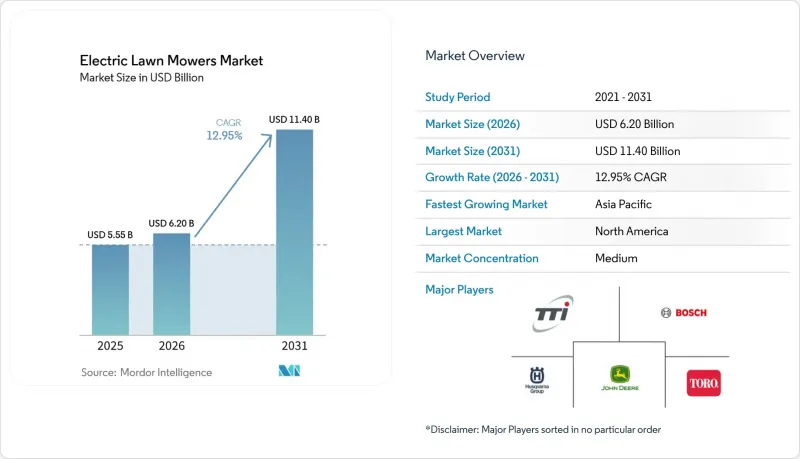
Mordor Intelligence에 의하면, 전동 잔디깎기기계 시장 규모는 2025년에 55억 5,000만 달러로 평가되었고, 2026년에는 62억 달러에 이를 것으로 추정되고 있습니다.
또한 2031년까지 114억 달러에 달할 것으로 예측되며, 2026-2031년 동안 연평균 성장률(CAGR) 12.95%를 기록할 전망입니다.
본 보고서는 제품 유형별(유선 손수레식, 무선 손수레식, 기타), 최종 사용자별(주택 DIY, 전문 조경 서비스, 기타), 배터리 전압별(36V 이하, 기타), 유통 채널별(오프라인 소매, 기타), 지역별(북미, 남미, 기타)로 분류되어 있습니다. 시장 예측은 금액(달러) 기준으로 제시되어 있습니다.
세계의 전동 잔디깎기기계 시장 동향 및 인사이트
배터리 비용 감소 및 에너지 밀도 향상
배터리 비용 측면의 발전으로 인해, 전동 잔디깎기기계 시장은 틈새 시장 도입보다는 광범위한 교체 수요로 다가서고 있습니다. 구매자는 구형 무선 모델에서 흔히 볼 수 있었던 무게 증가 없이 더 긴 작동 시간을 누릴 수 있게 되었습니다. 이는 한 번의 충전으로 일반적인 교외 잔디를 모두 깎을 수 있으면서도 다루기 쉬워야 하는 주거 부문에서 가장 중요한 요소입니다. 에너지 밀도의 향상으로 각 브랜드는 가정에서 사용 시 너무 무겁다는 느낌을 주지 않으면서도, 자체 주행이 가능하고 데크가 큰 보행형 제품을 제공할 수 있게 되었습니다. 두 번째 장점은 제품 라인업의 확충입니다. 동일한 배터리 플랫폼으로 잔디깎기기계, 트리머, 송풍기, 승용 잔디깎기기계 등을 모두 사용할 수 있게 되어, 보다 일관된 성능을 얻을 수 있게 되었습니다. 이로 인해 이미 무선 공구를 보유하고 있으며, 엔진 관련 유지보수를 최소화하고자 하는 가정의 경우 구매 결정이 수월해집니다. 또한 제조업체 입장에서는 배터리 투자를 더 많은 카테고리에 분산할 수 있게 되어 가격 전략을 철저히 수립할 수 있으며, 이는 향후 수년에 걸쳐 전동 잔디깎기기계 시장을 지탱하는 데에도 기여할 것입니다.
소형 엔진에 대한 배기가스 및 소음 규제 강화
규제는 전동 잔디깎기기계 시장에 있어 가장 명확한 구조적 뒷받침 중 하나입니다. 미국 환경보호청(EPA)이 2025년 1월에 승인한 캘리포니아주의 소형 오프로드 엔진 규제에 따라, 미국 주요 주에서 신제품의 규제 준수를 위한 현실적인 대안으로 무공해 기기가 자리 잡게 되었습니다. 제조업체들은 주마다 다른 하드웨어보다는 공통된 제품 플랫폼을 선호하는 경향이 있으므로, 이러한 변화는 캘리포니아주 이외의 지역에도 중요한 의미를 지닙니다. 또한, 지역의 소음 규제도 인구 밀도가 높은 주거 지역 수요를 형성하고 있으며, 이러한 지역에서는 전동 잔디깎기가 명확한 운영상의 이점을 제공합니다. 멘로파크와 같은 도시에서 시행되고 있는 바우처 및 트레이드인 프로그램은 초기 비용 장벽을 낮추고, 구형 가솔린식 잔디깎기의 교체를 가속화하고 있습니다. 규제의 영향은 규제 준수 압력과 소비자의 편의성이 결합될 때 가장 강력해집니다. 왜냐하면 저소음 기기는 사용 시간대 제한이 엄격한 인근 지역에서도 사용하기 편리하기 때문입니다. 이로 인해 전동 잔디깎기기계 시장은 단순한 자발적인 친환경 구매에 대한 의존도를 낮추고, 지속 가능한 정책 변화와의 연계성을 강화하고 있습니다.
높은 초기 구매 가격
초기 구매 가격은 여전히 전동 잔디깎기기계 시장에서 가장 뚜렷한 장벽 중 하나이며, 특히 고급 주택가나 규제가 엄격한 상업용 틈새 시장을 제외한 곳에서는 더욱 두드러집니다. 소형 손수 밀기식 모델의 경우 가격 차이는 미미하지만, 배터리 팩의 크기로 인해 비용이 상승하는 대형 승용형이나 제로 턴형 카테고리에서는 여전히 큰 차이가 있습니다. 상업용 배터리식 제로턴 제품은 여전히 가솔린식 제품보다 상당히 비싼 경우가 있어, 자금 조달의 유연성이 제한된 구매자에게는 투자 회수의 타당성을 설득하기 어렵습니다. 일부 지역에서는 인센티브 제도를 통해 가격 차이를 줄일 수 있지만, 이러한 제도가 널리 이용 가능한 것은 아니며, 지역에 따라 예산 배분도 고르지 않습니다. 또한, 배터리 교체 비용도 구매자의 구매 의욕을 저해하고 있습니다. 일부 사용자는 배터리 교체를 일상적인 유지보수가 아닌 추가적인 자본 지출로 간주하기 때문입니다. 이러한 우려는 서비스 네트워크가 취약한 신흥 시장이나 지방에서 더욱 크게 느껴집니다. 그 결과, 가격에 민감한 많은 구매자들은 장기적인 비용 절감 효과를 기대할 수 있는 경우에도 전환을 계속 미루고 있습니다. 이로 인해 전기 잔디깎기기계 시장의 일부는 가치 격차를 메우기 위해 정책 지원, 소매업체의 금융 지원, 혹은 급등하는 연료비에 의존하는 상태가 지속되고 있습니다.
부문 분석
2025년, 전동 잔디깎기기계 시장에서 손수레식 무선 잔디깎기기계는 시장 점유율 54.3%를 차지했으며, 제품 유형별로는 가장 큰 점유율을 기록했습니다. 이러한 우위는 일반 주택의 부지 면적에 적합하고, 대형 마트나 딜러 채널을 통해 제품을 널리 구할 수 있기 때문입니다. EGO, Greenworks, RYOBI, Makita 등의 주요 브랜드는 빈번한 신제품 출시와 배터리 생태계 지원을 통해 이 부문을 활성화해 왔습니다. 그 결과, 손수 밀기식 무선 잔디깎기는 가솔린식 잔디깎기를 대체하는 일반 가정에서 가장 쉽게 구할 수 있는 입문용 모델이 되었습니다.
로봇 잔디깎기기계와 자율 주행형 잔디깎기기계는 2031년까지 연평균 성장률(CAGR) 17.1%로 확대될 것으로 예상되며, 전동 잔디깎기기계 시장에서 가장 빠르게 성장하는 제품 형태가 될 전망입니다. 허스크바나(Husqvarna)의 ‘AI Vision’ 로드맵과 무선 로봇 기술에 대한 광범위한 노력은 이 부문이 얼리 어답터의 범위를 넘어 급속히 보급되고 있음을 보여줍니다. 고전압 플랫폼 덕분에 광활한 잔디밭이나 업무용 환경에서 가동 시간이 향상됨에 따라, 승용형 및 제로 턴형 전동 제품도 입지를 다지고 있습니다. Ariens Co의 ‘Arrow E’ 시리즈와 같은 스탠드온형 제품은 장애물 주위를 기동성 있게 이동할 수 있는 기능을 요구하는 도급업자나 지자체 구매자를 대상으로 합니다. 전선이 연결된 손수레형 모델은 유럽의 일부 지역에서 여전히 틈새 시장을 차지하고 있지만, 무선 제품의 가격 경쟁력이 높아짐에 따라 매장에서의 존재감은 점차 희미해지고 있습니다. 전동 잔디깎기기계 산업에서 더 근본적인 변화는 자동화로 인해 향후 지출이 수동식 잔디깎기기계의 반복적인 교체에서 관리형 로봇 잔디깎기기계 소유로 전환되기 시작했다는 점입니다.
주택 DIY 사용자는 전동 잔디깎기기계 시장 규모의 71.2%를 차지하며, 해당 시장에서 가장 큰 최종 사용자층을 형성하고 있습니다. 이 부문은 직접 잔디를 관리하는 많은 주택 소유자들이 노후화된 가솔린식 모델을 배터리식 장비로 교체하는 경향이 강해지고 있음을 반영합니다. 소매점에서의 인지도와 플랫폼에 대한 친숙함이 이러한 전환을 뒷받침하고 있으며, 특히 이미 배터리 구동식 야외용 공구를 소유하고 있는 구매자에게서 이러한 경향이 두드러집니다. 많은 가정용 구매가 여전히 홈센터에서 시작되기 때문에 시연과 비교가 중요한 측면에서 이 유통 채널의 영향력은 큽니다.
지자체 및 정부 기관 사용자는 2031년까지 연평균 성장률(CAGR) 13.3%로 확대될 것으로 예측되며, 전동 잔디깎기 시장에서 가장 빠르게 성장하는 최종 사용자 그룹이 될 전망입니다. 공공 차량의 전기화는 조달 규정, 배기가스 감축 목표, 학교, 병원, 공공시설 주변의 소음 저감에 대한 압력에 의해 추진되고 있습니다. 전동 잔디 관리 장비의 성능 향상에 따라 골프장 및 스포츠 시설도 수용 태도를 강화하고 있으며, 존 디어(John Deere)사의 ‘2775 E-Cut 전동 트리플렉스 잔디깎기기계’는 2025년 8월부터 미국과 캐나다에서 1회 충전으로 22개 이상의 그린을 깎을 수 있게 됩니다. 전문 조경업자는 여전히 주요 상업 구매층이지만, 사용 빈도가 높은 환경에서는 주간 충전 및 작업자에 의한 배터리 관리가 여전히 중요한 과제로 남아 있습니다. 라리머 카운티의 보조금을 통한 장비 교체 사례는 자금과 정책이 조화를 이룬다면 공공 기관의 장비 갱신이 얼마나 신속하게 진행될 수 있는지를 보여줍니다. 전동 잔디깎기기계 산업 전반에 걸쳐 이는 수요가 더 이상 주택 소유자에 의해서만 주도되는 것이 아니라는 것을 의미하며, 공공 및 관리된 녹지 공간이 더욱 확실한 성장의 기반이 되어가고 있기 때문입니다.
지역별 분석
북미는 2025년 매출의 30.2%를 차지하며 최대 지역 시장이 되고 있습니다. 규제, 소매망의 확대, 일반 가정에서의 보급이 모두 같은 방향으로 나아가고 있기 때문에 미국은 여전히 핵심적인 견인 역할을 하고 있습니다. 2025년 1월 미국 환경보호청(EPA)이 캘리포니아주의 요청을 승인함에 따라, 캘리포니아주의 소형 오프로드 엔진 기준은 지역 제품 구성을 형성하는 데 있어 가장 중요한 정책 변경 사항이 되었습니다. 지역별 바우처 제도 덕분에 그 영향은 캘리포니아주 이외의 지역으로도 확산되고 있으며, 솔트레이크시티에서는 2024-25 회계연도에 조경 기기 교체 지원이 이루어지고 있습니다. 또한 캐나다에서도 혼다가 2025년 7월 현지에서 배터리식 손수레형 잔디깎기기계 시리즈를 출시함에 따라, 상업용 및 일반 가정에서의 조기 전환이 활발해지고 있습니다.
아시아태평양은 2031년까지 연평균 성장률(CAGR) 16.8%를 나타낼 것으로 예측되며, 전동 잔디깎기기계 시장에서 가장 빠르게 확대되고 있는 지역입니다. 중국의 배터리 생산 규모는 무선 기기 전반에 걸친 가격 경쟁을 뒷받침하고 있으며, 이는 국내 판매와 수출에서의 입지 확립 모두에 기여하고 있습니다. 또한 일본의 높은 도시 밀도와 엄격한 소음 규제도, 특히 조작 편의성이 중시되는 주택가에서 로봇식이나 저소음 모터 유형의 보급을 뒷받침하고 있습니다. 한국과 호주는 지속가능성을 중시한 조달 및 전문 조경 수요를 통해 이 지역의 성장세를 견인하고 있습니다. 인도와 기타 아시아태평양은 여전히 도입 초기 단계에 있지만, 상업용 원예 및 고급 주택 프로젝트가 보다 광범위한 성장의 기반을 마련하고 있습니다. 지역별로 보면, 현재 북미가 여전히 전동 잔디깎기기계 시장 점유율을 주도하고 있지만, 아시아태평양은 성장을 지속하고 있습니다.
유럽은 로봇 잔디깎기기계의 높은 보급률과 엄격한 소음 규제에 힘입어 2025년에도 여전히 2위 지역 시장을 유지했습니다. 독일은 이 지역 최대의 국가별 시장으로 두각을 나타내며, 제조 및 제품 개발의 주요 거점 역할을 하고 있습니다. 이 지역에서는 로봇 잔디깎기가 이미 널리 받아들여지고 있어 북미와는 다른 수요 구성을 보입니다. 일부 국가에서는 자동화가 이미 일상화되었습니다. 중동 시장은 여전히 소규모이지만, 광대한 부지를 가진 주택 개발 및 그린 시티 프로젝트를 통해 초기 상업적 수요가 창출되고 있습니다. 아프리카는 인프라 및 구매력 제약에 직면해 있지만, 리조트 시설 및 스포츠 시설에서는 제한적이긴 하나 프리미엄 수요의 기회가 예상됩니다. 남미는 중기적인 성장 기회가 있으나, 환율 변동 및 배터리 공급망상의 제약으로 인해 전동 잔디깎기기계 시장의 단기적인 확대는 계속해서 둔화되고 있습니다.
기타 혜택
- 엑셀 형식 시장 예측(ME) 시트
- 3개월간의 애널리스트 지원
자주 묻는 질문
목차
제1장 서론
제2장 조사 방법
제3장 주요 요약
제4장 시장 구도
제5장 시장 규모 및 성장 예측
제6장 경쟁 구도
제7장 시장 기회 및 향후 전망
AJYAccording to Mordor Intelligence, the electric lawn mower market size was valued at USD 5.55 billion in 2025 and is estimated to reach USD 6.20 billion in 2026, and is projected to reach USD 11.40 billion by 2031, registering a CAGR of 12.95% from 2026 to 2031.
This report is Segmented by Product Type (Walk-Behind Corded, Walk-Behind Cordless, and More), by End User (Residential DIY, Professional Landscaping Services, and More), by Battery Voltage (Less Than or Equal To 36V, and More), by Distribution Channel (In-Store Retail, and More), and by Geography (North America, South America, and More). The Market Forecasts are Provided in Terms of Value (USD).
Global Electric Lawn Mowers Market Trends and Insights
Battery Cost Deflation and Higher Energy Density
Battery economics have moved the electric lawn mower market closer to broad replacement demand rather than niche adoption. Buyers are seeing better runtime without the weight penalties that older cordless models often carried. That matters most in the residential segment, where a mower needs to finish a typical suburban lawn on a single charge and remain easy to handle. Higher energy density is also helping brands offer self-propelled, larger-deck walk-behind products without making the machines feel too heavy for household use. A second benefit is an expanded product portfolio, as the same battery platform can now support mowers, trimmers, blowers, and riders with more consistent performance. That makes the purchase decision easier for households that already own cordless tools and want fewer engine-related service needs. It also helps manufacturers spread battery investment across more categories, strengthening pricing discipline and supporting the electric lawn mower market over the next few years.
Tightening Emission and Noise Rules for Small Engines
Regulation is one of the clearest structural supports for the electric lawn mower market. California's small off-road engine rules, which the United States Environmental Protection Agency authorized in January 2025, make zero-emission equipment the practical route for new product compliance in a major U.S. state. That shift matters beyond California because manufacturers often prefer common product platforms rather than state-specific hardware. Local noise regulations are also shaping demand in dense residential areas, where electric mowing offers a clear operational advantage. Voucher and exchange programs in cities such as Menlo Park are reducing the upfront barrier and speeding the replacement of older gas units. The rule effect is strongest when it combines compliance pressure with consumer convenience, since quieter equipment is easier to use in neighborhoods with tighter time-of-day expectations. This is making the electric lawn mower market less dependent on voluntary green purchasing alone and more tied to lasting policy change.
Higher Upfront Purchase Price
Upfront pricing remains one of the clearest barriers in the electric lawn mower market, especially outside premium residential and regulated commercial niches. The gap is modest in smaller walk-behind models, but it is still meaningful in larger riding and zero-turn categories, where battery pack size drives cost higher. Commercial battery zero-turn products can still sit well above gasoline alternatives, which makes payback harder to justify for buyers with limited financing flexibility. Incentive programs can narrow the gap in some locations, but those programs are not widely available, and their budgets are uneven across regions. Replacement battery costs also weigh on buyer confidence, as some users view battery replacement as a second capital event rather than routine maintenance. That concern is stronger in emerging markets and in rural areas where service networks are thinner. The result is that many price-sensitive buyers continue to delay switching even if they see long-term savings. This keeps a portion of the electric lawn mower market dependent on policy support, retailer financing, or rising fuel costs to close the value gap.
Other drivers and restraints analyzed in the detailed report include:
- Lower Maintenance and Operating Costs versus Gas Mowers
- AI-Enabled Robotic Mowing Reduces Labor Intensity
- Tariffs on Imported Batteries and Battery Components
For complete list of drivers and restraints, kindly check the Table Of Contents.
Segment Analysis
Walk-behind cordless mowers accounted for 54.3% of the electric lawn mowers market share in 2025, giving them the largest share of the electric lawn mower market by product type. Their lead comes from a good fit with common residential lot sizes and broad product availability across mass retail and dealer channels. Major brands such as EGO, Greenworks, RYOBI, and Makita have kept this segment active through frequent model launches and support for their battery ecosystems. That has made walk-behind cordless equipment the most accessible entry point for households, replacing gasoline mowers.
Robotic and autonomous mowers are projected to expand at a 17.1% CAGR through 2031, making them the fastest-growing product format in the electric lawn mower market. Husqvarna's AI Vision roadmap and broader push into wire-free robotics show how quickly the segment is moving beyond early adopters. Ride-on and zero-turn electric products are also gaining ground as higher-voltage platforms improve runtime for larger lawns and commercial use. Stand-on products such as AriensCo's Arrow E series are targeting contractor and municipal buyers who want maneuverability around obstacles. Corded walk-behind models still hold a niche in parts of Europe, but their shelf presence is fading as cordless pricing improves. Within the electric lawn mower industry, the deeper shift is that automation is starting to redirect future spending away from repeat walk-behind replacement and toward managed robotic ownership.
Residential do-it-yourself users accounted for 71.2% of the electric lawn mowers market size, making them the largest end-user segment in the electric lawn mower market. The segment reflects the large number of homeowners who manage lawns directly and increasingly replace aging gas models with battery equipment. Retail visibility and platform familiarity are helping that transition, especially for buyers who already own battery-powered outdoor tools. The channel effect is important because many residential purchases still begin in home centers, where demonstration and comparison matter.
Municipal and government users are forecast to grow at a 13.3% CAGR through 2031, making them the fastest-growing end-user group in the electric lawn mower market. Public fleet conversion is being pushed by procurement rules, emissions goals, and pressure to reduce noise around schools, hospitals, and public venues. Golf courses and sports facilities are also becoming more receptive as electric turf equipment improves, with John Deere's 2775 E-Cut Electric Triplex Mower offering more than 22 greens per charge in the United States and Canada from August 2025. Professional landscaping remains a major commercial buyer group, though mid-day charging and crew battery management still matter in intensive-use settings. Larimer County's grant-backed equipment transition shows how institutional replacement can move quickly once funding and policy align[3]. Across the electric lawn mower industry, this means demand is no longer driven only by homeowners, since public and managed landscapes are becoming a more dependable growth layer.
Complete Report Scope:
- By Product Type
- Walk-behind - Corded
- Walk-behind - Cordless
- Ride-on - Lawn Tractor
- Ride-on - Zero-Turn
- Stand-on
- Robotic/Autonomous
- By End User
- Residential DIY
- Professional Landscaping Services
- Golf Courses and Sports Facilities
- Municipal and Government
- By Battery Voltage
- Less than or equal to 36 V(Light-Duty)
- 37-60 V(Mid-Duty)
- More than 60 V (Commercial-Grade)
- By Distribution Channel
- In-store Retail
- Specialty
- Online Marketplaces
- By Geography
- North America
- United States
- Canada
- Mexico
- Rest of North America
- South America
- Brazil
- Argentina
- Rest of South America
- Europe
- Germany
- United Kingdom
- France
- Spain
- Russia
- Rest of Europe
- Asia-Pacific
- China
- Japan
- India
- South Korea
- Australia
- Rest of Asia-Pacific
- Middle East
- Saudi Arabia
- United Arab Emirates
- Rest of Middle East
- Africa
- South Africa
- Egypt
- Kenya
- Rest of Africa
- North America
Geography Analysis
North America accounted for 30.2% of 2025 revenue, making it the largest regional market. The United States remains the core driver because regulation, retail breadth, and homeowner adoption are all moving in the same direction. California's small off-road engine standards are the single most important policy change shaping regional product mix, since the U.S. Environmental Protection Agency authorized the state's request in January 2025. Local voucher programs are widening the impact beyond California, including Salt Lake City's FY2024-25 exchange support for landscaping equipment. Canada is also becoming an active market for early commercial and homeowner conversion, supported by Honda's July 2025 launch of its battery walk-behind lineup in the country.
Asia-Pacific is forecast to grow at a 16.8% CAGR through 2031, making it the fastest-expanding region in the electric lawn mower market. China's battery manufacturing scale supports price competitiveness across cordless equipment, which helps both domestic sales and export positioning. Japan's high urban density and stricter noise regulations also support robotic and low-noise electric formats, especially in residential areas where operational convenience matters. South Korea and Australia add to regional momentum through sustainability-led procurement and professional landscaping demand. India and the rest of Asia-Pacific are still early adopters, but commercial horticulture and premium residential projects are creating a foundation for broader growth. In regional terms, the Asia-Pacific is growing, even though North America still leads the electric lawn mower market share at present.
Europe remained the second-largest regional market in 2025, supported by strong robotic mower penetration and tighter noise regulations. Germany stands out as the largest country market in the region and a major base for manufacturing and product development. The region's mature acceptance of robotic mowing gives it a different demand mix from North America, with automation already normalized in several countries. The Middle East is still small, but large-lot residential development and green-city projects are creating early commercial demand. Africa remains constrained by infrastructure and purchasing power, though resorts and sports venues offer limited premium opportunities. South America is a mid-term opportunity, but currency volatility and supply chain constraints for batteries continue to slow near-term expansion of the electric lawn mower market.
- Deere & Company
- Husqvarna Group
- The Toro Company
- Robert Bosch GmbH
- Stanley Black and Decker
- STIGA S.p.A.
- AriensCo
- Greenworks North America
- Chervon (EGO Power+)
- Techtronic Industries (Ryobi)
- Positec (WORX)
- ANDREAS STIHL PVT LTD
- Segway Navimow
- Mammotion
- Makita
- Generac Holdings, Inc. (DR Power Equipment)
- AL-KO Gardentech
Additional Benefits:
- The market estimate (ME) sheet in Excel format
- 3 months of analyst support
TABLE OF CONTENTS
1 Introduction
- 1.1 Study Assumptions and Market Definition
- 1.2 Scope of the Study
2 Research Methodology
3 Executive Summary
4 Market Landscape
- 4.1 Market Overview
- 4.2 Market Drivers
- 4.2.1 Battery cost deflation and higher energy density
- 4.2.2 Tightening emission and noise rules for small engines
- 4.2.3 Lower maintenance and operating costs versus gas mowers
- 4.2.4 AI-enabled robotic mowing reduces labor intensity
- 4.2.5 Retailer shelf-space shift toward battery outdoor power equipment
- 4.2.6 Public-sector zero-emission grounds equipment programs
- 4.3 Market Restraints
- 4.3.1 Higher upfront purchase price
- 4.3.2 Runtime and recharge constraints on larger properties
- 4.3.3 Tariffs on imported batteries and battery components
- 4.3.4 Battery-platform fragmentation across brands and voltages
- 4.4 Regulatory Landscape
- 4.5 Technological Outlook
- 4.6 Porter's Five Forces Analysis
- 4.6.1 Threat of New Entrants
- 4.6.2 Bargaining Power of Buyers
- 4.6.3 Bargaining Power of Suppliers
- 4.6.4 Threat of Substitute Products
- 4.6.5 Intensity of Competitive Rivalry
5 Market Size and Growth Forecasts (Value)
- 5.1 By Product Type
- 5.1.1 Walk-behind - Corded
- 5.1.2 Walk-behind - Cordless
- 5.1.3 Ride-on - Lawn Tractor
- 5.1.4 Ride-on - Zero-Turn
- 5.1.5 Stand-on
- 5.1.6 Robotic/Autonomous
- 5.2 By End User
- 5.2.1 Residential DIY
- 5.2.2 Professional Landscaping Services
- 5.2.3 Golf Courses and Sports Facilities
- 5.2.4 Municipal and Government
- 5.3 By Battery Voltage
- 5.3.1 Less than or equal to 36 V(Light-Duty)
- 5.3.2 37-60 V(Mid-Duty)
- 5.3.3 More than 60 V (Commercial-Grade)
- 5.4 By Distribution Channel
- 5.4.1 In-store Retail
- 5.4.2 Specialty
- 5.4.3 Online Marketplaces
- 5.5 By Geography
- 5.5.1 North America
- 5.5.1.1 United States
- 5.5.1.2 Canada
- 5.5.1.3 Mexico
- 5.5.1.4 Rest of North America
- 5.5.2 South America
- 5.5.2.1 Brazil
- 5.5.2.2 Argentina
- 5.5.2.3 Rest of South America
- 5.5.3 Europe
- 5.5.3.1 Germany
- 5.5.3.2 United Kingdom
- 5.5.3.3 France
- 5.5.3.4 Spain
- 5.5.3.5 Russia
- 5.5.3.6 Rest of Europe
- 5.5.4 Asia-Pacific
- 5.5.4.1 China
- 5.5.4.2 Japan
- 5.5.4.3 India
- 5.5.4.4 South Korea
- 5.5.4.5 Australia
- 5.5.4.6 Rest of Asia-Pacific
- 5.5.5 Middle East
- 5.5.5.1 Saudi Arabia
- 5.5.5.2 United Arab Emirates
- 5.5.5.3 Rest of Middle East
- 5.5.6 Africa
- 5.5.6.1 South Africa
- 5.5.6.2 Egypt
- 5.5.6.3 Kenya
- 5.5.6.4 Rest of Africa
- 5.5.1 North America
6 Competitive Landscape
- 6.1 Market Concentration
- 6.2 Strategic Moves
- 6.3 Market Share Analysis
- 6.4 Company Profiles (Includes Global Level Overview, Market Level Overview, Core Segments, Financials as Available, Strategic Information, Market Rank/Share for Key Companies, Products and Services, and Recent Developments)
- 6.4.1 Deere & Company
- 6.4.2 Husqvarna Group
- 6.4.3 The Toro Company
- 6.4.4 Robert Bosch GmbH
- 6.4.5 Stanley Black and Decker
- 6.4.6 STIGA S.p.A.
- 6.4.7 AriensCo
- 6.4.8 Greenworks North America
- 6.4.9 Chervon (EGO Power+)
- 6.4.10 Techtronic Industries (Ryobi)
- 6.4.11 Positec (WORX)
- 6.4.12
ANDREAS STIHL PVT LTD
- 6.4.13 Segway Navimow
- 6.4.14 Mammotion
- 6.4.15 Makita
- 6.4.16 Generac Holdings, Inc. (DR Power Equipment)
- 6.4.17 AL-KO Gardentech