

|
시장보고서
상품코드
2099862
독일의 실내 농업 시장 : 시장 점유율 분석, 업계 동향 및 통계, 성장 예측(2026-2031년)Germany Indoor Farming - Market Share Analysis, Industry Trends & Statistics, Growth Forecasts (2026 - 2031) |
||||||
 Mordor Intelligence
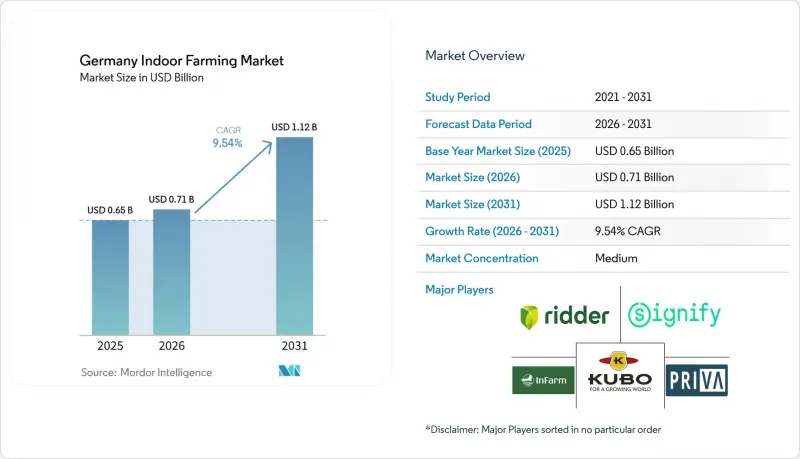
Mordor Intelligence에 의하면, 독일의 실내 농업 시장은 2025년 6억 5,000만 달러로 평가되었고, 2026년에는 7억 1,180만 달러로 확대될 것으로 추정되고, 2031년까지 11억 1,770만 달러에 이를 것으로 예측되며, 2026-2031년 CAGR은 9.54%를 나타낼 전망입니다.
본 보고서는 재배 시스템별(에어로포닉스, 하이드로포닉스, 아쿠아포닉스 등), 시설 유형별(유리 또는 폴리카보네이트 온실, 실내 수직 농장 등), 작물 유형별(과일 및 채소, 허브·마이크로그린 등)로 분류되어 있습니다. 시장 전망은 금액(달러)으로 표시되어 있습니다.
독일의 실내 농업 시장 동향 및 인사이트
신선하고 농약을 사용하지 않은 농산물에 대한 도시 지역 수요
독일의 유기농 식품 시장은 성장을 지속하고 있으며, 추적 가능성이 확보된 클린 라벨 식품에 대한 수요가 극히 일부의 프리미엄 틈새 시장에 그치지 않음을 보여주고 있습니다. 현재 할인 소매업체가 유기농 식품 구매에서 상당한 점유율을 차지하고 있으며, 이는 가끔 프리미엄 상품을 구매하는 것보다는 일상적인 광범위한 보급을 반영하고 있습니다. 이러한 변화는 실내 농업에 중요한 의미를 지닙니다. 왜냐하면 실내에서 재배된 잎채소, 허브, 딸기는 신선도, 유통기한, 무농약이라는 판매 포인트가 상업적으로 중요한 요소가 되는 대규모 슈퍼마켓 유통 채널을 통해 판매될 수 있기 때문입니다. 또한, 할인점을 통한 자체 브랜드 계약을 통해 생산자는 안정적인 판매량을 확보할 수 있게 되었습니다. 이는 실내 재배 농산물이 주로 전문 소매점을 통해 판매되던 이전에는 확보하기 어려웠던 부분입니다. 그 결과, 독일의 실내 농업 시장은 좁은 하이엔드 소비자층이 아닌, 주류 소매업과 연계된 지속적인 식품 수요에 의해 지탱되고 있습니다.
LED 효율 향상과 기후 제어 비용 감소
2025년 및 2026년에 판매된 상업용 원예용 LED 조명 기구는 일관되게 3.5µmol/J 이상의 광효율을 달성했으며, 이를 통해 동일한 광도에서 전력 사용량이 30%-40% 감소했습니다. 시그니파이(Signify)는 2025년 6월, Philips 그로우와이즈(Philips GrowWise) 스마트 스펙트럼 알고리즘을 출시하며 이러한 추세를 더욱 강화했습니다. 이 회사에 따르면, 이 알고리즘은 실시간 광량 조정을 통해 에너지 소비를 줄이거나 작물의 성장을 최대 6% 향상시킬 수 있다고 합니다. 2026년에는 리더(Rider)사와 시그니파이(Signify)사가 ‘Horti Lighting Protocol’ 하에 통합을 공식적으로 확립하여, 생산자들은 대규모 맞춤형 통합 작업 없이도 커넥티드 제어에 보다 직접적으로 접근할 수 있게 되었습니다. 또한, NLight의 중앙 집중형 DC 아키텍처는 온실 조명 프로젝트의 설비 투자를 10%-20% 절감할 수 있다고 홍보하고 있으며, 전력 비용이 프로젝트의 실현 가능성을 좌우하는 시장에서 이는 매우 중요한 의미를 지닙니다. 이러한 발전으로 에너지 리스크가 완전히 해소되는 것은 아니지만, 소규모 시설의 발목을 잡았던 가장 큰 비용 격차 중 하나를 줄여주고 있습니다. 그 결과, 독일의 실내 농업 시장에서는 더 소규모이며 도시 지역에서 상업적으로 실현 가능한 프로젝트를 위한 길이 더욱 명확해지고 있습니다.
높은 설비 투자액 및 에너지 집약도
중규모 수직 농장의 설비 투자액은 꾸준히 증가하고 있으며, 완전 밀폐형 시스템의 경우 에너지 비용이 운영비의 40%-70%를 차지합니다. 이것이 바로 에너지 가격 변동이 투자자의 신뢰에 큰 영향을 미쳐온 이유입니다. 이러한 부담은 더 유리한 조달 조건을 협상하거나, 더 큰 생산량으로 간접비를 분산시키기 전에 생산 규모를 확대해야 하는 신규 사업자에게 특히 큰 과제가 되고 있습니다. 부분적인 해결책도 나타나기 시작했는데, 그 일례로 2026년 3월 개장 예정인 슈네벨러호프(Schneeburgerhof) 온실에서는 풍력 및 태양광 발전을 통한 직접 전력 공급이 계획되어 있습니다. 또한, 2025년 6월에 출시된 Durr AG의 'EcoY' 시스템은 물 사용량을 최대 95%까지 줄일 수 있는 '그로우 튜브(Grow Tube)' 기술을 채택하고 있으며, 자연광이 부족한 경우에만 보조 LED 조명을 비춥니다. 하지만 높은 초기 투자 비용과 많은 전력 소비량과 같은 과제로 인해, 저비용 엔지니어링 기술과 더욱 강력한 에너지 통합이 상업 프로젝트 전반에 보급되기 전까지는 독일 실내 농업 시장의 성장은 계속해서 둔화될 것입니다.
부문 분석
2025년, 독일 실내 농업 시장에서 수경 재배는 47.8%의 점유율을 차지했으며, 상업 생산의 확고한 기반을 형성하고 있습니다. 이러한 우위는 비용 대비 수확량의 균형이 양호하고, 설비 공급 기반이 광범위하며, 사업자들이 충분히 이해하고 있어 실행 위험을 낮게 억제하면서 규모 확대가 가능한 생산 방식이기 때문입니다. 아쿠아포닉스나 토양 재배 시스템도 여전히 존재하지만, 아쿠아포닉스는 생물학적 복잡성이 높고, 토양 재배 방식은 수확량 효율이 낮기 때문에 그 적용 범위는 제한적입니다. 작물의 유연성이 중시되는 분야에서는 하이브리드 시스템에 관심이 쏠리고 있지만, 현재의 자금 조달 주기에서 대부분의 사업자가 실적이 입증된 시스템 설계를 선호하기 때문에 해당 시장의 입지는 여전히 미미합니다.
에어로포닉스는 성능에 대한 기대의 변화를 반영하여, 2026-2031년 연평균 성장률(CAGR) 15.8%를 기록하며 가장 빠르게 성장하는 시스템이 될 것으로 예측됩니다. 이러한 전망은 정밀 미스트 기술의 성숙과, 특히 고부가가치 허브, 마이크로그린, 특산 딸기에서 물 이용 효율에 대한 관심이 높아진 것과 관련이 있습니다. 2025년 6월, Korber Technologies와 Veganz Group AG는 ‘OrbiFarm’ 플랫폼을 발표하며, 프라운호퍼 연구소의 시험 결과 기존 재배 방식에 비해 최대 36배의 수확량을 기록했다고 보고했습니다. 이에 따라 본격적인 상업적 전개에 앞서 이 시스템은 전략적인 주목을 받고 있습니다. 폐루프식 수경 재배 시스템은 기존 노지 재배에 필요한 물의 양보다 불과 5%만 사용하며, 에어로포닉스를 통해 물 사용량을 더욱 줄일 수 있습니다. 독일의 실내 농업 시장에서는 구매자들이 자원 사용 현황과 공급 안정성에 더욱 주목함에 따라 이러한 효율 차이가 점점 더 중요하게 여겨지고 있습니다. 수경 재배는 당분간 주류 시스템으로 남아 있을 것으로 예상되지만, 에어로포닉스는 상업적 실증이 진행됨에 따라 새로운 고효율 프로젝트에서 더 큰 점유율을 확보할 가능성이 높습니다.
기타 혜택 :
- 엑셀 형식 시장 예측(ME) 시트
- 3개월간의 애널리스트 지원
자주 묻는 질문
목차
제1장 서론
제2장 조사 방법
제3장 주요 요약
제4장 시장 구도
제5장 시장 규모 및 성장 예측
제6장 경쟁 구도
제7장 시장 기회 및 향후 전망
AJY 26.08.07According to Mordor Intelligence, the Germany indoor farming market is forecasted to grow from USD 650 million in 2025 to USD 711.8 million in 2026, reaching USD 1,117.7 million by 2031, at a CAGR of 9.54% over 2026-2031.
This report is Segmented by Growing System (Aeroponics, Hydroponics, Aquaponics, and More), by Facility Type (Glass or Poly Greenhouses, Indoor Vertical Farms, and More), and by Crop Type (Fruits and Vegetables, Herbs and Microgreens, and More). The Market Forecasts are Provided in Terms of Value (USD).
Germany Indoor Farming Market Trends and Insights
Urban Demand for Fresh, Pesticide-Free Produce
Germany's organic food market is growing, indicating that demand for traceable and clean-label food extends beyond a small premium niche. Discount retailers now account for a substantial share of organic purchases, reflecting broad everyday adoption rather than occasional premium buying. This shift is relevant to indoor farming because leafy greens, herbs, and strawberries grown indoors can be sold through large supermarket channels where freshness, shelf life, and pesticide-free positioning carry commercial weight. Private-label contracts through discounters also give growers access to stable volume that was previously difficult to secure when indoor produce was sold primarily through specialty retail. As a result, the Germany indoor farming market is supported by recurring food demand tied to mainstream retail rather than a narrow high-end consumer segment.
LED Efficiency and Climate Control Cost Declines
Commercial horticultural LED fixtures sold in 2025 and 2026 routinely exceeded 3.5 µmol/J efficacy, which was linked to a 30%-40% reduction in electricity use for the same light intensity. Signify reinforced this trend in June 2025 with the launch of the Philips GrowWise smart spectrum algorithm, which the company stated can reduce energy use or increase crop growth by up to 6% through real-time light adjustment. In 2026, Ridder and Signify formalized integration under the Horti Lighting Protocol, giving growers a more direct route to connected control without extensive custom integration work. Additionally, NLight's centralized DC architecture claims a 10%-20% capital expenditure reduction for greenhouse lighting projects, which is significant in a market where power costs can determine project viability. While these developments do not eliminate energy risk, they narrow one of the largest cost gaps that has constrained smaller facilities. As a result, the Germany indoor farming market is seeing a clearer path toward commercially viable projects at more modest scales and in more urban settings.
High Capital Expenditure and Energy Intensity
Capital expenditure for a medium-scale vertical farm is regularly increasing and energy costs account for 40%-70% of operating expenditure in fully enclosed systems, which explains why energy price volatility has had a strong effect on investor confidence. This burden is especially difficult for new operators that need to scale output before they can negotiate better procurement terms or spread overhead across larger volumes. Partial solutions are emerging, including Schneebergerhof's March 2026 greenhouse opening with direct wind and solar power supply. Durr AG's EcoY system, launched in June 2025, uses grow-tube technology that can reduce water use by up to 95% and applies supplemental LED lighting only where natural daylight is insufficient. Even so, high upfront capital requirements and power intensity will continue to slow the Germany indoor farming market until lower-cost engineering and stronger energy integration become more widespread across commercial projects.
Other drivers and restraints analyzed in the detailed report include:
- Shrinking Arable Land and Weather Volatility
- Year-Round Production Strengthens Grocery Supply Reliability
- Shortage of Skilled Horticulture and Automation Talent
For complete list of drivers and restraints, kindly check the Table Of Contents.
Segment Analysis
Hydroponics held 47.8% of the Germany indoor farming market in 2025, making it the clear operating base for commercial production. Its lead reflects a favorable cost-to-yield profile, a broader equipment supply base, and production methods that operators understand well enough to scale with lower execution risk. Aquaponics and soil-based systems remain present but are more limited in scope, as biological complexity is higher in aquaponics and yield intensity is lower in soil-based formats. Hybrid systems are drawing interest where crop flexibility matters, yet their market position remains modest as most operators prefer proven system designs during the current financing cycle.
Aeroponics is forecast to be the fastest-growing system between 2026 and 2031, at a CAGR of 15.8%, reflecting a shift in performance expectations. This outlook is linked to maturing precision misting technology and growing interest in water efficiency, particularly for high-value herbs, microgreens, and specialty strawberries. In June 2025, Korber Technologies and Veganz Group AG introduced the OrbiFarm platform, reporting trial yields up to 36 times higher than conventional cultivation in Fraunhofer testing, which has drawn strategic attention to the system even before broad commercial rollout. Closed-loop hydroponic systems use only 5% of the water required by conventional field cultivation, and aeroponics reduces water input further. In the Germany indoor farming market, this efficiency gap is increasingly relevant as buyers pay closer attention to resource use and supply stability. Hydroponics is anticipated to remain the dominant system in the near term, while aeroponics is likely to capture a larger share of new high-efficiency projects as commercial validation improves.
Complete Report Scope:
- By Growing System
- Aeroponics
- Hydroponics
- Aquaponics
- Soil-Based
- Hybrid
- By Facility Type
- Glass or Poly Greenhouses
- Indoor Vertical Farms
- Container Farms
- Indoor Deep-Water Culture Systems
- Other Facility Types
- By Crop Type
- Fruits and Vegetables
- Leafy Vegetables
- Tomato
- Strawberry
- Eggplant
- Other Fruits and Vegetables
- Herbs and Microgreens
- Basil
- Tarragon
- Wheatgrass
- Other Herbs and Microgreens
- Flowers and Ornamentals
- Perennials
- Annuals
- Ornamentals
- Other Flowers and Ornamentals
- Other Crop Types
- Fruits and Vegetables
List of Companies Covered in this Report:
- Infarm Group GmbH
- Vertical Farm Systems GmbH
- Siemens AG
- Signify N.V. (Philips Horticulture LED Solutions)
- Priva Holding B.V.
- Ridder Holding B.V.
- KUBO Group B.V.
- Netafim Ltd.
- Grodan B.V.
- Valoya Oy
- Stulz GmbH
- Bosch Rexroth AG
- Yaskawa Electric Corporation
- Urban Crop Solutions
- Agrotonomy
Additional Benefits:
- The market estimate (ME) sheet in Excel format
- 3 months of analyst support
TABLE OF CONTENTS
1 INTRODUCTION
- 1.1 Study Assumptions and Market Definition
- 1.2 Scope of the Study
2 RESEARCH METHODOLOGY
3 EXECUTIVE SUMMARY
4 MARKET LANDSCAPE
- 4.1 Market Overview
- 4.2 Market Drivers
- 4.2.1 Urban demand for fresh, pesticide-free produce
- 4.2.2 LED efficiency and climate control cost declines
- 4.2.3 Shrinking arable land and weather volatility
- 4.2.4 Year-round production strengthens grocery supply reliability
- 4.2.5 Repurposing vacant industrial real estate
- 4.2.6 Carbon and energy efficiency monetization
- 4.3 Market Restraints
- 4.3.1 High capital expenditure and energy intensity
- 4.3.2 Shortage of skilled horticulture and automation talent
- 4.3.3 Investment pullback after operator failures
- 4.3.4 Urban grid capacity constraints
- 4.4 Regulatory Landscape
- 4.5 Technological Outlook
- 4.6 Porter's Five Forces Analysis
- 4.6.1 Threat of New Entrants
- 4.6.2 Bargaining Power of Buyers
- 4.6.3 Bargaining Power of Suppliers
- 4.6.4 Threat of Substitutes
- 4.6.5 Intensity of Competitive Rivalry
5 MARKET SIZE AND GROWTH FORECASTS (VALUE)
- 5.1 By Growing System
- 5.1.1 Aeroponics
- 5.1.2 Hydroponics
- 5.1.3 Aquaponics
- 5.1.4 Soil-Based
- 5.1.5 Hybrid
- 5.2 By Facility Type
- 5.2.1 Glass or Poly Greenhouses
- 5.2.2 Indoor Vertical Farms
- 5.2.3 Container Farms
- 5.2.4 Indoor Deep-Water Culture Systems
- 5.2.5 Other Facility Types
- 5.3 By Crop Type
- 5.3.1 Fruits and Vegetables
- 5.3.1.1 Leafy Vegetables
- 5.3.1.2 Tomato
- 5.3.1.3 Strawberry
- 5.3.1.4 Eggplant
- 5.3.1.5 Other Fruits and Vegetables
- 5.3.2 Herbs and Microgreens
- 5.3.2.1 Basil
- 5.3.2.2 Tarragon
- 5.3.2.3 Wheatgrass
- 5.3.2.4 Other Herbs and Microgreens
- 5.3.3 Flowers and Ornamentals
- 5.3.3.1 Perennials
- 5.3.3.2 Annuals
- 5.3.3.3 Ornamentals
- 5.3.3.4 Other Flowers and Ornamentals
- 5.3.4 Other Crop Types
- 5.3.1 Fruits and Vegetables
6 COMPETITIVE LANDSCAPE
- 6.1 Market Concentration
- 6.2 Strategic Moves
- 6.3 Market Share Analysis
- 6.4 Company Profiles (includes Global Level Overview, Market Level Overview, Core Segments, Financials as available, Strategic Information, Market Rank/Share, Products and Services, Recent Developments)
- 6.4.1 Infarm Group GmbH
- 6.4.2 Vertical Farm Systems GmbH
- 6.4.3 Siemens AG
- 6.4.4 Signify N.V. (Philips Horticulture LED Solutions)
- 6.4.5 Priva Holding B.V.
- 6.4.6 Ridder Holding B.V.
- 6.4.7 KUBO Group B.V.
- 6.4.8 Netafim Ltd.
- 6.4.9 Grodan B.V.
- 6.4.10 Valoya Oy
- 6.4.11 Stulz GmbH
- 6.4.12 Bosch Rexroth AG
- 6.4.13 Yaskawa Electric Corporation
- 6.4.14 Urban Crop Solutions
- 6.4.15 Agrotonomy


