

|
시장보고서
상품코드
2099951
당뇨병 관리용 의료기기 소프트웨어(SaMD) 시장 : 시장 점유율 분석, 업계 동향 및 통계, 성장 예측(2026-2031년)Software As A Medical Device (SaMD) For Diabetes Management - Market Share Analysis, Industry Trends & Statistics, Growth Forecasts (2026 - 2031) |
||||||
 Mordor Intelligence
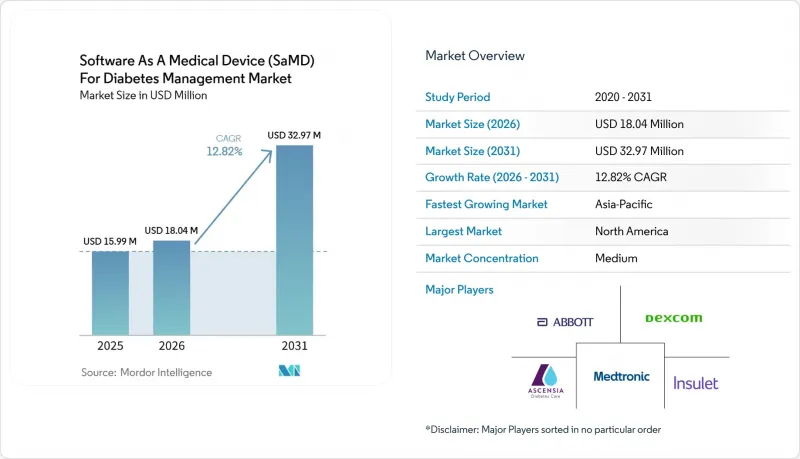
당뇨병 관리용 의료기기 소프트웨어(SaMD) 시장 규모는 2025년에 1,599만 달러로 평가되었고, 2026년 1,804만 달러에서 2031년까지 3,297만 달러에 이를 것으로 예측되며, 예측 기간(2026-2031년) CAGR은 12.82%로 성장이 전망됩니다.
본 보고서는 구성 요소별(소프트웨어 플랫폼, 서비스), 제품 유형별(모바일 앱, 폐쇄 루프/AID 등), 임상 이용 사례별(제1형, 제2형, 임신성 당뇨병), 도입 형태별(클라우드 기반, 온프레미스형, 하이브리드형), 최종 사용자별(환자, 병원, 외래 진료 등), 지역별(북미, 유럽, 아시아태평양 등)로 분류되어 있습니다. 예측치는 금액(달러)으로 표시되어 있습니다.
세계의 당뇨병 관리용 의료기기 소프트웨어(SaMD) 동향 및 인사이트
CGM 연동 소프트웨어 및 자동 인슐린 투여의 채택 확대
CGM 연동 소프트웨어는 당뇨병 관리의 핵심으로 자리 잡고 있으며, 당뇨병 관리용 의료기기 소프트웨어(SaMD) 시장을 더 높은 부가가치를 지닌 규제 대상 도구로 끌어올리고 있습니다. 2026년 1월, Diabeloop사는 DBLG2에 대해 FDA의 510(k) 승인을 획득하여, Diabeloop사의 승인된 제품 라인업에 새로운 자동 인슐린 투여 알고리즘이 추가되었습니다. 또한, 메드트로닉(Medtronic)도 2026년 1월 MiniMed Go Smart MDI 시스템의 FDA 승인을 발표했으며, 이는 소프트웨어를 통한 투여 지원이 임상 현장에서 더욱 확대되고 있음을 보여줍니다. 2026년 5월에 발표된 MiniMed 780G 시스템에 관한 연구에서는 두 가지 통합형 센서 브랜드 간에 유사한 혈당 조절 결과가 나타났으며, 알고리즘의 성능과 상호 운용성의 가치가 높아지고 있음이 부각되었습니다. 이러한 진전에 따라, 다양한 기기에서 작동하며 실제 임상 현장에서 일관된 성과를 입증할 수 있는 소프트웨어 주도형 공급업체에게 기회가 확대되는 동시에, 대상 환자층도 1형 당뇨병에 국한되지 않고 인슐린 관리가 필요한 더 광범위한 환자층으로 확대되고 있습니다.
원격 환자 모니터링 및 만성 질환 관리의 확대
원격 모니터링은 의료 제공업체, 고용주 및 건강 보험 플랜이 일상 진료에서 당뇨병 관리 시장을 위한 SaMD를 활용하는 방식을 변화시키고 있습니다. 구매자들은 현재 진료 후 혈당 수치 확인뿐만 아니라, 투여량 조정, 복약 순응도, 증상 추적, 그리고 진료 간격 동안의 대응 강화에 대한 지속적인 지원을 요구하고 있습니다. 이러한 수요는 대사 치료의 이용 확대에 따라, 특히 투여량 조정이나 내약성 변화에 따라 환자가 보다 면밀한 후속 관리를 필요로 하는 경우 더욱 높아지고 있습니다. 2026년, Twin Health사는 CGM 데이터, 분기별 검사 결과, 스마트 체중계, 활동량 추적을 하나의 지속적으로 학습하는 시스템으로 통합한 정밀한 GLP-1 스튜어드십 모델을 도입했습니다. 이러한 변화는 혈당 기록에 그치지 않는 수요를 뒷받침하며, 소프트웨어, 검토 도구, 관리형 지원을 단일 서비스로 통합한 공급업체에게 유리한 환경을 조성하고 있습니다.
의료기기, CDS, 웰니스 분류를 아우르는 규제상의 불확실성
규제상의 경계는 당뇨병 관리를 위한 SaMD 시장에 있어 여전히 중요한 사업적 제약 요인으로 남아 있습니다. 구매자가 사용 단계에서 이러한 제품들을 유사한 것으로 간주하더라도, 기업들은 의료기기 소프트웨어, 임상 의사결정 지원(CDS), 웰니스 용도 각 분야에서 서로 다른 요건에 직면하고 있습니다. 벤더가 미국과 유럽 양쪽 모두에서 시장 진입을 목표로 할 경우, 여러 규제 시스템에 걸친 승인 요건, 기술 문서, 시판 후 추적 관리, 임상 증거를 관리해야 하므로 과제는 더욱 커집니다. 소규모 개발 기업은 품질 관리 시스템, 감사 대응 체계, 증거 생성, 데이터 저장 장소에 관한 규정, 사이버 보안 심사 등이 비용 증가나 지연을 초래할 가능성이 있어 더 큰 위험에 노출되어 있습니다. 이는 국경을 넘어 기밀성이 높은 환자 정보를 다루는 클라우드 기반 및 하이브리드형 제품의 배포에 영향을 미치기 때문입니다.
부문 분석
2025년 당뇨병 관리용 의료기기 소프트웨어(SaMD) 시장 규모 중 소프트웨어 플랫폼이 70.65%를 차지했으며, 이는 앱, 대시보드, 뷰어, 투여 지원 도구가 확고한 역할을 수행하고 있음을 반영합니다. 이러한 기반은 CGM 표시, 인슐린 투여 지침 및 집단 관리 워크플로우에 중점을 둔 제품들을 통해 확장되어 왔습니다. 서비스 부문은 구매자들이 소프트웨어 접근 자체보다 ‘관리된 결과’를 더 중요하게 여기게 됨에 따라 2031년까지 연평균 성장률(CAGR) 15.93%를 나타낼 것으로 예측되며, 이는 전체 시장 성장률을 크게 상회하는 수치입니다.
이러한 변화는 구매자들이 당뇨병 관리용 의료기기 소프트웨어(SaMD) 산업을 더 이상 단순한 소프트웨어 카테고리로만 인식하지 않고 있음을 보여줍니다. DarioHealth사의 2025년 실적은 이러한 변화를 여실히 보여주며, 이 회사는 자사 플랫폼과 연계된 통합 서비스 제공을 통해 새로운 상업적 성장을 이끌어내고 있습니다. 플랫폼은 사용자와 의료 제공업체 간에 기기 데이터, 보고서, 치료 워크플로우를 정리하는 역할을 담당하기 때문에 여전히 핵심 계층으로 남아 있습니다. 서비스 제공을 자사 제품에 통합하지 않은 벤더는 지불 기관과의 계약이 성과 중심형으로 전환됨에 따라 가격 측면에서 압박을 받을 가능성이 있습니다.
2025년에는 당뇨병 관리용 모바일 애플리케이션이 38.23%로 가장 큰 점유율을 차지했으며, 지침, 기록, 코칭 도구의 도입 기반 규모를 보여줍니다. 클로즈드 루프 및 자동 인슐린 투여 소프트웨어는 2031년까지 연평균 성장률(CAGR)이 14.67%로, 가장 빠르게 성장하는 제품 유형입니다. Diabeloop사는 2026년 1월 DBLG2에 대한 FDA 승인을 획득했으며, 메드트로닉사도 같은 달 FDA 승인을 받은 새로운 투여 지원 시스템을 발표했습니다. 제품의 경쟁력은 자동화의 품질, 실시간 성능, 그리고 폭넓은 기기 호환성으로 점차 이동하고 있습니다.
당뇨병 관리용 의료기기 소프트웨어(SaMD) 시장은 인접한 제품 카테고리로도 확대되고 있습니다. 2026년 6월에 개최된 ADA 제86차 과학 총회에서 인슬렛(Islet)사는 차세대 Omnipod 6 알고리즘이 목표 범위 내 체류 시간 5.2% 증가를 포함해 모든 유효성 평가 항목에서 Omnipod 5를 능가하는 성능을 보였습니다고 보고했습니다. 고용주와 건강 보험 플랜이 당뇨병, 고혈압, 체중 관리를 아우르는 도구를 요구하는 가운데, 의사결정 지원 및 코칭 소프트웨어가 주목받고 있습니다. 2026년 5월 Glooko가 mylife Diabetes Care와의 제휴를 확대함에 따라, Glooko는 CamAPS FX가 탑재된 ‘mylife Loop’를 포함한 모든 mylife 제품의 주요 플랫폼이 되었습니다.
지역별 분석
2025년, 북미는 당뇨병 관리용 의료기기 소프트웨어(SaMD) 시장 점유율의 39.56%를 차지했으며, 해당 지역 내 주도적인 위치를 유지했습니다. 미국은 FDA 승인 제품의 풍부한 기반, 성숙한 고용주 주도형 복리후생 제도, 그리고 보험사와의 더욱 견고한 협력 관계에 힘입어 계속해서 주요 수요 거점으로 자리매김했습니다. 이 지역에서는 시판 후 성과를 입증하고, 보고 관리를 수행하며, 광범위한 상용화를 지원하는 벤더가 선호되었습니다. 캐나다는 규모는 작지만 중요한 성장 거점으로 남아 있었으며, One Drop사는 2025년 2월 캐나다에서 디지털 코칭 프로그램을 확대했습니다. 멕시코는 도입 초기 단계에 머물러 있었으며, 수요는 주요 대도시권의 민간 보험 및 고용주 웰니스 프로그램에 집중되었습니다.
유럽은 당뇨병 관리용 의료기기 소프트웨어(SaMD) 시장에서 두 번째로 큰 규모를 차지했습니다. 독일은 규제 대상인 디지털 치료제 및 커넥티드 케어 도구를 지원하는 보험 급여 체계를 바탕으로, 지역 내 도입을 주도했습니다. 2026년 7월, Diabeloop사와 ViCentra사는 Dexcom G7 및 Kaleido와의 연동 기능을 갖춘 ‘DBLG2’를 독일에서 처방전 대상 제품으로 출시했으며, 이 제품은 2026년 하반기 네덜란드에서도 출시될 예정이었습니다. 영국, 프랑스, 이탈리아, 스페인 및 북유럽 국가들은 여전히 중요한 시장이었으나, 문서화 요건 및 인증 기관(Notified Body)에 드는 비용 측면에서 여러 국가에 규정 준수 업무를 분산할 수 있는 공급업체가 유리했습니다.
아시아태평양은 가장 빠르게 성장하는 지역 부문였으며, 2031년까지의 연평균 성장률(CAGR)은 14.56%였습니다. 이러한 성장세의 대부분은 당뇨병 환자 수가 많고 디지털 헬스 분야에 대한 투자가 확대된 중국과 인도가 주도한 결과였습니다. 일본과 한국에서는 CGM(연속 혈당 모니터링)을 활용한 모니터링이나 기기 연동을 통한 프리미엄 서비스에 익숙해진 커넥티드 케어 사용자들로부터 수요가 발생했습니다. 중동 및 아프리카는 여전히 세계 시장 전체에서 차지하는 비중은 작지만, GCC(걸프협력회의) 국가들의 디지털 전환 프로그램을 통해 체계적인 만성 질환 관리 도구의 도입이 서서히 진행되었습니다. 남미 역시 계속해서 중요한 시장이며, 특히 브라질은 대사성 질환 관리에 대한 민간 보험 및 고용주의 투자 증가로 인해 가장 큰 시장 기회를 가진 국가로 두각을 나타내고 있습니다.
기타 혜택 :
- 엑셀 형식 시장 예측(ME) 시트
- 3개월간의 애널리스트 지원
자주 묻는 질문
목차
제1장 서론
제2장 조사 방법
제3장 주요 요약
제4장 시장 구도
제5장 시장 규모 및 성장 예측
제6장 경쟁 구도
제7장 시장 기회 및 향후 전망
AJY 26.08.11According to Mordor Intelligence, the software as a Medical Device for Diabetes Management Market size was valued at USD 15.99 million in 2025 and is estimated to grow from USD 18.04 million in 2026 to reach USD 32.97 million by 2031, at a CAGR of 12.82% during the forecast period (2026-2031).
This report is Segmented by Component (Software Platforms, Services), Product Type (Mobile Apps, Closed-Loop/AID, and More), Clinical Use Case (Type 1, Type 2, Gestational), Deployment Mode (Cloud-Based, On-Premises, Hybrid), End User (Patients, Hospitals, Ambulatory, and More), and Geography (North America, Europe, Asia-Pacific, and More). Forecasts in Value (USD).
Global Software As A Medical Device (SaMD) For Diabetes Management Market Trends and Insights
Rising Adoption of CGM-Connected Software and Automated Insulin Delivery
CGM-connected software is becoming a core part of diabetes care, pushing the SaMD for diabetes management market toward higher-value regulated tools. In January 2026, Diabeloop received FDA 510(k) clearance for DBLG2, adding another automated insulin delivery algorithm to DIABELOOP's cleared product base. Medtronic also announced FDA clearance for the MiniMed Go Smart MDI system in January 2026, indicating broader clinical adoption of software-guided dosing support. A May 2026 study on the MiniMed 780G system showed similar glycemic outcomes across two integrated sensor brands, highlighting the growing value of algorithm performance and interoperability. These developments expand opportunities for software-led vendors that can work across devices and demonstrate consistent real-world outcomes, while broadening the addressable base beyond type 1 diabetes into larger insulin-managed populations.
Expansion of Remote Patient Monitoring and Chronic Care Management
Remote monitoring is changing how providers, employers, and health plans use the SaMD for diabetes management market in routine care. Buyers now seek ongoing support for titration, adherence, symptom tracking, and escalation between visits, rather than only post-visit glucose review. This demand is also increasing with wider metabolic therapy use, especially when patients need closer follow-up during dose adjustments and tolerability changes. In 2026, Twin Health introduced a precision GLP-1 stewardship model combining CGM data, quarterly labs, a smart scale, and activity tracking in one continuously learning system. This shift supports demand beyond glucose logging and favors vendors that combine software, review tools, and managed support in a single offering.
Regulatory Uncertainty Across Device, CDS, and Wellness Classifications
Regulatory boundaries remain a key operating constraint for the SaMD for diabetes management market. Companies face different requirements across medical device software, clinical decision support (CDS), and wellness applications, even when buyers view these products as similar at the point of use. The challenge increases when vendors seek access across the United States and Europe, as they must manage clearance requirements, technical documentation, post-market follow-up, and clinical evidence across multiple regulatory systems. Smaller developers face higher exposure because quality systems, audit readiness, evidence generation, data residency rules, and cybersecurity reviews can increase costs and delay cloud and hybrid products that handle sensitive patient information across borders.
Other drivers and restraints analyzed in the detailed report include:
- Payer Preference for HbA1c Improvement and Utilization
- AI-Enabled Personalization for Dose Support and Behavioral Change
- Patient Drop-Off, Low App Engagement, and Long-Term Adherence
For complete list of drivers and restraints, kindly check the Table Of Contents.
Segment Analysis
Software platforms accounted for 70.65% of the SaMD for diabetes management market size in 2025, reflecting the established role of apps, dashboards, viewers, and dose support tools. This base grew from products focused on CGM viewing, insulin guidance, and population management workflows. Services are projected to grow at a 15.93% CAGR through 2031, well above the overall market rate, as buyers place greater value on managed outcomes than on software access alone.
This shift shows that buyers no longer view the SaMD for diabetes management industry only as a software category. DarioHealth's 2025 results highlighted this change, as the company linked new commercial growth to integrated service delivery along with its platform. Platforms remain the core layer because they organize device data, reporting, and care workflows across users and providers. Vendors that do not integrate services into their offer may face pricing pressure as payer contracts become more outcome focused.
Diabetes management mobile applications held the largest share at 38.23% in 2025, showing the scale of the installed base for guidance, logging, and coaching tools. Closed-loop and automated insulin dosing software is the fastest-growing product type, with a 14.67% CAGR through 2031. Diabeloop received FDA clearance for DBLG2 in January 2026, and Medtronic announced a new FDA-cleared dosing support system in the same month. Product leadership is shifting toward automation quality, real-time performance, and broad device compatibility.
The SaMD for diabetes management industry is also expanding across adjacent product categories. At the ADA 86th Scientific Sessions in June 2026, Insulet reported that its next-generation Omnipod 6 algorithm outperformed Omnipod 5 across all efficacy endpoints, including a 5.2% increase in time in tight range. Decision support and coaching software is gaining traction as employers and health plans seek tools covering diabetes, hypertension, and weight management. Glooko's expanded partnership with mylife Diabetes Care in May 2026 made Glooko the primary platform for all mylife products, including mylife Loop powered by CamAPS FX.
Complete Report Scope:
- By Component
- Software Platforms
- Services
- By Product Type
- Diabetes Management Mobile Applications
- Closed-Loop and Automated Insulin Dosing Software
- Decision Support and Coaching Software
- Data Integration and Analytics Platforms
- By Clinical Use Case
- Type 1 Diabetes Management
- Type 2 Diabetes Management
- Gestational Diabetes Management
- By Deployment Mode
- Cloud-Based
- On-Premises
- Hybrid
- By End User
- Patients and Caregivers
- Hospitals and Clinics
- Ambulatory Care Centers
- Payers and Pharmacy Benefit Managers
- Employers and Wellness Programs
- By Geography
- North America
- United States
- Canada
- Mexico
- Europe
- Germany
- United Kingdom
- France
- Italy
- Spain
- Rest of Europe
- Asia-Pacific
- China
- India
- Japan
- Australia
- South Korea
- Rest of Asia-Pacific
- Middle East and Africa
- GCC
- South Africa
- Rest of Middle East and Africa
- South America
- Brazil
- Argentina
- Rest of South America
- North America
Geography Analysis
North America held 39.56% of the SaMD for diabetes management market share in 2025, maintaining its leading regional position. The United States remained the key demand center, supported by a large base of FDA-cleared products, a mature employer-sponsored benefits structure, and stronger payer engagement. The region favored vendors that demonstrated post-market outcomes, managed reporting, and supported broad commercial rollouts. Canada remained a smaller but meaningful growth pocket, and One Drop expanded its digital coaching program there in February 2025. Mexico remained at an earlier adoption stage, with demand concentrated in private insurance and employer wellness programs across major urban markets.
Europe held the second-largest position in the SaMD for diabetes management market. Germany led regional adoption, as its reimbursement framework supported regulated digital therapeutics and connected care tools. In July 2026, Diabeloop and ViCentra launched DBLG2 for prescription use in Germany, with Dexcom G7 and Kaleido integration, and the product was set to reach the Netherlands later in 2026. The United Kingdom, France, Italy, Spain, and the Nordic countries remained important markets, but documentation requirements and Notified Body costs favored vendors that could distribute compliance work across several countries.
Asia-Pacific was the fastest-growing regional segment, with a 14.56% CAGR through 2031. China and India accounted for much of this momentum, driven by large diabetes populations and expanding digital health investment. Japan and South Korea added demand from connected care users comfortable with CGM-supported monitoring and premium device-linked services. The Middle East and Africa remained a smaller part of the global base, while GCC digital transformation programs supported gradual adoption of structured chronic care tools. South America remained relevant, with Brazil standing out as the largest country opportunity due to rising private insurance and employer investment in metabolic care.
- Abbott Laboratories
- Ascensia Diabetes Care Holdings AG
- Beta Bionics
- Biolinq, Inc.
- DarioHealth Corp.
- Dexcom
- Glooko, Inc.
- Insulet
- I-Sens
- Medtronic
- MicroPort
- OneDrop, Inc.
- PHC Holdings
- Roche
- Senseonics
- Tandem Diabetes Care
- Terumo
- Virta Health Corp.
- Welldoc, Inc.
- Ypsomed
Additional Benefits:
- The market estimate (ME) sheet in Excel format
- 3 months of analyst support
TABLE OF CONTENTS
1 INTRODUCTION
- 1.1 Study Assumptions and Market Definition
- 1.2 Scope of the Study
2 RESEARCH METHODOLOGY
3 EXECUTIVE SUMMARY
4 MARKET LANDSCAPE
- 4.1 Market Overview
- 4.2 Market Drivers
- 4.2.1 Rising Adoption of CGM-Connected Software and Automated Insulin Guidance
- 4.2.2 Expansion of Remote Patient Monitoring and Chronic Care Virtualization
- 4.2.3 Payer Preference for HbA1c Improvement and Utilization Reduction Evidence
- 4.2.4 Interoperability With CGM, Pumps, Connected Pens, and EHR Workflows
- 4.2.5 AI-Enabled Personalization for Dose Support and Behavioral Nudging
- 4.2.6 Shift Toward Subscription-Based Diabetes Care Platforms and Outcomes Contracts
- 4.3 Market Restraints
- 4.3.1 Regulatory Uncertainty Across Device, CDS, and Wellness Classifications
- 4.3.2 Clinical Validation Burden for SaMD Claims and Real-World Evidence Expectations
- 4.3.3 Patient Drop-Off, Low App Engagement, and Long-Term Adherence Challenges
- 4.3.4 Data Privacy, Cybersecurity, and Cross-Border Health Data Transfer Constraints
- 4.4 Value/Supply Chain Analysis
- 4.5 Regulatory Landscape
- 4.6 Technological Outlook
- 4.7 Porter's Five Forces Analysis
- 4.7.1 Bargaining Power of Suppliers
- 4.7.2 Bargaining Power of Buyers
- 4.7.3 Threat of New Entrants
- 4.7.4 Threat of Substitutes
- 4.7.5 Industry Rivalry
5 MARKET SIZE AND GROWTH FORECASTS (VALUE, USD)
- 5.1 By Component
- 5.1.1 Software Platforms
- 5.1.2 Services
- 5.2 By Product Type
- 5.2.1 Diabetes Management Mobile Applications
- 5.2.2 Closed-Loop and Automated Insulin Dosing Software
- 5.2.3 Decision Support and Coaching Software
- 5.2.4 Data Integration and Analytics Platforms
- 5.3 By Clinical Use Case
- 5.3.1 Type 1 Diabetes Management
- 5.3.2 Type 2 Diabetes Management
- 5.3.3 Gestational Diabetes Management
- 5.4 By Deployment Mode
- 5.4.1 Cloud-Based
- 5.4.2 On-Premises
- 5.4.3 Hybrid
- 5.5 By End User
- 5.5.1 Patients and Caregivers
- 5.5.2 Hospitals and Clinics
- 5.5.3 Ambulatory Care Centers
- 5.5.4 Payers and Pharmacy Benefit Managers
- 5.5.5 Employers and Wellness Programs
- 5.6 By Geography
- 5.6.1 North America
- 5.6.1.1 United States
- 5.6.1.2 Canada
- 5.6.1.3 Mexico
- 5.6.2 Europe
- 5.6.2.1 Germany
- 5.6.2.2 United Kingdom
- 5.6.2.3 France
- 5.6.2.4 Italy
- 5.6.2.5 Spain
- 5.6.2.6 Rest of Europe
- 5.6.3 Asia-Pacific
- 5.6.3.1 China
- 5.6.3.2 India
- 5.6.3.3 Japan
- 5.6.3.4 Australia
- 5.6.3.5 South Korea
- 5.6.3.6 Rest of Asia-Pacific
- 5.6.4 Middle East and Africa
- 5.6.4.1 GCC
- 5.6.4.2 South Africa
- 5.6.4.3 Rest of Middle East and Africa
- 5.6.5 South America
- 5.6.5.1 Brazil
- 5.6.5.2 Argentina
- 5.6.5.3 Rest of South America
- 5.6.1 North America
6 COMPETITIVE LANDSCAPE
- 6.1 Market Concentration
- 6.2 Market Share Analysis
- 6.3 Company Profiles (includes Global Level Overview, Market Level Overview, Core Segments, Financials as available, Strategic Information, Market Rank/Share, Products and Services, Recent Developments)
- 6.3.1 Abbott Laboratories
- 6.3.2 Ascensia Diabetes Care Holdings AG
- 6.3.3 Beta Bionics, Inc.
- 6.3.4 Biolinq, Inc.
- 6.3.5 DarioHealth Corp.
- 6.3.6 DexCom, Inc.
- 6.3.7 Glooko, Inc.
- 6.3.8 Insulet Corporation
- 6.3.9 i-SENS, Inc.
- 6.3.10 Medtronic plc
- 6.3.11 MicroPort Scientific Corporation
- 6.3.12 OneDrop, Inc.
- 6.3.13 PHC Holdings Corporation
- 6.3.14 Roche Holding AG
- 6.3.15 Senseonics Holdings, Inc.
- 6.3.16 Tandem Diabetes Care, Inc.
- 6.3.17 Terumo Corporation
- 6.3.18 Virta Health Corp.
- 6.3.19 Welldoc, Inc.
- 6.3.20 Ypsomed Holding AG
7 MARKET OPPORTUNITIES AND FUTURE OUTLOOK
- 7.1 White-Space and Unmet-Need Assessment


