|
시장보고서
상품코드
2125689
인도의 혈당 측정기 시장 : 시장 점유율 분석, 업계 동향 및 통계, 성장 예측(2026-2031년)India Blood Glucose Monitoring Devices - Market Share Analysis, Industry Trends & Statistics, Growth Forecasts (2026 - 2031) |
||||||
 Mordor Intelligence
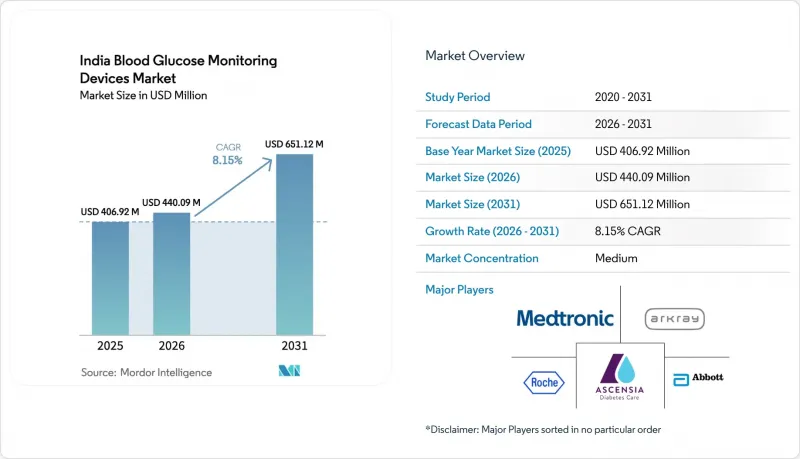
Mordor Intelligence에 의하면, 인도의 혈당 측정기 시장 규모는 2025년에 4억 692만 달러로 평가되었고, 2026년 4억 4,009만 달러에서 2031년까지 6억 5,112만 달러에 이를 것으로 예측되며, 예측 기간(2026-2031년) CAGR은 8.15%를 나타낼 전망입니다.
본 보고서는 제품 유형별(자가 혈당 측정(SMBG) 기기(혈당 측정기 등), 연속 혈당 모니터링 시스템(센서 및 내구 소비재)), 최종 사용자별(병원 및 클리닉, 재택치료, 진단센터), 유통 채널별(병원 약국, 소매 약국, 온라인 약국)로 분류되어 있습니다. 시장 예측은 금액(달러) 기준으로 제시되어 있습니다.
인도의 혈당 측정기 시장 동향 및 인사이트
당뇨병 유병률 증가 및 조기 검진
전국적인 선별 검사 캠페인을 통해 미진단 사례 2,500만-3,000만 건을 포함한 1억 명 이상의 대상자층이 파악되어, 인도의 혈당 측정기 시장의 모든 카테고리에 대한 수요를 끌어올리고 있습니다. 1차 의료시설에서의 선별 검사를 통해 10년 전보다 5-7년 더 빨리 질환이 발견됨에 따라, 환자 1인당 측정 기기에 대한 평생 수요 기간은 최대 30년에 달하게 되었습니다. 준도시 지역에서의 집중적인 선별 검사를 통해, 커넥티드 솔루션에 대한 친화도가 높은 젊은 층에서 측정 기기의 보급이 가속화되고 있습니다. 이러한 변화로 인해 조기 도입자들이 우수한 혈당 조절을 달성하고 장기적인 합병증 비용을 절감할 수 있게 됨에 따라, 정책 입안자들은 연속 혈당 모니터링에 대한 보험 적용을 지원하는 방향으로 나아가고 있습니다. 이러한 요인들이 복합적으로 작용하여 인도 혈당 측정기 시장의 예상 연평균 성장률(CAGR)을 2.0포인트 이상 끌어올리는 효과를 가져오고 있습니다.
‘Jan Aushadhi’ 매장을 통한 저렴한 SMBG 테스트 스트립의 급속한 보급
‘Jan Aushadhi’ 네트워크에서는 테스트 스트립을 브랜드 제품의 절반에서 10분의 1 가격으로 공급하고 있으며, 이를 통해 월간 모니터링 비용을 300-500루피로 절감하고 주당 평균 검사 빈도를 2배로 높이고 있습니다. 저렴한 가격의 소모품은 2022년 시점에서도 브랜드 혈당 측정기 보유율이 15% 미만이었던 2·3급 도시의 잠재적 수요를 자극하고 있습니다. 테스트 스트립 사용량 증가는 혈당 관리를 개선하고 기기 사용 유지율을 높이는 동시에, 가격에 민감한 이러한 시장을 위해 최적화된 가성비 뛰어난 혈당 측정기의 도입을 민간 제조업체들에게 촉진하고 있습니다. 테스트 스트립 수량의 급증은 인도 혈당 측정기 시장에 큰 긍정적 요인으로 작용하고 있으며, 이는 연평균 성장률(CAGR) 전망치 +1.8% 상향 조정에 반영되었습니다.
기존 혈당 측정기를 선호하는 의사의 처방 습관의 편차
일반 개업의는 당뇨병 관리의 70%를 담당하고 있지만, 1회 진료에 할당되는 시간은 고작 3-5분에 불과하여, 고도 모니터링 도구에 대한 논의가 제한되고 있습니다. 그 결과, 많은 의사가 의대 시절 처음 접했던 구형 혈당 측정기를 계속 처방하고 있습니다. 인구의 3분의 2를 담당하는 지방의 임상 의사들은 연속 혈당 모니터링 시스템에 관한 제조업체 교육 기회를 거의 받지 못해, CGM 보급을 지연시키는 브랜드에 대한 고집이 여전히 뿌리 깊게 남아 있습니다. 여러 의료 제공업체 간에 지침이 통일되지 않아 환자들은 혼란을 겪고 있으며, 최적의 검사 체계 준수율이 떨어지고 있습니다. 이러한 뿌리 깊은 보수적 태도로 인해 인도 혈당 측정기 시장의 예상 연평균 성장률(CAGR)은 약 1.4% 낮아졌습니다.
부문 분석
자가 혈당 측정(SMBG) 기기는 2025년 매출의 83.70%를 차지했습니다. 이는 주로 800-1,500 루피에 판매되고 Jan Aushadhi 매장을 통해 유통되는 저가 소모품으로 보충되는 측정기와 테스트 스트립 세트 덕분입니다. 테스트 스트립이 여전히 가장 큰 수익원인 이유는 새로운 측정기가 1대 도입될 때마다 소모품에 대한 지속적인 수요가 발생하기 때문입니다. 그러나 가격대가 낮아지고 임상 결과 데이터가 주류를 이루면서, 연속 혈당 모니터링(CGM) 센서는 연평균 성장률(CAGR) 8.78%로 시장 전체의 성장률을 상회하고 있습니다. 2026 회계연도까지월1,000루피의 국산 CGM 솔루션이 출시될 가능성이 있으며, 이로 인해 가격 경쟁력이 재정의되고 대규모 보급이 촉진될 수 있습니다.
SMBG의 사용자 기반은 꾸준히 확대되고 있습니다. 이는 2·3급 도시의 첫 구매자들이 여전히 저렴한 초기 비용과 간편한 조작을 중요시하기 때문입니다. 한편, 대도시권의 내분비 전문의들은 혈당 변동을 파악하고 야간 저혈당을 최소화할 수 있는 연속 혈당 모니터링 센서로 고위험 환자들을 전환시키고 있습니다. 국내에서 가격 인하가 실현된다면, 인도의 CGM 시장 규모는 2030년까지 2024년 수준에서 3배로 확대되어 SMBG의 점유율을 서서히 잠식해 나갈 가능성이 있습니다. 주요 브랜드들은 현재 두 카테고리의 기능 세트가 융합되고 있는 추세를 반영하여, 기존 혈당 측정기에 클라우드 대시보드를 결합함으로써 시장 내 입지를 지키려 하고 있습니다.
기타 혜택
- 엑셀 형식 시장 예측(ME) 시트
- 3개월간의 애널리스트 지원
자주 묻는 질문
목차
제1장 서론
제2장 조사 방법
제3장 주요 요약
제4장 시장 구도
제5장 시장 규모 및 성장 예측
제6장 경쟁 구도
제7장 시장 기회 및 향후 전망
AJY 26.09.15According to Mordor Intelligence, the India blood glucose monitoring devices market size was valued at USD 406.92 million in 2025 and estimated to grow from USD 440.09 million in 2026 to reach USD 651.12 million by 2031, at a CAGR of 8.15% during the forecast period (2026-2031).
This report is Segmented by Product Type (Self-Monitoring Blood Glucose Devices [Glucometer Devices, and More], Continuous Glucose Monitoring Systems [Sensors and Durables]), End User (Hospitals & Clinics, Home-Care Settings, Diagnostic Centers), Distribution Channel (Hospital Pharmacies, Retail Pharmacies, Online Pharmacies). The Market Forecasts are Provided in Terms of Value (USD).
India Blood Glucose Monitoring Devices Market Trends and Insights
Growing Diabetes Prevalence & Earlier Screening
National screening drives have identified an addressable base of more than 100 million people, including 25-30 million undiagnosed cases, lifting demand across all categories in the India blood glucose monitoring devices market. Screening at primary-care facilities now detects disease five to seven years earlier than a decade ago, stretching each patient's lifetime need for monitoring devices to as long as three decades. Intensive screening in semi-urban belts is accelerating device uptake among younger cohorts that show higher comfort with connected solutions. This shift is also guiding policymakers to support reimbursement for continuous monitoring because early adopters achieve superior glycemic control, lowering long-run complication costs. Collectively, these factors add more than +2.0 percentage points to the forecast CAGR of the India blood glucose monitoring devices market.
Rapid Penetration of Affordable SMBG Strips via Jan Aushadhi Stores
The Jan Aushadhi network supplies strips at half to one-tenth the branded price, cutting monthly monitoring outlay to INR 300-500 and doubling average weekly testing frequency. Affordable consumables are unlocking latent demand in Tier 2/3 cities where branded glucometer ownership languished below 15% as recently as 2022. Higher test-strip throughput improves glycemic control, reinforcing device stickiness and encouraging private manufacturers to introduce value-engineered meters tailored for these price-sensitive markets. The surge in strip volumes exerts significant positive pressure on the India blood glucose monitoring devices market, reflected in a +1.8% uplift to CAGR forecasts.
Fragmented Physician Rx Habits Favoring Legacy Glucometers
General practitioners deliver 70% of diabetes care but allocate only three to five minutes per visit, limiting discussion of advanced monitoring tools. As a result, many continue prescribing older glucometers they first encountered in medical school. Rural clinicians, serving two-thirds of the population, rarely receive manufacturer training on continuous systems, perpetuating brand inertia that slows CGM diffusion. Inconsistent guidance across multiple providers confuses patients and depresses adherence to optimal testing regimes. This entrenched conservatism removes roughly 1.4 percentage points from projected CAGR for the India blood glucose monitoring devices market.
Other drivers and restraints analyzed in the detailed report include:
- Widespread Adoption of Tele-diabetes Platforms Post-COVID-19
- GST Reductions on Essential Diabetes Devices
- Grey-Market Import of Low-Quality Strips Diluting Brand Trust
For complete list of drivers and restraints, kindly check the Table Of Contents.
Segment Analysis
Self-monitoring blood glucose devices generated 83.70% of 2025 revenue, primarily via meter-strip bundles sold at INR 800-1,500 and replenished with low-cost consumables distributed through Jan Aushadhi outlets. Test strips remain the largest contributor because each new reader drives recurring consumable demand. However, continuous glucose monitoring sensors outpace overall market growth at an 8.78% CAGR as price points fall and clinical outcome data becomes mainstream. The potential launch of a domestic INR 1,000/month CGM solution by FY26 could reset affordability and spur mass adoption.
The SMBG base maintains steady expansion because first-time buyers in Tier 2/3 cities continue to prefer upfront affordability and simple operation. Yet endocrinologists in metros are shifting high-risk patients to continuous sensors that capture glycemic variability and minimize nocturnal hypoglycemia. If domestic price compression materializes, the India blood glucose monitoring devices market size for CGM could triple its 2024 base by 2030, progressively eroding SMBG share. Leading brands now bundle cloud dashboards with traditional meters to defend position, reflecting the converging feature set between the two categories.
Complete Report Scope:
- By Product Type
- Self-Monitoring Blood Glucose (SMBG) Devices
- Glucometer Devices
- Test Strips
- Lancets
- Continuous Glucose Monitoring (CGM) Systems
- Sensors
- Durables (Receivers and Transmitters)
- Self-Monitoring Blood Glucose (SMBG) Devices
- By End User
- Hospitals & Clinics
- Home-Care Settings
- Diagnostic Centers
- By Distribution Channel
- Hospital Pharmacies
- Retail Pharmacies
- Online Pharmacies
List of Companies Covered in this Report:
- Abbott Laboratories
- Roche Diabetes Care AG
- Medtronic
- Dexcom
- Ascensia Diabetes Care Holdings AG
- Lifescan
- Arkray
- i-SENS Inc.
- Terumo
- Ypsomed
- SD Biosensor Inc.
- Nova Biomedical
- B. Braun
- Morepen Laboratories Ltd.
- Acon Laboratories
- Sinocare
- Mankind Pharma Ltd.
- Truworth Health Tech Pvt Ltd
Additional Benefits:
- The market estimate (ME) sheet in Excel format
- 3 months of analyst support
TABLE OF CONTENTS
1 Introduction
- 1.1 Study Assumptions & Market Definition
- 1.2 Scope of the Study
2 Research Methodology
3 Executive Summary
4 Market Landscape
- 4.1 Market Overview
- 4.2 Market Drivers
- 4.2.1 Growing diabetes prevalence & earlier screening
- 4.2.2 Rapid penetration of affordable SMBG strips via Jan Aushadhi stores
- 4.2.3 Widespread adoption of tele-diabetes platforms post-COVID-19
- 4.2.4 GST reductions on essential diabetes devices
- 4.2.5 Insurance regulator mandating CGM reimbursement
- 4.2.6 App-linked loyalty programs boosting test-strip adherence
- 4.3 Market Restraints
- 4.3.1 Fragmented physician Rx habits favouring legacy glucometers
- 4.3.2 Grey-market import of low-quality strips diluting brand trust
- 4.3.3 Low public-hospital budget for CGM procurement
- 4.3.4 Data-privacy concerns over cloud-linked monitoring apps
- 4.4 Value / Supply-Chain Analysis
- 4.5 Regulatory Landscape
- 4.6 Technological Outlook
- 4.7 Porter's Five Forces
- 4.7.1 Threat of New Entrants
- 4.7.2 Bargaining Power of Suppliers
- 4.7.3 Bargaining Power of Buyers
- 4.7.4 Threat of Substitute Products
- 4.7.5 Competitive Rivalry
5 Market Size & Growth Forecasts (Value, USD Million)
- 5.1 By Product Type
- 5.1.1 Self-Monitoring Blood Glucose (SMBG) Devices
- 5.1.1.1 Glucometer Devices
- 5.1.1.2 Test Strips
- 5.1.1.3 Lancets
- 5.1.2 Continuous Glucose Monitoring (CGM) Systems
- 5.1.2.1 Sensors
- 5.1.2.2 Durables (Receivers and Transmitters)
- 5.1.1 Self-Monitoring Blood Glucose (SMBG) Devices
- 5.2 By End User
- 5.2.1 Hospitals & Clinics
- 5.2.2 Home-Care Settings
- 5.2.3 Diagnostic Centers
- 5.3 By Distribution Channel
- 5.3.1 Hospital Pharmacies
- 5.3.2 Retail Pharmacies
- 5.3.3 Online Pharmacies
6 Competitive Landscape
- 6.1 Market Concentration
- 6.2 Market Share Analysis
- 6.3 Company Profiles (includes Global level Overview, Market level Overview, Core Segments, Financials as available, Strategic Information, Market Rank/Share for key companies, Products & Services, and Recent Developments)
- 6.3.1 Abbott Laboratories
- 6.3.2 Roche Diabetes Care AG
- 6.3.3 Medtronic plc
- 6.3.4 Dexcom Inc.
- 6.3.5 Ascensia Diabetes Care Holdings AG
- 6.3.6 LifeScan Inc.
- 6.3.7 Arkray Inc.
- 6.3.8 i-SENS Inc.
- 6.3.9 Terumo Corporation
- 6.3.10 Ypsomed Holding AG
- 6.3.11 SD Biosensor Inc.
- 6.3.12 Nova Biomedical
- 6.3.13 B. Braun Melsungen AG
- 6.3.14 Morepen Laboratories Ltd.
- 6.3.15 ACON Laboratories Inc.
- 6.3.16 Sinocare Inc.
- 6.3.17 Mankind Pharma Ltd.
- 6.3.18 Truworth Health Tech Pvt Ltd
7 Market Opportunities & Future Outlook
- 7.1 White-space & Unmet-Need Assessment