

|
시장보고서
상품코드
2099958
산업용 및 IoT 애플리케이션용 DRAM 시장 : 시장 점유율 분석, 업계 동향 및 통계, 성장 예측(2026-2031년)DRAM For Industrial and IoT Applications - Market Share Analysis, Industry Trends & Statistics, Growth Forecasts (2026 - 2031) |
||||||
 Mordor Intelligence
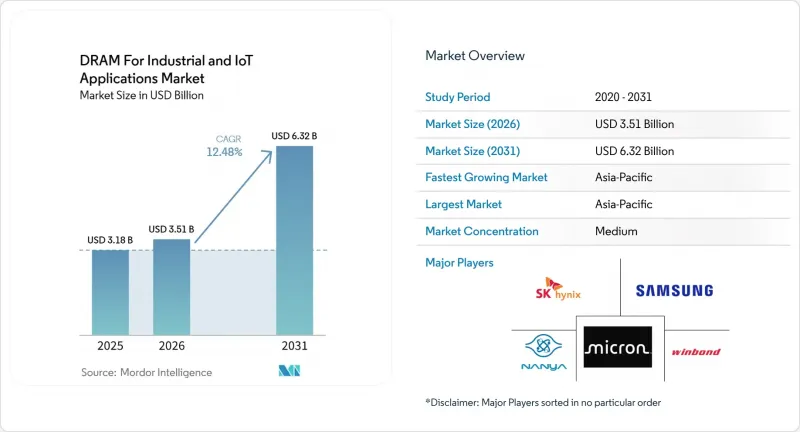
Mordor Intelligence에 의하면, 산업용 및 IoT 애플리케이션용 DRAM 시장 규모는 2025년에 31억 8,000만 달러로 평가되었고, 2026년 35억 1,000만 달러에서 2031년까지 63억 2,000만 달러에 이를 것으로 예측되며, 2026-2031년 CAGR 12.48%로 성장할 전망입니다.
본 보고서는 아키텍처별(DDR3, DDR4, DDR5 등), 공정 노드별(20 nm 이상, 19 nm-10 nm 등), 용량별(4GB-8 GB, 8 GB-16GB 등), 최종 용도별(산업용 PC 및 컨트롤러, 산업용 자동화 시스템 등), 그리고 지역별(북미, 아시아태평양 등)로 분류되어 있습니다. 시장 전망은 금액(달러) 기준으로 제시되어 있습니다.
세계의 산업용 및 IoT 애플리케이션용 DRAM 시장 동향 및 인사이트
증가하는 산업용 엣지 AI 워크로드
산업용 및 IoT 애플리케이션용 DRAM 시장은 AI 추론 워크로드가 중앙 집중식 서버에서 공장 현장에 설치된 장비로 이동함에 따라 직접적인 호재를 받고 있습니다. 스마트 카메라, 검사 스테이션, 로봇 컨트롤러, 산업용 게이트웨이는 현재 더 많은 데이터를 로컬에서 처리하게 되면서, 연산 능력의 한계에 도달하기도 전에 메모리 대역폭 요구 사항이 높아지고 있습니다. 엣지 AI 및 비전 얼라이언스(Edge AI and Vision Alliance)는 감지, 추적, 세분화을 수행하는 멀티 카메라 워크로드에서 신경망 처리 리소스가 완전히 활용되기도 전에 LPDDR5X의 대역폭 예산이 고갈될 가능성이 있다고 지적하고 있습니다. 또한 NVIDIA는 풀 DRAM ECC를 탑재한 약 128GB의 LPDDR5X 및 273GB/s의 대역폭을 특징으로 하는 산업용 플랫폼 ‘IGX Thor’를 선보이며, 로봇 공학, 의료, 공장 자동화 환경에서 메모리가 시스템 설계의 핵심 요소로 자리 잡고 있음을 강조하고 있습니다. 또한, 같은 업계 소식통은 엣지 AI 용도 전반에 걸쳐 LPDDR4X 및 LPDDR5X공급 부족이 지속되고 있다고 설명하며, 메모리가 단순한 BOM(부품표) 항목이 아닌, 제약이 있는 생산 투입 재료로 취급되는 경향이 강해지고 있음을 시사하고 있습니다. 이러한 추세가 확산됨에 따라, 산업용 및 IoT 애플리케이션용 DRAM 시장에서는 단순히 용량만으로 메모리를 판매하는 것이 아니라, 대역폭, ECC 보호 및 공급 보장을 통합적으로 제공할 수 있는 공급업체가 우위를 점할 가능성이 높습니다.
저전력 DDR5 및 LPDDR5X 모듈의 신속한 인증
또한, 산업용 및 IoT 애플리케이션용 DRAM 시장은 임베디드 시스템 및 내환경 시스템용 DDR5 및 LPDDR5X 모듈의 인증 절차가 가속화됨에 따라 더욱 탄력을 받고 있습니다. Innodisk는 2025년 8월, 최대 8,533 MT/s의 속도, SO-DIMM보다 60% 작은 실적, 산업용, 운송용, 항공우주 이용 사례에서 내진동을 확보하기 위한 나사 잠금식 장착 방식을 갖춘 DDR5 CAMM2 및 LPDDR5X CAMM2 모듈을 발표했습니다. 어드밴텍은 2026년 3월, 이러한 흐름을 더욱 가속화하여 스마트 시티, 국방, 산업 자동화용 SQRAM DDR5 7,200 MT/s 시리즈를 발표했습니다. 이 시리즈는 64GB의 용량과 -25°C-95°C의 작동 온도 범위를 갖추고 있습니다. 그 후, JEDEC은 2025년 10월에 JESD400-5D 버전 1.4 업데이트를 공개하여, 최대 9,200 MT/s의 DDR5 속도 지원을 추가하는 한편, 산업용 검증 프로그램이 장기적인 제품 주기로 전환하기 전에 필요로 하는 SOCAMM2 폼 팩터를 공식적으로 규정했습니다. 이를 통해 주류 메모리 세대와 산업 분야에서의 채택 사이에 기존에 존재하던 시차(타임 래그)가 단축됩니다. 또한, 여러 폼 팩터에 걸친 산업용 기계적·열적·신뢰성 요건에 대한 제품 검증 방법을 이미 숙지하고 있는 공급업체의 입지도 강화될 것입니다.
DRAM 가격의 주기성과 할당 리스크
산업용 및 IoT 애플리케이션용 DRAM 시장은 여전히 공급 부족과 불안정한 조달 상황으로 인한 명백한 제약에 직면해 있습니다. 이 문제는 더 이상 단순한 일반적인 메모리 주기에 그치지 않습니다. 제조업체들은 더 높은 수익을 가져다주는 AI 시대의 제품에 전략적 중점을 더욱 두고 있기 때문입니다. Samsung Electronics는 2026년 2월 HBM4의 상용 출하를 시작하며, 2026년에는 HBM 매출이 3배 이상 증가할 것으로 전망한다고 발표했습니다. 이는 프리미엄 생산 역량이 어디로 향하고 있는지를 보여줍니다. SK하이닉스도 2026년 6월에 12층 HBM4E 샘플을 출하하며, 고성능 컴퓨팅 수요에 부응하기 위해 더 높은 데이터 처리 속도와 뛰어난 전력 효율을 강조했습니다. 최첨단 웨이퍼가 이러한 제품에 우선적으로 배정됨에 따라, 산업용 구매자들은 자사 수요가 안정적이라 하더라도 표준 DDR4나 DDR5 자원에 대한 접근이 더욱 어려워질 것입니다. 이로 인해 가격, 리드타임 및 할당 리스크가 산업용 및 IoT 애플리케이션용 DRAM 시장에서 특히 장기 공급 계약을 체결하지 않은 구매자들에게 지속적인 제약 요인으로 작용하고 있습니다.
부문 분석
2025년 시점에서 산업용 및 IoT 애플리케이션용 DRAM 시장에서 DDR4가 50.71%를 차지했으나, DDR5는 2031년까지 연평균 성장률(CAGR) 13.14%를 나타낼 것으로 예측됩니다. 이러한 출발점은 이전에 DDR4 인증 주기를 완료하고, 장기 서비스 계약 하에 현재도 생산이 계속되고 있는 산업용 시스템이 다수 존재함을 반영합니다. 산업용 및 IoT용 DRAM 시장은 DDR4에게 여전히 중요한 시장으로 남아 있습니다. 이는 공장 시스템, SCADA 플랫폼, 임베디드 컨트롤러가 일반 소비자용 제품의 교체 주기를 훨씬 뛰어넘어 계속 가동되는 경향이 있기 때문입니다. 한편, 새로운 설계에서는 대역폭, 효율성, 온다이 ECC가 엣지 AI 추론 및 보다 중앙 집중화된 제어 기능에 적합하기 때문에 DDR5의 채택이 점점 늘어나고 있습니다. JEDEC이 2024년 4월에 발표한 JESD79-5C 업데이트를 통해 차세대 컴퓨팅 환경에서 중요한 신뢰성, 보안 및 성능 기능이 추가되었으며, 산업용 프로그램에서 DDR5 채택을 위한 더욱 견고한 표준 기반이 확립되었습니다.
이러한 전환이 레거시 메모리가 곧 사라질 것을 의미하는 것은 아닙니다. DDR3는 재설계 비용을 정당화하기 여전히 어려운 구형 PLC, SCADA 및 낮은 연산 부하를 가진 제어 시스템에서 여전히 일정한 역할을 수행하고 있습니다. LPDDR의 변형 제품은 기존 DIMM 아키텍처가 실용적이지 않은 소형 게이트웨이, 팬리스 임베디드 시스템, 그리고 공간이 극도로 제한된 엣지 노드에서 점점 더 중요해지고 있습니다. 따라서 산업용 메모리 구매 담당자들은 성숙한 플랫폼을 유지하면서, 더 높은 처리량이 필요한 시스템을 위해 차세대 메모리의 인증을 추진하는 두 가지 접근 방식을 병행하고 있습니다. 산업용 및 IoT 애플리케이션용 DRAM 시장은 이러한 중복에 의해 형성되고 있습니다. 공급업체의 가치는 플랫폼의 완전한 교체를 강요하는 것이 아니라, 연속성과 전환을 모두 지원하는 데 달려 있기 때문입니다. DDR4, DDR5 및 저전력 포맷 전반에 걸쳐 규격 준수, 장기적인 공급 보장, 산업용 검증을 입증할 수 있는 기업이 이 아키텍처 전환 과정에서 가장 견고한 입지를 구축할 가능성이 높습니다.
2025년에는 19nm에서 10nm 노드 범위가 54.26%의 점유율을 차지했으나, 10nm 미만의 EUV는 2031년까지 연평균 성장률(CAGR) 12.68%로 확대될 것으로 예측됩니다. 이는 산업용 및 IoT 애플리케이션용 DRAM 시장이 광범위한 산업용 제품에서 비용, 수율, 인증 성숙도의 균형이 가장 잘 잡힌 노드 범위에 여전히 의존하고 있음을 뒷받침합니다. 신뢰성, 가용성 및 예측 가능한 조달이 주요 구매 기준인 많은 산업 용도의 경우, 최고 밀도가 필요하지 않기 때문에 성숙한 생산 체제가 여전히 중요합니다. 반면, 로봇 공학, 머신 비전, 하이엔드 엣지 서버의 메모리 탑재량이 급속히 증가함에 따라, 더 미세한 노드가 가져다주는 고밀도화와 대역폭 향상이 점점 더 필요해질 것입니다. SK하이닉스는 2025년 9월, 업계 최초로 고NA EUV 리소그래피 시스템을 조립하여 이를 차세대 DRAM 로드맵에 반영했습니다. 이는 미래의 고성능 메모리를 위한 제조거점이 현재 구축되고 있음을 보여줍니다.
구매자에게 있어 실질적인 의미는 메모리 집적도가 급속히 높아지고 있는 상황에서 첨단 노드가 가장 중요하다는 점입니다. 고대역폭 자동화 셀, 엣지 환경의 대규모 AI 모델, 그리고 멀티 센서가 탑재된 로봇 플랫폼은 10nm 미만의 제조 기술이 가져다주는 혜택을 가장 먼저 누릴 가능성이 높습니다. 반면, 저밀도 IoT 엔드포인트, 통신 모듈, 그리고 보수적인 제어 시스템은 더 오랜 기간 동안 구세대 노드에 계속 의존하게 될 것입니다. 따라서 산업용 및 IoT 애플리케이션용 DRAM 시장은 성숙한 노드에 의한 공급이 공급량의 안정성을 뒷받침하고, EUV 주도의 진전이 성능 확대를 뒷받침하는 양극화된 구조를 보이고 있습니다. 애플리케이션의 기반이 다양하기 때문에 시장 전체에서 급격한 전환이 일어날 가능성은 낮습니다. 또한 이는 가장 매력적인 기회가 단순한 소폭의 기술적 업그레이드가 아니라, 첨단 노드를 통해 ‘와트당 대역폭’이나 ‘기판당 밀도’ 측면에서 눈에 띄는 개선을 가져오는 부문에 집중되어 있음을 의미합니다.
지역별 분석
아시아태평양은 2025년 산업용 및 IoT용 DRAM 시장의 46.53%를 차지했으며, 2031년까지 연평균 성장률(CAGR) 13.19%를 나타낼 것으로 예측됩니다. 이 지역이 주도적인 위치를 차지하고 있는 것은 중국, 일본, 한국, 대만의 대규모 제조 능력과 긴밀하게 연계된 산업용 OEM 생태계가 결합되어 있기 때문입니다. 이러한 조합 덕분에 아시아태평양은 공급 측면의 강점뿐만 아니라 자동화, 전자기기 제조, 임베디드 시스템 분야의 대규모 기존 수요 기반도 동시에 확보하고 있습니다. 한국은 특히 중요한 위치를 계속 차지하고 있습니다. 이는 삼성과 SK하이닉스가 2026년 7월, 충청 지역에 HBM 제조 및 첨단 패키징 시설을 포함한 새로운 반도체 클러스터 건설에 392조 원(252억 5,000만 달러)을 투자하기로 결정했기 때문입니다. 이 투자는 AI 시대의 메모리와 밀접한 관련이 있지만, 그 규모가 워낙 크기 때문에 산업용 및 IoT용 DRAM 시장 전체를 뒷받침하는 해당 지역의 제조거점을 한층 더 강화할 것입니다.
북미에서는 수요 규모는 작지만, 보다 하이엔드적인 수요 특성을 보입니다. 항공우주 및 방위용 전자기기, 반도체 제조 장비, 첨단 의료기기, 석유 및 가스 분야의 자동화 시스템 등은 모두 일반 소비자용 전자기기보다 엄격한 인증 기준, 폭넓은 열 설계 대응, 그리고 더 높은 문서화 기준이 요구됩니다. 2026년 1월 15일에 공식 발효된 BIS 규정은 첨단 반도체의 라이선싱 조건을 변경하여, 중국으로의 수출 시 보다 유연한 처리를 받기 위한 DRAM 총 대역폭 기준치를 6,500 GB/s 미만으로 설정했습니다. 이로 인해 메모리 조달 결정에 있어 규정 준수 측면의 새로운 요건이 추가되었습니다. 2026년 5월에 발표된 버지니아주 매나서스에 위치한 마이크론사의 제조 거점 확장은 미국의 산업 및 정부 관련 구매자들에게 국내 공급과 확실한 출처가 얼마나 중요해졌는지를 보여줍니다. 이로 인해 산업용 및 IoT 애플리케이션용 DRAM 시장에서 규정 준수 요건이 엄격한 프리미엄 조달에 있어 북미가 매우 중요한 역할을 담당하게 될 것입니다.
유럽은 여전히 독일, 프랑스, 북유럽 국가들을 중심으로 전개되고 있으며, 이 지역의 기계, 로봇, 정밀 제조 OEM 제조업체들은 산업용 기능 안전 및 환경 규제를 준수하는 데 필요한 메모리를 필요로 하고 있습니다. ‘세계 기타 지역’은 규모는 작지만, 석유 및 가스, 광업, 철도, 교통 시스템 분야의 자동화 수요로 인해 혜택을 보고 있습니다. 이러한 시장에서는 주로 성숙한 노드의 중간 밀도 구성이 소비되고 있으며, 주요 산업 경제국에 비해 차세대 메모리의 도입 속도는 완만한 경향을 보입니다. 모든 지역에서 산업용 및 IoT용 DRAM 시장은 첨단 노드의 생산 능력 집중과 안정적인 장기 공급을 요구하는 광범위한 산업 수요 사이의 구조적 격차에 의해 형성되고 있습니다.
기타 혜택 :
- 엑셀 형식 시장 예측(ME) 시트
- 3개월간의 애널리스트 지원
자주 묻는 질문
목차
제1장 서론
제2장 조사 방법
제3장 주요 요약
제4장 시장 구도
제5장 시장 규모 및 성장 예측
제6장 경쟁 구도
제7장 시장 기회 및 향후 전망
AJY 26.08.07According to Mordor Intelligence, the DRAM for industrial and IoT applications market size is projected to be USD 3.18 billion in 2025, USD 3.51 billion in 2026, and reach USD 6.32 billion by 2031, growing at a CAGR of 12.48% from 2026 to 2031.
This report is Segmented by Architecture (DDR3, DDR4, DDR5, and More), Technology Node (20 Nm and Above, 19 Nm To 10 Nm, and More), Capacity (4 GB To 8 GB, 8 GB To 16 GB, and More), End-Use Application (Industrial PCs and Controllers, Industrial Automation Systems, and More), and Geography (North America, Asia Pacific, and More). The Market Forecasts are Provided in Terms of Value (USD).
Global DRAM For Industrial and IoT Applications Market Trends and Insights
Rising Industrial Edge AI Workloads
The DRAM for industrial and IoT applications market is gaining direct support from the shift of AI inference workloads from centralized servers to equipment placed on factory floors. Smart cameras, inspection stations, robotics controllers, and industrial gateways now process more data locally, increasing memory bandwidth requirements even before compute limits are reached. The Edge AI and Vision Alliance noted that multi-camera workloads running detection, tracking, and segmentation can exhaust LPDDR5X bandwidth budgets before neural processing resources are fully used. NVIDIA also positioned its IGX Thor industrial platform around 128 GB of LPDDR5X and 273 GB/s of bandwidth with full DRAM ECC, underscoring how memory is becoming a core system design element in robotics, medical, and factory automation environments. The same industry source also described persistent undersupply of LPDDR4X and LPDDR5X across edge AI applications, indicating that memory is increasingly treated as a constrained production input rather than a routine bill-of-materials item. As this pattern spreads, the DRAM for industrial and IoT applications market is likely to reward suppliers that can offer bandwidth, ECC protection, and supply assurance together rather than selling memory only on capacity.
Fast Qualification of Low-Power DDR5 and LPDDR5X Modules
The DRAM for industrial and IoT applications market is also being boosted by faster qualification of DDR5 and LPDDR5X modules for embedded and rugged systems. Innodisk introduced DDR5 CAMM2 and LPDDR5X CAMM2 modules in August 2025 with speeds up to 8,533 MT/s, a footprint 60% smaller than SO-DIMM, and screw-lock mounting for vibration resistance in industrial, transportation, and aerospace use cases. Advantech extended that direction in March 2026 with its SQRAM DDR5 7,200 MT/s series, combining 64 GB capacity with an operating range of -25°C to 95°C for smart city, defense, and industrial automation deployments. JEDEC then published the JESD400-5D version 1.4 update in October 2025, adding support for DDR5 speeds up to 9,200 MT/s and formalizing the SOCAMM2 form factor that industrial validation programs need before committing to long product cycles. This reduces the historical lag between mainstream memory generations and industrial acceptance. It also strengthens the position of suppliers that already know how to validate products for industrial mechanical, thermal, and reliability requirements across multiple form factors.
DRAM Price Cyclicality and Allocation Risk
The DRAM for industrial and IoT applications market still faces clear restraints from allocation pressure and unstable procurement conditions. The issue is no longer just a normal memory cycle, because producers are placing greater strategic focus on AI-era products that deliver higher returns. Samsung began commercial HBM4 shipments in February 2026 and said HBM sales were expected to more than triple in 2026, which shows where premium capacity is being directed. SK hynix also shipped 12-layer HBM4E samples in June 2026 and emphasized higher data processing speeds and better power efficiency to meet the demand for high-performance computing. When advanced wafers favor those products, industrial buyers face tighter access to standard DDR4 and DDR5 resources, even if their own demand remains steady. This keeps pricing, lead times, and allocation risk as ongoing constraints for the DRAM market for industrial and IoT applications, especially for buyers without long-term supply agreements.
Other drivers and restraints analyzed in the detailed report include:
- Zonal and Domain Architectures in Industrial Automation
- CXL-Based Memory Expansion for Edge Servers
- Qualification and Reliability Burden for Harsh Environments
For complete list of drivers and restraints, kindly check the Table Of Contents.
Segment Analysis
DDR4 accounted for 50.71% of the DRAM for industrial and IoT applications market in 2025, while DDR5 is projected to grow at a 13.14% CAGR through 2031. That starting point reflects the large number of industrial systems that completed DDR4 qualification cycles earlier and are still in production with long service commitments. The DRAM for industrial and IoT applications market remains meaningful for DDR4 because factory systems, SCADA platforms, and embedded controllers typically remain active well beyond typical consumer replacement cycles. At the same time, newer designs are increasingly adopting DDR5 because bandwidth, efficiency, and on-die ECC are better aligned with edge AI inference and more centralized control functions. JEDEC's April 2024 JESD79-5C update gave industrial programs a firmer standards base for DDR5 adoption by adding reliability, security, and performance features that matter in next-generation compute environments.
This transition does not mean legacy memory disappears quickly. DDR3 still plays a residual role in older PLCs, SCADA, and low-compute control systems, where redesign costs remain hard to justify. LPDDR variants are becoming more relevant in compact gateways, fanless embedded systems, and tightly constrained edge nodes where conventional DIMM architectures are less practical. Industrial buyers are therefore running two tracks at once, maintaining mature platforms while qualifying newer memory generations for systems that need higher throughput. The DRAM for industrial and IoT applications market is shaped by that overlap because supplier value depends on supporting both continuity and migration rather than forcing a full platform break. Firms that can document standards compliance, long availability, and industrial validation across DDR4, DDR5, and low-power formats are likely to hold the strongest position in this architectural shift.
The 19 nm to 10 nm node range held a 54.26% share in 2025, while EUV below 10 nm is projected to expand at a 12.68% CAGR through 2031. This confirms that the DRAM for industrial and IoT applications market still relies on the node range that best balances cost, yield, and qualification maturity across a wide set of industrial products. Mature production remains important because many industrial applications do not need the highest densities if reliability, availability, and predictable sourcing are the main purchasing criteria. At the same time, faster memory content growth in robotics, machine vision, and high-end edge servers will increasingly need the density and bandwidth gains that come with smaller nodes. SK hynix assembled the industry's first High NA EUV lithography system in September 2025 and linked it to its next-generation DRAM roadmap, which shows how the manufacturing base for future high-performance memory is being built now.
The practical implication for buyers is that advanced nodes matter most when memory intensity is rising quickly. High-bandwidth automation cells, large AI models at the edge, and multi-sensor robotics platforms are likely to absorb the earliest benefits of sub-10 nm production. By contrast, low-density IoT endpoints, communication modules, and conservative control systems will continue to rely on older nodes for longer periods. The DRAM for industrial and IoT applications market, therefore, shows a split structure where mature-node supply supports volume stability and EUV-led advances support performance expansion. This reduces the chance of a sudden market-wide migration because the application base remains diverse. It also means the most attractive opportunities are concentrated in segments where advanced nodes unlock a visible improvement in bandwidth-per-watt or density-per-board rather than only a modest technical upgrade.
Complete Report Scope:
- By Architecture
- DDR2 and Earlier
- DDR3
- DDR4
- DDR5
- LPDDR
- Other Specialized DRAM
- By Technology Node
- 20 Nm and Above
- 19 Nm to 10 Nm
- Below 10 Nm EUV
- By Capacity
- 4 GB and Below
- 4 GB to 8 GB
- 8 GB to 16 GB
- 16 GB and Above
- By End-Use Application
- Industrial PCs and Controllers
- Industrial Automation Systems
- Industrial IoT Gateways and Edge Devices
- Robotics and Machine Vision
- Industrial Networking and Communication Equipment
- Other Industrial and IoT Applications
- By Geography
- North America
- Europe
- Asia Pacific
- China
- Japan
- South Korea
- Taiwan
- Rest of Asia Pacific
- Rest of the World
Geography Analysis
Asia-Pacific held 46.53% of the DRAM for industrial and IoT applications market in 2025 and is projected to grow at a 13.19% CAGR through 2031. The region leads because it combines major fabrication capacity with dense industrial OEM ecosystems in China, Japan, South Korea, and Taiwan. That mix gives Asia-Pacific both supply-side strength and a large installed demand base in automation, electronics manufacturing, and embedded systems. South Korea remains especially important because Samsung Electronics and SK hynix committed KRW 392 trillion (USD 252.5 billion) to a new semiconductor cluster in the Chungcheong region in July 2026, including HBM fabrication and advanced packaging facilities. Even though that investment is closely tied to AI-era memory, its scale reinforces the regional manufacturing base that underpins the broader DRAM for industrial and IoT applications market.
North America presents a smaller but more premium demand profile. Aerospace and defense electronics, semiconductor equipment, advanced medical devices, and oil and gas automation all require stronger qualification, broader thermal support, and higher documentation standards than mass-market electronics. The BIS rule formalized on January 15, 2026 changed export licensing conditions for advanced semiconductors and introduced a total DRAM bandwidth threshold below 6,500 GB/s for exports to China under more flexible treatment, which added a compliance layer to memory sourcing decisions. Micron's manufacturing expansion in Manassas, Virginia, announced in May 2026, shows how domestic supply and secure provenance have become more important for U.S. industrial and government-linked buyers. That gives North America an outsized role in premium, compliance-heavy purchasing within the DRAM for industrial and IoT applications market.
Europe remains centered on Germany, France, and the Nordic countries, where machinery, robotics, and precision manufacturing OEMs need memory that supports industrial functional safety and environmental compliance. The Rest of the World remains smaller, but still benefits from automation demand in oil and gas, mining, rail, and traffic systems. These markets mostly consume mature-node, mid-density configurations and tend to adopt newer memory generations more slowly than the largest industrial economies. Across all regions, the DRAM for industrial and IoT applications market is shaped by the same structural divide between advanced-node capacity concentration and broad industrial demand for stable long-lifecycle supply.
- Samsung Electronics Co., Ltd.
- SK hynix Inc.
- Micron Technology, Inc.
- Nanya Technology Corporation
- Winbond Electronics Corporation
- Apacer Technology Inc.
- ADATA Technology Co., Ltd.
- Innodisk Corporation
- Transcend Information, Inc.
- Kingston Technology Company, Inc.
- G.SKILL International Enterprise Co., Ltd.
- Rambus Inc.
- Renesas Electronics Corporation
- Super Micro Computer, Inc.
- Synology Inc.
- Elite Semiconductor Memory Technology Inc.
- Integrated Silicon Solution, Inc.
- Alliance Memory, Inc.
- GigaDevice Semiconductor Inc.
- ChangXin Memory Technologies, Inc.
Additional Benefits:
- The market estimate (ME) sheet in Excel format
- 3 months of analyst support
TABLE OF CONTENTS
1 INTRODUCTION
- 1.1 Study Assumptions and Market Definition
- 1.2 Scope of the Study
2 RESEARCH METHODOLOGY
3 EXECUTIVE SUMMARY
4 MARKET LANDSCAPE
- 4.1 Market Overview
- 4.2 Market Drivers
- 4.2.1 Rising Industrial Edge AI Workloads
- 4.2.2 Fast Qualification of Low-Power DDR5 and LPDDR5X Modules
- 4.2.3 Zonal And Domain Architectures in Industrial Automation
- 4.2.4 CXL Based Memory Expansion for Edge Servers
- 4.2.5 Ruggedized And Wide-Temperature Memory Adoption
- 4.2.6 Localization of Memory Supply Chains for Industrial OEMs
- 4.3 Market Restraints
- 4.3.1 DRAM Price Cyclicality And Allocation Risk
- 4.3.2 Qualification And Reliability Burden for Harsh Environments
- 4.3.3 Export Controls And Customer Vetting on High-End Memory
- 4.3.4 Legacy Industrial Platforms Lock In DDR3 And Low-Density SKUs
- 4.4 Industry Supply Chain Analysis
- 4.5 Regulatory Landscape
- 4.6 Technological Outlook
- 4.7 Impact of Macroeconomic Factors on the Market
- 4.8 Porter's Five Forces Analysis
- 4.8.1 Threat of New Entrants
- 4.8.2 Bargaining Power of Suppliers
- 4.8.3 Bargaining Power of Buyers
- 4.8.4 Threat of Substitutes
- 4.8.5 Intensity of Competitive Rivalry
5 MARKET SIZE AND GROWTH FORECASTS (VALUE)
- 5.1 By Architecture
- 5.1.1 DDR2 and Earlier
- 5.1.2 DDR3
- 5.1.3 DDR4
- 5.1.4 DDR5
- 5.1.5 LPDDR
- 5.1.6 Other Specialized DRAM
- 5.2 By Technology Node
- 5.2.1 20 Nm and Above
- 5.2.2 19 Nm to 10 Nm
- 5.2.3 Below 10 Nm EUV
- 5.3 By Capacity
- 5.3.1 4 GB and Below
- 5.3.2 4 GB to 8 GB
- 5.3.3 8 GB to 16 GB
- 5.3.4 16 GB and Above
- 5.4 By End-Use Application
- 5.4.1 Industrial PCs and Controllers
- 5.4.2 Industrial Automation Systems
- 5.4.3 Industrial IoT Gateways and Edge Devices
- 5.4.4 Robotics and Machine Vision
- 5.4.5 Industrial Networking and Communication Equipment
- 5.4.6 Other Industrial and IoT Applications
- 5.5 By Geography
- 5.5.1 North America
- 5.5.2 Europe
- 5.5.3 Asia Pacific
- 5.5.3.1 China
- 5.5.3.2 Japan
- 5.5.3.3 South Korea
- 5.5.3.4 Taiwan
- 5.5.3.5 Rest of Asia Pacific
- 5.5.4 Rest of the World
6 COMPETITIVE LANDSCAPE
- 6.1 Market Concentration
- 6.2 Strategic Moves
- 6.3 Market Share Analysis
- 6.4 Company Profiles (includes Global Level Overview, Market Level Overview, Core Segments, Financials as available, Strategic Information, Products and Services, Recent Developments)
- 6.4.1 Samsung Electronics Co., Ltd.
- 6.4.2 SK hynix Inc.
- 6.4.3 Micron Technology, Inc.
- 6.4.4 Nanya Technology Corporation
- 6.4.5 Winbond Electronics Corporation
- 6.4.6 Apacer Technology Inc.
- 6.4.7 ADATA Technology Co., Ltd.
- 6.4.8 Innodisk Corporation
- 6.4.9 Transcend Information, Inc.
- 6.4.10 Kingston Technology Company, Inc.
- 6.4.11 G.SKILL International Enterprise Co., Ltd.
- 6.4.12 Rambus Inc.
- 6.4.13 Renesas Electronics Corporation
- 6.4.14 Super Micro Computer, Inc.
- 6.4.15 Synology Inc.
- 6.4.16 Elite Semiconductor Memory Technology Inc.
- 6.4.17 Integrated Silicon Solution, Inc.
- 6.4.18 Alliance Memory, Inc.
- 6.4.19 GigaDevice Semiconductor Inc.
- 6.4.20 ChangXin Memory Technologies, Inc.
7 MARKET OPPORTUNITIES AND FUTURE OUTLOOK
- 7.1 White-Space and Unmet-Need Assessment


