

|
시장보고서
상품코드
2099968
모바일 애플리케이션 관리(MAM) 소프트웨어 시장 : 시장 점유율 분석, 업계 동향 및 통계, 성장 예측(2026-2031년)Mobile Application Management (MAM) Software - Market Share Analysis, Industry Trends & Statistics, Growth Forecasts (2026 - 2031) |
||||||
 Mordor Intelligence
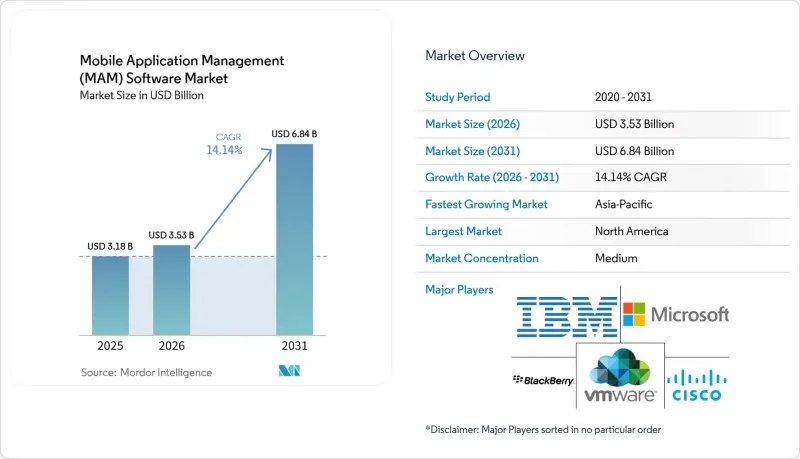
Mordor Intelligence에 의하면, 모바일 애플리케이션 관리(MAM) 소프트웨어 시장 규모는 2025년에 31억 8,000만 달러로 평가되었고, 2031년까지 68억 4,000만 달러에 이를 것으로 예측되며, 2026-2031년 CAGR 14.14%로 성장할 전망입니다.
본 보고서는 솔루션별(소프트웨어 및 서비스), 도입 형태별(클라우드 기반, 하이브리드형, 온프레미스형), 기업 규모별(대기업 및 중소기업), 최종 사용자별(IT 및 통신, 헬스케어 및 생명과학, 소매 및 전자상거래, 산업 제조 등) 및 지역별로 분류되어 있습니다. 시장 예측은 금액(달러)으로 표시되어 있습니다.
세계의 모바일 애플리케이션 관리(MAM) 소프트웨어 시장 동향 및 인사이트
하이브리드 업무 환경에서의 ‘클라우드 퍼스트’ 도입 수요
기업들이 재택, 사무실, 공유 업무 공간을 넘나드는 직원들을 지원하려고 함에 따라, 클라우드 관리형 엔드포인트 환경이 더욱 보편화되고 있습니다. 이러한 환경에서 모바일 애플리케이션 관리(MAM) 소프트웨어 시장은 확대되고 있습니다. 이는 기기의 완전한 등록이나 로컬 인프라 변경에 의존하지 않고도 앱 정책을 신속하게 업데이트할 수 있기 때문입니다. 마이크로소프트에 따르면, 미등록 기기를 위한 MAM은 개인용 기기나 BYOD(개인 기기 지참)에서 일반적으로 사용되며, 기기 전체를 등록하지 않고도 애플리케이션 내의 조직 데이터를 보호할 수 있습니다. 이 모델에서는 이메일, 파일, 협업 앱을 보호하는 동시에 개인 기기에 대한 통제는 기업 경계 밖으로 남겨두어 고용주와 직원 모두의 부담을 줄여줍니다. 또한, 모바일 기기는 기업 환경에서 필수적인 요소가 되었으며, 기업 소유 및 개인 소유 양쪽 시나리오 모두에서 통합적인 관리와 보호가 필요하다는 점도 지적되고 있습니다. 그 결과, 모바일 애플리케이션 관리(MAM) 소프트웨어 시장은 분산된 직원들에게 애플리케이션 계층을 가장 실용적인 제어 지점으로 간주하는 ‘클라우드 퍼스트’ 전략으로부터 계속해서 혜택을 받고 있습니다.
앱 수준의 데이터 유출 방지 요구 사항
비즈니스 데이터가 개인 소유 기기의 메시징 앱, 클라우드 드라이브, AI 도구를 통해 유통되기 시작함에 따라, 용도 수준의 데이터 유출 방지는 핵심 요건으로 부상했습니다. 이러한 변화는 모바일 애플리케이션 관리(MAM) 소프트웨어 시장을 견인하고 있습니다. 앱 제어를 통해 승인된 채널 외로 기밀 정보를 복사, 전송, 이동하는 것을 차단할 수 있기 때문입니다. 또한 앱 보호 정책을 통해 등록되지 않은 개인 소유 기기에서도 복사 및 붙여넣기 제어를 포함한 특정 앱 내 작업을 허용하거나 차단할 수 있다고 설명됩니다. 한 벤더는 2026년 7월, 네이티브 DLP, AI 사용 현황 가시화, 그리고 AI 애플리케이션, 웹 애플리케이션, 클라우드 서비스 간에 교환되는 데이터에 대한 통합된 정책 제어 기능을 갖추어 엔드포인트 플랫폼을 확장했습니다. 유럽에서는 NIS2 프레임워크에 따라 중요 부문 전반에 걸친 사이버 보안 의무가 확대되었으며, 보고 및 위험 관리 책임이 기업의 최우선 과제로 자리 잡았습니다. 이러한 데이터 유출 위험과 규정 준수 압박이 시너지를 일으키면서, 모바일 애플리케이션 관리(MAM) 소프트웨어 시장은 기업의 보안 계획에서 더욱 중요한 역할을 담당하게 되었습니다.
레거시 EMM 및 ID 스택과의 통합 과정에서 발생하는 마찰
많은 기업에서는 여전히 구식 엔터프라이즈 모빌리티 관리 환경, 레거시 인증서 설정, 중복된 ID 디렉터리를 사용하고 있어 신규 도입을 복잡하게 만들고 있습니다. 기업이 새로운 도구를 도입하는 속도가 해당 도구가 연결되어야 하는 시스템을 정리하고 정비하는 속도를 앞지르는 경우가 많기 때문에 모바일 애플리케이션 관리(MAM) 소프트웨어 시장의 성장이 둔화되고 있습니다. 2026년 3월에 발표된 Apple의 마이그레이션 기능은 데이터와 설정을 유지한 채 기기의 데이터를 삭제하지 않고도 조직이 MDM 플랫폼 간에 기기를 마이그레이션할 수 있게 해주는 것으로, 주목을 받았습니다. 이를 통해 마이그레이션의 부담은 일부 완화되지만, 기존의 정책 구조, 앱 래퍼 및 혼합된 사용자 레코드에 걸친 충돌을 완전히 해결하는 것은 아닙니다. 온프레미스 디렉터리와 클라우드 ID 도구가 여전히 중복되는 경우, 보안 팀은 이러한 종속 관계가 정리될 때까지 앱 정책의 전면적인 배포를 미루는 경우가 많습니다. 이러한 통합 지연은 모바일 애플리케이션 관리(MAM) 소프트웨어 시장의 더 빠른 확장을 가로막는 가장 뚜렷한 제약 요인 중 하나로 남아 있습니다.
부문 분석
2025년 모바일 애플리케이션 관리(MAM) 소프트웨어 시장에서 소프트웨어가 72.41%의 점유율을 차지했으며, 정책 엔진, 규정 준수 대시보드 및 SDK 라이브러리가 모든 도입에서 핵심적인 역할을 하고 있음이 부각되고 있습니다. 기업은 일반적으로 먼저 플랫폼을 구매한 후, 시간이 지남에 따라 그 주위에 워크플로우, 제어 기능, 보고 기능을 추가해 나가기 때문에 소프트웨어가 계속해서 가장 큰 점유율을 차지하고 있습니다. 대부분의 계약에서 소프트웨어 계층은 단일 인터페이스를 통해 앱 배포, 보호 규칙, 접근 제어 및 관리 가시성을 처리하므로 여전히 주요 지출 항목으로 남아 있습니다. 이러한 위상은 좁은 범위의 독립형 도구로 기능하기보다는 더 대규모의 엔드포인트 및 워크스페이스 프로그램 내에 통합될 수 있는 광범위한 플랫폼을 구매자가 선호하는 경향도 반영하고 있습니다. 모바일 애플리케이션 관리(MAM) 소프트웨어 시장이 성숙해짐에 따라, 구매자가 나중에 외부 컨설팅이나 관리형 지원으로 범위를 확장하더라도 소프트웨어는 계속해서 도입 기반의 토대가 되고 있습니다.
서비스 부문은 2031년까지 연평균 성장률(CAGR) 16.82%를 나타낼 것으로 예측되며, 이 부문에서 가장 빠르게 성장하는 분야가 될 전망입니다. 많은 조직에서 앱 정책 설정, ID 시스템 통합, 그리고 다양한 모바일 기기 전반에 걸친 규정 준수 규칙 유지에 필요한 내부 인력이 여전히 부족하기 때문에 성장이 가속화되고 있습니다. 앱 거버넌스의 기술적 복잡성이 높아짐에 따라, 점점 더 많은 구매자가 관리형 배포, 정책 미세 조정 및 지속적인 자문 지원을 요구하고 있습니다. 이러한 변화는 모바일 제어가 공식적인 보안 프로그램이나 감사 요건과 부합해야 하는 규제 대상 산업에서 서비스 파트너의 역할을 확대시키고 있습니다. 장기적으로는 모바일 애플리케이션 관리(MAM) 소프트웨어 시장이 소프트웨어 중심의 구조를 유지할 전망이지만, 조직이 보다 실무적인 도입 및 관리 지원을 요구함에 따라 수익 구성은 서비스 쪽으로 계속 이동할 것입니다.
2025년, 모바일 애플리케이션 관리(MAM) 소프트웨어 시장 규모의 68.19%를 클라우드 기반 도입이 차지했습니다. 이는 SaaS 제공에 따른 운영상의 용이성과 분산된 사용자 전체에 대한 신속한 대응 필요성에 힘입은 결과입니다. 클라우드 도입이 선호되는 이유는 정책 변경을 신속하게 반영할 수 있고, 용도 가시성을 유지하기 쉬우며, 클라우드 ID 환경과의 통합이 더 용이하기 때문입니다. 또한 이 모델은 조직이 스마트폰 전체를 관리하지 않고 앱과 데이터만 관리하고자 하는 ‘개인 소유 단말기 접근 모델’과도 잘 부합합니다. 등록되지 않은 단말기에서의 앱 보호 기능은 개인 소유 단말기에서 조직에 액세스할 때 Android, iOS, Windows 각 플랫폼에서 활용되고 있는 것으로 알려져 있습니다. 이러한 장점 덕분에 클라우드 모델은 모바일 애플리케이션 관리(MAM) 소프트웨어 시장의 여러 분야에서 기본적인 도입 출발점이 되고 있습니다.
하이브리드 배포는 2031년까지 연평균 성장률(CAGR) 15.43%를 나타낼 것으로 예측되며, 여전히 가장 빠르게 확대되고 있는 배포 모델입니다. 그 매력은 클라우드 기반 정책 관리를 원하면서도, 데이터의 소재지나 내부 규정 준수상의 이유로 온프레미스 제어 지점을 여전히 필요로 하는 업계에서 가장 강력하게 발휘됩니다. 엔드포인트 솔루션은 데이터 주권 및 규제 요건을 충족하기 위해 클라우드 관리형 배포와 온프레미스 제어를 모두 지원한다는 점이 지적되었습니다. 바로 이러한 균형이 모든 보안 관련 결정을 타사의 클라우드 환경으로 이전할 수 없는 기업 전반에서 하이브리드형에 대한 수요를 견인하고 있습니다. 완전한 온프레미스형 모델은 고립된 환경이나 규제가 엄격한 환경에서는 여전히 중요하지만, 운영 모델의 느린 속도로 인해 많은 분산형 팀에게는 매력이 떨어지는 것으로 여겨지고 있습니다. 그 결과, 모바일 애플리케이션 관리(MAM) 소프트웨어 시장에서 하이브리드 모델은 클라우드의 효율성과 관리 요건을 연결하는 실용적인 가교 역할을 하고 있습니다.
지역별 분석
2025년, 북미는 모바일 애플리케이션 관리(MAM) 소프트웨어 시장 점유율의 34.62%를 차지했으며, 지역별 1위를 유지했습니다. 이 지역은 기업용 소프트웨어 구매자가 밀집해 있고, 제로 트러스트 보안 모델 도입이 진행 중이며, 엔드포인트 및 ID 관리에 대한 지출이 높다는 점 등의 혜택을 누리고 있습니다. 금융, 의료, 기술 분야의 대기업들이 모바일 앱 거버넌스를 디지털 보안의 필수 요소로 계속 인식하고 있기 때문에 미국은 여전히 가장 큰 기여국으로 남아 있습니다. 캐나다 역시 금융 기관 및 기타 규제 대상 조직이 모바일 리스크 감시를 강화하고 업무용 애플리케이션에 대한 관리를 엄격히 하고 있어 지역 수요에 기여하고 있습니다. 이러한 성숙한 구매층과 꾸준한 규정 준수 압박이 결합되어 북미는 모바일 애플리케이션 관리(MAM) 소프트웨어 시장에서 계속해서 선두를 유지하고 있습니다.
아시아태평양은 2031년까지 연평균 성장률(CAGR) 17.83%를 나타낼 것으로 예측되어 가장 빠르게 성장하는 지역 부문으로 자리매김하고 있습니다. 인도는 기술 서비스 기업과 은행을 중심으로 기업 내 스마트폰 사용 및 BYOD(개인 소유 기기의 업무용 활용) 프로그램이 확대됨에 따라 주요 성장 동력이 되고 있습니다. 한국에서는 전 세계에 분산된 직원들에게 일관된 모바일 앱 정책을 필요로 하는 대형 대기업들 수요가 나타나고 있습니다. 동남아시아에서는 클라우드 제공 비용의 하락, 5G 커버리지 확대, 그리고 인도네시아, 베트남, 태국의 정부 디지털화 프로그램이 비즈니스 모빌리티 도입을 뒷받침하고 있어, 도입을 위한 새로운 여지가 생겨나고 있습니다. 중국은 데이터 현지화 규제로 인해 국내 호스팅이나 하이브리드 배포 모델을 우선시하고 있어, 다른 길을 걷고 있습니다. 한편, 일본에서는 보다 유연한 근무 방식에 대한 수요가 높아지고 있으며, 국내 데이터 처리를 선호하는 경향이 나타나고 있습니다.
유럽은 2025년 지역별 점유율에서 2위를 차지했으며, 계속해서 규정 준수를 중심으로 한 도입이 원동력이 되고 있습니다. NIS2 지침에 따라 18개 주요 부문에 걸친 사이버 보안 의무가 확대되었으며, 회원국들은 2024년 10월까지 이 프레임워크를 국내법에 반영해야 합니다. 독일, 영국, 프랑스는 해당 지역에서 가장 큰 국가별 시장이며, 금융 서비스, 제조업, 공공 부문에서 활발한 움직임이 관찰됩니다. 남미, 중동 및 아프리카는 여전히 초기 단계에 있는 지역이지만, 개인정보 보호법 및 광범위한 디지털 이니셔티브로 인해 모바일 기기의 용도 계층에서 제어의 필요성이 높아짐에 따라 수요가 확대되고 있습니다.
기타 혜택 :
- 엑셀 형식 시장 예측(ME) 시트
- 3개월간의 애널리스트 지원
자주 묻는 질문
목차
제1장 서론
제2장 조사 방법
제3장 주요 요약
제4장 시장 구도
제5장 시장 규모 및 성장 예측
제6장 경쟁 구도
제7장 시장 기회 및 향후 전망
AJY 26.08.07According to Mordor Intelligence, the mobile application management (MAM) software market size was USD 3.18 billion in 2025 and is forecast to reach USD 6.84 billion by 2031, growing at a CAGR of 14.14% from 2026 to 2031.
This report is Segmented by Solution (Software, and Services), Deployment (Cloud-Based, Hybrid, and On-Premises), Enterprise Size (Large Enterprises, and Small and Medium Enterprises), End User (IT and Telecommunication, Healthcare and Life Sciences, Retail and E-Commerce, Industrial Manufacturing, and More), and Geography. The Market Forecasts are Provided in Terms of Value (USD).
Global Mobile Application Management (MAM) Software Market Trends and Insights
Cloud-First Rollout Demand Across Hybrid Workforces
Cloud-managed endpoint environments became more common as enterprises tried to support workers across homes, offices, and shared workspaces. In that setting, the Mobile Application Management (MAM) Software Market is gaining because app policies can be updated quickly without depending on full device enrollment or local infrastructure changes. Microsoft states that MAM for unenrolled devices is commonly used for personal or BYOD devices and can protect organizational data inside applications without enrolling the full device. This model reduces friction for employers and employees by protecting email, files, and collaboration apps while leaving personal device control outside the enterprise boundary. It is also noted that mobile devices have become a permanent part of enterprise environments and need centralized management and protection across both corporate-owned and personally owned scenarios. As a result, the Mobile Application Management (MAM) Software Market continues to benefit from cloud-first programs that treat the application layer as the most practical control point for distributed workforces.
App-Level Data Loss Prevention Requirements
Application-level data loss prevention moved closer to a core requirement as business data began flowing through messaging apps, cloud drives, and AI tools on personal devices. This shift is supporting the Mobile Application Management (MAM) Software Market because app controls can block copying, forwarding, or moving sensitive information outside approved channels. It is explained that app protection policies can allow or block specific in-app actions, including copy-and-paste controls, on unenrolled personal devices. One vendor expanded its endpoint platform in July 2026 with native DLP, AI usage visibility, and centralized policy controls for data exchanged with AI applications, web applications, and cloud services. In Europe, the NIS2 framework widened cybersecurity obligations across critical sectors and kept reporting and risk management duties high on enterprise agendas. That combination of data exposure risk and compliance pressure is giving the Mobile Application Management (MAM) Software Market a stronger role in enterprise security planning.
Integration Friction with Legacy EMM and Identity Stacks
Many enterprises still use older enterprise mobility management environments, legacy certificate setups, and overlapping identity directories, which complicate new rollouts. This slows the Mobile Application Management (MAM) Software Market because companies often buy modern tools faster than they can clean up the systems that those tools must connect with. A March 2026 Apple migration feature was highlighted that lets organizations move devices between MDM platforms without wiping the device, while retaining data and configurations. That reduces part of the switching burden, but it does not fully solve conflicts across older policy structures, app wrappers, and mixed user records. Where on-premises directories and cloud identity tools still overlap, security teams often delay full app policy rollout until those dependencies are sorted. This integration drag remains one of the clearest restraints on faster expansion in the Mobile Application Management (MAM) Software Market.
Other drivers and restraints analyzed in the detailed report include:
- Zero Trust Policy Enforcement for Managed Apps
- App Containerization and Sandboxing Adoption
- Policy Drift Across Multiple Mobile Operating System Versions
For complete list of drivers and restraints, kindly check the Table Of Contents.
Segment Analysis
Software held 72.41% of the Mobile Application Management (MAM) Software Market share in 2025, underscoring the centrality of policy engines, compliance dashboards, and SDK libraries to every deployment. The largest share remained with software because enterprises usually buy a platform first, then add workflows, controls, and reporting around it over time. In most contracts, the software layer remains the primary spending center because it handles app distribution, protection rules, access controls, and administrative visibility through a single interface. That position also reflects buyer preference for broad platforms that can sit inside larger endpoint and workspace programs rather than operate as narrow standalone tools. As the Mobile Application Management (MAM) Software Market matures, software continues to anchor the installed base even when buyers later expand into outside consulting or managed support.
Services are projected to grow at a 16.82% CAGR through 2031, making them the fastest-growing part of this segment. Growth is picking up because many organizations still lack the in-house staff needed to configure app policies, integrate identity systems, and maintain compliance rules across mixed mobile fleets. The rising technical depth of app governance is pushing more buyers toward managed deployment, policy tuning, and ongoing advisory support. This shift is also widening the role of service partners in regulated sectors, where mobile controls must align with formal security programs and audit expectations. Over time, the Mobile Application Management (MAM) Software Market is likely to maintain its software-heavy structure, but the revenue mix should continue to shift toward services as organizations seek more hands-on implementation and management support.
Cloud-based deployment accounted for 68.19% of the Mobile Application Management (MAM) Software Market size in 2025, supported by the operational ease of SaaS delivery and the need for faster response across distributed users. Cloud deployment is favored because policy changes can be pushed quickly, application visibility is easier to maintain, and integration with cloud identity environments is more straightforward. It also aligns well with personal-device access models, where organizations want to manage the app and data without taking control of the whole phone. It is stated that app protection on unenrolled devices is used across Android, iOS, and Windows for organizational access on personal devices. These advantages have helped the cloud model become the default starting point in much of the Mobile Application Management (MAM) Software Market.
Hybrid deployment is projected to grow at a 15.43% CAGR through 2031 and remains the fastest-expanding deployment model. The appeal is strongest in sectors that want cloud-based policy administration but still need on-premises control points for data residency or internal compliance reasons. It was noted that an endpoint offering supports both cloud-managed deployments and on-premises control to meet data sovereignty and regulatory needs. That same balance is driving hybrid demand across enterprises that cannot move every security decision into a third-party cloud environment. Fully on-premises models still matter in isolated or highly restricted settings, but their slower operating model makes them less attractive for many distributed teams. As a result, the Mobile Application Management (MAM) Software Market is seeing hybrid become the practical bridge between cloud efficiency and control requirements.
Complete Report Scope:
- By Solution
- Software
- Services
- By Deployment
- Cloud-Based
- Hybrid
- On-Premises
- By Enterprise Size
- Large Enterprises
- Small and Medium Enterprises
- By End User
- IT and Telecommunication
- BFSI
- Healthcare and Life Sciences
- Retail and E-Commerce
- Industrial Manufacturing
- Education and Research Institutions
- Media and Entertainment
- Government and administration
- Energy and Utilities
- Other end-user industries
- By Geography
- North America
- United States
- Canada
- Mexico
- South America
- Brazil
- Argentina
- Rest of South America
- Europe
- Germany
- United Kingdom
- France
- Russia
- Spain
- Rest of Europe
- Asia-Pacific
- China
- Japan
- India
- South Korea
- Southeast Asia
- Rest of Asia-Pacific
- Middle East and Africa
- Middle East
- Saudi Arabia
- United Arab Emirates
- Turkey
- Rest of Middle East
- Africa
- South Africa
- Nigeria
- Egypt
- Rest of Africa
- Middle East
- North America
Geography Analysis
North America held 34.62% of the Mobile Application Management (MAM) Software Market share in 2025, maintaining its leading regional position. The region benefits from a dense base of enterprise software buyers, stronger adoption of zero-trust security models, and higher spending on endpoint and identity management. The United States remains the largest national contributor because large enterprises in finance, healthcare, and technology continue to treat mobile app governance as a necessary part of digital security. Canada is also contributing to regional demand as financial institutions and other regulated organizations tighten mobile risk oversight and strengthen controls around work applications. This combination of mature buyers and steady compliance pressure kept North America ahead in the Mobile Application Management (MAM) Software Market.
Asia-Pacific is projected to grow at a 17.83% CAGR through 2031, which makes it the fastest-growing regional segment. India is a major growth engine because enterprise smartphone use and BYOD programs are expanding across technology services firms and banks. South Korea is seeing demand from large conglomerates that need consistent mobile app policies across globally distributed workforces. Southeast Asia is opening new room for adoption as cloud delivery costs ease, 5G coverage expands, and government digitization programs improve the case for business mobility in Indonesia, Vietnam, and Thailand. China follows a different path because data localization rules favor local hosting and hybrid deployment models, while Japan is seeing stronger demand for more flexible work arrangements and a preference for local data-handling practices.
Europe held the second-largest regional share in 2025 and remains driven by compliance-led adoption. The NIS2 Directive widened cybersecurity obligations across 18 critical sectors and required member states to transpose the framework into national law by October 2024. Germany, the United Kingdom, and France are the region's largest country markets, with stronger activity in financial services, manufacturing, and the public sector. South America, the Middle East, and Africa remain early-stage regions, but demand is improving as privacy laws and broader digital initiatives heighten the need for application-layer controls on mobile devices.
- Microsoft Corporation
- VMware, Inc.
- Cisco Systems, Inc.
- Cloud Software Group
- Ivanti Neurons for MDM
- ManageEngine
- 42Gears SureMDM
- Amazon Web Services, Inc.
- Oracle Corporation
- SAP SE
- IBM Corporation
- ProMobi Technologies
- BlackBerry Limited
- Tangoe
- NinjaOne
- Jamf Pro
- Codeproof Technologies
- SOTI MobiControl
- Anysphere, Inc.
- Jamf Pro
Additional Benefits:
- The market estimate (ME) sheet in Excel format
- 3 months of analyst support
TABLE OF CONTENTS
1 INTRODUCTION
- 1.1 Study Assumptions and Market Definition
- 1.2 Scope of the Study
2 RESEARCH METHODOLOGY
3 EXECUTIVE SUMMARY
4 MARKET LANDSCAPE
- 4.1 Market Overview
- 4.2 Market Drivers
- 4.2.1 Cloud-First Rollout Demand Across Hybrid Workforces
- 4.2.2 App-Level Data Loss Prevention Requirements
- 4.2.3 Zero Trust Policy Enforcement For Managed Apps
- 4.2.4 App Containerization And Sandboxing Adoption
- 4.2.5 FinOps Pressure To Consolidate Endpoint And App Control Stacks
- 4.2.6 Mobile Privilege Segregation For Contractor And Frontline Access
- 4.3 Market Restraints
- 4.3.1 Integration Friction With Legacy EMM And Identity Stacks
- 4.3.2 Policy Drift Across Multiple Mobile Operating System Versions
- 4.3.3 Limited Security Budget Ownership Outside Central IT
- 4.3.4 App Wrapping And SDK Maintenance Overhead For In-House Apps
- 4.4 Impact of Macroeconomic Factors on the Market
- 4.5 Industry Value Chain Analysis
- 4.6 Technology Outlook
- 4.7 Regulatory Landscape
- 4.8 Porter's Five Forces Analysis
- 4.8.1 Threat of New Entrants
- 4.8.2 Bargaining Power of Suppliers
- 4.8.3 Bargaining Power of Buyers
- 4.8.4 Threat of Substitutes
- 4.8.5 Intensity of Competitive Rivalry
5 MARKET SIZE AND GROWTH FORECASTS (VALUE)
- 5.1 By Solution
- 5.1.1 Software
- 5.1.2 Services
- 5.2 By Deployment
- 5.2.1 Cloud-Based
- 5.2.2 Hybrid
- 5.2.3 On-Premises
- 5.3 By Enterprise Size
- 5.3.1 Large Enterprises
- 5.3.2 Small and Medium Enterprises
- 5.4 By End User
- 5.4.1 IT and Telecommunication
- 5.4.2 BFSI
- 5.4.3 Healthcare and Life Sciences
- 5.4.4 Retail and E-Commerce
- 5.4.5 Industrial Manufacturing
- 5.4.6 Education and Research Institutions
- 5.4.7 Media and Entertainment
- 5.4.8 Government and administration
- 5.4.9 Energy and Utilities
- 5.4.10 Other end-user industries
- 5.5 By Geography
- 5.5.1 North America
- 5.5.1.1 United States
- 5.5.1.2 Canada
- 5.5.1.3 Mexico
- 5.5.2 South America
- 5.5.2.1 Brazil
- 5.5.2.2 Argentina
- 5.5.2.3 Rest of South America
- 5.5.3 Europe
- 5.5.3.1 Germany
- 5.5.3.2 United Kingdom
- 5.5.3.3 France
- 5.5.3.4 Russia
- 5.5.3.5 Spain
- 5.5.3.6 Rest of Europe
- 5.5.4 Asia-Pacific
- 5.5.4.1 China
- 5.5.4.2 Japan
- 5.5.4.3 India
- 5.5.4.4 South Korea
- 5.5.4.5 Southeast Asia
- 5.5.4.6 Rest of Asia-Pacific
- 5.5.5 Middle East and Africa
- 5.5.5.1 Middle East
- 5.5.5.1.1 Saudi Arabia
- 5.5.5.1.2 United Arab Emirates
- 5.5.5.1.3 Turkey
- 5.5.5.1.4 Rest of Middle East
- 5.5.5.2 Africa
- 5.5.5.2.1 South Africa
- 5.5.5.2.2 Nigeria
- 5.5.5.2.3 Egypt
- 5.5.5.2.4 Rest of Africa
- 5.5.5.1 Middle East
- 5.5.1 North America
6 COMPETITIVE LANDSCAPE
- 6.1 Market Concentration
- 6.2 Strategic Moves
- 6.3 Market Share Analysis
- 6.4 Company Profiles (includes Global Level Overview, Market Level Overview, Core Segments, Financials as available, Strategic Information, Market Rank/Share, Products and Services, Recent Developments)
- 6.4.1 Microsoft Corporation
- 6.4.2 VMware, Inc.
- 6.4.3 Cisco Systems, Inc.
- 6.4.4 Cloud Software Group
- 6.4.5 Ivanti Neurons for MDM
- 6.4.6 ManageEngine
- 6.4.7 42Gears SureMDM
- 6.4.8 Amazon Web Services, Inc.
- 6.4.9 Oracle Corporation
- 6.4.10 SAP SE
- 6.4.11 IBM Corporation
- 6.4.12 ProMobi Technologies
- 6.4.13 BlackBerry Limited
- 6.4.14 Tangoe
- 6.4.15 NinjaOne
- 6.4.16 Jamf Pro
- 6.4.17 Codeproof Technologies
- 6.4.18 SOTI MobiControl
- 6.4.19 Anysphere, Inc.
- 6.4.20 Jamf Pro
7 MARKET OPPORTUNITIES AND FUTURE OUTLOOK
- 7.1 White-Space and Unmet-Need Assessment


