|
시장보고서
상품코드
2099980
항균 펩타이드 시장 : 시장 점유율 분석, 업계 동향 및 통계, 성장 예측(2026-2031년)Antimicrobial Peptides - Market Share Analysis, Industry Trends & Statistics, Growth Forecasts (2026 - 2031) |
||||||
 Mordor Intelligence
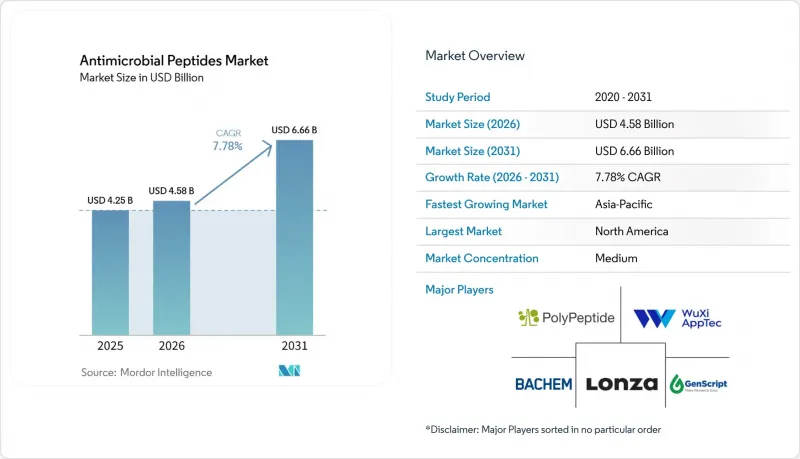
항균 펩타이드 시장 규모는 2025년 42억 5,000만 달러로 평가되었고, 2026년에는 45억 8,000만 달러로 확대될 것으로 추정되고, 2026-2031년 CAGR 7.78%로 성장을 지속할 전망이며, 2031년에는 66억 6,000만 달러에 이를 것으로 예측됩니다.
본 보고서는 제품 유형별(식물 유래, 세균 유래, 동물 유래, 곤충 유래), 원료별(천연, 합성, 재조합, 인공), 용도별(헬스케어, 농업, 화장품, 기타), 투여 경로별(외용, 경구, 주사, 흡입, 기타), 최종 용도별(의약품, 생명공학, 수의학, 기타), 지역별(북미, 유럽, 기타)로 분류되어 있습니다. 예측치는 금액(달러)으로 표시되어 있습니다.
세계의 항균 펩타이드 시장 동향 및 인사이트
증가하는 항균제 내성 및 다제내성 병원체
항균 펩타이드 시장은 선진국 및 개발도상국의 의료 시스템을 불문하고 내성균 감염증이 뚜렷이 증가하고 있는 데 힘입어 성장하고 있습니다. 2025년 10월 WHO의 경고에 따르면, 일반적으로 사용되는 항생제에 대한 광범위한 내성이 나타나고 있으며, 이로 인해 항생제 내성은 치료 계획 및 비축과 관련된 의사 결정의 핵심 과제로 남아 있습니다. 또한 『랜싯』지는 2025-2050년 세균의 항균제 내성이 직접적인 원인이 되어 사망자 수가 3,910만 명에 달할 것으로 예측하고 있으며, 이로 인해 서로 다른 살균 기전을 통해 작용하는 대체 요법의 도입이 시급한 과제가 되고 있습니다. 항균 펩타이드 시장에서 이러한 시급성은 중요한 의미를 지닙니다. 펩타이드가 단일하고 좁은 표적에만 의존하는 것이 아니라, 다각적인 작용을 통해 세균의 세포막을 파괴하기 때문입니다. 따라서 병원 구매 담당자들은 특히 내성으로 인해 표준 치료법의 신뢰성이 저하된 경우, 치료 과정의 더 이른 단계에서 펩타이드를 검토하려는 태도를 강화하고 있습니다. 이에 따라 상업적 논의는 단순한 과학적 관심에서 벗어나, 내성 감염병 환경에서의 향후 조달을 위한 실질적인 준비 단계로 전환되고 있습니다.
감염 예방, 상처 관리, 의료기기 코팅 분야의 용도 확대
항균 펩타이드 시장은 전신 투여를 통한 약물 도입에 의존하지 않는 용도를 통해 확대되고 있습니다. 의료기기 코팅이나 외용 상처 관리의 경우, 감염 위험이 있는 부위에 펩타이드가 사용되므로 노출에 대한 우려가 줄어들어 많은 구매 담당자들이 그 가치 제안을 평가하기 쉬워지고 있습니다. 2025년에 실시된 디스트로피성 표피 수포증 관련 상처에 대한 TCP-25의 1상 임상시험에서는 안전성, 내약성 및 상처 치유에 대한 잠재적 효과가 보고되었으며, 이 분야에서 국소용 펩타이드 생리활성 물질의 유용한 임상적 실증 사례가 확보되었습니다. 이러한 결과는 광범위한 치료용 승인을 받기 전에 의료기기 제조업체와 상처 관리 용품 공급업체가 펩타이드 제제를 평가할 수 있다는 더 광범위한 상업적 추세를 뒷받침합니다. 항균 펩타이드 시장은 대규모 전신 투여 프로그램이 아직 성숙 단계에 있는 동안에도 국소적 및 전문적인 용도를 통해 수익을 창출하기 시작할 수 있기 때문에 이러한 접근 방식의 혜택을 받고 있습니다. 이에 따라 중견 제조업체들은 병원 내 보급이 확대되기 전에 맞춤형 합성 및 제형화 역량을 계획할 이유가 생깁니다.
단백질 분해로 인한 불안정성과 생체 내 짧은 반감기
항균 펩타이드 시장은 많은 천연 펩타이드 서열이 생체 내에서 빠르게 분해된다는 큰 제약에 여전히 직면해 있습니다. 비수정한 직쇄 펩타이는 일반적인 프로테아제에 의해 신속하게 절단되기 때문에 생물학적 활성만으로 예상되는 것보다 전신 투여나 경구 투여가 훨씬 더 어려워집니다. 개발자들은 D-아미노산 치환, 불소화, 고리화 및 나노 캐리어를 이용한 접근 방식으로 이에 대응하고 있지만, 각 공정은 제조상의 부담과 제형의 복잡성을 증가시키고 있습니다. 2025년 『Journal of Medicinal Chemistry』지에 게재된 연구에 따르면, 불소화 유사체인 FuK는 모 펩타이드의 혈청 반감기가 225분 미만인 반면, 1,440분을 초과하는 혈청 반감기를 달성한 것으로 나타났습니다. 이러한 성과가 있음에도 불구하고, 많은 전신 투여용 제품이 가격 및 규모 면에서 충분한 경쟁력을 발휘할 수 있게 되려면, 항균 펩타이드 시장은 보다 고도화된 합성 워크플로우에 소요되는 비용을 흡수해야 합니다. 이 때문에 표준적인 펩타이드 합성만을 제공하는 제조업체가 아닌, 전달 기술에 대한 노하우를 보유한 기업이 여전히 가장 유리한 상업적 입지를 유지하고 있습니다.
부문 분석
2025년, 식물 유래 항균 펩타이드가 항균 펩타이드 시장 점유율의 48.31%를 차지했으며, 해당 시장에서 가장 큰 제품 유형이 되었습니다. 이러한 우위는 의약품, 농업, 식품 관련 용도에서 데펜신과 티오닌이 상업적으로 널리 인정받고 있음을 반영합니다. 또한, 해당 부문은 2031년까지 연평균 성장률(CAGR) 8.38%로 확대될 것으로 예측되며, 이는 식물 유래 제품이 단순히 성숙한 시장 기반을 유지하고 있을 뿐만 아니라 여전히 입지를 넓혀가고 있음을 보여줍니다. 식물 유래 펩타이드에는 단백질체학 분야의 폭넓은 다양성 외에도, 대두, 밀, 감자 등 바이오매스가 풍부한 작물을 사용함으로써 추출 부담을 줄일 수 있다는 장점이 있습니다. 이러한 조합 덕분에, 더 정교하게 설계된 펩타이드류에 수반되는 비용이나 설계의 복잡성을 감수하지 않고도 기능적 효능을 추구하는 구매자들에게 식물 유래 펩타이드는 계속해서 매력적인 선택지로 자리 잡고 있습니다.
항균 펩타이드 시장에서는 식물 유래 제품이 비치료용 제제 분야에서 가장 실용적인 진입점으로 계속해서 자리 잡고 있습니다. 이는 식물 유래 제품이 일부 최종 용도에서 클린 라벨 및 규정 준수를 중시하는 구매 행태에 부합하기 때문입니다. 유럽에서는 명확한 규정 준수 문서로 뒷받침되는 원료를 우선시하는 식품 접촉 및 퍼스널케어 요건에 의해 수요가 촉진되고 있으며, 이는 특성이 충분히 규명된 식물 유래 펩타이드 로트에 대한 지속적인 수요를 뒷받침하고 있습니다. 아시아태평양에서는 규제 대응이 잘 갖춰진 공급업체가 식품 안전 및 특수 원료 채널에서 조기에 진출할 수 있는 입지에 있으며, 이것이 식물 유래 서열이 해당 지역의 상업 계획에서 여전히 중심적인 위치를 차지하는 이유 중 하나입니다. 프로바이오틱스 및 마이크로바이옴을 표적으로 하는 제품에서는 박테리아 유래 항균 펩타이드의 존재감이 커지고 있습니다. 한편, 동물 유래 펩타이드, 특히 카테리시딘 관련 형태는 상처 치료 개발 프로그램에서 주목을 받고 있습니다. 곤충 유래 펩타이드의 매출 규모는 여전히 작지만, 하나의 유효 성분이 살충 작용과 항균 작용을 모두 겸비할 수 있어 작물 보호 용도로 주목받고 있으며, 이는 실용적인 제형상의 이점으로 작용하고 있습니다.
2025년에는 ‘천연 유래’가 38.44%의 점유율을 차지했으며, 항균 펩타이드 시장에서 계속해서 주요 공급원으로서의 지위를 유지했습니다. 이러한 우위는 확립된 추출 방법 외에도, 화장품, 기능성 식품 및 일부 특수 케어 용도에서 천연 소재가 여전히 ‘더 깨끗한 제품’이라는 인식을 받고 있기 때문인 것으로 보입니다. 그럼에도 불구하고, 합성 펩타이드 시장은 2031년까지 8.52%라는 가장 높은 연평균 성장률(CAGR)을 보일 것으로 예측되며, 이로 인해 원료 간의 경쟁은 항균 펩타이드 시장에서 가장 뚜렷한 구조적 변화 중 하나가 되고 있습니다. 합성 펩타이드가 부상하고 있는 이유는 특정 내성 균주에 대해 활성을 조정해야 할 경우, 서열 설계, 순도 및 배치 간 재현성을 보다 엄격하게 제어할 수 있기 때문입니다. 이는 신약 개발 프로그램이 광범위한 탐색 라이브러리에서 보다 의도적인 서열 설계로 전환되고 있는 가운데, 특히 중요한 요소가 되고 있습니다.
따라서 항균 펩타이드 업계는 단순한 생물 유래 원료 그 자체보다 합성의 품질과 설계의 정밀도에 점점 더 의존하게 되었습니다. 또한, 발효를 통해 특정 서열에 대해 현실적인 비용 구조를 실현할 수 있는 경우, 특히 장기적인 관점에서 공정 개발에 착수할 수 있는 생명공학 주도 환경에서는 재조합 펩타이드 분야도 확대되고 있습니다. 엔지니어링 펩타이는 D-아미노산, 스테이플 구조, 혹은 난치성 전신 적응증을 표적으로 하는 비천연 잔기를 포함하고 있기 때문에 단위당 가치가 가장 높은 원료 등급으로 자리매김하고 있습니다. 또한 인도, 스페인, 스웨덴의 SPPS(고상 폴리펩타이드 합성) 설비 확충으로 인해 중규모 상업적 합성이 이전보다 경쟁력을 갖추게 되면서, 항균 펩타이드 시장에서는 천연 유래와 합성 유래 접근법 간의 비용 격차가 점차 줄어들고 있습니다. 이러한 격차의 축소는 천연 소재의 규모의 경제성을 배제하는 것은 아니지만, 재현 가능한 설계와 보다 명확한 최적화 루프를 필요로 하는 합성 프로그램의 상업적 입지를 향상시키고 있습니다.
지역별 분석
2025년, 북미는 항균 펩타이드 시장 점유율의 38.61%를 차지하며 지역별 1위를 유지했습니다. 이 지역은 임상 파이프라인 활동, 펩타이드 제조 분야의 제휴 관계, 그리고 항감염제 개발에 대한 정부 지원 측면에서 미국의 강점을 바탕으로 혜택을 보고 있습니다. BARDA의 항균 제품에 대한 누적 투자액이 27억 달러를 넘어선 것은 정책 차원의 지속적인 의지를 보여주는 것으로, 이러한 지원 덕분에 펩타이드 개발 프로그램은 실질적인 상용화로 한 걸음 더 가까워지고 있습니다. 캐나다와 멕시코는 연구 협력 및 제조 서비스를 통해 기여하고 있지만, 항균 펩타이드 시장의 주요 수익원은 여전히 미국입니다. 또한, 북미 수요는 해외 제조업체와의 장기적인 공급 계획 수립을 촉진하고 있으며, 이는 지역 내 소비가 반드시 동등한 수준의 현지 제조 점유율로 직결되지는 않는다는 것을 의미합니다.
유럽은 항균 펩타이드 시장에서 2위의 지역 점유율을 차지하고 있으며, 특히 독일과 영국은 의약품 등급 펩타이드 연구와 탄탄한 과학 인프라로 두각을 나타내고 있습니다. 2024년 11월, 독일연구재단(DFG)과 관련된 조사 발표에서 프리드리히 알렉산더 에를랑겐-뉘른베르크 대학교와 괴팅겐 대학교의 공동 연구를 통해 루그두닌의 항균 선택성에 관한 연구가 지속되고 있음이 밝혀졌습니다. 독일에서는 다제내성 병원 내 감염으로 인한 경제적 부담이 2025년에 11억 유로(12억 6,000만 달러)에 달할 것으로 예상되며, 이로 인해 내성균 대책 비용이 병원 내 조달 결정에 있어 더욱 직접적인 쟁점이 되고 있습니다. 또한 유럽에서는 식품 접촉 용도 및 퍼스널케어 용도의 구매자들이 추적성, 규정 준수 및 문서화의 질을 중시하고 있어, 항균 펩타이드 시장의 비치료 용도 수요도 뒷받침되고 있습니다.
아시아태평양은 2031년까지 연평균 성장률(CAGR) 8.65%를 나타낼 것으로 예측되며, 항균 펩타이드 시장에서 가장 빠르게 성장하는 지역 블록으로 자리매김하고 있습니다. 중국은 합성 펩타이드 혁신과 농업 용도를 중심으로 사업을 전개하고 있는 반면, 일본은 고품질 제조 능력과 항감염증 연구 자금 네트워크에 대한 지속적인 참여를 통해 계속해서 기여하고 있습니다. 인도는 펩타이드 제조 설비의 광범위한 확충을 통해 SPPS(합성 펩타이드 합성) 생산 능력을 강화하고 있으며, 수주 패턴이 다양해지는 가운데 이러한 생산 능력은 항균 펩타이드 프로그램을 뒷받침할 수 있습니다. 또한, 항균 펩타이드 시장은 저비용 생산 확대와 첨단 생물활성 성분에 대한 강력한 현지 수요를 결합할 수 있는 해당 지역의 강점으로부터도 혜택을 받고 있습니다. 중동 및 아프리카 및 남미는 여전히 시장 점유율이 작지만, 일부 중저소득 국가에서 항생제 내성이 초래하는 부담은 항균 펩타이드 시장에 구조적으로 중요한 장기적인 수요 기반을 창출하고 있습니다.
기타 혜택 :
- 엑셀 형식 시장 예측(ME) 시트
- 3개월간의 애널리스트 지원
자주 묻는 질문
목차
제1장 서론
제2장 조사 방법
제3장 주요 요약
제4장 시장 구도
제5장 시장 규모 및 성장 예측
제6장 경쟁 구도
제7장 시장 기회 및 향후 전망
AJY 26.08.11According to Mordor Intelligence, the antimicrobial peptides market size is expected to grow from USD 4.25 billion in 2025 to USD 4.58 billion in 2026 and is forecast to reach USD 6.66 billion by 2031 at 7.78% CAGR over 2026-2031.
This report is Segmented by Product Type (Plant, Bacterial, Animal, Insect), Source (Natural, Synthetic, Recombinant, Engineered), Application (Healthcare, Agriculture, Cosmetics, Others), Route (Topical, Oral, Injectables, Inhalation, Others), End Use (Pharmaceuticals, Biotechnology, Veterinary, Others), and Geography (North America, Europe, and More). Forecasts are Provided in Value (USD).
Global Antimicrobial Peptides Market Trends and Insights
Rising Antimicrobial Resistance and Multidrug-Resistant Pathogens
The antimicrobial peptides market is being pushed forward by the clear rise in resistant bacterial infections across both advanced and developing health systems. The October 2025 WHO warning showed widespread resistance to commonly used antibiotics, which has kept antimicrobial resistance at the center of treatment planning and stockpile decisions. The Lancet also projected 39.1 million deaths directly attributable to bacterial antimicrobial resistance between 2025 and 2050, which strengthens the urgency behind alternatives that work through different killing mechanisms. In the antimicrobial peptides market, that urgency matters because peptides disrupt bacterial membranes through multi-modal action rather than depending on one narrow target. Hospital buyers are therefore becoming more willing to review peptides earlier in the treatment pathway, especially where resistance has already made standard options less dependable. This is changing the commercial discussion from scientific interest alone to practical readiness for future procurement in resistant infection settings.
Expanding Use in Infection Prevention, Wound Care, and Device Coatings
The antimicrobial peptides market is also expanding through applications that do not rely on full systemic drug adoption. Device coatings and topical wound care use peptides at the site of infection risk, which lowers exposure concerns and makes the value proposition easier for many buyers to assess. A 2025 Phase 1 study of TCP-25 in wounds linked to dystrophic epidermolysis bullosa reported safety, tolerability, and possible support for wound healing, which gave the field a useful clinical proof point for topical peptide bioactives. That result supports a broader commercial pattern in which device makers and wound care suppliers can evaluate peptide formulations before broad therapeutic approvals become available. The antimicrobial peptides market benefits from this path because revenue can begin building through localized and specialty uses while larger systemic programs are still maturing. This gives mid-sized manufacturers a reason to plan custom synthesis and formulation capacity ahead of broader hospital uptake.
Proteolytic Instability and Short In Vivo Half-Life
The antimicrobial peptides market still faces a major constraint from the rapid degradation of many natural peptide sequences in vivo. Unmodified linear peptides can be cleaved quickly by common proteases, which makes systemic and oral delivery much harder than the biological activity alone might suggest. Developers are responding with D-amino acid substitution, fluorination, cyclization, and nanocarrier approaches, but each step adds manufacturing burden and formulation complexity. A 2025 Journal of Medicinal Chemistry study showed that the fluorinated analogue FuK achieved a serum half-life above 1,440 minutes compared with fewer than 225 minutes for the parent peptide. Even with that gain, the antimicrobial peptides market still has to absorb the cost of more advanced synthesis workflows before many systemic products can compete comfortably on price and scale. This keeps the best commercial positioning with companies that own delivery know-how rather than with producers that only offer standard peptide synthesis.
Other drivers and restraints analyzed in the detailed report include:
- AI-Guided Peptide Design and Next-Gen Delivery Systems Improving Developability
- Translational Funding for Anti-Infective and Peptide Platforms
- High Cost of Solid-Phase Synthesis and Purification
For complete list of drivers and restraints, kindly check the Table Of Contents.
Segment Analysis
Plant Antimicrobial Peptides held 48.31% of the antimicrobial peptides market share in 2025, which made them the largest product type in the antimicrobial peptides market. Their lead reflects the commercial familiarity of defensins and thionins across pharmaceutical, agricultural, and food-related uses. The same segment is also forecast to expand at 8.38% CAGR through 2031, which shows that plant-derived formats are still gaining ground rather than simply defending a mature base. Plant peptides benefit from wide proteomic diversity and from the lower extraction burden that can be achieved with high-biomass crops such as soybean, wheat, and potato. That combination keeps them attractive for buyers that need functional efficacy without taking on the cost and design complexity of more engineered peptide classes.
The antimicrobial peptides market continues to treat plant-derived options as the most practical entry point for non-therapeutic formulations because they fit clean-label and compliance-driven purchasing behavior in several end uses. In Europe, demand is reinforced by food-contact and personal care requirements that favor ingredients backed by clear compliance documentation, and this supports continued demand for well-characterized plant peptide lots. In Asia-Pacific, suppliers with regulatory readiness are also positioned to move earlier in food-safety and specialty ingredient channels, which helps explain why plant sequences remain central to regional commercial planning. Bacterial antimicrobial peptides are gaining visibility in probiotics and microbiome-directed products, while animal-derived peptides, especially cathelicidin-linked formats, are drawing attention in wound-care development programs. Insect-derived peptides remain smaller in revenue terms, yet they are being watched for crop-protection use because one active can potentially cover both insecticidal and antibacterial roles, which gives them a practical formulation advantage.
Natural Sources held 38.44% share in 2025, which kept them in the leading source position within the antimicrobial peptides market. That lead came from established extraction methods and from the cleaner product perception that natural materials still hold in cosmetics, functional food, and some specialty care uses. Even so, Synthetic Peptides are forecast to record the highest CAGR at 8.52% through 2031, which makes source competition one of the clearest structural shifts in the antimicrobial peptides market. Synthetic formats are gaining because they allow tighter control over sequence design, purity, and batch reproducibility when activity needs to be tuned against defined resistant strains. This is especially important as discovery programs move away from broad exploratory libraries and toward more deliberate sequence engineering.
The antimicrobial peptides industry is therefore becoming more dependent on synthesis quality and design precision than on raw biological origin alone. Recombinant peptides are also expanding where fermentation can offer a workable cost profile for selected sequences, especially in biotechnology-led settings that can absorb process development with a longer view. Engineered peptides remain the highest-value source class on a unit basis because they include D-amino acids, stapled structures, or unnatural residues that are often aimed at difficult systemic indications. The antimicrobial peptides market is also seeing a narrower cost gap between natural and synthetic approaches because added SPPS capacity in India, Spain, and Sweden has made mid-scale commercial synthesis more competitive than it had been in earlier years. That narrowing does not remove the scale advantage of natural materials, but it does improve the commercial position of synthetic programs that need repeatable design and cleaner optimization loops.
Complete Report Scope:
- By Product Type
- Plant Antimicrobial Peptides
- Bacterial Antimicrobial Peptides
- Animal Antimicrobial Peptides
- Insect Antimicrobial Peptides
- By Source
- Natural Sources
- Synthetic Peptides
- Recombinant Peptides
- Engineered Peptides
- By Application
- Healthcare and Therapeutics
- Agriculture and Animal Health
- Cosmetics and Personal Care
- Other Applications
- By Route of Administration
- Topical
- Oral
- Injectables
- Inhalation
- Other Routes of Administration
- By End Use
- Pharmaceuticals
- Biotechnology
- Veterinary Clinics
- Others
- By Geography
- North America
- United States
- Canada
- Mexico
- Europe
- Germany
- United Kingdom
- France
- Italy
- Spain
- Rest of Europe
- Asia-Pacific
- China
- Japan
- India
- Australia
- South Korea
- Rest of Asia-Pacific
- Middle East and Africa
- GCC
- South Africa
- Rest of Middle East and Africa
- South America
- Brazil
- Argentina
- Rest of South America
- North America
Geography Analysis
North America accounted for 38.61% of the antimicrobial peptides market share in 2025, which kept it in the leading regional position. The region benefits from the United States' strength in clinical pipeline activity, peptide manufacturing relationships, and public support for anti-infective development. BARDA's cumulative investment of more than USD 2.7 billion in antimicrobial products continues to signal policy-level commitment, and that backing has helped move peptide programs closer to viable commercial pathways. Canada and Mexico contribute through research collaboration and manufacturing services, yet the United States remains the main revenue anchor in the antimicrobial peptides market. North American demand is also encouraging long-term supply planning with overseas manufacturers, which means regional consumption strength does not always translate into the same level of local manufacturing share.
Europe held the second-largest regional position in the antimicrobial peptides market, with Germany and the United Kingdom standing out for pharmaceutical-grade peptide work and deep scientific infrastructure. A November 2024 research announcement tied to the German Research Foundation highlighted continued work on the antimicrobial selectivity of lugdunin through collaboration between Friedrich-Alexander University Erlangen-Nurnberg and the University of Gottingen. In Germany, the economic burden of multidrug-resistant nosocomial infections reached EUR 1.1 billion (USD 1.26 billion) in 2025, which is making the cost of resistance a more direct procurement argument inside hospitals. Europe also supports non-therapeutic demand in the antimicrobial peptides market because buyers in food-contact and personal care applications place value on traceability, compliance, and documentation quality.
Asia-Pacific is forecast to grow at 8.65% CAGR through 2031, which makes it the fastest-growing regional block in the antimicrobial peptides market. China is building around synthetic peptide innovation and agricultural applications, while Japan continues to contribute through high-grade manufacturing and ongoing participation in anti-infective funding networks. India is adding SPPS capacity through a broader peptide manufacturing buildout, and that capacity can support antimicrobial peptide programs as order patterns diversify. The antimicrobial peptides market is also gaining from the region's ability to combine lower-cost production expansion with strong local demand for advanced bioactive ingredients. Middle East and Africa, along with South America, still represent smaller shares, yet the resistance burden across several low- and middle-income settings creates a long-run need base that is structurally important for the antimicrobial peptides market.
- Abzena
- AMP Biotech
- AnaSpec, Inc.
- Bachem Holding
- Bio-Techne
- Creative Peptides
- Genscript
- JPT Peptide Technologies GmbH
- Lonza Group
- Merck
- Novozymes A/S
- PeptiDream Inc.
- Phoenix Biotechnology, Inc.
- PolyPeptide Group
- Synpeptide Co., Ltd.
- Thermo Fisher Scientific
- WuXi App Tec
Additional Benefits:
- The market estimate (ME) sheet in Excel format
- 3 months of analyst support
TABLE OF CONTENTS
1 Introduction
- 1.1 Study Assumptions and Market Definition
- 1.2 Scope of the Study
2 Research Methodology
3 Executive Summary
4 Market Landscape
- 4.1 Market Overview
- 4.2 Market Drivers
- 4.2.1 Rising Antimicrobial Resistance and Multidrug-Resistant Pathogens
- 4.2.2 Expanding Use in Infection Prevention, Wound Care, and Device Coatings
- 4.2.3 Higher Success Potential of Engineered Peptides Versus Conventional Small-Molecule Antibiotics
- 4.2.4 AI-Guided Peptide Design and Next-Gen Delivery Systems Improving Developability
- 4.2.5 Rising Demand for Non-Antibiotic Bioactives in Cosmetics, Food Preservation, and Veterinary Use
- 4.2.6 Translational Funding for Anti-Infective and Peptide Platforms
- 4.3 Market Restraints
- 4.3.1 Proteolytic Instability and Short In Vivo Half-Life
- 4.3.2 High Cost of Solid-Phase Synthesis and Purification
- 4.3.3 Narrow Therapeutic Window and Cytotoxicity Risk
- 4.3.4 Weak Commercial Pull From Conservative Hospital Procurement and Reimbursement Scrutiny
- 4.4 Supply Chain Analysis
- 4.5 Regulatory Landscape
- 4.6 Technological Outlook
- 4.7 Porter's Five Forces Analysis
- 4.7.1 Threat of New Entrants
- 4.7.2 Bargaining Power of Suppliers
- 4.7.3 Bargaining Power of Buyers
- 4.7.4 Threat of Substitutes
- 4.7.5 Competitive Rivalry
5 Market Size & Growth Forecasts (Value, USD)
- 5.1 By Product Type
- 5.1.1 Plant Antimicrobial Peptides
- 5.1.2 Bacterial Antimicrobial Peptides
- 5.1.3 Animal Antimicrobial Peptides
- 5.1.4 Insect Antimicrobial Peptides
- 5.2 By Source
- 5.2.1 Natural Sources
- 5.2.2 Synthetic Peptides
- 5.2.3 Recombinant Peptides
- 5.2.4 Engineered Peptides
- 5.3 By Application
- 5.3.1 Healthcare and Therapeutics
- 5.3.2 Agriculture and Animal Health
- 5.3.3 Cosmetics and Personal Care
- 5.3.4 Other Applications
- 5.4 By Route of Administration
- 5.4.1 Topical
- 5.4.2 Oral
- 5.4.3 Injectables
- 5.4.4 Inhalation
- 5.4.5 Other Routes of Administration
- 5.5 By End Use
- 5.5.1 Pharmaceuticals
- 5.5.2 Biotechnology
- 5.5.3 Veterinary Clinics
- 5.5.4 Others
- 5.6 By Geography
- 5.6.1 North America
- 5.6.1.1 United States
- 5.6.1.2 Canada
- 5.6.1.3 Mexico
- 5.6.2 Europe
- 5.6.2.1 Germany
- 5.6.2.2 United Kingdom
- 5.6.2.3 France
- 5.6.2.4 Italy
- 5.6.2.5 Spain
- 5.6.2.6 Rest of Europe
- 5.6.3 Asia-Pacific
- 5.6.3.1 China
- 5.6.3.2 Japan
- 5.6.3.3 India
- 5.6.3.4 Australia
- 5.6.3.5 South Korea
- 5.6.3.6 Rest of Asia-Pacific
- 5.6.4 Middle East and Africa
- 5.6.4.1 GCC
- 5.6.4.2 South Africa
- 5.6.4.3 Rest of Middle East and Africa
- 5.6.5 South America
- 5.6.5.1 Brazil
- 5.6.5.2 Argentina
- 5.6.5.3 Rest of South America
- 5.6.1 North America
6 Competitive Landscape
- 6.1 Market Concentration
- 6.2 Market Share Analysis
- 6.3 Company Profiles (includes Global Level Overview, Market Level Overview, Core Segments, Financials as available, Strategic Information, Market Rank/Share, Products and Services, Recent Developments)
- 6.3.1 Abzena
- 6.3.2 AMP Biotech
- 6.3.3 AnaSpec, Inc.
- 6.3.4 Bachem Holding AG
- 6.3.5 Bio-Techne Corporation
- 6.3.6 Creative Peptides
- 6.3.7 GenScript Biotech Corporation
- 6.3.8 JPT Peptide Technologies GmbH
- 6.3.9 Lonza Group AG
- 6.3.10 Merck KGaA
- 6.3.11 Novozymes A/S
- 6.3.12 PeptiDream Inc.
- 6.3.13 Phoenix Biotechnology, Inc.
- 6.3.14 PolyPeptide Group
- 6.3.15 Synpeptide Co., Ltd.
- 6.3.16 Thermo Fisher Scientific Inc.
- 6.3.17 WuXi AppTec
7 Market Opportunities and Future Outlook
- 7.1 White-Space and Unmet-Need Assessment